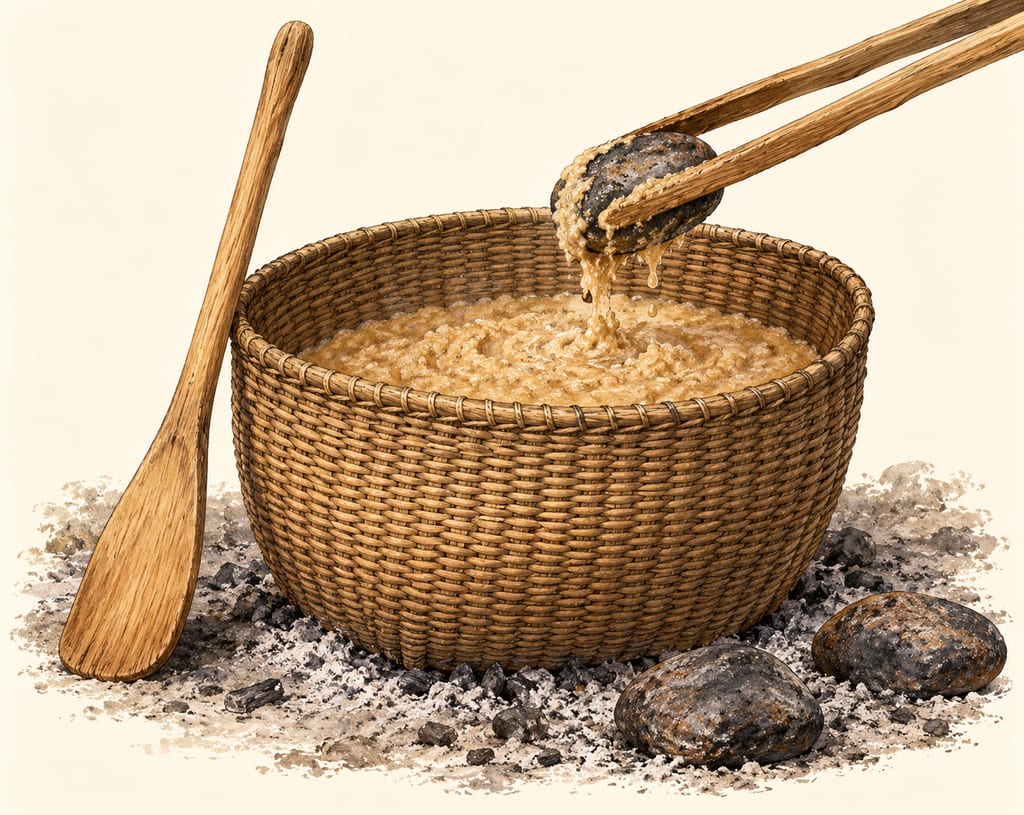
Cooking basket with heated stone (acorn mush)
A closely woven, watertight basket used in Yosemite-area Miwok cooking to boil acorn mush with heated stones. The basket holds water and meal while stones transfer heat.
 FermenteaWhere food goes to change
Equipment · Baskets, trays and beds
A Miwok parching basket is a shallow, broad coiled basket used to toss seeds with live coals. One documented plate-form example is 71 mm high; a Southern Miwok specimen is separately identified as a parching basket.
The Miwok parching basket is documented in more than one form. One plate shows a shallow, broad, single-rod coiled basket used for parching seeds and other foods; its recorded height is 71 mm. Another Southern Miwok specimen is captioned as a parching basket. The ethnography gives the Central Miwok term ke'waiyu and the Southern Miwok term to'gūn, while distinguishing this vessel from other basket shapes and uses.
The illustrated plate-form is identified as single-rod coiled work, but the plant species supplying the rods and sewing element of that specimen are not named. The wider collection contains a varied basketry material palette. That broader list should not be assigned wholesale to this vessel: its exact plant materials are unrecorded.
The shallow form lets the seed mass and live coals move together. In the described preparation of kotca, or red-maids seed, a discoidal basket plate about four inches deep held seeds and coals; a rotary movement of the basket turned the mass. Skilled handling distributes heat while keeping the coals moving through the seeds. No temperature, batch weight, timing, or fuel quantity is recorded, so none can be supplied as a standard.
Parching is one stage in a longer sequence, not a complete food process by itself. Seed accounts describe gathering and drying, then winnowing where needed, parching, and grinding. For kotca, the parched seeds were ground with a stone pestle in a bedrock mortar. The oily meal could be pressed into balls or cakes. Other seeds were eaten as dry meal or used in mush or porridge; those outcomes depend on the seed and preparation, not on the basket alone.
The ethnography lists many seed plants and distinct ways of gathering and preparing them. Some seeds were parched and pulverized for dry meal; other accounts describe seeds cooked as mush or mixed with water. It also records seeds stored without prior parching. The basket is evidence of a valued heat-processing technique, not proof that every seed had to be parched before storage or that one sequence applied across communities and seasons.
Some plate-form meal sifters or winnowers were also used for parching, but that does not make every winnowing basket a parching basket. The account assigns overlapping functions to certain forms alongside vessels with named, specific purposes. This entry keeps the shallow parching examples distinct from the openwork winnower used for grasshoppers and from deeper baskets used to cook with hot stones.
Barrett and Gifford published the ethnographic account in 1933, describing basket forms, regional names, materials, and food practices among the Miwok groups they studied. That is a dated written attestation, not a date of invention. It does not establish how long parching baskets had been used, how the practice changed over time, or whether the same form and use continue today. It also does not document a present-day source for commissioning or buying one.
The specimen caption gives one height but no diameter or capacity. The accounts do not describe cleaning, seasoning, or storage between uses, and do not quantify basket life under heat. The process depends on careful hand movement around hot coals; this historical description is not a modern operating or food-safety protocol.
Barrett and Gifford describe parching-basket forms and uses in their 1933 account; that publication attests the practice but does not date its beginning or establish continuity.
The cited ethnography documents Northern, Central, and Southern Miwok basket forms within California; this row does not claim one village of origin or a uniform practice.
A closely woven, watertight basket used in Yosemite-area Miwok cooking to boil acorn mush with heated stones. The basket holds water and meal while stones transfer heat.
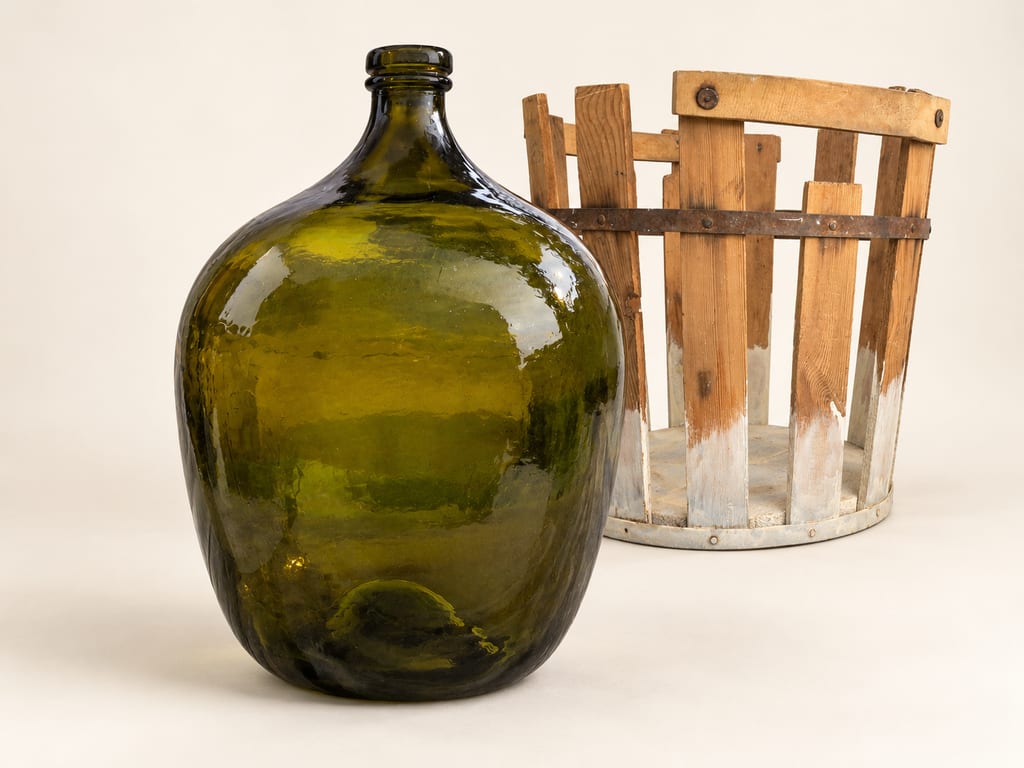
A glass demijohn or carboy is a stout, usually rounded bottle with a narrow neck, used for beverage fermentation, maturation, storage or transport. Its glass body, closure and any protective carrier are distinct parts of the vessel system.

A Cap-Pelé boucanière is an Acadian herring-smoking building. The documented Willie Niles example is a one-storey wood-frame structure with a ridge smoke vent and interior bays for hanging fish-bearing cannes.

Achcharu is a family of Sri Lankan vinegar pickles made with mixed vegetables or seasonal fruit and a piquant spice dressing. This version is a quick, refrigerated, non-fermented mixed-vegetable pickle.

The acocote is a long, hollowed and dried gourd used to draw aguamiel from a mature maguey. It is a harvesting tool: the sap is transferred to a separate vessel before it ferments into pulque.

Adrak murabba preserves young ginger in sugar syrup, a sweet South Asian preparation recorded in Indian cookery and food-processing sources.

Parkia biglobosa seeds are fermented into regional West African seasonings, including nététou, iru, dawadawa and soumbala. The yellow fruit pulp is a separate food, and names and methods vary by place.

Japanese reddish-brown vinegar from sake lees matured about three years, turned to vinegar by acetic bacteria; the vinegar of Handa and Edomae sushi rice.

A refined common-wheat flour blended for a broad range of baking; its protein and behavior vary with wheat, milling and market.

The almond mushroom, Agaricus subrufescens, was cultivated in eastern North America in the 1800s, lost its market, and returned as a cultivated mushroom from Brazil, where it is grown under several names.
No community contributions have been published for this entry yet.
Sign in to contribute. Published comments and photos are free to read.
Board of Trustees of the Public Museum of the City of MilwaukeeForm · Dimensions · Construction · Materials · Historical attestation
Miwok Material Culture: Indian Life of the Yosemite Region — Coiled BasketsPlate XLIX figure 1 is a 71 mm-high single-rod coiled plate-form basket used for parching seeds and other foods.
Plate XLVIII figure 2 is separately captioned as a Southern Miwok parching basket.
The wider coiled basket collection uses several plant materials, not all attributable to the parching specimens.
Cited in: A shallow coiled vessel for seed parching; What the record can and cannot date
Board of Trustees of the Public Museum of the City of MilwaukeeForm · Names · Regional use
Miwok Material Culture: Indian Life of the Yosemite Region — TechniquesParching basket names ke'waiyu (Central Miwok) and to'gūn (Southern Miwok); examples appear on plates XLVIII and XLIX.
A shallow, broad basket was used especially for parching seeds; a plate-form meal sifter or winnower could also be used for parching.
Cited in: A shallow coiled vessel for seed parching; Local practice rather than one universal recipe; What the record can and cannot date
Board of Trustees of the Public Museum of the City of MilwaukeeUse · Sequence · Variation
Miwok Material Culture: Indian Life of the Yosemite Region — SeedsSeed preparation accounts include winnowing, parching with coals, pulverizing, and dry meal or mush uses.
Some stored seeds were unparched.
For kotca/red-maids seed, a discoidal basket plate about four inches deep held seeds and coals turned by rotary motion; the seeds were later ground in a bedrock mortar.
Cited in: Seeds, coals, and controlled movement; Local practice rather than one universal recipe
Board of Trustees of the Public Museum of the City of MilwaukeeProcess · Terminology
Miwok Material Culture: Indian Life of the Yosemite Region — CookingThe ethnography lists parching with hot coals in a basket as a principal cooking method and records Northern and Central Miwok terms for parching in a basket.
Cited in: Seeds, coals, and controlled movement; Local practice rather than one universal recipe