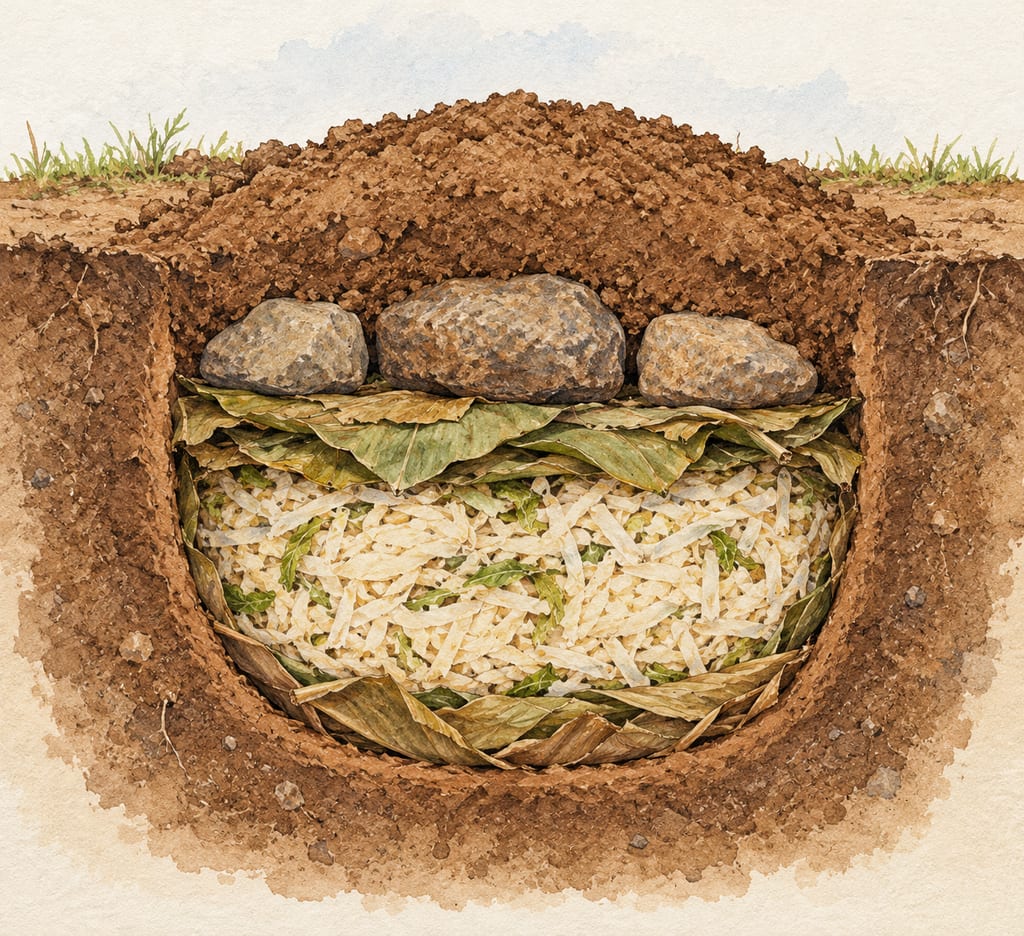
Sinki fermentation pit
A leaf-lined earthen pit used in documented Himalayan sinki preparation; construction materials and timings vary by source and household.
 FermenteaWhere food goes to change
Built structures · crop-curing-kilns
Bhaṭṭī
A traditional Sikkim large-cardamom bhatti is a fixed, field-side curing structure: a stone or earth-sided fire chamber supports a raised bamboo-mat drying bed, where capsules are exposed to direct heat and smoke.
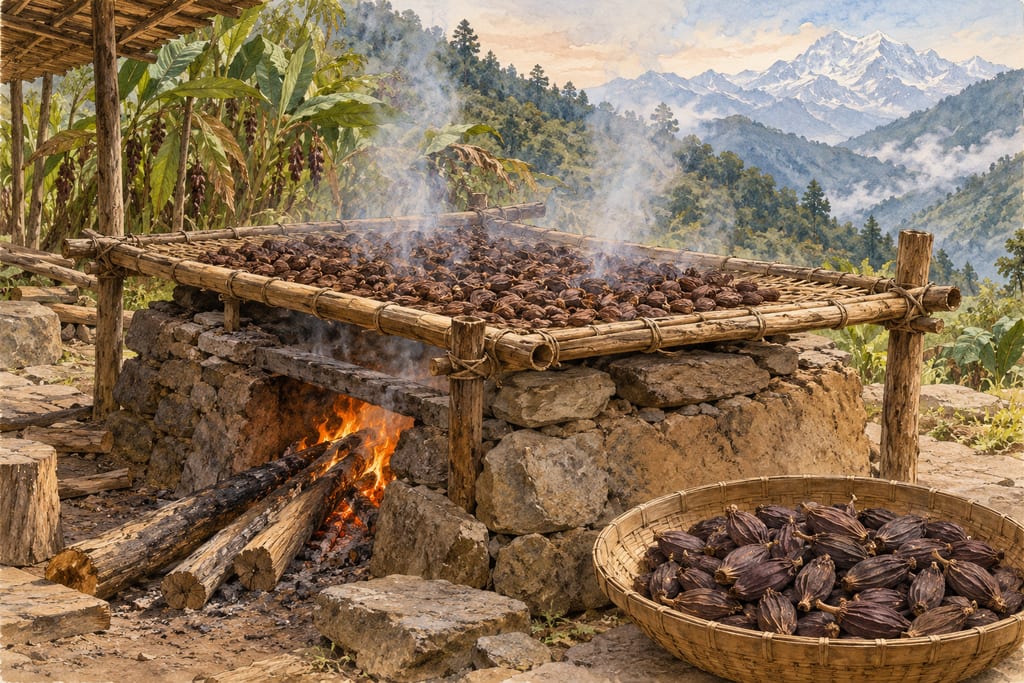
Bhatti (also written bhaṭṭī) is the name used in Sikkim for a traditional large-cardamom curing kiln. This page describes the fixed structure, rather than a recipe or a universal design. Large cardamom is cultivated in Sikkim and in other eastern Himalayan areas, including Nepal and Bhutan, but the sources used here document the described bhatti form specifically in Sikkim. They do not show that every neighboring region uses the same layout.
The FAO compendium says these curing houses are generally set near the fields because capsules should be brought for drying soon after harvest. The structure is a fire chamber with a raised drying bed above it. In the Sikkim Agriculture Department's description, the chamber has stone-and-mud walls, a small opening at the front and a bamboo mat over the top. FAO's more detailed survey describes a stone wall structure and a front opening about three feet by four feet in one example. It also records other bhattis with cement walls and smaller fuel ports, which shows that the name does not imply one standardized plan.
The FAO account describes some bhattis cut into the steep side of a hill. In those cases, the earth itself forms the rear wall and sometimes one or both side walls; a stone front wall closes the fire chamber around its opening. This is a reported siting approach, not a requirement to excavate a new kiln into a slope. Another documented variant has cement walls and a smaller fuel opening. The available descriptions do not specify a footing, wall thickness for every form, mortar, drainage design or a structural load rating.
Above the chamber, a meshed platform holds the capsules away from the fire. FAO identifies locally made bamboo mats as the traditional surface and says that four-to-six-inch-diameter logs support it. Six-to-eight-inch logs placed around the edge form a low boundary for the bed. The Sikkim department independently describes fresh capsules spread on a bamboo mat above the stone-and-mud chamber. FAO records wire mesh in some examples as an alternative; that variation should not be confused with the traditional bamboo-mat form.
The surveyed FAO example lists a total bed area of four to nine square metres and a bed height of about 1.2 to 1.8 metres above the fire. It gives the overall stove size as 335 × 310 × 138 centimetres but does not label the order of those axes. These are published observations, not a build-ready drawing or dimensions that should be transferred to another site.
In the traditional system, the fire heats the underside of the bed and smoke passes through the mesh and the layer of capsules. The Sikkim Agriculture Department says the direct-heating method brings the capsules into contact with smoke and yields a darker, smoky result. Its account contrasts that with improved systems that use indirect heating. The FAO compendium likewise distinguishes the traditional bhatti from an advanced gasifier-based drying system. This entry is about the direct-heating structure and does not treat those improved systems as the same form.
The sources give different timings rather than one fixed cycle. FAO reports 25–40 hours for the surveyed traditional system, depending on conditions including initial moisture, openings in the mesh, leakage and the fire level. The Sikkim department describes two to three days, while a KIRAN agricultural knowledge page gives 35–40 hours. These accounts are consistent in describing a long, multi-hour curing process, but they are not interchangeable operating specifications. They refer to different source contexts and do not establish one correct duration for every bhatti.
The FAO report also records repeated seasonal repairs to stone walls and replacement of bamboo mats, but that detail belongs to its surveyed examples. It is not a maintenance schedule for all structures. Taken together, the sources portray the bhatti as a locally built rural curing installation whose layout and materials depend on the site and local practice.
The word bhatti is used for more than one cardamom-drying arrangement. The Sikkim sources distinguish the direct-smoke traditional form from improved indirect-heating systems, and FAO describes variation in wall material, fire opening and bed mesh. Accordingly, this page identifies a documented traditional form rather than making a claim that all bhattis are identical or that one arrangement is the sole regional pattern.
The available sources do not establish when the structure originated, how widely it is currently used, or whether the same construction occurs throughout Nepal and Bhutan. The FAO publication documents its surveyed example in a 2001 compendium; that is an attestation date, not an origin date. No complete engineering or safety design appears in these descriptions, so the facts here are historical and structural documentation rather than instructions for constructing or operating a kiln.
The FAO compendium identifies its large-cardamom curing account as a traditional bhatti and was published in 2001. The Sikkim Agriculture Department also describes direct-heating bhattis as traditional. These attestations date the documentation, not the origin of the structure.
A build is made where it stands: moving it means building it again.
This entry describes the specific Sikkim large-cardamom form; neighboring crop-growing regions are not assumed to share this exact structure.
A leaf-lined earthen pit used in documented Himalayan sinki preparation; construction materials and timings vary by source and household.
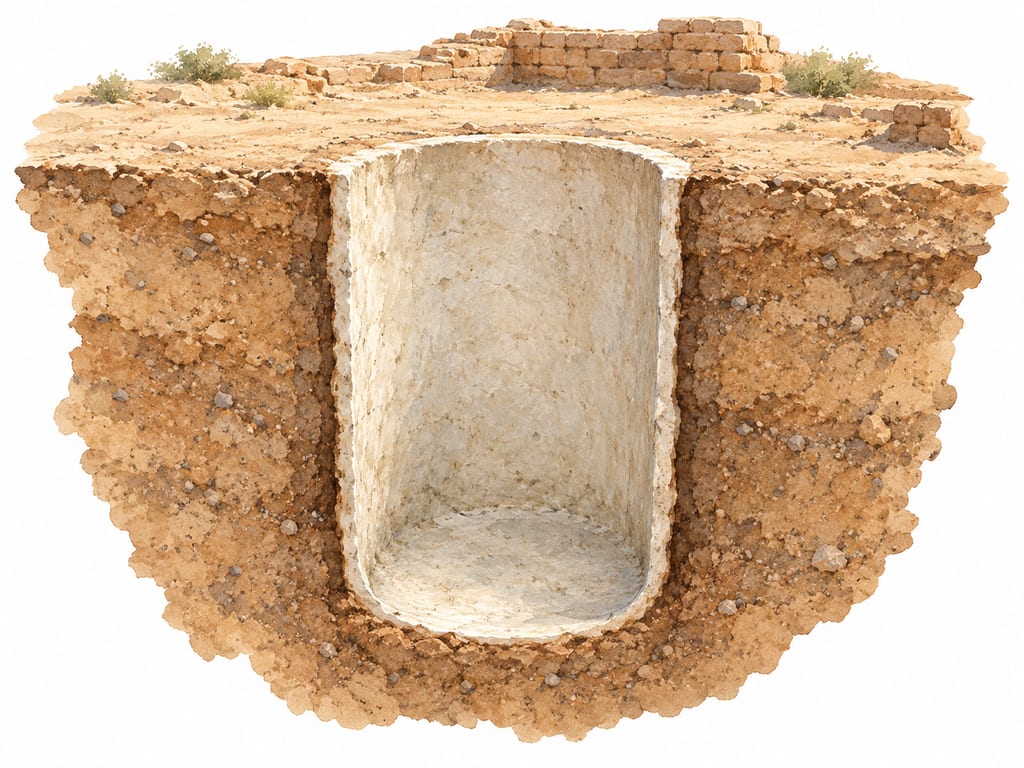
Kalibangan Period I preserves distinct lime-plastered pits and underground ovens. Grain storage is one interpretation of the pits; an earlier excavation account suggests water storage.

Soft, spreadable Calabrian pork sausage made with a great deal of red chilli and fatty pork, stuffed into natural casings, sometimes smoked and matured while staying soft.

A way to add independent temperature logging to an existing food dehydrator without changing its built-in controls or protections. It is a monitoring method, not a rewiring plan.

Pleurotus cystidiosus is the abalone mushroom, a cultivated oyster-type fungus with dark brown caps that grows more slowly and is more demanding than other Pleurotus species.

A dark, balanced vinegar from Emilia-Romagna made by combining cooked or concentrated grape must with wine vinegar, then acetifying and refining it in wood under a protected specification.

A living dairy inoculum that starts controlled cream fermentation, developing acidity and aroma before sour cream or cultured butter is finished.

A small electric incubator holds jars at a selected temperature for yogurt and other documented warm food preparations. Controls, capacity and vessel arrangement vary by model.

Adygean salt is a seasoned table salt associated with Adygea and the wider North Caucasian culinary tradition. Salt is blended with garlic and a variable selection of herbs and spices; the exact mix depends on the named style and maker.

The African Caesar-group mushroom, Amanita masasiensis, is a wild ectomycorrhizal species of central and southern African woodlands, eaten locally. The genus contains deadly poisonous species, so identification needs care.
No community contributions have been published for this entry yet.
Sign in to contribute. Published comments and photos are free to read.
Food and Agriculture Organization of the United Nations / ARECOPForm · Materials · Dimensions · Siting · Use · History
Asia Industrial and Institutional Stove Compendium, Chapter 2: Cardamom Curing Industry (Large)Large cardamom is grown in Sikkim and neighboring eastern Himalayan areas; bhattis are commonly field-side for prompt drying. The described form uses stone walls with a front fire opening, sometimes earth-banked into a slope, and a raised meshed platform traditionally made of bamboo mats on logs. The source reports a 335 × 310 × 138 cm stove size without axes, a 4–9 m² bed, and a 1.2–1.8 m bed height above the fire. It describes direct smoke/heat and reports traditional drying times of 25–40 hours in its surveyed account.
Cited in: A field-side curing structure; Walls, hillside and raised bed; Direct heat, smoke and curing; What the record does not establish
Agriculture Department, Government of SikkimMaterials · Use · Regional context · Distinction
Large Cardamom: Post Harvesting and CuringThe Department describes locally made Sikkim bhattis as stone-and-mud structures with a small front firewood opening and a bamboo mat above; traditional direct heating exposes capsules to smoke. It distinguishes improved indirect-heating systems from the traditional form and describes a separate 2–3-day curing account.
Cited in: A field-side curing structure; Walls, hillside and raised bed; Direct heat, smoke and curing; What the record does not establish
KIRAN: Empowering Agricultural Knowledge and Innovation in North EastRegional context · Use · Comparison
Cultivation of Large Cardamom in SikkimThe source describes traditional large-cardamom curing in a mud-and-brick bhatti, with capsules on raised platforms exposed to hot smoke; its reported drying time is 35–40 hours. It separately describes an improved mechanized dryer, which is not the traditional structure covered here.
Cited in: Direct heat, smoke and curing; What the record does not establish