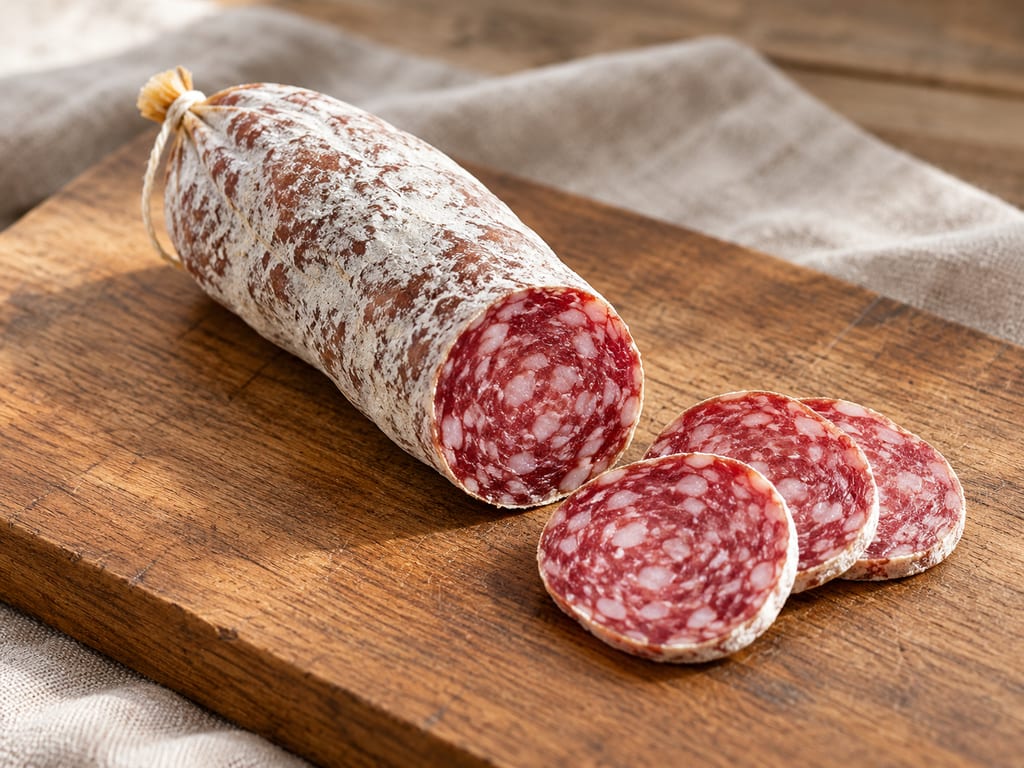
Cacciatore salami
Small Italian hunter-style salami of lean pork, firm fat, salt, pepper and garlic, mildly acidified and dry-matured; protected as Salamini Italiani alla Cacciatora DOP.
 FermenteaWhere food goes to change
Equipment · Bags, sacks and casings
Three manufactured casing families: collagen from animal protein, regenerated cellulose, and cellulose reinforced with fibrous paper. Edibility and process properties vary by grade.
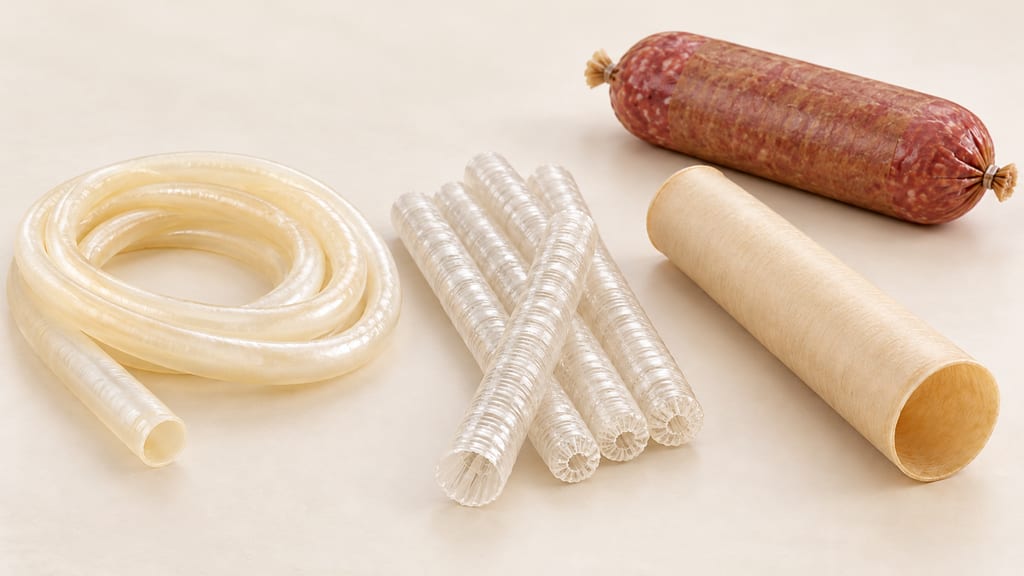
Manufactured sausage casings give a filling a tubular shape and repeatable size. They can be made to selected diameters and strengths, and filled by hand or machinery. This record groups collagen, cellulose and fibrous products because each is a manufactured casing used in sausage production; it does not treat them as a single material.
The comparison stops short of natural sausage casings, which are prepared from animal intestine and have a separate page. It also excludes barrier plastic casings. Similar tube shapes do not make the materials, edible status, moisture movement, or suitable processing stages interchangeable.
Collagen casing is manufactured from collagen extracted from skins and hides. Viscofan identifies the collagen-rich inner layer of bovine skin as its main raw material. This production route differs from using an intact intestine: animal tissue supplies a protein that is processed into a casing tube.
Edible and inedible collagen casings both exist. FAO describes edible collagen casings mainly for fresh pork sausages and frankfurters, while inedible collagen casings must be removed before consumption. The word “collagen” does not tell a reader whether a specific casing stays on the finished sausage; that depends on the product grade.
Cellulose casing is a different manufactured product. FAO describes casing made from cotton linters and notes that small-calibre casings are available in shirred form. Their permeability to smoke depends on condition: the cited guidance says they pass smoke when moist and become less permeable as they dry. Small sizes are used for skinless frankfurters, wieners and other small sausages.
The large cellulose casings covered by that FAO guidance are inedible and removed before eating. Kalle's product account also distinguishes pure viscose casings from its fibrous range. Some grades transfer smoke, colour or other properties in a controlled way, while other product constructions differ; a generic “cellulose” label is not enough to predict a finished casing's behaviour.
Fibrous casing is not a woven sack. It is a continuous cellulose-based tube reinforced with long-fibre paper, commonly abaca. ViskoTeepak's product guide describes the paper as a strength component and explains that cellulose coating, adhesion, stretch and other treatment are selected for the product and manufacturing process. Viscofan likewise describes fibrous products as a combination of cellulose and abaca paper.
That construction supports consistent dimensions and higher mechanical strength in larger sausage formats. FAO identifies dry-sausage fibrous casings as a casing that adheres as the sausage shrinks during drying. Manufacturer ranges also cover smoked, cooked and other products; suitability follows the grade and specification, not simply the broad family name.
The casing is a boundary around the filling. Its diameter, strength, adhesion and permeability affect how a product can be stuffed, handled, smoked, peeled or dried, but they do not replace the sausage's formulation and controlled process. Two tubes may look similar and still behave differently because their materials and treatments differ.
The protected Italian Salamini Italiani alla Cacciatora specification is one example of a product-specific rule: it permits natural or artificial casing up to 75 mm. That statement applies to the protected product, not every salami or as a general recommendation to select any artificial casing. Other sausages require their own documented grade and process.
These casings belong to modern industrial manufacture and circulate internationally. Kalle dates the introduction of its Nalo seamless cellulose-viscose casing to 1929. ViskoTeepak's own history says its Visko company began cellophane casing production in 1952 and started fibrous casing production in 1962. These dates are company-reported milestones for named products; they do not establish a single invention date for all manufactured collagen, cellulose and fibrous casings.
ViskoTeepak lists production plants for fibrous and cellulose casings in Hanko, Finland, and Lommel, Belgium, and reports a partner network through which its products reach nearly 100 countries. These details show named manufacturing and distribution contexts. They do not make Finland or Belgium the origin of every casing type, or mean every grade is available in every market.
Kalle says it introduced its Nalo seamless cellulose-viscose casing in 1929; ViskoTeepak dates its cellophane production to 1952 and fibrous-casing production to 1962. These are company milestones for named products, not dates for the origin of collagen casing or every artificial casing.
The three material families are not interchangeable: collagen comes from animal collagen; cellulose is regenerated plant cellulose; fibrous casing is cellulose strengthened with paper fibre.
Source →Cellulose casings described by FAO are inedible and removed before consumption. Collagen casings can be edible or inedible; check the exact grade.
Source →Permeability, adhesion, size and peelability are product-specific. A casing made for cooked or smoked products is not automatically suitable for a fermented drying process.
Source →The casing does not by itself establish fermentation, curing, drying or food-safety controls for the sausage.
Source →The inspected sources do not establish a specific place of origin or a representative place of use for this equipment category. Manufacturer-specific examples do not establish the geography of the broader type.
Small Italian hunter-style salami of lean pork, firm fat, salt, pepper and garlic, mildly acidified and dry-matured; protected as Salamini Italiani alla Cacciatora DOP.

A Cap-Pelé boucanière is an Acadian herring-smoking building. The documented Willie Niles example is a one-storey wood-frame structure with a ridge smoke vent and interior bays for hanging fish-bearing cannes.

Achcharu is a family of Sri Lankan vinegar pickles made with mixed vegetables or seasonal fruit and a piquant spice dressing. This version is a quick, refrigerated, non-fermented mixed-vegetable pickle.

The acocote is a long, hollowed and dried gourd used to draw aguamiel from a mature maguey. It is a harvesting tool: the sap is transferred to a separate vessel before it ferments into pulque.

Adrak murabba preserves young ginger in sugar syrup, a sweet South Asian preparation recorded in Indian cookery and food-processing sources.

Parkia biglobosa seeds are fermented into regional West African seasonings, including nététou, iru, dawadawa and soumbala. The yellow fruit pulp is a separate food, and names and methods vary by place.

Japanese reddish-brown vinegar from sake lees matured about three years, turned to vinegar by acetic bacteria; the vinegar of Handa and Edomae sushi rice.

A refined common-wheat flour blended for a broad range of baking; its protein and behavior vary with wheat, milling and market.

The almond mushroom, Agaricus subrufescens, was cultivated in eastern North America in the 1800s, lost its market, and returned as a cultivated mushroom from Brazil, where it is grown under several names.
No community contributions have been published for this entry yet.
Sign in to contribute. Published comments and photos are free to read.
Food and Agriculture Organization of the United NationsForm · Materials · Function · Limits
Guidelines for slaughtering, meat cutting and further processing: casingsFAO describes artificial casings as uniform cylindrical forms available in product-specific diameters and strengths, filled by hand or machine.
Cellulose casings from cotton linters can be shirred; small varieties can pass smoke when moist, while larger types are inedible and removed before eating.
Collagen casings are regenerated from skins and hides and can be edible or inedible.
Dry-sausage fibrous casings adhere to the product during drying.
Cited in: One casing family, three distinct material groups; Collagen: regenerated animal protein; Cellulose: a separate regenerated-cellulose tube; Fibrous: cellulose reinforced with paper fibre; Choose for the intended sausage and process
Viscofan GroupMaterials · Manufacture
Consolidated management report 2025Viscofan identifies cellulose as the main raw material for cellulose wraps and describes collagen casings as primarily using the collagen-rich inner layer of bovine skin.
Viscofan distinguishes fibrous casings as cellulose combined with abaca paper from collagen casings and plastic wraps.
Cited in: Collagen: regenerated animal protein; Fibrous: cellulose reinforced with paper fibre
ViskoTeepakMaterials · Manufacture · Geography · History · Use
Fibrous Casings Product GuideThe guide describes fibrous casing as a cellulose-based tube strengthened with long-fibre abaca paper, with properties tailored to product and process.
ViskoTeepak reports a worldwide partner network through which its products reach nearly 100 countries.
The guide identifies fibrous and cellulose production plants in Hanko, Finland, and Lommel, Belgium; these are company sites, not origins for all casing products.
The company's history dates cellophane casing manufacture to 1952 and its start of fibrous casing manufacture to 1962.
Cited in: One casing family, three distinct material groups; Fibrous: cellulose reinforced with paper fibre; An industrial family with named milestones
Kalle GroupHistory · Materials · Use
Fibrous casingsKalle dates its Nalo seamless cellulose-viscose casing, usually strengthened with fibre paper, to 1929.
Kalle distinguishes pure viscose casing from fibrous casing and describes fibrous casing for firm dry sausages where stable calibre is needed.
1929 is a company product milestone, not an origin date for all manufactured sausage casings.
Cited in: Cellulose: a separate regenerated-cellulose tube; An industrial family with named milestones
Gazzetta Ufficiale della Repubblica ItalianaDocumented use · Link
Disciplinare di produzione della DOP Salamini Italiani alla Cacciatora (decree of 13 November 2024)The protected-product specification permits natural or artificial casing up to 75 mm for Salamini Italiani alla Cacciatora; this is an example for that protected product only.
Cited in: Choose for the intended sausage and process