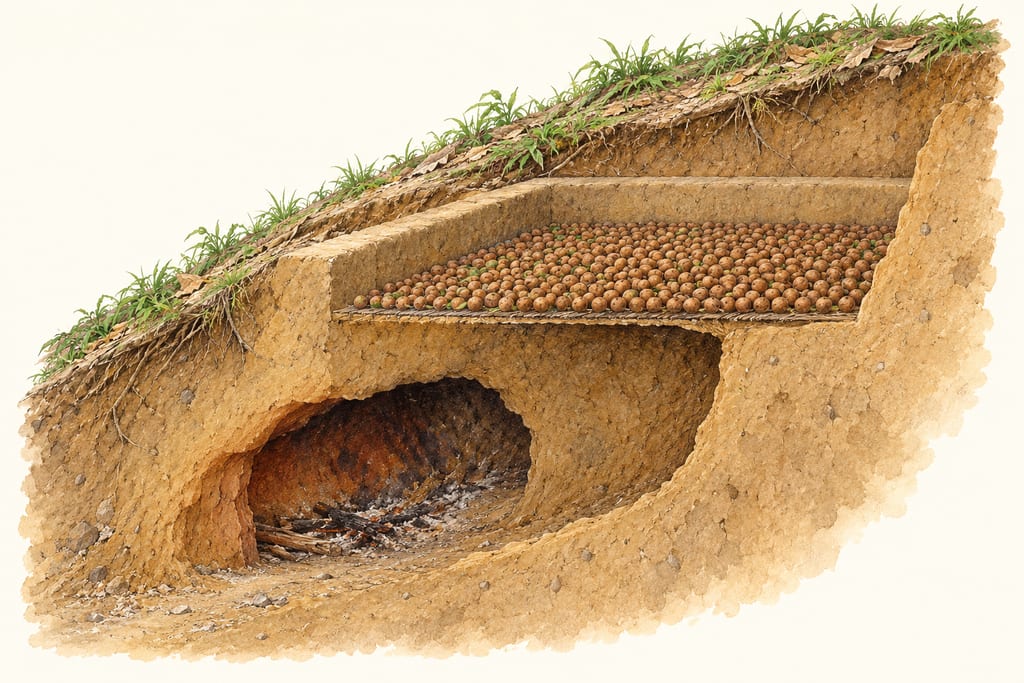
Two different kiln forms
Traditional longan drying in Dongshan, Tainan, uses more than one kiln construction. Taiwan’s Ministry of Agriculture describes an earth-pit form set into an orchard or hillside, with the roasting bed above the fire space, and a separate brick form built from earth blocks and bricks. A National Taiwan University local-history study documents locally represented earth-block, river-cobble and red-brick variants. These community-specific forms are not a universal sequence for every kiln.
In the earth-pit form, the slope and earth channel are part of the structure; the brick form has a built masonry body. Both place a roasting bed above a lower fire space, but the bed may be woven bamboo or wood slats. The sources do not establish one standard chamber size, capacity or plan.
Sources for this section
A slow roast using longan wood
The traditional method uses longan wood and careful fire tending over several days. The Ministry account describes a hotter initial fire followed by medium and low heat, with manual turning; its method takes at least four to five days. Tainan City’s 2025 account gives five to six days. PTS records a local worker’s account of six days and five nights. These are source-specific reports, not one guaranteed schedule for every kiln or batch.
The bed carries fruit above the fire space while heat moves through the structure. The HISP study describes a natural slope and earth channel for the early pit form; it does not establish mechanical airflow. Masonry variants remain distinct. These sources do not justify adding standard dimensions, a fan or an undocumented grate.
Sources for this section
A practice tied to Dongshan
The sources locate these kilns in Dongshan District, Tainan, Taiwan. The Ministry’s Food and Agriculture Education page identifies Nanshi Li’s earth-kiln lane and reports 92 older kilns along its slope. A 2025 Tainan City release describes support to repair 173 longan-drying kilns and continuing traditional roasting. These accounts document local use and care for kiln infrastructure, without implying identical designs.
PTS reports a local association representative’s statement that the practice dates to the Qing period. This is attributed community testimony, not independently verified construction dating. The cited sources do not give standard capacity, dimensions or a universal layout, so this record keeps the earth-pit and brick forms separate.
Sources for this section
History
Modern sources document continuing use and locally represented historical forms. PTS attributes a Qing-period origin to a local association representative; that is community testimony, not independently dated evidence.
Equipment details
CapacityNo source gives a standard capacity.
SizeNo source gives standard dimensions.
PowerFire or solid fuel The sources describe longan wood as kiln fuel.
How you get oneNot established The sources describe local construction and use but do not establish an acquisition route.
CareMulti-day roasting requires tending the fire and turning the fruit; bed materials and kiln details vary.
Made of
- earth and clay — hillside earth-pit kiln body
- brick — separate built kiln body
- woven bamboo or wood slats — roasting bed
- longan wood — fuel
Limits
The hillside earth-pit and built brick kilns are separate forms, not one standardized structure.
Source →Reported roast duration varies: the Ministry account gives at least four to five days, Tainan City reports five to six days, and PTS records a local account of six days and five nights.
Source →Places
Dongshan District
Traditional use · Locality evidenceThe sources document kilns in Dongshan, without implying identical construction across the district.