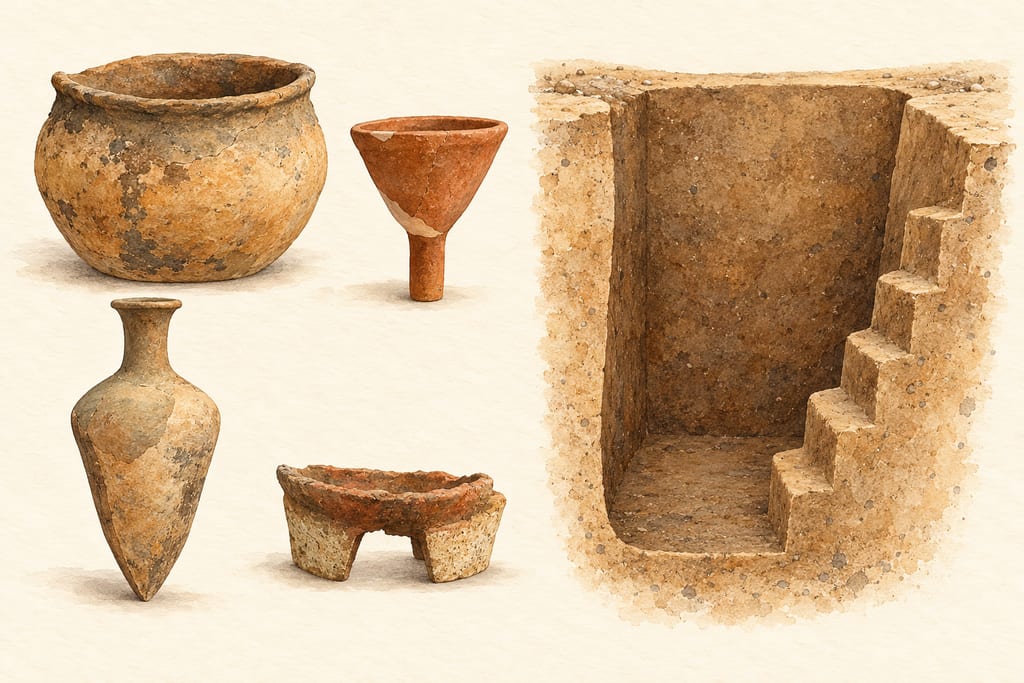
Mijiaya brewing suite
Excavated Mijiaya pottery includes wide-mouth pots, funnels, pointed-bottom jiandiping jars and pottery stoves. Residue analyses support a beer-making interpretation; exact vessel roles remain uncertain.
 FermenteaWhere food goes to change
Equipment · Tanks and vats
酒海 · liquor sea · wine sea
A jiuhai is a large vessel for storing and maturing baijiu. This entry focuses on a documented Xifeng example: a giant basket woven from local twigs and lined with layered paper, cloth and coatings. Other jiuhai use different materials.
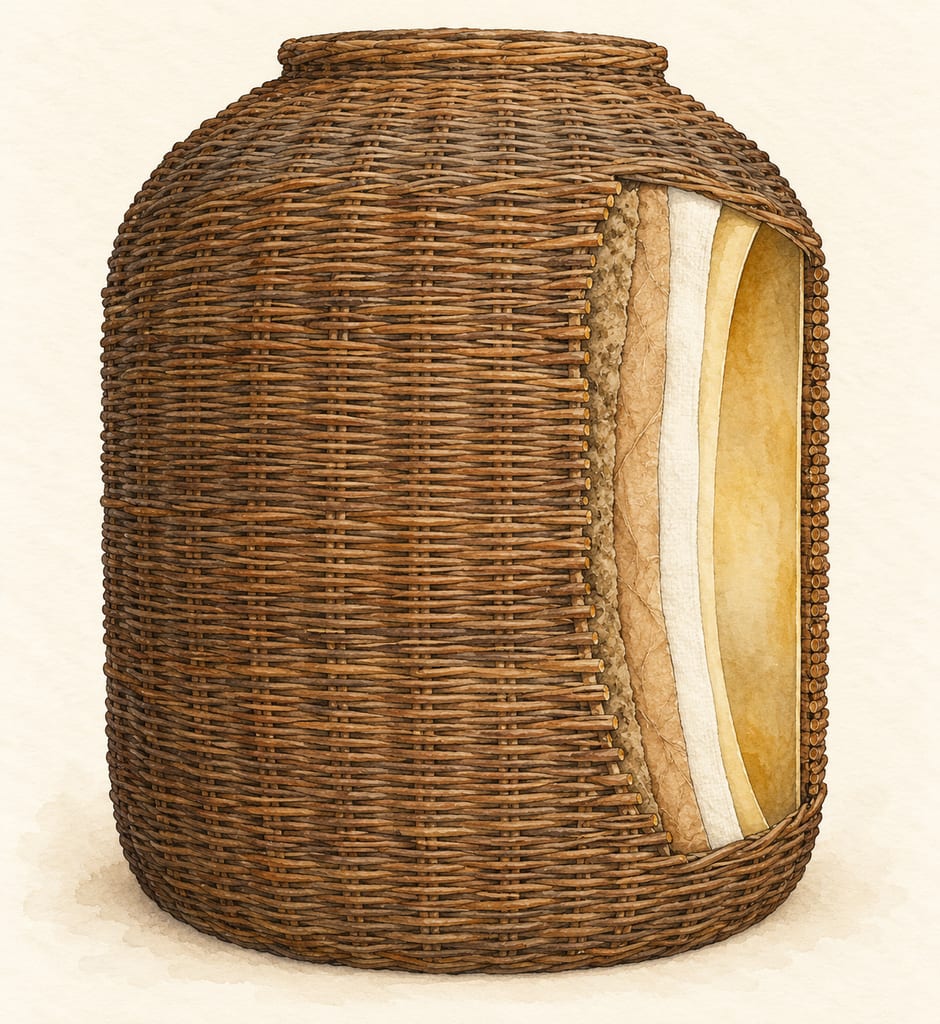
Jiuhai (酒海, often translated “liquor sea”) is a large vessel for storing and maturing baijiu after distillation. The name covers more than one construction. This page focuses on the Xifeng example: a large cylindrical, basket-like container woven from local woody twigs. It is an object made by craft workers and placed in a storage house, so it belongs with equipment rather than a built-in fermentation pit or cellar.
Xifeng Group reports large jiuhai around 2–2.5 metres in diameter and about 3 metres high, commonly holding five to six tonnes. These are example dimensions, not a standard for all jiuhai. The article says Xifeng base liquor matures in these vessels for at least three years; that duration applies to the producer's practice, not to baijiu storage generally.
For this Xifeng example, the twigs are gathered from the northern Qinling foothills and woven into a basket shell. The interior lining is described as gap filler, bark paper and white cotton cloth applied with an egg-white-based adhesive, finished with beeswax and rapeseed oil. Completing one large vessel takes about a year; six skilled makers weave its shell over roughly a month. These details describe one construction, not a universal jiuhai specification.
A Jiangnan University research summary describes a different wooden jiuhai, with locust- or pine-wood shell and an interior paste involving lime, blood material and egg white. That variation should not be blended into the wicker vessel. The accompanying cutaway illustration shows the Xifeng woven form and its reported lining as a simplified section, not a measured technical drawing.
A 2025 Food Chemistry study examined baijiu aged in a jiuhai and reports a composite aroma described as herbal, spicy, cut hay and woody. Its abstract reports 71 odorants and tests showing that several compounds, including a mixture of seven sub-threshold terpenes, affected the sample's aroma. The research supports treating jiuhai aging as a material system that can matter to sensory outcomes.
Those results concern the study's samples and methods. They do not show that every jiuhai has the same coating, that one lining ingredient alone produces a particular aroma, or that all jiuhai-aged baijiu tastes alike. The vessel is a maturation container, not the primary fermentation vessel.
The documented example belongs to Xifeng baijiu practice in Shaanxi. The producer-group page locates the storage at the winery and cites Fengxiang County records for jiuhai makers in Tingsitou Village, Liulin Town. It also describes local twig sourcing from the northern Qinling foothills.
Xifeng Group's article says the tradition reaches back to the Tang period and that Xifeng has used jiuhai since the Song. These are producer-attributed heritage claims; the sources consulted here do not provide an independently dated early specimen to establish an exact origin. A 2024 Sina News photograph shows a large woven vessel in a display setting; it is credited as a form reference only because photographer and reuse rights are unstated.
Xifeng Group's article traces the storage tradition to the Tang period and says it has been used since the Song; this is producer-attributed, not independently dated here.
A jiuhai stores and matures distilled spirit; it is not the primary grain fermenter.
Source →Sensory findings concern particular jiuhai-aged baijiu samples; they do not establish the same aroma for every container or lining.
Source →Wicker and wooden jiuhai constructions differ; their linings should not be combined into one presumed recipe.
Source →The Xifeng Group article describes jiuhai at its winery and cites nearby Tingsitou village as a place known for making them.
The producer-group article cites Fengxiang County records identifying this as a place of skilled jiuhai manufacture; not all jiuhai are made there.
Excavated Mijiaya pottery includes wide-mouth pots, funnels, pointed-bottom jiandiping jars and pottery stoves. Residue analyses support a beer-making interpretation; exact vessel roles remain uncertain.

Protected Italian vinegar made only from cooked grape must, fermented and aged in a battery of wooden barrels for at least 12 years: sweet, sharp and syrupy.
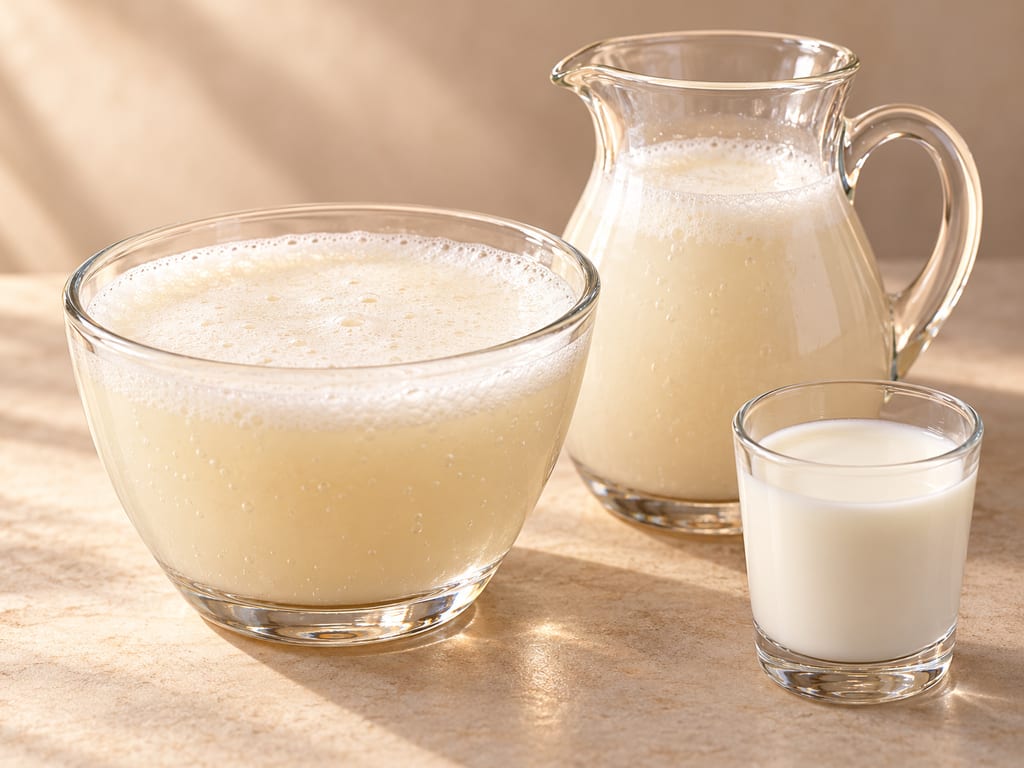
Airag is Mongolia’s fermented mare’s-milk drink, traditionally churned with saved starter in a reusable cowhide khokhuur.

Appam, or hoppers, are South Indian and Sri Lankan rice pancakes made from a fermented coconut-and-rice batter and cooked in a curved pan to a crisp lacy rim and a soft, spongy centre.
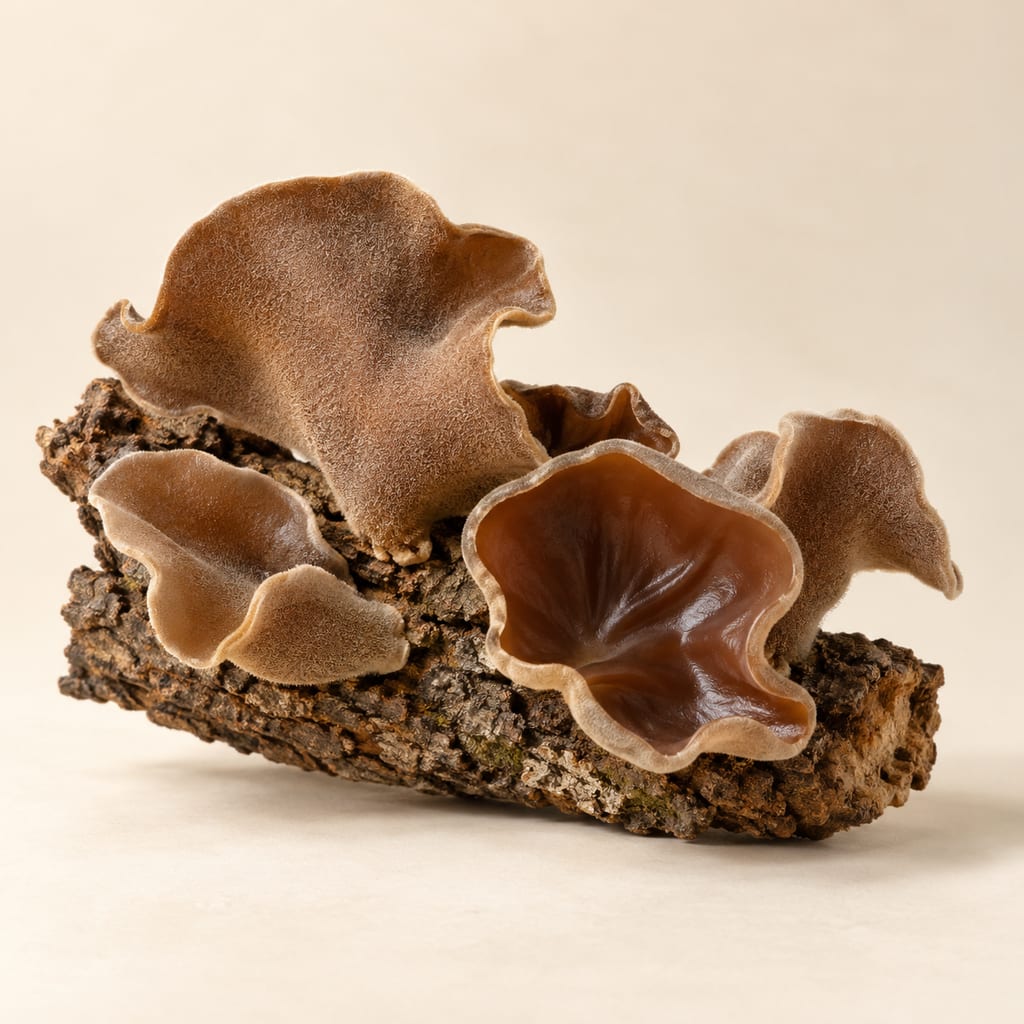
Auricularia tremellosa is a wood ear fungus of the genus that supplies most dried wood ear sold in China; its own food record is thin, and the culinary practice described here comes from the closely related wood ear species.
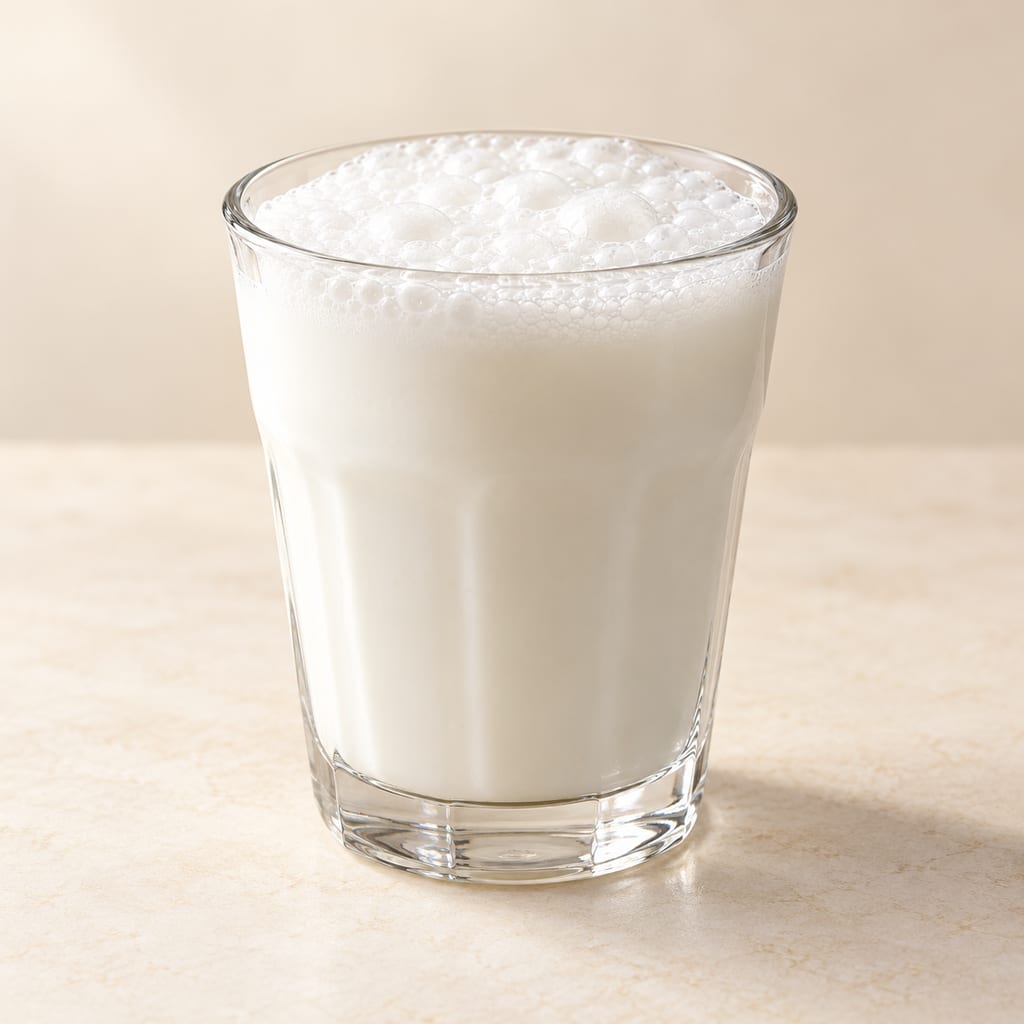
Ayran is Turkey’s cold, savoury yogurt drink: plain yogurt is loosened with water and lightly salted, then whisked smooth or aerated into a soft cap of foam.
A thin stone griddle used over an open hearth. Norwegian archaeology documents the established tradition from the early Middle Ages; a Viking-period origin is only a cautious suggestion linked to Shetland.

Crushed or milled barley cooked in water until the starch softens and the mixture thickens, the plainest way a northern household turned stored grain into a meal, here with apple and hazelnut.

Black carrot is the anthocyanin-pigmented Eastern carrot (Daucus carota var. atrorubens), the purple root that preceded orange types and still colours kanji and şalgam.
No community contributions have been published for this entry yet.
Sign in to contribute. Published comments and photos are free to read.
Shaanxi Xifeng Liquor Group (article credits Zhongfangwang as its source)Form · Materials · Manufacture · Geography · History
The ‘honey’ secret of Xifeng liquor hidden in a great jiuhaiThe article describes large jiuhai woven from local twigs, and reports example dimensions, capacity and construction materials.
Its Xifeng example uses gap filler, bark paper and cotton cloth with egg-white adhesive, finished with beeswax and rapeseed oil; this is not a universal recipe.
It reports at least three years of maturation for Xifeng base liquor and a Tang/Song heritage claim attributed to the producer.
Cited in: A storage vessel, not a fermenter; Woven shell and interior lining; Place and historical claims
Food Chemistry; abstract indexed by PubMedResearch · Sensory evidence
Molecular and sensory characterization of Chinese Baijiu aged in Jiuhai container and contribution of volatile odorous terpenes to Jiuhai-aromaThe 2025 study characterizes a jiuhai-aged sample as herbal, spicy, cut-hay and woody.
It reports 71 odorants and sensory effects from key odorants and a mixture of seven sub-threshold terpenes; these are sample-specific findings.
Cited in: What aging research can and cannot say
School of Biotechnology, Jiangnan UniversityMaterials · Variation · Research
Research on the flavor of Baijiu aged in traditional wooden JiuhaiThe university report describes a wooden jiuhai variant with locust or pine wood shell and interior paste using lime, blood material and egg white.
This variant differs from Xifeng's twig-woven construction.
Cited in: Woven shell and interior lining
Sina NewsVisual reference
Xifeng Liquor: the phoenix-aroma heritage and the large jiuhaiThe photo shows a large woven Xifeng jiuhai on a display stand; it serves as a form reference only. Reuse rights are not stated.
Cited in: Place and historical claims