An assemblage, not one canonical pot
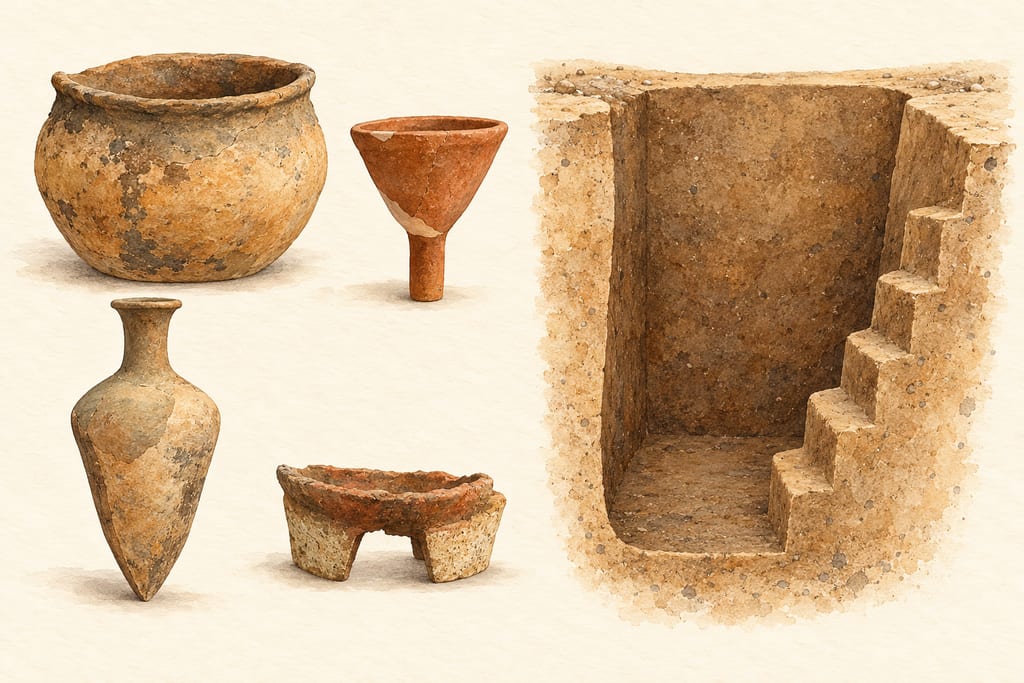
The Mijiaya finds are a toolkit of distinct forms, not a single standard “Chinese beer pot.” Excavated in two underground pits were wide-mouth pots, ceramic funnels and tall jiandiping amphorae with pointed bottoms. The amphora's narrow opening and elongated body distinguish it from a broad open pot; the funnel is a separate filtering form. A pottery stove was also found in each pit, but the stove is associated heating equipment, not a jar or fermenter.
These ceramic objects are portable equipment; the excavated pits are fixed features in the ground. The pits help establish archaeological context but do not belong to this equipment classification. H82 was 3.7 m deep, with straight walls and five steps. H78 was 2.5–2.7 m deep, with a flat bottom and a secondary platform. Those measurements describe the pits, not the vessels.
Sources for this section
Evidence and interpretation
The beer-making interpretation combines vessel forms with yellowish interior residues and analyses of starch, phytoliths and chemical residues. The reported recipe includes broomcorn millet, barley, Job's tears and tubers. The authors propose that the vessel forms represent stages of brewing, filtration and storage, and interpret the two installations as in-situ beer-making facilities.
That reconstruction is not a directly witnessed process. The evidence supports beer production at the site, but cannot show precisely how every pot was used, how long material remained in each vessel, or the exact sequence of tasks. This page keeps the stoves and vessels distinct and treats the proposed division of labor as an archaeological interpretation.
Sources for this section
Place and date
Mijiaya sits on a terrace northeast of the Chan River, a tributary of the Wei, in Shaanxi, North China. Both pits belong to the Banpo IV, or late Yangshao, phase, dated 3400–2900 BCE using regional ceramic chronology and radiocarbon dates. The date applies to the excavated features and assemblage; it does not imply that this equipment continued unchanged in later periods.
Figure 2 in the 2016 study shows a pit plan and section alongside a funnel, reconstructed wide-mouth pots, a pointed-bottom jar and a pottery stove. The accompanying illustration is a modern interpretive reconstruction guided by these forms and the documented pit profile; it does not assert a proven arrangement of the objects inside either pit.
Sources for this section
History
Regional ceramic typology and radiocarbon dates place the pits in this period. Residue, starch and phytolith evidence supports beer production at the site, while individual vessel roles remain interpretations.
Equipment details
PowerNo power The pots, jars and funnel are unpowered equipment. The assemblage also includes pottery stoves that required fire but are not fermentation vessels.
How you get oneNot obtainable today This page describes excavated archaeological objects, not obtainable original equipment; no modern replica route is documented.
CareNot applicable as operating advice: this page describes excavated objects and provides no present-day brewing or handling protocol.
Made of
- Pottery — Wide-mouth pots, funnels, pointed-bottom jars and associated stoves
Ceramic artifacts; clay recipes and firing techniques are not established.
Limits
Brewing, filtration and storage roles are proposed from vessel form and residue evidence; the exact workflow is reconstructed, not directly observed.
Source →The two pits are fixed archaeological features, not portable equipment. Their use as brewing facilities is an interpretation of excavated context.
Source →Places
Mijiaya archaeological site
Historical attestation · Locality evidenceThe study places the site northeast of the Chan River, a Wei tributary, in Shaanxi, North China.