Karas names a vessel, not a single wine
Karas (կարաս; plural forms include karases and karasi) is the Armenian name for a large clay or earthenware vessel used in wine-making. It names equipment, not one grape, fixed recipe or synonym for every ancient amphora. Armenian heritage sources connect the jar with grape pressing, must handling and storage, while a current producer uses karasi for maturation after fermentation in concrete. A household vessel of about 240 gallons is recorded in one heritage entry, but that historical example is not a standard size.
The word also appears in archaeological collections. The History Museum of Armenia calls an Early Bronze Age clay vessel from Shengavit a karas and catalogs a separate medieval Dvin object under the same name. Those entries describe the artifacts and materials; they do not demonstrate that either excavated vessel held wine. Their dates belong to the history of vessels catalogued as karas, not proof of an unchanged wine-making lineage.
Sources for this section
The jar's role changes by producer and region
Armenian heritage descriptions connect grape harvest, pressing and karas use, but they do not define one process for every household. The 2021 register describes a Vayots Dzor practice in which grapes are pressed in a basin and young wine is transferred for maturation after an eight-day stage. An Ashtarak ethnographic account records other historical household work and storage customs. These sources document specific regional and historical contexts rather than a complete contemporary protocol.
A current Areni wine from Zorah illustrates another arrangement: fermentation starts in concrete, then the wine matures in karasi. This separates the jar's role from fermentation itself and shows why “karas wine” should not be treated as one vessel-only method. The product is one producer's wine, not a representative rule for Armenia. The sources do not establish one yeast, capacity, closure or aging duration for every karas.
Sources for this section
Burial is documented for one modern installation
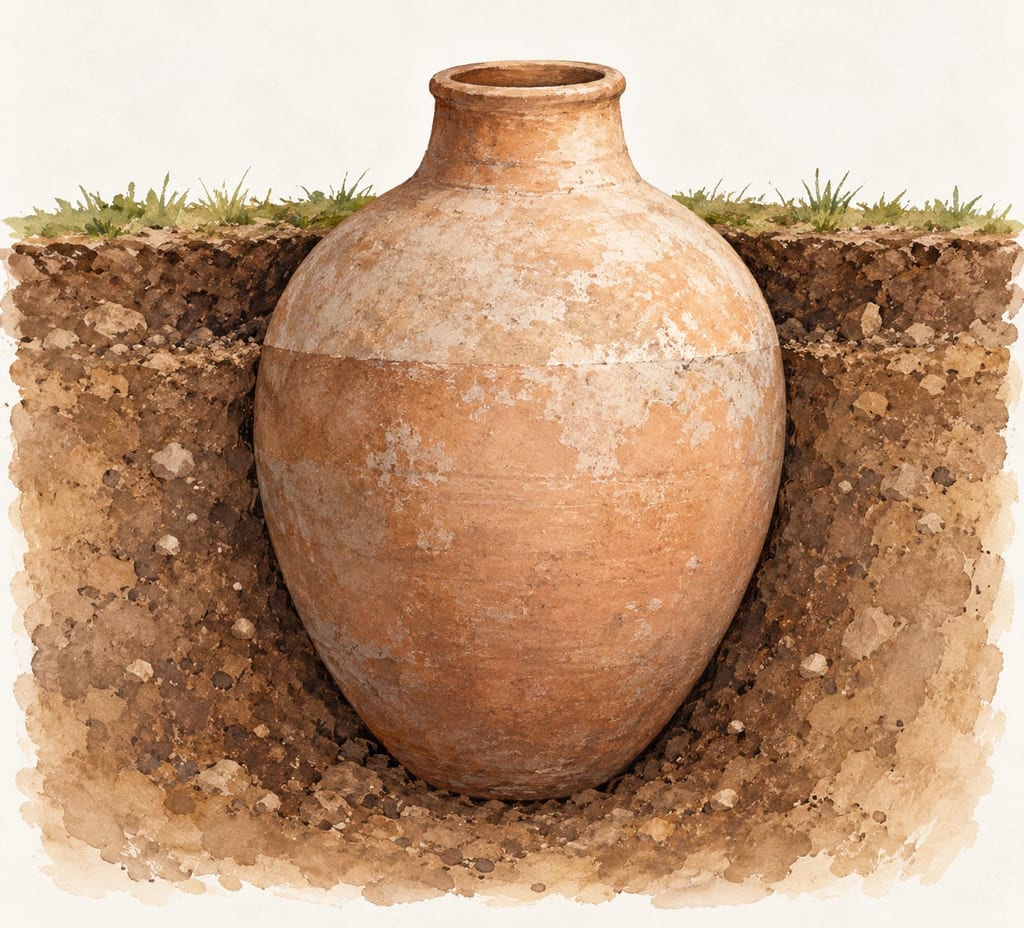
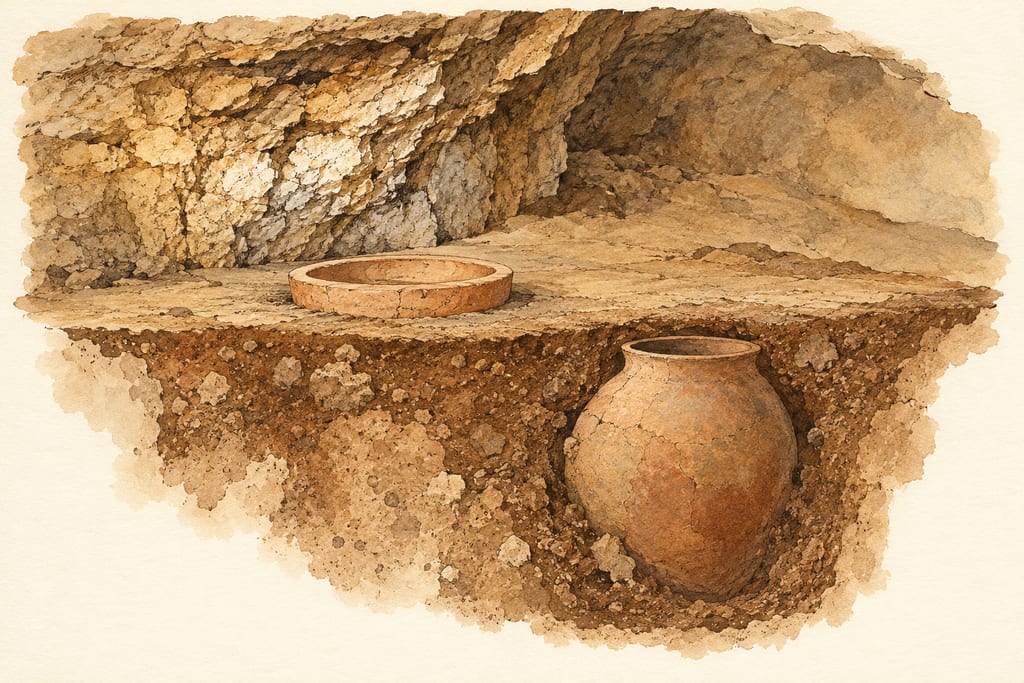
Zorah reports that its Karasi wine matures in karasi buried to about three-quarters of their height. This supports an illustration of a vessel partly held by earth, with its mouth accessible, but it does not establish a universal cellar plan or standard depth. Historical accounts place large wine vessels in cellar contexts, yet the cited evidence gives no single construction drawing, soil profile or foundation detail that can be applied everywhere.
A buried jar is not interchangeable with the ground around it: the vessel is made and can be moved before installation, while the cellar floor and surrounding soil belong to the building. This record describes the vessel and one documented placement, not a build design. The cutaway image is explanatory, not an installation instruction or measured plan.
Sources for this section
Archaeology and living practice answer different questions
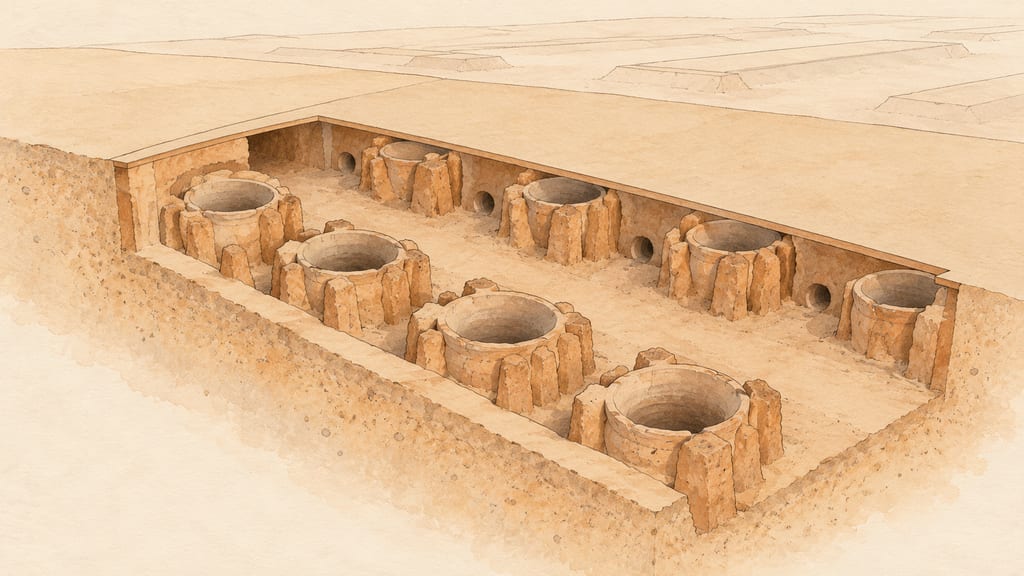
Areni-1 provides evidence for wine production in Armenia around 4000 BCE. The archaeological installation and finds make it an important early wine-making record; they do not establish that the same karas form, process or community persisted unchanged into modern times. Urartian cellar records, museum objects, heritage descriptions and current winery practice are separate evidence sets. The antiquity of wine-making is not proof of one continuous vessel tradition.
The museum's Shengavit object is dated broadly to the third millennium BCE and is made of clay; a separate vessel catalogued as a karas from Dvin is dated to the 12th–13th centuries and is faience with turquoise glaze. These examples show that catalogued vessels vary materially. Their ornament does not define a functional profile for present-day wine jars.
Sources for this section
Form, capacity and care remain vessel-specific
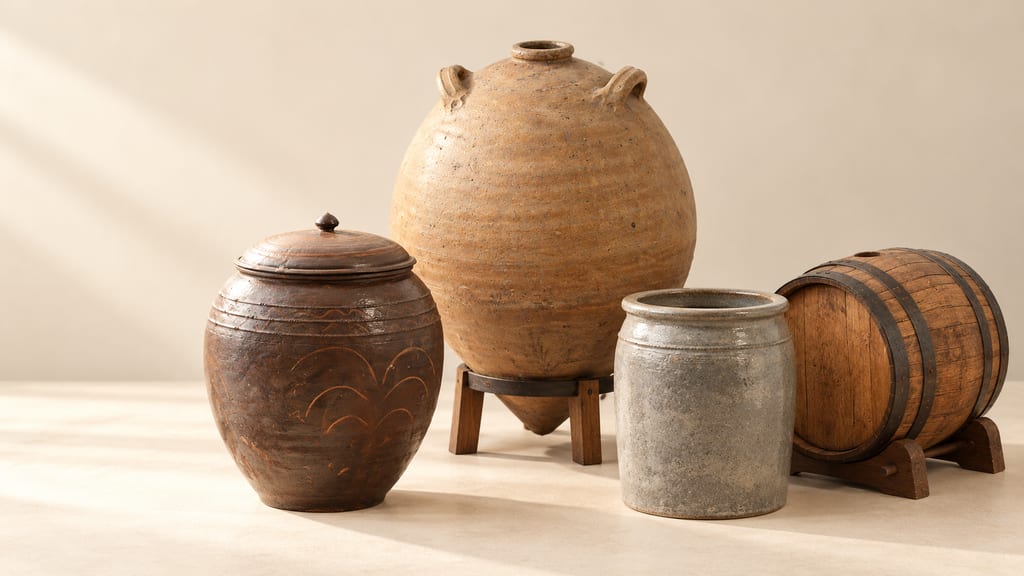
The inspected photographs show rounded earthenware jars with narrower openings. One Commons image is captioned as Armenian clay vessels (Karas), while a Goris festival photograph documents a display of varied traditional clay jars. They help readers recognize material and form, but do not show an active cellar, a particular wine or the buried portion of any jar. They are not a universal blueprint.
No general capacity range, dimensions, clay recipe, glaze rule, cleaning method or commissioning procedure is established by these sources. The heritage register's approximately 240-gallon household example is not a purchase recommendation. A current maker or cellar professional would need to specify an actual vessel and setting. Fermenting wine releases carbon dioxide; historical cellar narratives and occupational guidance underscore the hazard. This page gives no cellar-entry procedure, and traditional use does not make a confined space safe.
Sources for this section
History
The History Museum of Armenia catalogs a clay karas from Shengavit dated to the third millennium BCE and a separate faience karas from Dvin dated to the 12th–13th centuries. Areni-1 is a distinct Late Chalcolithic wine-production installation and does not establish direct continuity with modern karas practice.
Equipment details
CapacityNo general capacity range is established. The heritage register records one household maran example of about 240 gallons; that is not a standard size or current purchase specification.
PowerNo power The vessel itself is passive; cellar temperature control or other winery equipment is separate and varies by installation.
How you get oneNot established Sources document historic and modern use but not a current general maker, retail route or price for karas vessels.
CareNo broadly applicable cleaning, sealing, commissioning or storage procedure is established by the cited sources. Consult a qualified maker or cellar professional for a specific vessel; this record is not a home-use protocol.
Made of
- Clay / earthenware — Vessel body
Large earthenware karas vessels are described in Armenian heritage and producer sources. Archaeological objects catalogued as karas include a clay Shengavit find and a distinct faience Dvin object; materials and finishes vary across examples.
Limits
The approximately 240-gallon household vessel is one historical example; no universal or current standard capacity is known.
Source →Partial burial to about three-quarters of vessel height is reported for one modern Zorah wine; it is not a standard installation detail for all karasi.
Source →Areni-1 establishes ancient wine-production evidence but not direct continuity with current karas use.
Source →Places
Armenia
Traditional use · Country evidenceThe official register names communities in the Ararat plain and six provinces; no single birthplace is claimed.
Vayots Dzor
Documented use · Region evidenceThe register describes a regional wine-making practice; Zorah documents one producer-specific maturation in buried karasi.
Shengavit
Historical attestation · Locality evidenceA museum catalog calls a clay vessel from Shengavit a karas; the artifact entry does not establish wine contents.
Dvin
Historical attestation · Locality evidenceThe museum records a distinct faience vessel catalogued as a karas; Dvin is not asserted as a production origin.