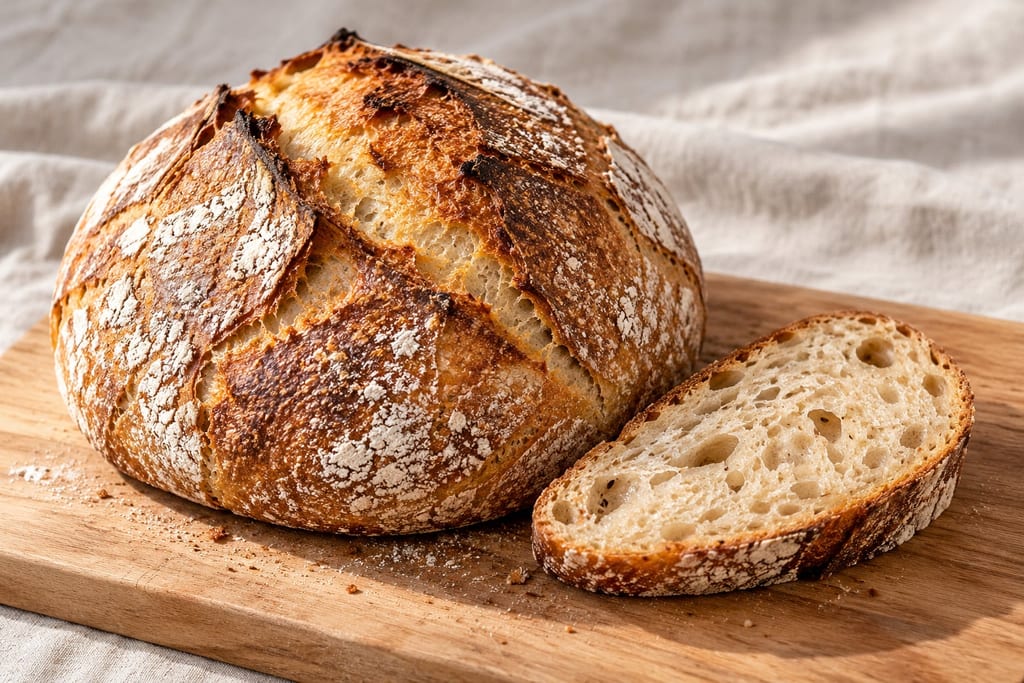
Pain de campagne with discard starter
Two large French-style wheat loaves use unfed sourdough starter, whole-wheat flour, long room-temperature fermentation and a covered-pot bake.
 FermenteaWhere food goes to change
Equipment · Tanks and vats
maie · pétrin · pâtière · coffre à boulange
A French maie is a legged wooden chest for hand-kneading bread dough and, in some Auvergnat forms, storing the baked loaves. Its shape and materials vary by region.
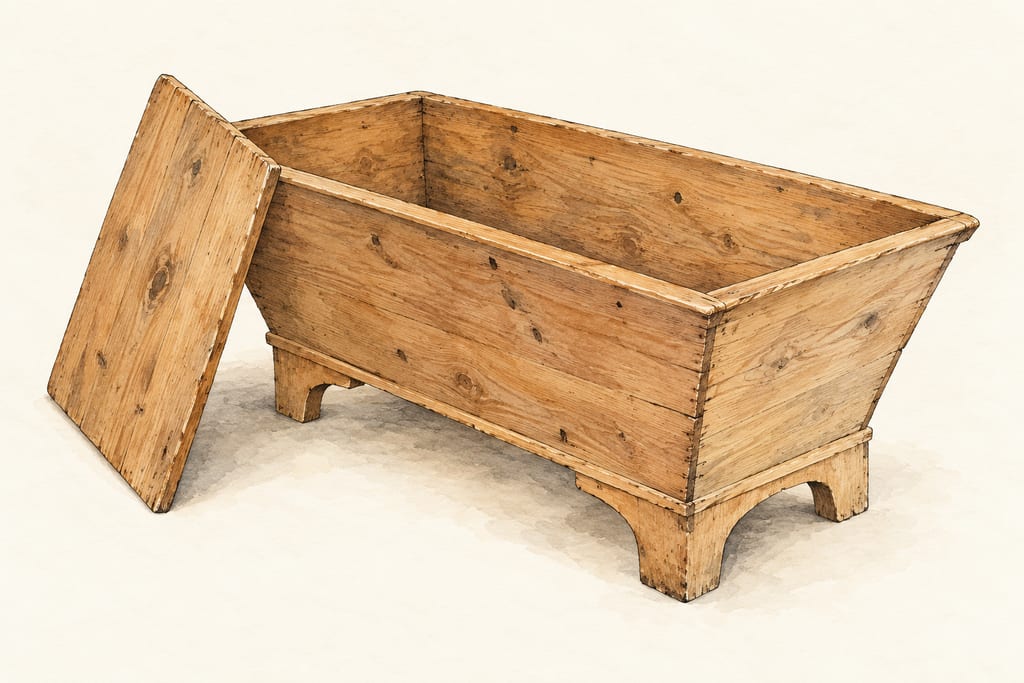
A maie is a wooden chest used in French breadmaking. Unlike a mixing bowl, it is a piece of household furniture raised on legs, with a broad top that can be lifted away to expose the working space. The French regional terms include maie and pétrin; in an Auvergnat account the same kind of bread chest is also called a pâtière or coffre à boulange. Names and details vary, so these words should not be treated as proof of one standard pattern.
The maie’s job was practical: it gave the household room to bring flour and dough together by hand, then hold the dough while breadmaking continued. In some Auvergnat examples the chest also stored finished loaves between meals. That second use connects it to the household bread chest, but it does not make every maie a purpose-built bread bin.
The Auvergnat form is described as trapezoidal: its four sides slope inward, and four sturdy legs raise it from the floor. The working cavity is broader above than at the base. A removable flat board covers it. Some models include a lower drawer for tools, but the documented photograph used here shows no such drawer, so it is not part of this depiction.
Regional maies could be made from fir, beech, elm or cherry, according to the Cézallier heritage account. Those are examples of material choices, not a species identification for every surviving chest. The source does not give a measured capacity, standard dimensions, joinery plan or wood species for the photographed object. A separate wooden dough trough in Sweden is catalogued under the broad English label “baking trough,” but it documents a different regional use: keeping and reviving sourdough. The French maie is treated here as a distinct chest for hand-kneading and sometimes bread storage.
The chest is the place where dough is worked; it does not make the dough ferment. Bread leavening depends on what is mixed into the dough and the conditions in which it rests, not on an assumed property of the wood. In the Massif des Bauges, breadmaking knowledge includes choosing flour, preparing dough, tending leaven, kneading and managing a wood-fired oven. The regional inventory presents these as connected household and community skills rather than a single universal formula.
The role of the maie also differs from a proofing basket. A chest holds the bulk dough during kneading and rest; the Bauges inventory separately names the paillât as a cloth-covered basket for a shaped loaf’s second rise. The distinction matters because the tools support different stages. A maie can be part of the bread workflow without being the vessel in which each loaf is finally shaped or proofed.
The Cézallier account places the maie in a scullery, storeroom or cellar and describes breadmaking as a family necessity. The Massif des Bauges inventory records how village breadmaking has also been collective: people maintained local knowledge of flour, leaven, dough, firewood and communal ovens. It describes a revival of traditional oven practices from the 1990s, through associations, restored ovens and shared baking days. These records situate the chest within a wider bread culture without claiming that every region or household used the same form.
The Musée des Maisons comtoises still uses a maie in its traditional-bread teaching programme. Its 2026 event invites participants to knead dough by hand and then follows the dough through a rising period and the historic bread oven. That is a present-day demonstration, not evidence for a fixed fermentation duration across French breadmaking.
A forged-iron racloir à pétrin was used to scrape dough and flour residues from the wooden interior. The local account says this helped avoid waste and mould, but it does not provide a modern cleaning protocol. It also does not establish the safe reuse of a damaged, poorly stored or contaminated wooden chest.
No standard capacity, dimensions, date of invention, maker, price or current purchase route is documented here. The maie is a passive piece of furniture, not a temperature-controlled proofing cabinet. Its history is best read through particular regional descriptions: the Auvergnat chest form, the breadmaking traditions of the Bauges and present-day museum teaching all illuminate the object, but none supplies a universal blueprint.
French regional heritage accounts document maies in breadmaking, but the inspected sources do not date the form or establish a single place of origin.
No standard capacity, dimensions or wood species for the pictured object are established.
Source →A maie is a kneading and holding chest, not a controlled fermentation chamber; the sources give no temperature or humidity control.
Source →A regional heritage account describes the Auvergnat maie and its bread-kneading and storage uses; this does not establish a single origin or universal design.
The inventory records regional breadmaking knowledge and its transmission; it does not date the maie type or assign one construction to all villages.
Two large French-style wheat loaves use unfed sourdough starter, whole-wheat flour, long room-temperature fermentation and a covered-pot bake.

Champagne’s traditional-method bottle holds wine through its second fermentation and subsequent maturation on lees. At tirage it has a crown cap and internal insert; bottle formats and specifications vary.
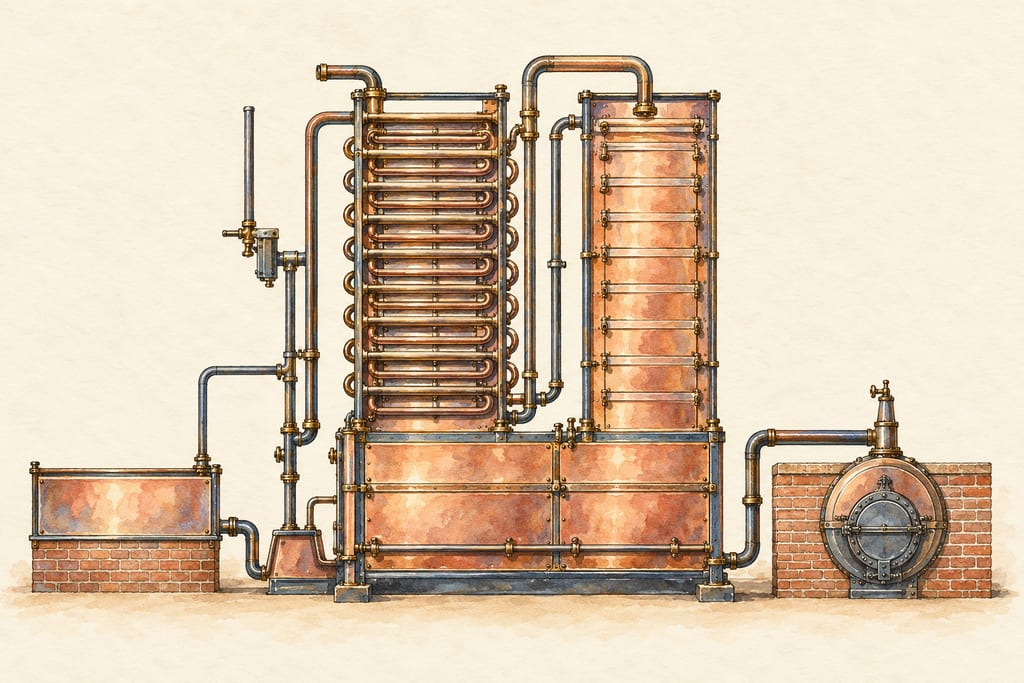
A column still is a distillation apparatus built around one or more vertical columns. Its continuous and rectifying designs appear in several spirits traditions, but materials and product character vary by installation.
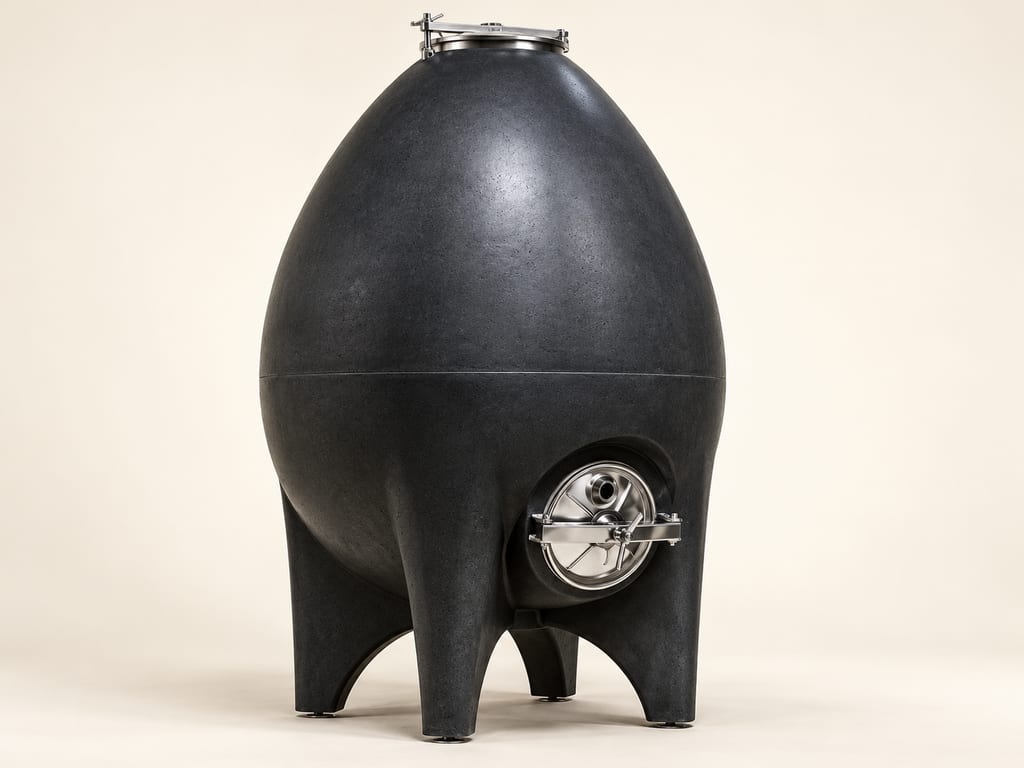
A modern ovoid concrete wine vat with smooth curved walls, made in several sizes and fitted according to model. Used for wine fermentation and maturation; support, access, cooling and interior treatment vary.
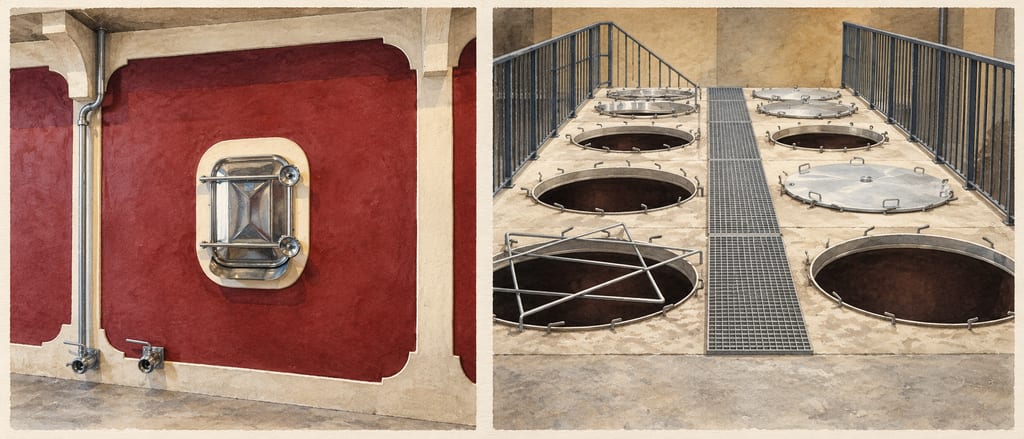
Concrete wine tanks are heavy, fixed vessels in rectangular, cylindrical and tapered forms. Their thermal response and wine contact depend on mix, wall construction and interior finish.
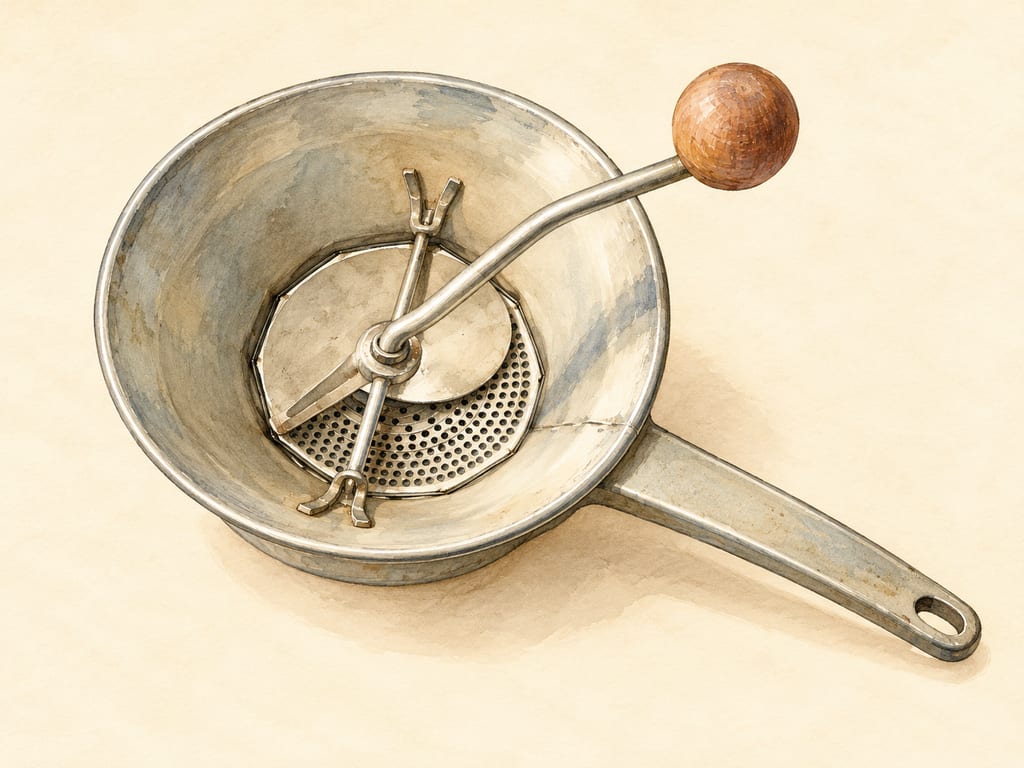
A hand-cranked food mill presses softened food across a perforated disk, producing a purée while keeping larger pieces in the chamber. Its exact shape and disk depend on the model.
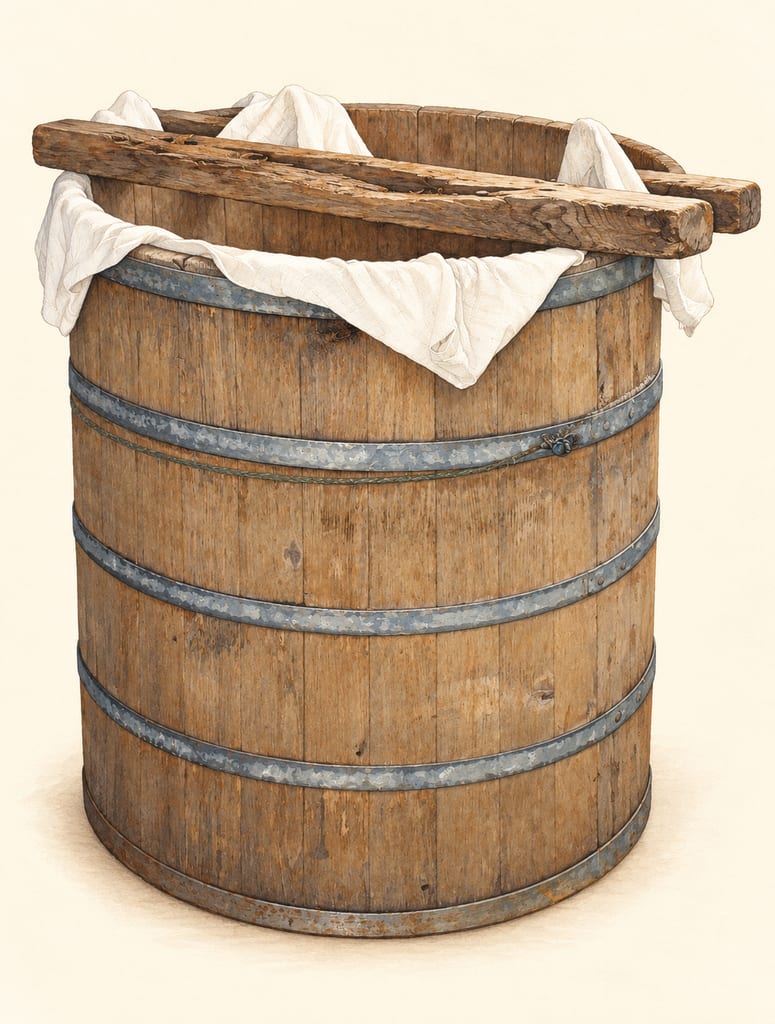
The gerle is a broad wooden vat used to receive and work milk for Salers cheese in its French AOP area. Its coopered form and microbial role are documented, but sources do not establish when this particular vessel first appeared.
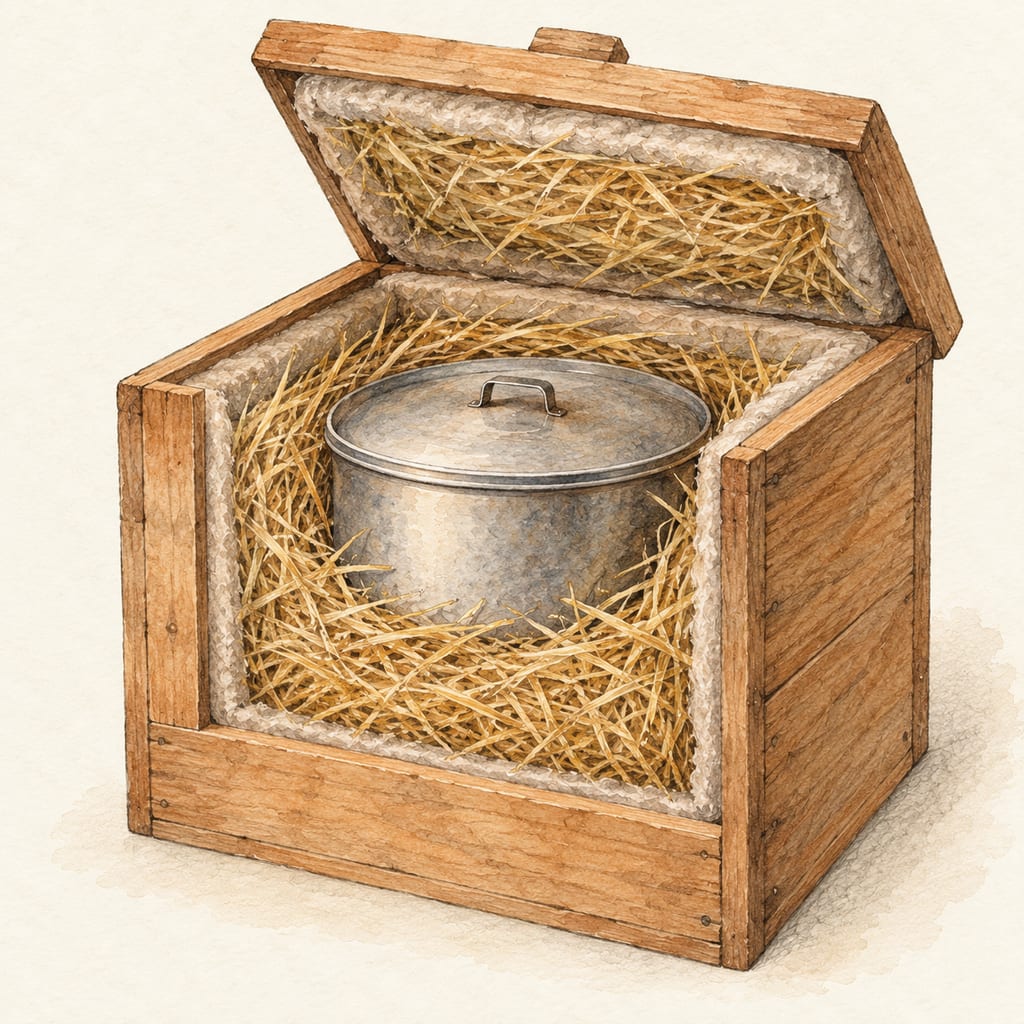
A haybox, also called a fireless or retained-heat cooker, is an insulated enclosure that lets a lidded pot finish cooking in heat already stored in the food after it leaves a stove. It generates no heat and is not a preservation method.
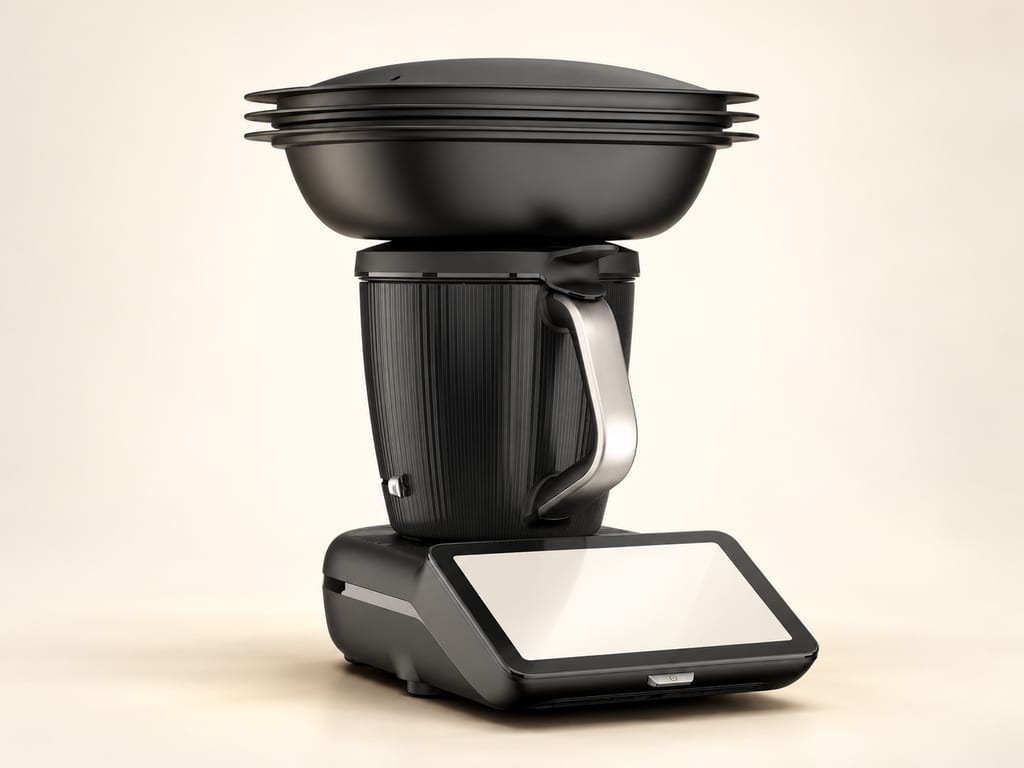
A modern electric countertop machine that heats, chops and stirs food in one mixing bowl. Cookidoo lists Thermomix models for making powidl and quince membrillo, although the full methods are not public on the pages reviewed.
No community contributions have been published for this entry yet.
Sign in to contribute. Published comments and photos are free to read.
Association Cézallier Vallée de SianneForm · Materials · Use · Care · Visual reference
Faire le painThe heritage account describes the maie as a wooden bread-kneading chest, also called pétrin, pâtière or coffre à boulange, often kept in a scullery, storeroom or cellar.
It lists fir, beech, elm and cherry; the Auvergnat form is trapezoidal, has four sloping sides and four legs, and some examples have a lower utensil drawer.
Some maies also served as bread boxes; a forged-iron scraper removed dough and flour residues from the interior.
The linked photograph shows a wooden maie; the webpage states no image reuse licence.
Cited in: A chest made for the work of bread; The regional chest and its materials; Kneading, leavening and the oven; A household object in living practice; Cleaning and what remains unknown
Ministère de la Culture, Patrimoine culturel immatériel en FranceHistory · Geography · Breadmaking context
La panification traditionnelle, ou le faire au four, dans le massif des BaugesThe inventory documents breadmaking practices in the Massif des Bauges, including flour knowledge, dough preparation, care of leaven, kneading gestures and wood-fired ovens.
It describes living community practice and renewed use of restored village ovens without assigning a single origin date to the maie.
Cited in: Kneading, leavening and the oven; A household object in living practice; Cleaning and what remains unknown
Musée des Maisons comtoisesModern use · Demonstration
Pain traditionnel et naturelThe museum's 2026 event describes participants hand-kneading bread dough in a maie before a rising period during a traditional-bread demonstration.
The event is evidence of a current teaching use, not a universal historical schedule or a recipe.
Cited in: A household object in living practice; Cleaning and what remains unknown