A perforated fragment from Neolithic Kuyavia
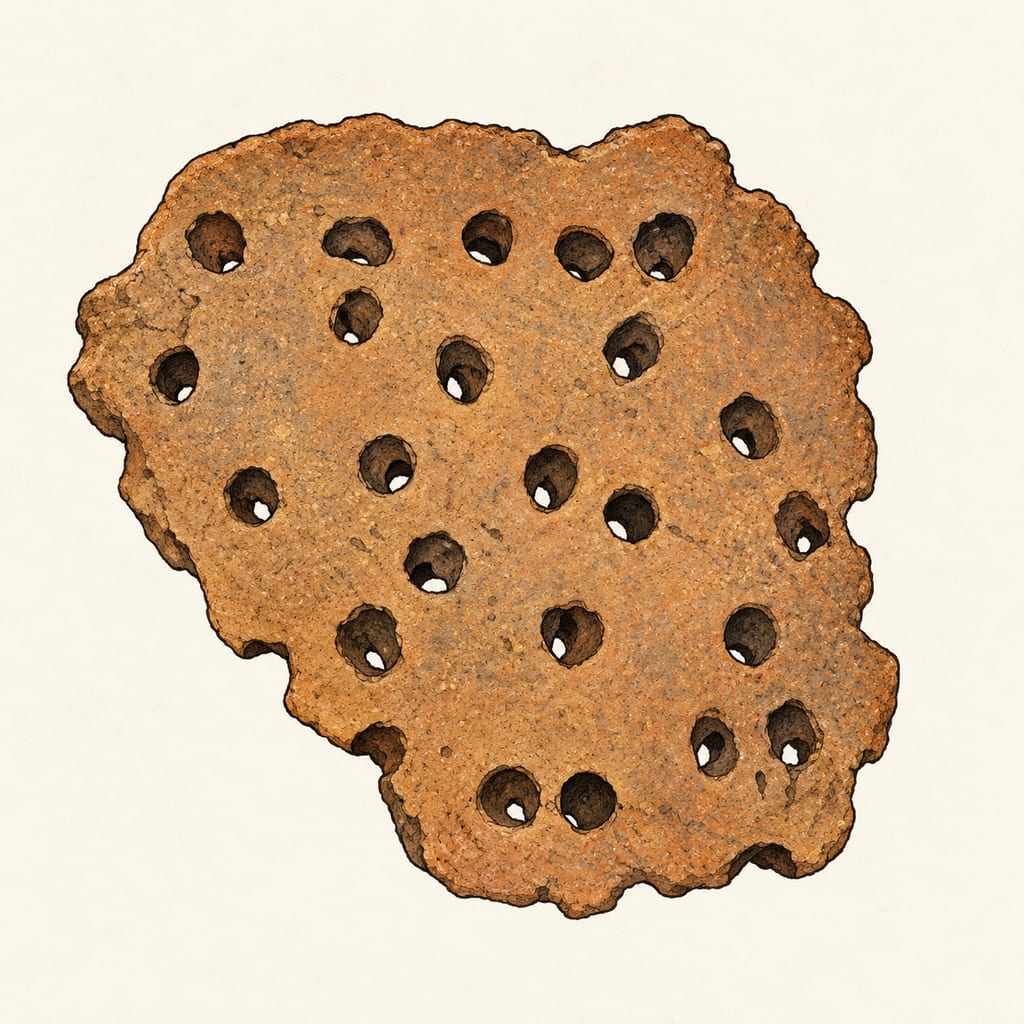
This strainer is known through archaeological pottery from Kuyavia, in central Poland. The securely documented object is a broken fragment of unglazed earthenware pierced by numerous small holes, not a fully preserved vessel with an agreed standard outline. It belongs to a group of sieve-like pottery associated with the sixth millennium BCE. The source photograph shows the irregular edge and the openings through the ceramic wall; its limited crop is not a measured drawing.
The interpretation as a cheese-making tool rests on more than resemblance. Researchers tested fatty acids preserved in the pottery fabric and found dairy residues in perforated vessels from the region. This supports the processing of milk products in the sieves and, together with their form, the interpretation that they separated curds from whey. The evidence is a direct chemical trace of dairy use, paired with an archaeological interpretation of what the perforations did.
Sources for this section
How the holes fit the work
A perforated wall allows liquid to pass while holding back larger solids. In cheese-making, that offers a way to drain whey away from curd. Removing liquid changes the mixture that remains: curd is more concentrated and easier to gather and carry than milk. The archaeological evidence supports this broad separating function, but it does not supply a set of operating instructions or demonstrate every step by which the milk first coagulated.
Milk residues were also found in non-perforated bowls from the same study, and the researchers suggested that bowls may have been used together with the sieves. That association is plausible but is not a preserved assembly: no source establishes that a particular bowl sat under this particular sherd, or shows the exact placement, batch size, or length of draining. Nor does the presence of holes alone prove cheese-making; the material evidence is what strengthens the interpretation over other possible straining uses.
Sources for this section
What the archaeological record can and cannot show
The record places the evidence in Neolithic Kuyavia during the sixth millennium BCE, a period when early farming communities in central Europe were exploiting animal products in regionally varied ways. A later open-access study of Ludwinowo 7, also in Kuyavia, uses integrated ceramic, isotopic, and faunal evidence to examine dairy and animal management in its own settlement context. That study helps situate the wider regional question; it does not identify the photographed strainer as a Ludwinowo find or provide a date for this exact sherd.
The recovered fragments do not establish one vessel capacity, height, rim, base, wall thickness, hole diameter, hole spacing, or maker. The source photograph includes no scale. Accordingly, an illustration of a complete bowl-shaped sieve would be a reconstruction requiring a measured archaeological drawing; this page keeps the object fragmentary. No exact clay recipe, workshop, purchase route, cleaning practice, or continued modern tradition is documented in the cited sources.
Sources for this section
History
Perforated unglazed pottery from Kuyavia was chemically analysed for preserved fatty acids. The milk-fat residues support dairy processing, while the shape of the vessels supports their interpretation as specialized strainers. These are fragments and do not establish one canonical complete profile.
Equipment details
CapacityNo capacity is reported for the excavated fragments.
SizeThe cited source photograph and text give no measurement for this fragment; the page does not infer the dimensions of an intact vessel.
PowerNo power The ceramic strainer is a passive tool; no powered mechanism is described.
How you get oneNot established The sources concern excavated archaeological pottery and do not establish a present-day maker, market, replica, or acquisition route.
CareThe archaeological sources do not describe cleaning, seasoning, or continued use of this fragment; no present-day care routine is documented.
Made of
- Unglazed earthenware — Perforated vessel wall
The published description identifies unglazed pottery with small holes. It does not report a specific clay recipe, temper, firing temperature, or surface treatment beyond the unglazed finish.
Limits
Perforations alone do not establish that a vessel processed dairy; the cheese-strainer interpretation is supported here by lipid-residue analysis alongside the vessel form.
Source →Places
Kuyavia
Historical attestation · Region evidenceThe regional association is archaeological; it is not a claim that every perforated pottery fragment from Poland was a cheese strainer.