← Equipment

Equipment · Jars, pots and crocks

Sri Lankan curd pot

මී කිරි මැටි හට්ටි · kiri haTi · hatti

Loading ratings…

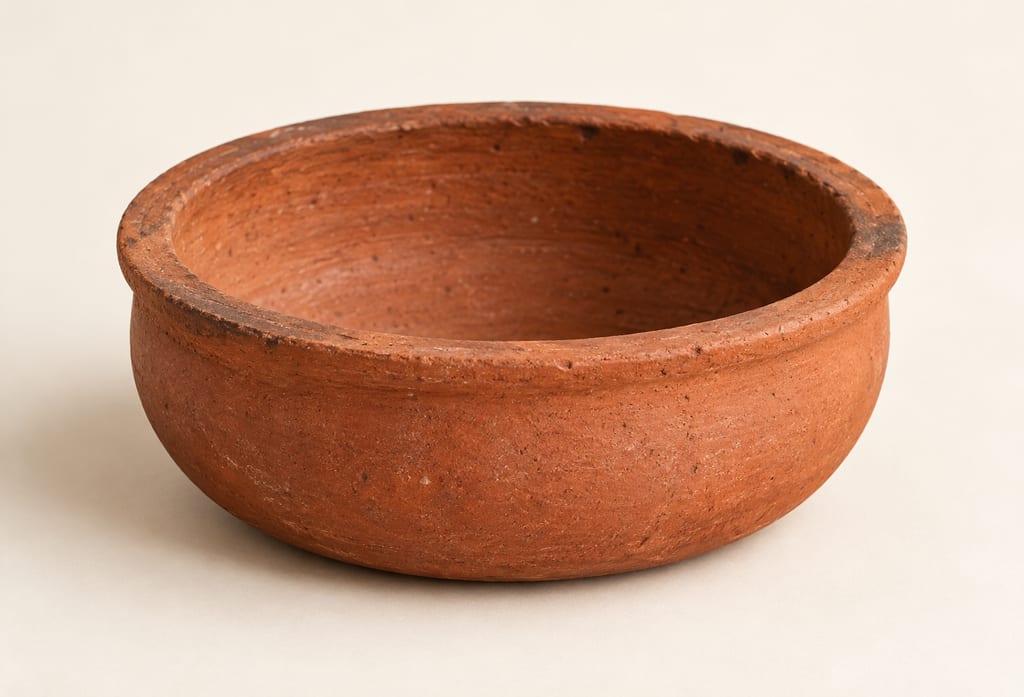
An open fired-clay pot holds Sri Lankan buffalo curd while it sets and travels to market. Sources document both hand-thrown and moulded forms.

An open reddish-brown fired-clay hatti pot for setting Sri Lankan mee kiri curd, shown empty on a warm ivory background.

A serving pot that also sets the curd

The Sri Lankan curd pot is a fired-clay vessel used both to set buffalo-milk curd and to carry it to sale. A University of Moratuwa paper calls clay pots a traditional packaging for buffalo curd. In a reportage account from Pallemalala, Hambantota, cleaned hatti are arranged open, filled with boiled buffalo milk and starter, and left uncovered while the curd sets. After setting, each pot is covered with tissue paper for sale. The container is therefore part of the product's setting and retail form, not simply a storage jar.

The observed pots are reddish-brown, open-mouthed bowls with sloping sides and a rounded, narrowing lower body. The sources do not establish one standard profile for all makers or regions. The paper and ethnography distinguish clay vessels from plastic packaging, but the written study does not specify a universal clay body, glaze, or firing recipe.

Sources for this section

What the vessel does during setting

In the Pallemalala account, buffalo milk is heated before it is poured into cleaned clay hatti. A spoonful of the previous day's curd, called muhun in the report, is added as starter; the vessels remain open so the milk can cool in the room's air while it sets. Once set, the curd stays in its pot for sale. This account documents one producer's practice and does not establish that every curd maker uses the same milk treatment or starter preparation.

The packaging study examined how re-firing used pots affected their physical and microbiological properties and the curd. It reports that repeated firing increased porosity; by the third firing, increased water loss was associated with a lower pH in the curd. Those are findings from that experiment, not a general recommendation to reuse or re-fire a food container. The source does not provide general cleaning, care, or safety directions for these pots.

Sources for this section

Hand-shaped and moulded pots

Deborah Winslow's ethnography follows curd-pot production in Walangama. In 1981, a trader there began supplying a northern dairy farm after noticing curd pots arriving from the south coast. By 1992, potters were making these pots by hand alongside their regular ware. Walangama potters already made a similar shallow cooking vessel, the ätiliya, with a rounded bottom; that familiarity helped them learn quickly. This does not mean every curd pot began as an ätiliya.

The production method changed again. The first mould machine appeared in Walangama in the late 1990s, and Winslow reports that handmade curd pots later disappeared there. Her comparison of two roughly one-litre examples records a hand-thrown pot at 900 ml and 50 mm high, and a moulded pot at 950 ml and 55 mm high. Their bases were 5.8 mm and 6.5 mm thick respectively. The moulded sample had a flat base and mould ridge and used about 40 percent more clay for a similar capacity. These measurements distinguish the photographed examples; they are not a specification for all pots.

Sources for this section

Places and limits of the record

The record spans different moments and sites rather than one island-wide production story. The Pallemalala report records a working curd maker and buffalo-milk setting practice; Winslow's long ethnography traces how Walangama's producers moved from hand-thrown pots toward moulded manufacture. Her account places the earlier supply of pots in southern Sri Lanka and later production in a different region, showing that the container travelled with a growing curd market.

Neither the studies nor the reportage supplies a universal mouth diameter, clay recipe, firing schedule, modern supplier list, or general cleaning procedure. A curd pot should therefore be understood through the documented local forms and examples, not as one fixed traditional design.

Sources for this section

Equipment details

CapacityIn Winslow's table, two approximately one-litre examples measured 900 ml (hand-thrown) and 950 ml (moulded); these are compared samples, not a universal capacity.
SizeWinslow measures the outside height at 50 mm for a 900 ml hand-thrown sample and 55 mm for a 950 ml moulded sample; base thicknesses are 5.8 mm and 6.5 mm respectively. No mouth diameter or general standard is given.
PowerNo power The vessel is passive; shaping and firing are separate pottery operations.
How you get oneNot established The sources describe production and sale history, not a current purchasing route.
CareThe consulted sources do not establish general cleaning or storage instructions. The Moratuwa paper studies controlled re-firing of used packaging pots; do not treat its laboratory procedure as household guidance.

Made of

  • fired clay — open curd-setting and retail pot
    The sources identify clay or earthenware pots; they do not specify a single clay recipe, glaze, or firing profile for all curd pots.

Limits

The sources document both older hand-thrown and later moulded examples; one profile, wall thickness or manufacturing method does not describe every Sri Lankan curd pot.

Source →

The Moratuwa re-firing experiment reports changed porosity and water loss after repeated firing; it does not establish a general safe reuse procedure.

Source →

Places

Sri Lanka

Documented use · Country evidence

A reportage account records hatti curd-setting in Pallemalala, Hambantota; Winslow's production history centers on Walangama. These are examples, not evidence of one island-wide form.

Related

Community

No community contributions have been published for this entry yet.

Share what you made

Sign in to contribute. Published comments and photos are free to read.

Sources