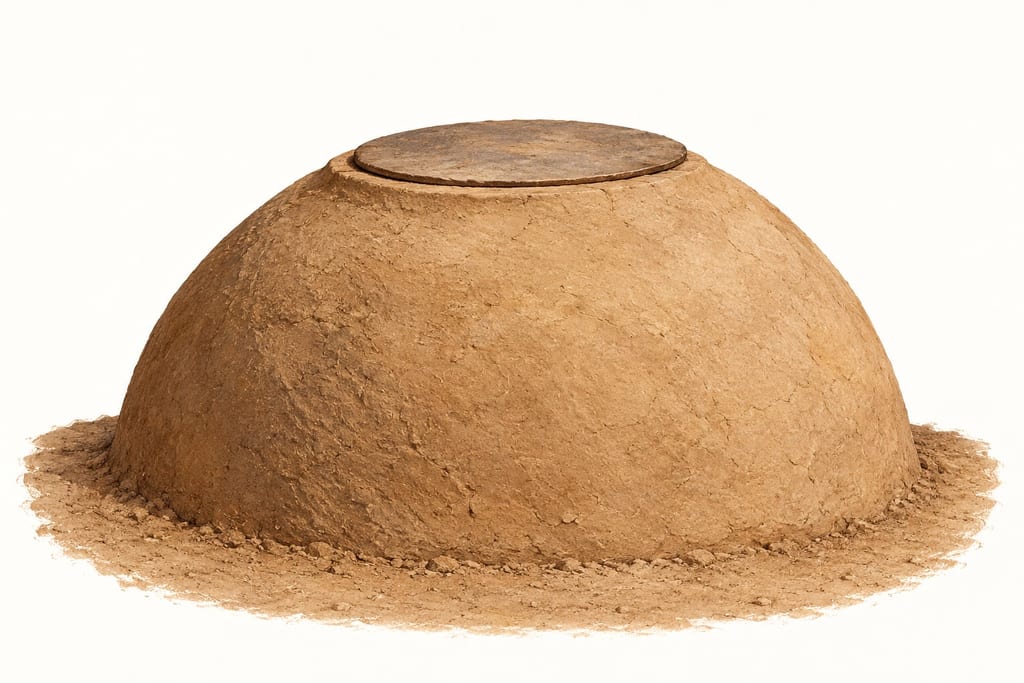
Taboon
A Palestinian fixed clay bread oven, broad and low rather than tall, with a closeable top opening and a heated floor; sources distinguish pebble-floor baking from wall-baking in the tannur.
 FermenteaWhere food goes to change
Built structures · Pits and cavities
The zarb is a ground-built oven used by Bedouin cooks in Jordan. A fire heats the bottom of a broad pit; food is then lowered on a rack, covered and slow-cooked with the surrounding earth helping retain heat.
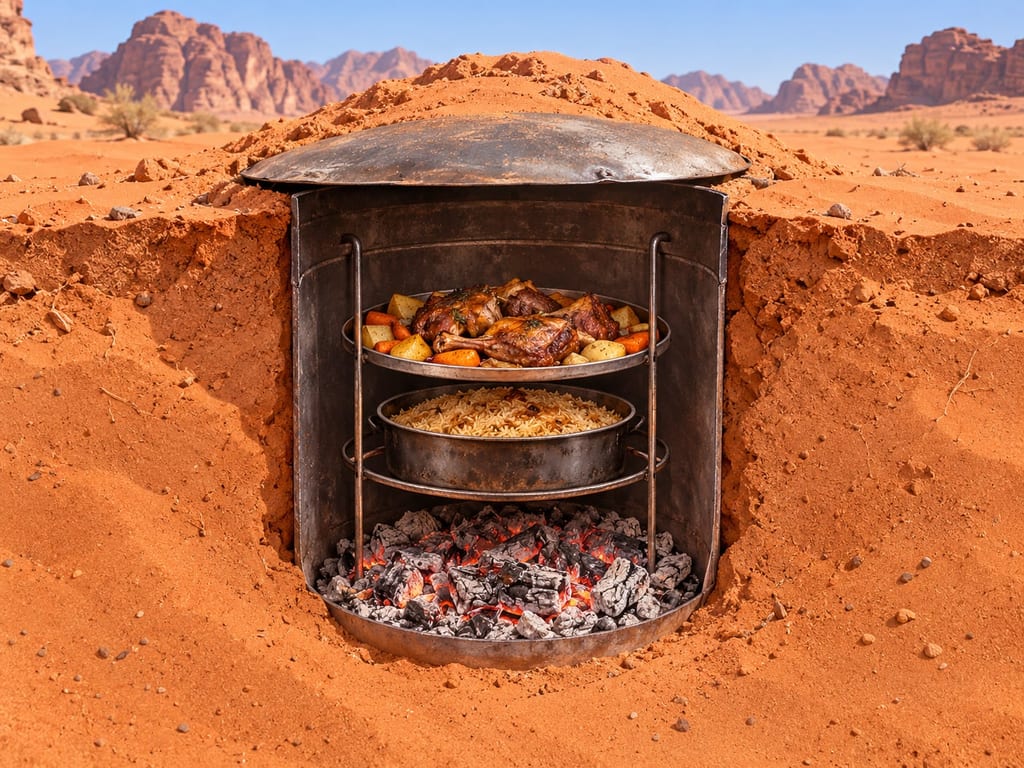
Zarb (زرب) is a Bedouin underground cooking installation documented in Jordan. It is a build because the cooking pit is prepared in the ground; the metal drum sometimes used as its casing is a separate movable object. In the southern desert around Wadi Rum, cooks use the earth around the pit as insulation while food cooks over coals. The method differs from baking bread against the wall of a clay dome: the zarb holds a rack above a fire bed and is closed under a cover of lid and sand. Hansen and Heinrich describe it as a fuel-efficient arrangement suited to cooking food for family and guests. Their account also places the zarb alongside other Jordanian cooking installations, rather than treating it as a generic synonym for every underground oven.
Casing materials have changed over time. Hansen and Heinrich report metal drums in contemporary examples and flagstones in earlier accounts. A 2007 Wadi Rum photograph documents a buried metal barrel after cooking, with spent coals at its base. This supports the visible modern form, but does not establish that every zarb uses a barrel or that one construction recipe applies across Bedouin communities. The chapter cites Jaussen's 1908 and Dalman's 1935 ethnographies as early written attestations; those dates document the practice by then, not its invention.
The documented sequence begins with a small wood or charcoal fire at the bottom of the pit. Once the fuel has heated the oven and settled to coals, a metal rack with several shelves is lowered above them. The chapter names chicken, lamb and goat, vegetables and a pot of rice among foods cooked in this arrangement; it also reports fish and game in older descriptions. A lid closes the opening. Some accounts add a blanket over the lid before covering the top with sand. The food then cooks for several hours, after which the cover is swept aside and the rack is lifted out.
The surrounding earth reduces heat loss, while the rack keeps food above the coals instead of placing it directly on the fire. The inspected sources give no standard depth, barrel diameter, fuel quantity, cooking temperature or fixed duration. The Wadi Rum photograph's visible barrel is only one documented example and should not be copied as a universal specification. The Aqaba tourism guide places zarb cooking in the Wadi Rum visitor setting and notes meat and vegetables, but its brief description is not a construction plan.
The best-localized example in the sources is Wadi Rum in Jordan's Aqaba Governorate. The Commons file page identifies its photograph as taken in the Hisma desert near Wadi Rum and records coordinates for the viewpoint. Hansen and Heinrich's chapter discusses the zarb within Jordanian foodways and connects the cooking installation to sharing meals. These sources support a Jordan association and a specific Wadi Rum example, but they do not establish exclusive ownership or a single origin for all practices called zarb.
This page records the oven as a cultural and technical form, not as a do-it-yourself design. The literature reviewed here does not set structural dimensions, fire clearances, ground-stability requirements or food-temperature controls. Do not infer those limits from the illustration or the historical description. The generated cutaway is explanatory editorial art, grounded in the photographed barrel and the authors' account of its rack, coals, lid and sand cover; it is not an archaeological image or a measured section drawing.
Hansen and Heinrich describe the zarb as an underground oven and cite early twentieth-century ethnographies. A Wikimedia Commons photograph documents a Wadi Rum example in 2007; current Jordan tourism material also describes the cooking practice.
A build is made where it stands: moving it means building it again.
This description is not a construction or food-safety plan; the inspected sources do not establish fire-clearance, structural-load or temperature controls.
The location is pinned to the Commons photograph and is not claimed as the zarb's place of origin.
Country-level association; not an exclusive national origin claim.
A Palestinian fixed clay bread oven, broad and low rather than tall, with a closeable top opening and a heated floor; sources distinguish pebble-floor baking from wall-baking in the tannur.

A Cap-Pelé boucanière is an Acadian herring-smoking building. The documented Willie Niles example is a one-storey wood-frame structure with a ridge smoke vent and interior bays for hanging fish-bearing cannes.

Achcharu is a family of Sri Lankan vinegar pickles made with mixed vegetables or seasonal fruit and a piquant spice dressing. This version is a quick, refrigerated, non-fermented mixed-vegetable pickle.

The acocote is a long, hollowed and dried gourd used to draw aguamiel from a mature maguey. It is a harvesting tool: the sap is transferred to a separate vessel before it ferments into pulque.

Adrak murabba preserves young ginger in sugar syrup, a sweet South Asian preparation recorded in Indian cookery and food-processing sources.

Parkia biglobosa seeds are fermented into regional West African seasonings, including nététou, iru, dawadawa and soumbala. The yellow fruit pulp is a separate food, and names and methods vary by place.

Japanese reddish-brown vinegar from sake lees matured about three years, turned to vinegar by acetic bacteria; the vinegar of Handa and Edomae sushi rice.

A refined common-wheat flour blended for a broad range of baking; its protein and behavior vary with wheat, milling and market.

The almond mushroom, Agaricus subrufescens, was cultivated in eastern North America in the 1800s, lost its market, and returned as a cultivated mushroom from Brazil, where it is grown under several names.
No community contributions have been published for this entry yet.
Sign in to contribute. Published comments and photos are free to read.
University of Groningen PressHistory · Construction · Method · Materials
Home Is Where the Hearth Is: Exploring the Fuel Economy of Traditional Ovens and Cooking Installations (ṭābūn, ṣāj, and zarb) in JordanZarb is an underground oven; the authors cite Jaussen 1908 and Dalman 1935 as attestations.
The basic form is a broad circular pit; contemporary examples use a metal drum casing while earlier examples used flagstones.
A small wood or charcoal fire heats the pit; a multi-shelf rack holds foods over the coals; a lid, sometimes blanket, and sand close the oven for several hours.
The chapter discusses fuel efficiency and communal sharing; it does not give dimensions or one fixed cooking time.
Cited in: A buried oven for shared cooking; How the heat is held; Place, use and limits of the record
Aqaba TourismModern use · Geography
Your Guide to Aqaba and Its SurroundingsThe tourism guide describes a Bedouin underground oven in the Wadi Rum visitor context and mentions meat and vegetables cooked slowly.
Cited in: How the heat is held; Place, use and limits of the record
Wikimedia CommonsImage reference · Documented use
The underground oven for Zarb.jpgThe contributor describes a metal barrel dug underground in the Hisma/Wadi Rum desert, with a metal rack and spent coals; the file page records the photo location and CC BY-SA 4.0 license.
Cited in: A buried oven for shared cooking; Place, use and limits of the record