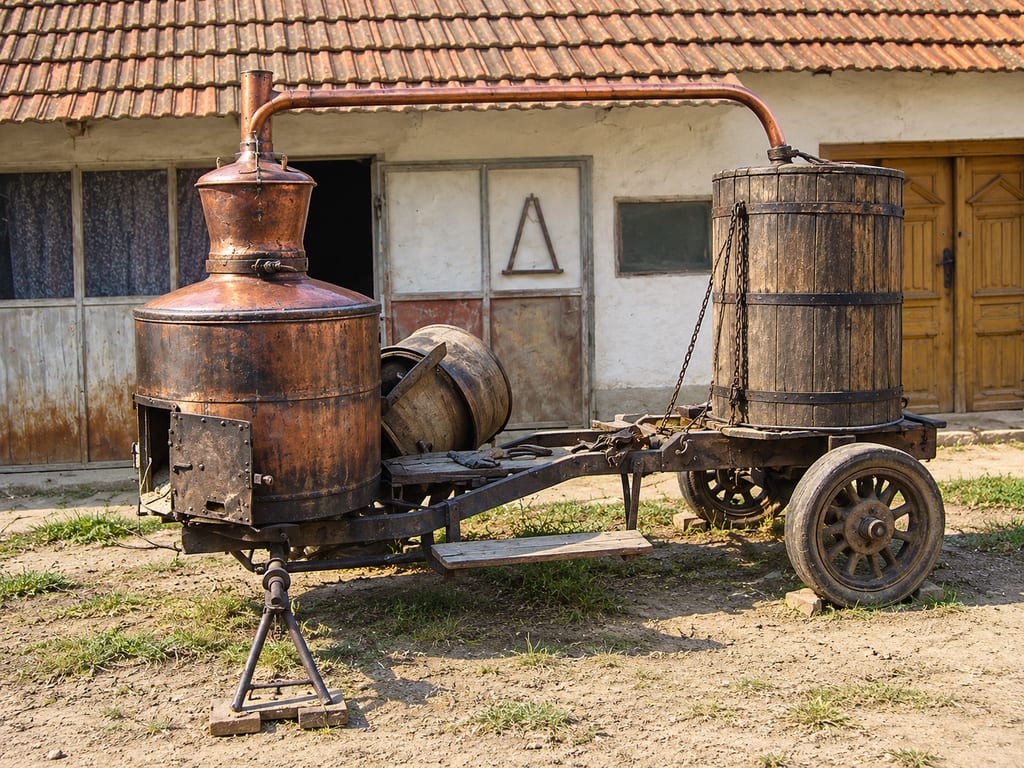
Copper pot still
A copper pot still is a portable batch-distillation apparatus with a boiler, vapour path and condenser. Serbian rakija traditions and Montenegrin plum-spirit production document varied forms, not one universal blueprint.
 FermenteaWhere food goes to change
Equipment · Jars, pots and crocks
Zlakusa pottery
A hand-formed, unglazed clay-and-calcite cooking pot from Zlakusa in western Serbia. Potters make varied forms for cooking and baking through a living hand-wheel craft.
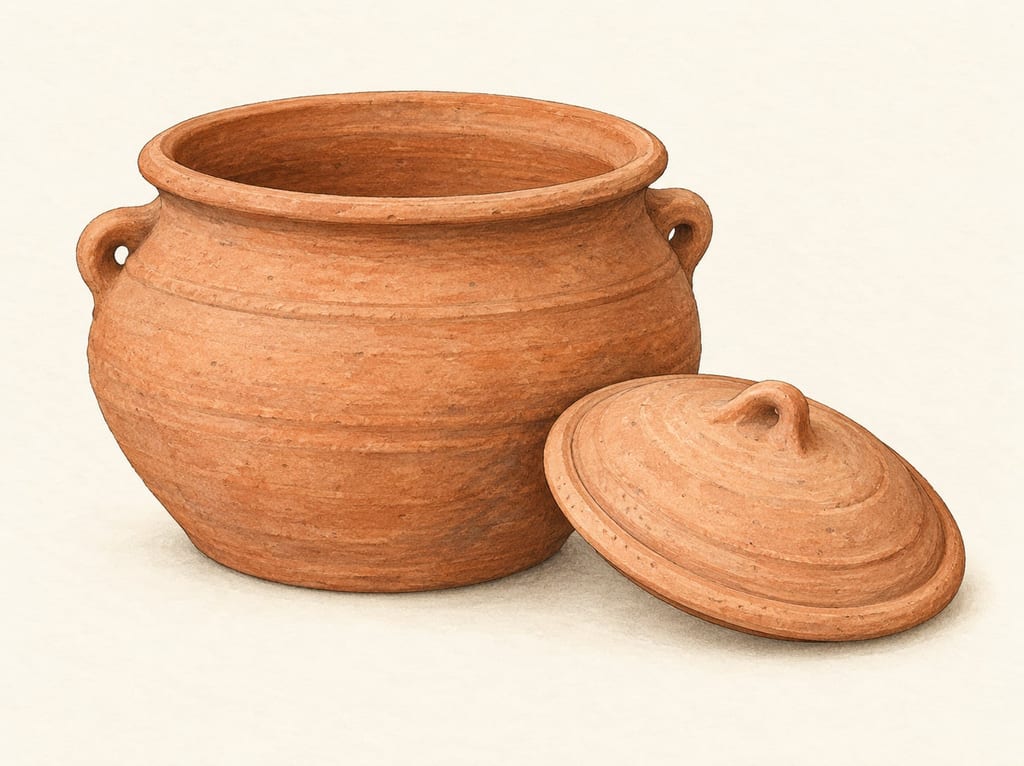
A Zlakusa pot is a fired earthenware cooking vessel made by potters in Zlakusa, near Užice in western Serbia. Its identity comes from the local clay body, the calcite mixed into it, and the hand-wheel skill used to shape it. The national cultural register describes these pots as vessels for cooking and baking, in forms ranging from small household pots to large vessels. This page concerns the portable pot made by a craftsperson, not an in-place hearth or kiln.
The craft is sustained by a local community of potters and families. Serbia's National Register records the practice as intangible cultural heritage, and UNESCO inscribed it on the Representative List in 2020. The dated inventory entry and inscription document recognition, not an origin date. Local tourism accounts describe potters still working in the village, pottery for sale at village fairs, and an autumn competition in which traditional dishes are prepared in Zlakusa pots. The vessel is therefore both a practical cooking tool and part of a living community craft.
The Serbian register describes a body made from clay and ground mineral calcite gathered from local sites in the surrounding villages. It says the materials are combined in a precisely determined proportion but does not give a ratio. That qualification matters: the mixture is a craft formula, not a general instruction to mix any clay with powdered stone. The atlas identifies material selection as central to the vessel's response to heat.
Potters shape the body on a hand wheel, called kolo in the register, using a building method that adds layers of clay to form the vessel. Making, drying and firing are separate stages in the documented sequence. The register calls the firing place an open kiln, žižanica. A technical paper by Biljana Đorđević and Richard Carlton records field observations of double-chamber kilns and extended firing at Zlakusa. The sources may describe different contexts; they do not support reducing the craft to one universal firing arrangement.
The technical study also cautions against assuming that calcite alone guarantees thermal-shock resistance. Its experiments with prepared calcite pastes found firing temperature and duration important; pastes fired above around 750 °C showed calcium-carbonate oxidation and later lime-spalling. That finding describes the tested pottery material and firing conditions, not a cooking temperature limit for finished Zlakusa pots. The locally controlled body and firing process belong together.
The National Register records traditional pots of different shapes and capacities, from 1 to 100 litres, used mainly for cooking and baking. Those endpoints describe the documented range, not a single model. A pot's capacity and shape affect how much food it can hold, but the sources do not provide common dimensions. The registered craft also includes shallow pans and lids; they are related pottery products, not interchangeable names for the cooking pot.
A photographed cooking demonstration shows earthenware at a wood fire, with a lidded pot beside an open vessel. The Tourist Organization of Užice also reports a local autumn contest for traditional dishes cooked in Zlakusa pots. These sources show culinary use, but they do not identify a specific recipe or establish that every pot suits the same flame, oven or handling method. The pot is heated by an external cooking setup rather than an integrated burner.
Zlakusa pottery remains a craft-made object. The Užice tourist organization reports that it can be bought in the village and at fairs, and that visitors can see vessels being made. This supports asking a potter for a vessel suited to a particular use. The inspected sources give no standard washing, seasoning or thermal-shock routine, so care for a specific pot should come from its maker rather than being inferred from the craft's heritage status.
The evidence ties manufacture to Zlakusa and its nearby material catchment in western Serbia, while the 2020 inscription records household and restaurant use throughout the country. It does not fix an origin year, standard dimensions, one universal firing setup or a care routine for every vessel. The pot's traditional material and form are source-specific, and a general resemblance is not proof that another earthenware pot shares its composition or performance.
Zlakusa potters continue a family-transmitted hand-wheel tradition for clay-and-calcite vessels used in cooking and baking. Serbia's National Register dates its entry to 2012, and UNESCO inscribed the craft in 2020; these dates record recognition, not the craft's beginning.
The clay-and-calcite body and firing practice are specific to this craft; the sources do not support substituting arbitrary clay and stone mixtures in home cookware.
Source →Technical literature notes that calcite-paste performance depends on firing conditions and records double-chamber kiln use in Zlakusa; it cautions against one universal firing account.
Source →The National Register identifies Zlakusa village near Užice as the craft location.
The register identifies raw-material sites in nearby villages; it does not identify one origin point for all inputs.
The inscription account says the vessels are used in households and restaurants throughout Serbia.
A copper pot still is a portable batch-distillation apparatus with a boiler, vapour path and condenser. Serbian rakija traditions and Montenegrin plum-spirit production document varied forms, not one universal blueprint.
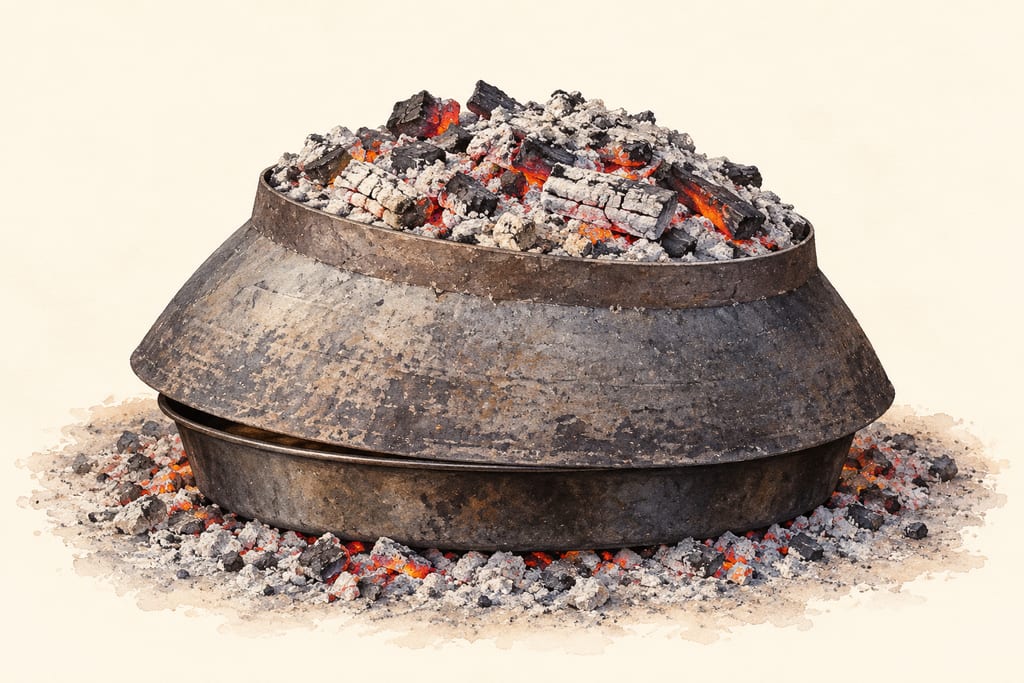
Peka names a family of hearth-baking lids: a domed clay or metal bell carries embers above food. In the later Dinaric assembly, a shallow pan sits beneath the lid, sometimes with a ring to hold coals in place.

Soft, spreadable Calabrian pork sausage made with a great deal of red chilli and fatty pork, stuffed into natural casings, sometimes smoked and matured while staying soft.

A way to add independent temperature logging to an existing food dehydrator without changing its built-in controls or protections. It is a monitoring method, not a rewiring plan.

Pleurotus cystidiosus is the abalone mushroom, a cultivated oyster-type fungus with dark brown caps that grows more slowly and is more demanding than other Pleurotus species.

A dark, balanced vinegar from Emilia-Romagna made by combining cooked or concentrated grape must with wine vinegar, then acetifying and refining it in wood under a protected specification.

A living dairy inoculum that starts controlled cream fermentation, developing acidity and aroma before sour cream or cultured butter is finished.

A small electric incubator holds jars at a selected temperature for yogurt and other documented warm food preparations. Controls, capacity and vessel arrangement vary by model.

Adygean salt is a seasoned table salt associated with Adygea and the wider North Caucasian culinary tradition. Salt is blended with garlic and a variable selection of herbs and spices; the exact mix depends on the named style and maker.

The African Caesar-group mushroom, Amanita masasiensis, is a wild ectomycorrhizal species of central and southern African woodlands, eaten locally. The genus contains deadly poisonous species, so identification needs care.
No community contributions have been published for this entry yet.
Sign in to contribute. Published comments and photos are free to read.
Intangible Cultural Heritage of Serbia; Ethnographic Museum in BelgradeCraft · Materials · Forms · Geography · History
Zlakusa potteryHand-wheel making uses a building technique that adds layers of clay; the register describes making, drying and firing in an open kiln called žižanica.
The vessel body combines clay and ground mineral calcite from local sites in a precisely determined proportion.
The register describes varied pot forms from 1 to 100 litres for cooking and baking, locates the craft in Zlakusa near Užice in western Serbia, and dates its national inventory entry to 18 June 2012.
Cited in: A cooking vessel and a living craft; Clay, calcite and the hand-wheel method; Many sizes for cooking and baking; Buying, care and limits of the record
Intangible Cultural Heritage of Serbia; Ethnographic Museum in BelgradeUNESCO inscription · Use · Transmission
Zlakusa pottery making inscribed on the Representative List of the Intangible Cultural Heritage of HumanityThe 2020 inscription recognizes the hand-wheel pottery craft and clay-and-calcite vessels for thermal processing of food.
The decision records use in households and restaurants throughout Serbia and family-based transmission through direct participation with experienced artisans.
Cited in: A cooking vessel and a living craft; Many sizes for cooking and baking; Buying, care and limits of the record
Tourist Organization of UžiceContemporary craft · Access · Use
ZlakusaThe tourist organization describes active local pottery households, clay mixed with ground calcite, village purchases and fairs, and an autumn competition in traditional dishes prepared in Zlakusa pots.
Cited in: A cooking vessel and a living craft; Many sizes for cooking and baking; Buying, care and limits of the record
Serbian Ceramic Society, Advanced Ceramics and Application IITechnical research · Firing limits
Calcite tempered cooking pottery in the Central and Western Balkans: some technological issuesExperiments with prepared calcite pastes found firing temperature and duration important; above around 750 °C, the tested pastes showed calcium-carbonate oxidation and later lime-spalling.
The paper reports double-chamber kilns and extended firing at Zlakusa, challenging a simple characterization of all calcite-tempered pottery as open-fired. These observations do not provide a universal firing recipe or a cooking temperature limit.
Cited in: Clay, calcite and the hand-wheel method; Buying, care and limits of the record
Center for Intangible Cultural Heritage of SerbiaVisual reference · Pottery form
Zlakusa pottery record, photograph of wheel work and finished vesselsInspected photograph shows a potter shaping a vessel on a hand wheel with finished Zlakusa vessels on workshop shelves.
Center for Intangible Cultural Heritage of SerbiaVisual reference · Cooking use
Zlakusa pottery record, photograph of cooking demonstrationInspected photograph shows traditional earthenware pots at a fire, including a lidded pot and an open vessel.
Cited in: Many sizes for cooking and baking