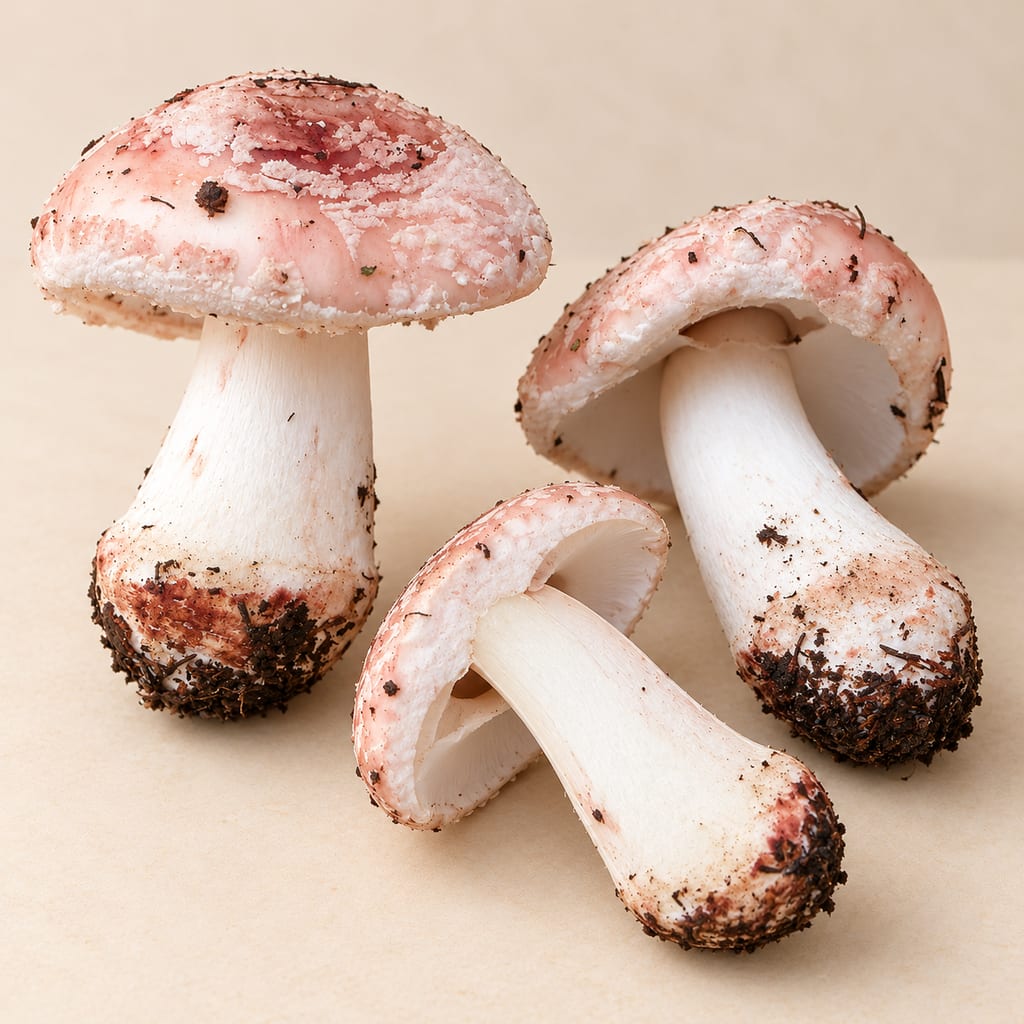
American blusher
Amanita novinupta is a western North American blusher, a forest mushroom recorded as food in Mexico, and one that must be cooked because its raw flesh is toxic.
 FermenteaWhere food goes to change
Mushrooms
The European blusher, Amanita rubescens, is a woodland amanita whose flesh turns pink when cut. It is eaten only well cooked and is easily confused with the poisonous panthercap.
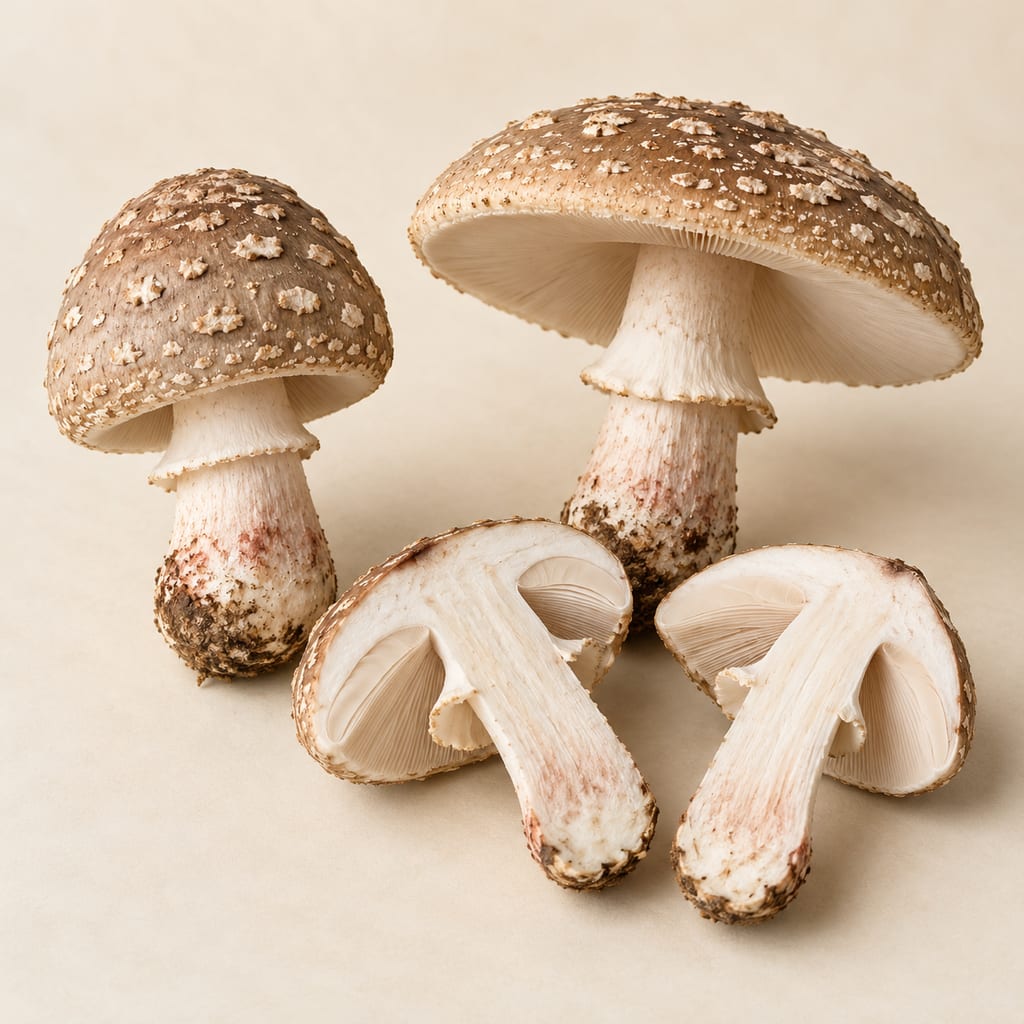
The blusher, Amanita rubescens, is a woodland mushroom with a brown to pinkish-brown cap dotted with small warts, white crowded gills and a skirt-like ring on the stem. Its name comes from the flesh, which turns pink to dull red where it is cut, bruised or chewed by a grub. The Latin epithet rubescens means reddening. Christiaan Hendrik Persoon described the species in 1797.
It belongs to Amanita, the genus that also holds the death cap, the fly agaric and the panthercap, and that is the reason this page spends more time on telling it apart than on cooking it. The blusher is eaten in parts of Europe, but only cooked, and only by people who can separate it from its poisonous relatives every time.
The cap is 5 to 15 cm across, convex when mature, reddish-brown in the usual form and covered with small white to greyish or pinkish-brown veil warts. Cap colour varies a lot, from pale greyish-white through pink to reddish brown, and rain can wash the warts away, so colour is no guide. The gills are white and free of the stem, and they show red spots where damaged. The stem is 5 to 15 cm long, white above the ring and flushed reddish-brown or pink-flecked below it, with an indistinct to bulbous base. Raw flesh tastes mild with a faint acrid aftertaste, and the smell is not distinctive. The spore print is white.
In English it is the blusher or the blushing amanita. German calls it Perlpilz (pearl mushroom) or Rotender Wulstling, and Czech knows it as muchomurka ruzovka or masak. Blusher is also a common name for a group of related species. Amanita novinupta, the new bride blushing amanita, occupies western North America and has its own page here as the American blusher. North American blushers east of the Rocky Mountains go under the provisional name Amanita amerirubescens, and may be several unnamed species. The catalogue does not treat these as interchangeable with the European species.
Named variants of the European blusher include Amanita rubescens var. alba, with a whitish cap, and a variety with a yellow ring described in Czech sources. Amanita flavorubescens, a related North American species, has a brighter yellow cap with warts that stay yellow. The grey-spotted amanita, Amanita excelsa, is also sold as the false blusher or false panthercap in some accounts. It looks very like the blusher but its flesh does not change colour and its cap scales are grey.
Amanita rubescens is common across much of Europe and Asia and has been recorded in Russia, Japan, Australia, Canada and the United States. In South Africa it is thought to have arrived with imported trees. In Britain it is widespread and common. In Germany it is described as very common, and in the Czech lands as fairly common.
It is mycorrhizal, which means it lives in partnership with tree roots and cannot be grown without them. It associates with both hardwoods and conifers, notably spruce and beech in Germany, and is especially abundant in conifer woods on poor, acidic soils, often in small groups. The main season in Britain and Ireland runs from June to October, and sometimes into December in a mild spell. German and Czech accounts give June to October or November. In eastern North America the blusher group is often parasitised by the mould Hypomyces hyalinus, which distorts the fruiting bodies and makes them hard to recognise.
The panthercap, Amanita pantherina, is the look-alike that matters most, and several accounts say the two can grow side by side. It is also called the false blusher. Brown caps are common to both, so the checks below have to be made on every single mushroom, and none of them works alone.
Flesh. Cut or break a blusher and the white flesh turns slowly pink to pinkish red, most noticeably around grub holes. The gills spot red where damaged and the stem base flushes pink. The panthercap's flesh is white and does not change colour when injured. The change is gradual, and the sources treat it as the main field mark that should support, not replace, the other checks.
Ring. On a blusher the hanging ring is thin, fragile and grooved on its upper surface, often ragged or notched at the edge. The Czech account explains the grooves as the imprint of the gills on the young ring, which is pressed against them. The panthercap's ring is smooth and solid, and German accounts add that it sits lower on the stem. English Wikipedia, a British forager's guide and the Czech account all give the ring as a separating feature, but the First Nature and Wikipedia pages on the panthercap do not describe its ring either way, so treat it as one clue among several.
Cap. The panthercap's cap is chocolate to hazel brown, sometimes pale ochre or very dark brown, with crisp pure white or cream warts that rub off easily. Its margin is very finely striate, grooved in short lines. That is the opposite of the ring: the panthercap has a grooved cap edge and a smooth ring, and the blusher has a smooth cap edge and a grooved ring. Blusher cap margins are usually not lined, though one description calls them slightly striate, so the margin is only a supporting clue.
Stem base. The panthercap's slightly swollen base carries white volva remains. Wikipedia describes them as one or two hoop-like rings above a bulb that turns grey with age, and First Nature as woolly rings or a helix above a narrow gutter. British and German accounts liken the edge to the rim of an acorn cup. A North American description of the blusher says its base has no prominent sack-like volva, and the Czech account says it has no volva at all. Dig the whole mushroom out of the ground so the base is intact.
Smell. The panthercap is described as unpleasant or like raw potatoes, or like radish when bruised. The blusher has no distinctive smell. Smell can support a decision but cannot make it.
Flesh when cut: blusher turns pink to red slowly; panthercap stays white. Ring: blusher grooved on the upper surface, fragile, often ragged; panthercap smooth and solid. Cap margin: blusher usually smooth; panthercap finely striate. Cap warts: blusher grey, pinkish or brownish, felty and soft; panthercap crisp white, easily removed. Stem base: blusher indistinct to bulbous, flushed pink, no distinct volva rim; panthercap bulbous with a rim-like band of white volva remains above it. Smell: blusher not distinctive; panthercap unpleasant, like raw potato or radish.
The panthercap is poisonous. Its main toxins are ibotenic acid and muscimol, with muscazone and muscarine also reported. Wikipedia lists nausea, vomiting and unconsciousness beginning 1 to 3 hours after eating, and notes that untreated poisoning could be fatal. Potency varies with season, age and habitat. First Nature says it must be treated as a poisonous mushroom. Because ibotenic acid and muscimol dissolve in water, one forager warns that boiling it is not a process to attempt carelessly. This page does not describe such a process.
The death cap, Amanita phalloides, belongs to the same genus. It has white free gills, a skirt-like ring on a stem with greyish-olive scales and a swollen, sac-like white volva that may stay hidden in leaf litter, which is why the whole base has to be dug up. It carries amatoxins, which damage the liver and kidneys. Cooking, freezing and drying do not reduce its toxicity. Symptoms usually start 6 to 12 hours after the meal, are often followed by a false recovery, and can progress to liver and kidney failure. Wikipedia gives it a large majority of mushroom-poisoning deaths. The destroying angel is another dangerous relative that boiling does not make safe. This record does not cover the false death cap (Amanita citrina) because the sources read for it say nothing about it.
The practical lesson from these accounts is the same: the base of an Amanita has to be dug out whole and examined, because the volva that identifies a dangerous species can sit below the soil or leaf litter.
Raw blusher flesh contains a haemolytic protein, a substance that breaks down red blood cells. Cooking destroys it. Wikipedia reports that David Pegler classes the blusher among haemolytic poisonous mushrooms, and that eating large quantities raw can cause anaemia if untreated. German sources also name heat-sensitive gastrointestinal toxins. First Nature says blushers must be thoroughly cooked, otherwise they can cause serious illness. Wikipedia describes it as edible if cooked and poisonous raw, and its summary box rates it edible but not recommended.
Preparation advice differs between sources. The method one British forager gives is to chop the mushroom, boil it in salted water for up to 5 minutes, throw the water away, rinse it and then cook as with any other mushroom, and readers of that page report shorter and longer boiling times. This record cannot confirm a safe time, so it does not offer one. The same forager thinks drying and powdering is probably wise only if the powder is cooked later. German sources advise removing the cap skin and the ring. Larvae infest the blusher heavily, and old fruiting bodies can smell unpleasant, so many finds are unusable.
Opinions about the blusher's value differ. Czech sources treat it as one of the better edible mushrooms: it is sliced thinly and dried, or fried in butter or lard with caraway and salt, when it is said to taste like fried meat. German sources record that opinions range from moderate to a prized mild taste. A British forager rates its edibility moderate and the mushroom unsuitable for beginners, and First Nature does not recommend it for its menus. A reader on that British page describes a meaty texture for a breakfast mushroom after boiling, rinsing, drying and browning in butter.
These are descriptions of how some people cook it, not an endorsement. None of the sources examined here describes a long traditional food culture of the blusher in a particular country, a market record, or a historical record of when it was first eaten, so this page makes no such claim.
Every source that gives a way of telling blusher from panthercap also says it is not enough. One British guide puts it plainly: the features it lists do not suffice, and the flesh test should support the identification rather than replace it. Amanita includes the death cap, which accounts for most deaths from mushroom poisoning worldwide, and some authorities advise against collecting Amanita for eating at all.
Pink bruising, smell, taste or colour never establishes that a mushroom is safe. A beginner should have a specimen checked in person by an experienced local mycologist, such as through a national mycological society, before eating any Amanita. This page describes features that are described for the species and is not a field guide. It does not establish that any particular mushroom is safe to eat.
Common across much of Europe and Asia; no single locality is claimed.
Described as very common and as edible only when thoroughly cooked.
Widespread and common in Britain, June to October.
Fairly common and eaten dried or fried.
Amanita novinupta is a western North American blusher, a forest mushroom recorded as food in Mexico, and one that must be cooked because its raw flesh is toxic.
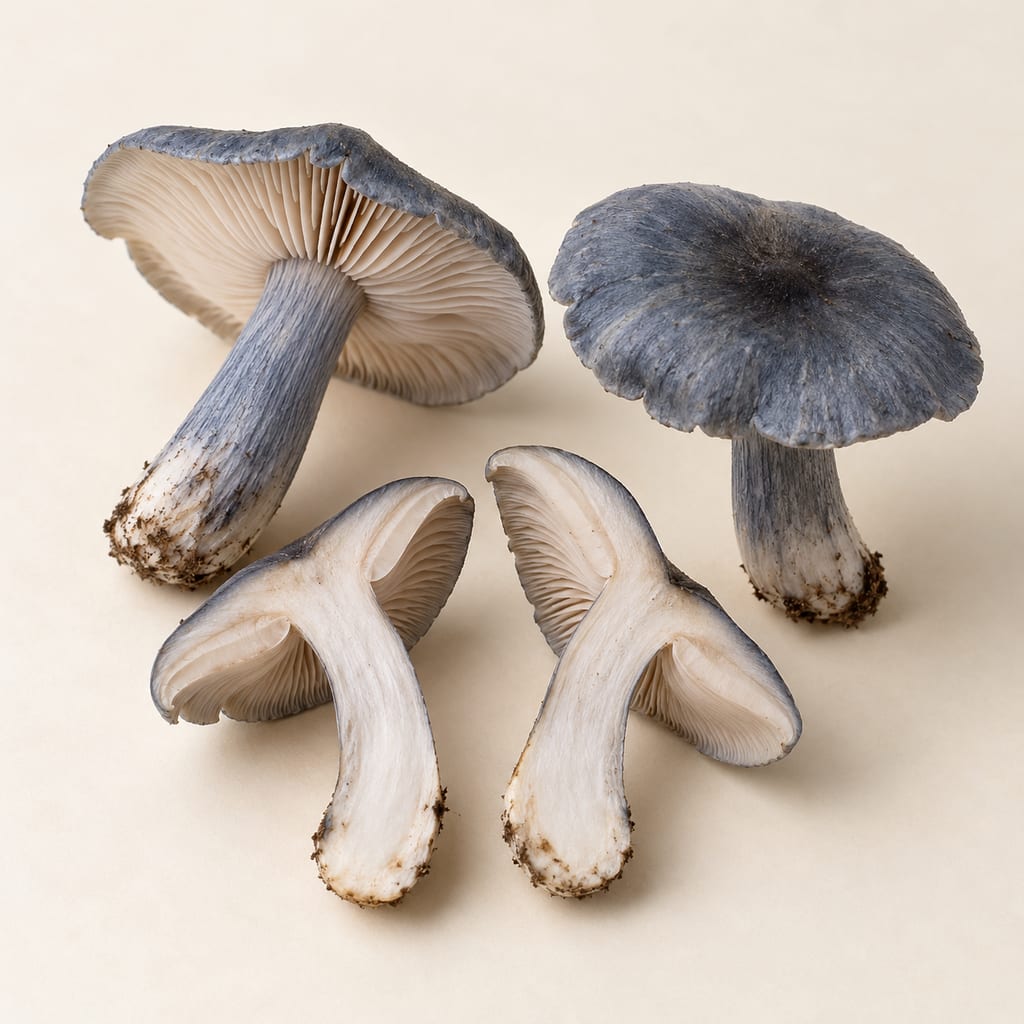
Bloxam's entoloma is a rare pink-gilled mushroom of old grasslands. Historical sources call it edible, but food-use evidence and older identifications remain uncertain; this does not recommend gathering or eating it.
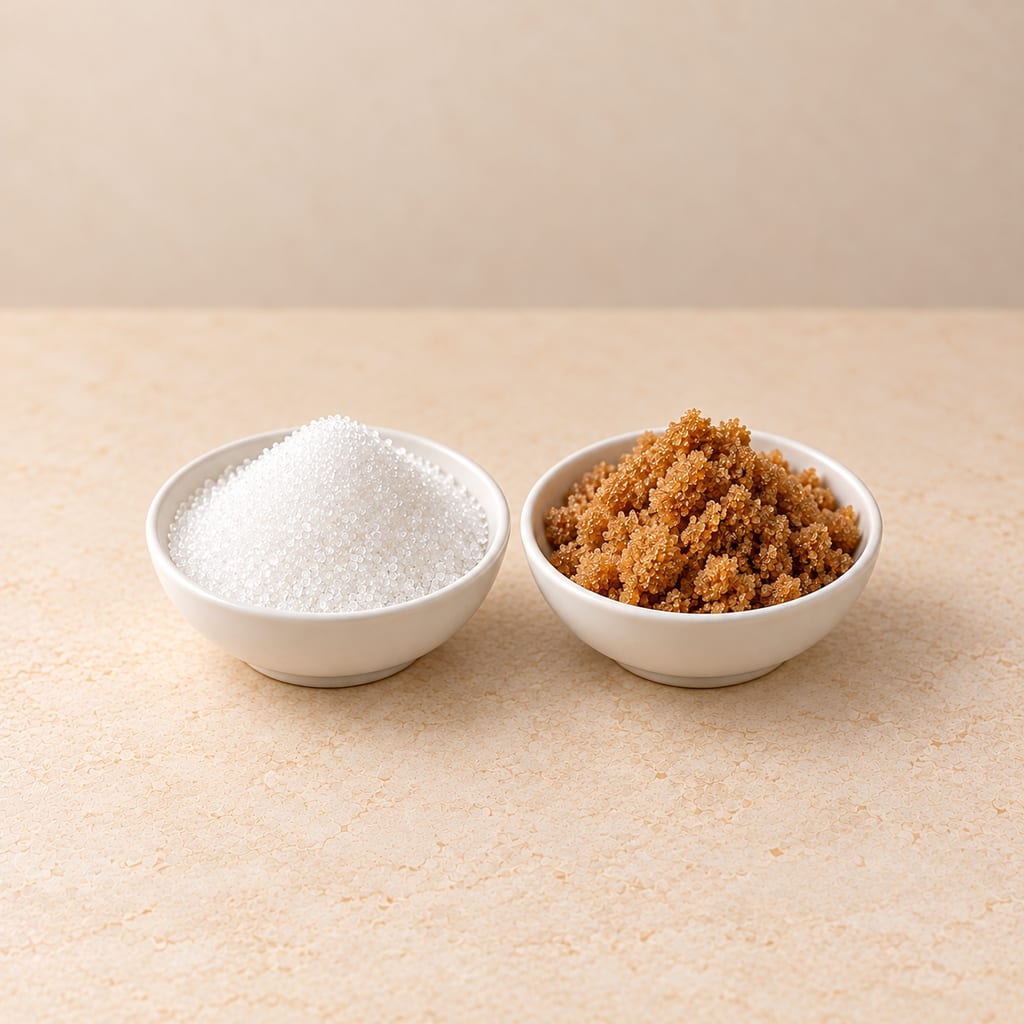
White sugar is refined sucrose, almost pure; brown sugar is sucrose with molasses, left in or added back. Molasses makes brown sugar moister, darker and more strongly flavoured.
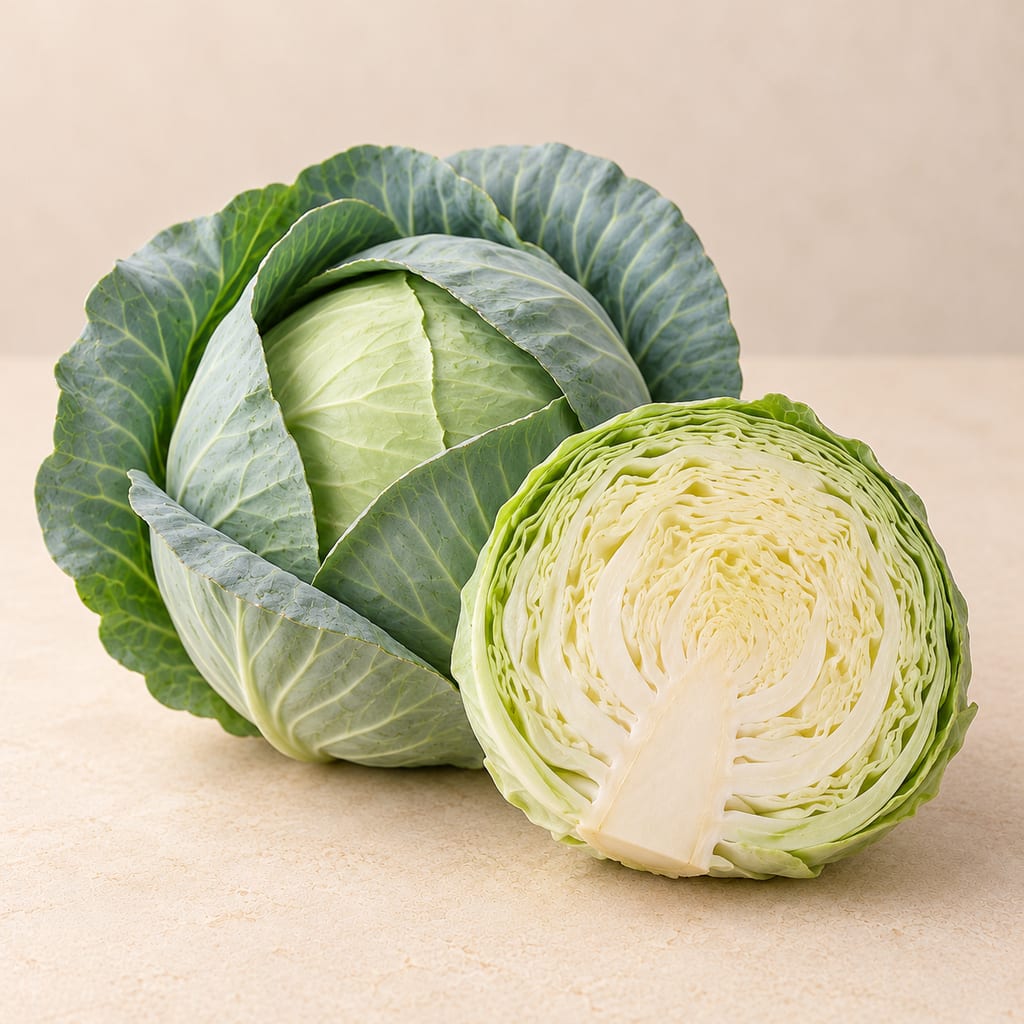
Cabbage is the dense leafy head of Brassica oleracea, a European vegetable that keeps for months and is the classic raw material for sauerkraut, with napa cabbage the base of kimchi.

Chicken eggs supply proteins and yolk fats that set and emulsify. Atlas breads use them in enriched doughs, surface washes and a sourdough pancake batter mixed after fermentation.
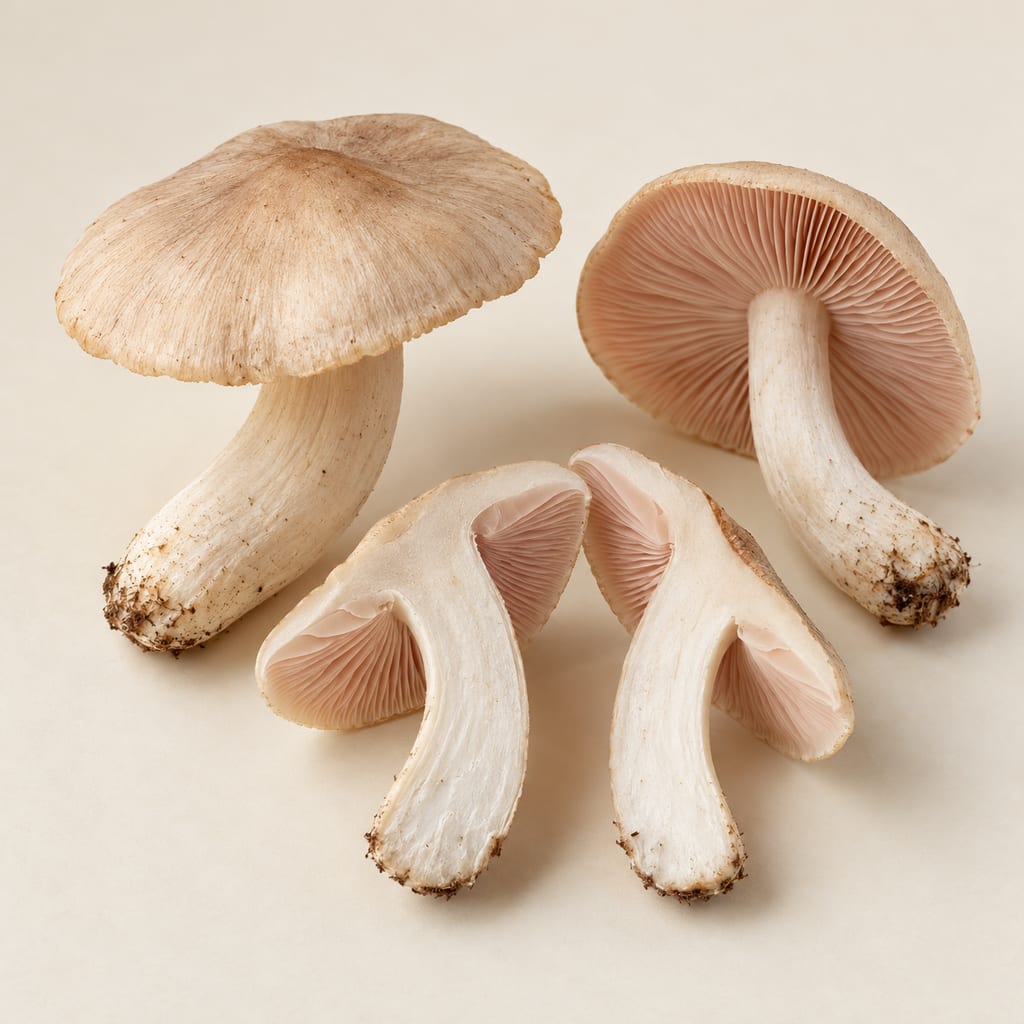
Entoloma sepium is a spring pinkgill associated with Rosaceae. Chinese and European sources list it as edible or conditionally edible, while taxonomic uncertainty and a poisonous lookalike warrant caution.
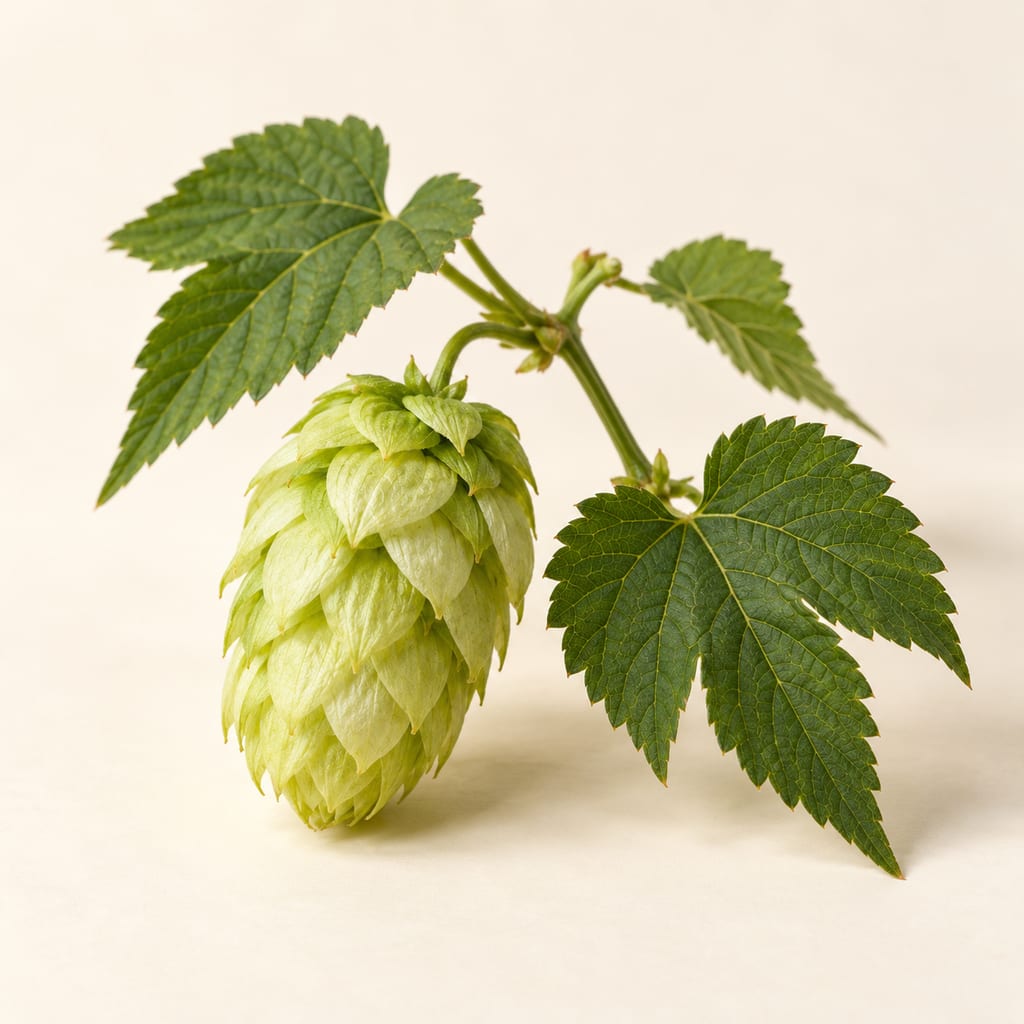
A traditional German aroma-hop land variety, associated with the Hallertau and described with herbal, spicy and floral notes. Cultivar identity, crop analysis and the growing place of a particular lot remain separate facts.
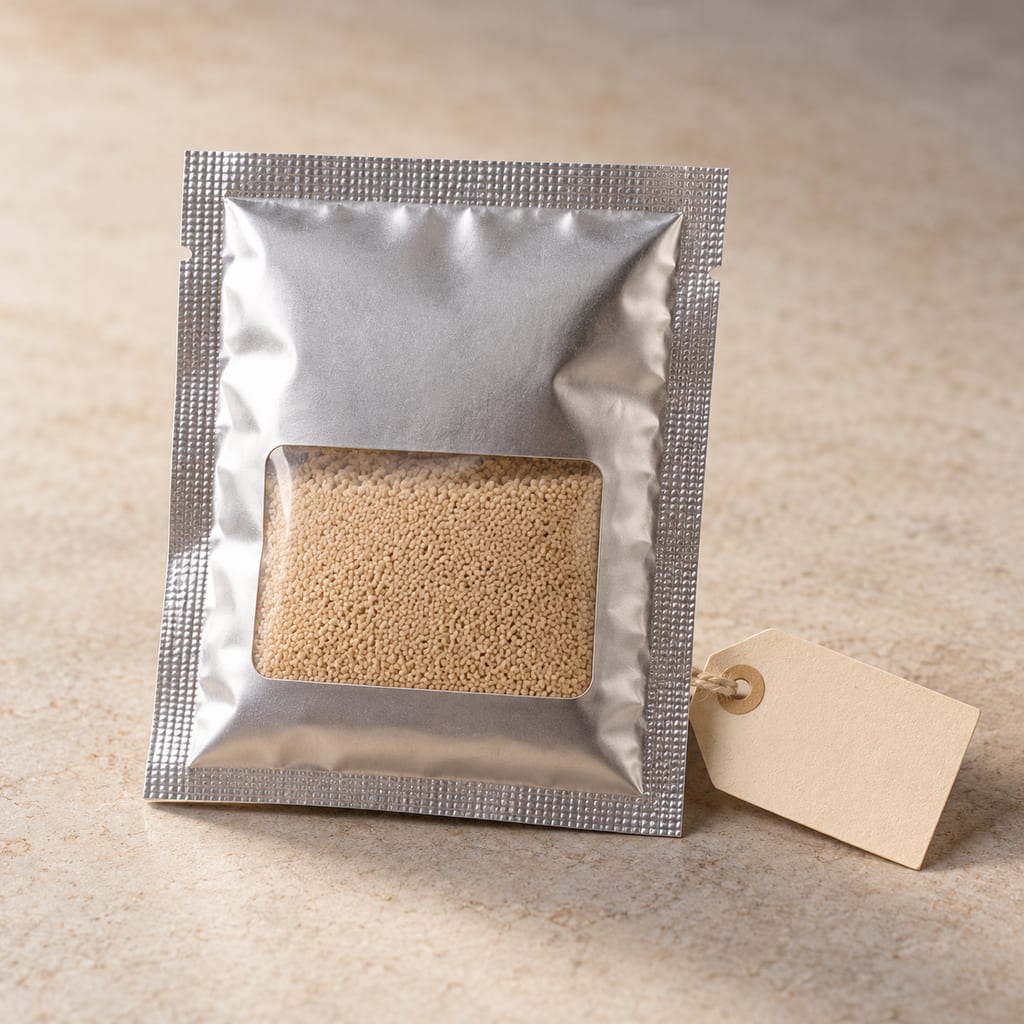
Lager yeast is the bottom-fermenting brewing yeast Saccharomyces pastorianus, a hybrid of S. cerevisiae and S. eubayanus, sold and kept as named strains that are not interchangeable.
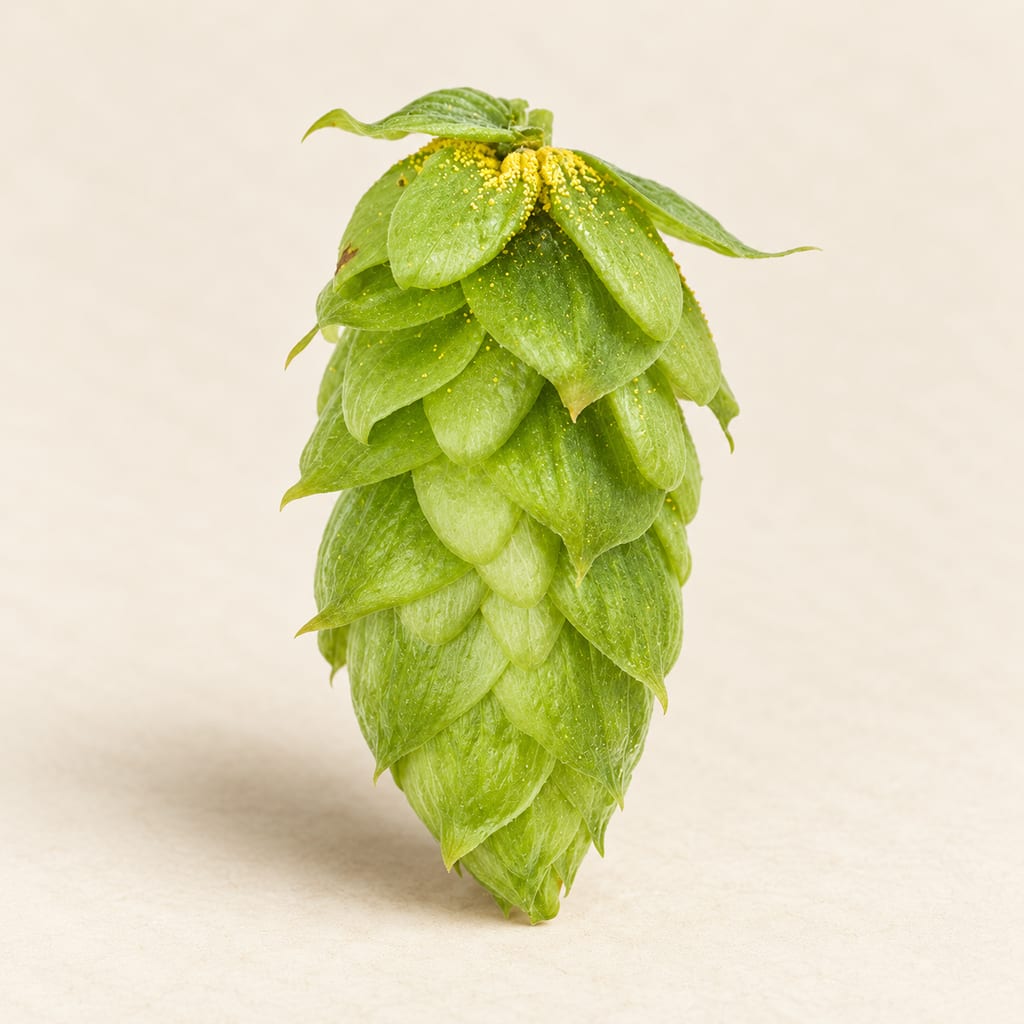
Hallertauer Magnum is a high-alpha hop cultivar used chiefly for bitterness in beer. Its crop form and lot analysis matter more than a variety name alone.
No community contributions have been published for this entry yet.
Sign in to contribute. Published comments and photos are free to read.
WikipediaTaxonomy · Identification · Geography · Toxicity
Blusher (Amanita rubescens)Blusher as a common name for several related species; A. rubescens in Eurasia, North America, Australia and Africa
Cap 5 to 15 cm, white to mahogany warts, flesh pink when bruised, white gills with red spots when damaged, ring striate on its upper side, mild taste with faint acrid aftertaste
Panthercap flesh does not pink and its ring is not striate
Edible if cooked but poisonous raw; raw flesh contains a haemolytic protein destroyed by cooking; Pegler on anaemia from large raw quantities
Common in Europe and Asia; June to November in the UK; introduced to South Africa; Hypomyces hyalinus parasitism in eastern North America
Cited in: What it is; Names and relatives; Where and when it grows; Telling it from the panthercap; Comparison at a glance; Why it must be cooked; Identification must be certain
WikipediaIdentification · Toxicity · Geography
Amanita pantherinaCap 5 to 18 cm, deep to hazel brown, easily removed white to cream warts, short striate margin, white flesh that does not change colour
Stem 5 to 15 cm with ring; white volva forming one or two hoop-like rings above a bulbous base
Smell unpleasant or like raw potatoes; spores smooth, inamyloid
Mainly beech and other deciduous trees; Europe and western Asia; late summer and autumn
Ibotenic acid and muscimol; nausea, vomiting and unconsciousness 1 to 3 hours after eating; untreated poisoning could be fatal
Main look-alike is A. rubescens, which reddens when damaged
Cited in: Telling it from the panthercap; Comparison at a glance; The panthercap and the deadly relatives
WikipediaSafety · Identification
Amanita phalloidesDeath cap: white free gills, skirt-like ring, sac-like white volva that may be hidden in litter, white spore print
Amatoxins; cooking, freezing and drying do not reduce toxicity; symptoms usually 6 to 12 hours after eating, then apparent recovery, then liver and kidney damage
Estimated to cause about 90 percent of mushroom-related fatalities in the figure the lead gives
Cited in: The panthercap and the deadly relatives; Identification must be certain
MushroomExpert.Com (Michael Kuo)Identification · Taxonomy
Amanita rubescensNorth American account: flesh white, discolouring slowly pale pinkish red especially around worm holes
Base lacks a prominent sack-like volva; fragile persistent ring; spore print white; cap warts fade from yellow to pinkish, grey or tan
A. rubescens var. alba, A. flavorubescens and A. novinupta as related taxa; the page gives no edibility advice
Cited in: What it is; Names and relatives; Telling it from the panthercap; Comparison at a glance; Identification must be certain
First NatureIdentification · Edibility · Taxonomy
Amanita rubescens Pers. - BlusherRing thin, fragile, usually grooved and often ragged; flesh and gills turn pink or dull red when cut or bruised
Stem reddish-brown with pink flecks below the ring; season June to October in Britain and Ireland, sometimes December
Must be thoroughly cooked; raw contains a haemolytic toxin; old fruitbodies prone to maggots
A. excelsa (grey spotted amanita) is similar but the flesh does not change colour; epithet rubescens means reddening; named by Persoon in 1797
Cited in: What it is; Names and relatives; Where and when it grows; Telling it from the panthercap; Comparison at a glance; Why it must be cooked; Eating it in Europe
First NatureIdentification · Toxicity
Amanita pantherina - PanthercapCap shiny brown to grey-brown, colour varies from pale ochre to very dark brown; pure white veil spots that can wash off
Very finely striate margin; slightly swollen stem base with white volva remains as woolly rings or a helix above a narrow gutter
Rare in Britain, more common in southern Europe; August to November in Britain; oak and beech
Contains ibotenic acid, muscimol, muscazone and muscarine; must be treated as poisonous
Cited in: Telling it from the panthercap; Comparison at a glance; The panthercap and the deadly relatives
Galloway Wild FoodsIdentification · Preparation · Food use
The Blusher - Edibility, Identification, DistributionBlusher rings are grooved; panther cap ring is solid and ungrooved; panther cap has a rim-like volva edge and fine striations at the cap edge and does not blush
Features alone are not enough; not a beginner's mushroom; larvae make many specimens unusable
Death cap and destroying angel stay dangerous when boiled
One forager's method: chop, boil in salted water for up to 5 minutes, discard the water, then cook; readers report other times
Cited in: Telling it from the panthercap; Comparison at a glance; The panthercap and the deadly relatives; Why it must be cooked; Eating it in Europe; Identification must be certain
NatureSpot (Leicestershire and Rutland)Identification · Geography
Blusher - Amanita rubescensRing large and striated; flesh reddens when cut or bruised; gills often spotted pink
Widespread and common in Britain; usually seen June to October
Cited in: What it is; Where and when it grows
Wikipedia (Czech)Identification · Food use · Geography
Muchomurka ruzovkaCzech names ruzovka and masak; fairly common, June to November in deciduous, mixed and coniferous forest
Panther cap ring is smooth, blusher ring notched and imprinted by the gills; blusher flesh reddens, panther cap flesh stays white; panther cap has a prominent volva
Regarded as a good edible, often thinly sliced and dried, fried with butter or lard, caraway and salt; raw mushrooms poisonous because of haemolytic proteins
Cited in: What it is; Names and relatives; Where and when it grows; Telling it from the panthercap; Comparison at a glance; Why it must be cooked; Eating it in Europe
Wikipedia (German)Identification · Food use · Geography
PerlpilzGerman name Perlpilz or Rotender Wulstling; very common in Germany; mycorrhizal mainly with spruce and beech
Edible only well cooked; raw toxic through heat-sensitive gastrointestinal toxins and haemolysins; opinions on culinary value differ; cap skin and ring should be removed; often infested with fly larvae
Panther mushroom lacks reddish tones, has small white wart-like remnants, a ring set lower, a bulbous base with a marked rim and a radish-like smell
Cited in: Names and relatives; Where and when it grows; Telling it from the panthercap; Comparison at a glance; Why it must be cooked; Eating it in Europe