
Sai krok Isan, starter-cultured
Sai krok Isan is a sour pork-and-rice sausage from northeastern Thailand. This garlic-rich version uses LHP-Dry starter and is cooked after fermentation.
 FermenteaWhere food goes to change
Spices and aromatics
Kaffir or makrut lime leaves are the aromatic foliage of Citrus hystrix, used whole for infusion or finely cut in soups, curries and seasonings.
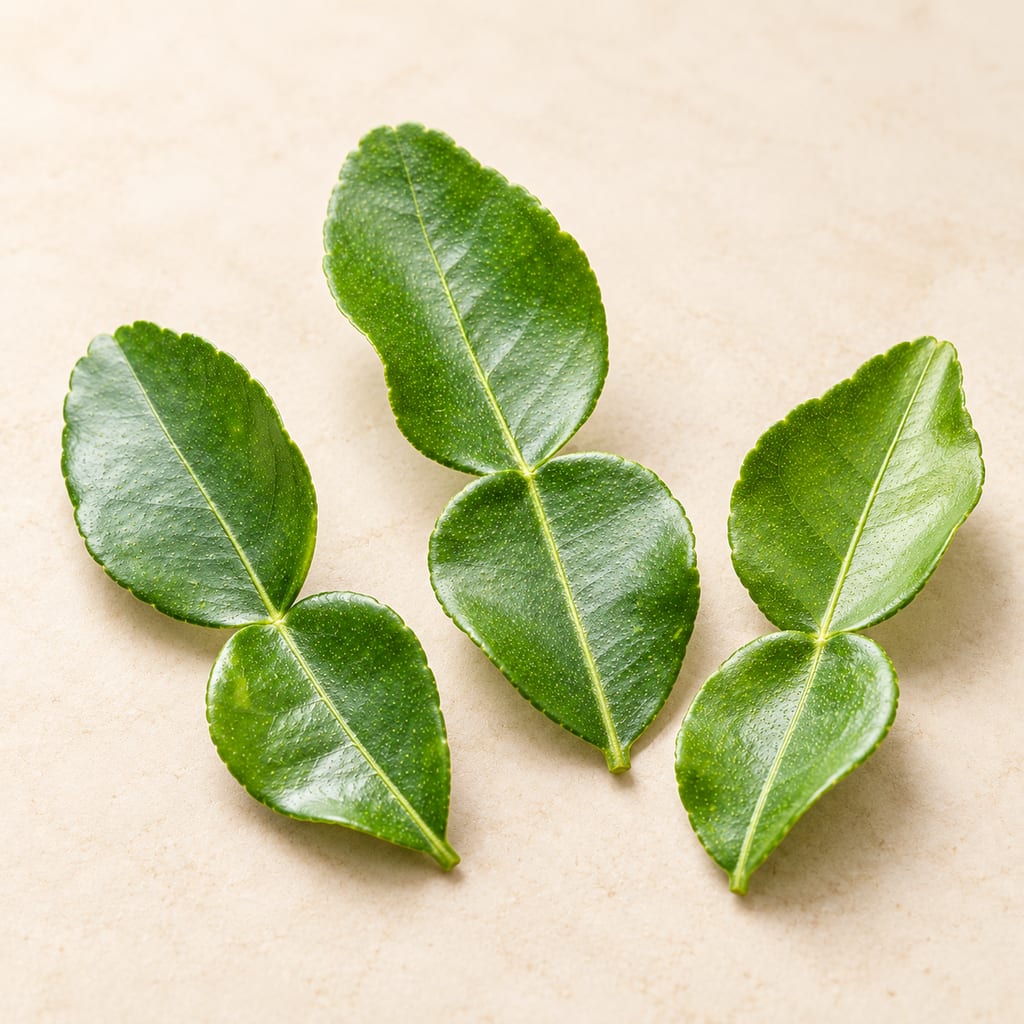
Kaffir lime leaves, also called makrut lime leaves, are the aromatic leaves of Citrus hystrix, a shrub or small tree in the citrus family, Rutaceae. They are used for their penetrating citrus fragrance in soups, curries, pastes and other seasonings. The leaf, rather than a squeeze of sour juice, is the ingredient on this page.
Their outline is unusually recognizable. What looks like two leaves joined end to end is a leaf blade attached to a very broadly winged petiole, the stalk that joins it to the branch. The green wings can be almost as conspicuous as the blade. Botanical descriptions classify the leaf as simple or unifoliate; the paired appearance should not be read as a pair of separate leaflets.
The foliage is glossy and dark green on its upper surface, paler beneath, and becomes fragrant when bruised. That combination of form and scent helps explain its culinary appeal. It is also a comparatively substantial leaf. How it is cut determines whether it will be removed after flavouring a liquid or remain in the food as fine shreds.
Makrut belongs to a much wider botanical and agricultural story than a single national dish. Citrus hystrix has a broad native range from the eastern Himalaya through parts of Asia and the Pacific, and a long history of cultivation and naturalization complicates the question of origin. Familiarity in a particular cuisine does not establish the first place where the tree was domesticated.
Trees are often kept in home gardens, where leaves can be gathered as a seasoning. This is an important contrast with citrus grown primarily for a large harvest of juicy fruit. A garden tree valued for leaves can supply an aromatic ingredient without waiting for its fruit to ripen. Leaf harvest and fruit harvest are different reasons for keeping the same plant.
The names recorded across the region reflect that reach. They include jeruk purut in Indonesia, limau purut in Malaysia and ma kruut in Thailand. These establish regional recognition of the plant, but a shared plant name does not imply identical dishes or a single preparation method. Its uses need to be understood in the cuisines in which they occur.
In 1930, a live plant reached the citrus collection at Riverside, California, from the Office of Crop Physiology and Breeding Investigations in Washington. Ceylon was recorded as the plant’s provenance. That documents the provenance of a collection plant. It does not identify Ceylon, now Sri Lanka, as the species’ birthplace.
The collected plant is a small, shrubby tree with a broad winged petiole and pungent leaves used in Thai and Indonesian cooking. Maintaining named plants also helps botanists distinguish related citrus forms, whose variable leaves and fruits have sometimes complicated identification. A living collection can therefore connect food use with observed plant material while retaining the history of how that particular plant arrived.
This is a more precise story than assigning the ingredient an unsupported ancient date. The tree’s movement into collections, its regional names and its continued use as a leaf seasoning are documented; the first occasion on which someone cooked with it is not. A named accession provides an actual event in the record without pretending to stand for every makrut tree.
Thai usage makes the harvested part explicit: ใบมะกรูด, bai makrut, means makrut leaves, while ผิวมะกรูด, phiu makrut, refers to the rind. มะกรูด, makrut, names the Citrus hystrix plant, whose fragrant rind and leaves both flavour food. A useful ingredient name thus carries more information than the English word lime alone.
The fruit has a conspicuously bumpy rind, while its flesh provides relatively little sour, slightly bitter juice. The leaf flavours tom yum soup; the rind can season a green curry paste. These are related uses of different plant parts. Adding ordinary lime juice can change sourness; it does not reproduce the texture of a leaf or turn juice into rind.
This distinction matters when shopping as well as cooking. Whole leaves, a fruit, grated rind and a concentrated oil may all appear under a citrus name, but they are not the same material. Read the requested part and form together. A leaf seasoning can be the intended ingredient even when the dish already contains another citrus product for acidity.
The plant is perennial, with a spreading or sprawling habit and thorny branches. It grows in full sun or semi-shade with moderate water and fertile loamy soil, and can be propagated by seed or stem cuttings. These are horticultural conditions for maintaining a tree, rather than a processing recipe for the leaves.
Thorns deserve practical attention when gathering foliage. The useful harvest is sound leaf material, but the shoots carrying it are not necessarily comfortable to handle bare-handed. In a home garden, that physical feature is as relevant as the attractive foliage. Identifying the actual tree also matters more than relying on the shape of an unidentified detached leaf.
In Thailand the leaf crop is available through the year. Where a tree is kept primarily for its foliage, its usefulness is not restricted to a seasonal fruit harvest. Availability in a producer’s region does not guarantee that every shop elsewhere will have fresh leaves at all times; fresh, frozen and dried forms answer different supply needs.
A whole leaf can flavour a soup or sauce and then be taken out. Leaves intended to be eaten need a different preparation: slicing them very thinly. This is a texture decision as much as a flavour decision. A substantial intact leaf remains a separate object in the bowl, whereas fine shreds can become part of a mouthful.
Bruising or tearing is another way of preparing leaves for a dish. Whole leaves suit simmered dishes; bruised or torn leaves can flavour stir-fries, while fine shreds can be eaten in Thai fish cakes. Older leaves may have tough midribs and stalks that need removing before fine cutting. These choices explain why a recipe’s cutting instruction should not be treated as decoration.
The leaf is used with many other aromatics. It can participate in a broth, a paste or a chopped mixture without becoming the largest ingredient. Those settings distribute fragrance differently and leave different textures behind. Whole, torn and finely sliced leaves are therefore useful forms of the same ingredient, selected for the dish rather than ranked as one universally best method.
The leaf’s citrus fragrance comes from a mixture of volatile compounds. In a study of fresh and dried Citrus hystrix leaves, Wannee Jirapakkul and colleagues identified citronellal as the most abundant measured volatile in the fresh material, with linalool among the important aroma compounds. Volatile means that a substance can pass into the air; aroma depends on that ability as well as on the compounds present.
The researchers compared leaves dried under different hot-air conditions and found that some key odourants were substantially reduced at higher drying temperatures. The result explains why drying is not simply fresh leaf minus water. The aromatic mixture can change during processing, and different compounds need not respond in exactly the same way.
The comparison does not establish one universal household drying schedule or a fixed replacement ratio between fresh and dried leaves. Its findings belong to the tested material and conditions. For cooking, the sound conclusion is narrower: fresh and dried leaves are recognizable forms of the same ingredient, but their aroma should not be assumed identical, and a concentrated extracted oil is a different product again.
Tom yum combines lemongrass and makrut leaves with sour and salty seasoning. Southern Thai khao yam mixes cooked rice with numerous finely cut additions, including makrut leaf. Those examples show two distinct culinary roles: fragrance carried through a liquid and finely cut foliage included in a mixed rice dish.
In Indonesian rendang, the leaves can accompany lemongrass, galangal and turmeric leaves, alongside coconut milk and a spice paste. This is another setting altogether, in which a citrus leaf contributes to a rich cooked seasoning. The association with rendang documents a use; it does not make makrut leaf a preservation control or establish one mandatory recipe for all rendang.
The leaves also season Thai fish cakes and Indonesian soto ayam. Across these examples, the significant differences are the dish, its companion aromatics and the way the leaf is handled. A regional ingredient can be shared without producing one universal Southeast Asian flavour mixture. Understanding the particular preparation is more useful than treating every citrus-scented dish as interchangeable.
The Sai krok Isan formulation linked here includes finely chopped makrut leaves with garlic, rice and green coriander. The cutting instruction fits their role: the foliage is incorporated into a meat mixture, rather than left as a whole infusion leaf to be removed later. The citrus aroma belongs within a much larger combination of pork, seasonings and other ingredients.
This is a particular published adaptation. The recipe author explicitly describes the leaves as part of his own version in the page’s discussion. Their inclusion should not be elevated into a claim that every Isan sausage contains them. A regional dish can have a recognizable identity while individual formulations vary.
The sausage formulation separately includes a starter culture. Makrut leaves provide flavour in that formulation; neither their scent nor findings about extracted citrus oils establish fermentation control. The ingredient should not be treated as a replacement for the culture, a cure, or the complete food-safety requirements of the linked preparation. This page identifies the leaf and its handling, while the recipe remains the place for its full method.
Fresh leaves can be refrigerated or kept frozen. Dried leaves are available for cupboard use. These forms make the ingredient accessible beyond the place where a tree is growing, but a dried leaf and a thawed leaf do not have the same physical condition as a leaf just gathered from a plant.
Commercial handling instructions are specific to the product. Fresh commercial leaves are sold with refrigerated storage instructions and short keeping periods, which vary between products and handling systems. Those recommendations cannot be combined into one expiry rule for every fresh, frozen or dried packet. Follow the packaging and storage directions attached to the actual product.
The leaves can infuse drinks and stock as well as accompany meat and fish. These extend the leaf’s culinary setting without changing its identity. A whole infusion leaf, a minced addition and a dried packet all call for attention to the form being sold and to whether the leaf itself will be eaten.
Buy leaves intended for food use and read the actual ingredient and allergen information, especially for a prepared paste or mixed seasoning containing them. A pure leaf product and a curry paste can have very different additional ingredients. A plain leaf product should not be assumed to carry the same dietary declarations as every prepared mixture containing it.
Dried aromatic herbs have been associated with foodborne pathogens and outbreaks. This category evidence does not measure the safety of a particular leaf packet. A strong citrus smell is a flavour characteristic, not a microbiological test, and ordinary culinary leaves should not be equated with concentrated medicinal or essential-oil products.
The exact first cultivation and earliest culinary use remain unresolved. Modern botanical distribution accounts and older crop descriptions differ in how they delimit the tree’s original range. The documented ingredient is clear nonetheless: Citrus hystrix foliage, prepared in the form the dish needs, with the rind and juice kept distinct.
Regional home-garden crop and leaf-seasoning context; exact origin unresolved.
Documented living collection accession, not a claimed origin or commercial production centre.
Sai krok Isan is a sour pork-and-rice sausage from northeastern Thailand. This garlic-rich version uses LHP-Dry starter and is cooked after fermentation.

Ripe avocado flesh is the soft, buttery, fat-rich pulp of Persea americana, eaten raw. It is low in acid, so it is a fresh ingredient that needs care in chilled dishes.
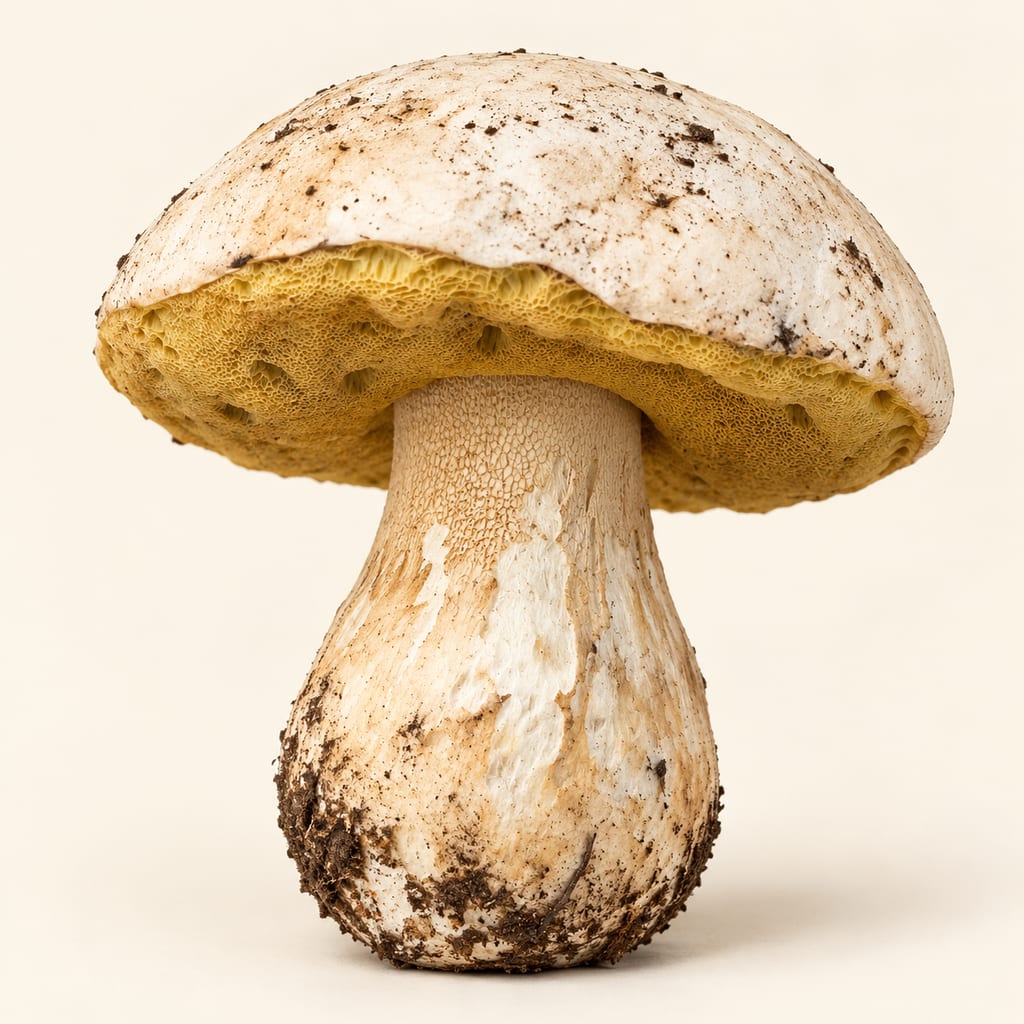
Boletus barrowsii, the white king bolete, is a western porcini relative with documented local food use in Mexico. Its pale cap and netted stem are not enough for field identification.
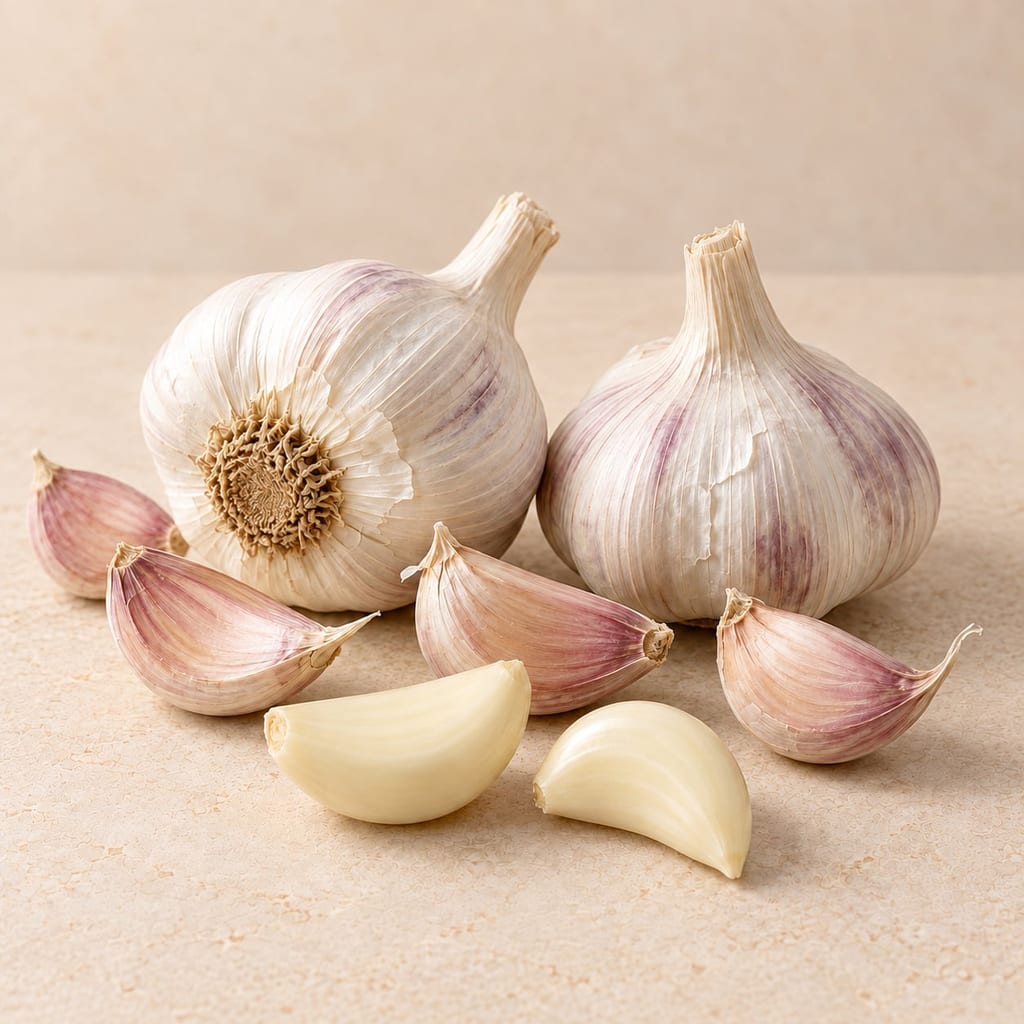
Garlic cloves are the separate bulblets of Allium sativum, pungent only once cut. They flavour herb salts, ferments such as Thai som-fak, and countless cooked dishes.
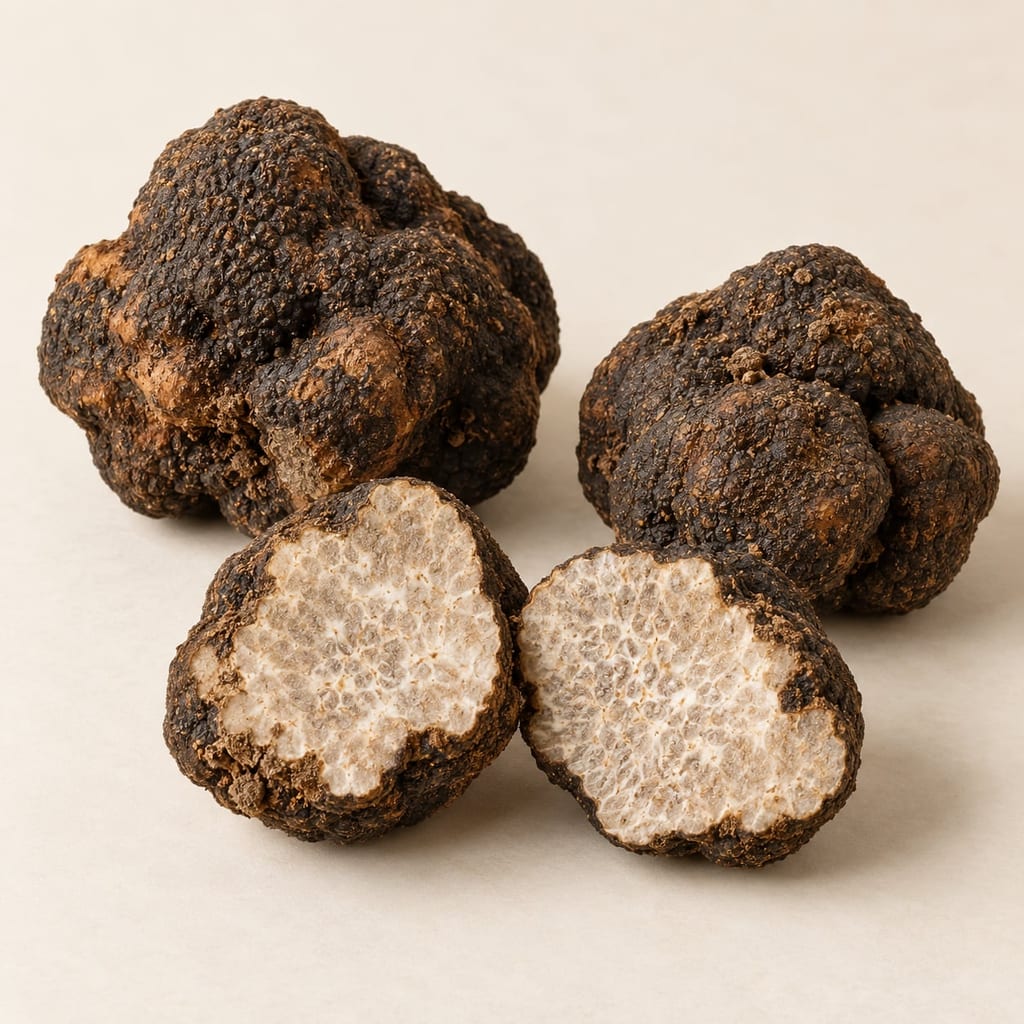
Kalapuya brunnea, the Oregon brown truffle, is a native truffle of the Pacific Northwest that is shaved raw over warm food. Sources describe it as a gourmet edible, and its safe identification needs an expert.
Heat-treated milk from domestic goats supplies lactose, proteins and fat for cultured dairy and cheese; its heat treatment and composition affect how it behaves in the vat.
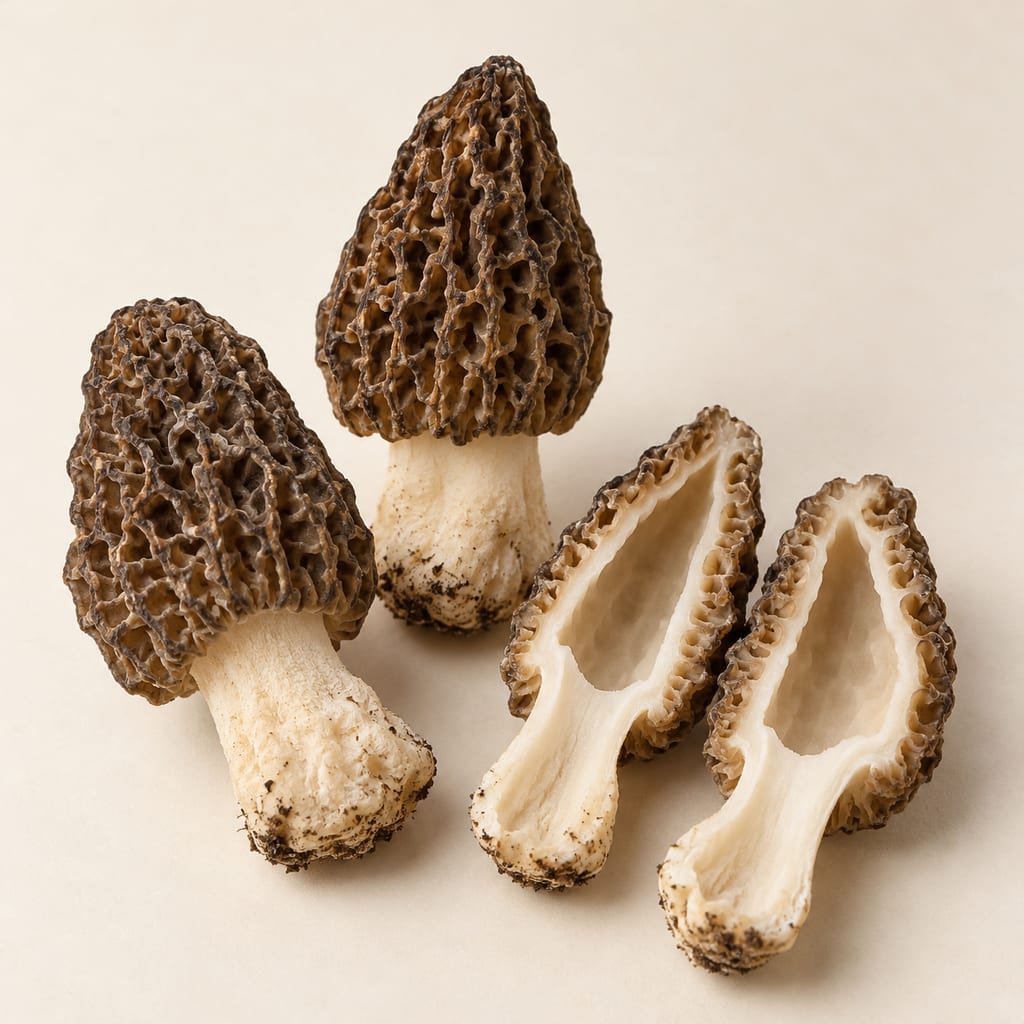
Morchella snyderi, Snyder's morel, is a true morel found under conifers in western North America in spring. It is eaten only well cooked, because raw or undercooked morels can cause serious illness.
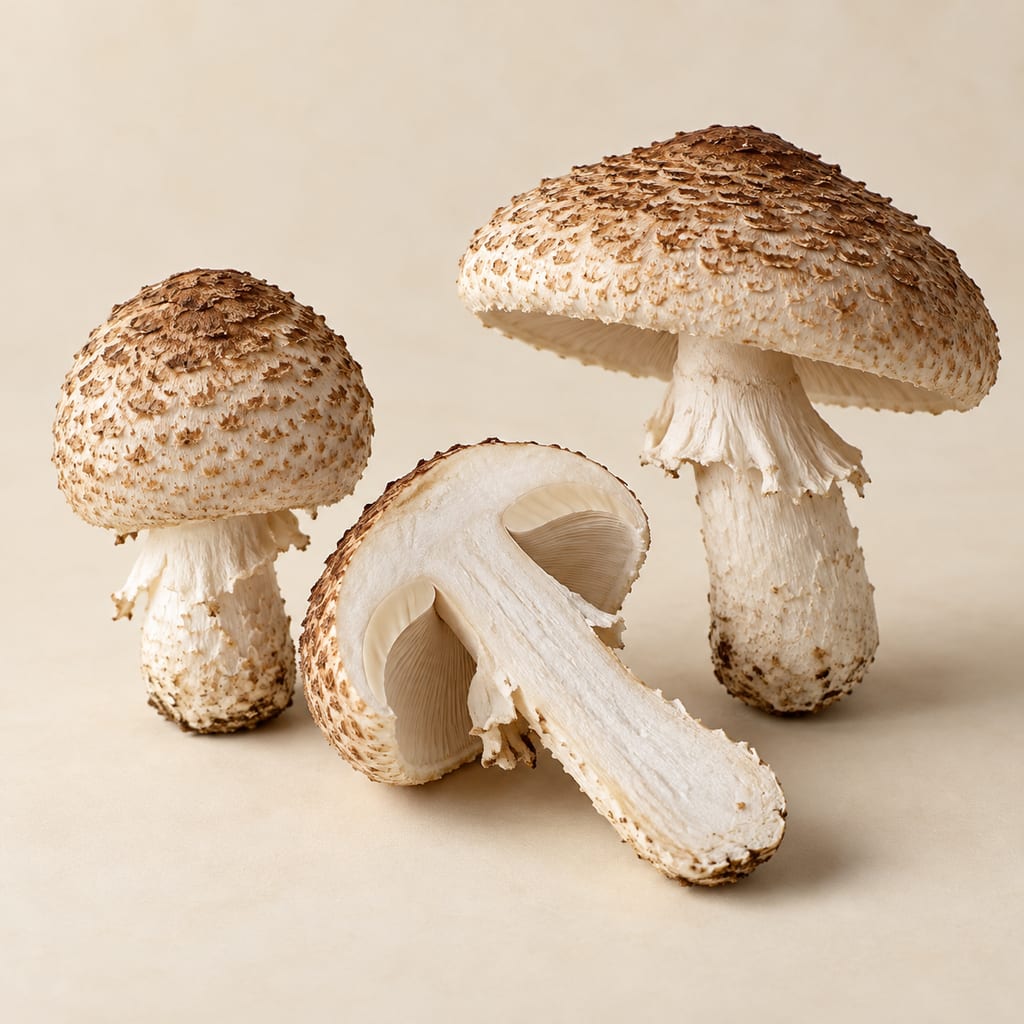
The prince (Agaricus augustus) is a large wild mushroom with a pale, brown-scaled cap and sweet almond-like aroma. Field guides describe it as edible, with species-specific contaminant cautions.
No community contributions have been published for this entry yet.
Sign in to contribute. Published comments and photos are free to read.
Royal Botanic Gardens, KewIngredient context
Citrus hystrix DC.Citrus hystrix is an accepted Rutaceae shrub or tree with native and introduced distributions across parts of Asia.
Cited in: An aromatic leaf with a double outline; A regional garden tree with an uncertain beginning; Food use, dietary information and open questions
Singapore National Parks BoardIngredient context
Citrus hystrixGlossy aromatic foliage, thorny growth, distinct culinary uses of leaves and fruit rind, and cultivation and propagation of Citrus hystrix.
Cited in: An aromatic leaf with a double outline; Leaf, rind and the names in a recipe; Growing a supply of leaves
University of California, Riverside, Givaudan Citrus Variety CollectionIngredient context
Kaffir lime, Citrus hystrix DC., CRC 2454CRC 2454 was received as a live plant from Washington in 1930 with Ceylon provenance; the accession account describes the broad winged petiole and pungent culinary leaves.
Cited in: An aromatic leaf with a double outline; A living collection records one journey
PROSEA Foundation; P.C.M. Jansen and colleagues, 1991Ingredient context
Citrus hystrix DC., Plant Resources of South-East Asia 2Regional names, uncertain original range, naturalization, home-garden occurrence and culinary leaf seasoning in Southeast Asia.
Cited in: A regional garden tree with an uncertain beginning; Growing a supply of leaves; Food use, dietary information and open questions
Longdo Dictionary, reproducing Royal Society dictionary and Volubilis entriesIngredient context
มะกรูด, ใบมะกรูด and ผิวมะกรูด dictionary entriesThai มะกรูด names the plant; ใบมะกรูด, bai makrut, names its leaves, distinct from ผิวมะกรูด, phio makrut, the rind. Dictionary entries also connect the leaves with tom yum and khao yam.
Cited in: Leaf, rind and the names in a recipe; Different dishes, different company
Thailand Department of Agricultural ExtensionIngredient context
Leech Lime LeafThe agricultural commodity page identifies Citrus hystrix leaves as Bai Ma Krud and lists availability throughout the year.
Cited in: Growing a supply of leaves; Fresh, frozen and dried purchases
The Herb Society of America, 2020Ingredient context
Makrut Lime Citrus hystrix: Recipes and tipsWhole leaves can infuse dishes before removal; very thin slices can be eaten. Fresh, refrigerated, frozen and dried forms have different handling uses.
Cited in: Whole for infusion, finely cut for eating; Fresh, frozen and dried purchases; Food use, dietary information and open questions
ASEAN TourismIngredient context
Southeast Asia Cuisine: MakrutRegional kitchens use whole, torn and finely shredded leaves in preparations including fish cakes and soto ayam.
Cited in: Whole for infusion, finely cut for eating; Different dishes, different company
Wannee Jirapakkul, Patcharaporn Tinchan and Siree Chaiseri, International Journal of Food Science & TechnologyIngredient context
Effect of drying temperature on key odourants in kaffir lime leavesThe study identifies citronellal and linalool among important leaf aroma compounds and describes changes in volatiles during drying.
Cited in: Aroma survives processing unevenly
Indonesia TravelIngredient context
Rendang: The Legendary Dish from West SumatraThe described rendang seasoning combines makrut leaves with coconut milk, lemongrass, galangal and turmeric leaves.
Cited in: Different dishes, different company
2 Guys & A CoolerIngredient context
Thailand’s – Sai Krok IssanThe author’s Sai Krok Issan version uses finely chopped leaves with other aromatics and a separate starter culture.
Cited in: The leaf in a starter-cultured sausage
Koppert Cress B.V.Ingredient context
Kaffir Lime Leaves: Taste, usage, availability and storageThe producer’s fresh-leaf sheet describes refrigerated storage, culinary infusions and pairings with protein foods.
Cited in: Fresh, frozen and dried purchases
World Health Organization and Food and Agriculture OrganizationIngredient context
Microbiological hazards in spices and dried aromatic herbs: meeting reportSpices and dried aromatic herbs can carry pathogens and have been implicated in foodborne outbreaks.
Cited in: Food use, dietary information and open questions