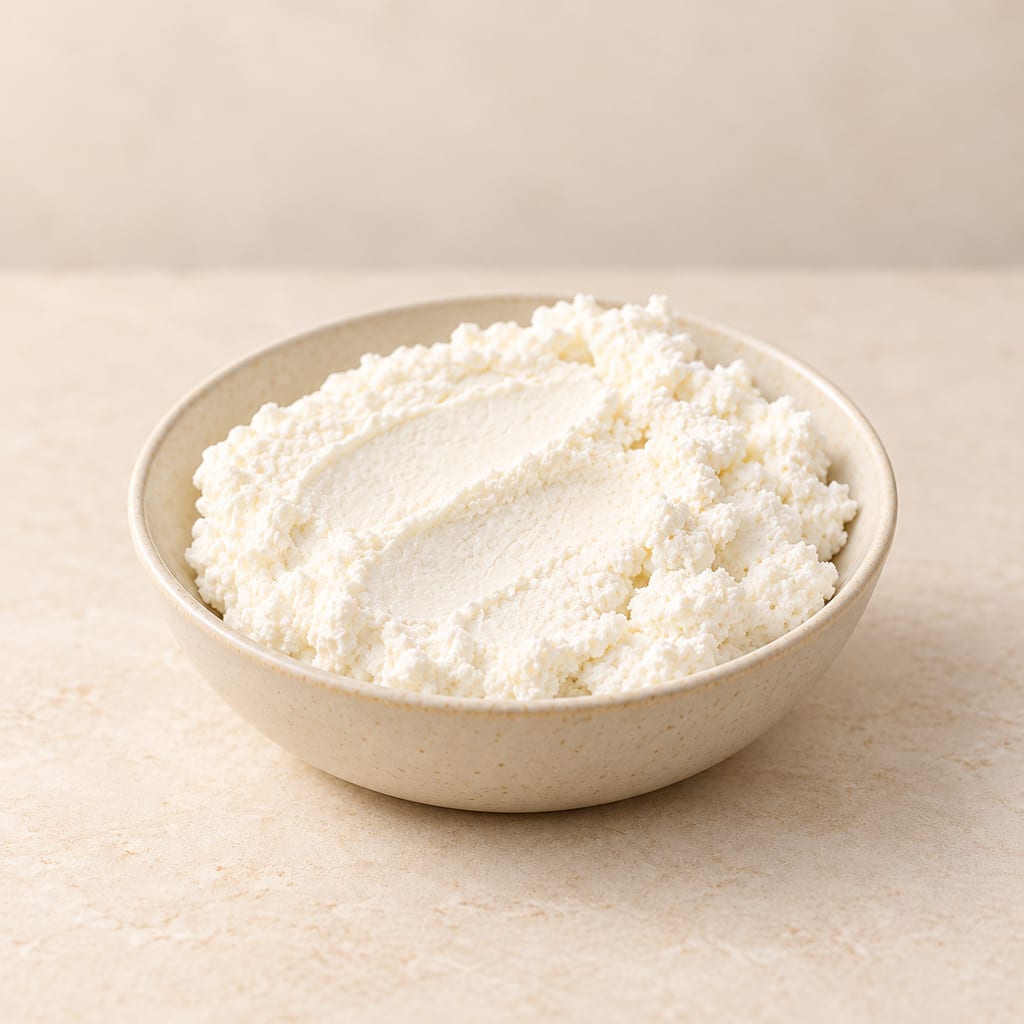
Fresh chèvre
Fresh chèvre is a soft goat-milk cheese with a gently tangy flavour. This home method uses a combined lactic starter and coagulant, then drains the curd in cloth before salting and chilling.
 FermenteaWhere food goes to change
Substrates
Heat-treated milk from domestic goats supplies lactose, proteins and fat for cultured dairy and cheese; its heat treatment and composition affect how it behaves in the vat.
Pasteurized goat milk brings two histories together: the keeping of goats for food and the much later development of controlled milk heating. It is liquid milk from the domestic goat, Capra hircus, treated with heat to destroy disease-causing bacteria. It remains a dairy ingredient with milk sugar, proteins, fat and minerals. Pasteurization changes its microbial starting conditions; it does not turn the milk into a fermented food or remove the components that make it useful for cheese.
Goat keeping has deep roots in western Asia. Archaeological work in the Zagros highlands of western Iran identified a shift towards the selective killing of young males about 10,000 calibrated calendar years ago. That pattern helps distinguish managed herds from animals taken by hunting. It is evidence about human management of goats, rather than a dated recipe for their milk. The distinction matters because an animal's domestication and the adoption of dairying are different historical questions.
Milk use has its own material record. Analysis of fats absorbed into pottery from the Near East and southeastern Europe found dairying by the seventh millennium BCE. The strongest regional pattern in that study was linked to cattle herding in northwestern Anatolia. It establishes early milk processing without identifying all the residues as goat milk. The history of today's bottle can therefore begin with early livestock keeping while leaving the first milking of goats an open question.
The name pasteurization comes from Louis Pasteur's work on heating wine and beer to prevent souring in the nineteenth century. The development of milk treatment involved other researchers, physicians, equipment makers and public-health services. Nathan Straus opened a milk depot in New York in 1893, and continuous-flow milk-heating equipment developed around the turn of the twentieth century. Milk heating became part of a larger effort to control milk-borne disease through production, treatment and protection from later contamination.
This history explains why pasteurization is more specific than simply warming milk in a cheese pot. A commercial treatment combines a defined temperature with a defined holding time and controlled equipment. The milk is then protected during handling and packaging. A later cheesemaking step that warms a bottle's contents to a culture's working temperature serves another purpose. It creates conditions for the intended culture and coagulant; it does not stand in for the earlier pathogen-control treatment.
Farm-scale and larger commercial systems both produce pasteurized goat milk. At Summerhill Goat Dairy in Hanford, California, milk is pasteurized and bottled on the farm using high-temperature short-time treatment. The dairy describes its product as neither ultra-pasteurized nor mechanically homogenized. This is one concrete production choice within a varied market. The animal species on a label does not tell the buyer everything about heat treatment, fat standardization or homogenization.
Milk looks continuous to the eye, but its components occupy different physical forms. Much of its water contains dissolved lactose, minerals and other soluble material. Fat occurs as small globules suspended in that watery phase. Casein proteins occur in particles called micelles, while whey proteins are present in the surrounding liquid. These arrangements give milk several possible futures: it can remain a drink, form an acid gel, develop an enzyme-set curd or be separated into concentrated and watery fractions.
Cheesemaking relies particularly on casein. A curd is a connected protein framework that holds water and traps fat. When the framework contracts and whey drains away, it retains much of the milk's casein and fat while losing liquid and dissolved constituents. Milk composition consequently affects both the amount of material available to make cheese and the character of the resulting body. A species name alone cannot promise a particular yield or firmness.
Goat milk has a broadly similar gross composition to cow milk, but it is not a fixed formula. Breed, feeding, age, stage of lactation, season and the farm environment influence milk composition and flavour. Goat-milk coagulation studies also show that the proportions of protein fractions matter alongside total protein and fat. Two supplies can behave differently even when both labels say whole goat milk. This variability is part of the ingredient's agricultural identity, rather than a fault that processing necessarily eliminates.
Pasteurization destroys harmful bacteria through a controlled combination of heat and time. It does not remove lactose, nor does it remove the milk proteins responsible for allergic reactions. Pasteurized milk still requires refrigeration because organisms capable of spoilage can remain and later contamination is possible. Its treatment belongs alongside clean production, protected packaging and a maintained cold chain.
Heat can also affect the properties that a cheesemaker needs. Whey proteins and casein do not respond identically to heating. With stronger treatments, whey proteins can become associated with casein, changing the way protein particles interact. Research on differently heated goat milk has found changes in the structure of rennet gels. Those experiments concern defined milk treatments and enzyme-set systems; they do not supply a universal prediction for every brand of milk or every acid-set cheese.
The Fresh chèvre preparation linked to this ingredient calls for goat milk that is not ultra-pasteurized. That qualification should remain visible when the milk is selected. A long-life or ultra-pasteurized product is not simply the same input with a more distant date. The degree of heating is a technological property that can matter to coagulation. Conversely, a restriction in one cheese method does not mean that ultra-pasteurized goat milk has no use as a drink or in other cooking.
Homogenization is a physical operation on the fat phase, separate from pasteurization. Commercial homogenization breaks fat globules into smaller particles and changes their distribution. Pasteurization is the controlled heat treatment. A bottle may have undergone either operation, both, or a different combination of processing steps, so the terms should not be treated as synonyms.
Goat milk is sometimes described commercially as naturally homogenized. That phrase can obscure the distinction between an animal's milk structure and an industrial operation. A producer may use this expression while also stating that the milk has not undergone mechanical homogenization. The important information for a buyer is the declared process, rather than treating the phrase as a guarantee about how every supply will behave. A producer's decision to sell non-homogenized milk is a product characteristic, not a separate animal species or a guarantee of cheesemaking performance.
For a cheese recipe, the useful question is whether the chosen milk matches the method's stated requirements. Whole milk, reduced-fat milk, mechanically homogenized milk and non-homogenized milk differ in more than package design. Reading the treatment and ingredient information avoids substituting a general impression of goat milk for the actual material being put into the vat.
In fresh cultured chèvre, lactose provides a substrate for lactic-acid bacteria. As the bacteria metabolize the sugar, lactic acid accumulates and changes the milk's acidity. This affects the interactions between casein particles and the minerals associated with them. The milk becomes capable of forming a delicate curd. The bacteria are doing biological work; the later separation of whey is a physical drainage operation.
The C20G pack used in the linked preparation combines lactic cultures with a coagulant enzyme. The enzyme helps destabilize casein, while bacterial acidification changes the wider milk environment. These contributions overlap in the same pot but remain different actions. Milk supplies the proteins that respond to both and the sugar that supports fermentation. It also supplies much of the water whose retention or loss will distinguish a moist spread from a drier cheese.
Calcium contributes to the aggregation of enzyme-altered casein particles. Milk heating can change the balance of calcium available in the liquid and protein phases, which is why some cheesemaking methods use calcium chloride. The linked chèvre method names it for pasteurized milk but does not supply an exact dose. The ingredient should therefore be handled through the particular cheese method and additive instructions, without inventing a standard addition for every bottle of pasteurized goat milk.
Once a cultured milk has set, gentle transfer into cloth begins a further separation. Whey leaves through the cloth while the curd remains. Some lactose and soluble milk constituents travel with that liquid. Fat and casein are concentrated in the retained body, while a portion of the liquid remains trapped within its structure. The milk has not simply become solid from edge to centre; its components have been redistributed.
The amount of drainage helps determine the final texture. A wetter curd is more spreadable, while further liquid loss produces a denser body. Acidification can continue while bacteria still have suitable conditions and access to lactose, so draining and fermentation are connected rather than perfectly separate stages. The process explains why the milk's initial composition, its treatment, the selected culture and the handling of the curd all matter to the finished food.
This ingredient page concerns the milk before that transformation. Fresh goat cheese, goat yogurt and other cultured products are preparations made from milk, each with its own cultures, temperatures and method. They should not be used as interchangeable substitutes for the liquid substrate merely because they share an animal source.
For the linked fresh cheese, choose milk identified as goat milk and check that it is pasteurized without being ultra-pasteurized. Read the full product description rather than relying on a bottle's shape or the word fresh. Check the date and the storage directions, and keep the milk cold on the journey home. Different producers and packaging systems have different instructions; there is no single unopened shelf life that applies to all pasteurized goat milk.
Canadian dairy-handling guidance recommends collecting milk late in a shopping trip, refrigerating it promptly, rotating supplies so older stock is used first, and keeping containers closed. It also advises against returning milk that has already been poured to its original container. These practices protect the remaining supply from warming, odours and avoidable contamination. They are handling measures for a perishable ingredient, not a way to extend an expired product indefinitely.
Clean utensils and vessels matter when a bottle is opened for fermentation. Pasteurization cannot compensate for dirty equipment introduced later. Residues of cleaners and sanitizers can also interfere with the intended lactic culture, so equipment preparation includes the appropriate rinsing and handling specified for the products used. Milk quality and a controlled process begin before the culture is sprinkled onto the surface.
Goat milk is used differently across dairy cultures. Cheese making is particularly important in Mediterranean countries and Latin America, while raw or acidified consumption occurs in parts of Africa and South Asia. These patterns describe food use; they do not make raw milk equivalent to pasteurized milk or establish one region as the birthplace of this modern processing category. Liquid pasteurized goat milk also has an everyday role as a drink and as an ingredient for cereal and cooking.
Pasteurized goat milk remains an animal-derived dairy food containing lactose and milk proteins. It is not a lactose-free ingredient, and heating does not turn it into a safe default replacement for someone with milk allergy. A finished goat cheese also retains its dairy identity. The useful distinction is between a milk's species, its processing and a person's dietary requirements, rather than a blanket claim that one animal's milk avoids every problem associated with another.
The first goat-milking event, the composition of an individual bottle and a universal shelf life are not established here.
milk; contains lactose
One documented modern producer pasteurizes and bottles goat milk on this farm; this is not an origin claim.
Fresh chèvre is a soft goat-milk cheese with a gently tangy flavour. This home method uses a combined lactic starter and coagulant, then drains the curd in cloth before salting and chilling.

Ripe avocado flesh is the soft, buttery, fat-rich pulp of Persea americana, eaten raw. It is low in acid, so it is a fresh ingredient that needs care in chilled dishes.
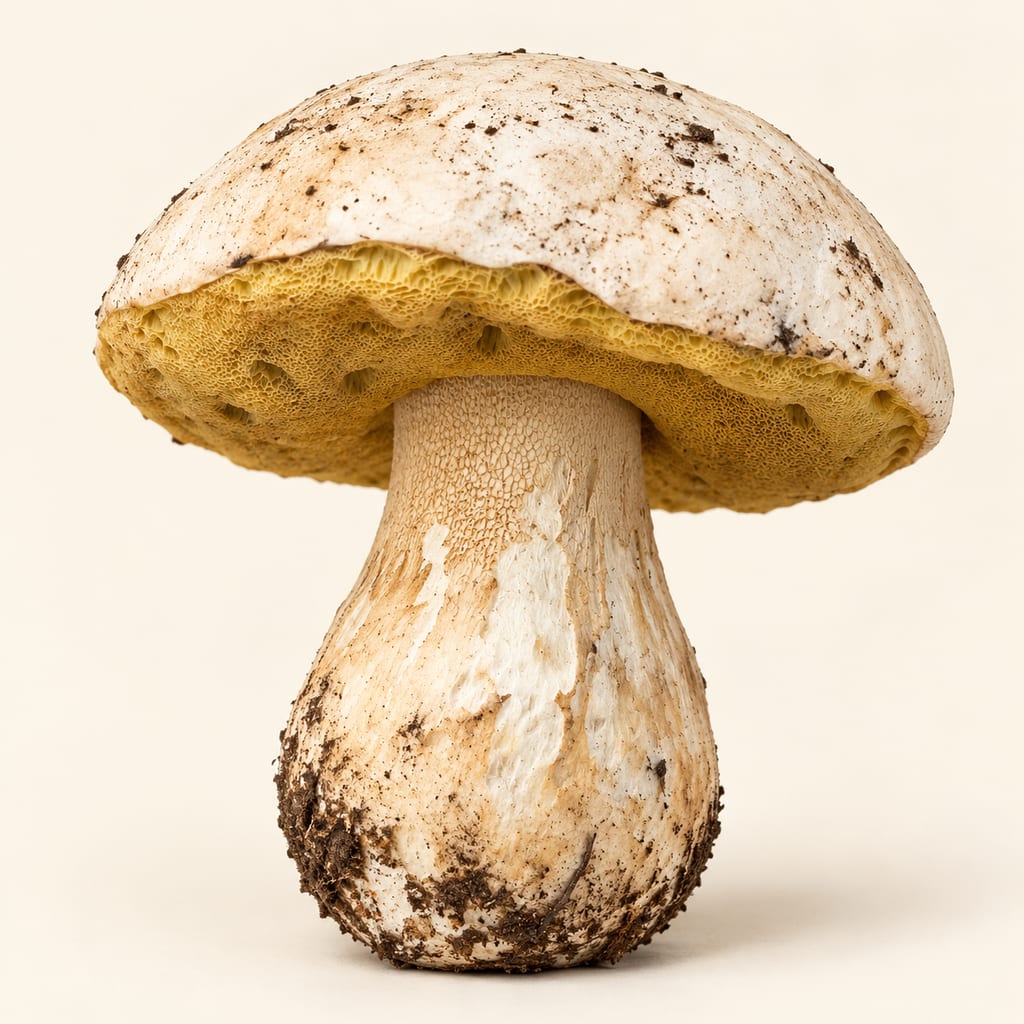
Boletus barrowsii, the white king bolete, is a western porcini relative with documented local food use in Mexico. Its pale cap and netted stem are not enough for field identification.
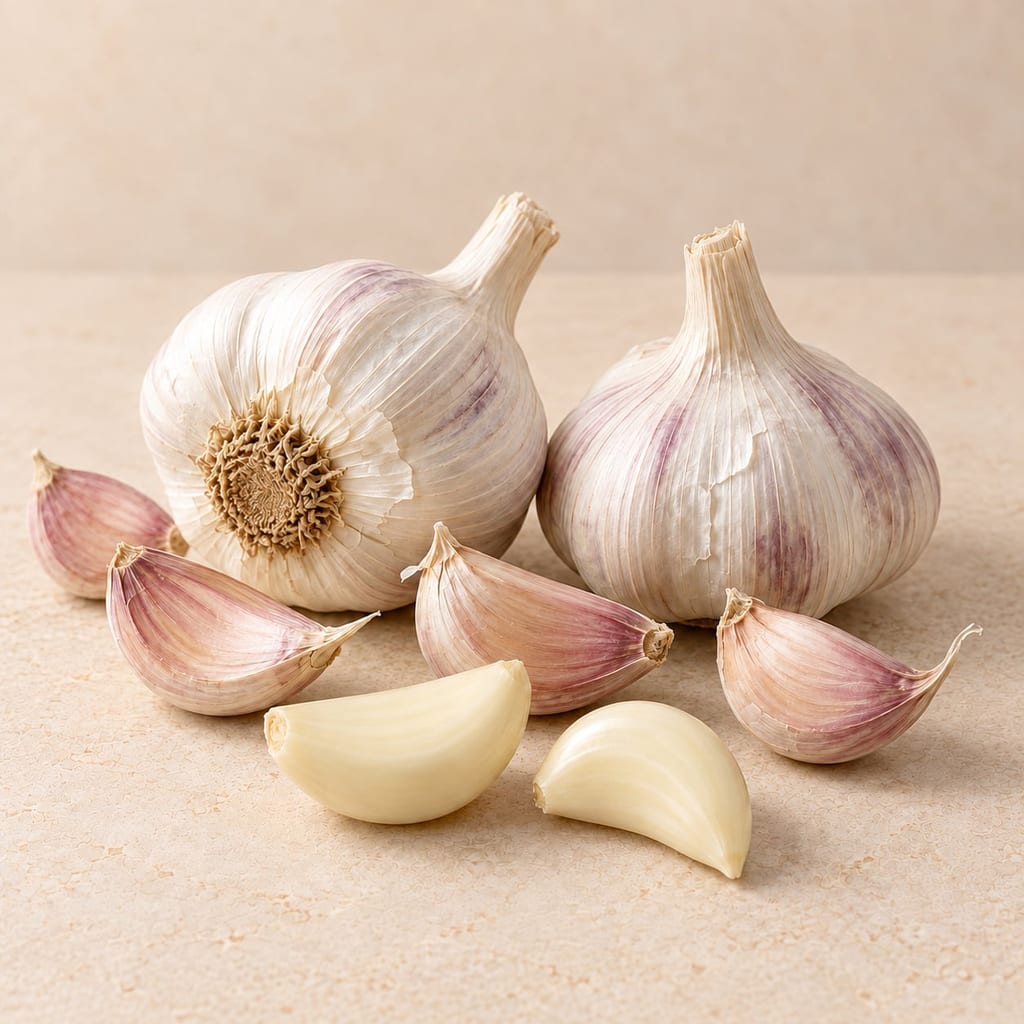
Garlic cloves are the separate bulblets of Allium sativum, pungent only once cut. They flavour herb salts, ferments such as Thai som-fak, and countless cooked dishes.
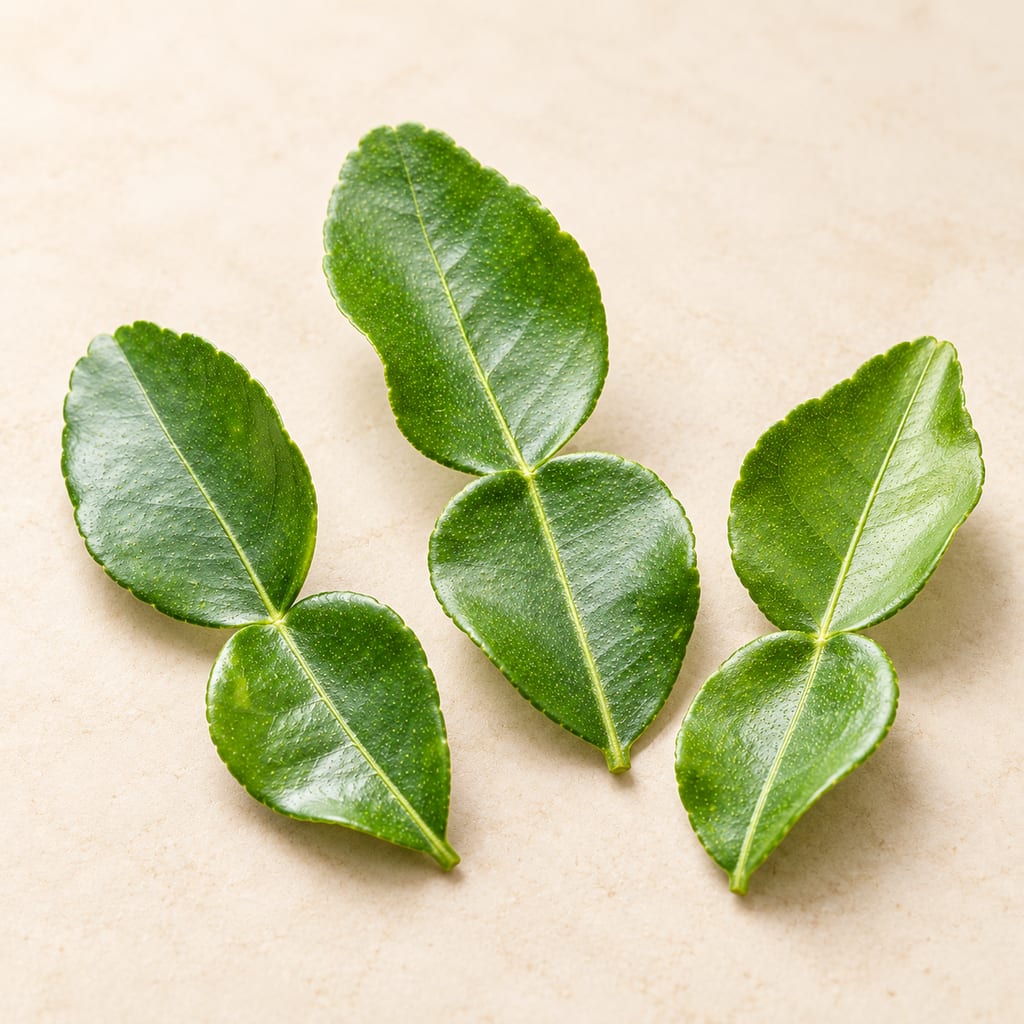
Kaffir or makrut lime leaves are the aromatic foliage of Citrus hystrix, used whole for infusion or finely cut in soups, curries and seasonings.
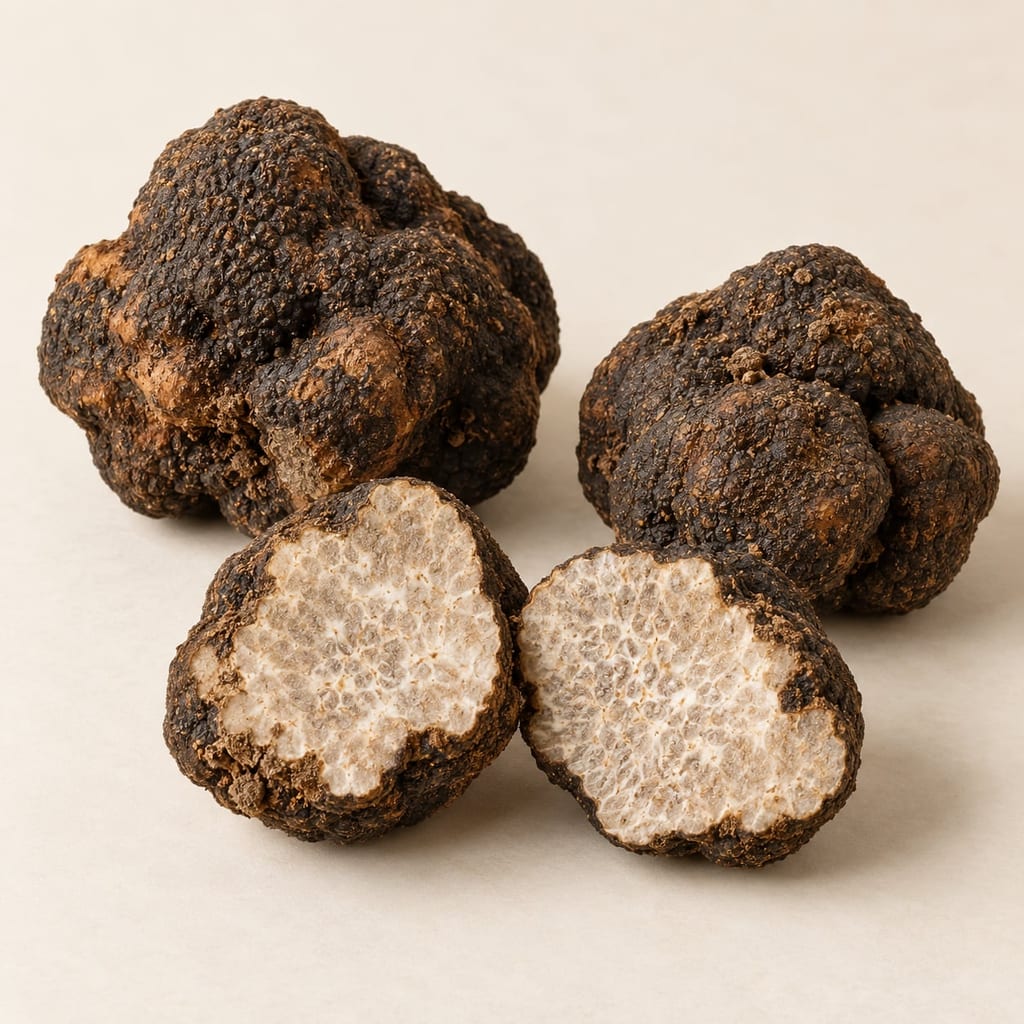
Kalapuya brunnea, the Oregon brown truffle, is a native truffle of the Pacific Northwest that is shaved raw over warm food. Sources describe it as a gourmet edible, and its safe identification needs an expert.
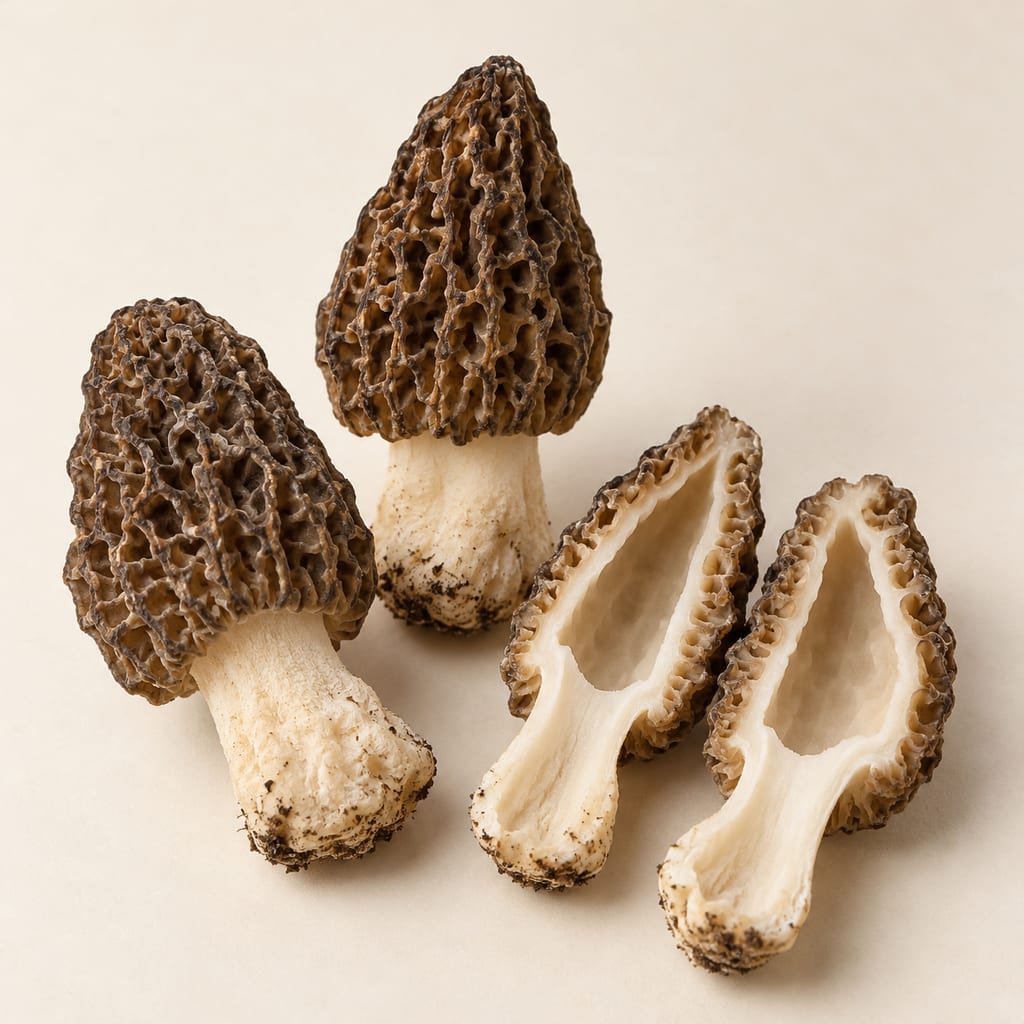
Morchella snyderi, Snyder's morel, is a true morel found under conifers in western North America in spring. It is eaten only well cooked, because raw or undercooked morels can cause serious illness.
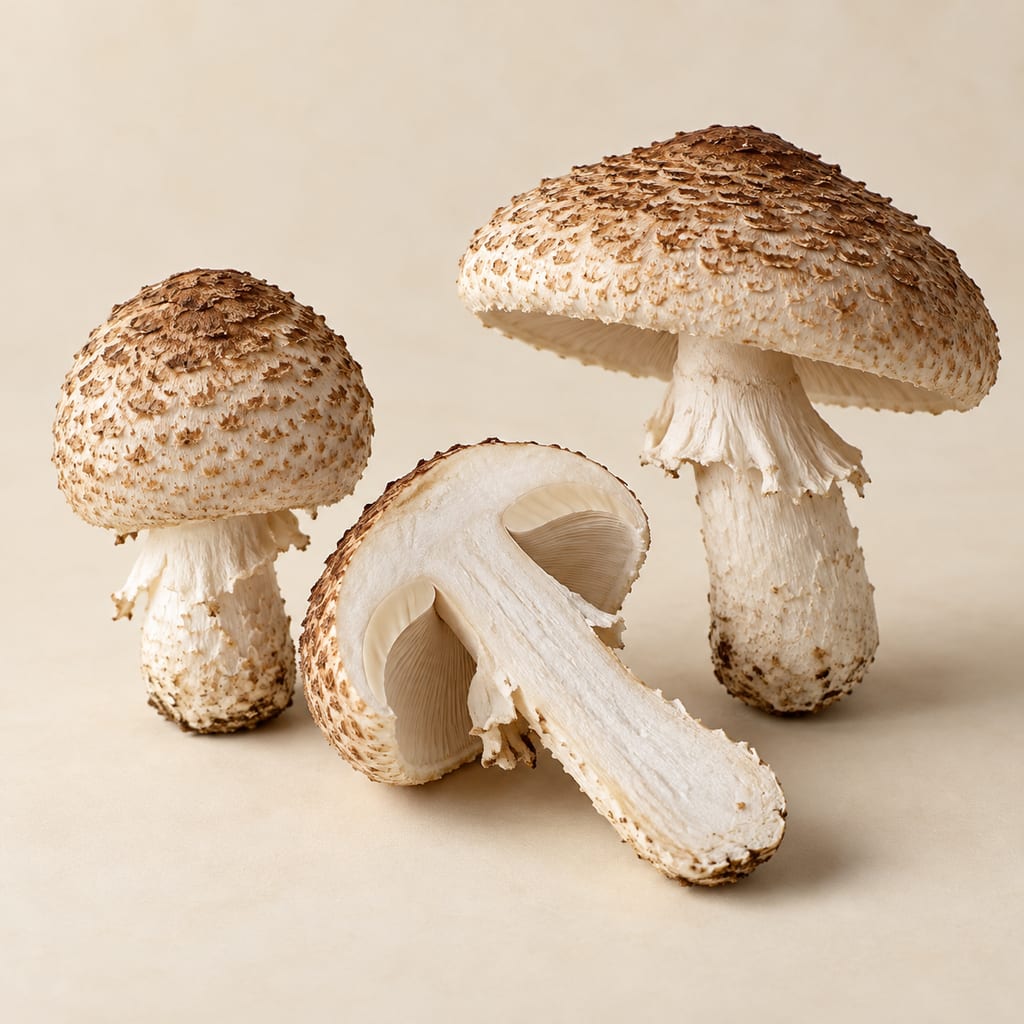
The prince (Agaricus augustus) is a large wild mushroom with a pale, brown-scaled cap and sweet almond-like aroma. Field guides describe it as edible, with species-specific contaminant cautions.
No community contributions have been published for this entry yet.
Sign in to contribute. Published comments and photos are free to read.
FAOIngredient context
Milk compositionSpecies, breed, feeding, lactation and seasonal variability; goat milk uses by region; general comparison with cow milk.
Cited in: A dispersed food rather than a uniform liquid; Dairy use and dietary identity
NCBIIngredient context
Taxonomy browser: Capra hircusDomestic goat scientific name; nomenclature resource, not milk analysis.
Cited in: An old dairy food in a modern milk bottle
Science / PubMedIngredient context
The initial domestication of goats (Capra hircus) in the Zagros mountains 10,000 years agoPrimary abstract only, personally read indexed full abstract: western Iran, selective young-male harvest, approximately 10,000 calibrated years; not evidence of goat milking.
Cited in: An old dairy food in a modern milk bottle
Nature / PubMedIngredient context
Earliest date for milk use in the Near East and southeastern Europe linked to cattle herdingPrimary abstract and paper excerpt: pottery lipid evidence, seventh millennium BCE, northwestern Anatolia association with cattle; not goat-specific milk proof.
Cited in: An old dairy food in a modern milk bottle
United States Public Health ServiceIngredient context
National Inventory of Needs for Sanitation Facilities II: Milk Pasteurization FacilitiesPublic Health Reports 11 February 1944, printed pp193–194: Pasteur wine/beer work, 1893 Straus depot and continuous-flow equipment history; retrospective institutional history.
Cited in: Heat treatment changes the dairy chain
Summerhill Goat DairyIngredient context
Summerhill Goat Dairy: products and frequently asked questionsHanford California on-farm HTST pasteurization, not ultra-pasteurized and no mechanical homogenization; producer process claims only, no marketing health assertions used.
Cited in: Heat treatment changes the dairy chain; Fat globules and homogenization
FAOIngredient context
Small-Scale Dairy Farming Manual, Small Scale Cheese MakingGeneral casein, acid/enzyme coagulation, calcium, whey drainage, clean equipment and cleaning-residue interference. Not a measured C20G batch.
Cited in: A dispersed food rather than a uniform liquid; Milk sugar feeds a culture; proteins build the curd; Drainage reveals the milk's different fractions; Choosing and keeping a supply
Foods / MDPIIngredient context
Rheology and Microstructures of Rennet Gels from Differently Heated Goat MilkOriginal 2020 article personally read via complete publisher PDF mirror https://pdfs.semanticscholar.org/e4e7/1dcf3c45a5c3ef664cdb008abc63ba0a0cef.pdf; experimental heating changed gel structure. No experimental values imported into recipe.
Cited in: A dispersed food rather than a uniform liquid; What heating preserves and what it changes
New England Cheesemaking Supply CompanyIngredient context
Chevre (Goat Cheese) RecipeGoat milk not ultra-pasteurized; combined culture/coagulant, calcium chloride named without dose, gravity drainage and continuing acidification.
Cited in: What heating preserves and what it changes; Milk sugar feeds a culture; proteins build the curd; Drainage reveals the milk's different fractions; Choosing and keeping a supply
Dairy ConnectionIngredient context
NEC-C20G Chevre Starter Culture product description sheetBoth pages personally read: lactic bacteria plus Rhizomucor miehei-derived coagulant, general functions; no live mould inference.
Cited in: Milk sugar feeds a culture; proteins build the curd
US Food and Drug AdministrationIngredient context
Raw Milk Questions & AnswersPasteurization controls pathogens, leaves lactose and allergenic proteins, and refrigeration remains necessary. No invented shelf life.
Cited in: An old dairy food in a modern milk bottle; Heat treatment changes the dairy chain; What heating preserves and what it changes; Dairy use and dietary identity
Dairy Farmers of CanadaIngredient context
Power Up! Cooking with Milk Products & Eggs: Product Cards, goat milk2018 card p13 personally read: purchase and cold storage practices, dairy uses, lactose and allergy cautions; no universal shelf life.
Cited in: Choosing and keeping a supply; Dairy use and dietary identity