
Microwave-assisted thermal sterilisation system
MATS uses microwave energy and pressurised hot water to heat sealed food packages in an industrial process. Product and package geometry affect heating; it is not a domestic microwave canner.
 FermenteaWhere food goes to change
Substrates
Lentils are the flat, lens-shaped seeds of Lens culinaris, a legume first cultivated in Southwest Asia 8,000 to 10,000 years ago. They are cooked whole, dehulled, split or milled into flour.
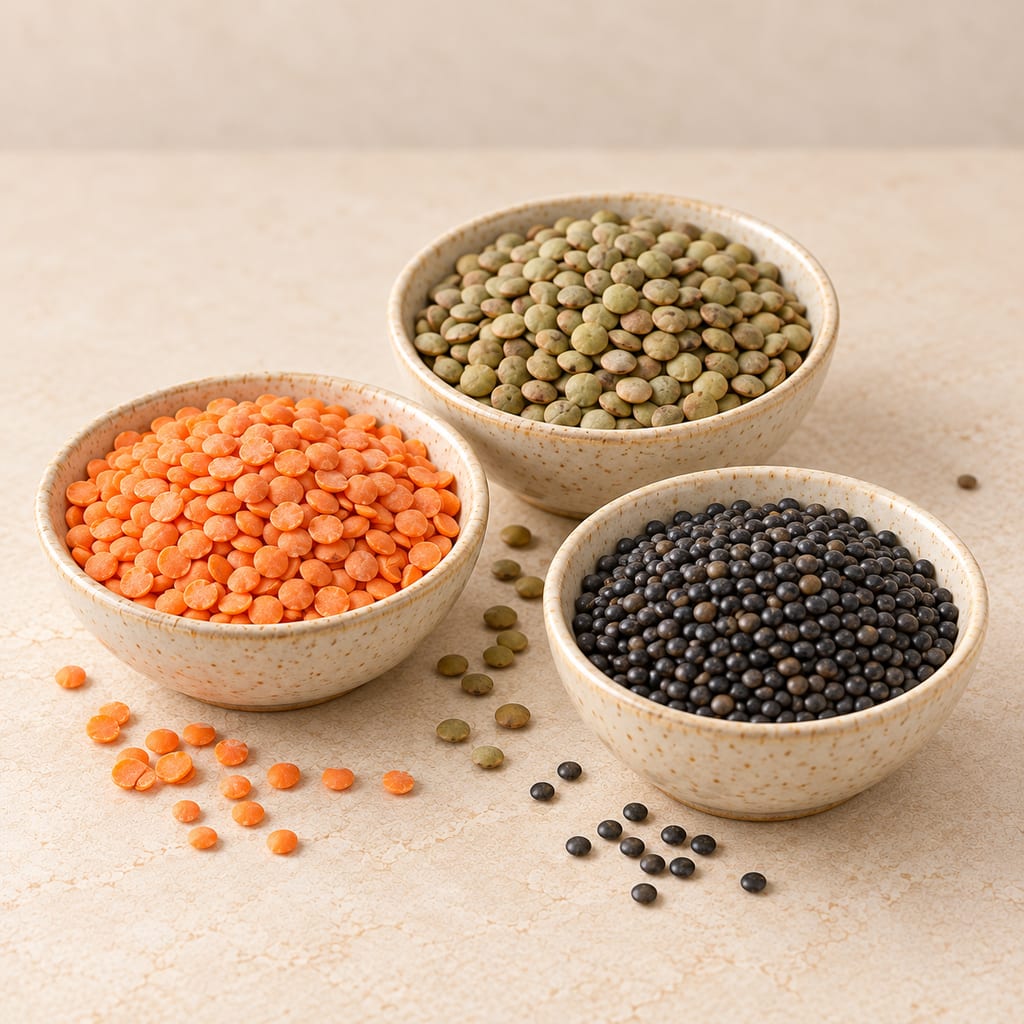
A lentil is the seed of Lens culinaris, a short, slender legume of 20 to 65 centimetres with compound leaves that end in tendrils and small white, lilac or pale blue flowers. The flowers pollinate themselves and each pod holds one or two seeds, which are flat, round and lens-shaped; the Latin word for the lentil, lens, gave its name to the optical lens. Lentils belong to the pulses, the dry edible seeds of legumes, along with peas, chickpeas and dry beans. The plant has an indeterminate habit and keeps flowering until stress or the season stops it, and much of its seed develops on branches from the middle and lower parts of the main stem.
The seed is sold in many forms. Whole lentils keep their coat; dehulled lentils have lost it; split lentils have separated into their two halves, the cotyledons. Green and brown lentils are often eaten whole, while red lentils are mostly dehulled and split. Grain-grading rules in Canada divide lentils into two classes by the colour of the cotyledon, which may be red, yellow or green: red lentils, and lentils other than red. Within them, types are defined by seed-coat colour or a particular trait, such as black, tan or speckled green. Red varieties have reddish-orange cotyledons under a grey, pale green or brown coat; green varieties have greenish cotyledons under a grey, green, brown or black coat.
Named varieties divide further by size. Canadian breeding lists large green types such as Laird, medium green types such as Richlea and small green types such as Eston, and the market also knows French green, Spanish brown, LeMay and Peridot. A name on a bag is a clue to size and cooking behaviour more than a fixed recipe. The Latin name is the origin of the word in several languages; in Czech the lentil is čočka, in Hindi masoor (मसूर), in Arabic ʿadas (عدس) and in Turkish mercimek.
Lentils were first cultivated in Southwest Asia some 8,000 to 10,000 years ago. The wild ancestor is Lens culinaris subsp. orientalis, which still grows in Southwest Asia and occasionally in Central Asia and Cyprus, and a 2021 genetic study of 190 accessions, 67 of them wild, concluded that it is the sole wild progenitor of cultivated lentil, with negligible input from other wild species.
The archaeology reaches back much further than farming. Wild lentils were gathered at Ohalo II in Israel 23,000 years ago, at Abu Hureyra in Syria between about 13,400 and 11,350 years ago and at Mureybit in Syria between 11,800 and 11,300. Plants of the wild type were cultivated before they were domesticated, at Jerf el Ahmar in Syria and Netiv HaGdud in the Jordan Valley, both about 11,000 calibrated years ago. By 10,100 to 9,700 calibrated years ago a hoard of more than a million carbonised lentils from Yiftah'el in Israel, mixed with weed seeds, shows the crop was widely grown, and in the southern Levant lentil became the most widespread legume of the pre-pottery Neolithic. Later Neolithic villages at Jarmo in Iraq, Tepe Sabz in Iran and Girikihaciyan in Turkey also held lentil remains.
The genetic study read 87,647 variable sites across the genome and found four groups in the genus Lens. Wild orientalis splits into two: one from Central Asia, Cyprus and southeastern Turkey, and one from Syria, Jordan, the Caucasus and western Turkey, which is genetically closer to the cultivated lentils. The cultivated lentils fall into three geographic groups, and the study infers two domesticated gene pools in Southwest Asia. One, running from Turkey east, travelled through Iraq and Iran to Central Asia and the Indian subcontinent, where lentil became a staple of the Harappan civilisation; the other, centred on the southern Levant, spread from there to the Arabian Peninsula, the Horn of Africa and North Africa. Lentils were among the first crops introduced to Europe and Egypt when farming left the Fertile Crescent, and by the fifth millennium BCE they were already adapted to the colder, wetter climate of Central Europe and grown by Linear Pottery farmers. Gene flow between the crop and its wild relative has been very low. Researchers who revisited the concept of Neolithic founder crops add that the plants people exploited first, the plants they first cultivated and the crops that spread to Europe need not be the same list, so lentil's story is one strand in a longer experiment, not a single event.
Rome knew lentils as a seasoned dish. The lentil chapter of Apicius, in its 1936 English translation, gives recipes with herbs and mixtures of vinegar, honey, reduced must, broth and oil, and one with leeks and green coriander. The entry headed lentils and chestnuts leaves lentils out of its text, which the translator took as a link to the recipe that follows.
Lentils fix nitrogen in the soil, which lowers fertiliser needs and makes them useful in crop rotation. In Canada, lentils entered production in the late 1960s as an alternative to leaving land fallow. More than 95 percent of the Canadian crop is grown in Saskatchewan, on a harvested area of about a million hectares across the country, and a record 1.947 million tonnes came in 2010. Canada has been the largest lentil exporter since 2005 to 2006, with over 80 percent of global exports. Breeding is done mainly at the Crop Development Centre of the University of Saskatchewan, and over 35 varieties are registered.
Breeders select for the factory as well as the field. For red lentils the province's guidance singles out dehulling and splitting performance alongside adaptation and yield, since the thickness of the seed and its behaviour in processing decide how much saleable product a tonne yields. A lentil crop that is perfect in the field but breaks in the dehuller is not a good crop for the red-lentil market.
Lentils are traded by class and type. The Canadian Grain Commission sets the grading standards, and its inspectors check the class by eye: the cotyledon, the part left when the coat is removed, decides whether a lot is red, yellow or green. The distinction matters because red lentils are processed by dehulling and splitting, while green lentils are mostly sold whole, so the two classes go to different mills and different kitchens.
Dry lentils are 47 to 65 percent carbohydrate, 20 to 33 percent protein, 2 to 4 percent minerals and a little over 2 percent fat. The carbohydrate is soluble and insoluble fibre together with starch. The protein is rich in leucine, lysine, threonine and phenylalanine and low in the sulphur-containing amino acids methionine and cysteine. Lentils are a good source of potassium, phosphorus, magnesium, calcium, selenium and folate. A figure for dry weight cannot be carried over to cooked lentils, which have taken up water.
Removing the coat changes the proportions. A review of lentil processing explains that seed coats and cotyledons differ in composition: dehulling reduces fibre and compounds concentrated in the hull and raises, in proportion, what lies inside, without creating any protein or starch. Milling makes a flour with finer particles and more broken tissue, which behaves with water and with digestive enzymes differently from intact seed.
Raw lentils carry compounds that interfere with digestion, among them trypsin inhibitors and lectins. Cooking destroys them. Health Canada lists lentils among the legumes that contain lectins in varying amounts; its detailed directions of soaking at least five hours and vigorous boiling for at least ten minutes are written for dry red kidney beans, which carry far more of a particular lectin, and they should not be transferred to lentils. Canadian guidance for lentils is shorter: most lentils are soaked and then cooked for 10 to 30 minutes, and some newer Canadian varieties cook fast enough to need no soaking.
A study of Canadian pulses measured what soaking and cooking do to anti-nutrients. Across the pulses tested, soaking reduced lectins by 0.11 to 5.18 percent and total oxalate by 17.4 to 51.9 percent and left phytic acid unchanged, and cooking removed more than soaking did for all of them except phytic acid in common bean and soybean. The oxalate range given for lentils is 168.6 to 289.1 milligrams per 100 grams. The lectin and phytate figures cover all the pulses together and do not belong to lentils alone.
Lentils are mostly cooked and eaten as they are, and the sources reviewed describe lentil fermentation chiefly as processing experiments and as the base of a few traditional preparations, not as a staple fermented food of its own.
Lentils are nonetheless fermented. A review of lentil processing describes experiments in which lentil material was fermented with selected organisms, among them the mould Rhizopus oryzae, the same genus that makes tempeh, and the lactic acid bacterium Lactobacillus plantarum. The fermentations break proteins into peptides and amino acids and change phenolic compounds, and results differ among studies, so it is not true that fermentation improves every property of every lentil food. The Canadian Encyclopedia lists fermented beverages among the uses of lentil flour. Two preparations start from lentils: tempeh made with chickpeas, lentils and other pulses, which keeps the soybean tempeh method but changes the cooking and moisture preparation, and bari and wadi, the dried lentil dumplings of South Asia.
Germination is another route that is easily confused with fermentation. A seed that takes up water and begins to sprout mobilises its own stored starch and protein with its own enzymes and changes the composition and behaviour of a flour made from it. That is the seed's metabolism, not a microbial one; a swollen lentil proves nothing about fermentation.
Lentils are cooked whole, split or milled across a wide belt of cuisines. In South Asia, dal is split lentils cooked into a thick, spiced stew and eaten with rice or flatbread. In the Levant, mujaddara combines lentils with rice; in Egypt, kushari is a rice and lentil dish described as the national dish; in Ethiopia, misir wot is a lentil stew eaten with injera. Lentil soup is found throughout Europe and the Americas.
Lentils are used mainly as human food and only in small part as livestock feed. Green lentils are eaten whole or split, and they go into soups, stews, salads and canned products. Lentil flour is used in breads, pastries, cakes, meat products, extruded products and cereals, and the high protein content and quality make lentils a common meat extender or substitute. Goodlok, a maker of fermented seasonings, suggests duck garum as a seasoning for lentils, a serving suggestion for the finished sauce and not evidence that lentils are an input.
Lentil is a recognised allergen: the review of lentil processing discusses identified lentil proteins that provoke reactions. Cooking changes texture but does not make lentils safe for people allergic to them. Milling or splitting does not change that either, so lentil flour, split lentils and any seasoning or snack made with lentils belong on an ingredient list as plainly as the whole seed does.
Some matters remain open in the sources. The place and number of domestication events are uncertain, the first date of lentil fermentation foods is unknown, and no source read for this page gives production figures current to the year, shelf lives for stored lentils or lentil-specific anti-nutrient reductions from soaking, germination or fermentation.
lentil
Region of first cultivation; the sources do not fix a single place or number of domestication events.
Lentil was a staple of the Harappan civilisation, reached by the eastern gene pool.
Lentil was grown by Linear Pottery farmers, adapted to a colder, wetter climate.
More than 95 percent of the Canadian crop; Canada has been the largest exporter since 2005 to 2006.
MATS uses microwave energy and pressurised hot water to heat sealed food packages in an industrial process. Product and package geometry affect heating; it is not a domestic microwave canner.
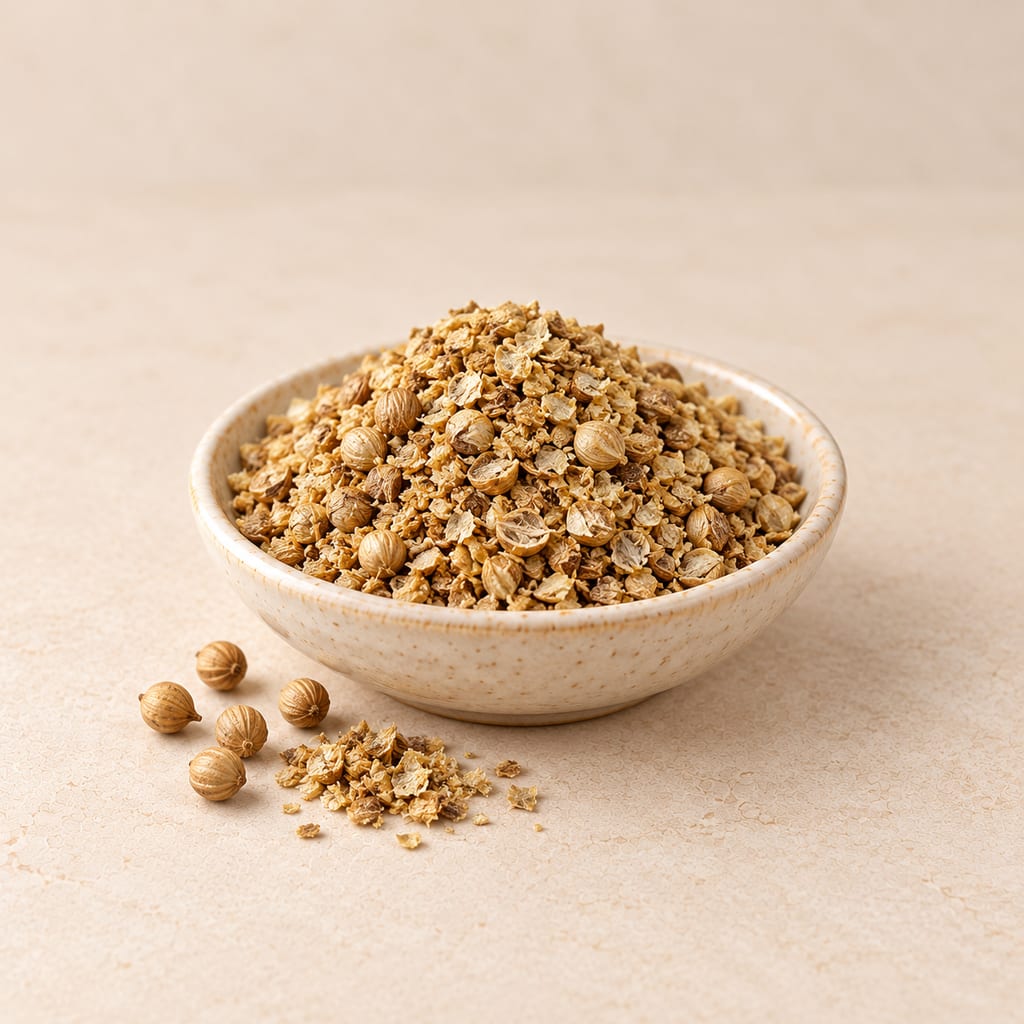
Crushed coriander seed is the ripe, dried fruit of Coriandrum sativum broken into coarse aromatic pieces for curries, sauces and meat seasonings.

At North Abydos in Egypt, a fixed early Dynastic brewery comprised parallel semi-subterranean installations with rows of ceramic mash vats; excavation reports revise their number, scale and estimated batch capacity.

Ají amarillo is the orange-yellow Peruvian chilli cultivar group of Capsicum baccatum, used to colour and season huancaína sauce and ají de gallina. Published heat estimates do not establish one range for the named cultivar.

Toasted almonds are whole sweet almond kernels dry-roasted until golden to brown. Heat replaces their marzipan note with a roasted, nutty one; they thicken and flavour romesco.

Kodiak salmon, halibut and cod cut as seg'aq and hung on an initaq rack to become tamuuq, with kac'amaasaq and kupcuunaq named as different results.

Aniseed is the dried ripe fruit of Pimpinella anisum, an aromatic Apiaceae spice commonly called a seed. It adds a sweet, warm aroma to breads such as Moroccan krachel and South African mosbolletjies, and is distinct from star anise.

A fixed Late Chalcolithic installation in Areni-1 cave combined a shallow clay pressing basin with a large jar set into the cave floor and storage vessels nearby.

Ripe avocado flesh is the soft, buttery, fat-rich pulp of Persea americana, eaten raw. It is low in acid, so it is a fresh ingredient that needs care in chilled dishes.

A portable dome and pan used over a hearth, with embers on the lid and heat from below. Regional peka and saç forms share this principle while differing in materials, pan shape and how the food is cooked.
No community contributions have been published for this entry yet.
Sign in to contribute. Published comments and photos are free to read.
Goodlok PlayIdentity · Processing
Duck garumLentils appear as a serving suggestion for duck garum. Their variety, form and preparation are unspecified, and they are not identified as a garum input.
Cited in: Lentils in the kitchen
Frontiers in Plant Science12:628439Identity · Processing
The History of Lentil (Lens culinaris subsp. culinaris) Domestication and Spread as Revealed by Genotyping-by-Sequencing of Wild and Landrace AccessionsFirst cultivated in Southwest Asia 8,000 to 10,000 years ago; subsp. orientalis sole wild progenitor; wild gathering at Ohalo II, Abu Hureyra, Mureybit; pre-domestication cultivation at Jerf el Ahmar and Netiv HaGdud; Yiftah'el hoard; two domesticated gene pools; spread to Europe, Egypt and the Indian subcontinent
Cited in: One of the first crops
Vegetation History and Archaeobotany32:475–499Identity · Processing
Revisiting the concept of the ‘Neolithic Founder Crops’ in southwest AsiaThe plants most exploited, first cultivated or domesticated, and later spread into Europe need not be the same group of crops
Cited in: One of the first crops
Legume Science5(1):e156Identity · Processing
Nutrient profile and effect of processing methods on the composition and functional properties of lentils (Lens culinaris Medik): A reviewComposition and processing: dehulling, splitting, milling, cooking, germination and microbial fermentation (Rhizopus oryzae, Lactobacillus plantarum) with variety- and study-dependent results; identified lentil allergens
Cited in: What is inside a lentil; Lentils and fermentation; Allergy and what is not settled
Government of SaskatchewanIdentity · Processing
Red LentilsIndeterminate growth, self-pollination, pods with one or two seeds, breeding for red-lentil dehulling and splitting
Cited in: The small lens-shaped pulse; Growing the crop
LacusCurtius transcription of Cookery and Dining in Imperial Rome, Walter M. Hill1936Identity · Processing
De re coquinaria, BookV: LentilsSeasoned lentil dishes in the 1936 English translation of Apicius; the lentils and chestnuts entry omits lentils in its text
Cited in: Lentils in the kitchen
Health CanadaIdentity · Processing
Lectins in Dry LegumesLentils are listed among legumes containing lectins in varying levels; soaking and boiling directions are for red kidney beans
Cited in: What is inside a lentil
The Canadian Encyclopedia (Historica Canada)Botany · Production · Composition · Cooking
LentilPlant 20 to 65 cm, pods with one or two seeds; Canadian production from the late 1960s, over 95 percent in Saskatchewan, record 1.947 Mt in 2010, over 80 percent of global exports since 2005-06; over 35 varieties; nitrogen fixation
47 to 65 percent carbohydrate, 20 to 33 percent protein, 2 to 4 percent minerals, over 2 percent fat; low in methionine and cysteine
Most lentils soaked then cooked 10 to 30 minutes; cooking destroys trypsin inhibitors and lectins; some varieties need no soaking; lentil flour used in fermented beverages
Cited in: The small lens-shaped pulse; Growing the crop; What is inside a lentil; Lentils and fermentation
Canadian Grain Commission, Official Grain Grading GuideMarket classes
Lentils: classes, types and varietiesTwo classes, red and other than red, by cotyledon colour (red, yellow or green); types by seed-coat or cotyledon colour or a trait such as black, tan or speckled green
Cited in: The small lens-shaped pulse
Food Research International 107:660-668Anti nutrients
Changes in levels of phytic acid, lectins and oxalates during soaking and cooking of Canadian pulsesSoaking reduced lectins by 0.11 to 5.18 percent and total oxalate by 17.4 to 51.9 percent across pulses and did not change phytic acid; cooking more effective except phytic acid in common bean and soybean; lentil total oxalate 168.6 to 289.1 mg per 100 g
Cited in: What is inside a lentil
Wikipedia (tertiary; cited only for the dishes named)Culinary use
LentilDal, mujaddara, kushari and misir wot named as lentil dishes; no better source for the dish list was found
Cited in: Lentils and fermentation; Lentils in the kitchen
WiktionaryNames
čočkaCzech čočka, inherited from Old Czech sočovicě; also the optical lens
Cited in: The small lens-shaped pulse
WiktionaryNames
lensLatin lēns, lentil; the optical lens is named from it
Cited in: The small lens-shaped pulse