Overview
Russula compressa is a brittlegill recorded in the institutional edible-fungi inventory for tropical Africa. It is a wild, ectomycorrhizal mushroom of open forest and miombo woodland, and the catalogue records it in several countries from Benin to Zimbabwe.
The species page from the Edible Fungi of Tropical Africa project describes the mushroom but does not describe food use or preparation. The inventory record is the basis for the edible label, and the catalogue states that preparation, identity and current safety need separate validation.
Sources for this section
Description
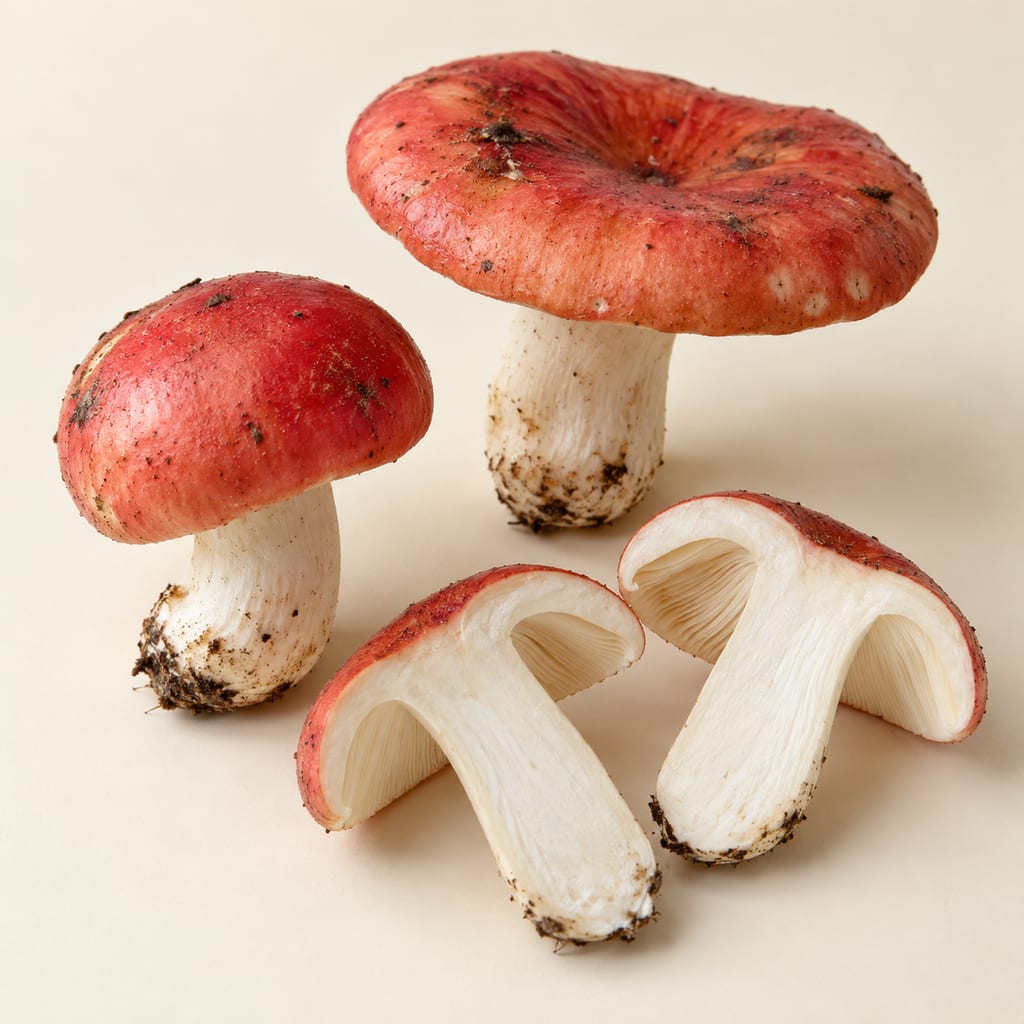
The cap is 50 to 70 millimetres across, entirely red with a darker centre, smooth and slightly sticky when wet. The stipe is 55 to 65 by 10 to 20 millimetres, white to greyish, without a ring, and it becomes hollow with age. The gills are 4 to 6 millimetres wide, white at first and sometimes creamy-yellow near the cap. The flesh is brittle, and the taste is mild. The description records an unpleasant, fish-like odour. The spore print is white to creamy, and the spores are ellipsoid with amyloid warts that do not form a network.
Sources for this section
Ecology and hosts
Russula compressa is ectomycorrhizal. The EFTA page lists Uapaca kirkiana, Julbernardia paniculata, J. globiflora, Brachystegia spiciformis and Marquesia macroura as its hosts. It occurs in open forest, miombo and muhulu. The catalogue records the supply as wild.
Sources for this section
Identification
The EFTA page says R. compressa looks much like R. congoana. It differs by its larger size, weak yellowing and a totally white stipe without any red or pink tinge. Russula species are hard to separate in the field, and the catalogue advises that the name be checked against current taxonomy before any record is used.
Sources for this section
How to recognise a brittlegill
A mushroom is a brittlegill, a Russula, only when several features line up. The cap is usually brightly coloured. The gills are brittle: they snap when you try to bend them, and the flesh breaks cleanly like chalk instead of tearing into fibres. The stem carries no ring and no cup or sack at its base, and there are no veil remnants on the cap. The gills are attached to the stem, and a spore print is white, cream or dark yellow.
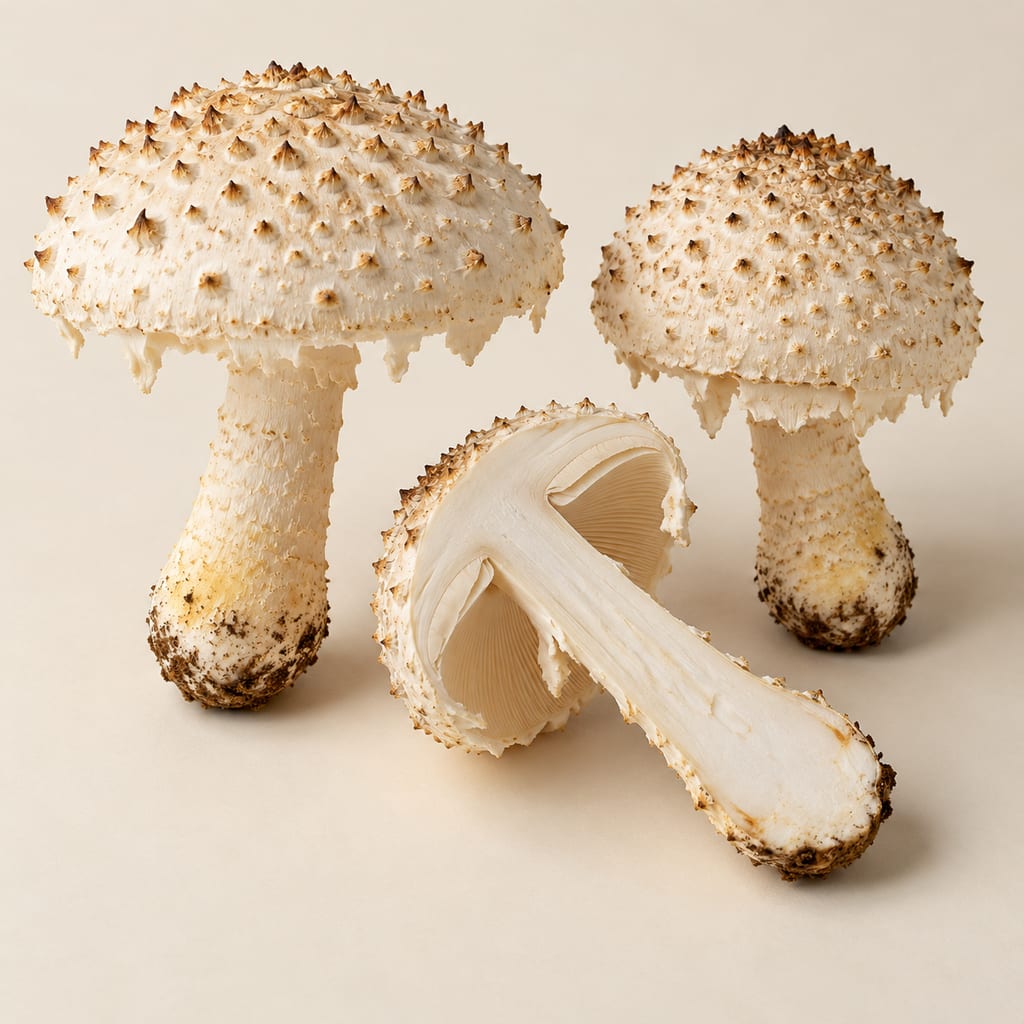
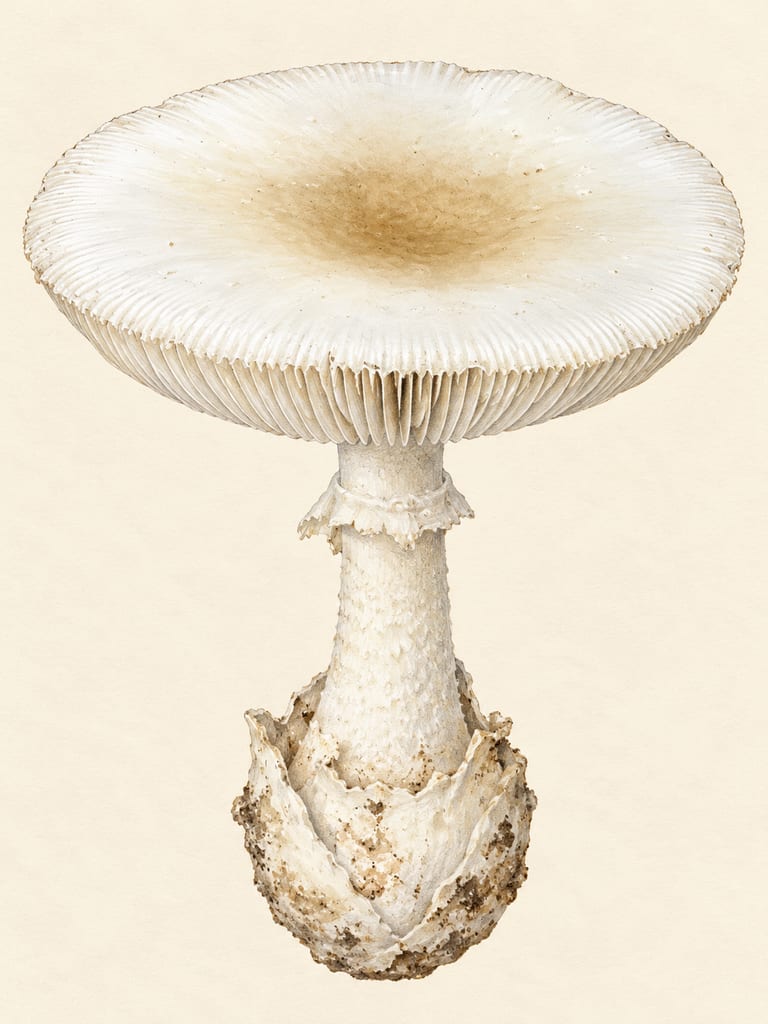
Two checks separate Russula from its look-alikes. Break a gill or cut the flesh: a brittlegill gives no milky juice, while a milkcap (Lactarius or Lactifluus) weeps latex. Then look at the stem. A ring on the stem, a cup or a sack or bulb with torn remnants at its base, or flesh that tears in fibres points away from Russula and towards Amanita, a genus that includes the deadly death cap and many other poisonous species. A mushroom with a ring or a cup at the base is not a Russula, whatever colour its cap is.
Recognising the genus is much easier than naming the species. Cap colour varies widely inside one species, so experts rely on the colour of the spore print, the taste, colour changes in the flesh, how far the cap skin peels, chemical tests and the microscope. A collector who is sure of the genus but not of the species should treat the species as unidentified.
Sources for this section
The taste test, and what it cannot tell you
Foragers have long sorted brittlegills by taste. Break off a small piece of cap flesh or gill, chew it for several seconds and spit it out without swallowing; the burn of an acrid species can take half a minute to build. Brittlegills that taste mild are the traditional edibles. Those that taste hot, peppery or acrid, and many bitter ones, are left alone because they irritate the stomach and bowel and can cause vomiting and diarrhoea.
The method works only inside the genus. Use it once the mushroom is positively a Russula, never to decide whether an unknown mushroom is safe: the deadliest mushrooms do not taste unpleasant, and a mild taste says nothing about an Amanita, a Cortinarius or any other family. Within Russula it is a screen for rejecting species, not proof of safety. Some mild species are poor eating, rare species are poorly documented, and a few brittlegills have been linked with poisoning. Cook what you eat, start with a small portion, and identify to species where you can. This record is not a field guide.
Sources for this section
Food use and safety
The catalogue describes the species as African brittlegill recorded in the institutional edible-fungi inventory. It gives no preparation method, and the EFTA page gives no edibility statement of its own. The genus includes toxic species, so a listing in an inventory does not establish that a given collection is safe.
Do not use this page to identify or eat wild fungi. Confirm identification with a qualified mycologist or a reliable local authority before consumption.
Sources for this section
Places
Benin
Documented use · Country evidenceDistribution note from the EFTA page; not an origin claim.
Democratic Republic of the Congo
Documented use · Country evidenceDistribution note from the EFTA page; not an origin claim.
Miombo woodland, southern Africa
Documented use · Region evidenceHabitat region; not a food-use claim.