The plant behind the name
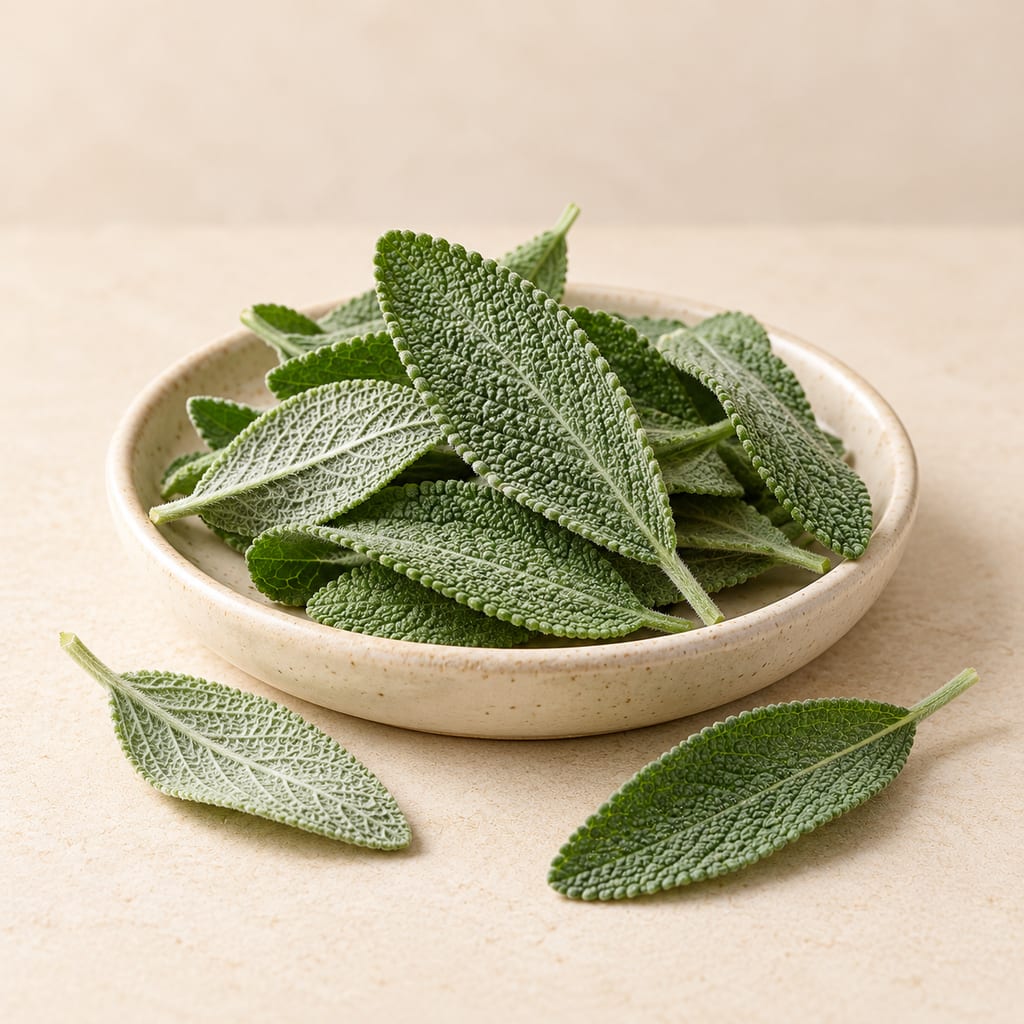
Kew accepts Salvia officinalis L., a perennial subshrub native from south-western Germany to southern Europe. The RHS calls this species common sage and the standard culinary sage. It distinguishes it from other plants whose common names include sage, such as Russian sage, pineapple sage and Turkish sage. Its guide also covers cultivated culinary varieties with different leaf colours, sizes and strengths, so a name like "sage" or a leaf-colour description alone does not establish a cultivar.
Sources for this section
Sage in European kitchens
Sage has a long written history, though its kitchen history is harder to document than its medical one. The Met Cloisters garden blog places the herb in the work of Theophrastus and Dioscorides, but the Dioscorides passage it describes concerns remedies such as diuretic and wound uses rather than cooking.
Culinary use appears later in the record. A UCL medieval garden account places sage in recipes from the fourteenth century onward. Most ordinary medieval cooking was pottage, and herbs of this kind flavoured it. Neither source gives quantities or a method, so this history records attested seasoning rather than a standard preparation.
Sources for this section
Leaves in cooking
The RHS describes the leaves as strongly aromatic, earthy and slightly peppery. It names sage-and-onion stuffing as a classic use and says leaves may be used fresh, dried or frozen. The guide does not provide a complete stuffing recipe with amounts, yield, ordered preparation, cooking endpoint or storage, so this is a food-use description rather than a cooking procedure.
Sources for this section
Growing in the RHS UK context
The RHS profile rates common sage H5 in its UK hardiness scheme, whose H5 band is -15 to -10 C. This is a regional horticultural category, not a measured survival cutoff or a guarantee for each cultivar or site. The RHS guide recommends a warm, sunny, sheltered position and free-draining soil. For a container it gives a minimum width and depth of 30 cm, drainage holes, soil-based peat-free compost and up to 25% horticultural grit by volume. It advises watering newly planted plants during dry spells in the first year; established plants in the ground are described as drought-tolerant, while pots should stay slightly moist but not saturated. The guide recommends spring planting, describes seed starting indoors, and gives softwood cuttings and layering as propagation options. These are UK home-gardening recommendations, not a global climate or greenhouse protocol.
Sources for this section
Food, oil and medicinal products
NCCIH says sage is likely safe in amounts commonly found in foods, while noting that high doses or prolonged use may be unsafe because some sage species, including S. officinalis, contain thujone. NCCIH separately says sage use during pregnancy may be unsafe and that little is known about breastfeeding; it does not translate this into a recipe-specific amount. EMA's statement that safety during pregnancy and lactation has not been established, and that use is not recommended, concerns its sage-leaf herbal medicinal products. It is not a general statement about culinary seasoning. EMA and NCCIH also distinguish ordinary food use from herbal preparations; distilled essential oil or concentrated extract should not be treated as interchangeable with leaves.
Sources for this section
What the sources do not establish
The sources do not provide a complete stuffing batch, a culinary dose, or a cultivar-by-cultivar thujone measurement for food. RHS hardiness and growing fields keep their UK horticultural scope; they do not establish a universal frost limit, heat ceiling, greenhouse method or expected yield. The medicinal monograph does not validate a food recipe.
Sources for this section
Places
South-western Germany to southern Europe
Documented use · Region evidenceNative range of the species from Kew; the food-use sources are not tied to one place.