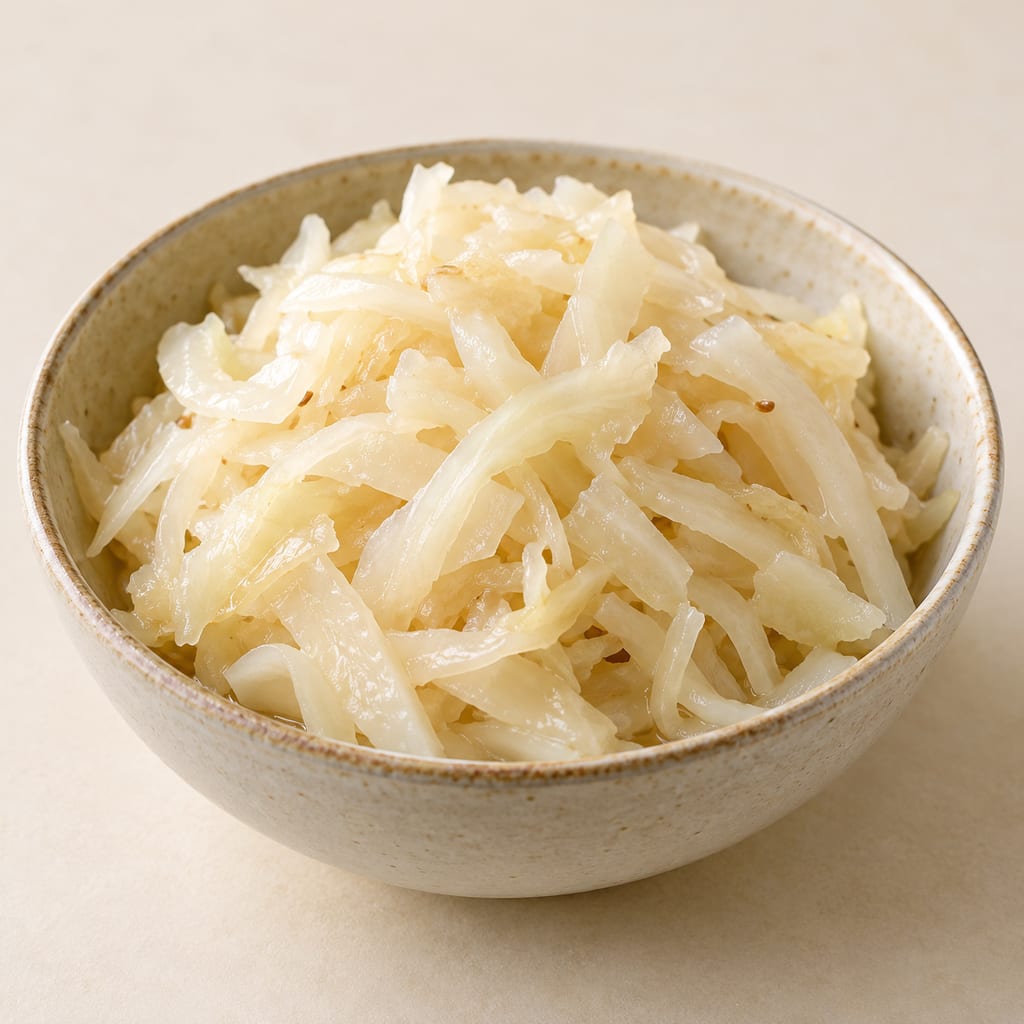
Sauerrüben
Swiss fermented white turnips, cut into strips, salted and fermented like sauerkraut; called compote aux raves in French-speaking Switzerland.
 FermenteaWhere food goes to change
Modern method
Sauerreuben
Shredded turnips and carrots are dry-salted, pressed beneath their juice and fermented as a cabbage-free kraut-style preserve.
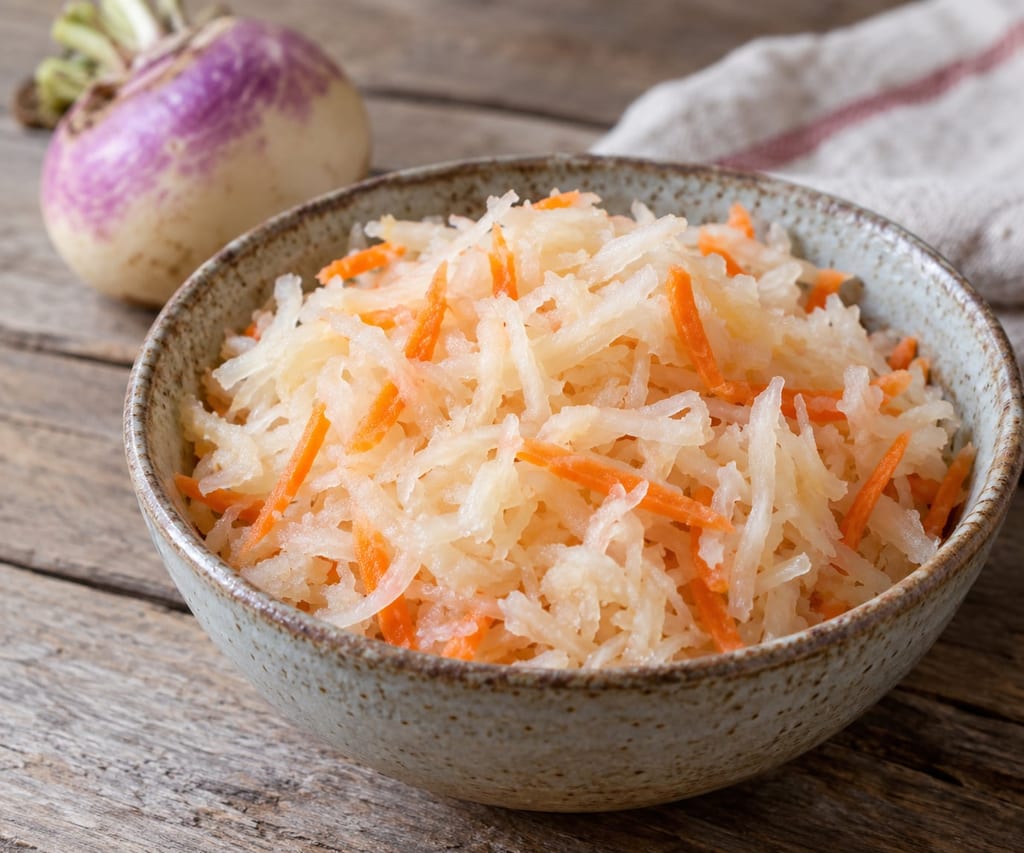
Sauerreuben, more commonly written Sauerrüben in German, is a fermented vegetable preparation made from turnips.
The name literally means sour turnips.
The process is closely related to that used for sauerkraut, but the principal vegetable is a root rather than cabbage.
The contemporary recipe recorded here uses shredded turnips and carrot, mixed with salt, packed beneath their own juice and allowed to undergo lactic-acid fermentation.
The result is a crisp, sour and mildly earthy vegetable relish that can be eaten cold or incorporated into cooked dishes.
Turnips belong to the species Brassica rapa, with the familiar cultivated turnip generally classified as Brassica rapa subsp. rapa.
The carrot is Daucus carota subsp. sativus.
Because turnips and carrots have different natural flavors and pigments, the resulting ferment has a character distinct from ordinary cabbage sauerkraut.
The turnip supplies mild brassica pungency and a firm structure.
The carrot contributes sweetness and color.
The recipe is notable for its relatively small batch size and its explicitly temperature-dependent fermentation schedules.
The documented formulation uses 1 lb turnips, ½ lb carrot and ½ oz salt.
Fermented turnips occur within central European vegetable-preservation traditions.
In German-speaking regions, the term Sauerrüben identifies a sour root-vegetable product.
Its broad technological relationship with sauerkraut is clear: shredded plant material is salted, compacted and fermented through the activity of lactic acid bacteria.
However, the specific recipe here is a contemporary publication by Ernest Miller, published by PBS SoCal in 2015.
The source does not claim that its turnip-and-carrot proportions derive from a particular German village, historical manuscript or dated household tradition.
The inclusion of carrot and the suggested serving applications reflect a modern recipe designed for a broad audience.
The history of European root-vegetable fermentation is older than this publication, but a precise origin date for the particular formulation is not established.
The original article explicitly compares sauerreuben with sauerkraut and curtido.
It also suggests serving the finished product with foods far beyond the German-speaking world.
That is a useful example of a traditional food technology being adapted to contemporary cooking.
Use fresh, firm roots.
The source permits different turnip varieties, including white and yellow forms, and refers to Swedish turnips or rutabagas as alternatives.
These are not always botanically identical.
Rutabaga or swede is commonly classified as Brassica napus var. napobrassica.
Ordinary turnip is Brassica rapa subsp. rapa.
Both can be fermented, but they differ in flavor, sugar content, color and texture.
The primary page should retain turnip as the principal ingredient rather than silently combining all these roots into one species.
Older, woody roots may produce a less pleasant texture than fresh, firm vegetables.
The original source recommends beginning processing within 24–48 hours of harvest for best results.
That is a freshness recommendation, not a safety critical limit.
Carrot brings a different plant chemistry to the mixture.
It contains sugars that contribute sweetness and can be used by fermentation microorganisms.
Orange varieties also contain carotenoids, responsible for their distinctive color.
The carrot makes the finished ferment more visually varied than a preparation made entirely from pale turnips.
It can also influence the flavor balance.
Turnips may be mildly pungent or earthy.
Carrot sweetness helps moderate those characteristics.
The original ratio uses one part carrot to two parts turnip by the stated weights.
That is an intentional part of the contemporary recipe, not an ingredient to omit when reproducing this version.
Salt draws moisture from the shredded vegetables.
As water is released, it dissolves the salt and creates the liquid in which the vegetables ferment.
This is known as dry salting.
The process differs from immediately pouring a large prepared brine over whole vegetables.
Because the roots are shredded, their surface area is relatively large and salt can contact them efficiently.
Salt also shapes the microbial environment.
Lactic acid bacteria can grow under appropriate salted conditions, while many competing microorganisms are inhibited.
However, final microbial safety depends on successful acidification as well as salt concentration.
The exact final salt level is affected by the amount of water in the vegetables and any supplemental brine added.
Shredding changes the geometry of the vegetable.
A whole turnip has a relatively low surface-area-to-volume ratio.
Salt applied only to its exterior would need time to penetrate deeply.
Shredded turnip exposes many internal surfaces.
Water and soluble compounds can move out more readily.
The thin pieces can also be packed tightly, reducing large air pockets.
This helps create conditions suitable for lactic-acid fermentation.
The source instructs grating or slicing the vegetables to a relatively thin consistency but does not establish a standardized millimeter thickness.
It describes a cut thickness of “a quarter,” without a clearly identified unit in the accessible text.
It would be inappropriate to invent a precise thickness from that ambiguous wording.
Use a knife or suitable grater, a clean bowl, fermentation jar and weight.
The source suggests a food-grade plastic bag filled with brine as a weight.
The bag presses the shredded vegetables beneath their liquid.
A suitable fermentation lid or loose closure is needed to accommodate gas production.
The original recipe specifies approximately 1½ inches of headspace.
A calibrated food pH meter is useful for assessing completion when fermentation is being relied upon for preservation.
Prepare the roots. Trim, wash and peel 1 lb turnips and ½ lb carrot.
Remove damaged portions. The vegetables should be fresh and firm.
Shred. Grate or finely slice the turnips and carrot.
Keep the pieces reasonably consistent so they pack evenly.
The exact cut thickness is not established by the source.
Add the salt. Combine the vegetables with ½ oz salt in a clean bowl.
Add optional spices only if making a separately identified variation.
Mix thoroughly with clean hands or suitable utensils.
Encourage liquid release. Continue mixing and lightly pressing the vegetables.
Salt draws moisture from their tissues. The source does not specify a preliminary standing time.
Pack firmly. Transfer the mixture into a clean fermentation jar.
Press down so the released liquid rises around the vegetables.
Leave approximately 1½ inches headspace. Weight the vegetables.
Use a suitable clean fermentation weight or the documented brine-filled bag method.
Keep the shredded roots below their liquid.
Floating shreds are more vulnerable to surface spoilage.
Add supplemental brine if needed. If the released vegetable juice does not cover the mixture, prepare brine using 1 oz salt per quart water.
Add enough to maintain coverage. The source does not require adding the full quart.
Close safely. Cover the jar in a way that allows fermentation gases to escape.
The original recipe specifies a loose lid.
Avoid creating uncontrolled pressure in a rigid closed container.
Ferment at the documented warmer range. At 70–80°F, the source gives approximately 5 days.
This is a source-specific schedule, not a universal proof of safe acidification.
Alternatively, ferment at the cooler range. At 60–65°F, the source gives 7–9 days.
The lower temperature generally slows the fermentation process.
Assess the product. The intended result is a sour, crisp fermented vegetable.
Reject products showing soft, slimy decomposition or disagreeable odor.
Proper acidity should be verified when safety depends on fermentation.
Refrigerate. Once fermentation is complete under suitable controls, keep tightly covered in refrigeration.
Refrigerated storage runs for several months, with no specific validated expiry date established.
The desired process is lactic-acid fermentation.
Organisms naturally carried by the vegetables can metabolize available sugars.
Lactic acid bacteria produce acids that lower the pH of the vegetable juices.
The broad microbial principles resemble sauerkraut fermentation.
Some early-stage organisms tolerate relatively mild acidity and may produce gas and other metabolites.
As the environment becomes more acidic, organisms with greater acid tolerance can become more important.
The exact microbial succession in this particular turnip-and-carrot formula has not been established by the recipe source.
It would be inaccurate to list specific species as confirmed members of every batch.
The key measurable transformation is acidification.
A changing sour flavor is evidence of chemical activity but does not independently prove that all microbial hazards have been controlled.
Turnips belong to the brassica family.
They contain glucosinolates that can contribute pungent flavor through their breakdown products.
The intensity varies with cultivar and growing conditions.
Cutting exposes plant cells and allows enzymes to interact with compounds previously separated within those cells.
Salting and fermentation then change the environment around those compounds.
Some substances move into the brine.
Others may be transformed chemically or by microbial activity.
This helps explain why fermented turnip tastes different from raw grated turnip dressed with vinegar.
The sourness is produced during fermentation rather than being introduced solely as an external acid.
Microbial growth and enzyme activity are temperature-sensitive.
At a warmer temperature, suitable fermentation organisms often grow and metabolize sugars more quickly.
This can shorten the period needed for noticeable acid production.
At cooler temperatures, the process may be slower.
The original recipe explicitly distinguishes the schedules:
Approximately 5 days at 70–80°F
Approximately 7–9 days at 60–65°F
These values should not be averaged into a single seven-day rule.
Nor should the warm range be interpreted as appropriate for every possible vegetable fermentation.
The schedule belongs to this particular published formulation.
A modern producer should establish an acidity endpoint appropriate to the intended product.
Sauerkraut traditionally uses cabbage.
Sauerreuben uses turnip.
Both may involve dry salting, compression and lactic fermentation.
But the plant tissue and flavor are different.
Cabbage leaves are thin layered structures, while turnip is a dense storage root.
Shredded turnip may have a different water-release pattern, sweetness and texture.
Carrot further changes the formulation.
The result is a root-vegetable pickle rather than a cabbage preserve.
The comparison is useful technologically, but the names should remain distinct.
Traditional fermented turnips can be prepared with different root varieties.
Swedes or rutabagas may be used, producing a somewhat different flavor and color.
Some recipes include spices.
Others rely only on salt and the vegetable.
The present recipe includes carrot, which is not mandatory for all historical sauerrüben.
Modern preparations may be eaten as a salad-like side dish or incorporated into sandwiches.
Different variations should be identified by their actual ingredients rather than grouped under one supposedly unchanged traditional recipe.
Sauerreuben can be eaten cold as a fermented salad or relish.
Its acidity pairs well with rich foods.
The original source suggests using it wherever coleslaw might otherwise be served.
It can accompany sausages, grilled food or sandwiches.
It also works as a substitute for sauerkraut on hot dogs or Reuben-style sandwiches.
Small portions can serve as banchan-style accompaniments to a meal.
This latter use is a modern culinary suggestion, not evidence that sauerreuben originated in Korea.
The vegetable can also be gently cooked, although heating changes texture and reduces viable microorganisms.
A satisfactory product is sour, crisp and recognizably vegetable-like.
Some brine cloudiness may occur.
Bubbles can develop as microorganisms produce gas.
The roots may soften slightly compared with their original raw texture, but should not become slimy or disintegrate.
The source explicitly advises discarding a batch that becomes soft, slimy or develops an unpleasant odor.
These are rejection signs, not a complete set of safety controls.
A product without visible defects may still be unsafe if fermentation has failed.
The measured ingredients and temperature schedules are useful, but the recipe does not give a final pH measurement.
General produce-fermentation guidance identifies adequate acidification, clean equipment and submersion as important controls.
The source's recommendation of refrigerated storage for several months is not a validated universal expiry date.
For commercial production, the final pH, salt content, microbial quality and refrigeration conditions need to be established.
The optional supplemental brine changes the total liquid and salt relationship, so it should be recorded if used.
The product is not intended for unrefrigerated storage in a sealed jar without further validation.
PBS SoCal describes sauerreuben as a turnip counterpart to sauerkraut but supplies no traditional regional origin for this recipe.
Scaling: source batch only
Poor brine coverage or contaminated equipment can compromise vegetable fermentation; this recipe has not been professionally validated.
Hazard sourceUse clean food-grade equipment, keep produce submerged where the method uses brine, and follow established acidity-monitoring guidance. No recipe-specific validated endpoint is supplied.
Control sourceUnknown documented preparation location. The contemporary recipe does not claim a traditional regional origin.
Swiss fermented white turnips, cut into strips, salted and fermented like sauerkraut; called compote aux raves in French-speaking Switzerland.
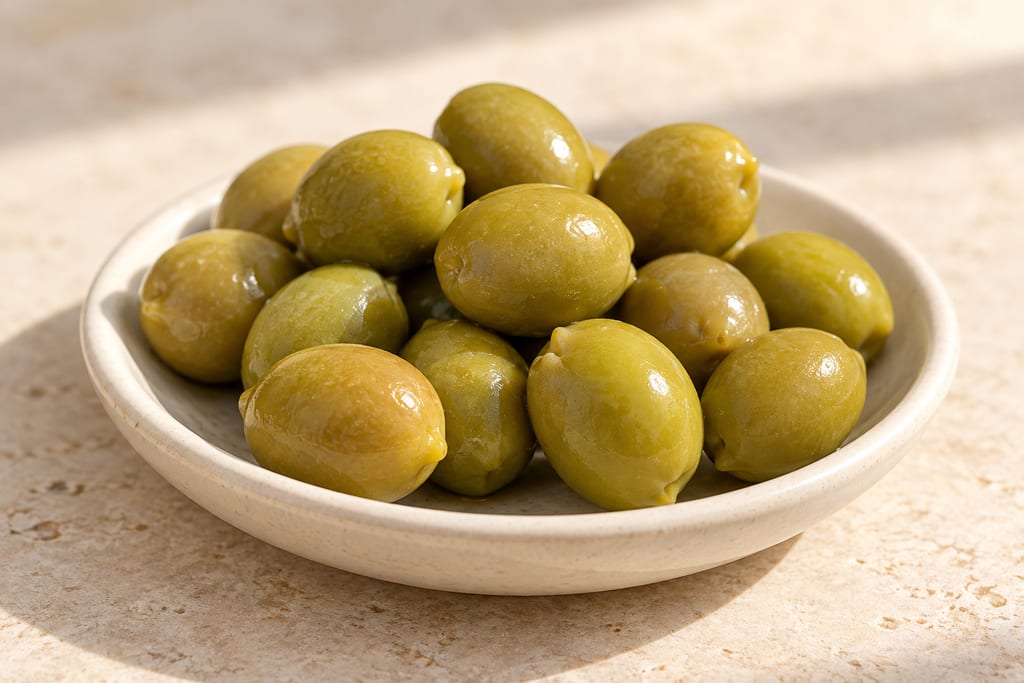
A Portuguese table-olive product from the Negrinha cultivar in northeastern Portugal, sold in three commercial styles, two of them brined fermentations and one oxidised to black.
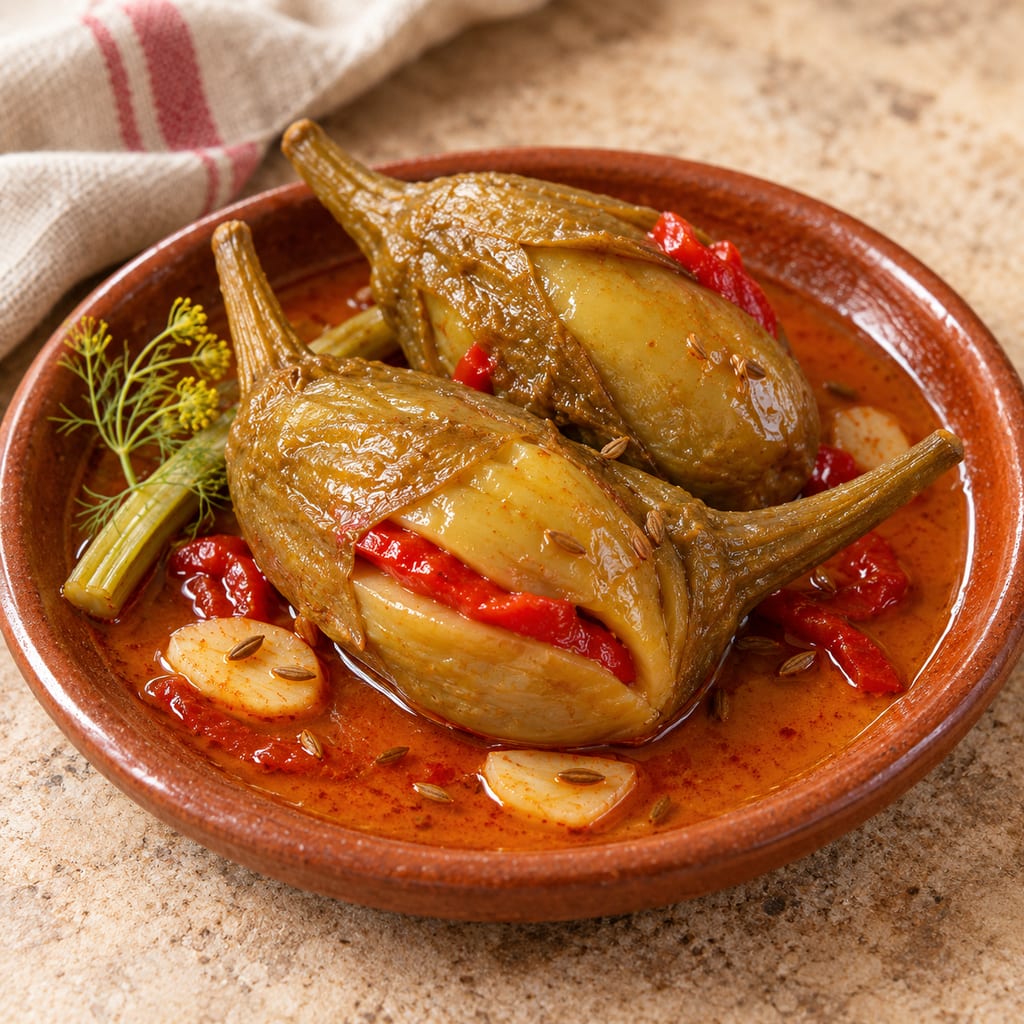
A protected aubergine preserve from Ciudad Real in Spain: tender fruit of the local Dealmagro variety, cooked briefly and then fermented in a vinegared, paprika-seasoned dressing.
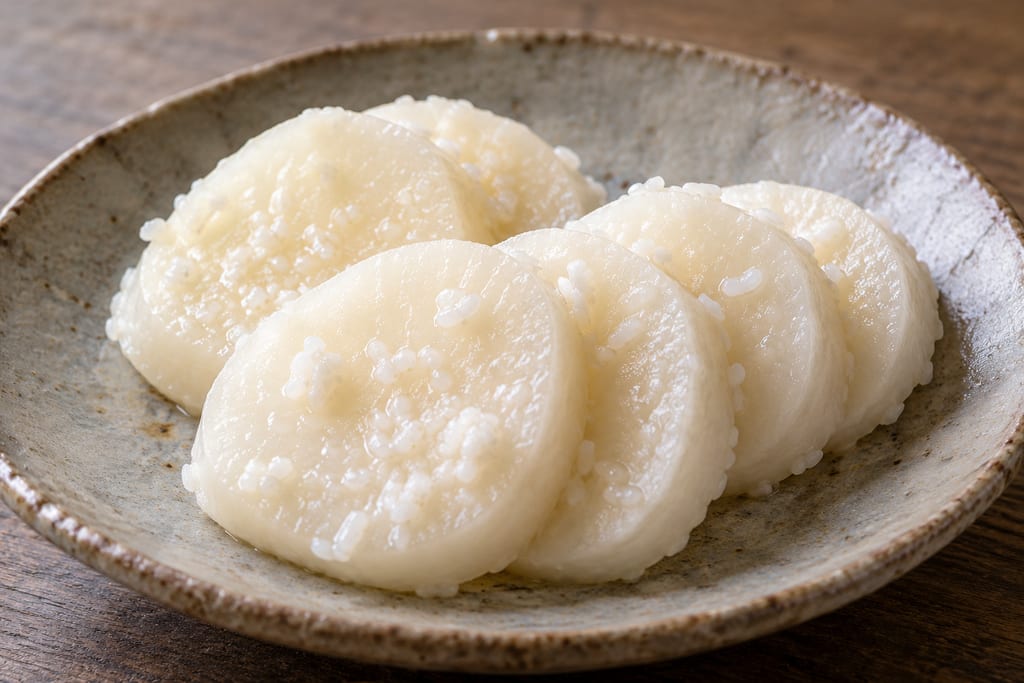
A sweet, crisp Japanese daikon pickle from Tokyo's Nihonbashi district, made by salting fresh radish and dressing it in rice koji, sugar or koji amazake without the heavy drying used for takuan.
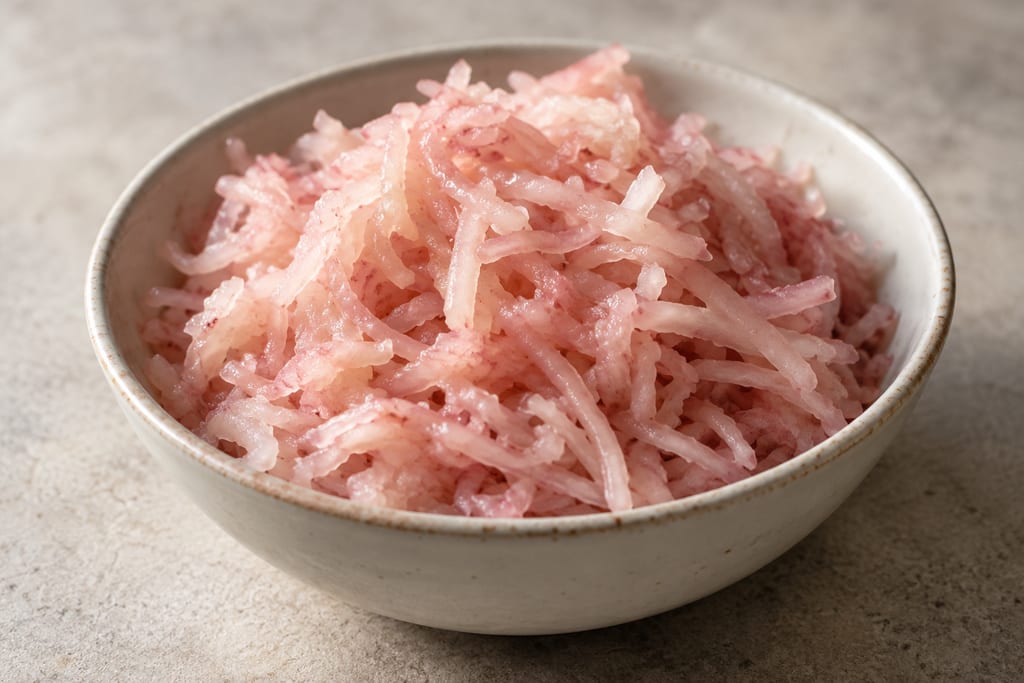
Source-specific Brovada DOP producer method for Friuli Venezia Giulia turnips and red-grape marc. This records a regulated producer process; it is not a validated home-scale recipe.
An industrial fermentation patio places factory-made fiberglass-reinforced polyester olive tanks below floor level, with drainage and transfer infrastructure arranged around the buried vessels.
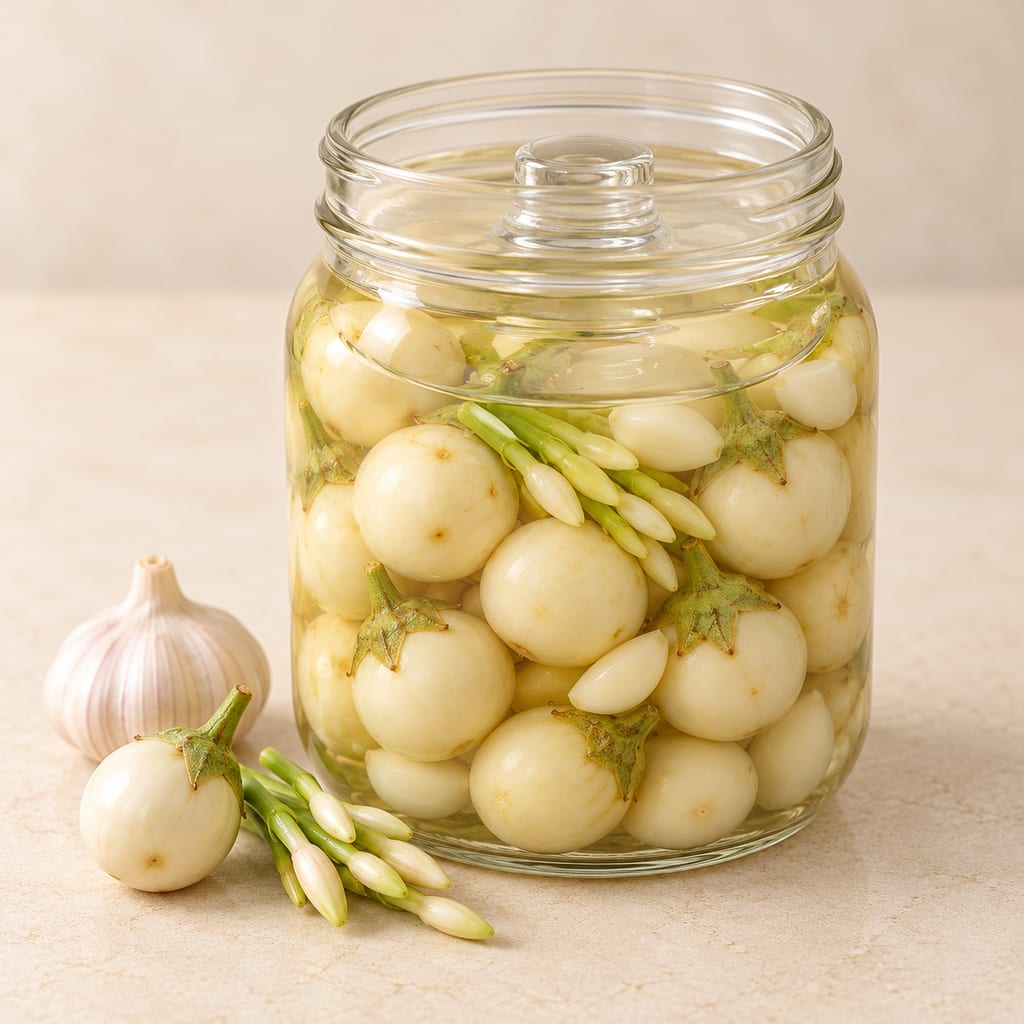
Vietnamese salted and fermented small eggplant, dried on the day of purchase, then held submerged in warm salty water with garlic and galingale flower for a week or longer.
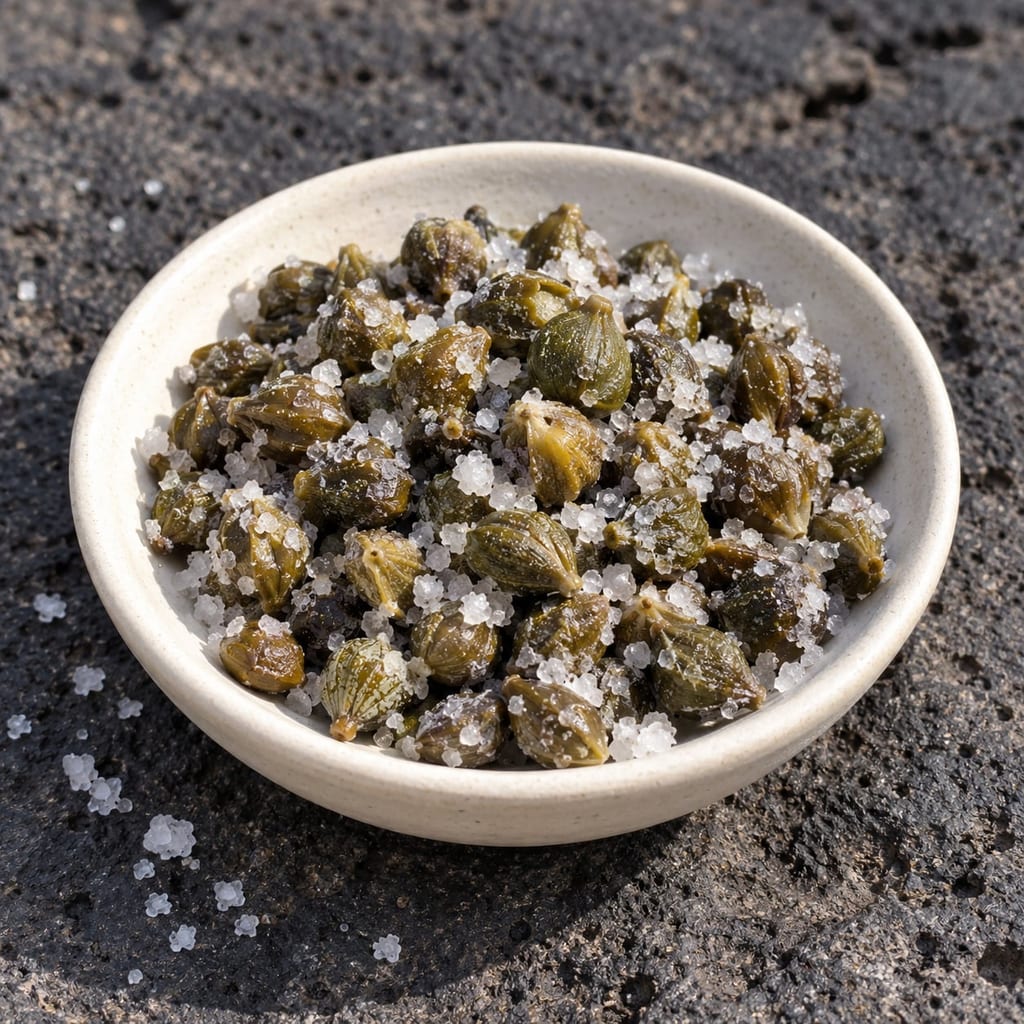
A protected Sicilian product: unopened caper buds from the island of Pantelleria, dry-salted with sea salt in a two-stage process that encourages lactic fermentation.
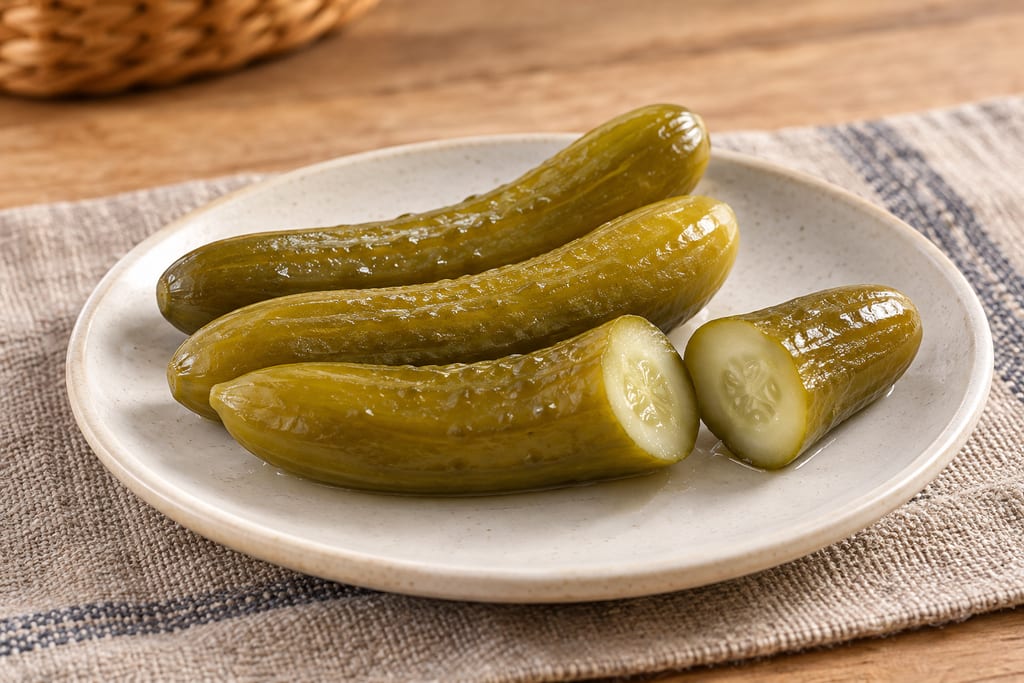
Çubuk turşusu is a registered pickle from Çubuk district in Ankara. Its cucumber variant is sold as Salatalık Turşusu, and a commercial specification sets its brine and room-temperature period.
No community contributions have been published for this entry yet.
Sign in to contribute. Published comments and photos are free to read.
PBS SoCal; recipe by Ernest MillerInspiration
Recipe: Sauerreuben (Fermented Turnips)Exact turnip/carrot weights, salt ratios, brine, jar handling, time/temperature schedules and refrigeration.
Cited in: Sauerkraut's turnip relative; History and culinary context; Choosing turnips; Why carrot is included; The role of salt; Why shredding matters; Equipment; Method; The microbiology of sauerreuben; The chemistry of turnips; Why temperature changes the schedule; How sauerreuben differs from sauerkraut; Regional and culinary variations; How to eat sauerreuben; Signs of successful fermentation
University of Minnesota ExtensionSafety
Preserving food at home: FermentationGeneral guidance for vegetable fermentation, submersion and acidity monitoring; not validation of this recipe.
Cited in: Safety and storage
National Center for Home Food PreservationSafety guidance
National Center for Home Food Preservation — FermentingCited in: Safety and storage
Oregon BrineworksCulinary background
Oregon Brineworks — SauerübenContemporary commercial product illustrating the traditional name.
Cited in: History and culinary context; How sauerreuben differs from sauerkraut; Regional and culinary variations