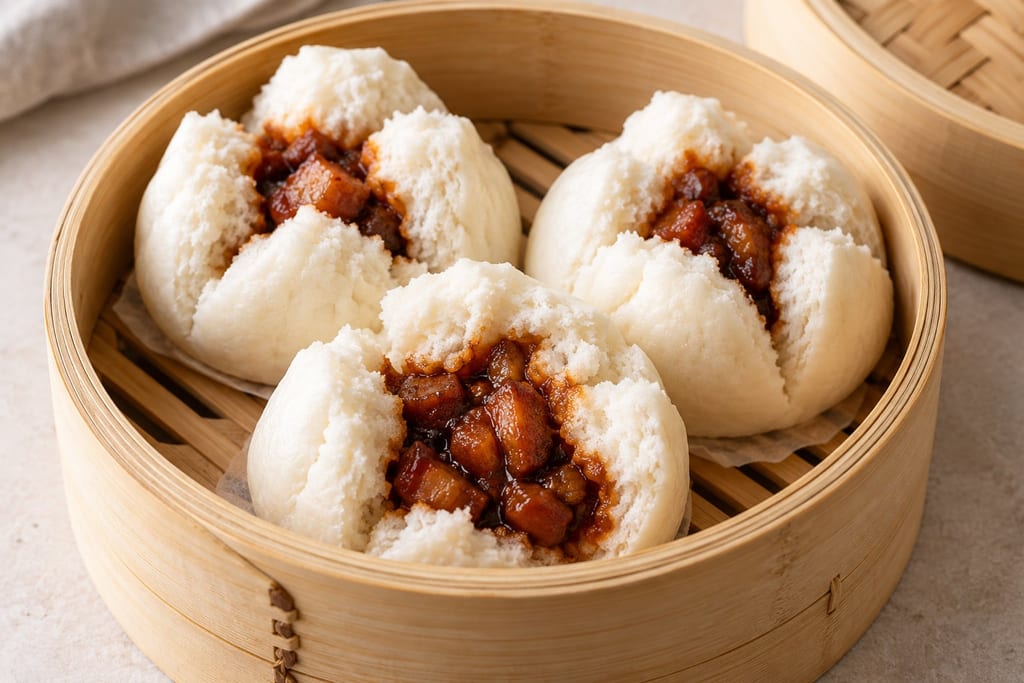
Char Siu Bao (Wei Guo’s 14-bun recipe)
Fourteen fluffy steamed buns filled with cooked char siu and a thickened oyster-soy sauce.
 FermenteaWhere food goes to change
沙茶酱 (shāchájiàng) · 沙茶醬 · shāchájiàng · sha cha sauce · sacha sauce · Chinese barbecue sauce
Shacha is a savoury, granular Fujian, Teochew and Taiwanese condiment of oil, garlic, shallot and dried seafood, often sold as Chinese barbecue sauce.
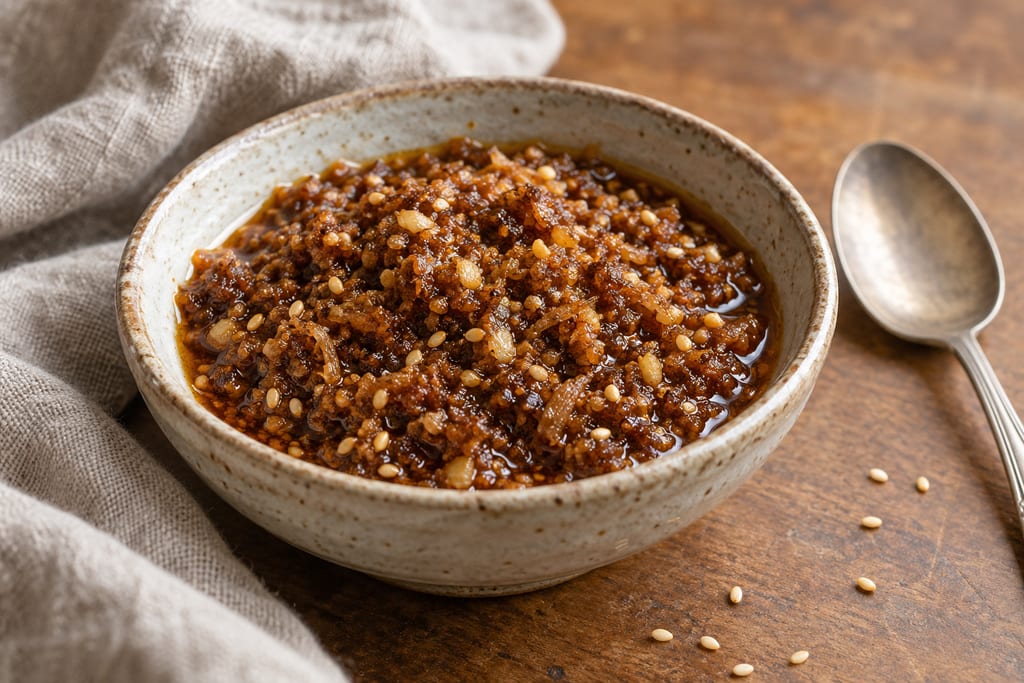
Shacha (shachajiang, 沙茶醬, also written sha cha or sacha) is a savoury, oil-rich condiment of garlic, shallot, chilli and dried seafood, most often brill and dried shrimp. The characters mean sand tea sauce, and the origin of the name is unclear. English-language jars call it Chinese barbecue sauce, but it has nothing to do with a sweet tomato barbecue sauce; it is oily, aromatic and seafood-rich, with a coarse, granular texture. It is used in Fujian, Teochew (Chaozhou) and Taiwanese cooking, in soups, marinades and rubs, stir-fries and dipping sauces.
Products differ, so the name does not fix a formula. A Bull Head label transcribed by a retailer lists dried fish, shrimp, sesame and coconut among its ingredients. The retailer names the fish as lizardfish, while the Woks of Life glossary gives brill; the two descriptions do not establish that the same fish is used. The manufacturer's own page says its product is made with dried fish and a second ingredient, with garlic, galangal and aromatics, cooked by roasting and frying to a granular texture. It declares soy, fish, nuts, crustaceans and sesame.
The method above is a Taiwanese hotel chef's home version. It is a dry stir-fry: garlic fried in lard, then the dried seafood and sesame chopped fine or powdered, shallot crisps and three savoury ingredients, soy sauce, doubanjiang and fermented black beans, cooked together on low heat for about five minutes, with rice wine at the end. The chef keeps it dry and grinds it fine if the texture of a jarred sauce is wanted. The article gives amounts for the garlic, shallot crisps and sauces but not for the sesame, dried shrimp, dried fish, lard or rice wine, and no yield, so those lines carry no figures here.
He says it keeps more than six months in the refrigerator if no water gets into the jar. That is the chef's claim, not a tested shelf life. The fermentation in this recipe is in the bought black beans and chilli paste. The sauce itself is cooked, not fermented.
The National Museum of Taiwan History entry in the National Cultural Memory Bank connects the name and the sauce to Southeast Asian satay and describes Shantou migrants adapting it after 1949. A Geographical Society of China (Taiwan) essay emphasises nineteenth-century Fujian and Guangdong migration, the Teochew changes to the ingredients and the postwar shops that made shacha dishes familiar in Taiwan. Scholarly abstracts describe the satay-to-sha-cha transmission by Chaozhou and Shantou migrants, the sauce's arrival in Kaohsiung and the sha-cha hot-pot businesses of Taipei from the 1950s to the 1980s.
These accounts overlap but their chronologies differ. They support connected regional histories, not a precise birthplace or one inventor. The exact date and the order of the satay-to-shacha adaptation remain disputed.
The Geographical Society essay describes Teochew shacha beef noodles, stir-fried beef, rice cakes, beef balls and hot pot in which the sauce goes into the broth. It contrasts this with Taiwan's clear hot-pot broth, where shacha is served as a dip. A hot-pot dip from the Woks of Life combines prepared shacha with sesame paste, soy sauce, chilli oil and fresh aromatics; that is a meal accompaniment built on a bought sauce, not a way to make shacha. XO sauce is named as the closest substitute, though it costs more because of its dried shrimp and scallops.
Scholarship traces sha-cha to adaptations of Southeast Asian satay by Chaozhou and Shantou migrants, then documents postwar migration and popularization in Taiwan. A Taiwan museum entry places the Shantou adaptation after 1949 while a geographical-society essay stresses nineteenth-century Fujian and Guangdong migration. These accounts describe cultural transmission with different chronologies, not a single birthplace or one universal formula.
Scaling: source batch only
The home method uses dried shrimp, dried fish, soy sauce, fermented black beans and sesame. The Bull Head product page declares soy, fish, nuts, crustaceans and sesame for that product.
Hazard sourceThe chef says the dry sauce keeps more than six months in the refrigerator with water kept out of the jar. That is the chef's claim and is not validated; a retailer's or a manufacturer's keeping advice does not transfer to a home batch.
Hazard sourceCheck the full allergen and ingredient statement on any bought product; do not infer allergen absence from the sauce name or another brand's formulation.
Control sourceKeep a homemade batch refrigerated in a dry jar and use a clean utensil each time.
Control sourceThe home method is one chef's recipe with several amounts missing; it is not a reproduction of a bought brand.
The listed allergens describe the cited Bull Head product page and the home method only; other shacha products can differ.
The cited historical account describes Southeast Asian satay as a precursor and migration route, not a single precise birthplace for every shacha sauce.
Scholarship describes Chaozhou and Shantou migrants as carrying and adapting sha-cha; this is a regional transmission association, not a claim that every formula originated here.
A Taiwanese manufacturer and a Taiwanese hotel chef document shacha preparations; neither is the sole origin of shacha.
Fourteen fluffy steamed buns filled with cooked char siu and a thickened oyster-soy sauce.
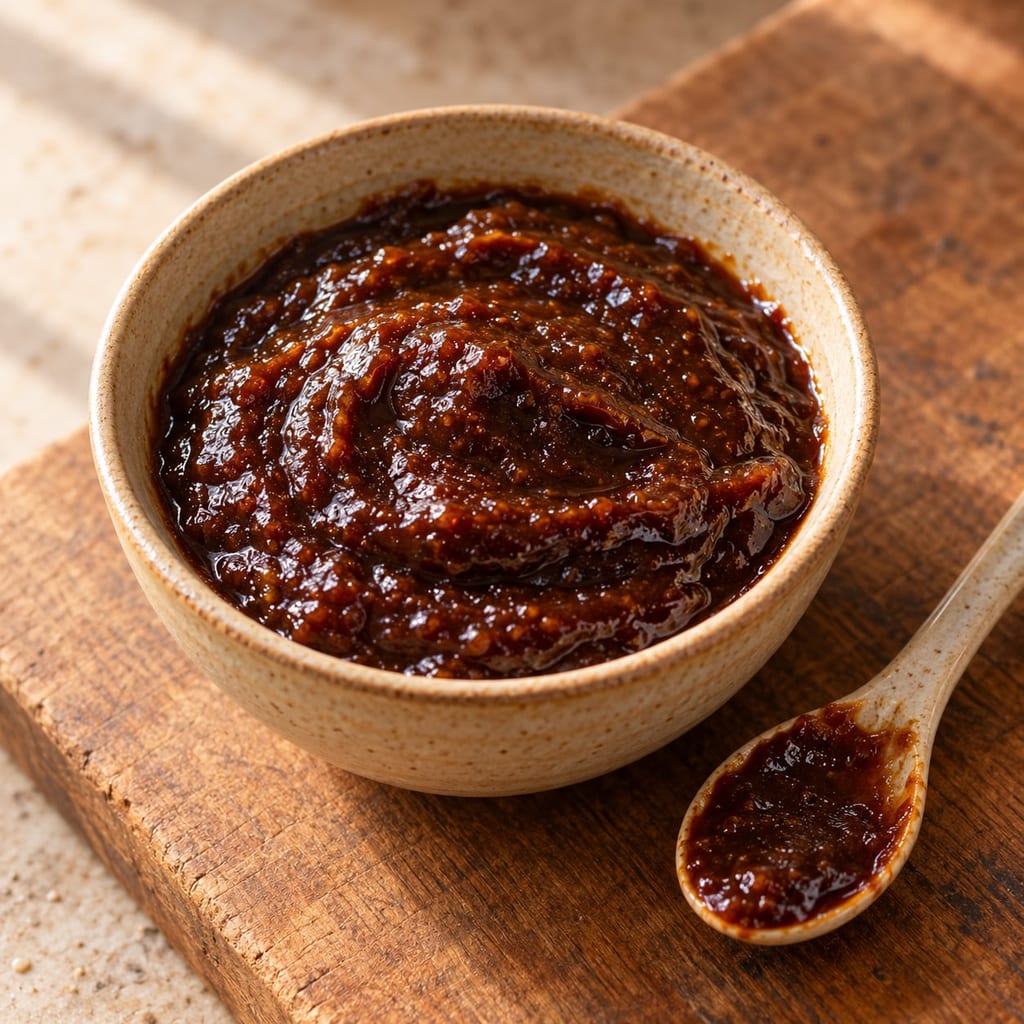
Chu hou is a sweet, savoury Cantonese paste of fermented soybeans, fermented bean curd, garlic, ginger and sesame, used mainly to braise meat.

Ajvar is a cooked Balkan pepper preserve built around roasted red peppers, peeled, drained, ground and slowly fried with oil and seasoning. Leskovac’s protected version is a pepper specialty; regional versions vary.

Amlou is a nutty, lightly sweet Moroccan spread of roasted almonds, culinary argan oil and honey. The almonds are ground first, then loosened with oil and sweetened; the balance can range from a thick spread to a dip.

Apple sauce for goose and pork is a plain English accompaniment: cooked apples pulped with water, then sweetened with sugar and finished with a little butter.

A warm dip of garlic, anchovy and olive oil, often enriched with butter, that Piedmont serves over a flame with raw and cooked vegetables and bread.

A sweet-hot table sauce of ripe banana simmered with vinegar, sugar, onion, garlic and fresh chilli, in the manner of Philippine banana ketchup. An untested development batch of about 500 g.

A Georgian walnut sauce of ground walnuts, garlic, vinegar and spices, thinned with water or broth. It is served with poultry, vegetables and bread, and is the sauce of the dish satsivi.

A pourable dessert sauce of brown sugar, butter and cream, with a little corn syrup and salt. It is the sauce form of the butterscotch confection and is made without water, unlike caramel.

Byzantine murrī is a cooked imitation of murrī from the medieval Arabic repertoire, made from scorched honey, toasted bread, walnuts, quince, carob and spices rather than from a long grain fermentation.
No community contributions have been published for this entry yet.
Sign in to contribute. Published comments and photos are free to read.
TVBS NewsRecipe · Method
醬做最安心 5料3醬=主廁牌沙茶Chef Luo Jinhan's home shacha: lard-fried minced garlic (2 tbsp), white sesame, dried shrimp and dried small fish (finely chopped or powdered), fried shallot crisps (2 tbsp), then soy sauce, doubanjiang and fermented black beans (1 tbsp each) stir-fried 5 minutes on low heat, rice wine added at the end.
Total preparation about 10 minutes; kept dry and ground fine for a jarred texture; the article says it keeps more than six months refrigerated, with water kept out.
Cited in: A home method
The Woks of LifeIdentity · Use
Shacha SauceShacha (sha cha, sacha) is made from oil, garlic, shallots, chillies and seafood, usually brill and dried shrimp; the name means sand tea sauce, origin unclear; jars call it Chinese BBQ sauce.
Used in Fujian, Teochew and Taiwanese cooking in soups, marinades and rubs, stir-fries and dipping sauces; Bullhead is the common brand; XO sauce is the closest substitute; keep refrigerated once opened.
Cited in: What shacha is; How it is eaten
Haw-Di-I Foods Co., Ltd. (好帝一食品有限公司), Bull Head brandIngredients · Flavour · Allergens · Documented use
沙茶醬250g (250 g Barbecue Sauce)This Bull Head product uses dried fish and 赤尾青 with garlic, galangal and aromatics, cooked by roasting/frying; the maker describes a granular texture and uses as hot-pot dip, noodle sauce, braising and other seasoning.
This product page declares soy, fish, nuts, crustaceans and sesame allergens. It does not provide a home recipe.
Cited in: What shacha is
Infigoo GmbH retail listingIngredients
牛头牌 沙茶酱 127gA retailer's transcription of a Bull Head label lists dried fish, shrimp, sesame and coconut among other ingredients and names the fish as lizardfish; the family glossary names brill, so the fish species is not settled by the sources.
Cited in: What shacha is
The Woks of LifeUse
How to Make a Hot Pot Dipping SauceA hot-pot dip combines prepared shacha with sesame paste, soy sauce, chilli oil and fresh aromatics.
Cited in: How it is eaten
Geographical Society of China (Taiwan)History · Use
從他鄉到故鄉:你所不知道的沙茶故事Emphasises nineteenth-century Fujian and Guangdong migration, Teochew changes to the ingredients and postwar shops that made shacha dishes familiar in Taiwan.
Describes Teochew shacha beef noodles, stir-fried beef, rice cakes, beef balls and hot pot with the sauce in the broth, against Taiwan's clear broth with shacha as a dip.
Cited in: Where it came from; How it is eaten
Foundation of Chinese Dietary Culture; abstract by 曾齡儀History · Geography
The Wu Yuan-sheng family and the development of Taipei’s sha-cha hot-pot industry (1950s–1980s)The abstract describes sha-cha as brought to Taiwan by Chaozhou and Shantou migrants after World War II and documents its spread in Taipei from the 1950s to the 1980s.
Cited in: Where it came from
Taipei Medical University; peer-reviewed article record by 曾齡儀History · Geography
Migration and Food: The Chaozhou-Shantou Migration to Kaohsiung after WWII and Sha-cha Beef Hot PotThe abstract describes a Southeast Asian satay-to-sha-cha transmission through Chaozhou and Shantou migrants, followed by postwar introduction and promotion in Kaohsiung.
Cited in: Where it came from
National Taiwan Museum of History, National Cultural Memory Bank; author 黃英嘉History · Geography · Flavour
沙茶醬 (Sha-cha sauce)The museum account presents shacha as an adaptation of Southeast Asian satay associated with Shantou migration and later Taiwan localization, after 1949; it describes savoury, spicy and aromatic characteristics.
Cited in: Where it came from