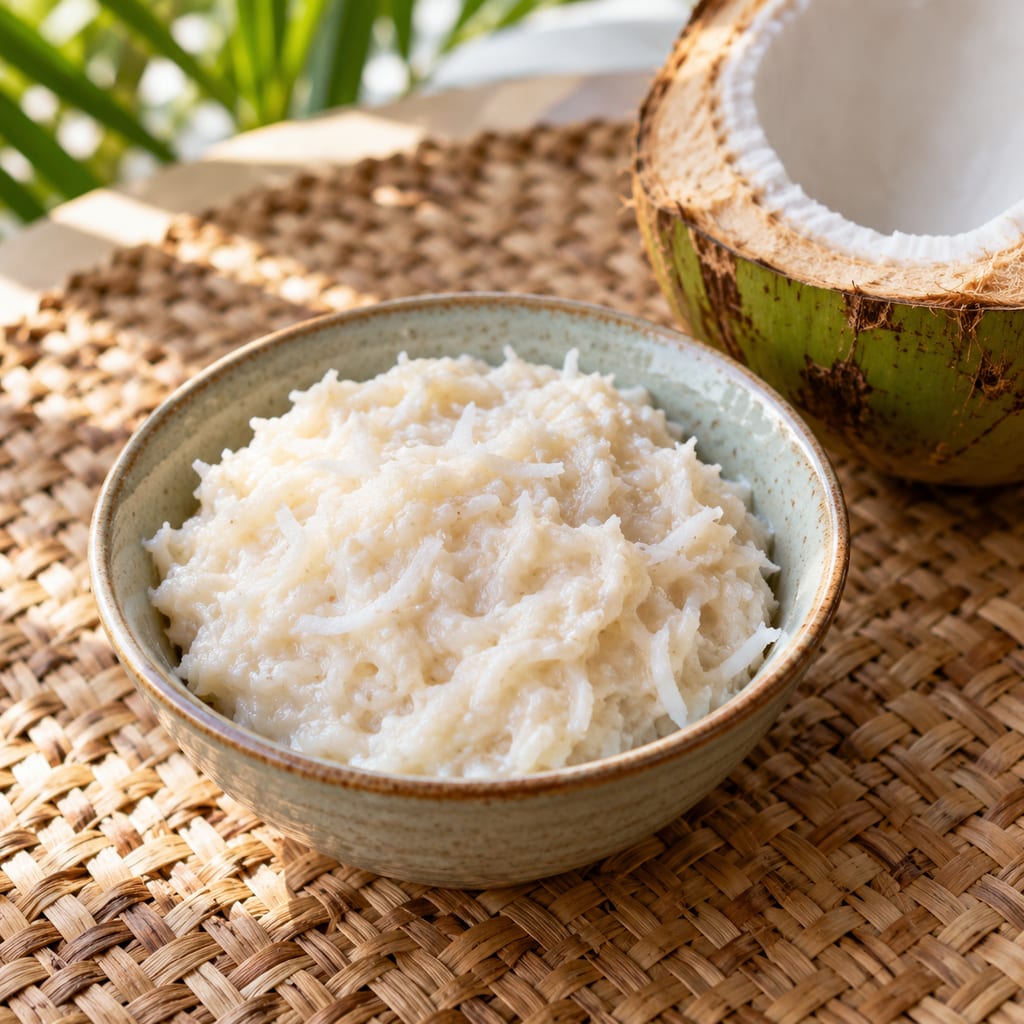
Mitihue
A documentary account of Tahitian mitihue, a fermented coconut condiment traditionally associated with freshwater prawns. It records cultural context and source-reported risks without giving a household preparation method.
 FermenteaWhere food goes to change
Traditional method
Taioro · Taiero (spelling in supplied inventory row; not independently verified)
Taioro is a Polynesian condiment of grated coconut fermented with freshwater prawn heads in seawater, then rested in a cool place for a day before it is used.
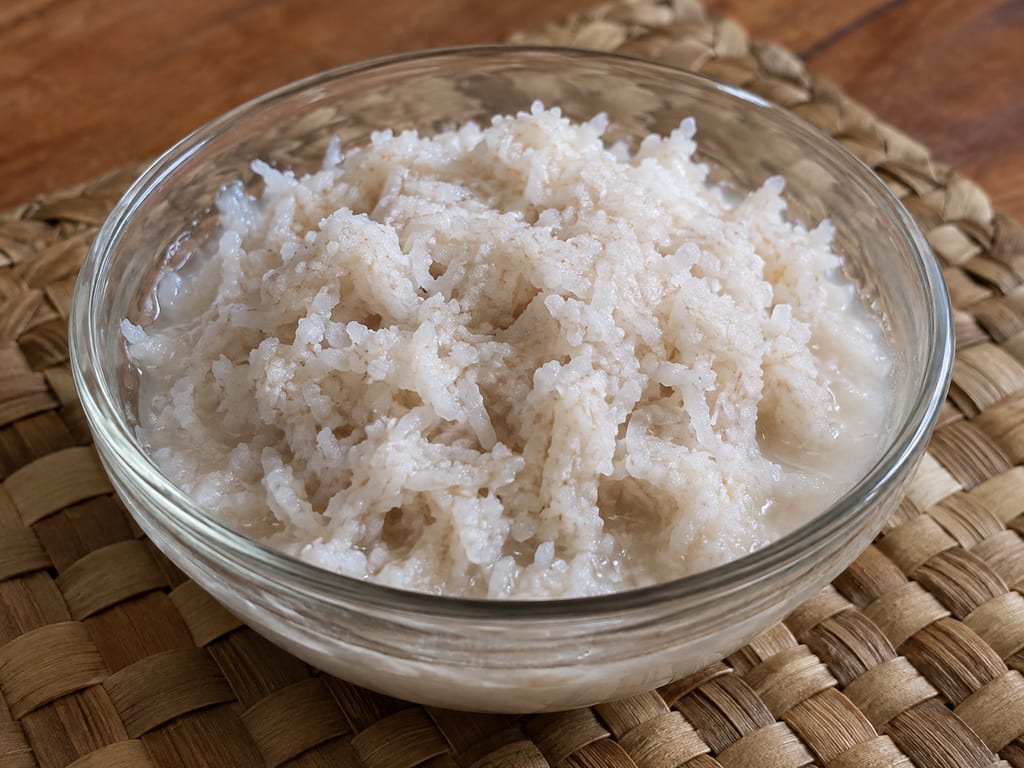
Taioro, also spelled taiero, is a traditional Polynesian preparation made from grated mature coconut and liquid associated with small freshwater prawns or, in some versions, small shore crabs.
The mixture undergoes fermentation and develops a distinctive flavour before being served as an accompaniment to other foods.
It belongs to the food traditions of Tahiti and the wider Society Islands.
Unlike ordinary coconut milk, taioro involves a microbial transformation. It is also different from mitihue, a related fermented coconut preparation commonly served as a sauce.
The distinction is important because coconut appears in many Polynesian preparations, but not all of them undergo fermentation.
The title of the existing Fermentea record refers to a CAPL manual. CAPL, the Chambre de l'agriculture et de la pêche lagonaire, publishes material on local Polynesian food. Its Tama'a Maita'i manual was publicly promoted in October 2024, but the specific taioro recipe page could not be independently retrieved from that manual.
The preparation details given here are consequently based on separately identifiable French Polynesian government material and historical ethnographic literature. They must not be misattributed to a CAPL recipe page that could not be read.
Important: Traditional taioro prepared with raw freshwater prawns presents a documented risk of parasitic infection and eosinophilic meningitis. The preparation below records the traditional method and its ingredients, but does not claim that it is a validated home-fermentation procedure.
Tahitian — Taioro, taiero
French — Coco fermenté aux chevrettes
English — Fermented grated coconut
Related Tahitian preparation — Mitihue
Fresh coconut milk — Miti ha'ari
The coconut palm is Cocos nucifera.
The word chevrette refers to small freshwater prawns in this culinary context. It should not automatically be assigned to a single species without identifying the animals used locally.
Certain freshwater prawns in Polynesia belong to the genus Macrobrachium, but the precise species in an individual historical recipe is not established by the sources examined.
The shore crabs called ohiti represent another traditional ingredient.
Taioro belongs to a long-established Polynesian pattern of using coconut in sauces, cooked preparations and accompaniments.
The coconut palm supplied far more than an edible nut.
Its flesh provided fat-rich food, its liquid could be consumed, and its fibrous and woody parts had numerous practical uses.
Coconut processing therefore occupied an important place in island economies.
A Tahitian lexical reference identifies taioro and taiero as synonyms for a fermented sauce involving grated coconut, salted water and freshwater prawns.
This establishes the term within documented Tahitian language usage.
An ethnographic article published in the Journal de la Société des Océanistes in 1981 discusses traditional freshwater-prawn fishing and explicitly links the catch to preparing taioro.
That reference is particularly useful because it connects the food to the practical work of obtaining its ingredients.
Historical anthropological writing also identifies taioro among Tahitian coconut preparations and connects its description with earlier accounts by European observers.
However, the literature does not establish a precise date of invention.
The fact that an ethnographer records a dish in the twentieth century does not prove it originated in a particular prehistoric century.
Taioro should therefore be described as a traditional Polynesian food with documented ethnographic and linguistic evidence, rather than assigned an invented age.
Mature coconut flesh contains substantial fat, water and other organic constituents.
Grating breaks the flesh into small pieces.
This increases the exposed surface area and allows liquid to penetrate and contact the material more evenly.
The grated texture also gives taioro its distinctive physical structure.
Unlike a completely filtered coconut milk, the preparation retains coconut solids.
Those solids provide body and contribute the characteristic mouthfeel.
The use of mature coconut is significant.
Young coconuts contain different proportions of water and developed flesh.
A very young drinking coconut does not provide the same substantial grated material as a mature one.
The historical preparation therefore begins with an ingredient that already has a particular composition before fermentation.
The traditional method uses liquid obtained by crushing prawn heads and combining them with water.
That liquid is filtered and mixed through the grated coconut.
It introduces biological material from the prawns, including substances originating from their tissues and microbiota.
Crustacean tissues contain enzymes, proteins and other compounds that may influence food transformations.
However, the exact microbiology of traditional taioro has not been established by the available sources.
It would be inaccurate to claim that one named lactic acid bacterium is universally responsible or that prawn heads act as a standardised starter culture.
The preparation does not use a commercially defined inoculum with a known microbial composition.
That uncertainty is especially important because microorganisms and parasites associated with raw freshwater animals can present serious hazards.
Fermentation does not automatically make those hazards disappear.
A recipe published by the Direction des Ressources Marines of French Polynesia gives the following ingredients.
Traditional source formulation; recorded for historical and culinary reference, not a validated home process.
Mature coconuts, husked — 4
Freshwater prawn heads — 5
Lemon — 1
Fish or specified shellfish, optional — 500 g
The stated quantity serves approximately 2–4 people.
The optional seafood may include fish, giant clam (pahua), troca or ma'oa.
The recorded method does not supply a precise volume of water or a measured salt concentration for the coconut mixture.
These omissions matter because such conditions influence microbial growth.
Open the mature coconuts and remove the edible flesh.
Grate the coconut into a suitable vessel with a lid.
The grated material should remain available for thorough mixing with the liquid introduced later.
The government recipe uses four coconuts but does not specify their total flesh weight.
The historical procedure uses material from prawn heads.
The stomach is removed, and the remaining material is crushed and mixed with water.
The mixture is then filtered.
This describes the traditional method, not an assurance that raw crustacean tissue is safe to use without additional controls.
The filtered prawn-derived liquid is distributed through the grated coconut.
The original preparation emphasises thorough contact between the liquid and the coconut.
This is important for consistency, since poorly distributed liquid could create local differences in moisture and microbial activity.
The coconut mixture is covered and allowed to undergo fermentation.
The available extract of the government recipe does not reliably preserve its complete fermentation temperature and timing instructions.
A separate contemporary Tahitian recipe describes refrigeration for at least 24 hours, but this is a distinct formulation with different ingredient quantities.
It must not be represented as a verified fermentation endpoint for the government recipe.
Traditional serving methods can incorporate seafood into the completed taioro.
The government recipe includes 500 g fish or specified shellfish as an optional ingredient.
The lemon is used in preparing the accompanying seafood.
The final holding instructions for this stage are not given.
The presence of lemon juice must not be mistaken for a validated treatment against seafood pathogens or parasites.
The published traditional descriptions do not supply all the information needed to establish a safe and repeatable fermentation.
The exact species and microbial condition of the crustacean ingredient may vary.
Water and salt quantities are not fully specified.
The identity of the fermenting microbial community is not established.
The available recipe does not document a measured pH trajectory or validated microbiological endpoint.
Temperature and holding conditions are not fully established.
They determine whether desirable organisms can grow and whether unwanted organisms are adequately controlled.
A food can develop a traditional sour or pungent aroma while still containing a dangerous pathogen or parasite.
The most important health concern associated with taioro is Angiostrongylus cantonensis, a parasitic nematode commonly known as rat lungworm.
Its life cycle involves rats and intermediate hosts such as snails and slugs.
Other animals, including freshwater prawns, can carry infective larvae in relevant environments.
Human infection can occur through exposure to contaminated animals or foods.
In Polynesia, consumption of raw freshwater-prawn material used in taioro and mitihue has been identified as an important risk factor.
The parasite can affect the nervous system and cause eosinophilic meningitis.
Symptoms may include severe headaches, nausea, vomiting, fever and other neurological or systemic complaints.
A French Polynesian public-health bulletin describes annual cases and hospitalisations associated with this disease.
The bulletin records 21 reported cases in 2017, 10 in 2018, 19 in 2019, 10 in 2020, 2 in 2021 and 4 in 2022.
These are historical surveillance figures, not current estimates for 2026.
The public-health guidance specifies that freshwater prawns used for taioro or mitihue must be frozen for at least 48 hours before use.
That figure is a locally published prevention requirement. It is not an independently established guarantee that every domestic freezer, regardless of its temperature and loading, will reliably eliminate every possible food hazard.
Cooking freshwater crustaceans thoroughly is a more conservative approach to parasitic risk, but heating may change the traditional fermentation process.
For readers who wish to try traditional taioro, the responsible recommendation is to obtain it from a declared producer operating under the applicable French Polynesian public-health requirements.
French Polynesia requires producers placing taioro and mitihue on the market to register with the relevant environmental-health authorities.
Products must carry the appropriate producer identification, including the T.A.H.I.T.I. number.
This traceability matters because it provides a mechanism for identifying a commercial source.
It does not mean the product is sterile or that food handling after purchase can be ignored.
A homemade mixture of grated coconut and cooked seafood can be prepared as a separate coconut dish, but it should not be labelled authentic fermented taioro unless its microbiology and production method are established.
The coconut contains relatively little free sugar compared with many fruit substrates used in lactic fermentation.
Its high fat content also produces a different environment from cabbage or cucumber brine.
Microorganisms present in a traditional preparation may metabolise available nutrients, producing acids, volatile compounds and other metabolites.
Enzymatic activity may contribute to the development of aroma.
However, the exact pathways responsible for traditional taioro's flavour have not been adequately characterised in the sources used for this page.
No particular lactic acid concentration, pH endpoint or microbial succession can responsibly be specified.
It is possible to explain the broad science of fermentation without pretending that every traditional process has been subjected to the same microbiological study.
Taioro and mitihue are related but distinguishable.
Taioro retains grated coconut as a substantial part of the finished preparation.
Mitihue is commonly described as a coconut-based sauce.
Its production can involve coconut pieces rather than finely grated flesh.
The Direction des Ressources Marines describes a mitihue method involving coconut cut into pieces, preliminary heating, liquid derived from prawn heads and a subsequent resting period.
The published recipe includes 10 coconuts and 10 large prawn heads, with an approximately 24-hour resting stage.
These are values for mitihue, not substitutions for the taioro recipe.
The distinction in physical structure matters.
Finely grated coconut provides a different surface area and mouthfeel from sliced coconut pieces used in sauce preparation.
Traditional accounts describe freshwater prawns as one source of the ingredient used to initiate the preparation.
Some also mention small shore crabs.
The species and habitats of the animals are not interchangeable from a food-safety perspective.
A freshwater animal associated with the rat lungworm life cycle may present different hazards from a marine animal.
The presence of alternative animals in historical descriptions must not be interpreted as evidence that any available crab or prawn can be safely substituted.
Taioro may be eaten with fish or shellfish, but the accompanying species depend on availability and local preferences.
The government documentation mentions fish, giant clam and several other molluscs.
No complete, verified island-by-island map of recipe differences is available from the sources examined.
Taioro belongs to the context of Polynesian shared meals.
It can accompany fish and other seafood and may form part of a larger meal with starchy local foods.
Breadfruit, taro and cooked bananas are important elements of the broader Tahitian food environment.
The combination of coconut richness and seafood is characteristic of many dishes, but taioro's fermented flavour distinguishes it from freshly prepared coconut sauces.
Some preparations add seafood after the coconut has fermented.
This separates the fermentation of the coconut mixture from the final assembly of the dish.
The precise serving arrangements vary and are not completely standardised in the documentary material.
A traditional product may have an assertive, developed aroma.
However, no single smell can establish microbiological safety.
A sour taste does not prove that the mixture has reached a protective acidity.
Gas production cannot demonstrate the absence of parasites.
Visible mould, abnormal deterioration or unexpected contamination are grounds for rejection.
Even a product without visible defects can be unsafe if its raw ingredients were contaminated.
The only responsible safety assessment is one grounded in validated production controls and applicable public-health requirements.
The precise CAPL manual wording could not be read.
The identity and relative abundance of microorganisms responsible for traditional taioro fermentation remain insufficiently documented.
The available recipes do not establish a universally applicable pH endpoint, salt concentration or incubation temperature.
The ancient origin of the process cannot be assigned a specific date.
Those uncertainties do not diminish the cultural importance of taioro.
They distinguish what can be described historically from what can safely be recommended as a modern kitchen method.
CAPL published the inspected local-food manual in September 2023. Its Taioro recipe is a documented preparation, not evidence of an origin date or first attestation. The source dossier records Taioro in the DCP traditional-recipe index; a fresh ordinary request during the audit returned HTTP 503, and the linked article was not retrieved. No history or process claim is taken from the inaccessible article or search-rendered text.
Scaling: source batch only
The Direction de la santé form identifies raw chevrettes as a parasite risk and says not to consume Taioro made with unfrozen chevrettes.
Hazard sourceDraft transcribed from CAPL, not a validated home process. It gives no water volume or salinity, measured temperature, yield, monitoring, objective endpoint, failure response or storage life.
CAPL's cool one-day rest and cold serving instruction do not establish a safe fermentation endpoint or storage limit.
Separate official guidance in SSA-F6 Rev2, dated 11 January 2022, advises freezing chevrettes for at least 48 hours before preparation and says not to consume Taioro made with unfrozen chevrettes. The same form sets separate freezing, registration and labelling/declaration obligations for producers. This guidance is not a CAPL instruction or validation of the fermentation.
The CAPL manual documents this preparation in a French Polynesia local-food publication; the DCP index previously read in the source dossier listed Taioro among traditional recipes. These sources do not establish an origin or territory-wide distribution. The linked DCP article could not be retrieved during the source audit.
A documentary account of Tahitian mitihue, a fermented coconut condiment traditionally associated with freshwater prawns. It records cultural context and source-reported risks without giving a household preparation method.
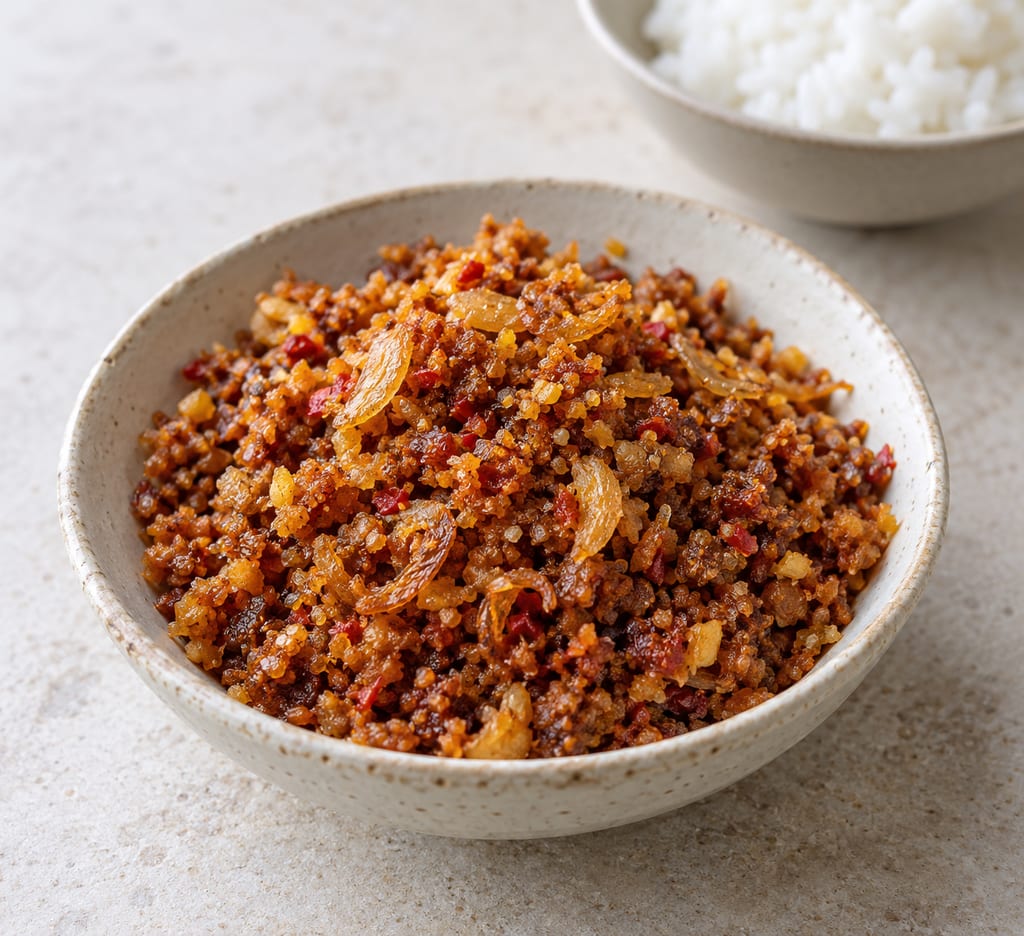
A Myanmar relish of dried shrimp, fried eschalot and garlic, chilli, turmeric, tamarind and ngapi. Naomi Duguid’s published recipe makes about 1 cup; it contains crustacean shellfish.
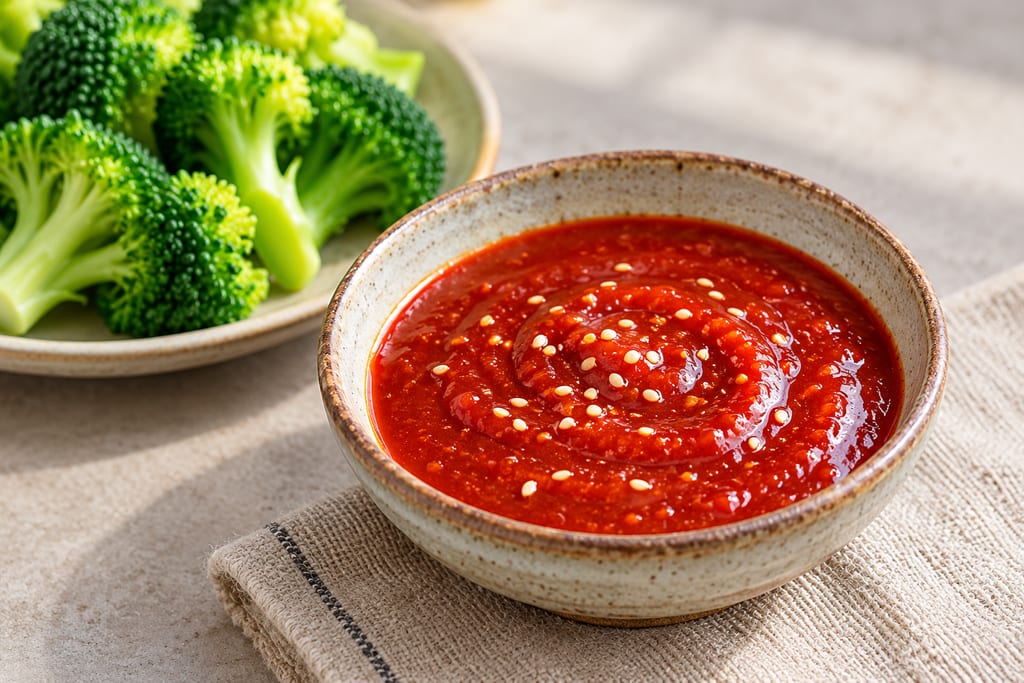
Chogochujang is a Korean sweet-sour sauce made by seasoning gochujang with vinegar and sugar. This development batch adds water and toasted sesame seeds, with optional garlic for the portion being served.
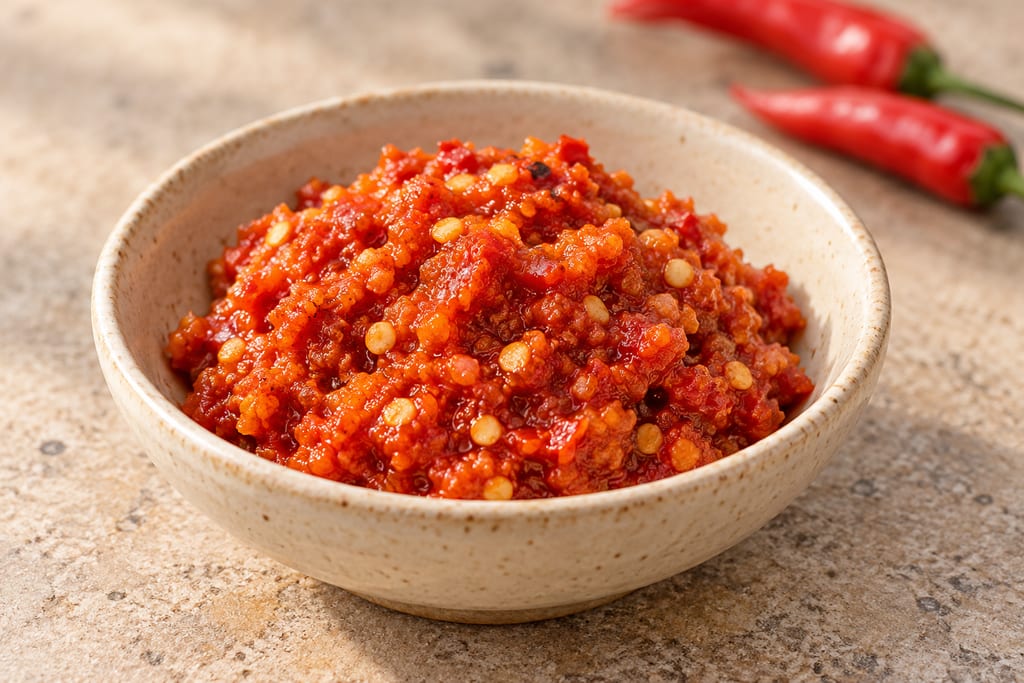
Dinanche, or donne' dinanche, is a Chamorro hot pepper paste of crushed chillies that Guam cooks use on its own or stir into fina'denne'. Its versions range from pepper alone to ones with eggplant, miso or coconut milk.
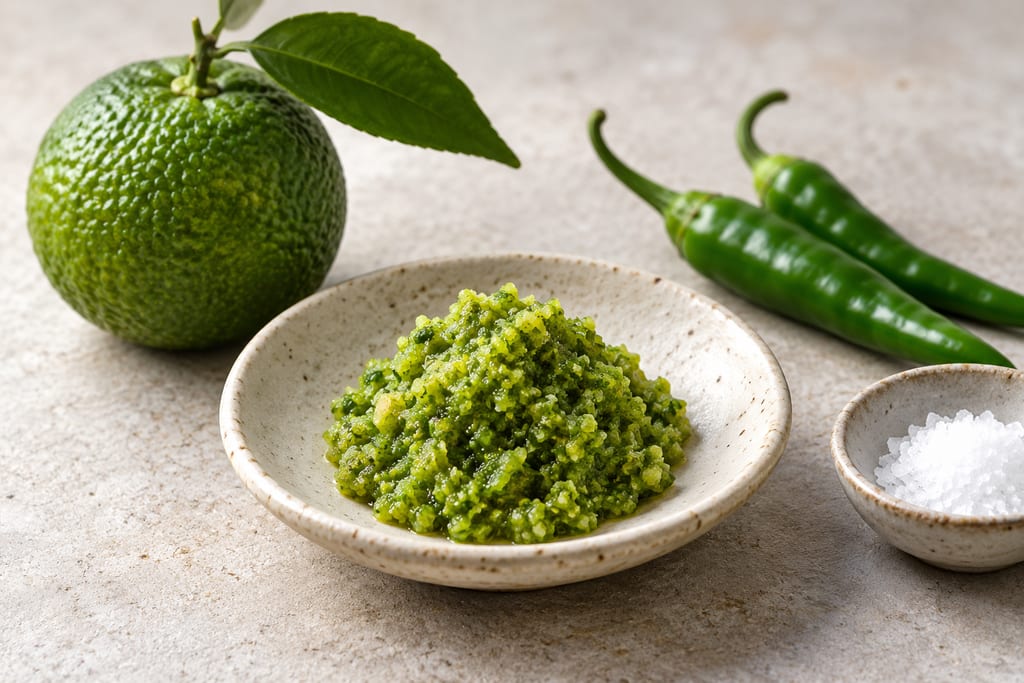
A fresh, uncooked yuzu and green chilli paste inspired by Kyushu’s yuzu kosho, made here as an untested small-batch seasoning rather than a preservation formula.
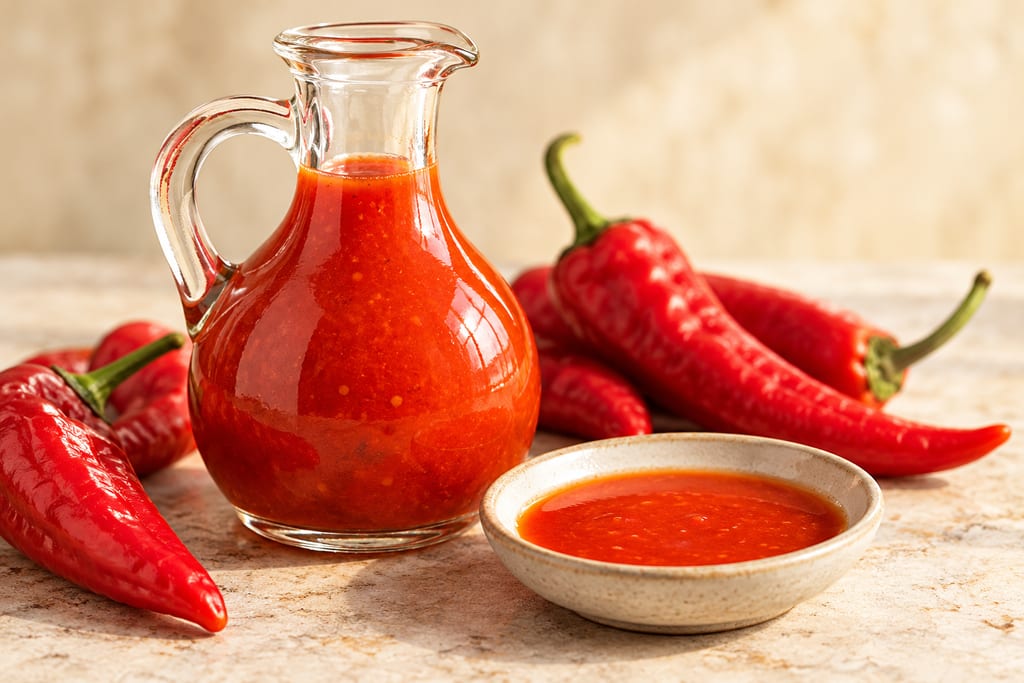
Fresh hot peppers ferment beneath a measured salt brine, then become a bright, tangy sauce blended from the peppers and their liquor.
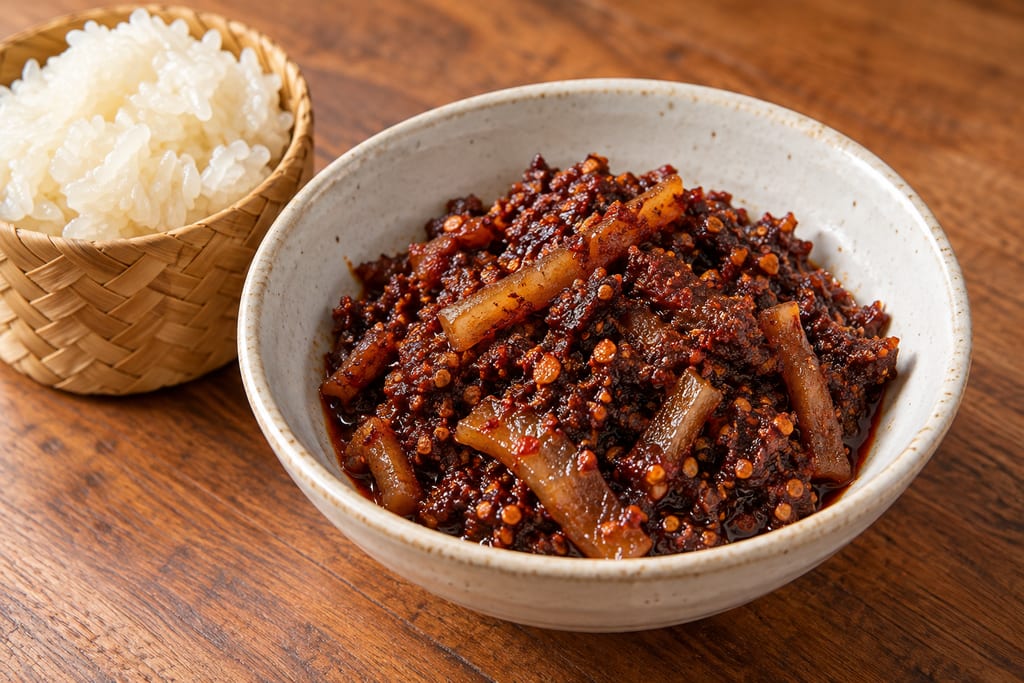
Jeow bong is a Lao paste of dried chilli, shallot, garlic and galangal cooked with buffalo or cow skin, a Luang Prabang specialty eaten with sticky rice and grilled meat.
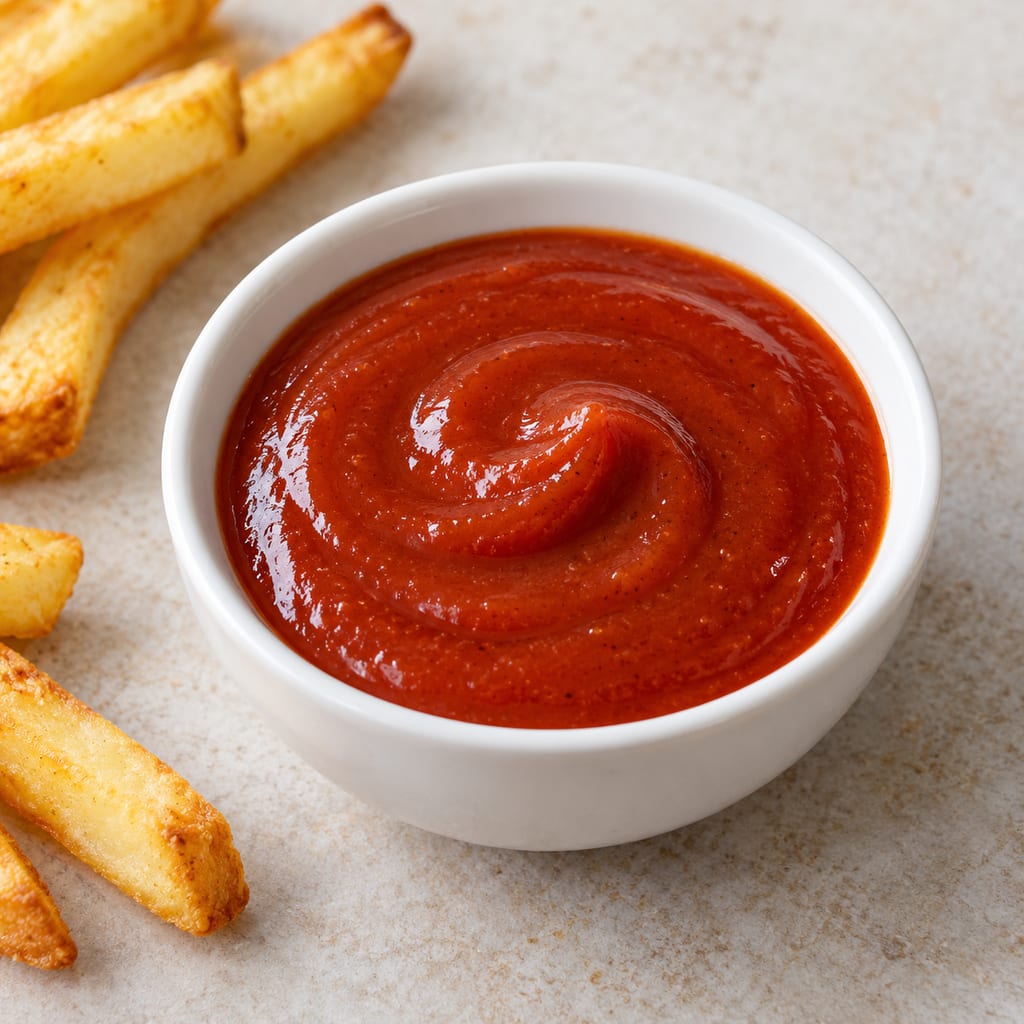
A modern tomato condiment sharpened with the spicy, savoury tang associated with kimchi; this measured version whisk-mixes prepared ketchup and commercial kimchi seasoning.
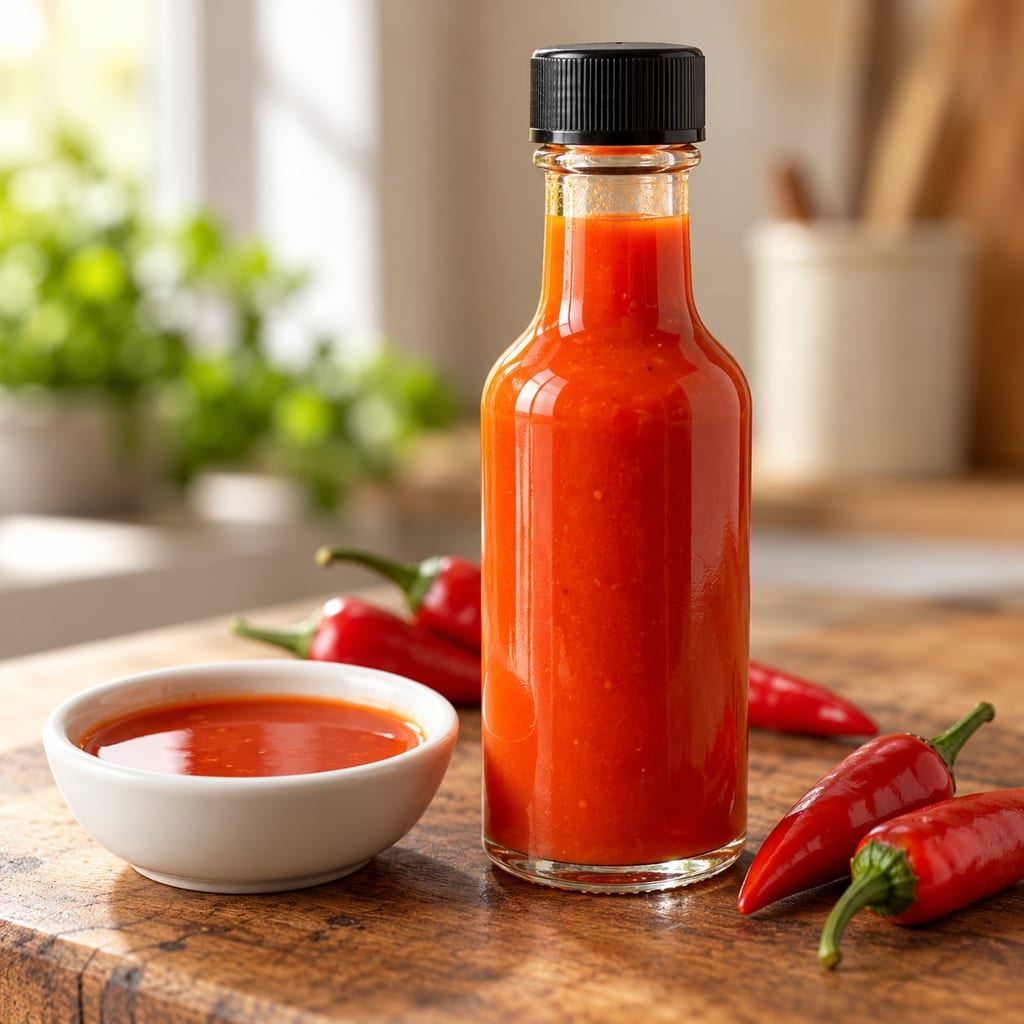
Documentary account of Louisiana pepper sauces, using TABASCO's published barrel-aged commercial process as one specific example; the source does not provide a validated home recipe.
No community contributions have been published for this entry yet.
Sign in to contribute. Published comments and photos are free to read.
Chambre de l'agriculture et de la pêche lagonaire (CAPL)Inspiration · Process · Location · History
Tama'a Maitai: Manuel du manger localFront matter, pp. 1-3: title, September 2023 publication information and Marc Fabresse's publication/editorial credit; recipe author is not named in the source register.
Printed p. 69 / PDF p. 71, seafood table: Oura pape / Chevrette, Macrobrachium sp., and the March-October season entry associated with Taioro. This is an ingredient-table season, not a Taioro calendar.
Printed p. 80 / PDF p. 82, Taioro heading and full recipe: four coconuts, five chevrette heads, seawater and green onion; ordered grating, head cleaning/crushing in a punu, straining, mixing/covering, cool one-day rest, onion and cold serving. CAPL lists fish, bénitier and korori pairings.
The manual gives no ingredient mass, seawater volume or salinity, measured temperature, yield, monitoring, objective endpoint or storage life. It is not process validation.
Cited in: What is taioro?; Names and terminology; Historical evidence; Coconut as the principal ingredient; Why freshwater prawns are involved; Documentary ingredient list; Stage 1 — Prepare the coconut; Stage 2 — Prepare the traditional crustacean ingredient; Stage 3 — Combine the materials; Stage 4 — Fermentation; Stage 5 — Optional seafood accompaniment; Why this is not a reproducible home preservation protocol; Rat lungworm and eosinophilic meningitis; A safer approach to experiencing taioro; How fermentation might change the coconut; Taioro and mitihue; Regional and ingredient variations; How taioro is eaten; Quality indicators and limitations; What remains unknown
Direction de la santé, Polynésie française; Bureau de santé environnementaleSafety
Préparation de Taioro et de Mitihue: Formulaire d'information et d'engagement, SSA-F6 Rev2Full one-page official form, dated 11 January 2022, p. 1 lines 10-34: raw chevrettes may carry a parasite; the form directs freezing them for at least 48 hours and says not to consume Taioro made with unfrozen chevrettes. It also states producer freezing, registration and labelling/declaration obligations.
The form is independent local health guidance; it does not validate CAPL's fermentation or supply its missing process measurements.
Cited in: Coconut as the principal ingredient; Documentary ingredient list; Stage 1 — Prepare the coconut; Stage 2 — Prepare the traditional crustacean ingredient; Stage 3 — Combine the materials; Stage 4 — Fermentation; Stage 5 — Optional seafood accompaniment; Regional and ingredient variations; How taioro is eaten
Direction de la culture et du patrimoine, French PolynesiaHistory · Location
Découvertes culinaires et artisanales (DCP traditional-recipe index)The accepted source dossier reports that an ordinary HTTP 200 full-list read included Taioro in the traditional-recipe index. The independent audit's fresh ordinary request returned HTTP 503; its body was not inspected then. The linked article also returned HTTP 503. This record supplies access history only; no search-rendered text or inaccessible article content supports the recipe method or local spelling Taiero.
Cited in: Names and terminology; Historical evidence; Coconut as the principal ingredient; Documentary ingredient list; Stage 1 — Prepare the coconut; Stage 2 — Prepare the traditional crustacean ingredient; Stage 3 — Combine the materials; Stage 4 — Fermentation; Stage 5 — Optional seafood accompaniment; Regional and ingredient variations; How taioro is eaten
French Polynesia, Direction des Ressources MarinesReference
French Polynesia, Direction des Ressources Marines — La préparation du taiorotraditional ingredients and preparation. DCP
Cited in: Names and terminology; Historical evidence; Coconut as the principal ingredient; Documentary ingredient list; Stage 1 — Prepare the coconut; Stage 2 — Prepare the traditional crustacean ingredient; Stage 3 — Combine the materials; Stage 4 — Fermentation; Stage 5 — Optional seafood accompaniment; Regional and ingredient variations; How taioro is eaten
French Polynesia, Centre de Santé EnvironnementaleReference
French Polynesia, Centre de Santé Environnementale — Taioro, mitihue et méningiteofficial health warning. CSE
French PolynesiaReference
French Polynesia — Public-health surveillance bulletin, March 2023surveillance and prevention. service-public.pf
CAPLReference
CAPL — Tama'a Maita'i manual descriptionmanual's existence and scope, not a verified taioro recipe. capl.pf
Cited in: Coconut as the principal ingredient; Documentary ingredient list; Stage 1 — Prepare the coconut; Stage 2 — Prepare the traditional crustacean ingredient; Stage 3 — Combine the materials; Stage 4 — Fermentation; Stage 5 — Optional seafood accompaniment; Regional and ingredient variations; How taioro is eaten
Bodin, 1981Reference
Bodin, 1981 — La chevrette et le nœud coulantethnographic evidence. Persée
Cited in: Names and terminology; Historical evidence
IRDReference
IRD — Tahitian–French lexical referenceoriginal names and definitions. horizon.documentation.ird.fr
Cited in: Names and terminology; Historical evidence