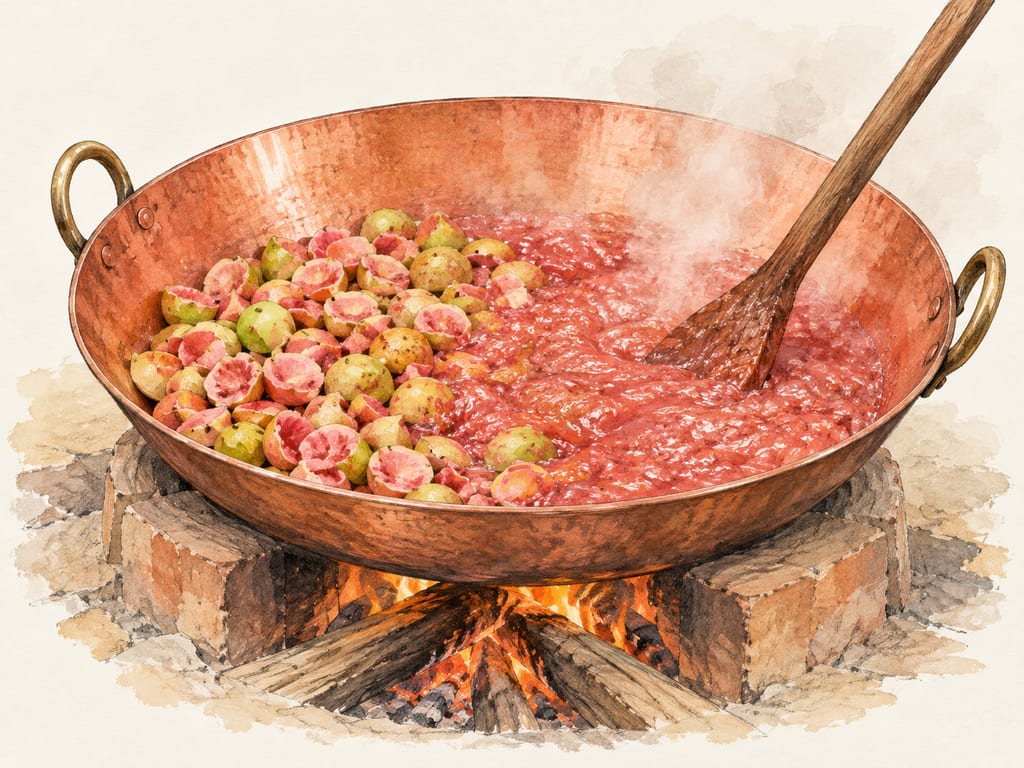
Copper kettle for goiabada
The tacho de cobre is a broad copper kettle used to cook guava and sugar into goiabada cascão in São Bartolomeu, Minas Gerais. Local accounts pair it with a wood-fired brick hearth.
 FermenteaWhere food goes to change
Equipment · Tanks and vats
Closed coffee fermenter · closed coffee fermenter · coffee anaerobic fermentation vessel · hermetic coffee fermentation bag
Contemporary vessels used to ferment coffee cherries or pulped coffee with restricted air exchange. Drums, rigid tanks and hermetic bags differ in material and monitoring; “anaerobic” alone does not describe a batch's conditions.
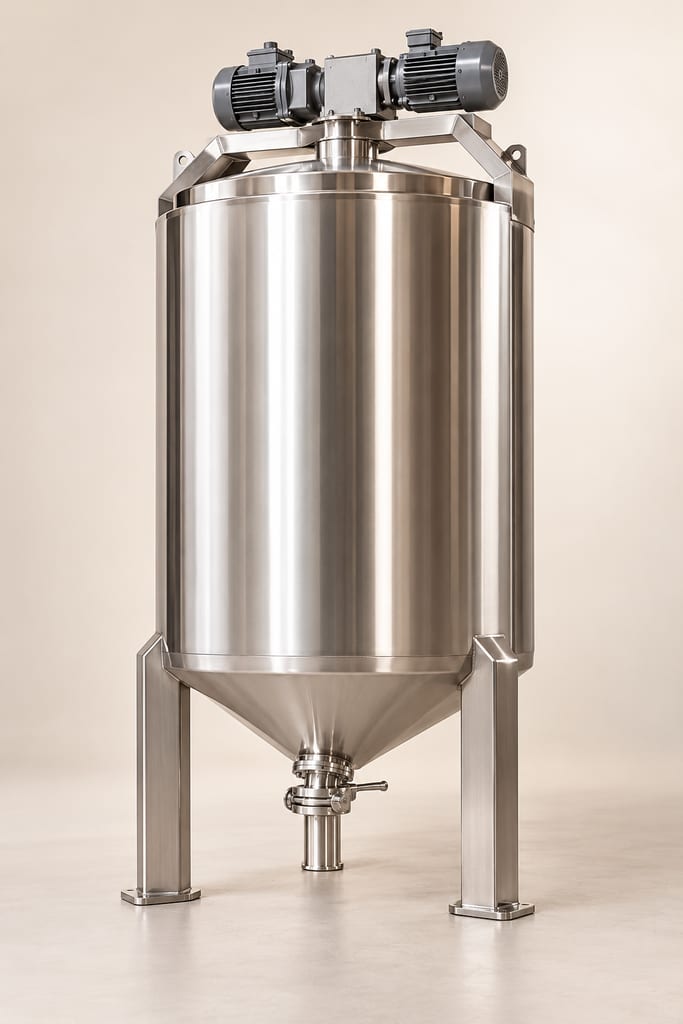
Coffee processing uses a closed vessel when a producer or researcher wants to limit exchange with surrounding air during fermentation. The equipment can be a rigid drum or tank with a sealed lid and a gas-management fitting, a stainless research bioreactor, or a flexible hermetic bag. These are related solutions, not one standardized machine. A batch may contain whole ripe cherries or pulped coffee with mucilage; the chosen coffee form, closure, water, headspace and monitoring all affect how a particular run behaves.
“Anaerobic” is often used as a process label, but a closed lid is not a measurement of oxygen in every part of a coffee mass. In self-induced systems, microbes and the coffee consume oxygen remaining after closure while carbon dioxide accumulates; a one-way valve can let gas escape while reducing inward air exchange. Other bag treatments may remove air or use a different gas regime. The source system must therefore be described by its actual closure and measurements, not by the label alone.
A practical farm-scale example uses a food-grade HDPE drum with a gasketed lid and a one-way airlock; a tap can be added to draw off liquid. The guide describes this as a low-cost experimental arrangement, rather than an industrial specification. Its closure and gas fitting are functional parts: an unvented, fully sealed container is not equivalent to a vessel designed to manage gas.
Stainless steel bioreactors are another documented form. Martinez and colleagues studied stainless fermentation tanks for coffee, and their figure pairs a photograph with a dimensioned drawing of a tall cylindrical body, upper drives and stirrers, a sloped lower section and an outlet. A later description of this design gives overall height and diameter, but those dimensions identify that apparatus only. A jacket, sampling points, valves or agitators should be included only when a chosen model actually has them.
Flexible hermetic bags make a different compromise. A University of the Philippines Los Baños doctoral study, catalogued by SEARCA, evaluated 25-litre bag treatments for Excelsa coffee cherries and parchment coffee. The abstract reports measurements of temperature, humidity, inflation, oxygen and carbon dioxide in the headspace, alongside mucilage pH and soluble solids. The bag conforms to the batch instead of presenting rigid tank walls, and the study's monitoring belongs to its protocol; it is not a specification for every pouch.
The point of comparing vessels is to understand the whole process, not to assume that steel, plastic or a hermetic package creates a better cup by itself. Coffee species and ripeness, whole fruit versus pulped coffee, inoculation, temperature, time, whether water is present, and how the batch is opened all matter. A vessel can make closure and sampling more repeatable, but it cannot make different protocols comparable without those details.
For the reader, the equipment decision begins with the intended coffee process and scale. A rigid drum is easy to handle and can accept a lid fitting; a research tank can add instrumentation or agitation; a flexible bag accommodates a compact batch and can support headspace monitoring. The sources do not establish a single preferred design, universal capacity, or common cleaning schedule across these forms. Use a vessel built for the selected food-contact and gas-management conditions, and keep measurements tied to the actual batch rather than treating the vessel's name as proof of control.
The sources do not provide a shared pressure rating or validated gas-management specification for this family; use only the selected vessel's documented closure and operating limits.
A closed container or a process label such as “anaerobic” does not establish a measured oxygen concentration throughout the coffee mass; closure changes gas exchange but does not guarantee uniform conditions.
Source →The studies are process-specific: vessel, coffee form, water, headspace, sealing and monitoring differ, so their results cannot be transferred to every vessel or batch.
Source →Country-level study location; not an origin claim for the equipment family.
Country-level dissertation record; not an origin claim for hermetic coffee bags.
SICC describes its small-batch tank setup at Mooleh Manay; no claim is made about the origin of the design.
The tacho de cobre is a broad copper kettle used to cook guava and sugar into goiabada cascão in São Bartolomeu, Minas Gerais. Local accounts pair it with a wood-fired brick hearth.
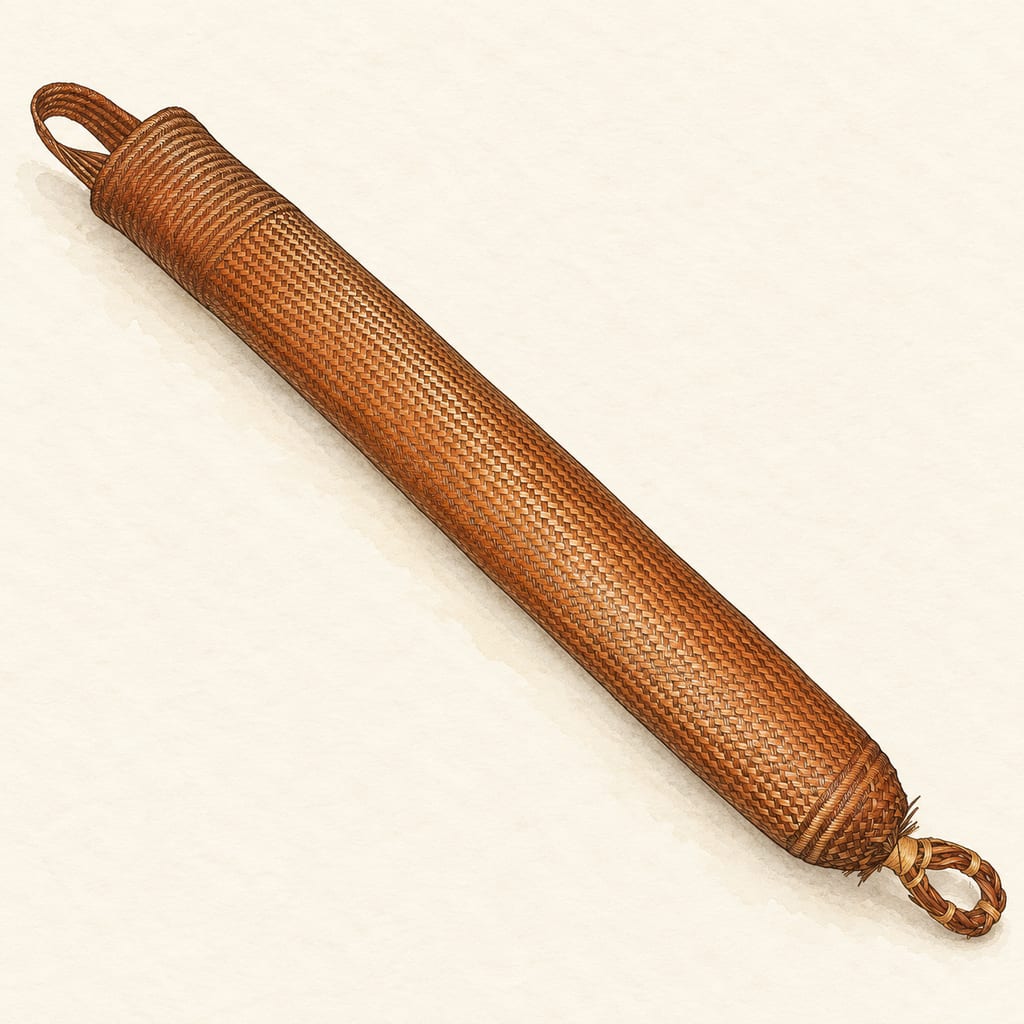
Tipití is a long, flexible woven basket press used to squeeze grated cassava mash. Its looped ends let a maker suspend and stretch the tube; it is a processing tool, not a fermenting vessel.
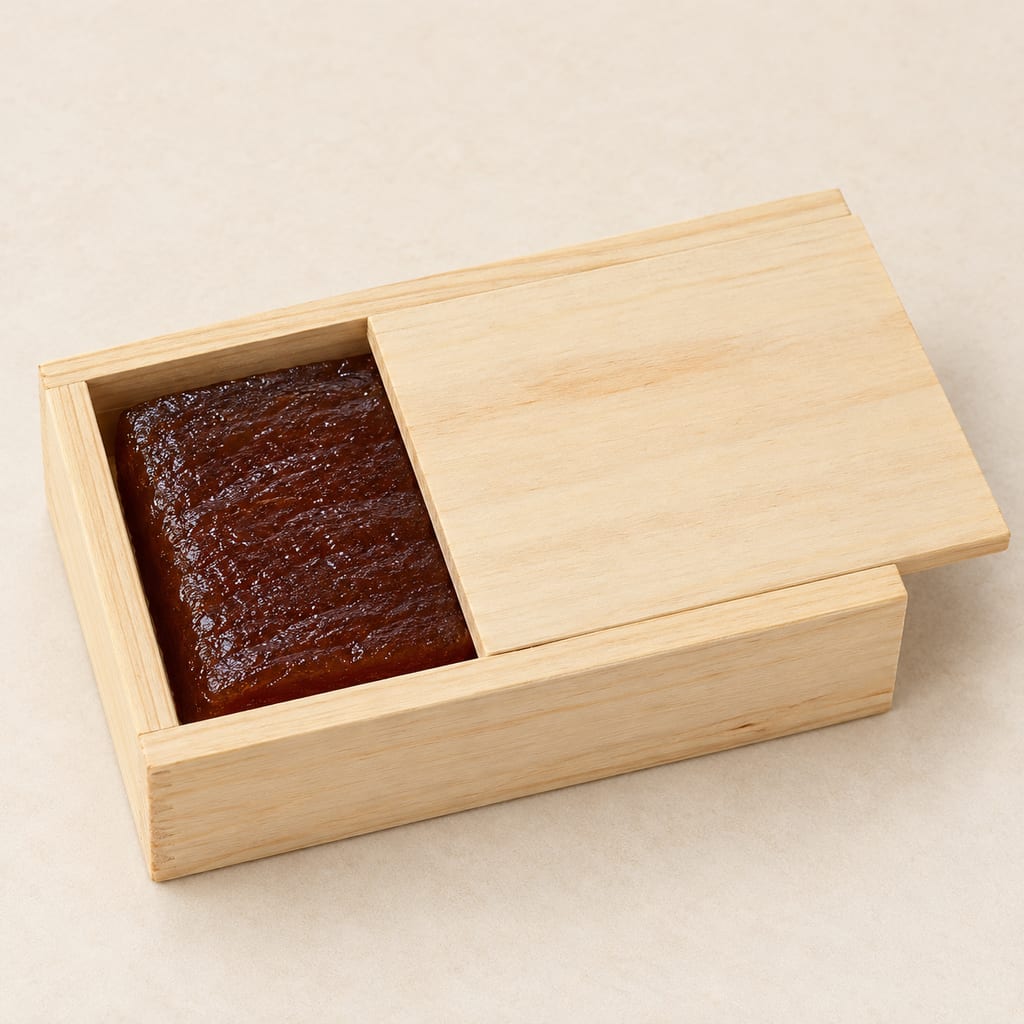
Handmade wooden boxes package Santa Luzia’s firm quince paste in Goiás. Their exact dimensions, wood species and construction are not documented.

Soft, spreadable Calabrian pork sausage made with a great deal of red chilli and fatty pork, stuffed into natural casings, sometimes smoked and matured while staying soft.

A way to add independent temperature logging to an existing food dehydrator without changing its built-in controls or protections. It is a monitoring method, not a rewiring plan.

Pleurotus cystidiosus is the abalone mushroom, a cultivated oyster-type fungus with dark brown caps that grows more slowly and is more demanding than other Pleurotus species.

A dark, balanced vinegar from Emilia-Romagna made by combining cooked or concentrated grape must with wine vinegar, then acetifying and refining it in wood under a protected specification.

A living dairy inoculum that starts controlled cream fermentation, developing acidity and aroma before sour cream or cultured butter is finished.

A small electric incubator holds jars at a selected temperature for yogurt and other documented warm food preparations. Controls, capacity and vessel arrangement vary by model.

Adygean salt is a seasoned table salt associated with Adygea and the wider North Caucasian culinary tradition. Salt is blended with garlic and a variable selection of herbs and spices; the exact mix depends on the named style and maker.

The African Caesar-group mushroom, Amanita masasiensis, is a wild ectomycorrhizal species of central and southern African woodlands, eaten locally. The genus contains deadly poisonous species, so identification needs care.
No community contributions have been published for this entry yet.
Sign in to contribute. Published comments and photos are free to read.
Food Research InternationalEquipment · Method
Novel stainless steel tanks enhances coffee fermentation qualityThe study evaluates stainless-steel coffee bioreactor tanks; Figure 1 combines a photograph with a dimensioned diagram of the tank design.
Cited in: Three documented forms
Southeast Asian Regional Center for Graduate Study and Research in AgricultureEquipment · Method · Geography
Evaluation of hermetic grain bags as fermentation vessel for Excelsa (Coffea liberica var. dewevrei) coffee cherriesThe dissertation record describes 25 L bags, whole cherries and parchment coffee, and headspace and process measurements; it is a study-specific protocol, not a universal bag specification.
Cited in: Three documented forms; Reading studies and choosing a form
SICCEquipment · Method · Geography
How To Make An Anaerobic Fermentation Tank For Coffee FermentationThe farm guide describes a food-grade HDPE drum with a watertight lid, one-way valve and optional tap as an experimental tank setup.
Cited in: What the closed vessel changes; Three documented forms
FoodsMethod · Limits · Geography
Understanding the Effects of Self-Induced Anaerobic Fermentation on Coffee Beans Quality: Microbiological, Metabolic, and Sensory StudiesA Brazilian study describes closed screw-cap polypropylene tanks, airlocks, taps and layers sampled at different heights; closure and study conditions are source-specific.
Cited in: What the closed vessel changes; Reading studies and choosing a form
Journal of Food Science and TechnologyMethod · Context
Challenges in coffee fermentation technologies: bibliometric analysis and critical reviewThe review surveys varied coffee fermentation systems and emphasizes differences among materials, methods and technology.
Cited in: Reading studies and choosing a form