Biltong
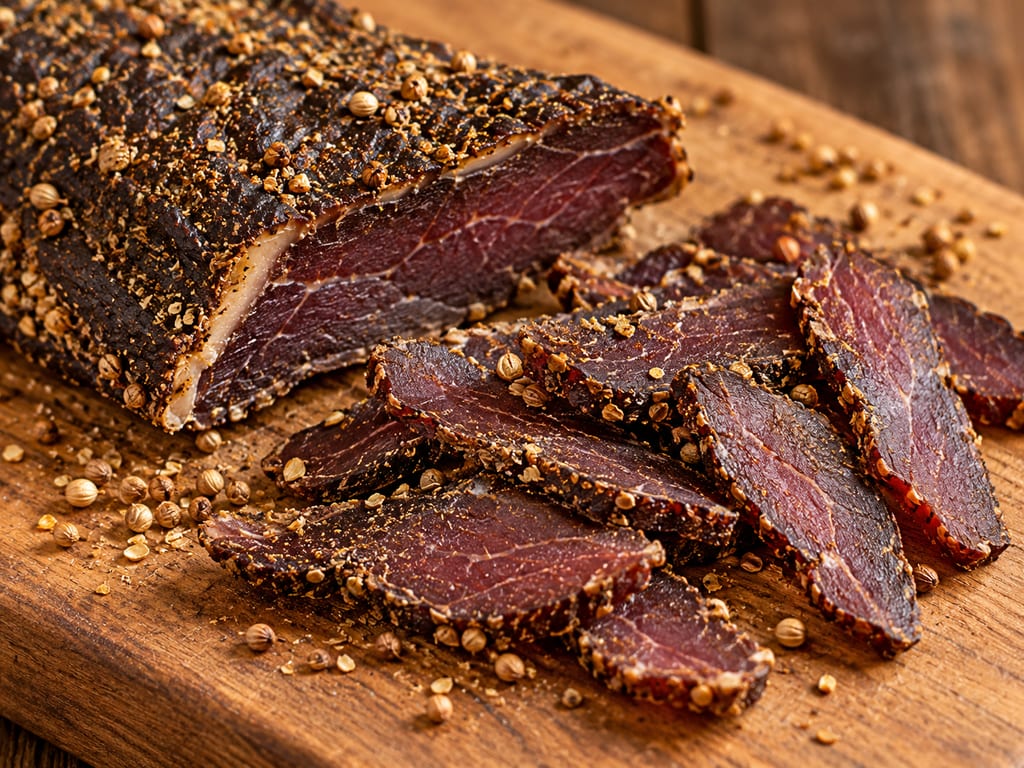
Strips of whole-muscle beef or game seasoned with salt, vinegar, roasted coriander and pepper and air-dried without cooking, sold anywhere from soft and moist to hard and very salty.
 FermenteaWhere food goes to change
Built structures · Smokehouses and smoke rooms
Household chimney for biltong drying · biltong chimney
Two South African historical accounts describe biltong hung in a household chimney after initial drying or curing; neither supplies a construction plan or modern processing schedule.
Hilda Duckitt’s 1891 cookbook describes wind-dried beef hung in a chimney and later sliced thin or rasped. The description is evidence for the published recipe, not proof that all South African households used the same arrangement.
In a separate essay dated 26 November 1943, C. Louis Leipoldt describes a soft beef biltong variation with prolonged chimney hanging. These sources establish historical household use, but give no plan, dimensions or modern drying schedule.
The two accounts do not specify a standard chamber shape, hanging fixture, fire arrangement or building dimensions. Their saltpetre references are historical and are not converted here into current curing advice. This entry documents the accounts; it is not a construction guide or validated food-processing method.
Duckitt's cookbook was published in 1891; Leipoldt's essay is dated 26 November 1943.
A build is made where it stands: moving it means building it again.
Historical descriptions only; not a modern drying or curing method.
The sources establish historical accounts, not the precise household location or universal use of chimney drying.
Strips of whole-muscle beef or game seasoned with salt, vinegar, roasted coriander and pepper and air-dried without cooking, sold anywhere from soft and moist to hard and very salty.
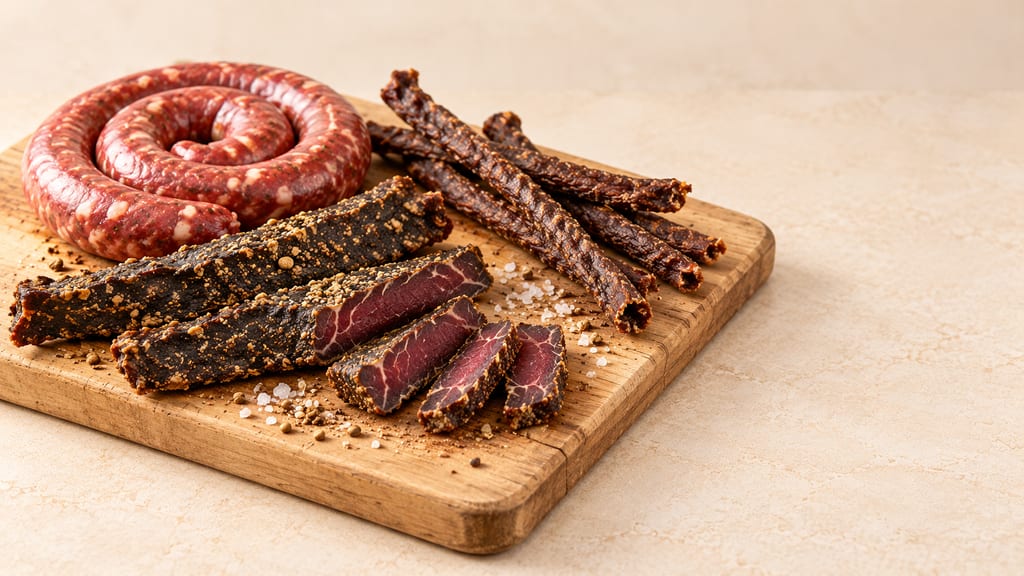
Boerewors, biltong and droëwors share a table but follow different paths from meat to meal. Their histories lead from the braai and butcher's counter to drying lines, household pots and the science of keeping food.

A Cap-Pelé boucanière is an Acadian herring-smoking building. The documented Willie Niles example is a one-storey wood-frame structure with a ridge smoke vent and interior bays for hanging fish-bearing cannes.

Achcharu is a family of Sri Lankan vinegar pickles made with mixed vegetables or seasonal fruit and a piquant spice dressing. This version is a quick, refrigerated, non-fermented mixed-vegetable pickle.

The acocote is a long, hollowed and dried gourd used to draw aguamiel from a mature maguey. It is a harvesting tool: the sap is transferred to a separate vessel before it ferments into pulque.

Adrak murabba preserves young ginger in sugar syrup, a sweet South Asian preparation recorded in Indian cookery and food-processing sources.

Parkia biglobosa seeds are fermented into regional West African seasonings, including nététou, iru, dawadawa and soumbala. The yellow fruit pulp is a separate food, and names and methods vary by place.

Japanese reddish-brown vinegar from sake lees matured about three years, turned to vinegar by acetic bacteria; the vinegar of Handa and Edomae sushi rice.

A refined common-wheat flour blended for a broad range of baking; its protein and behavior vary with wheat, milling and market.

The almond mushroom, Agaricus subrufescens, was cultivated in eastern North America in the 1800s, lost its market, and returned as a cultivated mushroom from Brazil, where it is grown under several names.
No community contributions have been published for this entry yet.
Sign in to contribute. Published comments and photos are free to read.
W. P. Schreiner & Co.History · Form · Use
Hilda’s “Where Is It?” of RecipesThe 1891 biltong entry describes initial wind drying followed by hanging in a chimney, then slicing thin or rasping.
Historical cookbook account, not a validated modern process.
Cited in: A household chimney in historical biltong accounts; Limits of the evidence
DBNLHistory · Form · Use
BiltongEssay dated 26 November 1943 describes soft beef biltong with cloth and prolonged chimney hanging.
Historical ingredients and methods are not modern safety guidance.
Cited in: A household chimney in historical biltong accounts; Limits of the evidence