Sunken pantry cask (Hofstaðir)
A large cask set into the pantry floor at Hofstaðir was used to store food in whey.
 FermenteaWhere food goes to change
Built structures · Place · Pits and cavities
A round, stone-filled pit at Hrísbrú was interpreted as a barrel position; its exact vessel, contents and use remain uncertain.
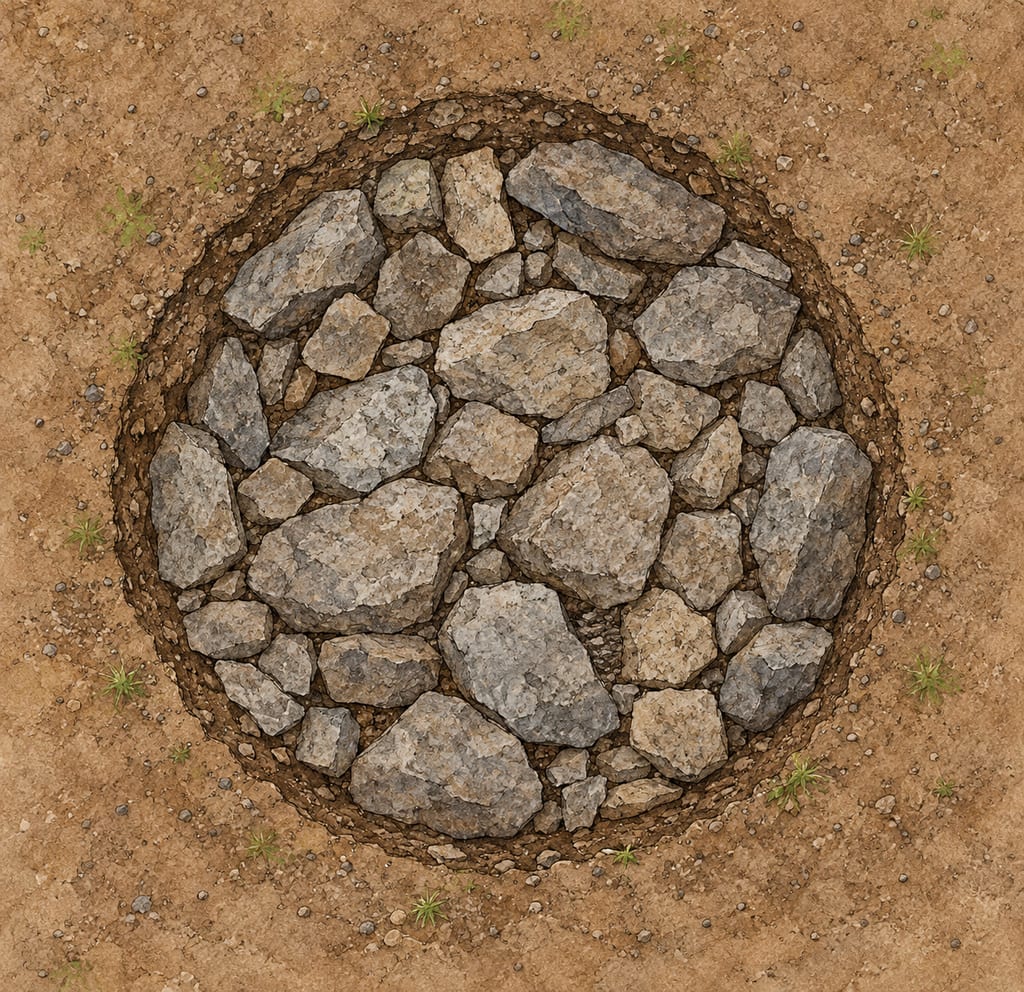
At Hrísbrú, a Viking-Age farm in Iceland’s Mosfell Valley, archaeologists recorded a round, flat-bottomed pit in an antechamber east of the longhouse entrance. The feature, C-2007-46, measured about one metre across in the spatial study; a wood-identification report gives about 1.15 metres along its longer axis. Both accounts describe tightly packed stones inside it.
The researchers interpret the feature as a place where a barrel stood on the stones. That interpretation gives the pit a possible role in food storage, but the excavation does not establish a surviving barrel, its shape or material, or what it held. The room’s upper phase may have functioned as a pantry, an interpretation based on the pit and other traces rather than a preserved storage plan.
The packed-stone fill is the strongest physical evidence for the pit’s form. It suggests a deliberately prepared base, while the proposed barrel above it remains an archaeological reconstruction. The published descriptions do not specify the pit’s depth, exact outline beyond its round and flat-bottomed character, the stones’ geology, the barrel’s cooperage, or a lid, lining, insulation, seal or drainage system. The reported 1.15-metre measurement is the pit’s longer axis, not a barrel diameter or capacity.
The barrel interpretation matters because the authors connect the room to pantry work and describe barrels as containers used for dairy products or meat preserved in sour whey. That context makes food storage plausible, but it does not identify the contents of this particular vessel. The pit should therefore be read as evidence for a probable barrel position within one house, not as proof of a specific recipe or preservation schedule.
Hrísbrú lies in the Mosfell Valley, about 30 kilometres north of Reykjavík. The excavated house belongs broadly to the tenth or early eleventh century, but the pit is not independently dated to a single year. Its room position, packed stones and possible barrel use are specific to this excavated feature.
A separate floor-set cask is described at Hofstaðir in northern Iceland. Both sites contribute evidence for food storage associated with barrels or casks, but their installations differ: Hofstaðir’s source describes a cask embedded in a pantry floor, while Hrísbrú’s researchers infer a barrel placed over a stone-filled pit. Comparing them is useful only if those differences remain visible.
The source references include a photograph of archaeological remains at Kvívík in the Faroe Islands and a photograph of the modern Stöng longhouse reconstruction in Iceland. These are comparative images from other sites; neither depicts Hrísbrú or pit C-2007-46, and neither establishes its dimensions, fill or room layout.
The generated plan view is a schematic based on the excavation description of a round pit with tightly packed stones. It shows no barrel, food or whey and does not claim to reconstruct the excavated feature, its depth, exact stone arrangement or surrounding room. The barrel position remains an archaeological interpretation.
The pit belongs to the Viking-Age house at Hrísbrú, dated to the tenth or early eleventh century. Excavators associate its upper phase with a possible barrel and pantry use; the exact contents and duration are unknown.
A build is made where it stands: moving it means building it again.
This archaeological description is not a construction specification or validated food-storage process.
The excavation identifies the Hrísbrú longhouse and antechamber; no coordinates are added.
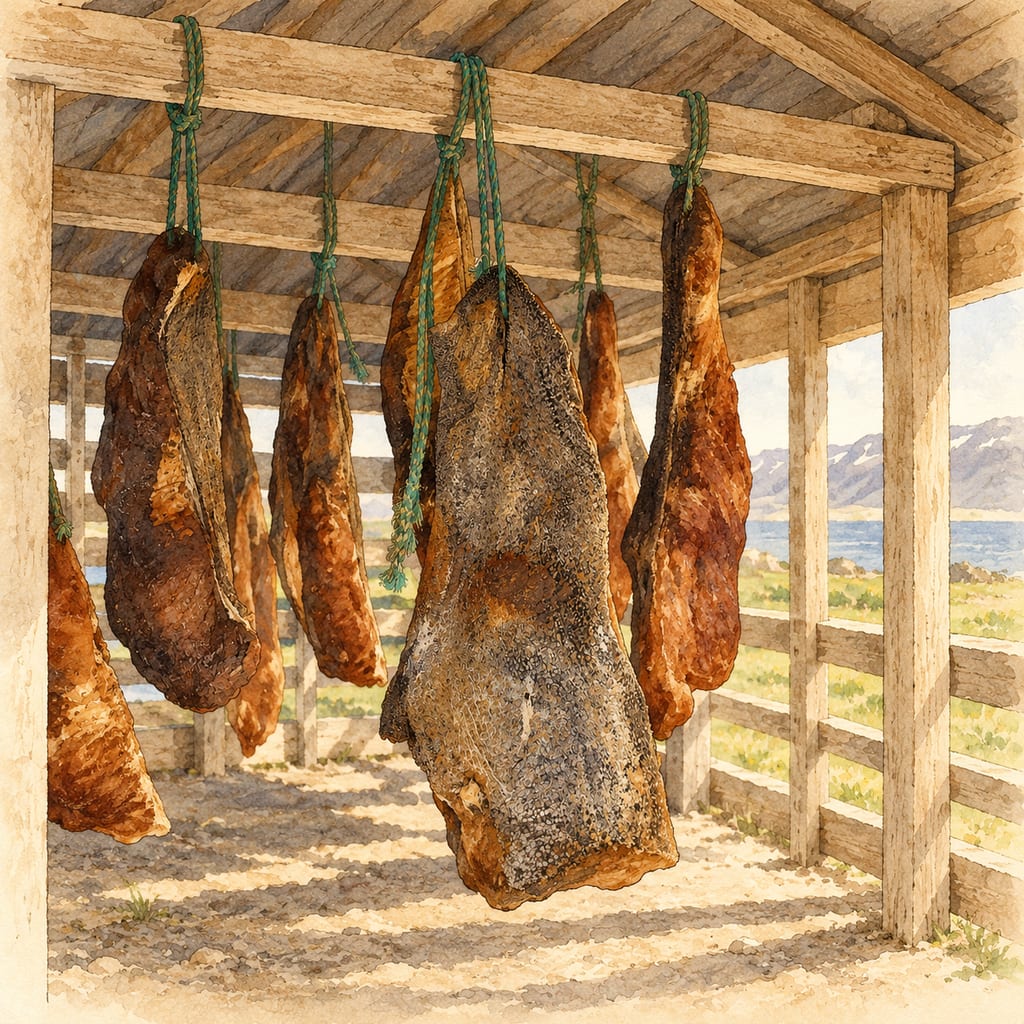
Historical hákarl pits were covered gravel features near Iceland's coast; later production uses draining containers and a separate outdoor drying stage. Sources describe varied practice, not one standard plan.

Protected Italian vinegar made only from cooked grape must, fermented and aged in a battery of wooden barrels for at least 12 years: sweet, sharp and syrupy.

Airag is Mongolia’s fermented mare’s-milk drink, traditionally churned with saved starter in a reusable cowhide khokhuur.

Appam, or hoppers, are South Indian and Sri Lankan rice pancakes made from a fermented coconut-and-rice batter and cooked in a curved pan to a crisp lacy rim and a soft, spongy centre.
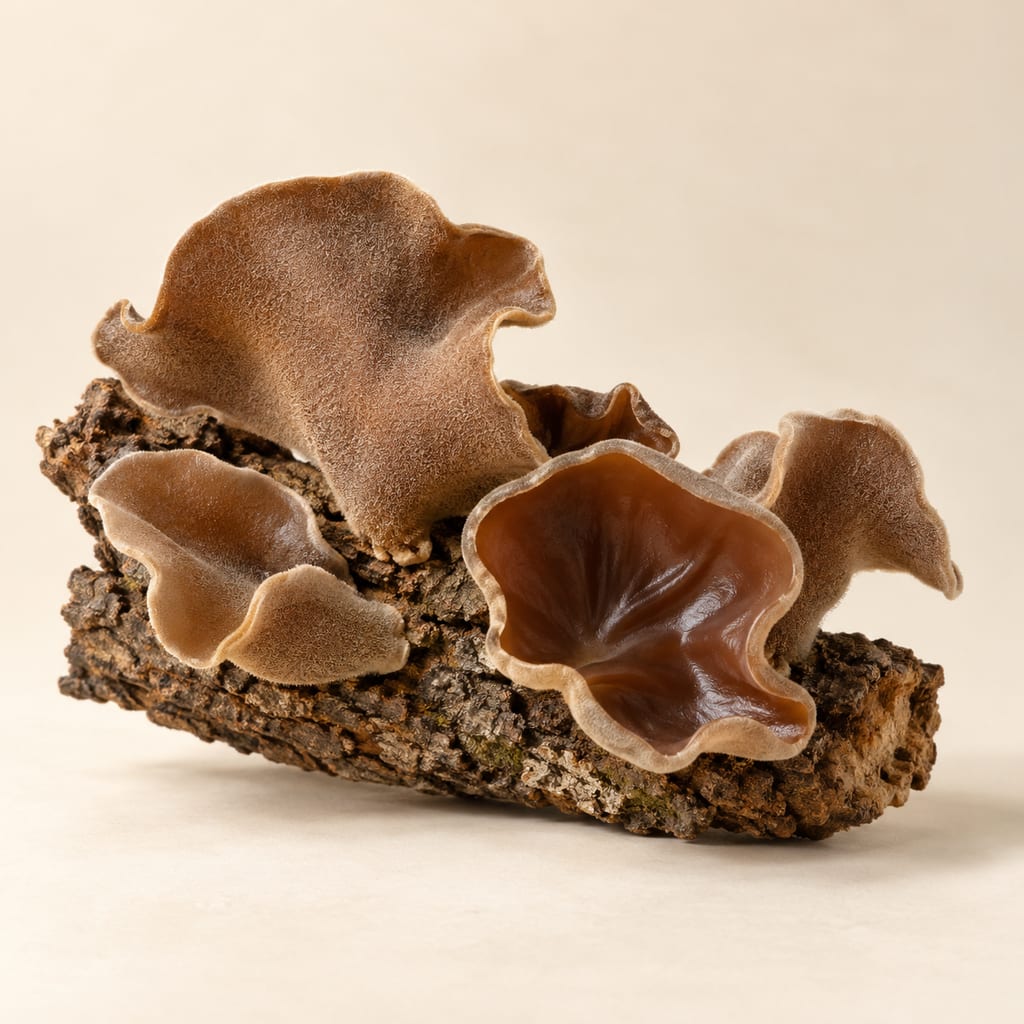
Auricularia tremellosa is a wood ear fungus of the genus that supplies most dried wood ear sold in China; its own food record is thin, and the culinary practice described here comes from the closely related wood ear species.

Ayran is Turkey’s cold, savoury yogurt drink: plain yogurt is loosened with water and lightly salted, then whisked smooth or aerated into a soft cap of foam.
A thin stone griddle used over an open hearth. Norwegian archaeology documents the established tradition from the early Middle Ages; a Viking-period origin is only a cautious suggestion linked to Shetland.

Crushed or milled barley cooked in water until the starch softens and the mixture thickens, the plainest way a northern household turned stored grain into a meal, here with apple and hazelnut.

Black carrot is the anthocyanin-pigmented Eastern carrot (Daucus carota var. atrorubens), the purple root that preceded orange types and still colours kanji and şalgam.
No community contributions have been published for this entry yet.
Sign in to contribute. Published comments and photos are free to read.
Brepols, in Viking Archaeology in Iceland: Mosfell Archaeological ProjectFeature · Function · Chronology · Interpretation
Interpreting Social Space and Social Status in the Viking-Age House at Hrísbrú Using Integrated Geoarchaeological and Microrefuse AnalysesA round, flat-bottomed pit about 1 m across in an antechamber east of the main entrance contained tightly packed stones; the authors interpret it as a likely barrel placement.
The authors suggest the antechamber served as a pantry during the room's later phase, while distinguishing other activity and later floor deposits.
Cited in: A stone-filled pit in the entrance-side room; What the installation can tell us; A site-specific comparison; Comparative images and schematic illustration
Mosfell Archaeological ProjectFeature · Dimensions · Interpretation
Wood identifications on wood remains from various buildings from the archaeological investigation at HrísbrúReport describes cut C-2007-46 as a pit for a barrel, about 1.15 m on its longer axis, filled with stones; it says the barrel was thought to have stood on top of the stones.
Cited in: A stone-filled pit in the entrance-side room; What the installation can tell us; Comparative images and schematic illustration
AntiquityGeography · Chronology
A Viking Age farm, church, and cemetery at Hrísbrú, Mosfell Valley, IcelandLocates Hrísbrú in the Mosfell Valley about 30 km north of Reykjavík and dates the farm remains to the 900s.
Cited in: A site-specific comparison
Ruralia VIII / Universität WienHistorical context · Storage
From self-sufficiency to external supply and famine in IcelandMehler surveys Icelandic storage and later traditions of wooden barrels and storage trunks, including floor installations; this broader context is not direct proof of the Hrísbrú barrel's material or contents.
Cited in: What the installation can tell us
Wikimedia CommonsVisual reference · Comparative site context · Rights
Kvívík excavations.jpgPhoto of archaeological remains at Kvívík in the Faroe Islands; CC BY-SA 4.0. A different site and not evidence for the Hrísbrú pit.
Cited in: Comparative images and schematic illustration
Wikimedia CommonsVisual reference · Comparative reconstruction · Rights
Stöng Viking Longhouse.jpg2007 photo of a modern reconstruction of the Viking longhouse Stöng in Iceland; CC BY-SA 3.0. A different site and not evidence for the Hrísbrú pit.
Cited in: Comparative images and schematic illustration