← Equipment

Equipment · Barrels and casks

Pitched wooden lager cask

ležácký sud

Loading ratings…

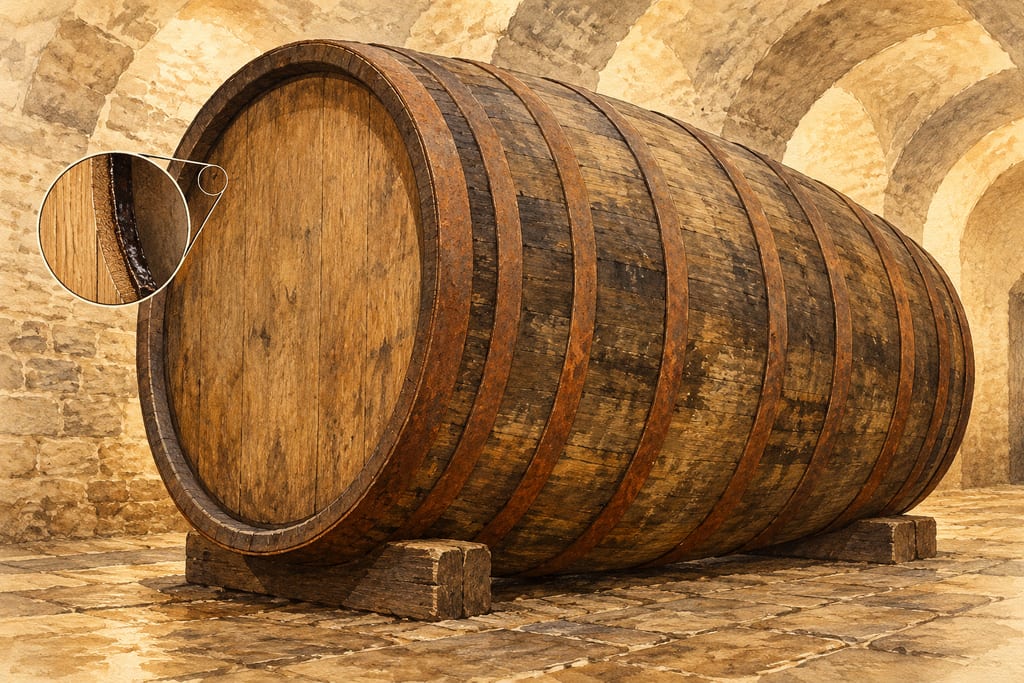
A massive oak lagering cask maintained by Plzeňský Prazdroj’s coopers. Its inner pitch lining keeps the beer from direct contact with the oak during Pilsner Urquell’s small-batch cellar maturation.

Historical illustration of a very large oak lager-maturation cask with broad hoops and a small cutaway showing its pitch-lined interior.

A very large cellar cask, not a generic beer barrel

Plzeňský Prazdroj’s pitched lager cask is an oak vessel built and maintained by the brewery’s cooper team. It lies horizontally in the cellars as a large barrel with a rounded body, circular head and broad outer hoops. One Prazdroj photograph shows a cask marked 39 hL; the company’s 2023 account describes this class as holding up to 40 hectolitres and weighing 800 kilograms when empty. These are brewery-scale casks, not the ordinary small barrels used for transport or household storage.

The word ležácký sud means a lagering cask. Its defining feature here is not oak alone but the thin pitch coating on the inside. Prazdroj says the coating keeps the beer from direct contact with the oak and limits unwanted wood-derived aromas and flavours. The cask is therefore a particular piece of cellar equipment used in the brewery’s parallel production, not a claim that all lager needs pitched wood or that every oak barrel behaves the same way.

Fermentation and maturation also need to be distinguished. Prazdroj’s 2014 account says the small parallel batch ferments in oak tubs and matures in the large barrels in the historic cellars. The large lager cask is documented as a maturation vessel; it should not be described as the brewery’s only or universal fermentation vessel.

Sources for this section

Pilsen’s cellar tradition and the rise of steel

Pilsen’s brewery cellars were begun in 1839, shortly before the new Burghers’ Brewery opened in 1842. Pilsner Urquell’s account says the first production there stored beer in large wooden barrels. Prazdroj dates its original cooperage to the same year. The cellar and the coopered cask belonged to one production system: cold underground storage gave the beer a place to mature, while the brewery’s carpenters and coopers kept the vessels in working order.

The scale grew far beyond the surviving comparison casks. Prazdroj’s 2007 history records 150 coopers in 1892 and a highest stock of 6,000 lager barrels; it also describes 9,000 wooden barrels and vats in the cellars at the start of the twentieth century. A 2023 company account instead says the brewery once had up to 7,000 large oak lager casks at the turn of the nineteenth and twentieth centuries. These are differently scoped historical figures, and the accounts do not explain how the estimates relate. The 2007 history dates mechanised cooperage to 1931. Steel casks reduced demand for coopers, and the brewery says its large-scale barrel production and maintenance ended in 1992 when cylindro-conical tanks replaced the old production equipment.

The cask did not disappear entirely. Prazdroj retained a small group of coopers to look after surviving barrels and tubs and to keep a small traditional batch alongside modern beer. That retained batch lets the brewers compare the barrel-matured beer with the tank-made production. It is a working craft within one brewery, rather than evidence that large wooden casks remain standard across the modern lager industry.

Sources for this section

What the pitch lining changes

Oak is the cask’s structure, but it is not the beer’s contact surface on the inside. Prazdroj describes brewer’s pitch as a mixture cooked from conifer resin, mainly pine. After the vessel is cleaned and its old coating is melted away, the hot new pitch is spread along the interior by rolling the enormous barrel; surplus is drained. Once set, the thin lining separates the beer from the oak and reduces the wood-derived aromas and flavours that an unlined cask could contribute.

This is a form of control, not a guarantee that the wood has no influence or that every pitched cask produces identical beer. The brewery uses the barrel-matured batch as a reference against modern production. The comparison only makes sense alongside the cellar conditions, the beer, the yeast and the rest of the brewing method; the cask alone does not explain every sensory difference.

The maintenance is seasonal and substantial. Prazdroj says coopers bring some barrels out in spring and autumn to re-pitch them. In 2023, fifteen of the more than one hundred large casks went through the autumn work, a two-week operation for the team. The company describes pitch at about 200°C and a vessel weighing 800 kg empty. These figures explain why this is specialist brewery work by an eight-person crew, not a practical home-barrel treatment.

Sources for this section

Oak selection, capacity and the limits of the record

Prazdroj says its large casks are made from oak that grew slowly on hard ground, producing close annual rings, and that the wood is air-dried naturally for six to ten years before use. It reports that two coopers need about a month to make a 40-hectolitre lager cask. This detail gives a sense of why the vessel belongs to a skilled cooperage rather than a general-purpose kitchen: the scale, long wood preparation and specialised construction are part of the equipment itself.

Capacity statements vary by publication date. The 2014 company article calls the casks about 50 hectolitres; Prazdroj’s 2023 account gives a maximum of 40 hectolitres, and its photograph shows one barrel marked 39 hL. The sources do not explain whether the difference reflects a particular vessel, a reporting change or a different measurement. This record uses the 2023 limit for the current example and keeps the earlier estimate visible, rather than treating one figure as a standard for all lager casks.

The sources document manufacture and use at Plzeňský Prazdroj in Plzeň, not a retail route for buying one. They do not give the barrel’s height, diameter or detailed joinery drawings. Nor do they establish that every oak barrel should be pitched: this is the brewery’s documented practice for its own large casks and its parallel Pilsner production.

Sources for this section

A living cellar practice

Pilsner Urquell still describes its cellars as a place for parallel brewing and maturation in wood. The brewery offers visitors a taste of unfiltered, unpasteurised beer from the large casks, while its brewers use the small batch as a comparison with beer from modern equipment. That continuing use explains why the cooperage survives even though steel and cylindro-conical tanks replaced most large-scale wooden-vessel production.

The cask is best understood in this specific setting: an oak barrel with a pitch-lined interior, made and cared for by the Pilsen brewery’s coopers, used for a small lagering comparison in the historic cellars. The available evidence does not turn it into a universal fermentation technique, a home-brewing specification or a claim that the current barrel is physically unchanged from the vessel used in 1842.

Sources for this section

History

Prazdroj dates its original cooperage to 1842. Its sources describe large oak lager casks in the Plzeň brewery cellars, the decline of cooperage as steel and cylindro-conical tanks replaced wood, and the later continuation of a small cask-based brew for comparison with modern production. The current casks and the earlier industrial stock are not one unchanged standardized design.

Equipment details

Capacityup to 4000 L Prazdroj’s 2023 accounts give up to 40 hL; its 2014 account describes a cask of about 50 hL. The sources do not reconcile the difference, so this is not a universal cask specification.
PowerNo power The cask is a passive vessel. Prazdroj describes the pitching work as manual rolling by its cooper team.
How you get oneBought, manufactured The documented large cellar casks are made and maintained by Plzeňský Prazdroj’s own cooper team. The sources do not describe a general retail supplier or purchase route.
CarePrazdroj maintains large lager casks twice each year, in spring and autumn. The documented work includes cleaning, melting off old pitch, applying new hot pitch, rolling the cask to spread it over the inner surface and draining the excess. The 2023 account says this large-vessel work requires the brewery’s eight-person cooper team; it is a description of specialist brewery maintenance, not a home procedure.

Made of

  • Oak — Coopered barrel body and heads
    Prazdroj says the large lager casks are made from oak; the 2023 photograph shows the staves and circular head of one example.
  • Brewer’s pitch made from conifer resin — Thin internal lining
    The brewery describes the pitch as a cooked resin mixture, mainly from pines, applied inside the cask to prevent direct beer-to-wood contact and unwanted wood-derived aromas and flavours.
  • Metal hoops — External barrel bands
    Broad hoops are visible on the inspected Prazdroj cask photographs; the sources do not specify their alloy.

Limits

The capacity and empty weight describe Prazdroj’s large cellar casks, not every wooden lager barrel. The brewery reports up to 40 hL and 800 kg empty in 2023, while its 2014 article estimates about 50 hL; the sources do not explain the difference.

Source →

Places

Plzeň

Manufacture · Locality evidence

This is the documented place where Plzeňský Prazdroj’s cooper team makes and maintains the large casks; it is not a claim about every oak lager cask.

Plzeň

Documented use · Locality evidence

The association is Pilsner Urquell’s brewery cellars and its small parallel-maturation practice, not a nationwide Czech use claim.

Related

Community

No community contributions have been published for this entry yet.

Share what you made

Sign in to contribute. Published comments and photos are free to read.

Sources