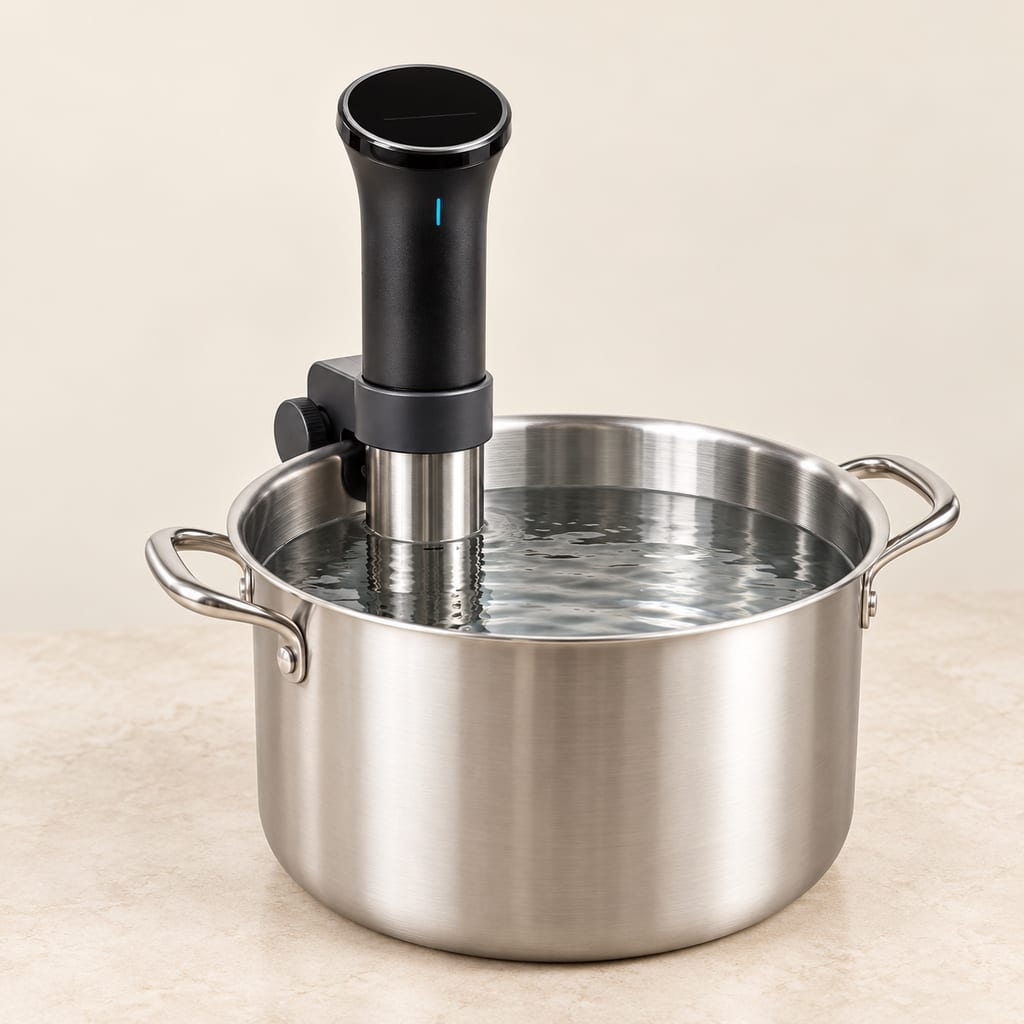
Anova Precision Cooker
The Anova Precision Cooker 3.0 is a clamp-on electric immersion circulator with a stainless skirt, adjustable clamp and two-line touchscreen. It heats and moves water around food held separately.
 FermenteaWhere food goes to change
Equipment · Incubators and warm holds
immersion circulator · sous-vide immersion circulator
An immersion circulator heats and moves water around food held separately in bags or containers. For fermentation, it can provide a controlled warm bath for jar-based cultures when the recipe and appliance support that use.
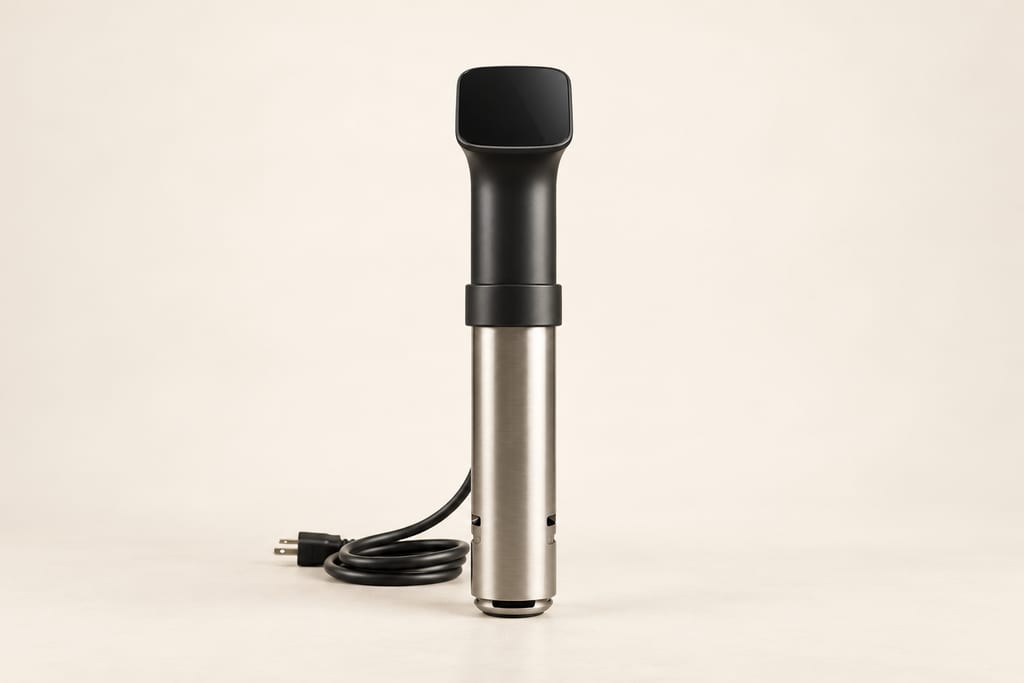
A sous-vide circulator is an electric immersion appliance that clips to the rim of a separate pot or tank. Its submerged section heats the bath and pumps water around it, while a sensor and controller regulate the model's selected temperature. The vessel holding the water is separate equipment; the appliance is not a self-contained tank. Anova's setup instructions show its cooker clamped to a user-supplied metal, glass or plastic vessel, with the bath level kept between the marks on that model. That range and vessel compatibility should not be generalized to other products.
The device controls the surrounding water, not the food directly. Anova and Breville/PolyScience both specify water-only operation in the manuals consulted. Food goes into a separate bag or container, and that container sits in the moving bath. For long runs, Anova's support guidance calls attention to the water-level limits; evaporation or a vessel that does not suit the model can interrupt operation. Product power, flow rate, usable bath size, water-depth range and materials belong to individual models, so this page gives no single capacity or dimension.
A circulator can serve as a temperature-controlled water jacket around jars used for a cultured milk preparation. In a contributor recipe hosted by Anova, milk is heated and cooled separately, mixed with yogurt culture, portioned into small jars and then incubated in a water bath set by an Anova cooker. The circulator's job in that example is to hold the surrounding bath; the culture acts in the milk inside the jars. This illustrates a modern appliance adaptation, not a traditional vessel or a universal yogurt formula.
A water bath may also be used for non-fermentation cooking, so the appliance itself is not a fermentation vessel in every use. The food and its container remain separate from the heating element and pump. When adapting a culture process, the recipe must establish its own ingredients, temperatures, time, vessel and food-safety controls; the appliance cannot supply those decisions. The manufacturer or recipe author may describe one model's range, but it should not be treated as a target for a different culture or device.
Current models share the basic arrangement—a powered head mounted above water, an immersion body and a way to attach it to a bath vessel—but their materials and controls differ. Anova's product page lists stainless steel and Teflon-coated aluminum for its Precision Cooker Pro; the manual for another model or brand may specify a different body, temperature range, vessel requirement or water-level limit. Those distinctions matter when a circulator is used beside a ferment: the bath must suit the appliance, and the culture container must be compatible with the intended process.
Clamp the device securely to a level, stable vessel and keep water within the exact model's marked range. Follow its cleaning instructions, disconnect power before cleaning, and stop if its cord or housing is damaged. Anova warns about hot pouches and electric shock if a unit falls into water; do not reach into hot water to retrieve food. The consulted manuals establish water-only use, not permission to pump milk, brine, wort or another food through the circulator. The sources do not establish one historic origin, universal construction material or a standard capacity for the class.
Anova Culinary and Breville/PolyScience publish instructions and safety information for contemporary immersion circulators. Their documents establish how these models heat and circulate a surrounding water bath, but they do not identify an inventor, a first design date or a single country of origin for the equipment class.
Anova's consulted model and Breville/PolyScience's HydroPro manual specify water-only operation; the device is not intended to circulate food or other liquids directly. Keep food in a suitable separate bag or container and check the exact model manual.
Source →A circulator heats and moves the water bath; it does not itself ferment food, determine a culture's endpoint or make a recipe safe. Its vessel size, water-level limits and temperature range vary by model.
Source →The inspected sources document current Anova and Breville/PolyScience models but do not establish the equipment class's place of invention, manufacture across models or full geographic reach.
The Anova Precision Cooker 3.0 is a clamp-on electric immersion circulator with a stainless skirt, adjustable clamp and two-line touchscreen. It heats and moves water around food held separately.
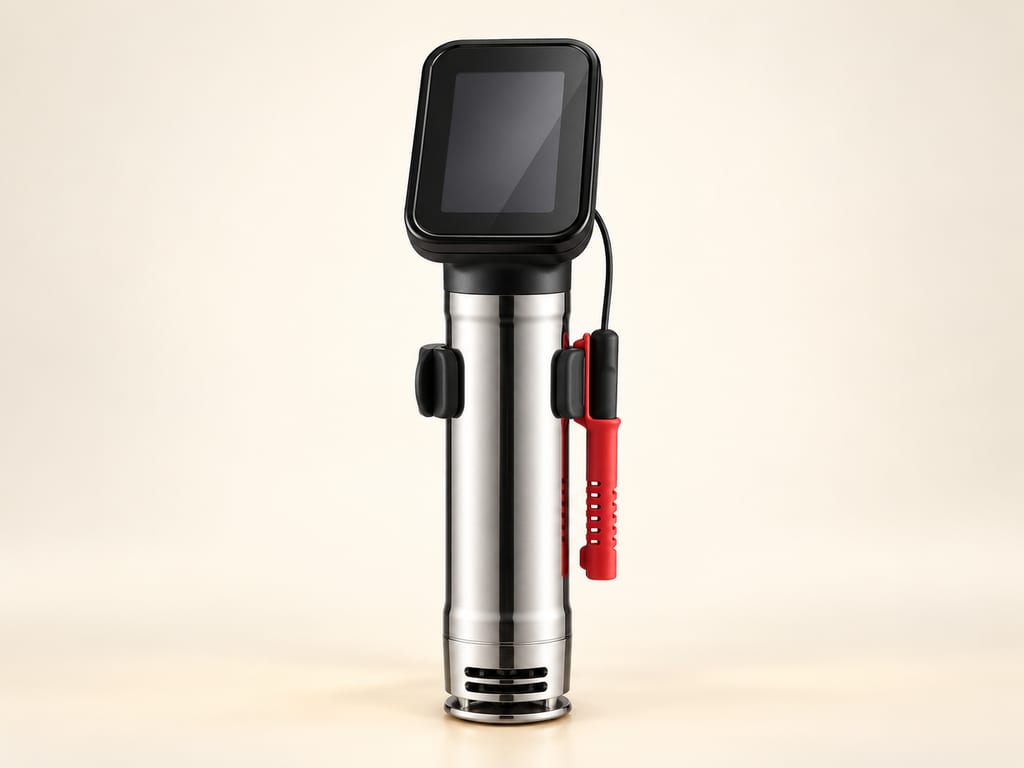
The HydroPro is Breville | PolyScience’s commercial immersion-circulator family: CSV700 HydroPro and CSV750 HydroPro Plus heat and circulate a separate water bath.
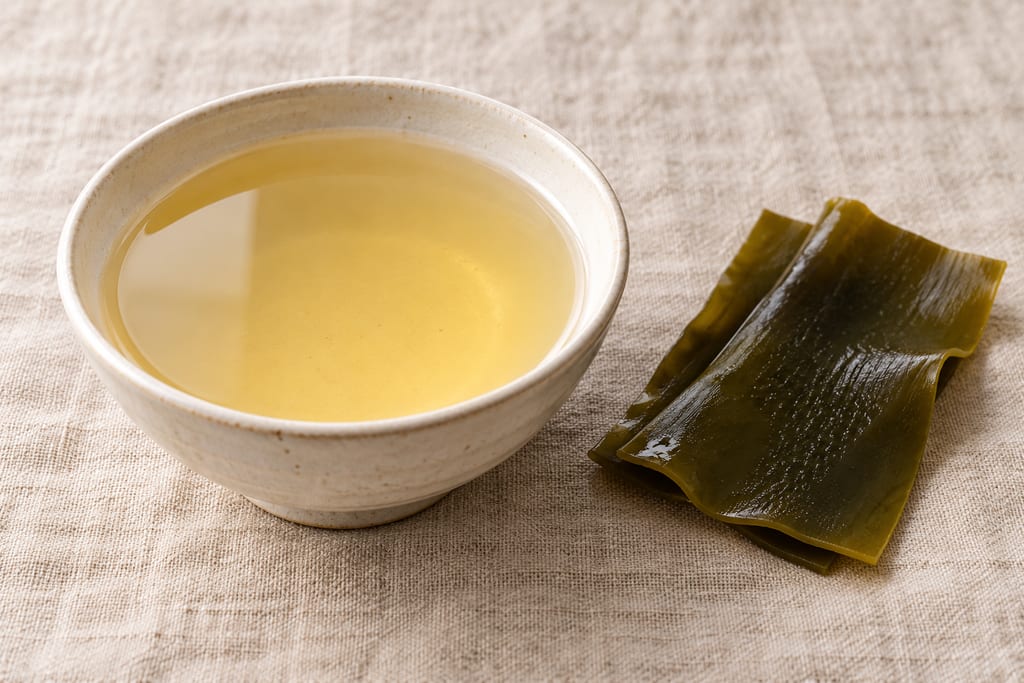
A clear Japanese broth made by gently extracting kombu’s savoury taste into water. Use it on its own for delicate dishes or as the kelp base for a separate bonito or dried-fish dashi.
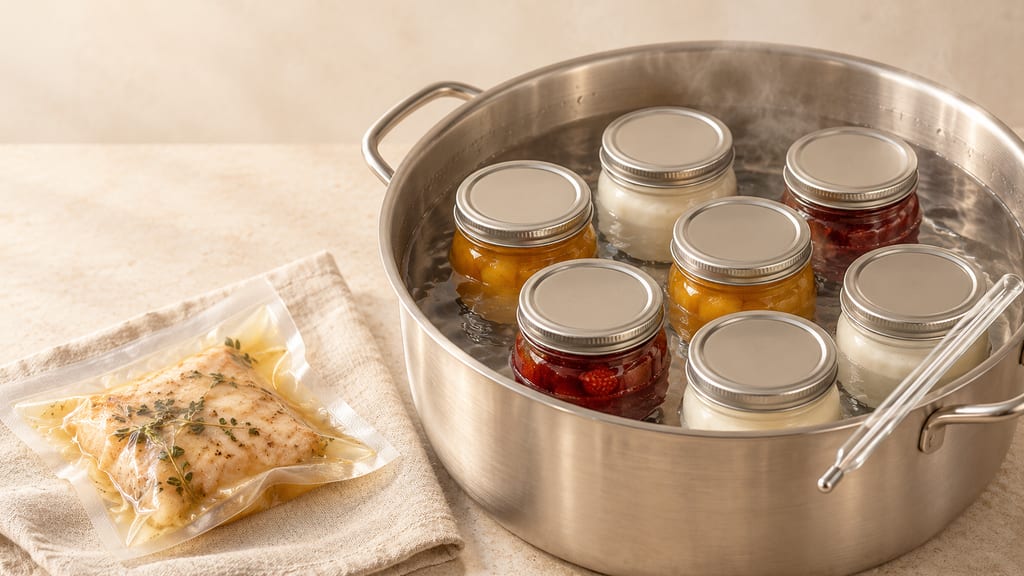
A sous-vide circulator holds a tank of moving water at a set temperature. With jars instead of bags it can incubate yogurt, set eggs, extract kombu and steep syrups, once you know what it does and does not control.

Soft, spreadable Calabrian pork sausage made with a great deal of red chilli and fatty pork, stuffed into natural casings, sometimes smoked and matured while staying soft.

A way to add independent temperature logging to an existing food dehydrator without changing its built-in controls or protections. It is a monitoring method, not a rewiring plan.

Pleurotus cystidiosus is the abalone mushroom, a cultivated oyster-type fungus with dark brown caps that grows more slowly and is more demanding than other Pleurotus species.

A dark, balanced vinegar from Emilia-Romagna made by combining cooked or concentrated grape must with wine vinegar, then acetifying and refining it in wood under a protected specification.

A living dairy inoculum that starts controlled cream fermentation, developing acidity and aroma before sour cream or cultured butter is finished.

A small electric incubator holds jars at a selected temperature for yogurt and other documented warm food preparations. Controls, capacity and vessel arrangement vary by model.

Adygean salt is a seasoned table salt associated with Adygea and the wider North Caucasian culinary tradition. Salt is blended with garlic and a variable selection of herbs and spices; the exact mix depends on the named style and maker.

The African Caesar-group mushroom, Amanita masasiensis, is a wild ectomycorrhizal species of central and southern African woodlands, eaten locally. The genus contains deadly poisonous species, so identification needs care.
No community contributions have been published for this entry yet.
Sign in to contribute. Published comments and photos are free to read.
Anova CulinaryForm · Materials · Manufacture
Anova Precision® Cooker ProThe current Anova Pro is a specific immersion-circulator example; its product page documents stainless steel and Teflon-coated aluminum construction, electric heating and water circulation. Specifications are model-specific.
Cited in: A heated, moving water bath; Model-specific form, operation and limits
Anova Culinary SupportForm · Operation · Care
Setting up a manual cook with your Anova Precision® CookerAnova instructs the user to clamp its cooker to the side of a vessel and keep bath water between that model's minimum and maximum levels; it lists metal, glass and plastic vessels for that model.
Cited in: A heated, moving water bath; Model-specific form, operation and limits
Anova Culinary SupportLimits · Safety
Safety Procedures While Using the Anova Precision® CookerAnova specifies water-only use, an even surface, a firmly secured clamp and a grounded outlet; it warns about hot pouches and electric shock if the unit falls into water.
Cited in: A heated, moving water bath; Using a circulator for a cultured food; Model-specific form, operation and limits
Breville | PolyScienceFunction · Limits · Safety · Care
the HydroPro™ Plus: Instruction ManualThe manual describes an immersion circulator intended for water only and says food must remain separated from the water by a bag or container; its vessel size and height limits are model-specific.
Cited in: A heated, moving water bath; Model-specific form, operation and limits
Anova Culinary recipe platformDocumented use · Modern adaptation
Sous Vide YogurtA contributor recipe shows milk heated and cooled separately, mixed with yogurt culture, portioned into small jars and incubated in a water bath using an Anova circulator; this is a documented adaptation, not a universal or validated method.
Cited in: Using a circulator for a cultured food