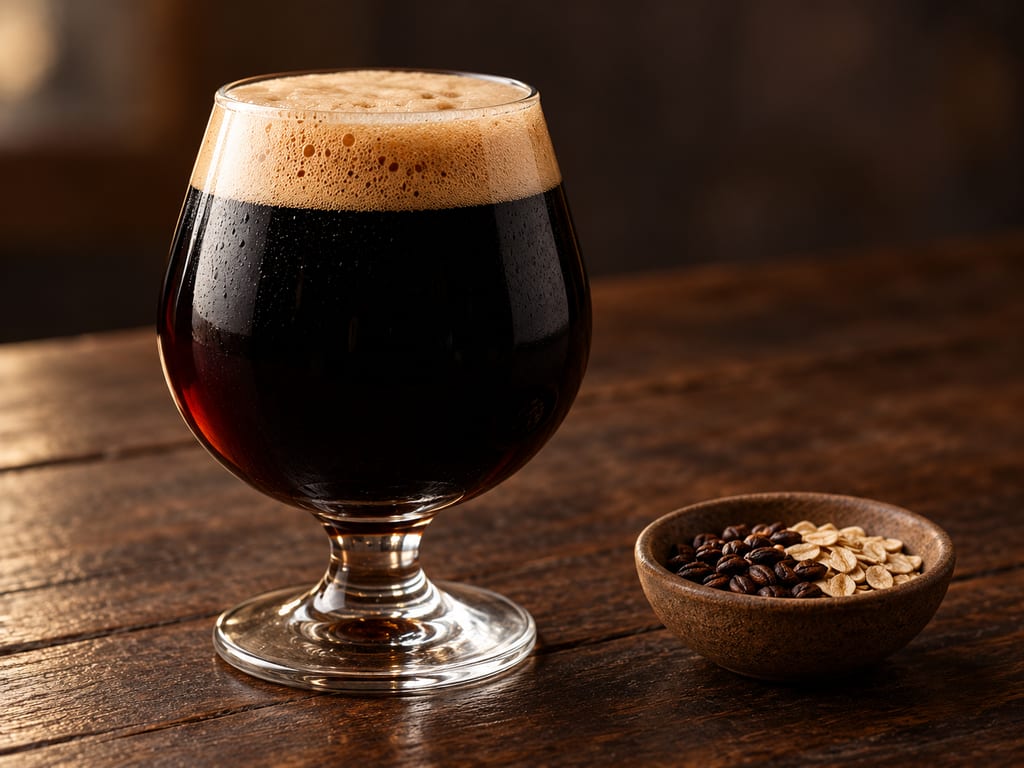
Dark Cellar imperial stout
An all-grain imperial stout with pale malt, roasted barley, dark malts and oats, fermented with an American ale-yeast starter.
 FermenteaWhere food goes to change
Substrates
An intensely roasted malt used for dark colour and dry roasted flavour in beer, with a nineteenth-century patent name and distinct whole, milled and flour forms.
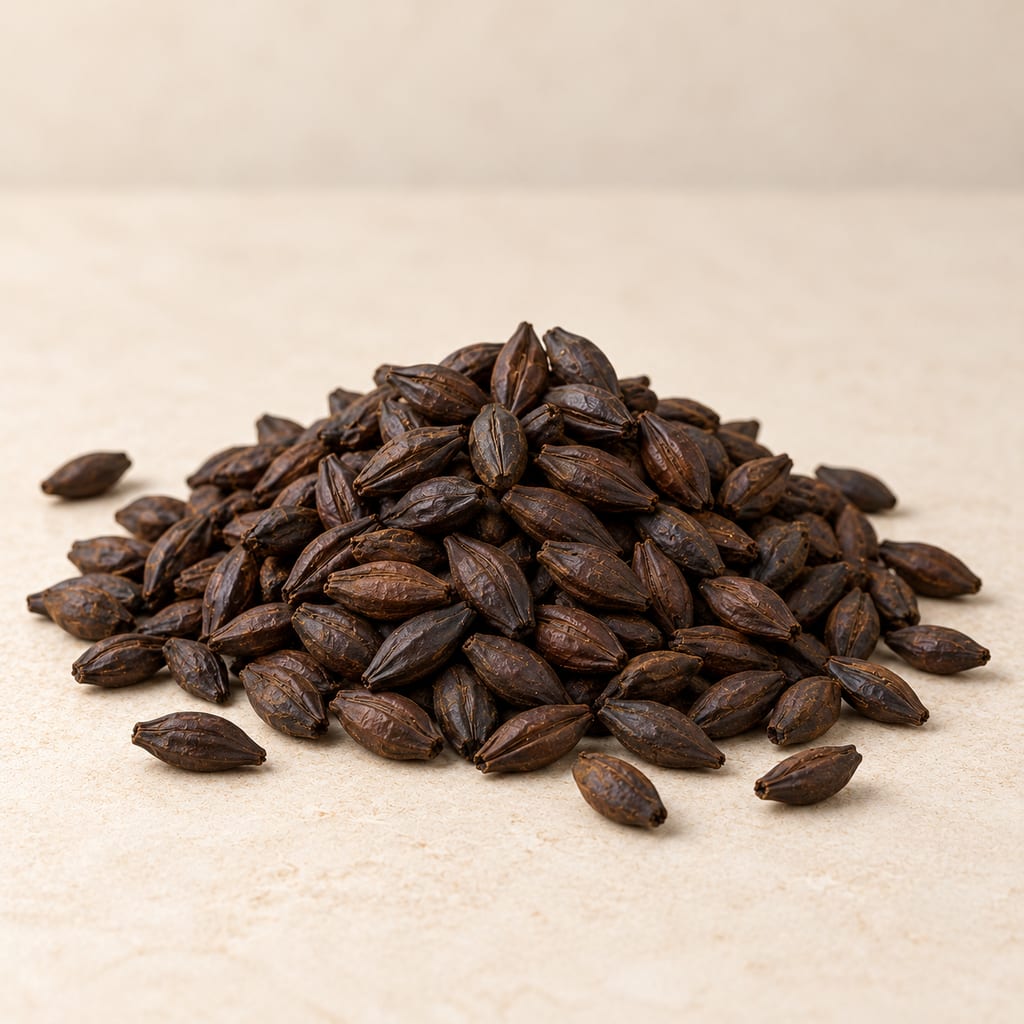
Black patent malt is a deeply roasted malt used to darken beer and supply a dry roasted character. Modern maltsters often sell it simply as black malt. It is a grain ingredient, usually malted barley, whose intense colour allows it to serve a different purpose from the pale base malt in the same recipe. The word patent carries a history of industrial change and argument, rather than a modern certification that every bag follows one protected process.
Daniel Wheeler's name became associated with a highly coloured malt process through an 1817 patent. The episode was soon contested. In August 1818 Michael Faraday wrote to Simon Cock about testimony concerning high-dried malt, the temperatures used to make it and whether similar colouring malt had already been produced before the patent. The letter brings the story down to a working problem: witnesses were arguing about grain, heat and previous practice, not merely defending an abstract invention.
Faraday discussed experiments with fusible metals placed among the malt to investigate the temperature. He was unconvinced by parts of the opposing interpretation, but recognized that the testimony could influence the case. The scholarly notes accompanying his correspondence explain a further problem: Wheeler had failed to file the required specification in time, and the patent could not be enforced. The familiar story of one inventor simply patenting the modern black-malt drum is therefore too neat.
By the 1857 edition of W. L. Tizard's brewing manual, porter or black malt was explicitly described as commonly called patent malt. Tizard described pale malt roasted in revolving iron cylinders and recorded several ways brewers extracted its colour. His account documents a practical nineteenth-century ingredient and its commercial name. It should be read as a period description, rather than as a universal present-day manufacturing specification or proof that no earlier dark grain existed.
The distinction from roasted barley begins before the final roast. Malted barley has received controlled water uptake and germination, followed by treatment that stops further growth. Unmalted roasted barley bypasses the conventional malting sequence. The two ingredients can both look very dark and appear together in a stout, but their starting material and processing histories differ. Dark Cellar's separate ingredient lines preserve precisely that distinction.
Barley is Hordeum vulgare, a cereal whose kernel contains an embryo, a starch-rich endosperm and outer tissues. During malting, enzymes modify the endosperm so its stored material can become available for brewing. Black malt retains the grain's identity after this biological preparation and a much more intensive heat treatment. Its colour is part of a transformed cereal ingredient, not an instruction to add charcoal or an unspecified black powder.
Names also need their commercial context. Black malt, black patent malt, black barley, dehusked malt and huskless dark malt are not automatically the same purchase. A producer may offer several products with overlapping colour ranges and different sensory aims. Identify the actual malted cereal and processing form before treating one of those names as a substitute. The complete description is especially useful when a recipe names both black malt and roasted barley.
Ordinary base-malt production seeks to stop germination and dry the grain while retaining useful enzymes. Briess describes standard malt as relatively gently kiln-dried, whereas specialty malts can be dried more intensely, roasted or both. Altering the treatment changes colour, flavour and enzyme survival. The darkest malt's defining quality is therefore not simply a larger amount of the enzyme activity found in pale malt.
For roasted products, the maltster controls heat to create a desired character without losing control of the grain. Simpsons describes a roast process in which the starting malt, moisture condition, heating and final cooling all matter. It also analyzes and blends batches to maintain a consistent commercial result. These operations explain why a purchased black malt can be predictable enough for formulation while still originating in a variable agricultural crop.
The roast house is an industrial process with its own equipment and controls. Its cooling stage is important because freshly discharged grain can be extremely hot. A description of that manufacturing sequence helps explain the ingredient; it is not a home-roasting instruction. The brewer generally buys the finished material and then follows a separate brewing process involving milling, extraction, boiling and fermentation.
High-temperature treatment promotes non-enzymatic reactions among grain constituents. Maillard chemistry involves sugars and amino compounds; caramelization and further thermal breakdown also contribute within the wider range of specialty-malt manufacture. Time, moisture, temperature and the grain's previous modification influence the result. These processes create both coloured material and volatile aroma compounds, rather than simply coating the outside of an unchanged kernel.
General roasted-malt research describes changes toward chocolate, coffee, bitter and burnt impressions at more intense processing levels. That range gives a framework for understanding black malt's character. It does not establish the exact compounds or proportions in every producer's product. A finished beer's aroma also depends on the rest of its ingredients and on the changes during brewing and fermentation.
Coffee, cocoa, smoke and liquorice can therefore appear as sensory descriptions of a roasted malt without those foods being added ingredients. Different maltsters emphasize different parts of the range. Briess describes its black malt as dry roasted and sharp to neutral, while Simpsons emphasizes intense roast, dry bitterness and coffee-like character. Those descriptions are compatible with products designed for somewhat different balances of colour and flavour.
Black malt can be used in very small quantities to adjust colour with a relatively restrained flavour contribution, or in a larger specialty role where roast is part of the intended beer. Briess describes both applications for its product. The choice depends on the formulation rather than the assumption that anything black must dominate the taste. Quantity, extraction and the surrounding malt profile all influence what the drinker perceives.
Briess reports a typical colour of 500 SRM for its Black Malt, while clearly stating that its typical analysis is not a guaranteed specification. This describes that manufacturer's product assessment. It is not the colour of a beer containing a spoonful or a particular percentage of the malt. The finished wort has a volume, other colouring ingredients and its own extraction history.
Colour comparisons also need the named analytical scale. A number in EBC should not be treated as an identical number in SRM or Lovibond. Nor does a colour match establish equal roast flavour, husk condition or extract contribution. Read the producer's sensory description and technical sheet together, then keep the chosen product in the batch record when evaluating a recipe.
The heavy heat treatment of nondiastatic roasted malt inactivates the enzymes that would otherwise convert starch. Briess explicitly identifies its specialty roasted malts and black malted-barley flour as nondiastatic. Such products are selected for colour and flavour, rather than to supply the mash's conversion capacity. Active base malt can perform that enzymatic work within the mixed grist.
Mashing combines grain and water so soluble material can be extracted and accessible starch can be broken down by available enzymes. The resulting wort contains a mixture of carbohydrates and other extracted compounds. Yeast later ferments the sugars it can use, producing alcohol and carbon dioxide. A black kernel is neither a yeast culture nor evidence that fermentation has already happened inside the grain.
Lack of enzyme activity also does not mean that the ingredient contributes literally nothing to wort. Colour and flavour material are extracted, and the complete carbohydrate contribution depends on the product and process. A precise extract or fermentability value needs a relevant analysis. Do not infer it from a nearly black surface or transfer the base malt's analysis to the smallest roast addition.
The grain's outer tissues help distinguish standard black malt from some lower-bitterness alternatives. Briess describes Blackprinz as made from hull-less barley and Midnight Wheat as another husk-free dark product, designed to give deep colour with a subtler flavour. These are separately named ingredients with their own cereal identity and application. A wheat product should remain wheat, rather than becoming an unspecified barley malt because both are dark.
Husk reduction and complete absence of a husk are also different descriptions. A dehusked or debittered malt may be processed differently from a naturally hull-less cereal. The actual supplier's explanation matters when evaluating claims of smoothness, bitterness or astringency. A lower-bitterness alternative can be useful, but changing the outer grain material and roast profile changes the ingredient selected by a recipe.
Chocolate malt and roasted barley offer other comparisons. They can overlap with black malt in colour or roasted aroma while emphasizing different flavours and production histories. Briess describes combinations of black malt with roasted barley or chocolate malt to shape a stout or porter. Those combinations illustrate a blending approach, with each product retaining its own role rather than all the dark ingredients being collapsed into one name.
The linked Dark Cellar imperial stout uses 4 ounces, or 113 grams, of black patent malt. Its formulation separately lists 2 pounds of roasted barley, along with chocolate malt, Carafa III, caramel 60, coffee malt, oats and a large American two-row pale-malt base. The black malt is a comparatively small entry within that mixed grain bill. The source does not isolate its individual sensory contribution or identify the maltster.
The American Homebrewers Association published the beer in its 2026 Big Brew recipes after Joel McGormley's gold-medal result in the 2024 National Homebrew Competition final round. Its all-grain brewing notes call for a mash before boiling and an American ale yeast fermentation. That modern homebrew use is distinct from the nineteenth-century porter context behind the patent-malt name.
An extract alternative replaces the pale malt with pale malt extract while retaining the other grains for milling and steeping. Both approaches use a purchased roast ingredient whose manufacturing is already complete. The extract supplies the pale wort base in one approach, while the all-grain version develops that base through mashing. The black malt and the other specialty grains then contribute to the larger mixture that is boiled and fermented into the stout.
Black malt is available in different physical forms. Briess lists whole kernels, pre-ground malt and flour for its product. Whole or crushed grain can suit particular brewing arrangements; finely milled flour belongs to a different handling form and can also enter food formulations. The size and preparation should match the intended method rather than be inferred solely from the ingredient's dark colour.
Briess describes black malted-barley flour as a colour ingredient for dark breads, crackers and other baked foods, with relatively little flavour at small additions. It distinguishes that nondiastatic use from an enzyme-active malt flour used to modify dough. This provides another example of why malt is not one functional category: one preparation can be selected for enzyme action, another for a strong colouring effect.
For brewing, retain the exact product name and milling state when purchasing. A flour, a whole-kernel husked black malt and a huskless alternative each bring a different physical form to the method. Fine flour has already been reduced to small particles, while whole kernels still need the preparation suited to the extraction process. The producer's description connects that form with its intended application, whether the ingredient is entering a brewery or a bakery.
Store the malt according to its package directions, protecting it from moisture, pests and contamination. Briess's product sheet calls for a temperate, low-humidity, pest-free environment and warns that poor storage reduces freshness and flavour. General homebrewing guidance likewise distinguishes whole and crushed grain when discussing quality retention. These are reasons to care for the purchased material, rather than borrow one universal expiry date for every dark malt.
Black barley malt contains gluten. Roasting, milling into flour and selecting a nondiastatic product do not justify a gluten-free description. Check the package's cereal and other ingredient declarations, especially when considering alternatives made from wheat or another grain. A finished stout's dietary context also includes every other ingredient in its formulation.
Dark Cellar names no modern black-malt producer, cultivar or country of production. The original patent specification has not been established here; Faraday's correspondence and Tizard's later manual document different parts of the nineteenth-century story. A purchased product's own analysis describes its colour and form, while the recipe determines how that ingredient joins the rest of the grain bill.
barley (gluten)
Dark Cellar does not identify the black patent malt supplier or growing place. British historical context and modern producer examples do not establish the recipe ingredient’s origin.
An all-grain imperial stout with pale malt, roasted barley, dark malts and oats, fermented with an American ale-yeast starter.
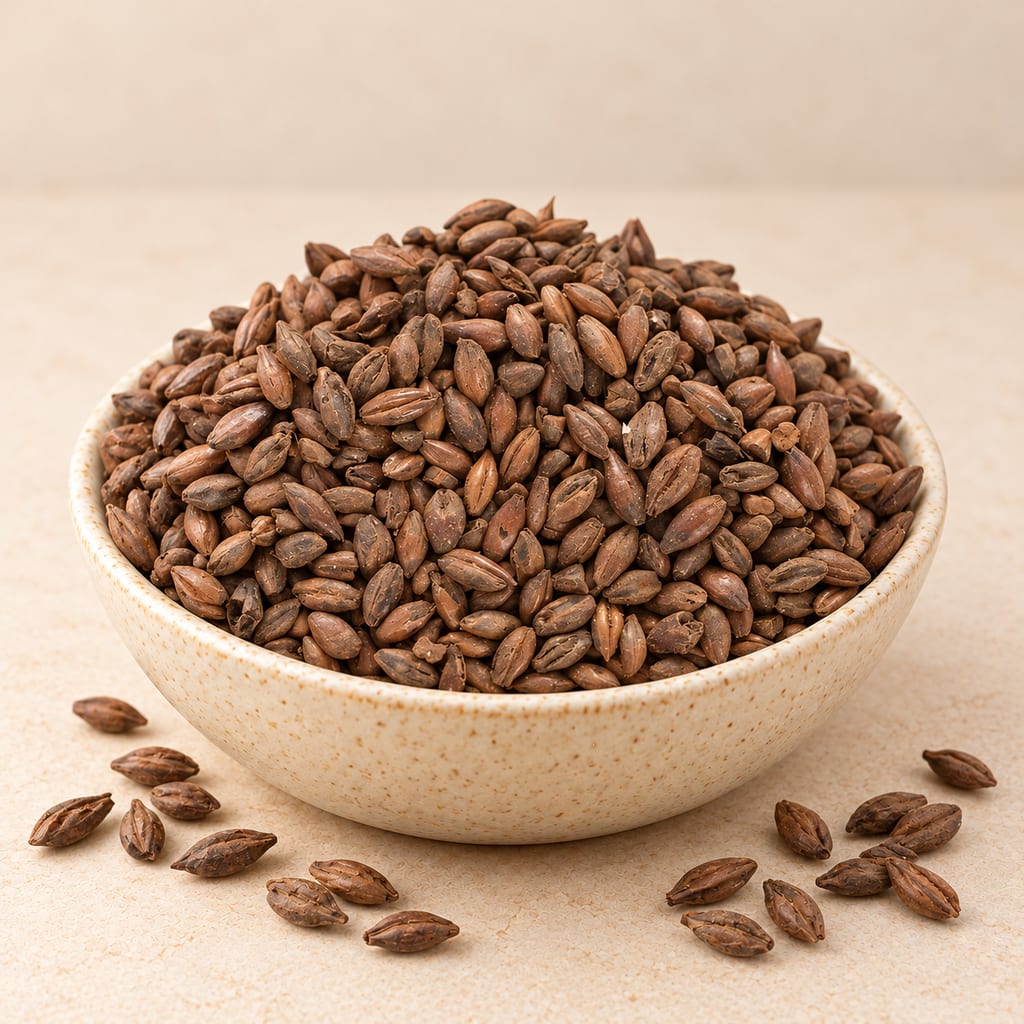
Chocolate malt is barley that has been malted and then roasted to a dark brown, used in porters, stouts and brown ales for colour and a bitter-cocoa, roasted-coffee flavour. It contains no cocoa.

A Cap-Pelé boucanière is an Acadian herring-smoking building. The documented Willie Niles example is a one-storey wood-frame structure with a ridge smoke vent and interior bays for hanging fish-bearing cannes.

Achcharu is a family of Sri Lankan vinegar pickles made with mixed vegetables or seasonal fruit and a piquant spice dressing. This version is a quick, refrigerated, non-fermented mixed-vegetable pickle.

The acocote is a long, hollowed and dried gourd used to draw aguamiel from a mature maguey. It is a harvesting tool: the sap is transferred to a separate vessel before it ferments into pulque.

Adrak murabba preserves young ginger in sugar syrup, a sweet South Asian preparation recorded in Indian cookery and food-processing sources.

Parkia biglobosa seeds are fermented into regional West African seasonings, including nététou, iru, dawadawa and soumbala. The yellow fruit pulp is a separate food, and names and methods vary by place.

Japanese reddish-brown vinegar from sake lees matured about three years, turned to vinegar by acetic bacteria; the vinegar of Handa and Edomae sushi rice.

A refined common-wheat flour blended for a broad range of baking; its protein and behavior vary with wheat, milling and market.

The almond mushroom, Agaricus subrufescens, was cultivated in eastern North America in the 1800s, lost its market, and returned as a cultivated mushroom from Brazil, where it is grown under several names.
No community contributions have been published for this entry yet.
Sign in to contribute. Published comments and photos are free to read.
The Correspondence of Michael Faraday; EpsilonIngredient context
Michael Faraday to Simon Cock, 12 August 1818, with scholarly notesFaraday’s 12 August 1818 letter to Simon Cock discusses contested high-dried-malt testimony. Editorial notes identify Wheeler patent 4112 of 28 March 1817 and the late specification that prevented enforcement.
Cited in: A colour ingredient with a contested name; Keeping the ingredient fit for its purpose
W. L. TizardIngredient context
The Theory and Practice of Brewing Illustrated, fourth edition, 1857, pages 86–88Tizard’s 1857 fourth edition, pages 86–88, calls porter or black malt patent malt and describes revolving roasting cylinders and period brewing uses.
Cited in: A colour ingredient with a contested name; Keeping the ingredient fit for its purpose
Briess Malt & IngredientsIngredient context
Black Malt: Product Information Sheet, revised April 25, 2021Briess Black Malt: typical 500 SRM colour, dry roasted character, whole, ground and flour forms, brewing applications and storage. Typical figures are not guaranteed lot specifications.
Cited in: How roast colour and aroma develop; Colour adjustment and roasted flavour; Whole grain, crushed malt and flour; Keeping the ingredient fit for its purpose
Briess Malt & IngredientsIngredient context
Dark Roasted MaltsBlack Malt and its uses alongside roasted barley or chocolate malt; Blackprinz and Midnight Wheat illustrate separately named hull-less dark-grain alternatives.
Cited in: Malted grain, not simply burnt barley; Colour adjustment and roasted flavour; Husks and the choice of a smoother alternative
Briess Malt & IngredientsIngredient context
MaltingSteeping, germination and drying prepare malt; stronger heat treatment changes enzyme activity. Nondiastatic black malted-barley flour supplies colour in breads and crackers.
Cited in: Two different purposes for heat; Enzymes belong to another part of the grist; Whole grain, crushed malt and flour
Simpsons MaltIngredient context
Black MaltSimpsons Black Malt: intensely roasted character, dry bitterness, coffee-like flavour and whole or milled forms.
Cited in: How roast colour and aroma develop
Simpsons MaltIngredient context
Malt Roasting ProcessRoasting starting materials, heating, cooling, analysis and batch blending in Simpsons’ production system.
Cited in: Two different purposes for heat
University of Minnesota ExtensionIngredient context
Understanding grain qualityBarley quality and malting: cleaning, steeping, germination, modification, drying and the role of enzymes in mash starch conversion.
Cited in: Malted grain, not simply burnt barley; Enzymes belong to another part of the grist
Marčiulionytė et al.; Journal of the American Society of Brewing Chemists, 2022Ingredient context
Roasted Malt for Distilling: Impact on Malt Whisky New Make Spirit Production and Aroma Volatile DevelopmentGeneral roasted-malt chemistry: Maillard reactions, caramelization, thermal breakdown, colour and aroma development. The original study concerns distilling malt; it does not measure the named recipe ingredient.
Cited in: How roast colour and aroma develop
American Homebrewers Association; Joel McGormleyIngredient context
2026 Official Big Brew Recipes: Dark Cellar Imperial Stout, page 3Dark Cellar’s 4 oz(113 g) black patent malt, its other grain additions,2024 award and 2026 publication. The all-grain and extract approaches use the same specialty selection; the maltster is unnamed.
Cited in: Malted grain, not simply burnt barley; Enzymes belong to another part of the grist; Four ounces in Dark Cellar; Keeping the ingredient fit for its purpose
Lukinac and Jukić; Plants, 2022Ingredient context
Barley in the Production of Cereal-Based ProductsBarley identity, Hordeum vulgare, kernel anatomy and changes during malting; a general cereal account rather than identification of the recipe malt’s cultivar.
Cited in: Malted grain, not simply burnt barley
U.S. Food and Drug AdministrationIngredient context
Gluten and Food LabelingBarley is a gluten-containing cereal; the guidance explains gluten-related food labeling.
Cited in: Keeping the ingredient fit for its purpose
American Homebrewers AssociationIngredient context
How To Store Homebrew IngredientsMalt storage, moisture protection, whole and crushed forms, and the loss of flavour and aroma under poor conditions.
Cited in: Keeping the ingredient fit for its purpose