A living leaven, ready for a particular dough
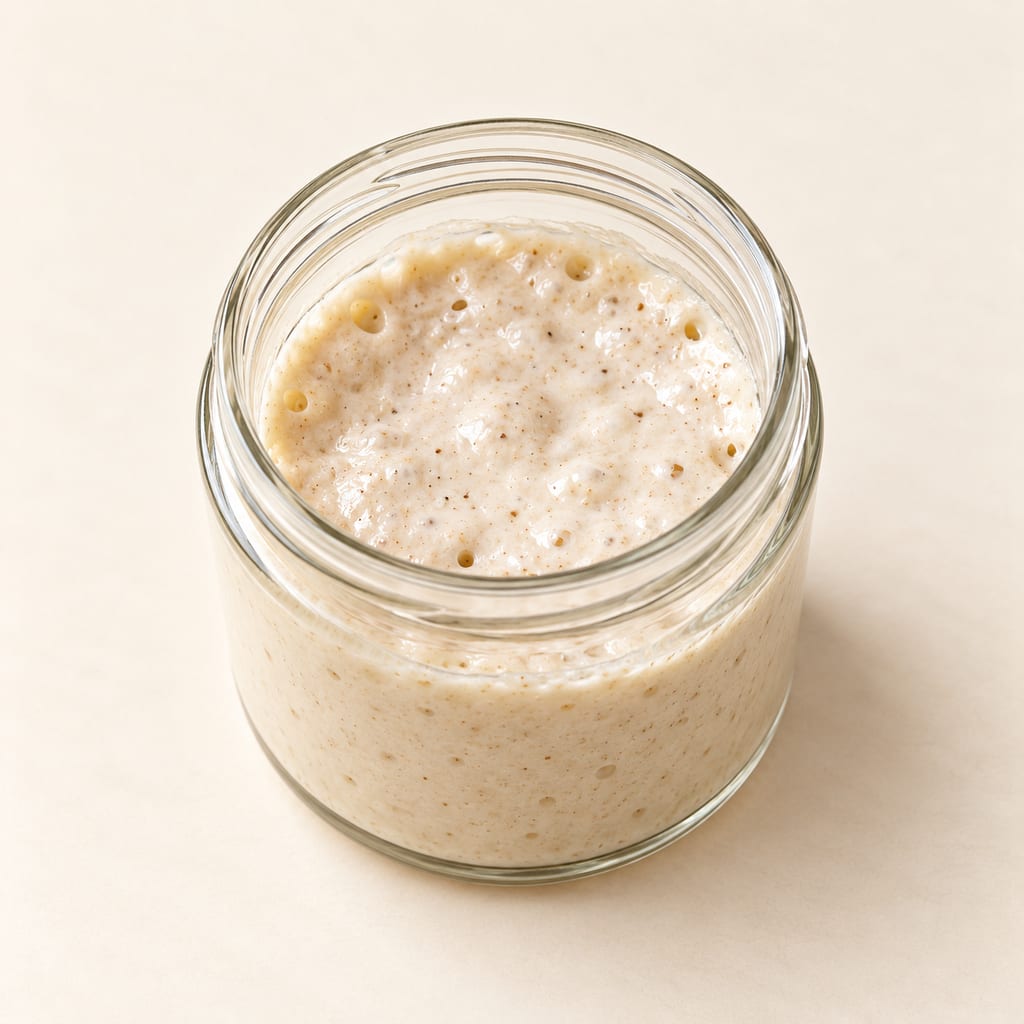
A ripe starter is neither a powder nor a single organism. It is a hydrated mass of flour carrying a community of yeasts and bacteria that has been fed and allowed to ferment. In a typical home culture, it looks like a thick batter or soft dough, with bubbles through the body or across the surface. It may have risen from its post-feeding level and may smell mildly sour, fruity, cereal-like, or fermented. The exact texture and aroma depend on the flour, water, hydration, feeding history, temperature, and point in the fermentation cycle.
“Ripe” is a baker’s practical word, not a formal species label or a fixed age. It usually means that a culture has fermented enough, after its latest refreshment, to perform the job intended for it. For a bread leaven, that job is to contribute gas-producing organisms and an established acid-producing community to fresh dough. A baker may watch for a rise, a web of bubbles, and a predictable pattern over successive refreshments. Those observations are more useful when compared with the same culture’s own past behavior than when treated as a universal clock. A starter made with one flour, hydration, and refreshment routine cannot be expected to peak on the same schedule as another.
That distinction matters especially for a newly mixed flour-and-water culture. Early bubbles can appear before the community has settled into a useful, repeatable fermentation. Starters made with ten different flours shifted through recognizable bacterial stages during a fourteen-day experiment, while the later communities and aromas differed by flour. “It rose once” is therefore weaker evidence of reliable leavening than a repeatable rise after feeding and an appropriate performance in the baker’s dough.
The word *starter* often means the seed culture kept for future refreshments, while *levain* or *leaven* may mean a portion built from it for a particular dough. Terminology varies, so the useful question is what a baker means by the term.
Sources for this section
The old practice of carrying fermentation forward
Bread fermentation is much older than microbiology. Ancient bread remains establish a long practice of working grain into loaves, including loaves made with yeast, while the exact organisms and lineages of old doughs cannot be carried forward by their appearance alone. The long history lies in the practice: retaining a portion of fermented dough, mixing it with fresh flour and water, and letting the next batch continue the work. In modern baking this is called backslopping or propagation. Its logic is practical and cumulative. A small amount of an established culture inoculates a larger fresh supply, which is fermented and then partly kept for another cycle.
Ancient Egypt is often named as sourdough’s birthplace, but the archaeology tells a more specific and useful story. Delwen Samuel examined desiccated Egyptian loaves with light and electron microscopy and found that bakers used flour from raw grain in some breads, malted grain in others, and yeast in some preparations. Those loaves document varied, technically skilled breadmaking; they do not identify the microbes in every ancient dough or prove that a present-day flour-and-water starter originated at one place and date. Naturally leavened bread has a long, widespread history. Cultivated baker’s yeast later displaced it in many commercial settings, while artisan and home bakers continued or revived sourdough practice.
For generations, bakers maintained cultures as part of ordinary bread production. A piece of old dough or a maintained mother culture served as the inoculum for the next batch; the names and handling varied between bakeries and regions. This made starter a working ingredient and a small piece of production continuity: it carried fermentation from one bake to the next. Modern bakeries may instead use selected cultures, controlled fermentation, or dried sourdough preparations. Those methods share the use of sourdough organisms or products, but they are not all the same kind of starter.
Sources for this section
A changing community, not a fixed recipe of species
Flour and water provide the habitat and food. Flour also brings microorganisms from the grain and milling environment, carbohydrates, amino acids, minerals and other compounds. Water makes these resources available in a moist mixture. As fermentation proceeds, microbes use available sugars and interact with one another. Lactic acid bacteria produce organic acids, chiefly lactic acid and, depending on the organisms and conditions, acetic acid and other metabolites. These compounds lower pH and contribute the sour taste and aroma associated with sourdough. Yeasts and some bacteria produce carbon dioxide; gas trapped in the viscous mixture creates the bubbles and expansion that make a culture visibly active.
The community changes as its surroundings change. Early flour-and-water mixtures contain a range of bacteria. Repeated fermentation and refreshment alter the food supply and acidity, favoring organisms able to thrive under the culture’s particular conditions. This sequence is ecological succession: the community shifts as organisms transform their environment and compete for resources. It is not a reliable way to predict the identity of a household culture from smell or appearance. Naming a species requires laboratory evidence. Even a well-known species reported in a study should not be assigned to an untested starter simply because it is made from wheat or rye.
The flour matters twice: it supplies food and it influences which organisms and sensory qualities emerge. Whole-grain flours carry more of the grain’s outer layers and germ than refined flour, along with different nutrients and enzyme activity. Rye and wheat do not behave identically as substrates; neither do individual flours within those broad categories. In the multi-flour study, starters followed broadly similar succession patterns but ended with flour-specific bacterial communities and aromas. Flour choice thus changes the culture’s food supply and can change its aroma, although the result depends on the individual flour and maintenance conditions.
Enzymes help make flour’s starch available. Grain amylases break some starch into smaller sugars that microbes can ferment. Microbial metabolism then changes those sugars into acids, gases, alcohols and aroma compounds. In bread dough, acidification and fermentation also affect dough behavior: acids and microbial enzymes can modify proteins and carbohydrates over time, while carbon dioxide expands the dough’s gas cells. What happens depends on the flour, culture, dough formula, and fermentation conditions. The starter carries a community and a history into the dough; it does not guarantee a particular crumb, sourness, digestibility, or shelf life by itself.
Hydration—the amount of water relative to flour—changes the starter’s consistency and the conditions in which the community grows. A firm starter can be kneaded or shaped; a liquid one can be stirred and poured. Flour choice, hydration, temperature, elapsed fermentation, and refreshment practice interact. A baker who changes several at once may find the starter’s behavior changes without knowing which factor caused it. This is why a culture’s rise and aroma are best interpreted against its own recent feeding pattern rather than a universal timetable or a single sensory ideal.
Sources for this section
What the starter contributes to bread
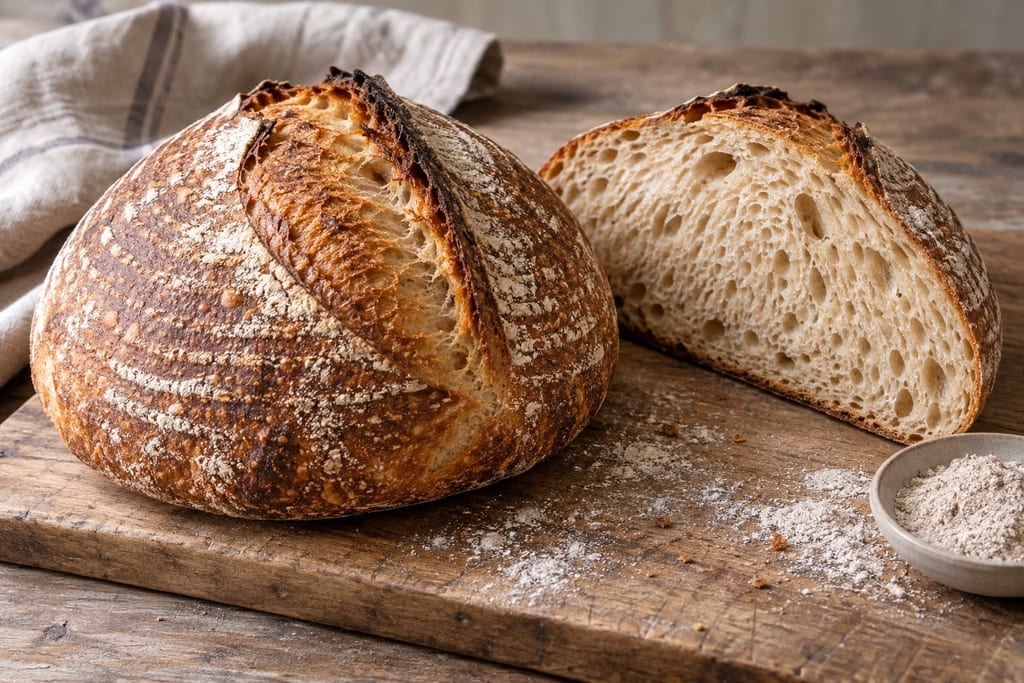
In a bread formula, starter contributes several things at once. Its viable yeasts and bacteria continue fermentation after mixing; its acids and aroma compounds already present in the culture enter the dough; and its flour and water count toward the dough’s total ingredients. The yeast contribution to carbon dioxide helps inflate the dough. Acid-producing bacteria develop the sour profile and affect the chemistry of fermentation. The balance of those effects varies: a lively culture can raise dough without producing an aggressively sour loaf, while a highly acidic culture may taste sharp but provide less predictable expansion if its leavening activity is weak.
Bread flavor is not simply the starter’s flavor diluted into dough. Fermentation continues in a new mixture with fresh flour, salt, water and often other ingredients. Yeasts and bacteria encounter new nutrients and conditions, and their activity produces additional compounds. Flour enzymes and microbial enzymes change some carbohydrates and proteins; acids influence flavor and dough properties; fermentation generates aroma compounds. Baking then drives a separate set of changes through heat, including expansion, setting of the crumb, crust formation and browning. The loaf’s final character belongs to the combined process, not to the starter alone.
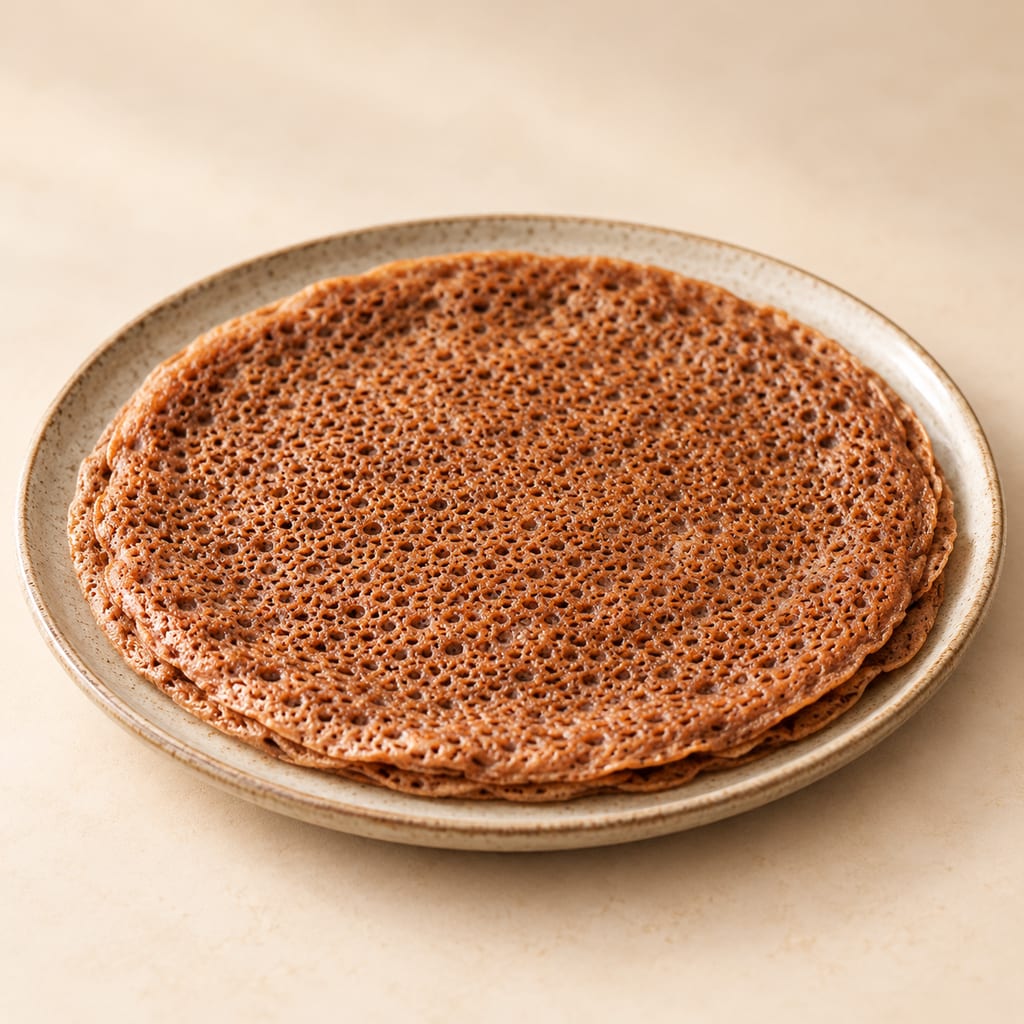
Excess starter can go into crackers, pancakes, waffles and other batters or doughs. Depending on the recipe, it may leaven, contribute acidity and flavor, or simply use flour and water already fermented. Its flour and water matter to the formula, and its acidity and strength depend on its fermentation history.
The starter’s acidity can influence the keeping quality of bread, but it should not be treated as a preservation guarantee. Bread storage depends on the baked product and its handling, while the live starter has its own maintenance and contamination concerns. Nor should claims about improved nutrition or digestibility be generalized from the existence of fermentation alone. Research reports changes to some grain components during sourdough fermentation, but outcomes depend on flour, organisms and process; a culture label is not a medical or nutritional claim.
Sources for this section
Feeding, ripeness and the difference between quality and safety
Refreshing a starter means retaining some culture and mixing it with fresh flour and water. The new flour supplies fermentable material; water restores a moist environment; and the retained culture inoculates the mixture with its established community. Removing part of the old mixture is a way to control the amount of culture being carried forward and give the remaining organisms fresh resources. It also prevents an ever-growing jar from accumulating more material than the baker needs. Refreshment is therefore both feeding and population management, not a ritual number of stirs or a universal ratio.
A baker can follow a starter’s progress by marking its level after feeding and watching how it changes, noting bubbles, texture and aroma, and recording the flour and feeding routine. A culture intended to leaven bread should show useful, repeatable activity in the conditions of its intended use. The exact peak may be reached sooner or later with changes in flour, water proportion, temperature, inoculation amount and feeding history. A laboratory pH value or fermentation time cannot serve as a universal household endpoint. The ready point is tied to the baker’s formula and process, not simply the number of hours since feeding.
Those observations are quality and performance clues, not a safety test. Raw flour is not ready to eat, and raw starter should not be tasted. Bubbles, expansion, a pleasant tang, or a low pH do not certify that a culture is safe. Baking is the heat treatment in breadmaking; a jar’s appearance cannot substitute for it. Use clean utensils and surfaces, keep the culture covered while allowing fermentation gas to escape, and do not use a starter showing visible colored or fuzzy mold. A liquid layer with an alcoholic smell can occur in a neglected culture, but that observation alone does not establish that every unusual change is harmless. When contamination is suspected, do not try to rescue the culture by scraping, stirring, or feeding over it.
“Peak,” “ripe,” “young,” and “overripe” describe points in a fermentation cycle in relation to a dough. A culture near its high point may suit a baker seeking active leavening; one fermented longer may bring more acidity or a different aroma. There is no visual peak shared by every hydration and vessel. A starter that falls after rising has passed its height maximum; that change does not show that it is unsafe.
Sources for this section
Different flours, textures and maintenance rhythms
A starter is shaped by the flour and water used to maintain it. Wheat and rye are common substrates, while spelt, einkorn, emmer and gluten-free grains can also serve as substrates. Changing from refined to whole-grain flour changes more than color: it changes the nutrients and enzyme environment supplied to the culture. That can alter fermentation behavior and aroma. A starter’s color also depends on its flour, so the appearance of a pale wheat culture should not be imposed on a dark rye one.
The flour also determines dietary suitability. Wheat, spelt, einkorn and emmer matter to people with wheat allergy; wheat and rye contain gluten, which matters to people with coeliac disease. Ordinary sourdough fermentation is not a method for removing gluten. A starter fed with gluten-containing grain should not be described as gluten-free because it bubbles or tastes sour. A culture intended for gluten-free baking needs verified gluten-free flour and protection from cross-contact in storage, utensils and feeding. Check the actual flour and any commercial product label rather than assuming every starter has the same allergens.
Firm and liquid cultures are different working forms of the same broad ingredient category. Their consistency changes how easily they can be mixed, stored, measured and incorporated, and hydration is one of the factors that affects fermentation. A firm culture may suit a bakery’s established dough process; a liquid culture may be easier to stir into a home formula. Neither is inherently more “real” or universally more vigorous. When adapting a recipe, the starter’s flour and water need to be considered as part of the dough rather than treated as an undefined spoonful.
Regular refreshment at room temperature and refrigeration are two maintenance approaches described in extension guidance. Refrigeration slows activity and can extend the interval between feedings for an active starter; it does not freeze the culture in time. Drying is also described as a way to preserve a culture for longer storage, though reactivation and performance depend on the specific culture and method. These are preservation options, not precise storage promises: the evidence cited here does not establish one safe or reliable interval for every starter. A baker should follow a tested procedure suited to the culture and avoid treating a forgotten jar as automatically healthy because it once performed well.
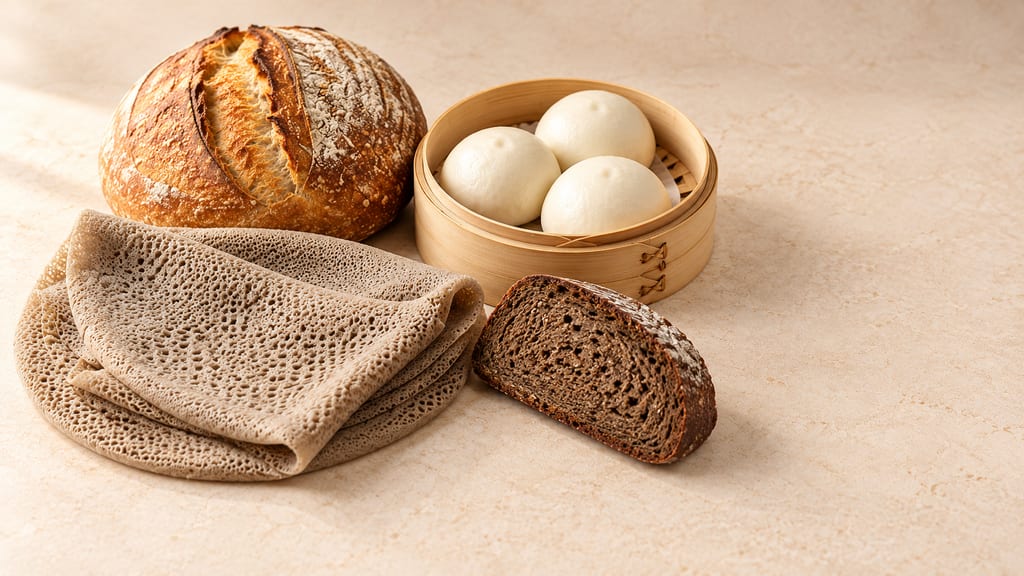
Commercial terminology can obscure these differences. A fresh, live mother culture maintained by backslopping is not interchangeable with a dried sourdough powder, a packaged yeast, or a defined bacterial culture simply because each may be used in breadmaking. Some commercial sourdough systems are designed to provide fermentation; others provide flavor or acidification in a controlled production process. Ingredient lists and product directions determine what a commercial preparation contributes. In home baking, a named heritage culture may bring a useful lineage and story, but the flour and maintenance conditions still shape its present behavior.
Sources for this section
Allergens
wheat (when wheat or its varieties are used), gluten (when wheat, rye or another gluten-containing grain is used)
Places
Unknown
Documented preparation · Place not establishedThe reviewed sourdough cultures vary by flour and practice; no single birthplace or current culture provenance is established for this generic ingredient.