
Aceto Balsamico Tradizionale di Reggio Emilia
Protected Italian vinegar made only from cooked grape must, fermented and aged in a battery of wooden barrels for at least 12 years: sweet, sharp and syrupy.
 FermenteaWhere food goes to change
Spices and aromatics
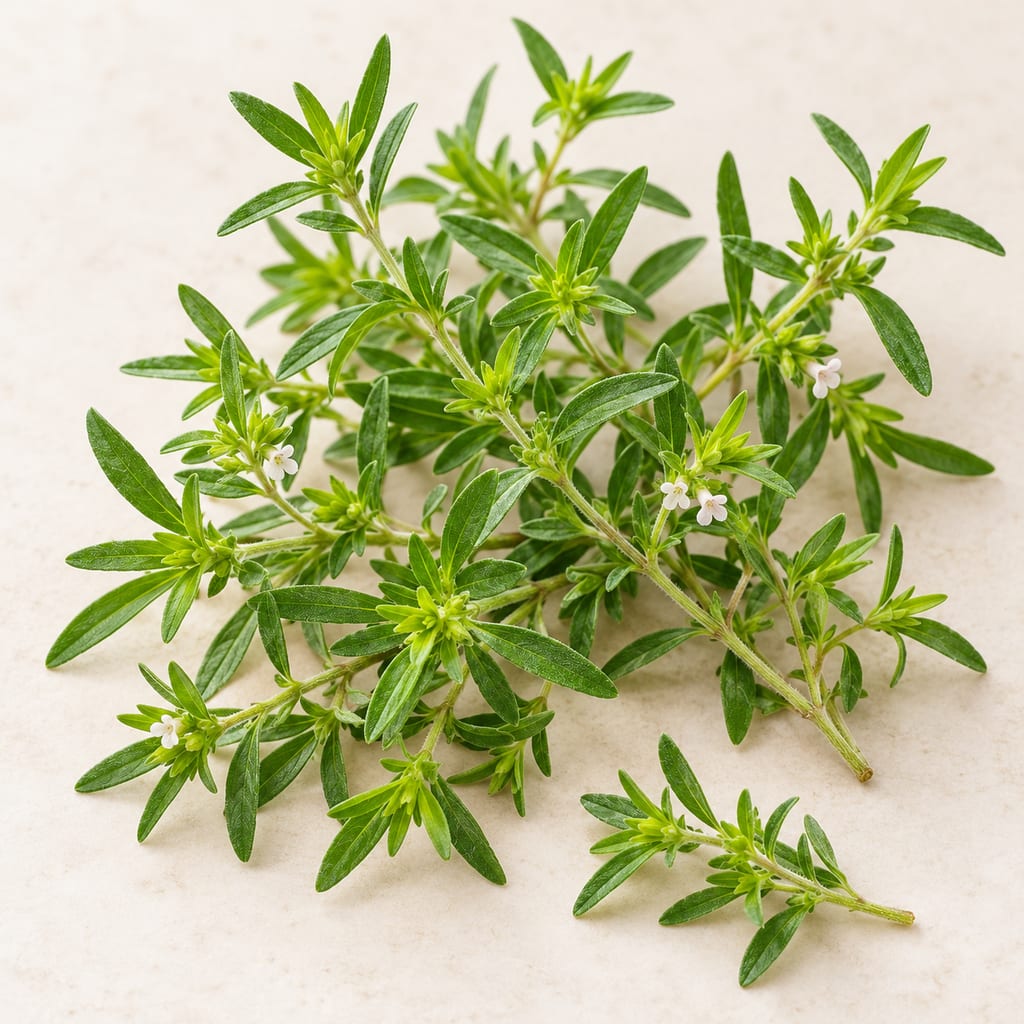
Summer savory (Satureja hortensis) is an annual aromatic herb whose fresh or dried leaves season beans, vegetables and other foods.
The native range is described at different scales. Kew lists it from south-eastern Europe eastward to Kazakhstan and north-western Iran; the PROSEA spice treatment describes an eastern Mediterranean origin. These accounts need not mean that the plant was cultivated everywhere within that range or that all cooking traditions began there. PROSEA also records plants escaped from cultivation and a later spread through cultivation across parts of Europe, Asia, Africa and the Americas. A species' native range, places where it escaped, and commercial growing regions are different kinds of geography.
The plant has an old culinary association, but the earliest history should be stated carefully. PROSEA describes it as probably grown as a condiment in ancient Rome. That is a probability, not a dated recipe establishing the modern botanical identification in every classical reference. Ancient plant names covered multiple related herbs, and a present-day Latin name cannot automatically be mapped backward onto every word translated as savory.
At 16–22 Coppergate in York, plant remains identified as summer savory were recovered from Anglo-Scandinavian deposits dated broadly from the mid-ninth to mid-eleventh centuries. The archaeological account groups the plant among probable flavourings. A later synthesis suggests the remains may represent whole fresh or dried herb and notes modern northern European use with field beans as a possible long continuity. That proposal is an interpretation, not proof that a specific Viking-age recipe survived unchanged, or that every seed in a deposit was deliberately used as food.
The York evidence places this plant in an urban archaeological assemblage; it does not show where it was grown, who gathered it, which dish received it or how often it was eaten. The period attached to this page follows the dated Coppergate plant remains, with the proposed flavouring use marked as probable. The Roman condiment history may be older, but the evidence cited here does not fix a secure first culinary attestation. This distinction keeps botanical presence, inferred food use and a named modern tradition from collapsing into one origin story.
Summer savory is the leaf herb of Satureja hortensis L., an accepted species in the mint family, Lamiaceae. It is an annual: the plant grows, flowers, sets seed and dies within a growing season. Garden descriptions call it bushy and compact, while crop accounts describe erect, much-branched plants from roughly 10 to 50 centimetres tall. Height varies with climate, crop management and the material being grown; a single garden measurement is not a defining feature of the ingredient.
Its narrow leaves grow in opposite pairs along slender stems. Botanical descriptions give leaves from about one to four centimetres long and one to five millimetres wide, with entire margins, a short stalk or almost no stalk, and visible oil glands. The foliage is aromatic when handled. Flower clusters form at the stem nodes in summer; they are small, tubular and two-lipped, usually white, pale violet or pinkish, sometimes with reddish marks in the throat. The fruit breaks into four small nutlets within the persistent calyx.
This plant form helps distinguish the culinary leaf from seeds sold for sowing and from extracted savory oil. The edible material described in food references is the green aerial growth or, after drying, the leaves and flowering tips. The stem and flower parts can occur in harvested fresh herb; the dried commercial grade is often more selective. A jar of dried leaves is therefore not botanically identical to an essential-oil product or to seed.
The English name summer savory refers to Satureja hortensis, not every plant called savory. Annual savory is another English name. The genus has also appeared under the spelling Satureia, and older taxonomic literature lists several synonyms for this species. Kew currently accepts Satureja hortensis L. as the name of the species. PROSEA notes that classification within Satureja has been difficult and that the plant itself varies considerably; cultivated forms are not always separable from wild ones by a neat set of cultivar boundaries.
Winter savory is the closest familiar kitchen comparison, but it is a different species: Satureja montana. The RHS describes it as a perennial, shrubby plant with semi-evergreen foliage, while summer savory is an annual. The leaves of summer savory are usually described as milder and more delicate; winter savory is earthier, more piquant and persists through more of the year. Their oils are similar enough that winter savory can substitute in some cooking, but a substitution changes the plant identity and flavour balance.
Thyme and oregano can resemble savory in the broad sense that all are aromatic members of the mint family and are used as seasoning. They are not the same ingredient. In commercial savory oil, PROSEA distinguishes summer-savory oil from thyme and oregano oils and notes that winter savory can be used as a substitute. Similar aromas do not establish botanical identity. A label that gives only “savory” may leave the species unclear; the name summer savory is the more specific retail term when Satureja hortensis is meant.
Summer savory is raised from seed. Horticultural guidance recommends spring sowing; crop references describe shallow sowing and note that germination is normally slow, often taking two to three weeks and longer in unfavourable conditions. Young plants develop quickly after emergence. PROSEA places flowering at roughly 75 to 80 days after germination in its summarized growing accounts, while the RHS describes harvest from mid-summer until the annual plant dies back in autumn. These timings describe common cultivation, not a calendar that transfers unchanged across climates.
The plant grows in full sun and free-draining ground. PROSEA records good growth across many temperate and subtropical climates on light, rich soils, notes a preference for alkaline conditions, and describes native Mediterranean sites as often calcareous. The RHS gives full sun and well-drained soil in its UK gardening advice. This is compatible guidance rather than a guarantee: soil, rainfall, temperature, seed freshness and local season length affect the crop.
Commercial crop spacing and seed rates are not garden rules. PROSEA summarizes rows, broadcast sowing, shallow seed placement and field spacing from European and US production information, while emphasizing that planting practice details are available from only those areas. Tight spacing can increase fungal-disease risk in field production. The same review notes a broad range of field yields and strong variation by season, planting date and fertilizer. Those measurements describe particular commercial trials and should not be used to promise a home harvest.
A 2025 field experiment in Malatya, Türkiye, compared eight genotypes harvested at three flowering stages over two growing seasons. Under those specific conditions, full bloom produced the highest fresh and dry herb yields and the highest essential-oil yield; the oil's composition also changed with genotype and harvest stage. That result is useful evidence that timing matters for production, not a universal instruction that every cook should wait for full flowering. A grower harvesting tender leaves for the kitchen has a different aim from a crop grown for oil yield.
For culinary use, the plant is harvested for its aromatic leaves. Fresh savory may include the aerial portions of the plant; dried savory is commonly sold as leaves or leafy flowering tops. PROSEA notes that a premium commercial dried class is made from leaves alone. The difference matters in texture: a fresh leafy sprig can be chopped or removed after cooking, while a dried product may be rubbed or crumbled and can include small stem fragments depending on its grade.
Harvest stage changes the amount and balance of the aromatic material. In commercial crop descriptions, cutting at flowering is standard; the recent genotype experiment found that fresh and dry yield and essential-oil yield peaked at full bloom in its trial, while the optimal stage for oil composition could differ. A buyer cannot infer a precise oil profile from the word dried on a packet. The cultivar, place of growth, weather and maturity all contribute to variation.
Fresh leaves are soft and green, with an immediately noticeable herbal smell when bruised. The dried herb is lighter, more brittle and concentrated by water loss. PROSEA describes the dried material as fragrant, warm, slightly sharp and somewhat camphoraceous, sometimes compared with thyme. These are broad tasting descriptors rather than a fixed flavour test. Fresh, dried and distilled products have different intensity and composition, so they should not be measured as interchangeable forms by volume.
The green plant may flower before the entire crop is cut. For seed production, fruit ripens over time and can shatter; that is a separate harvest objective from collecting leaves for seasoning. Planting for leaves, for dried herb, for seed and for essential oil therefore uses the same species but not necessarily the same timing or selection. The available evidence does not identify one universal harvest stage for every cuisine or end use.
Summer savory is used primarily as a flavouring. Its dried leaves smell aromatic and warm; the taste is often described as slightly sharp, with a camphoraceous note and a thyme-like resemblance. The RHS characterizes summer savory as milder and more delicate than winter savory. Flavor intensity varies with plant, harvest, drying and storage, so these descriptions are a useful orientation rather than a guarantee about every packet.
Legumes are its best-known pairing in European cooking. PROSEA describes it with beans and peas and notes that “bean herb” is the local equivalent of its name in several European languages. The RHS places it in bean and lentil dishes; the Royal Botanic Gardens Victoria flora records it as a condiment used fresh or dried, often in mixed herbs, and notes beans and several vegetables. This association is strong but not exclusive.
The herb also appears in mixed seasoning for baked goods, meat and sausages, eggs, processed vegetables, salads, soups, gravies and pickles in the economic-botany account. Montana State Extension lists meat, fowl, green salads and egg dishes. These lists reflect recorded uses across different culinary references, not a single recipe or rule that every savory dish should contain it. A modest amount can contribute a distinctive herbal note; the sources do not establish one standard dose.
The fresh and dried forms can be selected according to the preparation. Fresh leafy tops can be chopped or added whole and removed later, while dried leaves disperse more readily through a dry seasoning mix. These are practical kitchen choices, not a claim that one form is historically authentic for all dishes. In a blend, savory works alongside other herbs, but the relative proportions depend on the named preparation and the cook; the botanical sources do not establish a universal herb mixture.
The herb's aroma comes in part from volatile oil in its leaves and flowers. PROSEA reports that the oil yield and composition change across the plant's growth cycle and says that the isolated oil differs from the aroma compounds present in ground herb. Steam distillation itself changes the relative composition. A dried leaf, a ground seasoning and a distilled oil are therefore not chemically equivalent products even when they come from the same species.
The spice treatment names carvacrol, gamma-terpinene and p-cymene among major constituents of the distilled oil; it lists a different balance of compounds for ground herb. The 2025 harvest study likewise found changes across genotype and flowering stage. These measurements explain why growers and food manufacturers may care about cultivar and harvest conditions. They do not let a reader identify the oil profile of an unlabeled packet from taste alone.
Savory oil is a concentrated extracted product used in food processing and other industries. It is not a home substitute for leaves, and the presence of aromatic compounds in the herb does not show that an ordinary culinary amount can perform a controlled preservation step. Experimental results on extracts or oils must not be transferred to a whole-leaf seasoning without a tested preparation and dose. This page uses the chemistry to explain aroma and variation, not to make a health claim or a preservation guarantee.
For the cook, the practical point is simpler: summer savory contributes aroma and flavor. It is not salt, acid, a starter culture or a validated safety control. A recipe may combine savory with a preserving ingredient, but that does not make the herb the reason the food is preserved. No processing limit, household antimicrobial effect or shelf-stability claim follows from the plant's volatile-oil content.
Harvested herb is usually dried, cleaned and kept in a closed container. PROSEA recommends drying soon after cutting to limit loss of quality and describes air-dried savory as retaining its flavor and smell well. It also notes that freeze-dried savory loses aroma rapidly when stored with oxygen. Montana State Extension describes drying leafy tops in an airy, shaded place. These accounts support prompt, protected drying and storage, but they do not provide a universally validated household shelf life for every moisture level or package.
Colour, smell and taste are useful quality clues, not safety tests. A green, aromatic herb may still have been handled poorly; a fading aroma says quality has declined but does not establish whether a product is unsafe. This ingredient page does not turn a general drying description into a preservation process. It gives no moisture target, validated drying temperature or guaranteed storage duration because the cited food and horticultural references do not establish those limits for a home batch.
The references used here do not assess allergen status for summer savory. The page therefore makes no allergen-free claim. People who need an allergen decision should use product-label and qualified medical guidance rather than infer it from the plant's usual culinary role. Similarly, the phrase “aromatic herb” is a botanical and culinary description, not evidence of a therapeutic effect.
The reliable picture is specific but bounded: an annual Mediterranean-origin herb now cultivated and escaped beyond its native range; narrow aromatic leaves used fresh or dried; a strong association with beans and a wider range of seasoning uses; and archaeological remains in York whose likely flavouring role is inferred. The remaining uncertainty concerns how far any one ancient use can be reconstructed, how much plant variation sits behind a common name, and where an individual commercial packet was grown.
This is a botanical native-range statement; it does not identify where culinary crops are currently grown, sourced or traditionally used.
Protected Italian vinegar made only from cooked grape must, fermented and aged in a battery of wooden barrels for at least 12 years: sweet, sharp and syrupy.

Airag is Mongolia’s fermented mare’s-milk drink, traditionally churned with saved starter in a reusable cowhide khokhuur.

Appam, or hoppers, are South Indian and Sri Lankan rice pancakes made from a fermented coconut-and-rice batter and cooked in a curved pan to a crisp lacy rim and a soft, spongy centre.
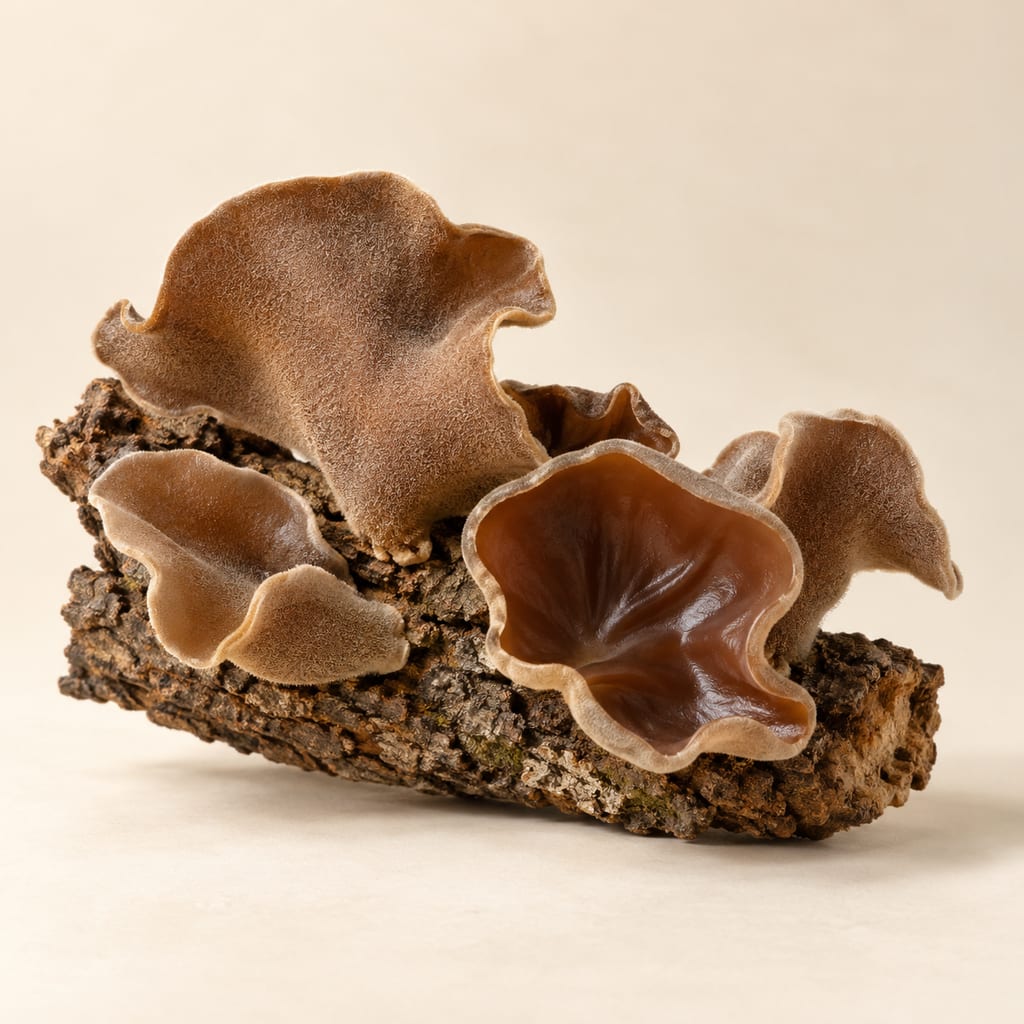
Auricularia tremellosa is a wood ear fungus of the genus that supplies most dried wood ear sold in China; its own food record is thin, and the culinary practice described here comes from the closely related wood ear species.

Ayran is Turkey’s cold, savoury yogurt drink: plain yogurt is loosened with water and lightly salted, then whisked smooth or aerated into a soft cap of foam.
A thin stone griddle used over an open hearth. Norwegian archaeology documents the established tradition from the early Middle Ages; a Viking-period origin is only a cautious suggestion linked to Shetland.

Crushed or milled barley cooked in water until the starch softens and the mixture thickens, the plainest way a northern household turned stored grain into a meal, here with apple and hazelnut.
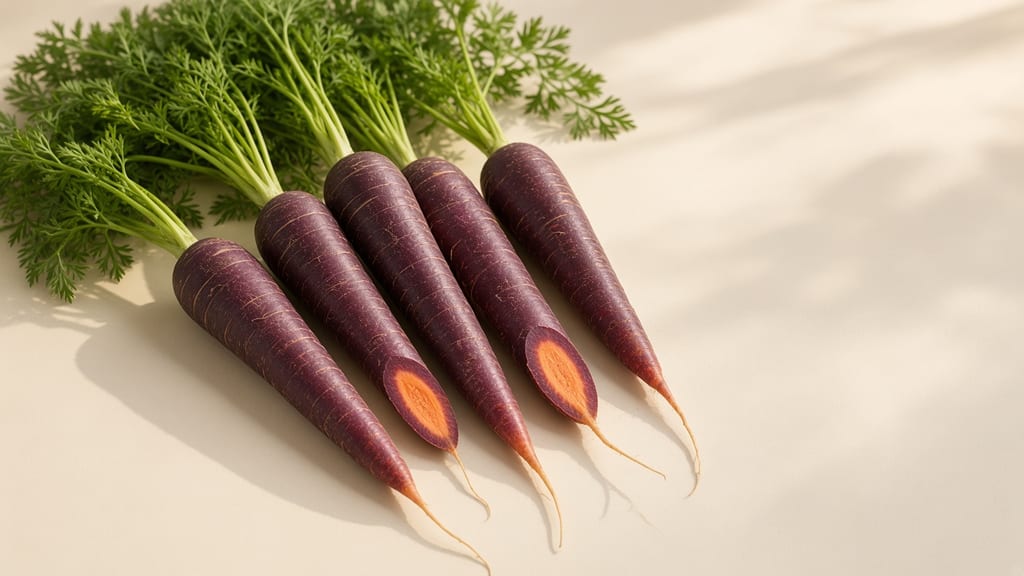
Black carrot is the anthocyanin-pigmented Eastern carrot (Daucus carota var. atrorubens), the purple root that preceded orange types and still colours kanji and şalgam.
No community contributions have been published for this entry yet.
Sign in to contribute. Published comments and photos are free to read.
Council for British Archaeology for York Archaeological TrustHistory
Biological Evidence from Anglo-Scandinavian Deposits at 16–22 CoppergateThe publication reports plant remains identified as summer savory in Anglo-Scandinavian deposits and places them among probable flavourings; the sampled deposits broadly date from the mid-ninth to mid-eleventh centuries.
Cited in: Origin, spread and the archaeological record
Council for British Archaeology for York Archaeological TrustHistory
Aspects of Anglo-Scandinavian YorkThe plant-remains synthesis says seeds may represent whole fresh or dried summer savory, notes contemporary northern European use with field beans, and presents continuity from the tenth century as a possibility rather than proof.
Cited in: Origin, spread and the archaeological record
PROSEA Foundation, Plant Resources of South-East Asia No. 13: SpicesIdentity · History · Culinary use · Cultivation · Handling
Satureja hortensis L.The species account covers botanical form, synonyms, culinary uses, native range and cultivation; it describes Roman condiment use as probable, notes variation between wild and cultivated forms, and distinguishes fresh herb, dried leaves and essential oil.
Cited in: Origin, spread and the archaeological record; A small annual in the mint family; Names and near relatives; Cultivation and growing cycle; Harvest and forms; Flavour and culinary use; Aroma compounds and what they do not prove; Drying, storage and limits
Plants of the World Online, Royal Botanic Gardens, KewTaxonomy · Geography
Satureja hortensis L.Kew accepts Satureja hortensis L. and lists its annual habit and native range from south-eastern Europe to Kazakhstan and north-western Iran.
Cited in: Origin, spread and the archaeological record; A small annual in the mint family; Names and near relatives
Royal Horticultural SocietyIdentity · Cultivation
Satureja hortensis | summer savoryThe RHS describes a bushy annual culinary herb with narrow aromatic leaves and summer flowers, grown in full sun and well-drained soil.
Cited in: A small annual in the mint family; Cultivation and growing cycle
Royal Horticultural SocietyIdentity · Culinary use · Cultivation
How to grow SavoryThe RHS compares annual summer savory with perennial winter and creeping savory; it describes summer savory as milder and lists culinary uses and seasonal cultivation guidance.
Cited in: Names and near relatives; Cultivation and growing cycle; Harvest and forms; Flavour and culinary use
Royal Botanic Gardens Victoria, HortFloraIdentity · Culinary use
Satureja hortensis L.The flora describes the annual herb and its narrow leaves, and reports its use as a fresh or dried condiment, including with beans and vegetables.
Cited in: Flavour and culinary use
Montana State University ExtensionCulinary use · Cultivation · Handling
Herbs for Montana GardensThe guide describes summer savory as an annual, gives culinary uses for its leaves, and recommends drying leafy tops in an airy shaded place.
Cited in: Harvest and forms; Flavour and culinary use; Drying, storage and limits
PLOS ONECultivation
Impact of different harvest times on yield and quality of summer savory (Satureja hortensis L.) genotypesA 2021–2022 field study in Malatya compared eight genotypes at three flowering stages; harvest-stage and genotype affected herb yield and essential-oil composition, with full bloom maximizing fresh and dry herb yield under those conditions.
Cited in: Cultivation and growing cycle; Harvest and forms; Aroma compounds and what they do not prove