A familiar mushroom under a changing name
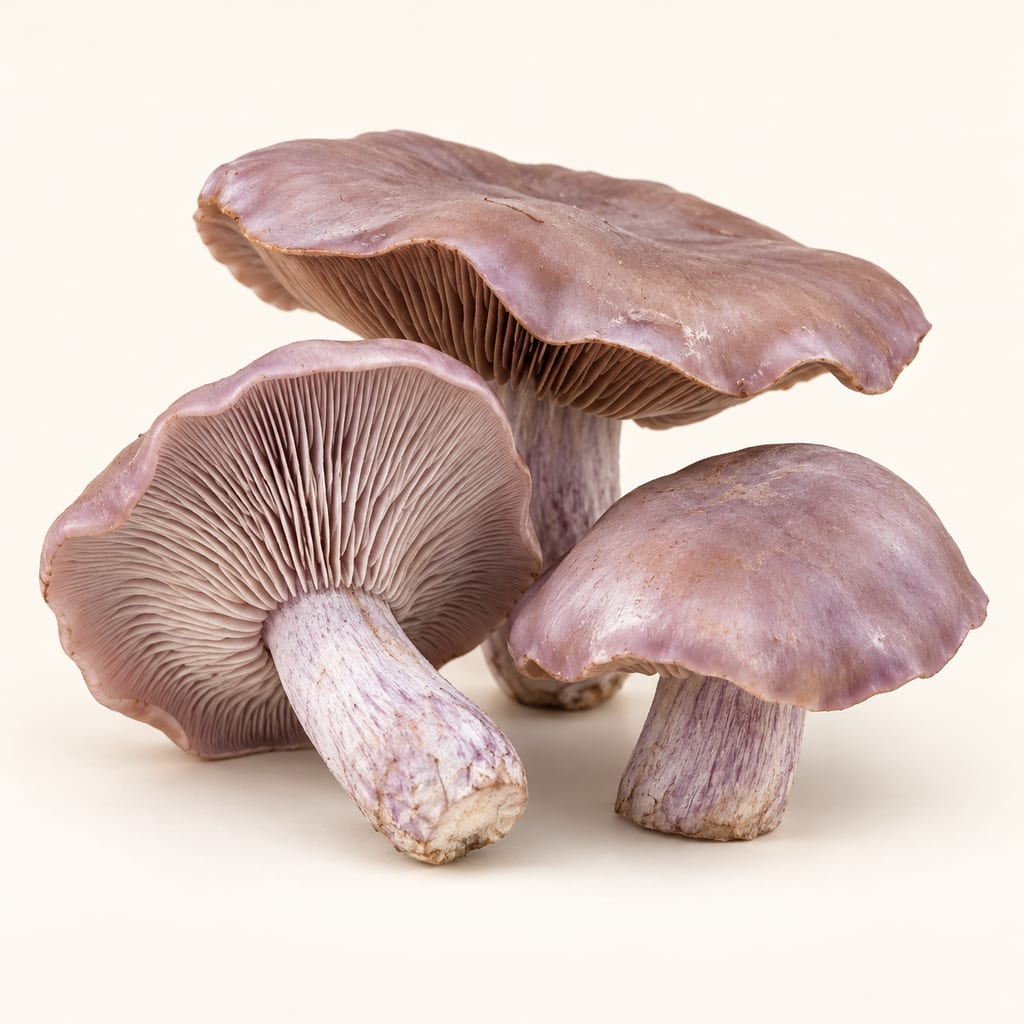
Wood blewit is the familiar English name for a purple gilled mushroom known to many field guides and cooks as Lepista nuda. The name used by current Index Fungorum and Species Fungorum treatments is Collybia nuda, a combination published in 2023. Earlier combinations include Agaricus nudus, Tricholoma nudum, and Clitocybe nuda. Those names refer to the same nomenclatural species, not to a sequence of different foods.
The change reflects a revised classification of the family Clitocybaceae. A 2023 study combined DNA sequence evidence from several loci and phylogenomic evidence with morphology to restructure genera in the family, and made the combination Collybia nuda. The newer name is therefore useful in a current catalogue, while the older Lepista name remains important for older food, cultivation, and identification literature. Searching both names avoids losing relevant records.
The common name does not promise a fixed shade of blue. Young caps, gills, and stems can be lilac or violet; mature caps often fade toward brown, and gills can become pale buff. Color varies with age and conditions. The useful account is a whole specimen with its gills, stem, spore print, habitat, and other characters considered together.
Sources for this section
A decomposer of leaf litter and garden debris
Wood blewit is saprotrophic: its mycelium obtains nutrients from dead organic matter rather than forming a root partnership with a living tree. Fruiting bodies may appear in broadleaved or coniferous woodland, parks, gardens, hedgerows, lawns, deep leaf litter, compost, or piles of plant debris. It can grow singly or in groups and sometimes forms a ring. The broad range of substrates helps explain why it is found both in woodland and in managed places.
It is a late-season mushroom in many European records. In the United Kingdom, the reported fruiting period is September through December. In central France, the Lyon 1 mushroom database gives September through February and describes it as a late species that can persist through early frosts. A Portuguese biodiversity portal gives autumn, winter, and spring as the best observation periods. These calendars describe regional observations; they are not a guarantee that mushrooms will fruit on schedule, and local weather matters.
The Brazilian edible-mushroom audit lists a large set of reported species whose occurrence or consumption evidence still requires taxonomic follow-up. The supplied index flags Collybia nuda in Brazil with variable occurrence confidence, and no species-specific Brazilian locality or confirmed Brazilian food-use record was independently verified for this account. It should not be mapped as a confirmed Brazilian occurrence on the strength of that checklist entry alone.
Sources for this section
Where people gather and cultivate it
Wood blewit has a documented food tradition in Europe. It is described as widespread in the United Kingdom, where it is gathered and eaten, and as habitually collected for consumption in the University of Évora’s Portuguese biodiversity catalogue. Regional Spanish records place it in Navarra’s Valdorba area and describe autumn and winter collection there; a regional mycological society also reports it as common in Extremadura. These records support European food-use locations, not a claim that every country or habitat has equal abundance.
Some European cultivation is also reported. The Woodland Trust describes the species as cultivated, and the Université Claude Bernard Lyon 1 database notes that it is among the relatively few wild mushroom species grown commercially. Cultivation can make it available outside its natural fruiting season, but cultivated availability should not be confused with the timing or distribution of wild fruit bodies.
The mushroom is eaten as a flavorful, firm ingredient. European food references mention frying or adding it to stews and omelettes; a Navarre regional page includes it in a fish-and-potato stew. Such examples show how it is used, but are not a single canonical recipe. Mature specimens may be less appealing, and the strong aroma and purple color are not reliable signs of identity or safety.
Sources for this section
Thorough cooking is essential
Wood blewit should not be eaten raw or lightly cooked. A Nordic risk assessment reports gastrointestinal illness from raw or insufficiently cooked specimens and advises thorough cooking. The Woodland Trust also notes that some people react badly even when the mushroom is cooked. This means a familiar European edible reputation is conditional: it does not establish tolerance for every person, guarantee safety in every serving, or justify tasting a wild specimen before expert identification.
Cooking advice in the sources is qualitative; no universal time or core temperature is established here. Follow reliable local expert guidance for the specimen and preparation being used. Start with a small portion only if an experienced source recommends doing so, and avoid the species if you have had a previous reaction. A food page should not be used as a field-identification key.
Purple fungi are not interchangeable. The most consequential lookalikes mentioned in public safety material are Cortinarius webcaps, some of which are seriously poisonous. They can share violet tones, but have rusty-brown spore deposits and often a cobweb-like veil; age, damage, or incomplete specimens can make comparison harder. Other blewits and related funnel-shaped mushrooms also vary in color and size. No single color, habitat, photograph, or app result is enough to determine an individual mushroom.
Foraged mushrooms should be eaten only when identified by a qualified local expert who can inspect the whole specimen and distinguish hazardous lookalikes. Never rely on this ingredient page or an online image alone. If a mushroom is uncertain, do not eat it. In a suspected poisoning, seek emergency medical help and retain a sample for clinical identification.
Sources for this section
A careful place record
European records support a broad regional association, with more specific documentation in the United Kingdom, Portugal, and Spanish regions including Navarra and Extremadura. These are reported food-use and observation contexts, not a full range map. A record of use cannot identify the origin of the species, and photographs from Europe or North America do not validate a Brazilian report.
Reported Brazilian occurrence records for wood blewit do not establish its identity or food use. Many names in such reports need further taxonomic work, and some occur only in lists or incomplete morphological accounts. Brazil is not placed as a place of food use until a traceable locality, voucher and use record exist.
Sources for this section
Places
Europe
Documented use · Region evidenceBroad regional food-use association; not a uniform range or abundance claim.
United Kingdom
Documented use · Country evidenceReported widespread and eaten; fruiting window is source-specific.
Navarra
Documented use · Region evidenceRegional foraging and food reference; no coordinates assigned.
Extremadura
Documented use · Region evidenceRegional mycological-society food/occurrence report; no coordinates assigned.
Portugal
Documented use · Country evidenceUniversity of Évora catalogue reports habitual gathering for consumption.