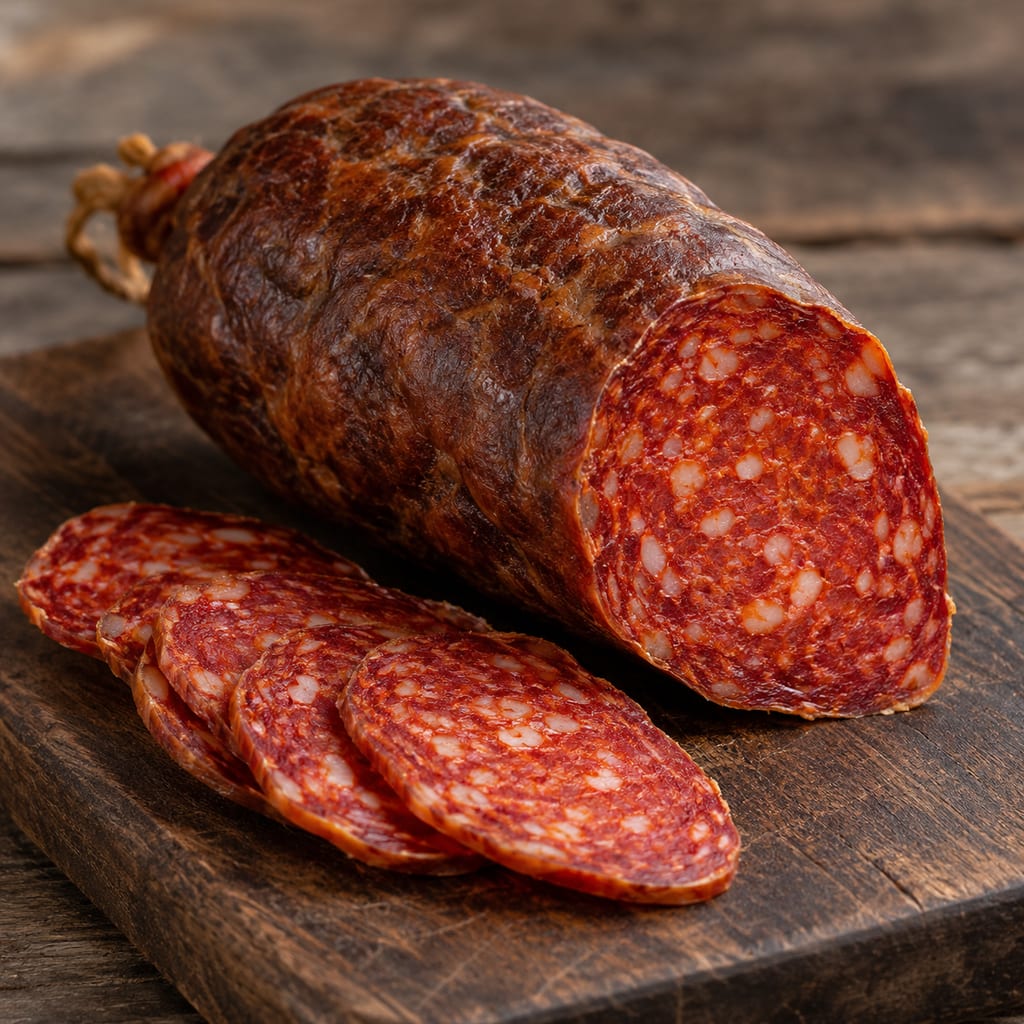
Baranjski kulen
Baranjski kulen is a Croatian protected fermented pork sausage seasoned with sweet and hot paprika, garlic and white pepper, stuffed into a pig’s caecum called katica, cold-smoked and matured.
 FermenteaWhere food goes to change
Spices and aromatics
Paprika is ground, dried Capsicum fruit used for red color and pepper flavor; the name alone does not specify its heat, smoke, cultivar or origin.
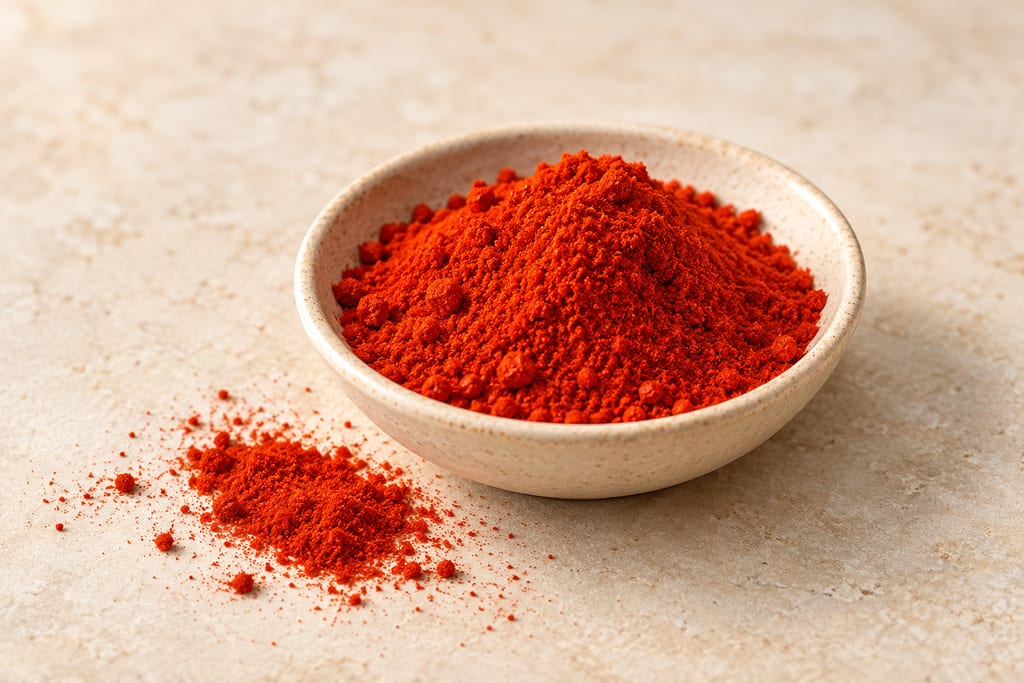
The peppers used for paprika belong to Capsicum, a genus native to the Americas. Genetic, archaeological, ecological and linguistic evidence places domestication of Capsicum annuum in Mexico, though the studies describe uncertainty about the precise centre and history of domestication. That is the history of the crop. It does not mean that ground paprika originated in Mexico, or that a packet sold today was grown there.
European paprika traditions formed after Capsicum crossed the Atlantic. The Hungarikum Committee dates paprika’s arrival in the Carpathian Basin to the sixteenth and seventeenth centuries. Around Szeged, it records cultivation from the start of the nineteenth century, with Franciscan monks as a likely early local cultivator rather than a proven first grower. By the late nineteenth century, paprika in whole, broken, crushed and ground forms had become a leading commercial product of Szeged.
Paprika history is not one straight line from a single birthplace. Peppers could be grown in household gardens and then developed into local crops and market goods. The Hungarian account, Murcia’s protected-product history and La Vera’s drying tradition describe different regional paths. None establishes the origin of all paprika powder.
The Szeged account describes a shift in what Hungarian paprika meant to buyers. It says the country's paprika was hot until the 1940s, while manual removal of the cores and veins produced sweet and semi-sweet versions. That history is useful when reading old recipes or product names: “Hungarian paprika” does not guarantee the same heat profile across periods. The account's description of changing forms—from whole and broken peppers to crushed and ground spice—also shows that a regional name can refer to a changing trade rather than one fixed recipe.
Paprika is a ground spice made from dried Capsicum fruit. In most common products the fruit is ripe and red, but the name does not identify one cultivar, one exact part of the fruit, a heat level, or a drying method. Capsicum annuum is the species most often associated with paprika, yet that species itself includes an unusually wide range of fruit shapes and pungencies. A packet labelled only “paprika” leaves those product details open.
This record uses Paprika for the broad, unspecified ground spice. It keeps the name distinct from more specific catalogue entries for spicy paprika and for sweet or smoked paprika. Those labels describe product traits that can overlap: sweetness or heat concerns pungency, while smoke describes drying. A paprika can therefore be hot and smoked, or mild and smoked. The word alone does not resolve the combination.
Paprika is also not the same as every chilli powder. In some markets, “chilli powder” means ground dried peppers; in others, especially in the United States, it can mean a seasoning blend that includes cumin, garlic or other ingredients. The ingredients panel and the maker’s description are better guides than color alone.
Spanish Pimentón de la Vera is a specified regional product, not a synonym for every smoked paprika. Its product specification limits the pepper varieties and production area and requires drying with oak or holm-oak wood. The smoke, intense aroma and deep red color are tied to that process. The specification recognizes sweet, bittersweet and hot grades, showing that smoke and pungency are separate properties.
Pimentón de Murcia is a different protected product. Its specification defines it as milled from fully red, mature Bola peppers grown and processed in Murcia. The regional authority describes the result as completely sweet, strongly aromatic, savoury and bright red. This is evidence about that protected product; it does not establish that all mild paprika comes from Murcia or uses Bola peppers.
Hungarian products from Szeged and Kalocsa have their own histories. The Szeged account records the former use of hand-splitting to remove hot parts when making sweet and semi-sweet ground paprika. The Kalocsa account dates its first paprika mill to 1861 and describes a dark-red powder with a pleasant spicy aroma and sweet, fruity taste. These places are documented regional associations, not a universal origin claim.
The La Vera specification also makes the production sequence unusually clear. It names ripe red peppers from the Ocales group—Jaranda, Jariza and Jeromín—and the Bola variety, and restricts production to named municipalities in Cáceres. The fruit is hand-picked at ripeness, then dried in farm sheds over oak or holm-oak fire. Workers turn the peppers during drying. Afterward, the stems are removed; seeds may be removed as well, before the fruit is crushed and milled. This is a protected local method, not a universal recipe for paprika.
The specification distinguishes the product by pepper variety and resulting pungency: sweet grades use Bola or Jaranda, bittersweet grades use Jaranda or Jariza, and hot grades use Jeromín, Jariza or Jaranda. Those names describe the regional specification and cannot be used to infer the variety in an unlabelled jar. Even within a protected product, the grade carries information that the broad word paprika leaves out.
The Szeged account also connects household preparation to milling and trade. It describes paprika in whole, broken, crushed and ground forms, and records hand-splitting peppers to remove hot internal parts when making sweet or semi-sweet powder. By the late nineteenth century, the spice had become a major commercial product there. The account says more than ten thousand people were involved in paprika work between the world wars and that the town had twenty mills. This regional record shows how a household spice became an organized agricultural and milling trade; it does not describe every paprika supply chain.
The La Vera specification describes a regional history as well as a product rule. It places cultivation in Cáceres by the late fifteenth century and links the crop's early establishment to local religious communities. This is a history of paprika in that area, not proof that the spice began there. The same document distinguishes La Vera's fire-and-smoke drying from the sun-drying practices associated with other Spanish growing areas. Drying technology therefore helps explain why two red powders from different regions can have different aromas even when both are called pimentón.
Paprika can refer to the spice made by milling pepper, but Capsicum is also sold as whole dried fruit, crushed pieces and flakes. A flake is visibly coarser than a fine powder and distributes differently through food. It can be another product from the same broad crop family without being the same physical form. When a recipe says paprika without a particle-size description, it usually means ground spice, but the recipe’s own context and the package should settle the choice.
Drying and grinding do not make every paprika interchangeable. A protected regional product may specify which varieties, fruit maturity, drying technique and milling characteristics qualify. The Pimentón de la Vera specification, for example, names its varieties and wood-smoke drying, and defines a fine grind. Such details explain why “paprika” alone cannot promise a particular aroma or texture.
Some commercial powders may contain a small quantity of edible oil for consistency or gloss, and blends may include other seasonings. The La Vera specification allows a limited oil addition to its product, while other products follow their own rules. If a recipe depends on pure ground pepper rather than a blend, check the ingredient list instead of assuming that every red powder is single-ingredient.
Paprika’s red color is not a measure of heat. Capsicum fruits contain carotenoid pigments responsible for red and orange hues; capsaicinoids are the compounds associated with pungency. Studies of Capsicum chemistry treat color, aroma and pungency as separate sensory properties. A strongly colored powder can be mild, and a hot powder is not necessarily the reddest one.
The fruit variety and its tissues affect heat. Capsaicinoids are produced in placental tissue, and pungent and non-pungent cultivars accumulate different amounts. Regional specifications make this distinction concrete: the La Vera specification defines a sweet grade with a mild, entirely sweet taste, a bittersweet grade with mild heat, and a hot grade with pronounced palate heat. No single Scoville value applies to paprika as a category.
Drying also matters to the final character. The slow wood-smoke drying specified for La Vera adds smoke to the aroma; Murcia’s product is unsmoked and defined as completely sweet. Drying can alter the spice’s volatile aroma compounds and pigments, but those effects depend on the starting pepper and process. It is more accurate to name a product’s stated variety and process than to predict its flavor from the word paprika.
Paprika is used to add pepper flavor and red color to cooked dishes, meat preparations and seasoning mixtures. A mild product can provide color and a rounded pepper note without much pungency; a hot grade contributes a noticeable burning sensation; smoke-dried products add smoke aroma. The same measure may not create the same result across brands or regions because the underlying peppers and their processing differ.
Heat, smoke and sweetness are independent choices rather than a single ladder. If the recipe is meant to stay mild, a label such as sweet or mild offers more information than plain paprika. If it calls for a smoke character, look for smoked paprika or a named product such as Pimentón de la Vera. If it names hot or spicy paprika, a mild sweet product will not supply the same pungency. When the recipe does not specify, the author’s intended product remains uncertain.
Paprika also appears in fermented sausages and other preparations. There it seasons the food and provides color or pungency; it does not replace salt, a starter culture or the process controls. The fact that a spice is used in a fermented product does not make the spice itself a fermenting agent.
Read the full product name and ingredient list. “Sweet,” “hot,” “smoked,” “bittersweet,” and a protected regional name tell different things. For a blend, the ingredient list shows whether cumin, garlic, salt or other seasonings are included. A product name cannot establish where an unspecified packet was grown or milled; record unknown origin when supplier data is absent.
Store ground paprika closed, dry and away from light and heat, and follow the package’s storage directions. Its pigments and volatile aromas can fade with exposure and time; that is a quality change, not evidence that a particular container is unsafe or safe. No universal household shelf life is inferred here.
Dried spices are not sterile. FDA’s spices risk profile documents microbial hazards, including a historic outbreak linked to paprika used in potato-chip seasoning. That history does not mean a current packet is contaminated, and ordinary color, smell or appearance cannot certify a spice’s microbiological status. Use reputable products and follow any applicable recall or package instructions.
Without a brand, product specification or origin label, the word paprika does not tell us the cultivar, exact country or region of production, grind, seed and placenta content, pungency, smoke treatment, or whether the powder is a blend. Those gaps should stay open rather than being filled from the histories of Murcia, La Vera, Szeged or Kalocsa. The catalogue’s named regional entries describe their own documented products; they do not assign every paprika packet to one of those places.
Capsicum annuum domestication is associated with Mexico; this is plant history, not the origin of paprika powder.
The protected Murcia product is made from fully ripe Bola peppers; this row does not assign generic paprika to Murcia.
The product specification locates Pimentón de la Vera production in this area; it is one smoke-dried regional product, not the origin of all paprika.
The source documents a distinct Hungarian paprika-growing and milling tradition.
The source documents a distinct protected ground-paprika tradition in the Kalocsa growing region.
A generic label does not identify the crop's supplier or the powder's growing and processing origin.
Baranjski kulen is a Croatian protected fermented pork sausage seasoned with sweet and hot paprika, garlic and white pepper, stuffed into a pig’s caecum called katica, cold-smoked and matured.
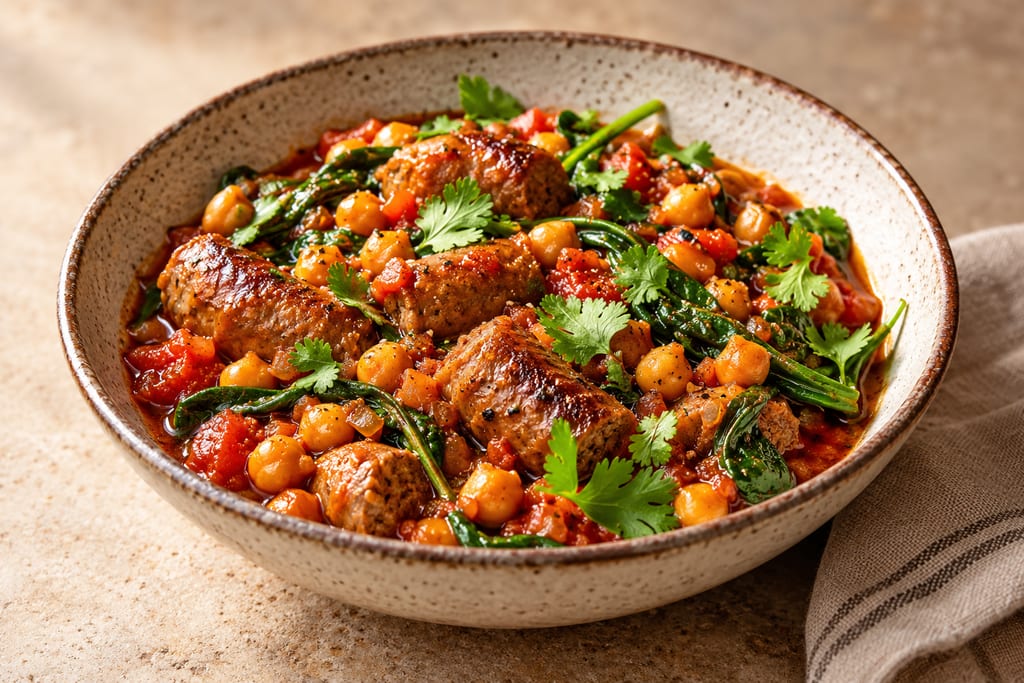
Lesego Semenya’s contemporary South African stew combines browned boerewors, chickpeas, tomato, spinach and warm spices.
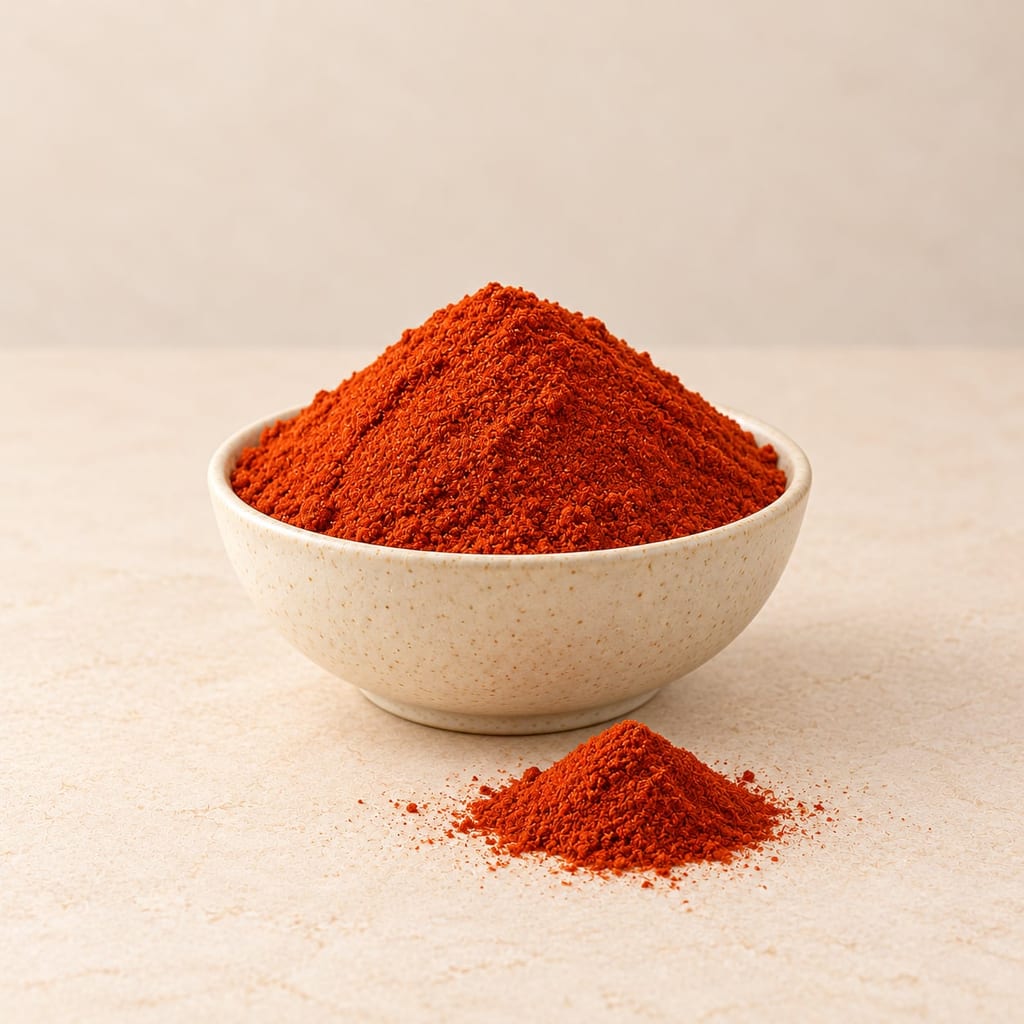
Sweet and smoked paprika are mild red powders made from dried ripe peppers, the smoked kind dried over oak or holm oak fires, used for colour and flavour in sausages, stews and rubs.
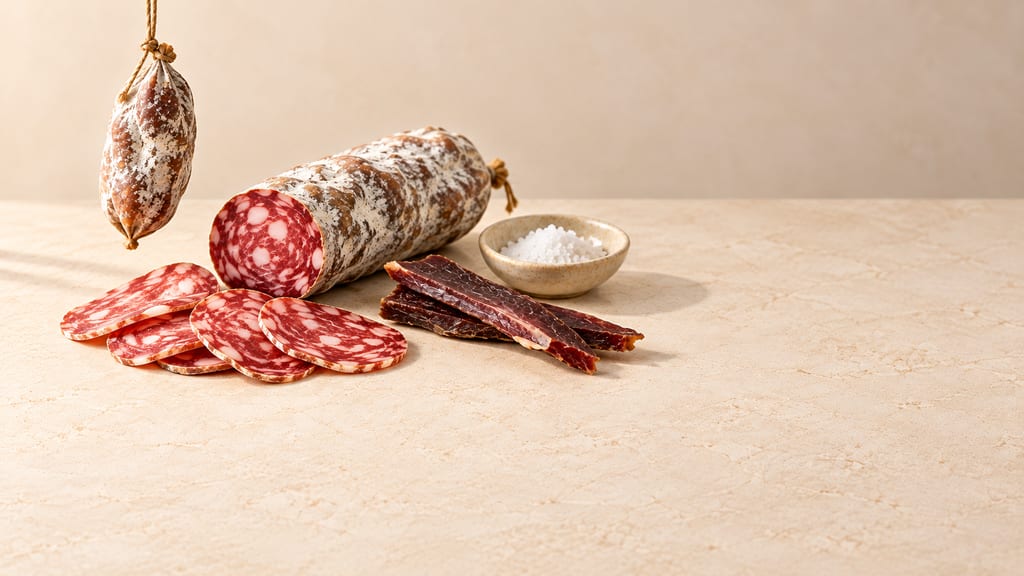
Dry salami, sour pork with rice, matured sheep and aged blubber follow different paths from animal to food. Their stories connect microbes with climate, slaughter, migration and the meals people share.
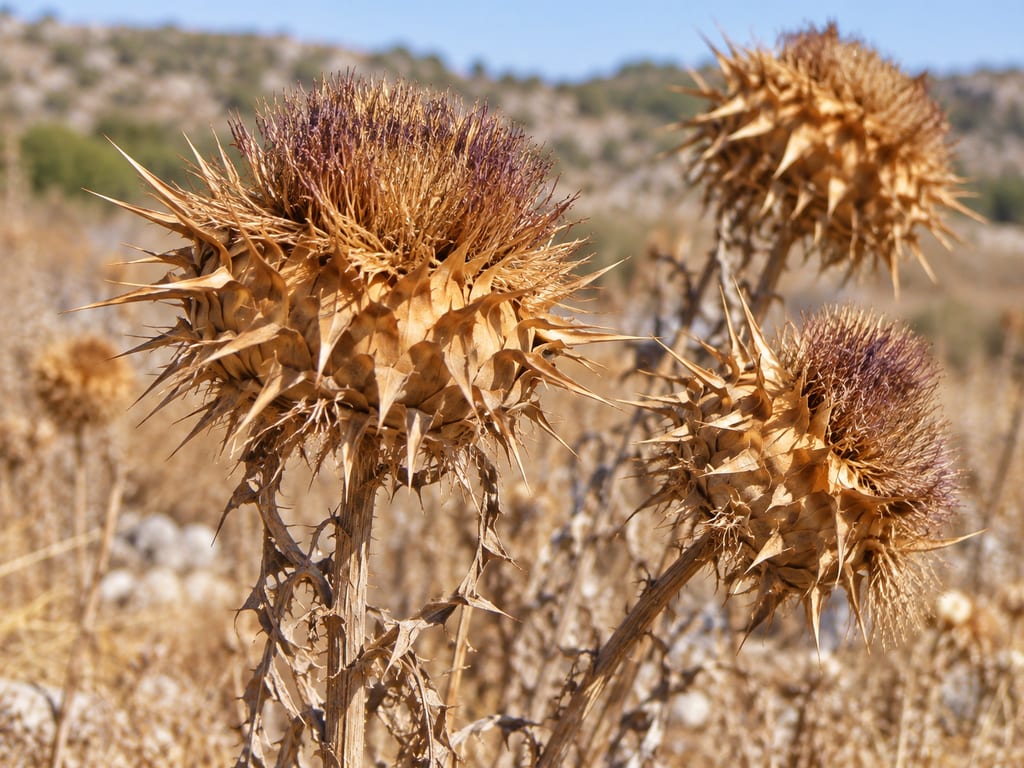
Dried flower heads of cardoon (Cynara cardunculus) supply plant proteases used to coagulate milk in several documented regional cheeses. Plant, extraction, milk and dose matter; evidence does not establish a universal home method.
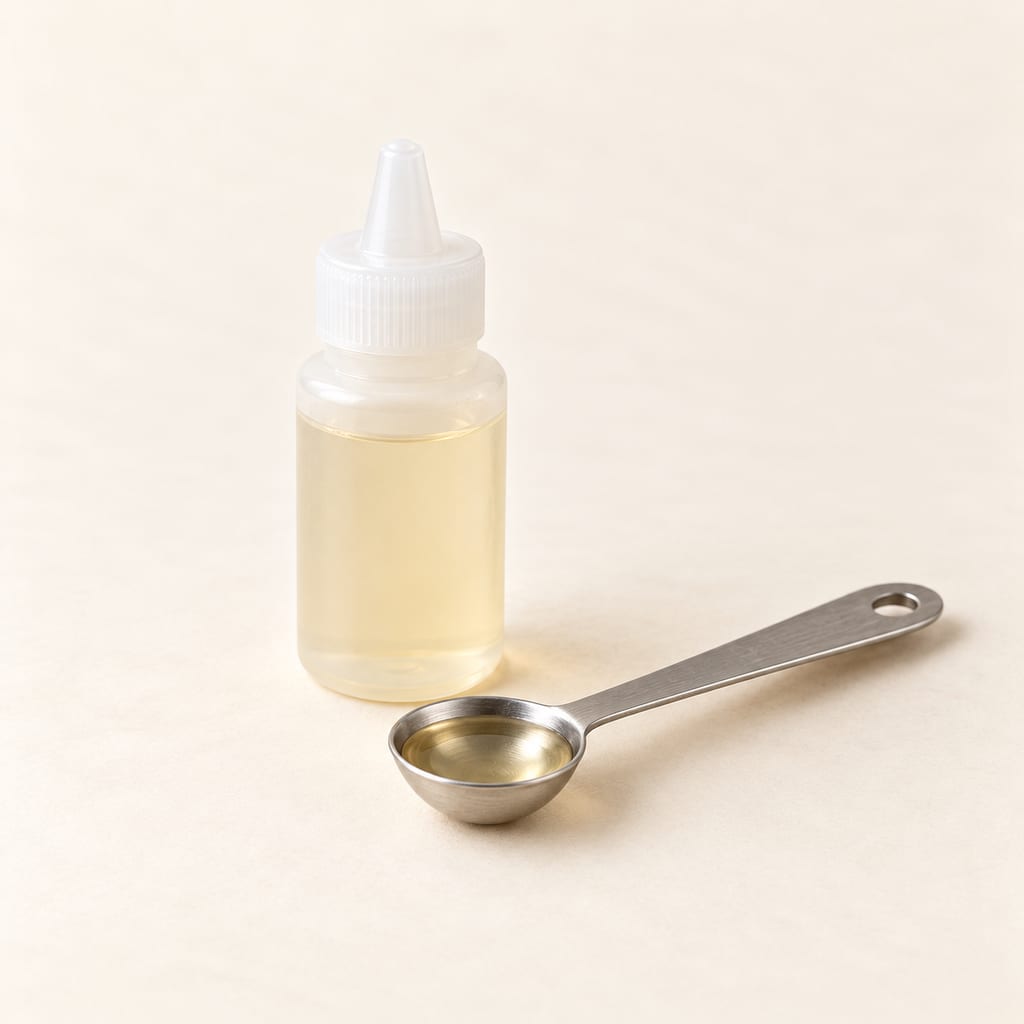
Rennet is an enzyme preparation that helps milk form a cuttable curd. Animal, microbial, fermentation-produced and plant coagulants have distinct identities and strengths.
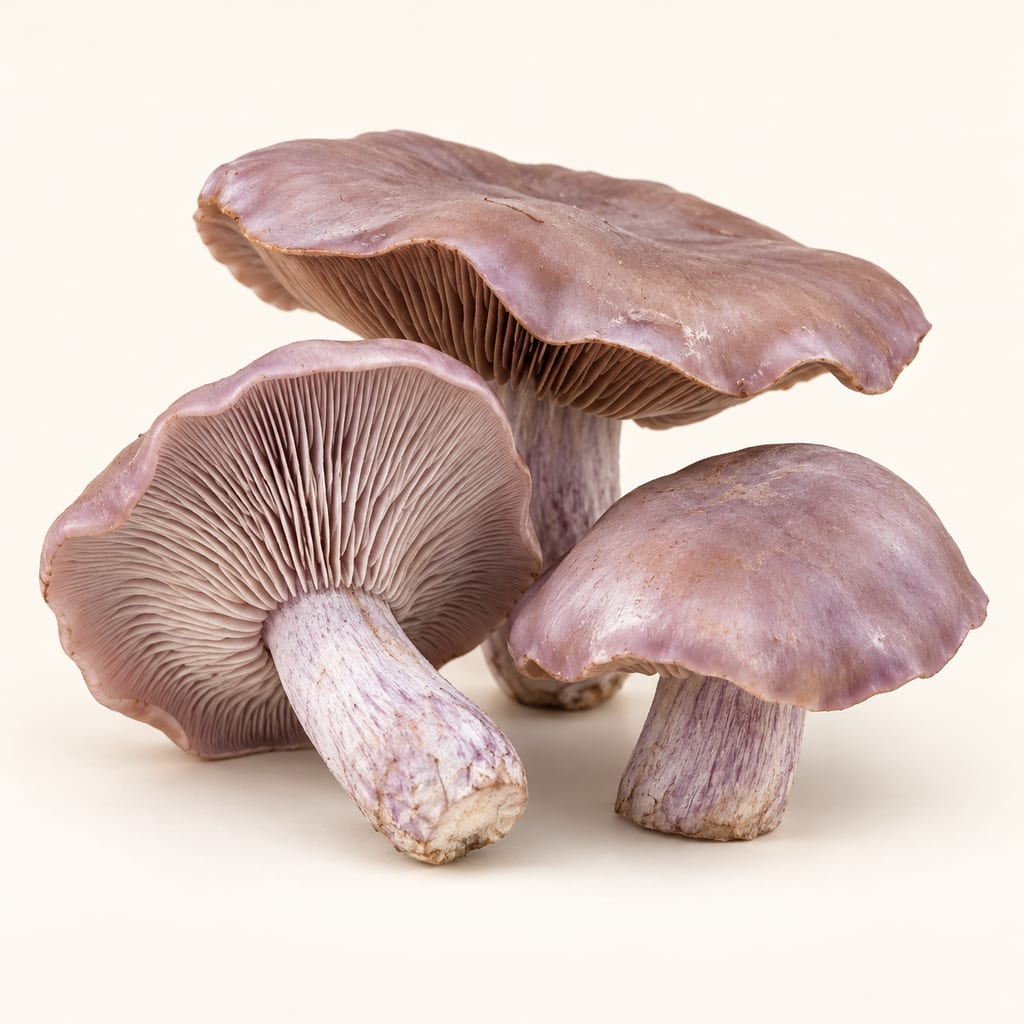
Wood blewit is a violet, litter-feeding mushroom collected and cultivated in parts of Europe. It is eaten only after thorough cooking; raw or undercooked specimens can cause gastrointestinal illness.
No community contributions have been published for this entry yet.
Sign in to contribute. Published comments and photos are free to read.
Royal Botanic Gardens, Kew, Plants of the World OnlineIdentity · Botany · Geography
Capsicum annuum L.Capsicum annuum is an accepted species with an American native range and a broad distribution of cultivated fruit forms.
Cited in: Paprika names a spice, not one pepper; Whole fruit, flakes and powder are different forms
Proceedings of the National Academy of SciencesHistory · Botany
Multiple lines of evidence for the origin of domesticated chili pepper, Capsicum annuum, in MexicoMultiple evidence lines support domestication in Mexico; this concerns the crop, not the later ground spice.
Cited in: A crop from the Americas, with a later spice history
Hungarikum CommitteeHistory · Geography · Taste · Heat · Uses
Ground paprika from SzegedThe source dates paprika's arrival in the Carpathian Basin to the 16th–17th centuries and cultivation around Szeged to the early 19th century; it records hot Hungarian paprika until the 1940s and hand-removal of hot parts to make sweet or semi-sweet ground product.
Cited in: A crop from the Americas, with a later spice history; Paprika names a spice, not one pepper; Regional products show why the label matters; How cooks use the broad spice; What this generic name cannot tell us
Hungarikum CommitteeHistory · Geography · Taste
Ground paprika from KalocsaIt dates the first Kalocsa paprika mill to 1861 and describes protected ground paprika from that growing region as dark red with a pleasant spicy aroma and sweet, fruity taste.
Cited in: Regional products show why the label matters; What this generic name cannot tell us
Region of Murcia, Department of AgricultureIdentity · Geography · History · Taste · Heat
D.O.P. Pimentón de MurciaProtected Pimentón de Murcia is milled from mature, healthy, clean and dry fully red Bola peppers; the specification describes it as completely sweet, strongly aromatic, savoury and bright red.
Cited in: A crop from the Americas, with a later spice history; Regional products show why the label matters; Red color, pepper aroma and heat come from different qualities; How cooks use the broad spice; What this generic name cannot tell us
UK Department for Environment, Food & Rural Affairs, reproducing product specificationIdentity · Geography · History · Processing · Taste · Heat
Protected Designation of Origin Pimentón de la Vera: specificationsThe protected paprika is milled from ripe Capsicum annuum and C. longum fruit of named varieties, dried with oak or holm-oak wood in the specified area; the product specification distinguishes sweet, bittersweet and hot grades and describes smoke aroma.
Cited in: A crop from the Americas, with a later spice history; Paprika names a spice, not one pepper; Regional products show why the label matters; Whole fruit, flakes and powder are different forms; Red color, pepper aroma and heat come from different qualities; How cooks use the broad spice; Choosing and storing a packet; What this generic name cannot tell us
Critical Reviews in Food Science and NutritionTaste · Heat · Science
Capsicum—production, technology, chemistry, and quality. Part III. Chemistry of the color, aroma, and pungency stimuliCapsicum's colour, aroma and pungency arise from different compound groups; carotenoids colour red paprika and capsaicinoids supply pungency.
Cited in: Red color, pepper aroma and heat come from different qualities
BMC Plant BiologyScience · Heat
Evidence of capsaicin synthase activity of the Pun1-encoded protein and its role as a determinant of capsaicinoid accumulation in pepperCapsaicinoids cause pepper pungency and are produced in placental tissues; cultivars differ in capsaicinoid accumulation.
Cited in: Red color, pepper aroma and heat come from different qualities
U.S. Food and Drug AdministrationFood safety
Risk Profile: Pathogen and Filth in SpicesThe FDA identifies microbial hazards in spices and records a historic Salmonella outbreak associated with paprika; ground spices are not sterile by virtue of being dry.
Cited in: Choosing and storing a packet