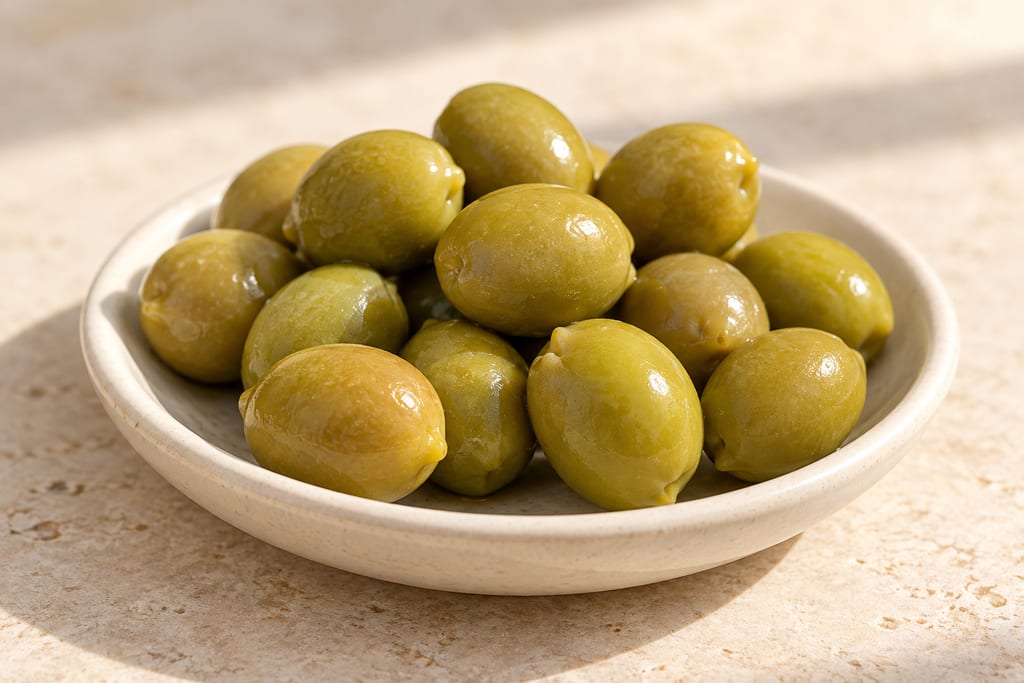
Azeitona de conserva Negrinha de Freixo
A Portuguese table-olive product from the Negrinha cultivar in northeastern Portugal, sold in three commercial styles, two of them brined fermentations and one oxidised to black.
 FermenteaWhere food goes to change
Modern method
Whole green beans fermented in a salt brine, with dill and garlic as optional seasonings, staying crisp as they sour.
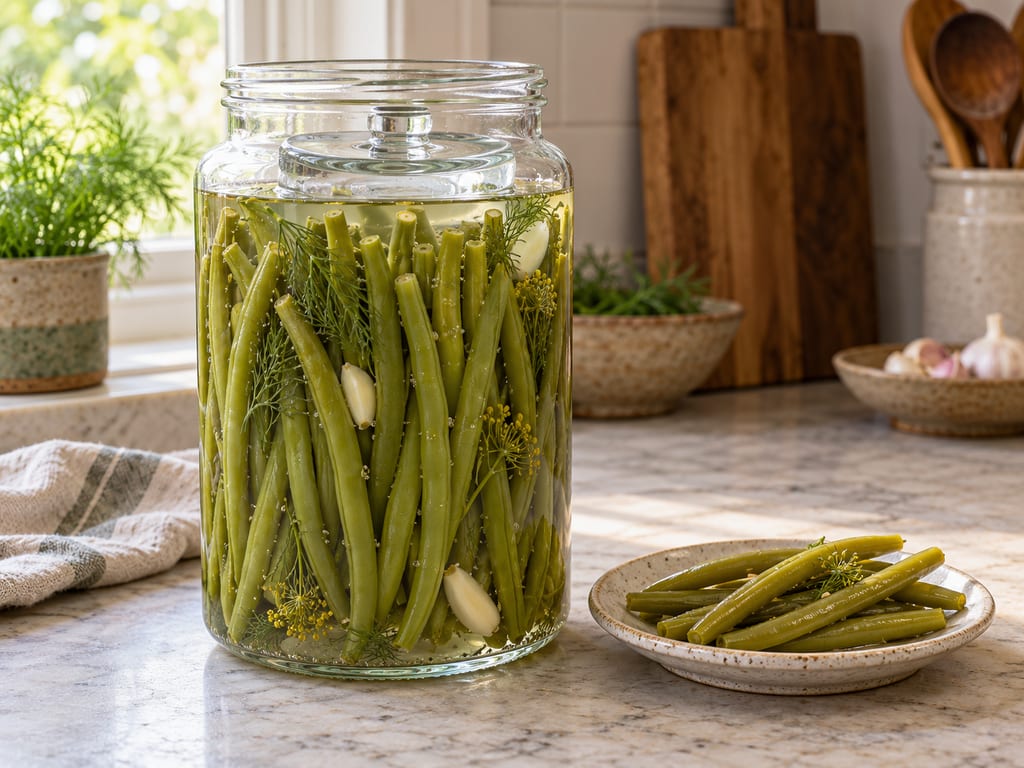
Lacto-fermented green beans are immature bean pods preserved in salt brine through the activity of lactic-acid-producing microorganisms.
The beans come from Phaseolus vulgaris L., the common bean species.
Unlike mature dried beans, green beans are harvested while the pods are still tender and edible.
The finished preparation is intended to retain a recognisable bean shape and a firm, pleasantly acidic texture.
Dill and garlic are common additions.
The resulting product resembles a cucumber pickle in seasoning but has the distinctive flavour and structure of green beans.
These preparations are sometimes called dilly beans.
However, that name is also widely used for vinegar-pickled green beans.
It is important to distinguish between the two.
Vinegar-pickled beans receive their acidity from added vinegar.
Lacto-fermented beans rely on microorganisms generating organic acids during fermentation.
The specific recipe held in the Fermentea database comes from a modern video demonstration rather than an identified historical regional tradition.
Green beans belong to the common bean species, domesticated in the Americas and subsequently spread around the world.
Their modern cultivation includes many bush and climbing varieties.
Fresh green pods are perishable.
They lose moisture after harvest and can become limp or fibrous.
Traditional preservation methods include drying, salting, pickling and, in more recent times, canning and freezing.
The precise historical origin of the modern salt-brined dill-and-garlic recipe is unknown.
Its culinary identity reflects the combination of a familiar pickling technique with a readily available vegetable.
Dill-and-garlic pickles are strongly associated with several European and North American food traditions.
Green beans provide an alternative to cucumbers, especially when gardens produce a large seasonal harvest.
However, there is no verified invention date or one country that can be assigned to this exact modern formulation.
Fresh green beans — Enough to fill the jar
Kosher salt — 1 tablespoon
Water — 2 cups
Dill — Optional; quantity unspecified
Garlic — Optional; quantity unspecified
The recorded method describes the saltwater mixture as a 2% brine.
That label is not independently established by the volumetric recipe.
A tablespoon of salt does not have one universal mass.
The weight depends on the crystal size and packing density of the specific salt.
The original record therefore preserves both the recorded method's stated percentage and the actual tablespoon-based formulation, without pretending that the two are analytically identical.
Green beans provide the vegetable tissue, modest quantities of fermentable carbohydrates and naturally occurring microorganisms.
Salt influences microbial growth and moisture movement.
Water creates a liquid environment through which salt and acids can diffuse.
Dill contributes volatile aromatic compounds associated with traditional dill pickles.
Garlic contributes sulfur-containing flavour compounds.
Neither dill nor garlic is the primary mechanism that makes the product acidic.
The fermentation depends on suitable microorganisms consuming available nutrients and producing acid.
The starting condition of the beans matters.
Fresh, tender pods provide a different texture from old, fibrous pods.
Beans held too long after harvest may already have lost quality.
1. Select and wash the beans. Use fresh green pods and remove damaged or decaying material.
2. Trim the ends. The video describes snapping the beans and preparing them to fit in the jar.
3. Clean the vessel. Use a suitable food-grade jar and fermentation weight.
4. Make the brine. Dissolve 1 tablespoon kosher salt in 2 cups water.
5. Add optional seasonings. Dill and garlic may be placed in the vessel. The original source does not establish exact quantities.
6. Pack the beans. Arrange them with approximately 1 inch of headspace.
7. Cover with brine. Use a weight to keep the beans submerged.
8. Allow fermentation. The recorded method describes 5–7 days on a warm counter. No exact numerical temperature is provided.
9. Refrigerate. The recorded method describes transferring the beans to refrigeration afterward.
The creator's time and method are documentary evidence of the recipe, not a validated safe fermentation endpoint.
Successful lactic-acid fermentation begins when suitable microorganisms grow in the vegetable-brine environment.
These organisms consume available carbohydrates.
Their metabolism produces organic acids, including lactic acid.
As acidity increases, the pH declines.
The resulting food develops sourness.
Some bacterial species also produce carbon dioxide, acetic acid or small quantities of other metabolites.
Different microbial communities can therefore create different flavours and levels of visible gas production.
Not every successful ferment produces vigorous bubbling.
Conversely, bubbles are not evidence that the product has reached a safe acidity.
The actual acidification must be assessed independently where safety matters.
Green beans are botanically and physically different from carrots or beets.
The edible portion is an immature pod containing developing seeds.
The pod wall contains cellulose, hemicellulose, pectic substances and other structural components.
The balance changes as the pod matures.
Young beans tend to be more tender.
Older beans can become fibrous, and the developing seeds become more prominent.
During fermentation, the plant tissues exchange water and dissolved substances with the brine.
The texture may soften as cellular pressure changes and cell-wall components are modified.
Maintaining desirable firmness is one of the important challenges in fermented green-bean production.
Pectin and related substances help maintain cohesion between plant cells.
Pectolytic enzymes can alter these materials.
Some enzymes originate in the vegetable itself, while others may be produced by microorganisms.
Their activity can contribute to softening.
This means that firmness depends on more than the salt concentration.
The initial state of the plant tissue, any heat treatment and the fermentation conditions can all affect the outcome.
A 1999 scientific study examined how blanching time and salt concentration influenced the texture of fermented green beans.
The researchers used a bean variety known as Tuf.
They blanched samples at 90°C for 1, 10 or 20 minutes and used brines containing 3.08% or 4.6% salt.
These treatments produced different texture outcomes.
The published trial found significant changes in bean shearing properties during the early stages of fermentation.
Longer blanching in the investigated process improved some texture characteristics.
This is useful evidence that pre-fermentation treatment can strongly influence the final product.
It is not evidence that the modern video recipe should be modified to include 20 minutes of blanching without further validation.
PubMed
Blanching is a brief heat treatment.
It can reduce the activity of plant enzymes and alter the initial microbial population.
It can also soften tissues and change the permeability of cell structures.
The precise effect depends on temperature, time, vegetable variety and subsequent processing.
The 1999 experiment investigated blanching under controlled conditions.
The original Fermentea recipe uses raw green beans.
Those are materially different processes.
Heating the beans before fermentation may suppress naturally occurring microorganisms that would otherwise participate in spontaneous lactic fermentation.
A controlled process using a selected starter can compensate for this, but the original video does not describe such a system.
Therefore, the scientific findings should be presented as an explanation of texture control, not silently incorporated into the source recipe.
Researchers also studied fermented green beans using a defined starter culture.
The 1996 investigation used beans blanched at 90°C for 20 minutes and subsequently fermented in 3.08% salt solution.
It examined nutrients and anti-nutritional substances during fermentation and storage.
The published trial found significant reductions in trypsin inhibitors and vitamins B1 and B2 during processing.
It also recorded changes in protein content early in fermentation.
These findings illustrate a general principle: fermentation changes the nutritional profile of vegetables rather than necessarily increasing every desirable nutrient.
Some compounds may become more available or decrease, while others can be lost.
The result depends on the process.
The study's findings cannot simply be assigned to raw fermented green beans prepared in a different brine without blanching.
PubMed
Green beans belong to the legume family.
That creates an opportunity for confusion with fermented mature beans, such as soybeans, black beans or other pulses.
The immature pod is botanically related but chemically and structurally different.
Mature dried beans contain much more concentrated starch and protein and usually require substantial cooking before consumption.
Fermented green beans are prepared from tender pods.
A brined green-bean recipe should therefore not be used as a method for fermenting raw dried kidney beans or other mature pulses.
Those foods have different preparation requirements and potential hazards.
In particular, some mature beans contain lectins that require appropriate cooking.
The present recipe does not address those products.
Dill gives the fermented beans a familiar herbal pickle character.
Garlic adds savoury depth.
Both may be used in whole or cut form, depending on the recipe.
A modern University of Michigan vegetable-fermentation formula lists green beans among suggested vegetables and gives garlic, dill and black peppercorns as a flavour combination.
Its general brine formula is 2 tablespoons salt per 4 cups water.
This is the same tablespoon-to-water ratio as the original video, although the exact mass concentration still depends on the salt used.
The combination therefore has support as a contemporary recipe family.
It should not be described as a historically fixed national dish.
Green beans make convenient pickles because of their elongated shape.
They can be eaten as cold snacks or side dishes.
Their acidity pairs well with sandwiches, cooked meats and foods containing substantial fat.
They may be included in mixed pickle assortments.
The beans can also be chopped into salads.
Their dill-and-garlic seasoning makes them useful in dishes that would otherwise contain cucumber pickles.
A chopped green-bean pickle can contribute texture as well as acidity.
The brine may carry flavour, but its use as a food ingredient depends on the safety and condition of the finished product.
The strongest distinction is between vinegar-pickled dilly beans and lacto-fermented beans.
Vinegar-pickled versions may be heat-processed according to tested canning recipes.
Lacto-fermented versions develop acidity through microbial activity.
They require different safety controls.
Other variations involve chilli, black peppercorns or different herbs.
Some producers use whole tender beans, while others cut them.
The cut changes surface area and may influence fermentation behaviour.
A thick, mature bean pod should not be assumed to behave exactly like a slender young pod.
A successful ferment should develop appropriate acidity while retaining an acceptable bean texture.
Some cloudiness and gas may occur.
Persistent slime, putrefaction, visible mould or abnormal disintegration are warning signs.
Excessively soft beans may result from poor raw material, uncontrolled fermentation conditions or enzyme activity.
However, the absence of softness does not establish safety.
A product can remain firm even if acidification is inadequate.
Sensory observations must therefore be distinguished from microbiological controls.
Green beans are low-acid vegetables before fermentation.
The safety of the final product depends on the fermentation achieving suitable acidity.
The five-to-seven-day duration in the video is not proof of a safe endpoint.
The recorded method does not provide one measured pH or fermentation temperature.
The University of Minnesota recommends monitoring acidity and maintaining brine coverage.
Penn State cautions that tested fermented-pickle and sauerkraut recipes cannot be freely modified without affecting safety.
Green beans also require appropriate handling to prevent contamination.
A jar of fermented beans should not be treated as safely shelf-stable simply because it was kept warm for the stated period.
A present-day online demonstration; no traditional history or geographic origin is asserted.
Scaling: source batch only
A vegetable ferment can spoil if acidification or brine coverage is inadequate; the video has not been independently process-validated.
Hazard sourceUse clean food-grade equipment, keep produce below brine and monitor acidity; do not transfer the video's unsupported sensory endpoint as a safety test.
Control sourceBased on a video demonstration; no professional process validation is recorded.
Do not use smell, taste, bubbling or appearance alone to establish safety.
The linked extension guidance recommends acidity monitoring; recipe-specific validated limits are not established.
Unknown; video does not establish recipe origin. The video documents a present-day demonstration, not a traditional regional origin.
A Portuguese table-olive product from the Negrinha cultivar in northeastern Portugal, sold in three commercial styles, two of them brined fermentations and one oxidised to black.
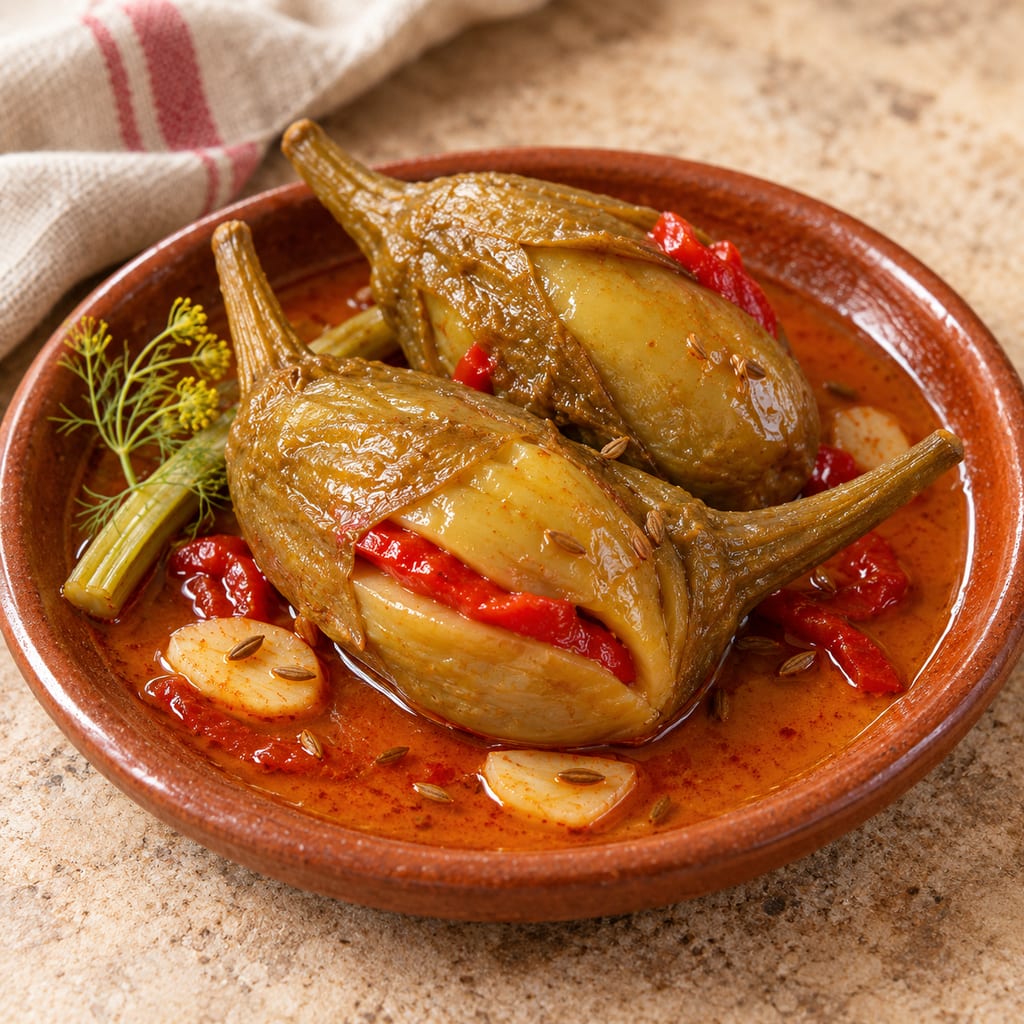
A protected aubergine preserve from Ciudad Real in Spain: tender fruit of the local Dealmagro variety, cooked briefly and then fermented in a vinegared, paprika-seasoned dressing.
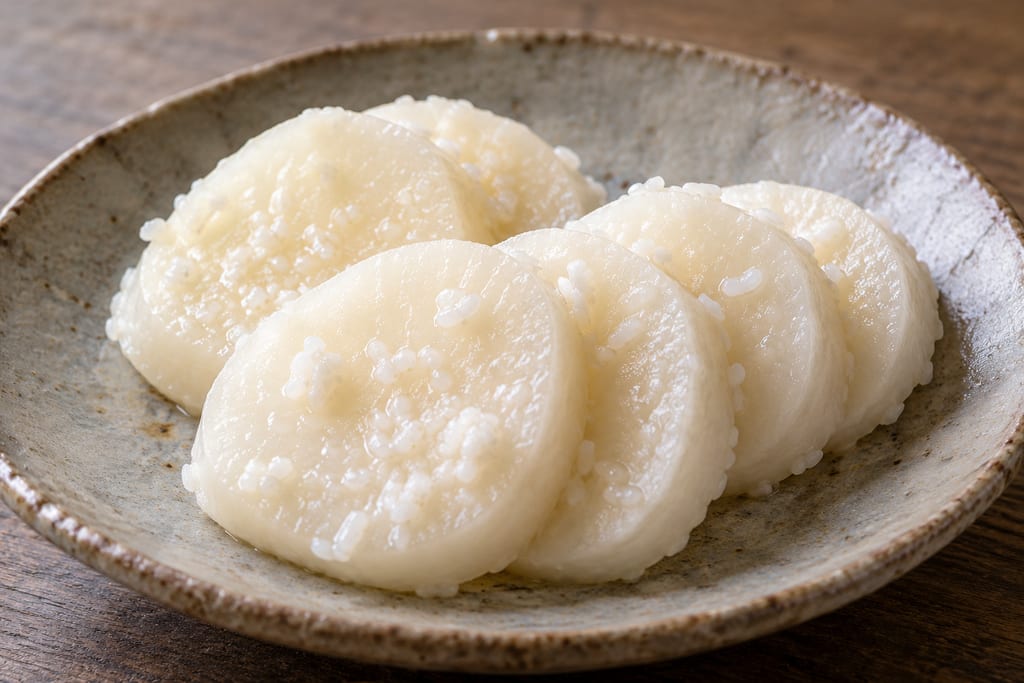
A sweet, crisp Japanese daikon pickle from Tokyo's Nihonbashi district, made by salting fresh radish and dressing it in rice koji, sugar or koji amazake without the heavy drying used for takuan.
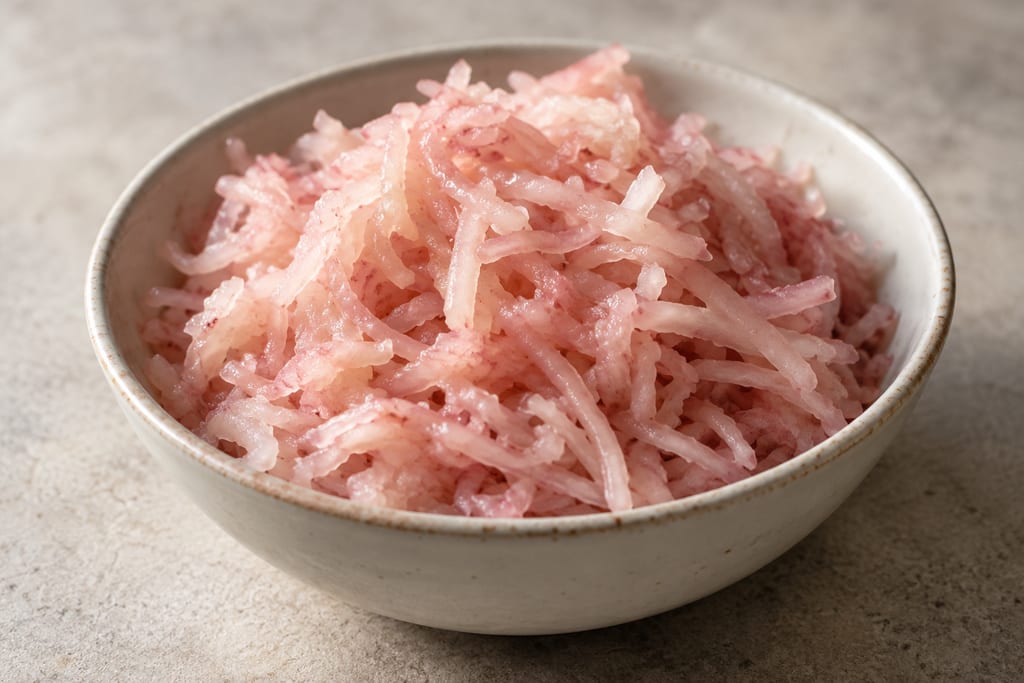
Source-specific Brovada DOP producer method for Friuli Venezia Giulia turnips and red-grape marc. This records a regulated producer process; it is not a validated home-scale recipe.
An industrial fermentation patio places factory-made fiberglass-reinforced polyester olive tanks below floor level, with drainage and transfer infrastructure arranged around the buried vessels.
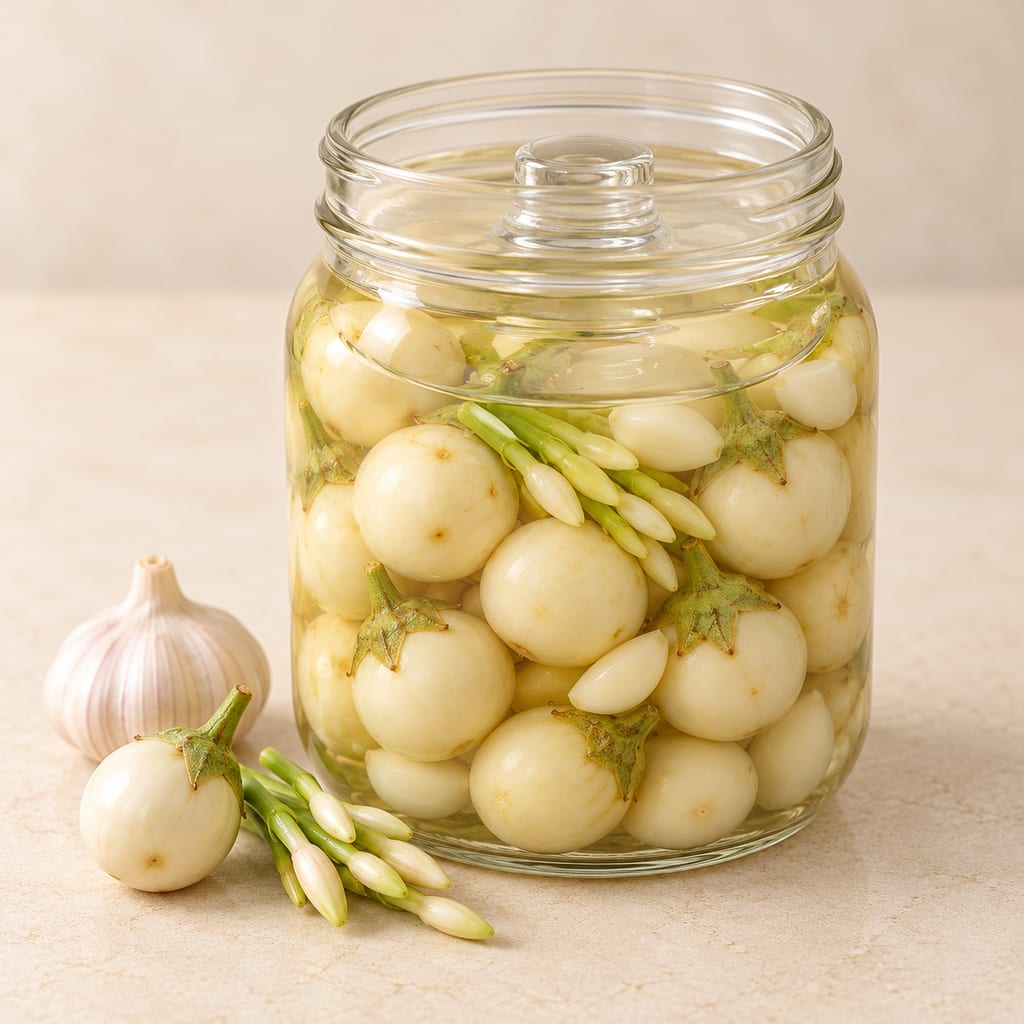
Vietnamese salted and fermented small eggplant, dried on the day of purchase, then held submerged in warm salty water with garlic and galingale flower for a week or longer.
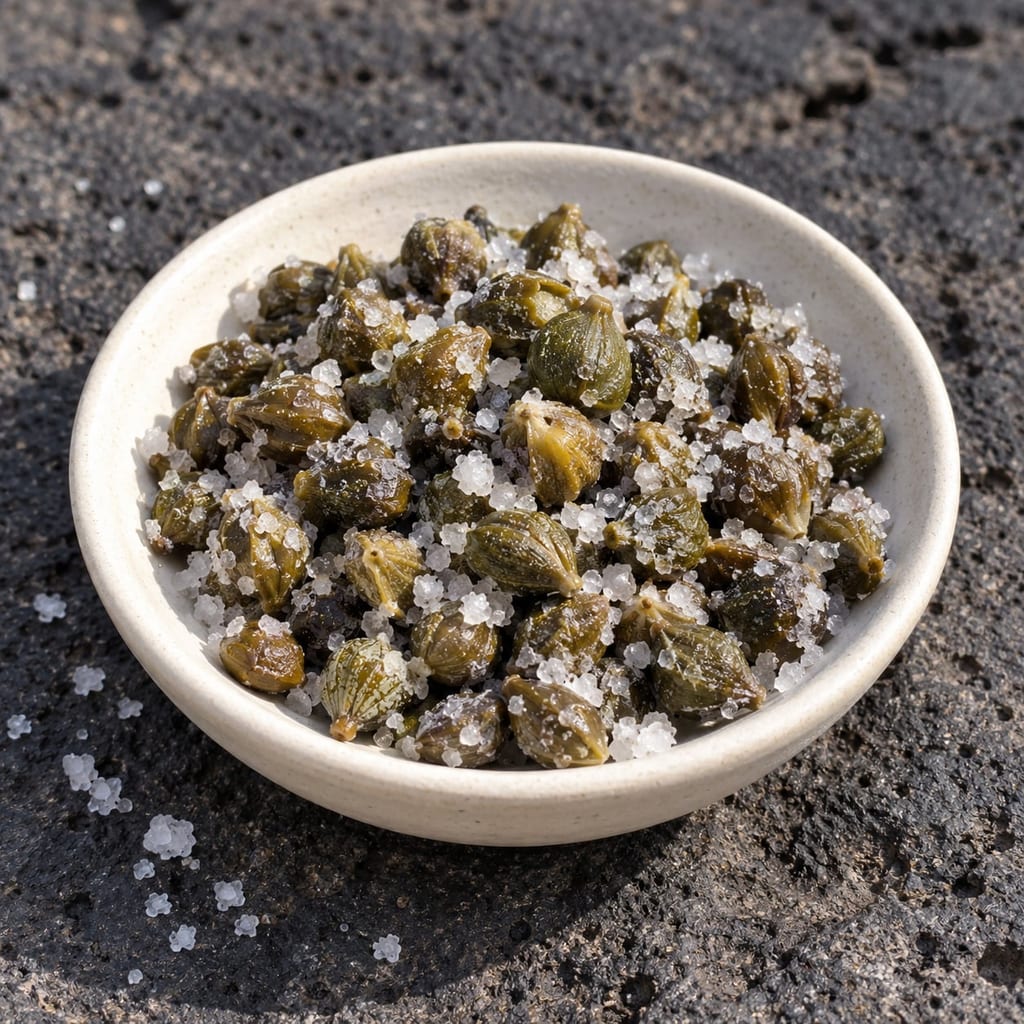
A protected Sicilian product: unopened caper buds from the island of Pantelleria, dry-salted with sea salt in a two-stage process that encourages lactic fermentation.
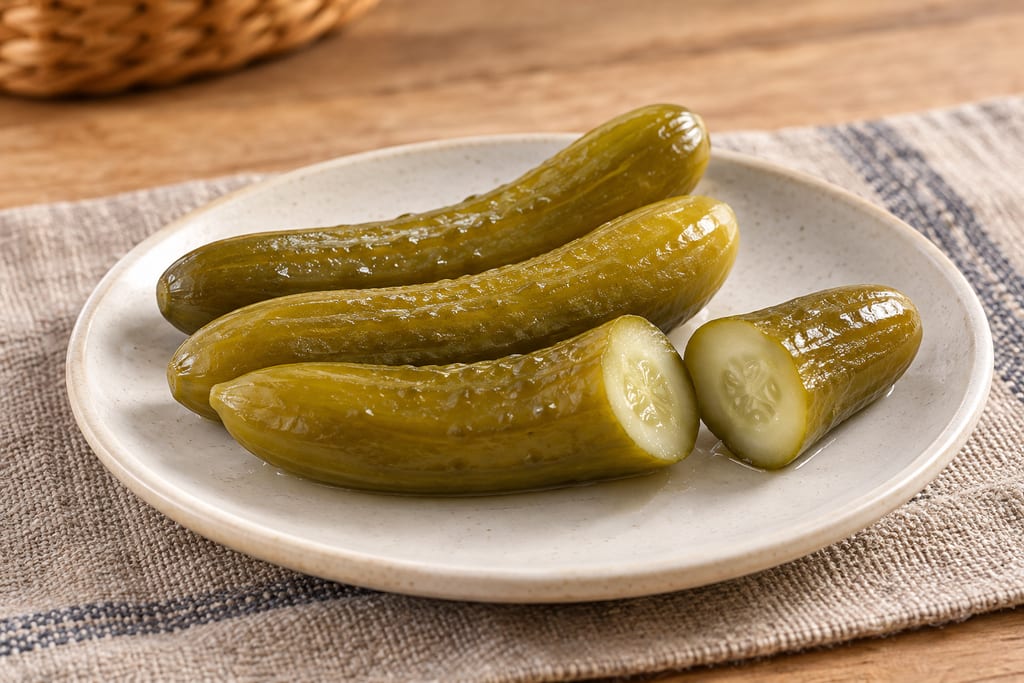
Çubuk turşusu is a registered pickle from Çubuk district in Ankara. Its cucumber variant is sold as Salatalık Turşusu, and a commercial specification sets its brine and room-temperature period.
No community contributions have been published for this entry yet.
Sign in to contribute. Published comments and photos are free to read.
The Prairie HomesteadInspiration
How to Ferment Green BeansSalt-to-water ratio at 02:05–02:22; pack/cover at 02:29–03:55; warm counter and 5–7 days at 04:14–04:25.
Cited in: What are lacto-fermented green beans?; Ingredients — recorded video method; Why the ingredients matter; The recorded preparation; Why blanching changes the process; A 1996 study of nutritional changes; Green beans, legumes and fermentation; Dill, garlic and the dilly-bean tradition; How fermented green beans are served; Regional variants and related foods; Safety and storage
University of Minnesota ExtensionSafety
Preserving food at home: FermentationGeneral vegetable-fermentation controls; this is not a validation of the video recipe.
Cited in: Ingredients — recorded video method; Why the ingredients matter; The recorded preparation; Why blanching changes the process; Regional variants and related foods; How to recognise problems; Safety and storage
Penn State ExtensionSafety
Let's Preserve: Fermentation — Sauerkraut and PicklesPenn State notes only sauerkraut and fermented pickles have research-based home processes and warns that changing tested proportions can make products unsafe.
Cited in: Ingredients — recorded video method; Why the ingredients matter; The recorded preparation; How green-bean fermentation works; Green-bean structure and texture; The role of pectolytic enzymes; Why blanching changes the process; Regional variants and related foods; How to recognise problems; Safety and storage
Mnkeni, Gierschner and Maeda, 1999Reference
Mnkeni, Gierschner and Maeda, 1999 — Effect of Blanching and Salt on Fermented Green Bean TextureCited by the written account of this record.
Cited in: Green beans and preservation history; Ingredients — recorded video method; Why the ingredients matter; The recorded preparation; How green-bean fermentation works; Green-bean structure and texture; The role of pectolytic enzymes; Why blanching changes the process; Regional variants and related foods; How to recognise problems; Safety and storage
Mnkeni, Gierschner and Maeda, 1996Reference
Mnkeni, Gierschner and Maeda, 1996 — Nutritional Quality of Fermented Green BeansCited by the written account of this record.
Cited in: Green beans and preservation history; Ingredients — recorded video method; Why the ingredients matter; The recorded preparation; How green-bean fermentation works; Green-bean structure and texture; The role of pectolytic enzymes; Why blanching changes the process; Regional variants and related foods; How to recognise problems; Safety and storage
University of MichiganReference
University of Michigan — Lacto-Fermented VegetablesCited by the written account of this record.
Cited in: Ingredients — recorded video method; Why the ingredients matter; The recorded preparation; Why blanching changes the process; Regional variants and related foods; How to recognise problems; Safety and storage
Food52Reference
Food52 — Fermented Green BeansCited by the written account of this record.
Cited in: Green beans and preservation history; Ingredients — recorded video method; Why the ingredients matter; The recorded preparation; How green-bean fermentation works; Green-bean structure and texture; The role of pectolytic enzymes; Why blanching changes the process; Regional variants and related foods; How to recognise problems; Safety and storage