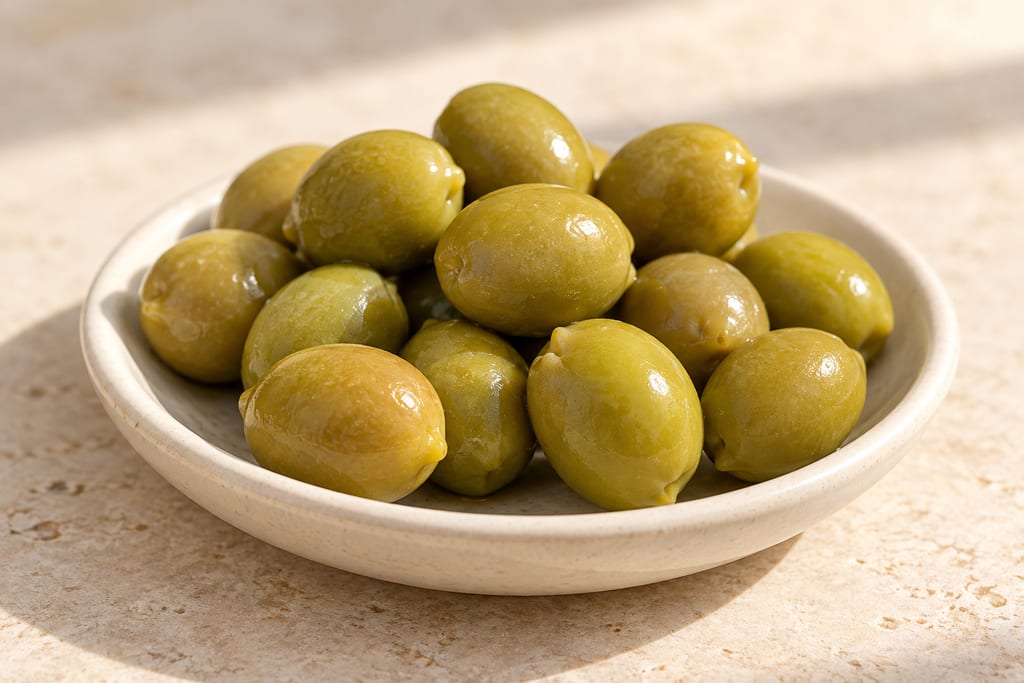
Azeitona de conserva Negrinha de Freixo
A Portuguese table-olive product from the Negrinha cultivar in northeastern Portugal, sold in three commercial styles, two of them brined fermentations and one oxidised to black.
 FermenteaWhere food goes to change
Modern method
A small brine ferment of peeled garlic; the video also demonstrates optional onion and herbs.
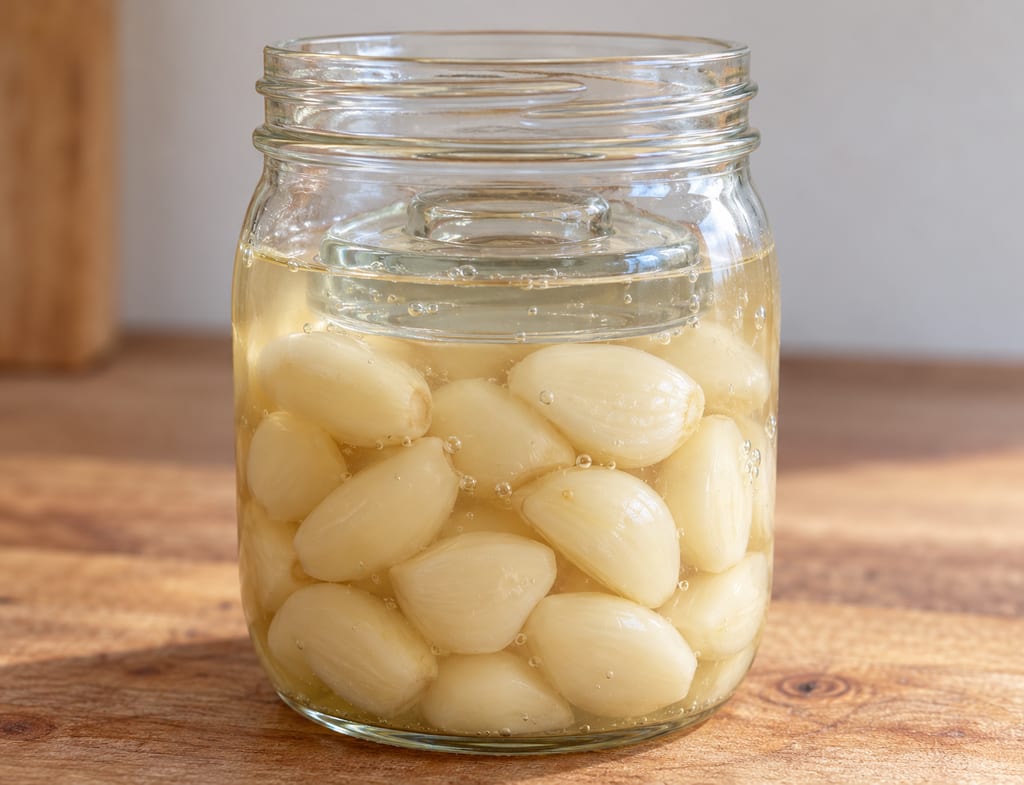
Lacto-fermented garlic is a preparation in which peeled garlic cloves are immersed in salt brine and undergo microbial fermentation.
The botanical species is Allium sativum L.
Garlic is distinctive because its flavour chemistry differs substantially from that of most other vegetables.
Fresh garlic contains numerous sulfur-containing compounds, some of which become strongly pungent when the cloves are cut or crushed.
During suitable fermentation, microbial metabolism produces organic acids and may alter the flavour and texture of the cloves.
The resulting product can taste less aggressively pungent than raw garlic, with additional acidity and savoury character.
However, the name fermented garlic is used for several different foods.
Whole garlic in salt brine is not the same as black garlic, garlic preserved in oil or garlic submerged in honey.
Those preparations differ chemically, microbiologically and in their safety requirements.
The specific recipe in the Fermentea record derives from a modern video demonstration and has not been independently validated as a safe home-preservation process.
Garlic has been cultivated and consumed for thousands of years.
It appears in numerous food cultures across Eurasia, Africa and later the Americas.
Its uses include fresh cooking, drying, pickling, incorporation into pastes and seasoning fermented foods.
Garlic preservation practices vary widely.
In some regions, garlic is preserved using vinegar or other acidic liquids.
Elsewhere it is included in fermented vegetable mixtures.
Garlic may also be subjected to controlled warm ageing to produce black garlic.
The existence of these traditions does not establish a single ancient origin for whole-clove salt-brine fermentation.
The exact recipe recorded here is a contemporary preparation.
For historical accuracy, it should be described as part of modern fermentation practice rather than assigned an unsupported traditional national identity.
Garlic's characteristic flavour comes largely from organosulfur chemistry.
Intact cloves contain substances such as alliin and the enzyme alliinase.
These components are normally separated within the plant's cellular structure.
When garlic tissue is damaged, alliinase can act on alliin, contributing to the formation of allicin.
Allicin is reactive and can undergo further transformations into other sulfur-containing substances.
The sequence helps explain why crushed garlic smells and tastes substantially stronger than an intact peeled clove.
Cutting, chopping or crushing determines how much tissue is disrupted.
A whole peeled clove therefore enters fermentation with a different chemical state from minced garlic paste.
This matters because both microbial activity and chemical reactions can alter the final flavour.
The resulting product is not simply raw garlic made sour.
Whole garlic cloves have relatively limited exposed surface area compared with minced garlic.
Salt and acid must move through the intact tissue.
The rate of diffusion depends on clove size and structure.
A paste has much more extensively disrupted tissue.
Its carbohydrates, enzymes and other compounds are more immediately exposed.
It also has a different physical relationship with the surrounding liquid.
The two forms may ferment differently and require separate safety assessment.
A fermentation schedule used for whole cloves should not automatically be assigned to garlic paste.
Similarly, a result obtained from a laboratory homogenate cannot be assumed to describe intact cloves.
Peeled garlic cloves — Approximately 1 heaping cup — Main substrate
Fine salt — 15 g — Brine and microbial selection
Water — 250 mL — Fermentation liquid
Onion, optional — Small amount, unspecified — Additional vegetable and flavour
Fresh herbs, optional — Quantity unspecified — Aromatic seasoning
Jar — Approximately 500 mL — Fermentation vessel
The recorded method also describes the salt as approximately three-quarters of a tablespoon of fine salt.
The mass-based value of 15 g is the more useful specification because tablespoon measurements vary with salt grain size.
The initial mixture contains 15 g salt per 250 mL water, equivalent to 6 g per 100 mL of water.
That is a calculation from the recorded ingredients, not a measured final equilibrium concentration.
As water and dissolved substances move between the cloves and the brine, the liquid composition changes.
Garlic provides fermentable material, natural flavour compounds and the physical structure of the cloves.
Salt influences osmotic movement and microbial growth.
Water allows acids and dissolved salt to circulate around the vegetable.
Optional onion contributes additional plant carbohydrates and flavour.
However, the original creator's suggestion that onion may encourage fermentation should not be interpreted as an established safety intervention.
Adding onion changes the mixture and may introduce additional microorganisms.
Fresh herbs such as rosemary, dill or tarragon affect aroma.
They do not eliminate the need for acidification or appropriate storage controls.
The following is a description of the original preparation, not a validated home-preservation recommendation.
1. Prepare the vessel. The video uses a clean jar of approximately 500 mL and a fermentation weight.
2. Peel the cloves. Remove the outer skins and discard obviously damaged or deteriorating garlic.
3. Pack approximately one heaping cup. The cloves are arranged in the jar with room for the brine and weight.
4. Add optional seasonings. Onion or herbs may be layered between the cloves. The recorded method does not give exact amounts.
5. Prepare the brine. Dissolve 15 g fine salt in 250 mL water.
6. Submerge the garlic. The brine covers the cloves, which are held below the surface using a weight.
7. Allow gas release. The recorded method describes loose covering during fermentation. A purpose-made fermentation system is preferable to a sealed vessel that may accumulate pressure.
8. Follow the documented observation period. The recorded method describes approximately 2–3 weeks on the counter, without specifying an exact ambient temperature.
9. Refrigerate afterward. The recorded method calls for refrigeration but does not establish a validated endpoint pH or storage life.
The historical record for this particular recipe consists of the contemporary demonstration.
Its quantities are useful for documenting what was done, but they do not prove the procedure reliably produces a safe food.
Garlic presents an unusual environment for microorganisms.
Its sulfur-containing compounds can have antimicrobial activity.
However, these compounds do not make garlic sterile.
Suitable lactic-acid bacteria can grow in garlic fermentation systems.
They metabolise available carbohydrates and produce organic acids.
As successful acidification proceeds, the pH decreases.
The resulting acidity changes flavour and can inhibit the growth of some undesirable organisms.
The actual microbial community depends on the garlic, salt concentration, temperature, inoculation and handling.
It is therefore inappropriate to assume that every jar will be dominated by the same bacterial species.
An important advance in the scientific literature appeared in 2024.
Researchers investigated lacto-fermented garlic produced by small artisanal manufacturers in Lower Silesia, Poland.
The study combined microbiological analysis with investigation of texture and volatile flavour compounds.
It identified substantial populations of lactic-acid bacteria, with counts reaching approximately 8 log CFU/g in the analysed products.
The observed bacterial community included several genera now recognised within the lactic-acid bacterial group.
These included Levilactobacillus, Lactiplantibacillus, Latilactobacillus, Secundilactobacillus, Weissella, Leuconostoc, Lactococcus, Pediococcus and Lacticaseibacillus.
This demonstrates that garlic fermentation can involve a diverse microbial community rather than a single species.
The results are significant for food research because they characterise real commercial-style products.
However, the published trial does not validate the specific home recipe described in the video.
Its observations should be used to understand fermentation, not to erase the need for product-specific safety controls.
PubMed
The Polish investigation analysed the substances contributing to the aroma of fermented garlic.
It identified 86 volatile compounds using headspace solid-phase microextraction and gas chromatography–mass spectrometry.
The compounds included sulfur-containing substances, alcohols, esters, acetates, terpenes and other chemical classes.
This is particularly interesting because garlic's flavour is dominated by reactive sulfur chemistry.
Fermentation can modify the balance of these compounds.
Some reactions occur through microbial metabolism.
Others may result from chemical transformations during storage and processing.
The final aroma is therefore a combination of the original garlic chemistry and the changes introduced during fermentation.
A fermented clove may smell less sharply raw yet remain recognisably garlicky.
The exact outcome depends on the process.
Fresh garlic cloves are firm because of their plant-cell structure and internal water content.
Salt exposure changes water movement.
Acidification may influence the cell walls.
Microbial and endogenous enzymes may also contribute to structural changes.
The resulting cloves can soften.
However, texture varies considerably between products.
Some commercial fermented garlic remains relatively firm.
Other preparations produce softer cloves.
The size and age of the garlic, cultivar, salt concentration and fermentation conditions all influence the result.
Excessive softening or slime may indicate deterioration, but firmness alone cannot establish microbiological safety.
One of the most surprising features of pickled or fermented garlic is its potential to change colour.
Cloves sometimes develop blue or green patches.
This can result from chemical reactions involving garlic's sulfur compounds and other substances.
Acidic conditions can influence the reactions.
Minerals, including certain metals present in water or cookware, may also affect colour.
University extension guidance documents blue-green garlic in pickles and explains that such changes are not automatically signs of spoilage.
However, this statement applies to the specific chemical colour phenomenon in an otherwise properly preserved food.
It should not be used to declare an unvalidated ferment safe.
A blue-green clove may have undergone an ordinary pigment-related chemical reaction, but a batch can still have unrelated microbiological problems.
Colour is therefore a quality observation, not a substitute for safety assessment.
National Center for Home Food Preservation
Black garlic is sometimes described casually as fermented garlic.
In many commercial processes, however, the principal transformation involves controlled warm ageing and chemical reactions rather than ordinary lactic fermentation in brine.
During warm ageing, reactions between sugars and amino compounds contribute to darkening and flavour development.
The resulting black cloves can have sweet, savoury and caramel-like characteristics.
This is fundamentally different from whole peeled cloves submerged in saltwater.
The processes involve different temperatures, moisture conditions and chemistry.
A reference site should classify black garlic separately.
It should not inherit the salt concentration, fermentation duration or microbial description of the present recipe.
Garlic in oil is another distinct category.
The oil creates a reduced-oxygen environment around the garlic.
Garlic is a low-acid food and may carry soil-associated microorganisms.
If the preparation is not properly controlled, conditions can favour the growth of Clostridium botulinum and the production of botulinum toxin.
Oil itself is not an antimicrobial preservation step sufficient to overcome this hazard.
Garlic in oil therefore requires specific validated controls.
A brined garlic fermentation also requires suitable acidification, even though its liquid environment differs from oil.
The fact that the two products are not identical does not mean either can be made safely without proper process control.
The existence of artisanal fermented-garlic products demonstrates that garlic can be fermented under appropriate conditions.
It does not establish that every spontaneous household process is safe.
Commercial production can include defined raw-material standards, microbial cultures, temperature control, acidity measurements and microbiological testing.
The home video does not provide this level of validation.
A particularly relevant university extension response published in May 2026 states that there are currently no validated home recipes for fermenting garlic.
The response specifically warns that garlic is low-acid and that inadequate preservation can create a botulism risk.
That is an important limitation for any public-facing recipe website.
The recipe can be documented as a contemporary practice, but it should not be labelled as a tested safe home-preservation method.
Ask Extension
Commercial fermented garlic is used for its altered flavour.
The cloves can be chopped into sauces, dressings or savoury preparations.
They may be incorporated into cooked vegetables or dishes that benefit from garlic flavour without the full sharpness of raw garlic.
Some preparations use the cloves whole as a condiment.
Their acidity can provide contrast to rich dishes.
The specific amount depends on the intensity and saltiness of the finished product.
A fermented garlic clove should not automatically be treated as nutritionally or medically equivalent to raw garlic.
The sulfur compounds may have changed during processing.
Nor does a high count of lactic-acid bacteria establish a clinically demonstrated probiotic benefit.
The source demonstration includes optional onion and fresh herbs.
These are seasoning variations of the same basic recipe.
Rosemary, dill and tarragon produce quite different aromatic effects.
The published trial of Polish artisanal garlic provides another variation in processing conditions and microbial ecology.
However, different salt concentrations, fermentation temperatures or starter cultures are not merely cosmetic differences.
They can alter fermentation behaviour and safety.
A recipe database should therefore distinguish flavour variations from process variations requiring separate validation.
Successful commercial fermented garlic should meet defined sensory and microbiological specifications.
The cloves may become less pungent and develop acidity.
The brine may be cloudy.
Gas production may occur.
However, these observations do not prove that the intended organisms dominated the process.
Visible mould, putrefaction, abnormal slime and severe tissue breakdown are warning signs.
A product without those signs may still be unsafe if acidification was inadequate.
A calibrated pH meter can provide useful information, but an endpoint measurement alone does not replace validation of the complete process.
A present-day online demonstration; no traditional history or geographic origin is asserted.
Scaling: source batch only
A vegetable ferment can spoil if acidification or brine coverage is inadequate; the video has not been independently process-validated.
Hazard sourceUse clean food-grade equipment, keep produce below brine and monitor acidity; do not transfer the video's unsupported sensory endpoint as a safety test.
Control sourceBased on a video demonstration; no professional process validation is recorded.
Do not use smell, taste, bubbling or appearance alone to establish safety.
The linked extension guidance recommends acidity monitoring; recipe-specific validated limits are not established.
The creator’s companion article’s 72–85°F (22–29°C) range is not an independently validated process control.
Unknown; video does not establish recipe origin. The video documents a present-day demonstration, not a traditional regional origin.
A Portuguese table-olive product from the Negrinha cultivar in northeastern Portugal, sold in three commercial styles, two of them brined fermentations and one oxidised to black.
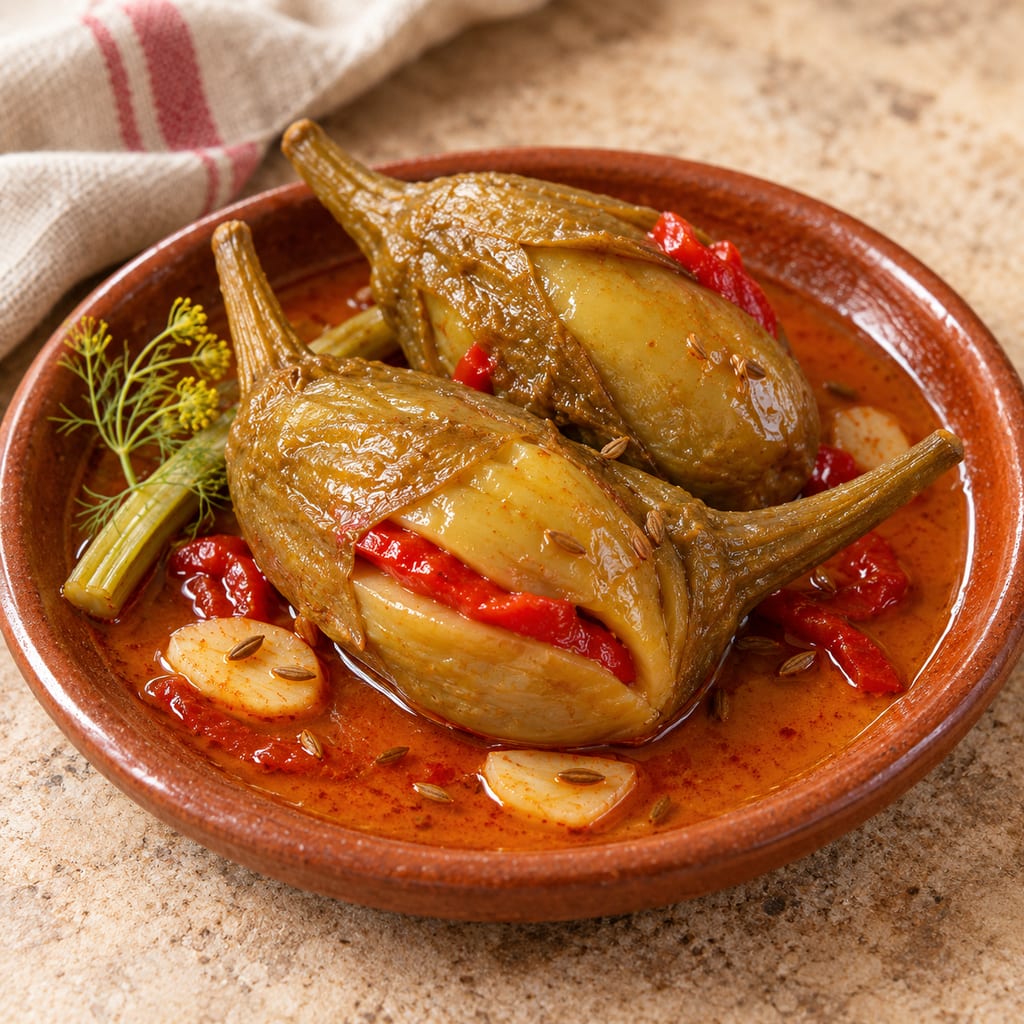
A protected aubergine preserve from Ciudad Real in Spain: tender fruit of the local Dealmagro variety, cooked briefly and then fermented in a vinegared, paprika-seasoned dressing.
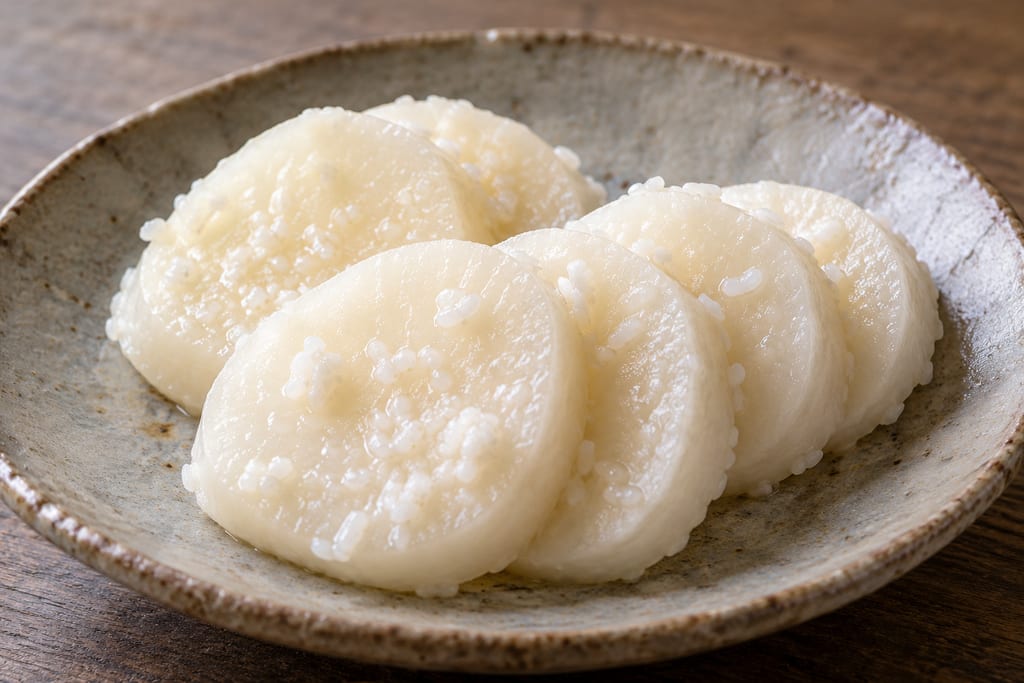
A sweet, crisp Japanese daikon pickle from Tokyo's Nihonbashi district, made by salting fresh radish and dressing it in rice koji, sugar or koji amazake without the heavy drying used for takuan.
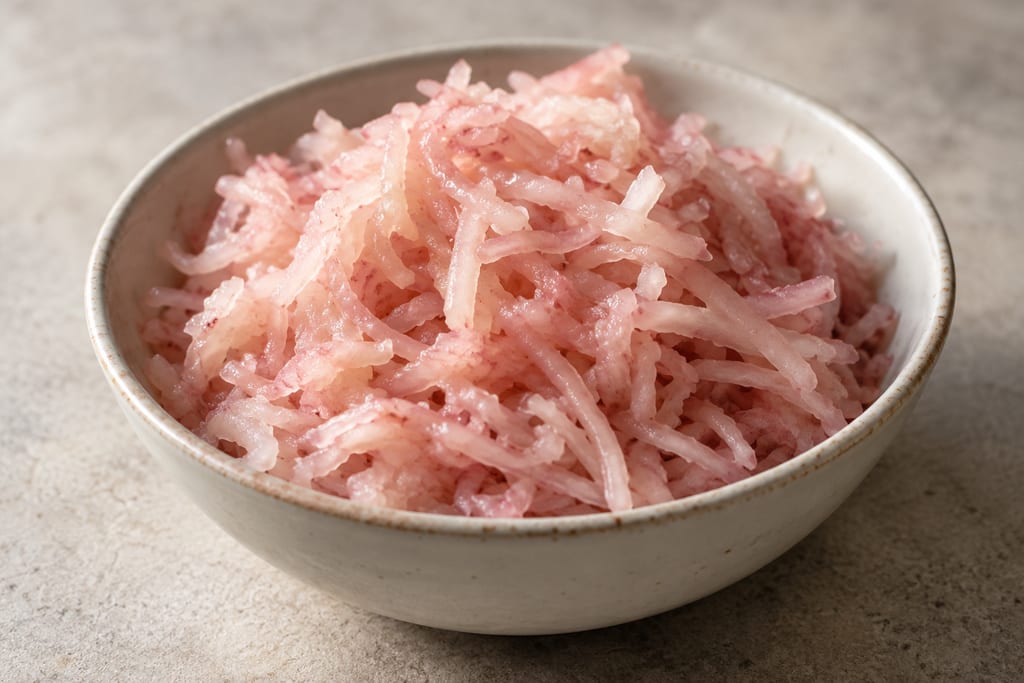
Source-specific Brovada DOP producer method for Friuli Venezia Giulia turnips and red-grape marc. This records a regulated producer process; it is not a validated home-scale recipe.
An industrial fermentation patio places factory-made fiberglass-reinforced polyester olive tanks below floor level, with drainage and transfer infrastructure arranged around the buried vessels.
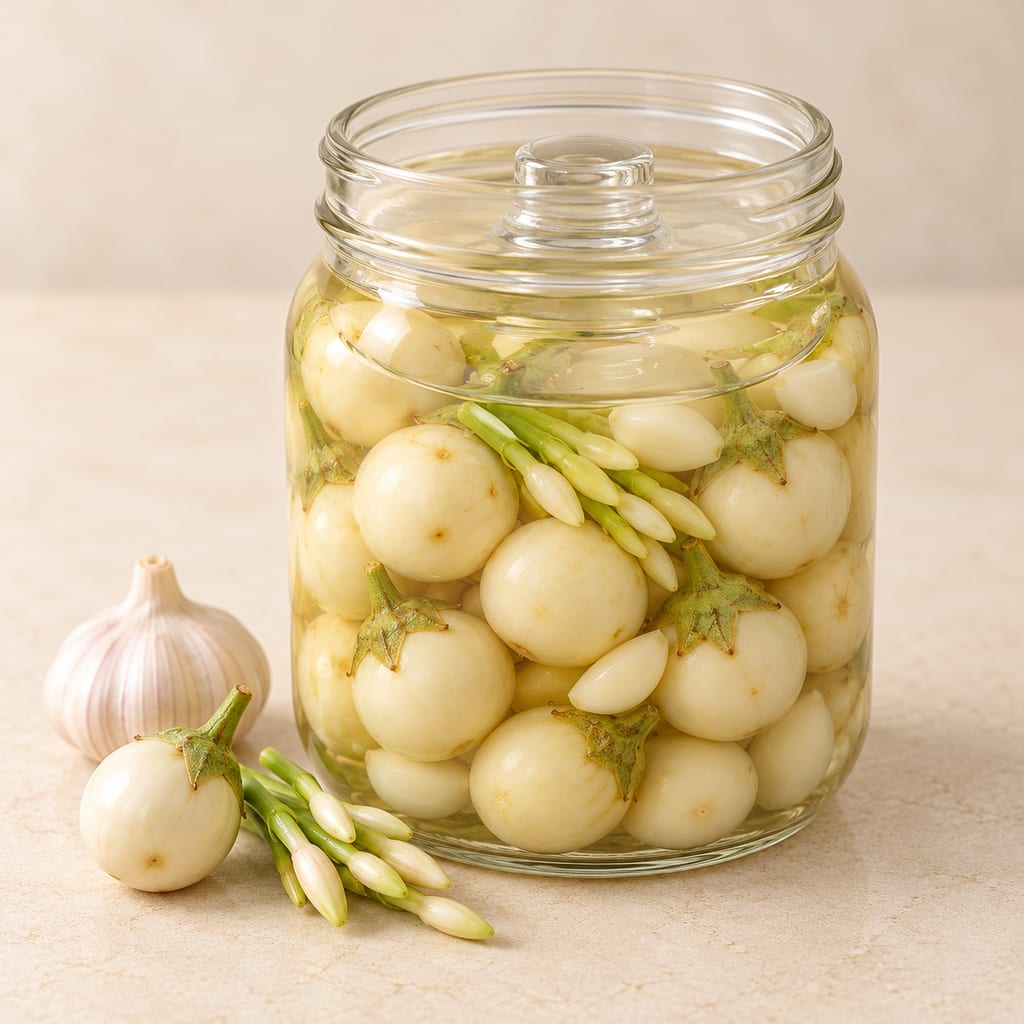
Vietnamese salted and fermented small eggplant, dried on the day of purchase, then held submerged in warm salty water with garlic and galingale flower for a week or longer.
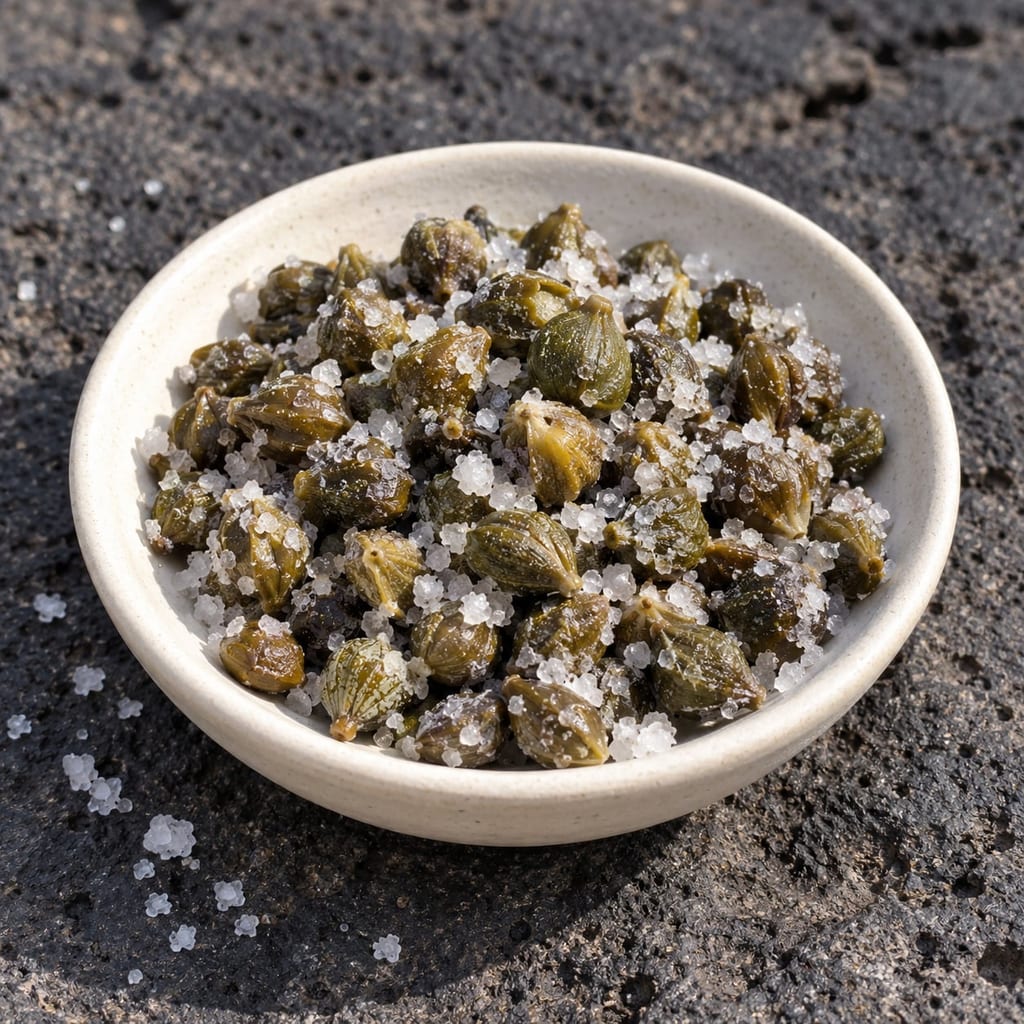
A protected Sicilian product: unopened caper buds from the island of Pantelleria, dry-salted with sea salt in a two-stage process that encourages lactic fermentation.
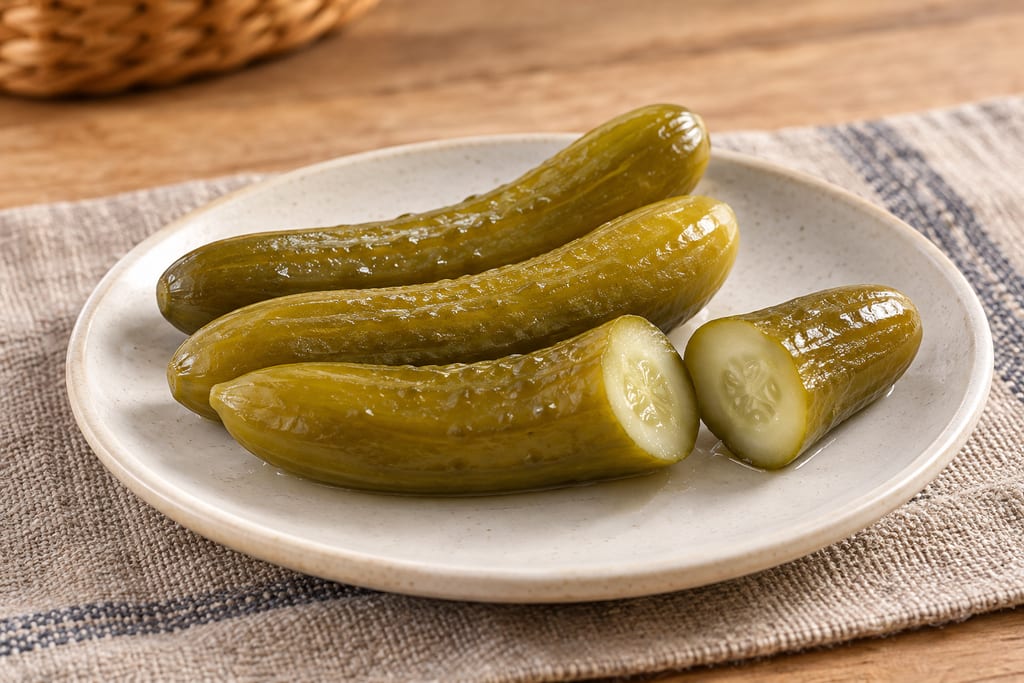
Çubuk turşusu is a registered pickle from Çubuk district in Ankara. Its cucumber variant is sold as Salatalık Turşusu, and a commercial specification sets its brine and room-temperature period.
No community contributions have been published for this entry yet.
Sign in to contribute. Published comments and photos are free to read.
Clean Food LivingInspiration
FERMENTED GARLIC - Ordinary Garlic Becomes Extraordinary! Easy RecipeBrine and jar at 00:20–01:18; garlic amount at 02:00–02:13; layering/submersion at 02:13–03:23; fermentation period at 04:43–05:05; refrigerate at 08:10–08:17.
Cited in: What is lacto-fermented garlic?; What makes garlic chemically unusual?; Whole cloves versus garlic paste; Ingredients — original recorded recipe; What the ingredients contribute; The recorded video process; The 2024 Polish artisanal study; Garlic preserved in oil; Commercial fermentation versus home recipes; Serving and culinary applications; Variations; Quality assessment
University of Minnesota ExtensionSafety
Preserving food at home: FermentationGeneral vegetable-fermentation controls; this is not a validation of the video recipe.
Cited in: Ingredients — original recorded recipe; What the ingredients contribute; The recorded video process; Commercial fermentation versus home recipes; Serving and culinary applications; Variations
Penn State ExtensionSafety
Let's Preserve: Fermentation — Sauerkraut and PicklesPenn State notes only sauerkraut and fermented pickles have research-based home processes and warns that changing tested proportions can make products unsafe.
Cited in: Ingredients — original recorded recipe; What the ingredients contribute; The recorded video process; The microbiology of garlic fermentation; What the volatile-compound analysis revealed; What happens to texture?; Why garlic sometimes turns blue or green; Why black garlic is different; Commercial fermentation versus home recipes; Serving and culinary applications; Variations
Cardinali et al., 2024Reference
Cardinali et al., 2024 — Lacto-Fermented Garlic from Lower Silesia: Microbial Diversity, Texture and Volatile CompoundsCited by the written account of this record.
Cited in: The microbiology of garlic fermentation; What the volatile-compound analysis revealed; What happens to texture?; Why garlic sometimes turns blue or green; Why black garlic is different
PubMedReference
PubMed — Cardinali et al., 2024Cited by the written account of this record.
Cited in: Garlic's long culinary history; Ingredients — original recorded recipe; What the ingredients contribute; The recorded video process; The microbiology of garlic fermentation; What the volatile-compound analysis revealed; What happens to texture?; Why garlic sometimes turns blue or green; Why black garlic is different; Commercial fermentation versus home recipes; Serving and culinary applications; Variations
Ask ExtensionReference
Ask Extension — Food Preservation and Lacto-Fermenting Garlic, May 2026Cited by the written account of this record.
Cited in: Ingredients — original recorded recipe; What the ingredients contribute; The recorded video process; Commercial fermentation versus home recipes; Serving and culinary applications; Variations
UC DavisReference
UC Davis — Garlic: Safe Methods to Store, Preserve and EnjoyCited by the written account of this record.
Cited in: Ingredients — original recorded recipe; What the ingredients contribute; The recorded video process; Commercial fermentation versus home recipes; Serving and culinary applications; Variations
National Center for Home Food PreservationReference
National Center for Home Food Preservation — General Pickling FAQsCited by the written account of this record.
Cited in: Ingredients — original recorded recipe; What the ingredients contribute; The recorded video process; Commercial fermentation versus home recipes; Serving and culinary applications; Variations
Clean Food LivingMethod
Fermented GarlicThe written recipe card lists 1 heaping cup peeled garlic, 1–2 onion slices, optional herbs, 3/4 tablespoon salt, and 2 cups water; this differs from the video-derived 15 g salt per 250 ml water currently recorded.
The article lists a creator-recommended fermentation temperature range of 72–85°F (22–29°C) and 2–3 weeks on the counter; this is creator-reported guidance, not an independently validated process control.