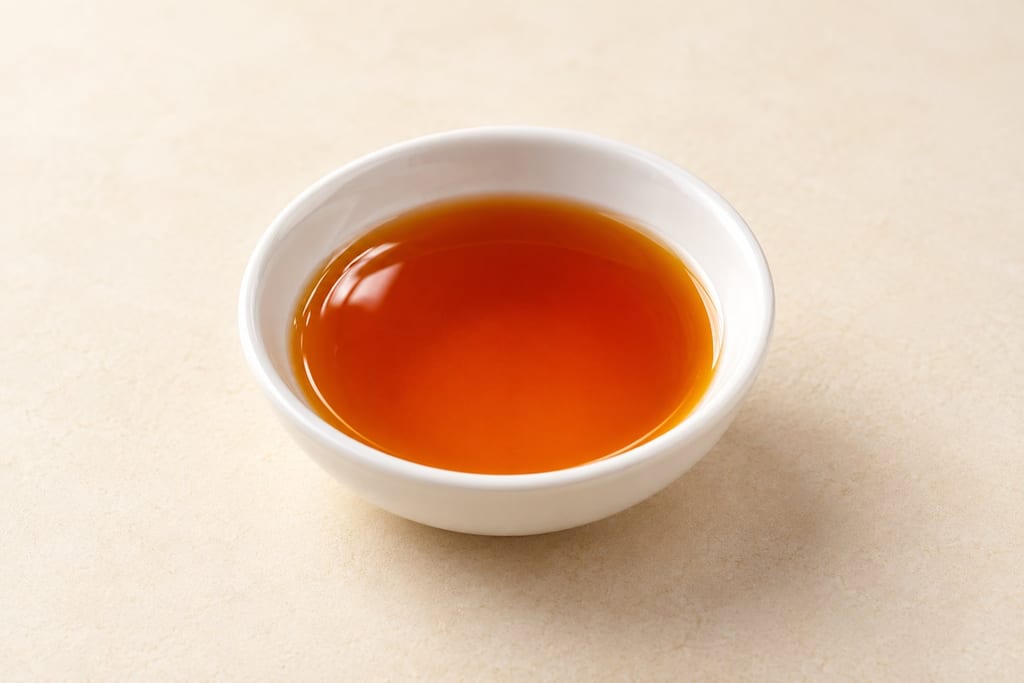
Fish sauce
Fish sauce is a clear, salty seasoning made by maturing fish with salt and drawing off the liquid. The broad family includes distinct regional sauces rather than one interchangeable method.
 FermenteaWhere food goes to change
Modern method
น้ำปลาพริก · Nam pla prik
Fresh sliced chillies, fish sauce and lime form a sharp Thai table condiment. Spoon a little alongside rice, eggs or other cooked dishes.
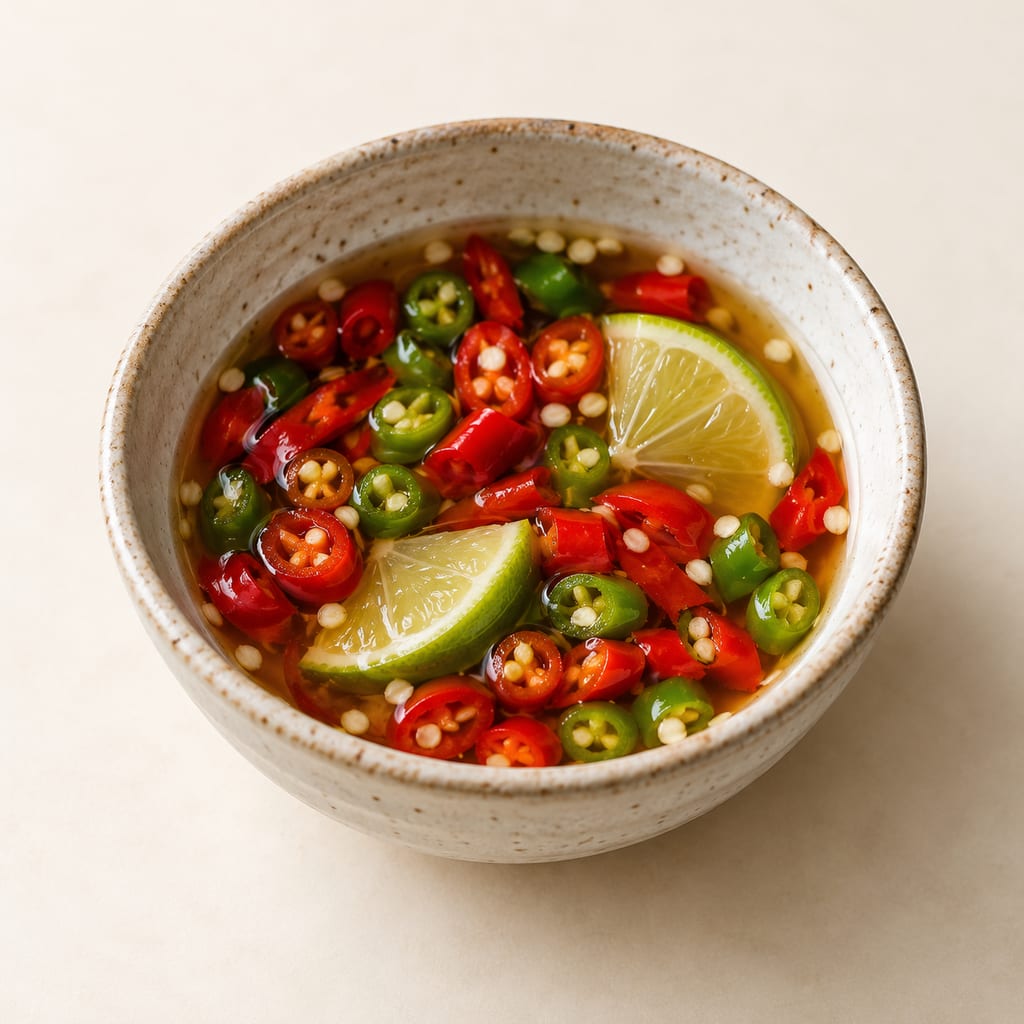
Prik nam pla is a familiar Thai table condiment combining fresh chilli peppers with fish sauce and often lime juice.
The Thai names พริกน้ำปลา (phrik nam pla) and น้ำปลาพริก (nam pla phrik) are both used.
Their ordering places emphasis on different parts of the mixture, but the names commonly refer to the same family of condiments.
The simplest version contains sliced chilli, fish sauce and fresh lime juice.
Its purpose is not to create a separate meal or sauce base. It is served in small quantities so diners can add heat, saltiness, acidity and savoury intensity to food that has already been cooked.
The preparation is especially associated with Thai rice meals, street-food stalls, restaurants and everyday household cooking.
This exact formula was presented in October 2025 by chef Sujira “Aom” Pongmorn of Khaan in Bangkok.
It is the first of three related variations.
The other two versions add aromatics or substitute dried chilli, and belong on the same recipe page rather than being treated as unrelated dishes.
The finished condiment is not ordinarily fermented after mixing.
This distinction matters for a fermentation reference.
One of its principal ingredients, nam pla, is a fermented fish product.
Commercial fish sauce is produced by preserving fish with salt and allowing extensive biochemical transformations.
When that finished sauce is mixed with freshly sliced chilli and lime, the resulting condiment is ready to eat.
There is no required additional fermentation stage.
The acidity of lime juice should not be confused with acid produced by microorganisms in a newly fermenting chilli mixture.
The appropriate classification is therefore fresh condiment containing fermented fish sauce.
Fresh red jinda or bird's-eye chillies — 1 tablespoon, finely sliced
Thai fish sauce — 1 tablespoon
Fresh lime juice — 1 tablespoon
Yield: Two small servings.
No preparation time, storage period or holding temperature is specified.
The source does not require adding sugar, garlic or shallots to this basic version.
Fresh Thai chillies provide heat and aroma.
Depending on the actual cultivar, they may belong to Capsicum annuum or Capsicum frutescens.
The name bird's-eye chilli is not sufficient to identify a single botanical species with certainty.
The heat comes principally from capsaicinoids.
Capsaicin activates sensory receptors associated with the perception of heat and irritation.
It is not literally raising the temperature of the mouth.
Different chilli cultivars vary greatly in pungency.
A tablespoon of finely sliced mild chilli can therefore taste very different from a tablespoon of extremely hot bird's-eye chilli.
The chef's formula permits red, green or mixed chillies.
Red chillies contribute stronger visual contrast, while green chillies often provide a fresher vegetal aroma.
Fish sauce provides salt, soluble nitrogen compounds and a distinctive savoury flavour.
During fish-sauce fermentation, fish proteins are broken down by endogenous enzymes and enzymes produced by salt-tolerant microorganisms.
Proteolysis releases smaller peptides and amino acids.
Glutamate is among the compounds associated with umami flavour.
Other amino acids and their breakdown products contribute additional aroma and taste.
High salinity is a central part of the production technology.
Fish sauce is therefore fundamentally different from fresh fish juice.
The chef's preference for an aromatic, undiluted first-quality fish sauce should be interpreted as a preference for genuine fish-derived flavour rather than a claim that fish sauce can be manufactured without salt.
Salt is normally essential to its production.
Scientific studies of Thai fish sauce have examined protein-degrading halophilic microorganisms, including certain archaea, and their effects on volatile flavour compounds.
These findings explain part of fish sauce's savoury intensity but do not identify the organisms present in the particular commercial bottle used for this condiment.
PubMed
Fresh lime contributes acidity and citrus aroma.
Its juice contains citric acid and other compounds.
The acid balances the salt and chilli heat.
It also makes the overall condiment taste sharper and fresher.
The lime's acidity can alter the immediate chemical environment, but the sauce is not intended to undergo a further controlled fermentation.
The original recipe permits lemon as a substitution.
Lemon and lime differ in aroma, acid composition and perceived freshness.
The substitution changes flavour but does not fundamentally change the method.
The amount of added lime juice in the classic formula is exactly one tablespoon.
Choose a commercial fish sauce suitable for direct culinary use.
Check the label.
Fish sauces differ in saltiness, amino-acid content and aroma.
The colour alone is not a reliable measure of quality.
Wash the fresh chillies.
Remove any damaged fruit.
Slice finely.
The original formula specifies 1 tablespoon of sliced chilli, not one tablespoon of whole peppers.
This distinction affects the quantity.
Place the chilli in a small clean serving bowl.
Add 1 tablespoon fish sauce.
The sauce immediately wets the cut chilli surfaces.
Squeeze fresh lime.
Measure 1 tablespoon juice.
Add it to the bowl.
Stir gently until the ingredients are distributed.
The mixture is ready to serve.
The source does not instruct the cook to leave it overnight or ferment it.
Place the condiment beside the meal.
Use a small spoon to add the desired amount to rice, eggs or other cooked food.
It is intended as a seasoning rather than a drink or large-volume sauce.
The three ingredients contribute very different sensory effects.
Fish sauce provides intense saltiness and umami.
Chilli contributes heat and fresh vegetable aroma.
Lime provides acidity.
A mixture dominated by fish sauce can become unpleasantly salty.
One dominated by lime can become sharply sour.
Excessive chilli can overwhelm more delicate dishes.
The documented one-to-one-to-one volume ratio creates a starting balance.
However, differences in commercial fish sauce and chilli cultivar mean the same measurements do not always produce identical flavour.
The chef allows adjustment to taste.
For recipe archiving, the original quantities should remain intact, while adjustments are recorded as serving preferences.
The second documented formula uses:
Fresh sliced chilli — 2 tablespoons
Fish sauce — 1 tablespoon
Fresh lime juice — 1 tablespoon
Fresh garlic — 1 tablespoon, thinly sliced
Fresh shallot — 1 tablespoon, thinly sliced
The ingredients are mixed in the same way.
This version provides stronger allium aroma and a more substantial texture.
Garlic, Allium sativum, releases characteristic sulphur compounds when sliced.
Shallots, forms of Allium cepa, introduce their own sharp, sweet aromatic profile.
Powdered garlic or shallot are not recommended in the documented version because they change the character of the condiment.
A third version replaces fresh chilli with chilli flakes.
It retains 1 tablespoon fish sauce and 1 tablespoon lime juice.
There is a discrepancy between the source's Thai and English editions: the Thai text lists ½ tablespoon chilli flakes, while the English page lists 1 tablespoon.
The two figures should not be silently reconciled.
For Fermentea, this variant requires a source discrepancy note until the intended quantity is confirmed.
Both editions agree that the purpose is to provide an alternative when fresh chillies are unavailable.
Dried chilli has a different flavour profile from freshly sliced chilli.
Drying changes volatile aromatic compounds and moisture content.
It can produce a more concentrated dried-pepper aroma.
This is a culinary variant, not a separate fermentation method.
Capsaicinoids are relatively hydrophobic compounds.
Their behaviour in an aqueous mixture differs from that of water-soluble salt.
Some flavour compounds remain associated with the chilli pieces rather than distributing completely through the surrounding liquid.
The sliced fruit therefore remains a significant part of the eating experience.
The condiment is more than merely chilli-flavoured fish sauce.
A spoonful containing several chilli slices can taste hotter than one containing mostly clear liquid.
The chilli seeds themselves are not the principal site of capsaicin production, although they can carry pungent material from adjacent tissues.
Fine slicing changes the amount of cut surface exposed and the distribution of heat during eating.
Plain steamed rice provides a relatively neutral base.
Small amounts of prik nam pla can transform its flavour dramatically.
Fish sauce supplies salt and savouriness.
Lime introduces freshness.
Chilli provides sharp heat.
The rice absorbs some liquid, distributing the seasoning through the mouthful.
The same principle explains why the condiment works with rice topped by fried eggs, omelets or stir-fried dishes.
It gives the diner direct control over the final balance.
The original chef's description strongly emphasises serving it with steamed jasmine rice.
Prik nam pla is particularly effective with fried eggs.
Egg yolk contains fat and produces a rich texture.
The condiment contributes acidity and saltiness that contrast with that richness.
Thai omelets are another familiar pairing.
Their browned surfaces and fluffy texture benefit from a sharp, liquid condiment.
Boiled and steamed eggs can also be seasoned.
The aromatic garlic-and-shallot variant is especially suitable with fried fish, pork or curries served over rice.
The dried-chilli version is also described with grilled chicken and sticky rice.
Thailand has numerous nam jim and seasoning-sauce preparations.
They differ in ingredient balance and intended food pairings.
Prik nam pla is relatively simple compared with complex dipping sauces containing herbs, roasted rice powder or several sweetening agents.
Fish-sauce-based condiments also exist in neighbouring countries.
Vietnamese nước chấm, for example, may combine fish sauce with water, sugar, lime or vinegar, garlic and chilli.
It should not automatically be treated as the same recipe.
Likewise, a fish-sauce condiment from the Philippines or Cambodia may have a different identity and purpose.
These neighbouring preparations deserve their own records rather than being indexed as synonyms.
The recipe is designed for immediate use.
The chilli and lime are fresh ingredients.
The source does not provide a validated storage period.
Although bottled fish sauce itself can be shelf-stable under suitable commercial conditions, adding fresh chilli, garlic or lime changes the mixture.
The final condiment should not inherit the unopened fish sauce's storage instructions.
Prepare it close to serving.
If holding leftovers, refrigerate promptly and follow appropriate perishable-food handling.
Do not assume the salt in the fish sauce guarantees the safety of indefinitely stored fresh ingredients.
Too salty: The fish sauce may be particularly concentrated. Adjust the balance when serving rather than assuming all brands are identical.
Too hot: Chilli variety and quantity matter.
Not sour enough: Lime acidity varies with fruit and freshness.
Bitter citrus flavour: Excessive pith or unsuitable citrus handling may introduce bitterness.
Dull aroma: Old sliced chilli or stale citrus juice can lose fresh volatile compounds.
The mixture separates visually: Chilli pieces naturally remain suspended or settle. It is not intended to form an emulsified sauce.
Fish sauce contains fish and is not vegetarian.
Some commercial products may contain other declared ingredients or allergens.
Use the label for precise allergen information.
Fresh chillies can irritate skin and eyes.
Wash hands and utensils after cutting very hot chillies.
The preparation contains no new fermentation step and should not be described as probiotic merely because fish sauce originated through fermentation.
A contemporary Thai table condiment presented by chef Sujira Pongmorn of Khaan. This is the first of three separate formulas in the article.
Yield 2 servings · Scaling: source batch only
Made with fish sauce and raw chilli; the recipe gives no make-ahead holding time.
Lime juice is a flavouring here, not evidence of a preservation process.
Culinary association of this preparation; no exact birthplace is established.
Fish sauce is a clear, salty seasoning made by maturing fish with salt and drawing off the liquid. The broad family includes distinct regional sauces rather than one interchangeable method.
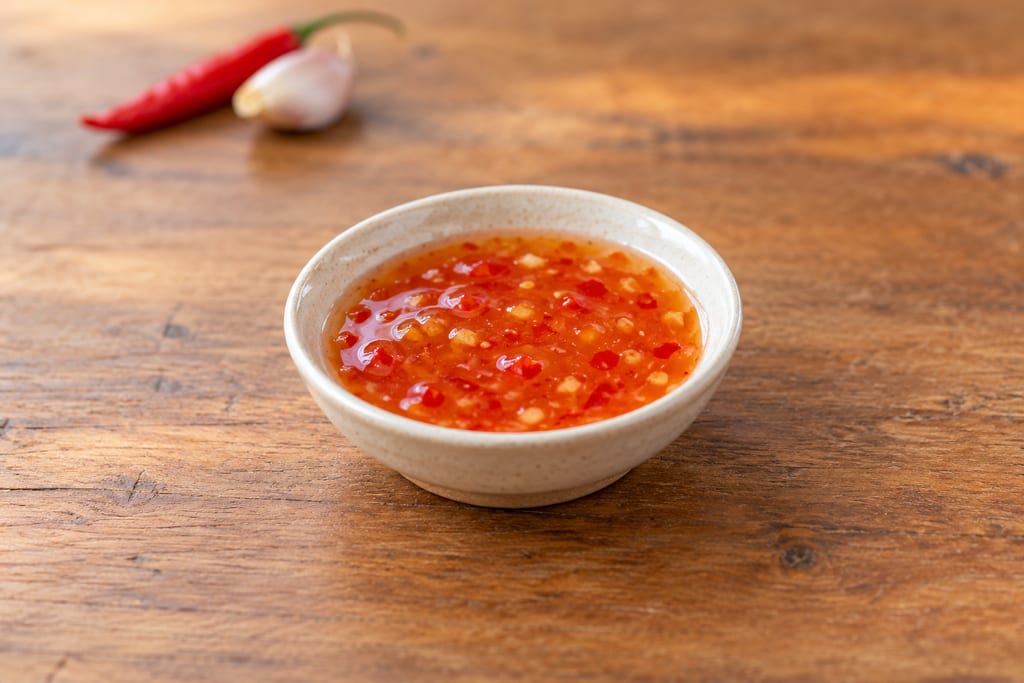
A cooked Thai-style sweet chilli dip combines red chillies, garlic, sugar and vinegar, then uses a small cornflour slurry to give this batch a glossy, spoonable body.

Naem is a Thai sour pork preparation made with minced pork, rind or ear, glutinous rice, garlic and salt. Its documented room-temperature method has no validated food-safety endpoint.
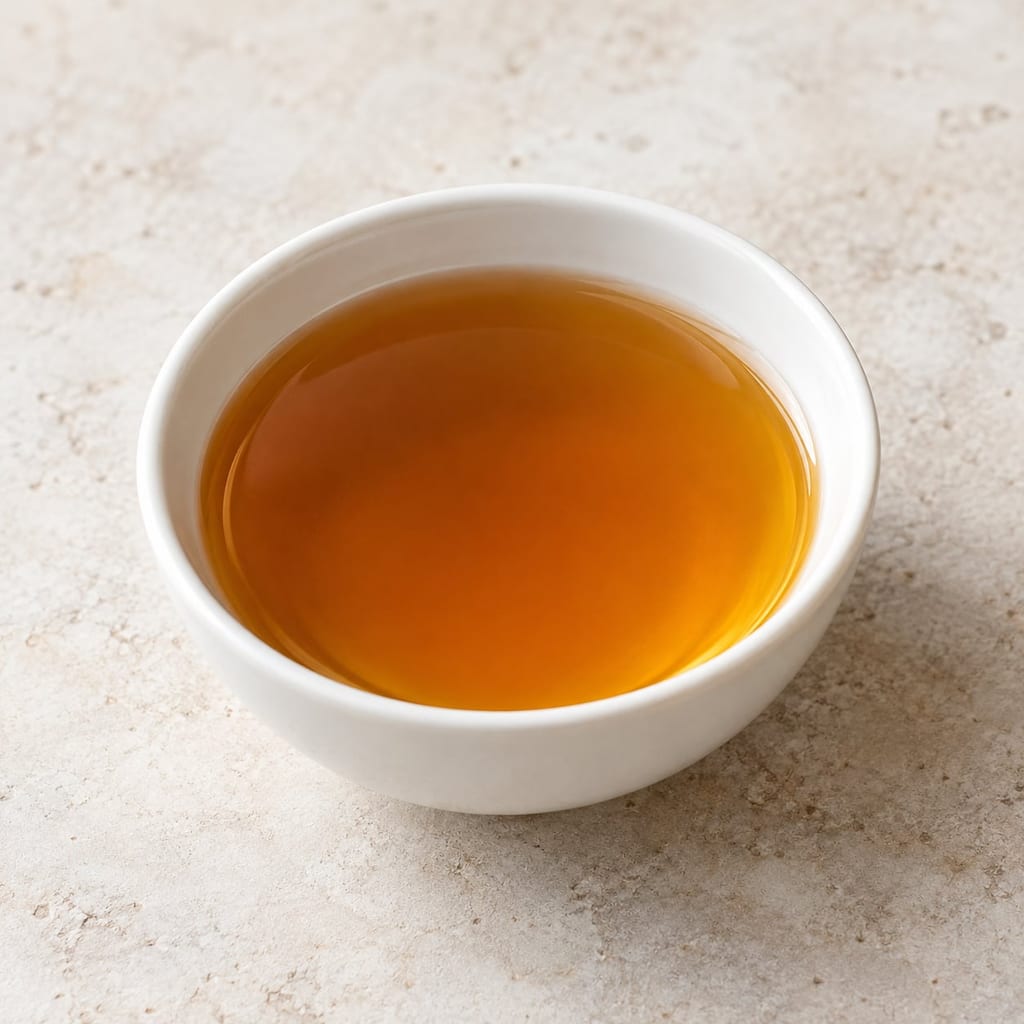
Thai fish sauce is a clear yellow-brown seasoning drawn from salted fish. Tank maturation produces a first extract, with further brine extractions giving other grades.
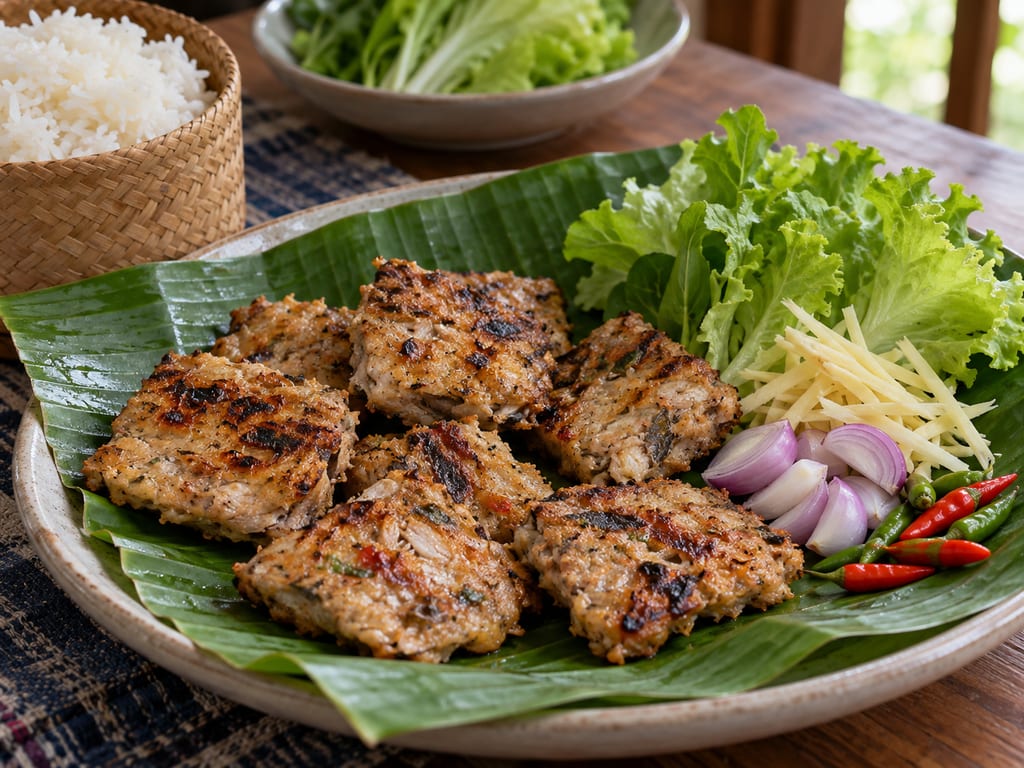
Som-fak is a Thai fermented freshwater-fish cake. JIRCAS records its ingredients, proportions, wrapping and 3–5-day fermentation, but does not validate a safe household process or endpoint.
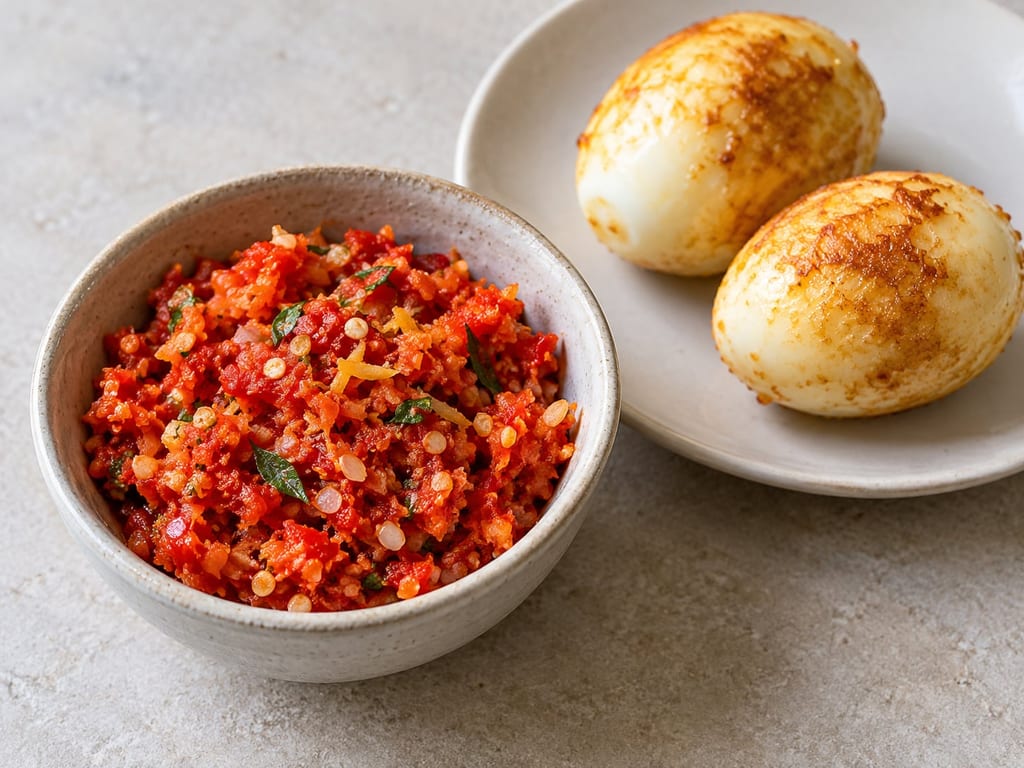
Ai-manas is described as a very hot chilli paste served with Timorese meals. One published version blends fresh chillies, shallots, garlic, Thai basil, ginger, lemon and salt, and serves it with eggs. Sources do not establish a standard formula, precise birthplace or earliest date.
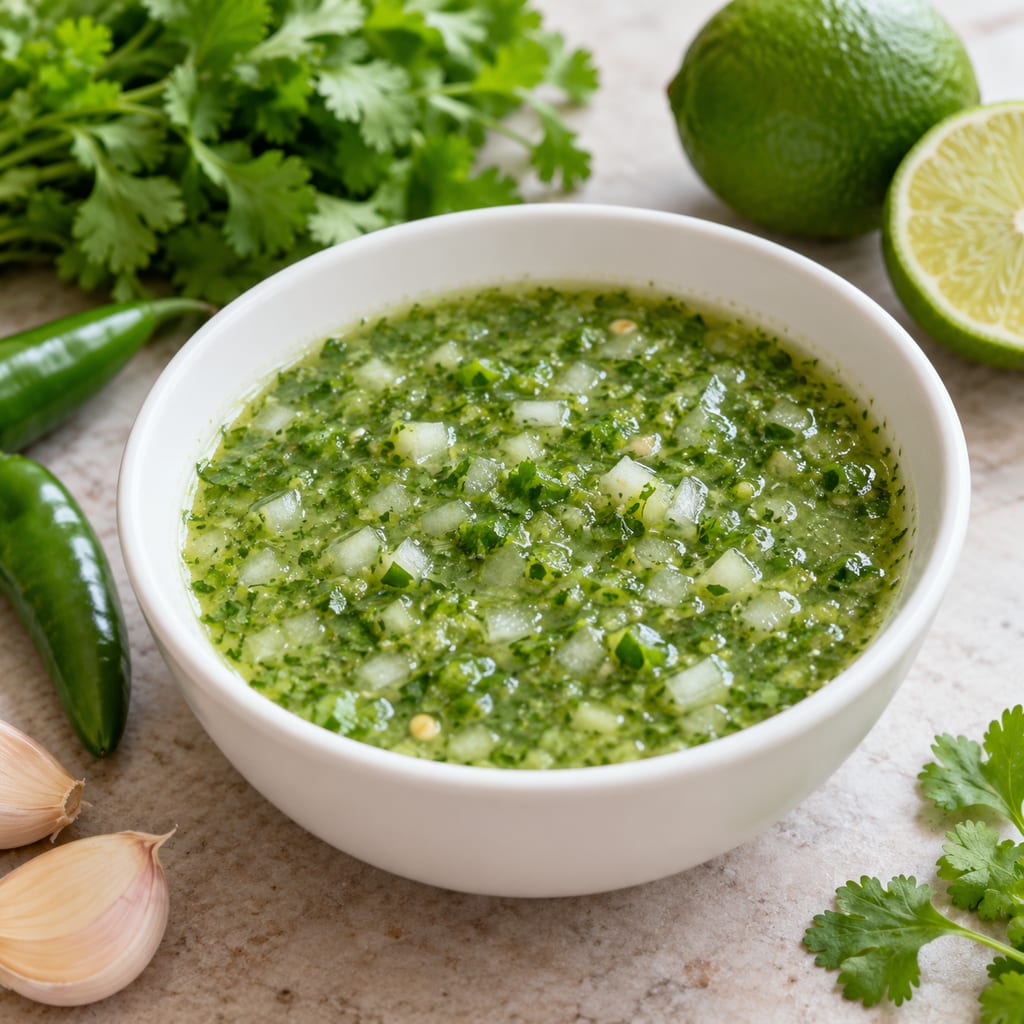
A fresh, uncooked Ecuadorian table sauce of hot pepper, cilantro, garlic and lime, served with most everyday dishes.
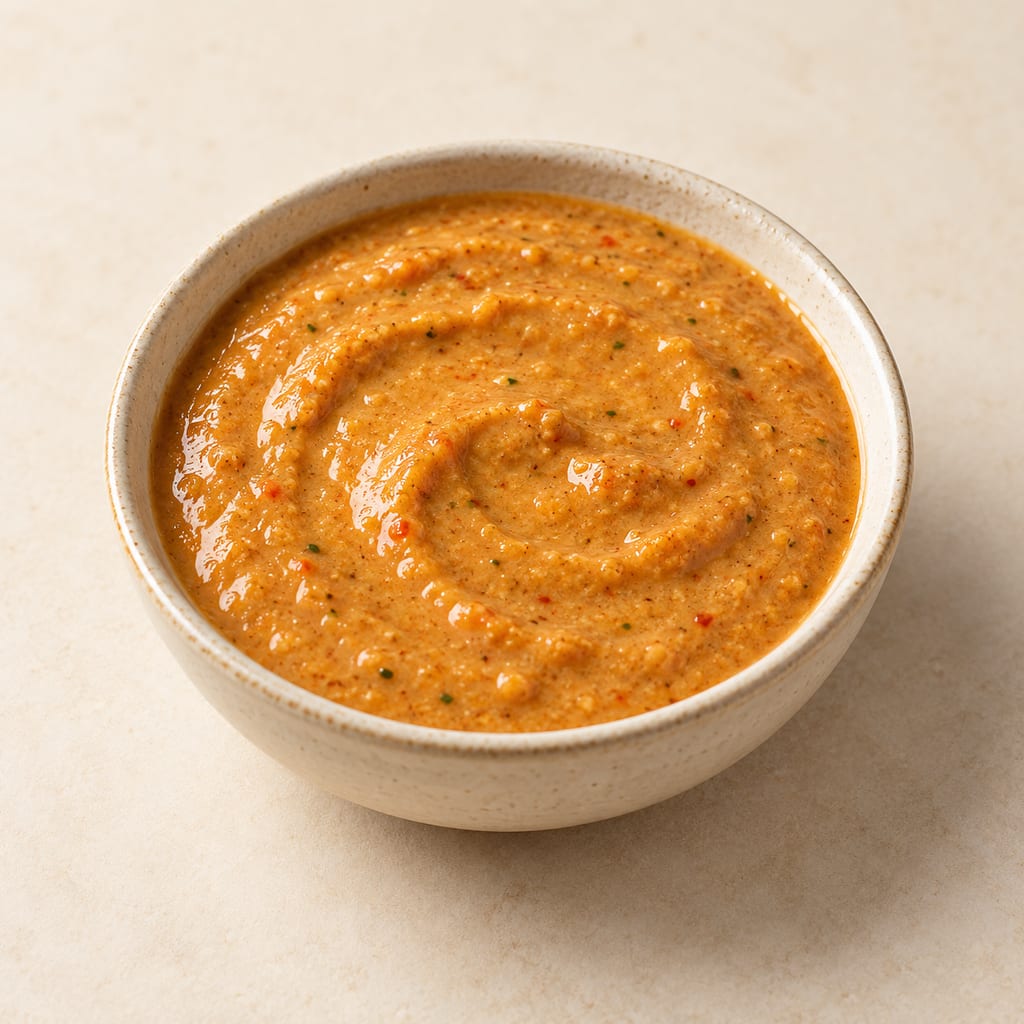
A spicy peanut hot sauce from the Popayán and Cauca region of Colombia, traditionally served with pipián empanadas and tamales.
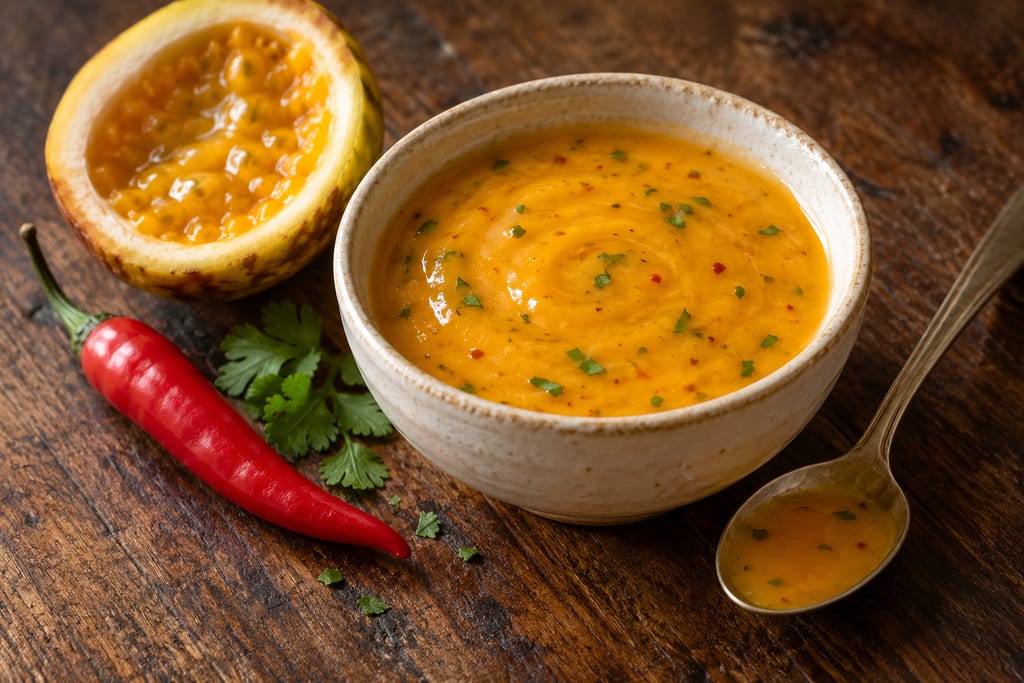
A contemporary Ecuadorian hot sauce that pairs passion fruit juice with boiled chile peppers, oil and lime.
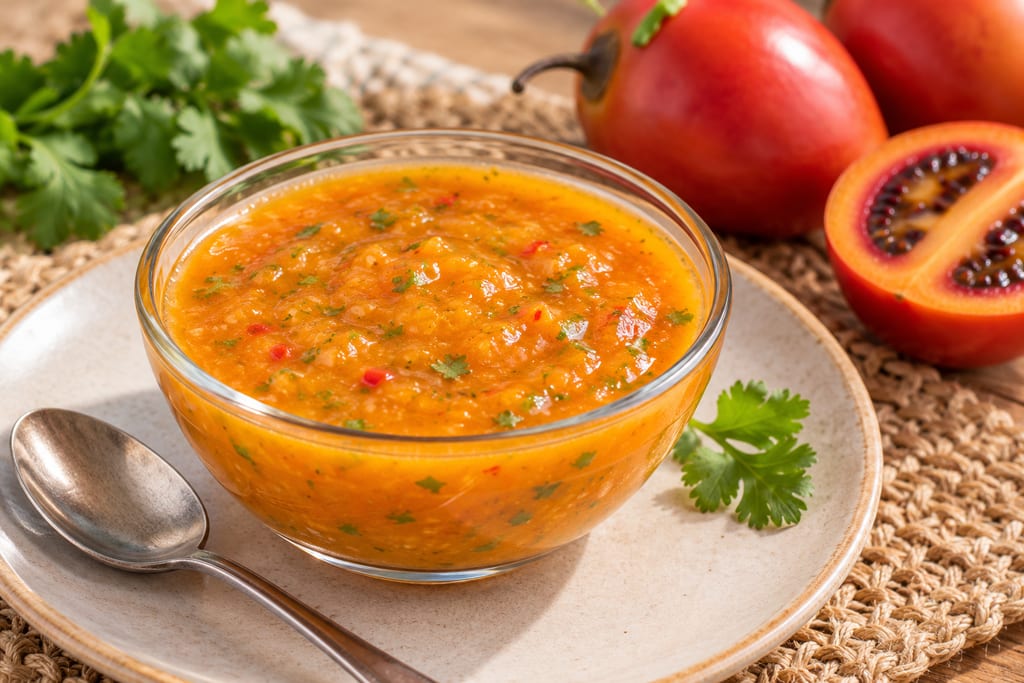
An Ecuadorian hot sauce built on tamarillo, a tart fruit that gives a sharper, fleshier base than ordinary tomato salsa.
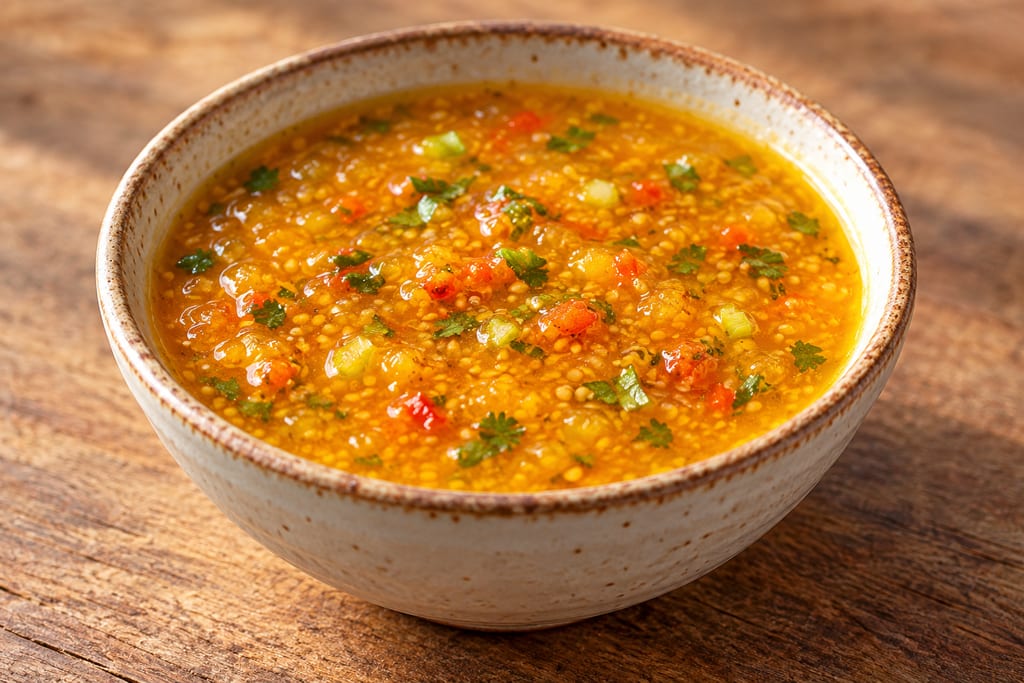
A sweet, tart and spicy Colombian sauce of uchuva, the yellow physalis fruit, with hot pepper, scallion, cilantro and lime.
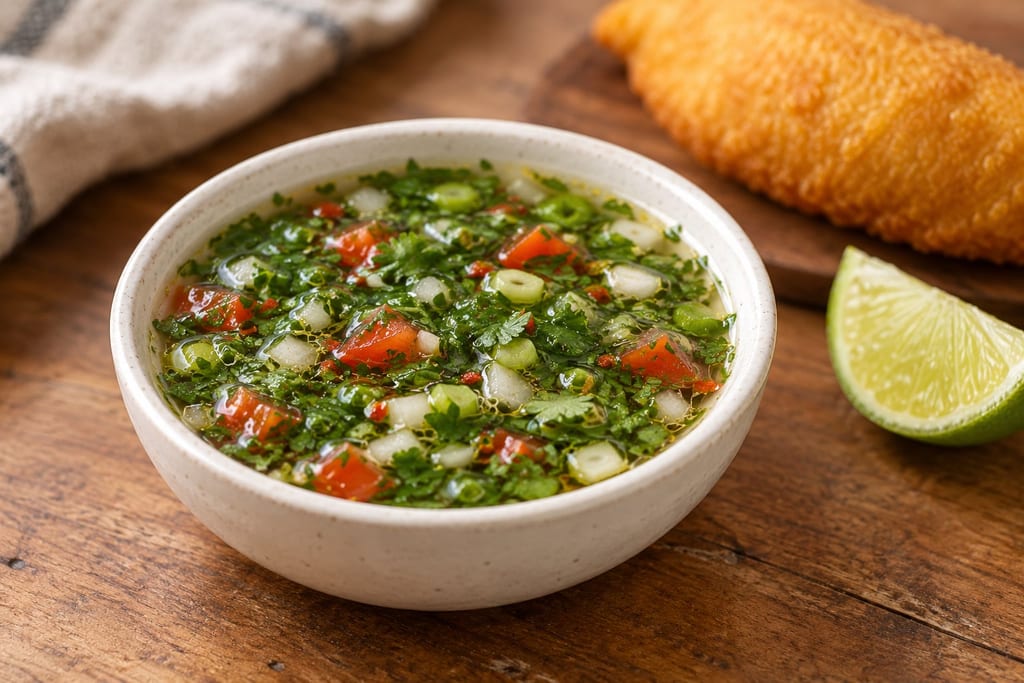
A fresh Colombian table condiment of chopped herbs, scallion and tomato in a vinegar and chile base, served beside fried and filled dishes.
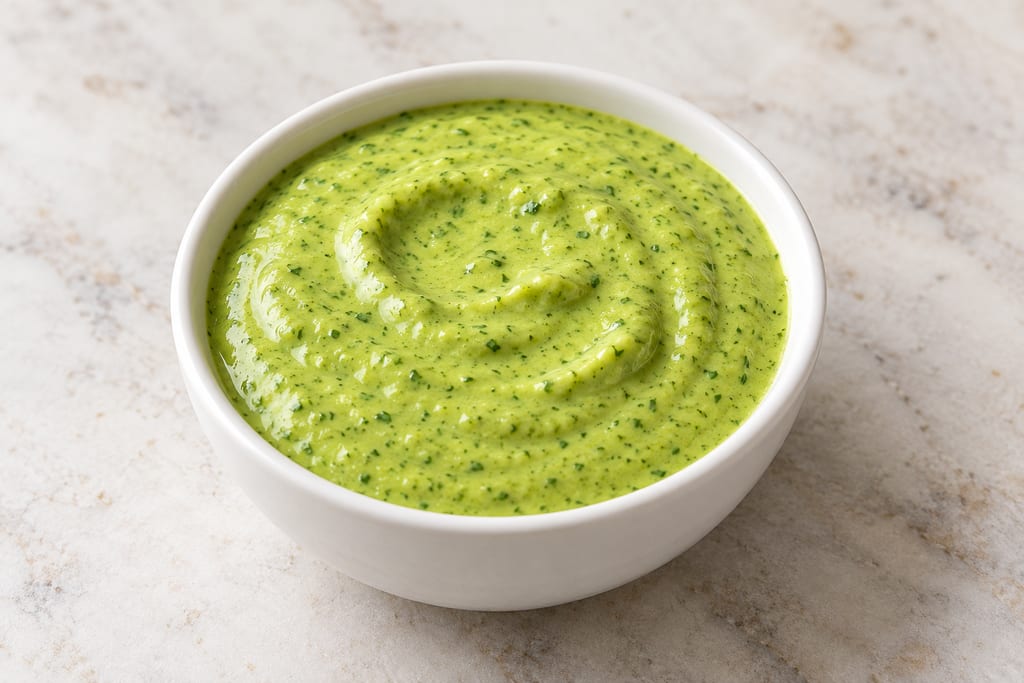
Ají verde is a Peruvian green sauce of coriander, chilli, onion and garlic in a mayonnaise or cheese base. It is best known through Peruvian restaurant cooking abroad.
No community contributions have been published for this entry yet.
Sign in to contribute. Published comments and photos are free to read.
MICHELIN Guide ThailandInspiration · Process · Geography
น้ำปลาพริกสูตร (ไม่) ลับ ฉบับเชฟอ้อม-สุจิรา พงษ์มอญ แห่ง Khaan ร้านอาหารไทยระดับมิชลินThai article, formula 1 for two servings: 1 tbsp sliced fresh chillies, 1 tbsp fish sauce, 1 tbsp fresh lime juice; combine.
Other formulas add aromatics or use dried chilli; they are not combined with formula 1. No holding time is given.
Cited in: What is prik nam pla?; Is prik nam pla fermented?; Ingredients — Classic version; The chilli ingredient; What fish sauce contributes; What lime adds; Stage 1 — Select the fish sauce; Stage 2 — Prepare the chillies; Stage 3 — Add fish sauce; Stage 4 — Add lime; Stage 5 — Mix; Stage 6 — Serve; Why proportions matter; Variation 1 — Garlic and shallot; Variation 2 — Dried chilli; The chemistry of chilli pungency; Why this condiment is especially useful with rice; Serving with eggs; Regional comparisons; Freshness and storage; Troubleshooting; Safety and allergens
MICHELIN Guide ThailandRecipe · Use · Variation
How to Make Thai Fish Sauce Dip Like a MICHELIN Restaurant: KhaanEnglish text of the same article: the classic proportions and the two named variations
Serving practice with rice and eggs
Cited in: What is prik nam pla?; Is prik nam pla fermented?; Ingredients — Classic version; The chilli ingredient; What fish sauce contributes; What lime adds; Stage 1 — Select the fish sauce; Stage 2 — Prepare the chillies; Stage 3 — Add fish sauce; Stage 4 — Add lime; Stage 5 — Mix; Stage 6 — Serve; Why proportions matter; Variation 1 — Garlic and shallot; Variation 2 — Dried chilli; The chemistry of chilli pungency; Why this condiment is especially useful with rice; Serving with eggs; Regional comparisons; Freshness and storage; Troubleshooting; Safety and allergens
PubMedScience
Halophilic archaea in Thai fish sauce fermentationOrganisms and chemistry of the fish-sauce fermentation that happens before this condiment is mixed
Cited in: Is prik nam pla fermented?; What fish sauce contributes