A family of hearth-linked smoke structures
A broad hood or chimney chamber uses the rising smoke of a domestic hearth to reach food hung above or near the fire. The label groups several related building arrangements, not one standardized device. The Austrian Rauchkuchl, the farmhouse hood at Jougne and the Franche-Comté tuyé differ in their room, chimney and smoke-chamber forms.
Sources for this section
Three documented regional forms
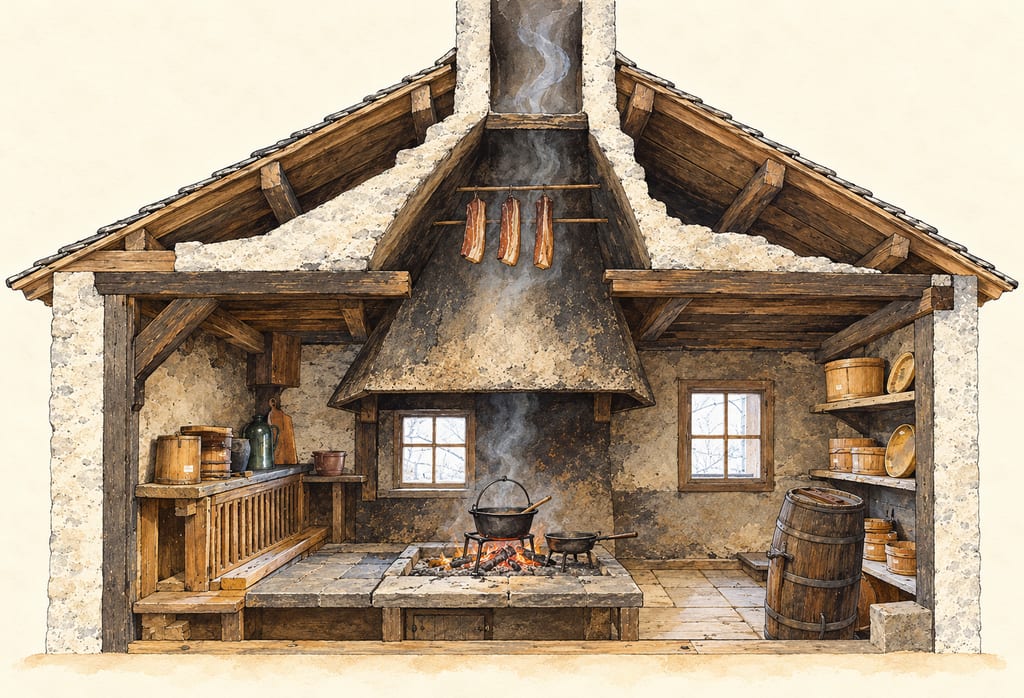
The Bergbauernmuseum z'Bach describes the Rauchkuchl as an open-hearth kitchen where smoke was also used to smoke bacon; its spark hood was intended to protect against fire. At Jougne, the regional heritage inventory describes a monumental fireplace with a heavy beam supporting a hood where several kinds of cured meat were hung. After chimneys were closed in the second half of the nineteenth century, smoking chambers were made beneath the hoods.
The Franche-Comté tuyé is a distinct regional smokehouse named in the European Commission's Morteau specification. A local producer's account describes it as a tall, pyramidal wooden hood over the hearth. That is a regional example and should not be generalized to Austrian or Jougne structures.
Sources for this section
Part of a house, not a portable smoker
These structures belonged to the layout of a farmhouse and its everyday hearth. Depending on the example, smoke passed into a kitchen hood or a dedicated chamber; hanging meat could be above the fireplace or inside the chimney space. The Jougne inventory also separates smoking from later storage by describing a meat room above the barn entrance.
Sources for this section
What the record cannot specify
The examples establish a family resemblance, not a plan. They do not set one height, footprint, fire arrangement, airflow, material specification or modern food-safety procedure for all broad hoods and chimney chambers. The hero is an editorial reconstruction of the documented Wildschönau Rauchkuchl exemplar; it is not a photograph or construction drawing.
Sources for this section
History
The Jougne heritage inventory dates smoking chambers beneath closed hoods to the second half of the nineteenth century. The Austrian museum describes the Rauchkuchl without an exact date; the Franche-Comté product specification distinguishes the traditional tuyé from a conventional smokehouse.
Site
SettingDomestic farmhouses in Jougne, France, and Wildschönau, Austria, with the Franche-Comté tuyé as a separate regional example.
GroundNot documented in the cited structure sources.
ClimateNot documented as a design specification.
FootprintNo common footprint is supplied; these hoods and chambers were integrated into particular farmhouses.
NotesThe published illustration shows the Austrian Rauchkuchl exemplar only; the Jougne farmhouse hood and Franche-Comté tuyé are distinct related forms.
A build is made where it stands: moving it means building it again.
Places
Jougne
Historical attestation · Locality evidenceThe regional heritage inventory documents this farmhouse form in Jougne; it is one example within a broader family.
Wildschönau
Traditional use · Locality evidenceThe local museum documents a Rauchkuchl open-hearth room used to smoke bacon; the record does not date this example precisely.
Franche-Comté
Traditional use · Region evidenceRegional product documentation ties the traditional tuyé method to Franche-Comté; this does not imply every farm had the same construction.