What a CO₂ sensor measures
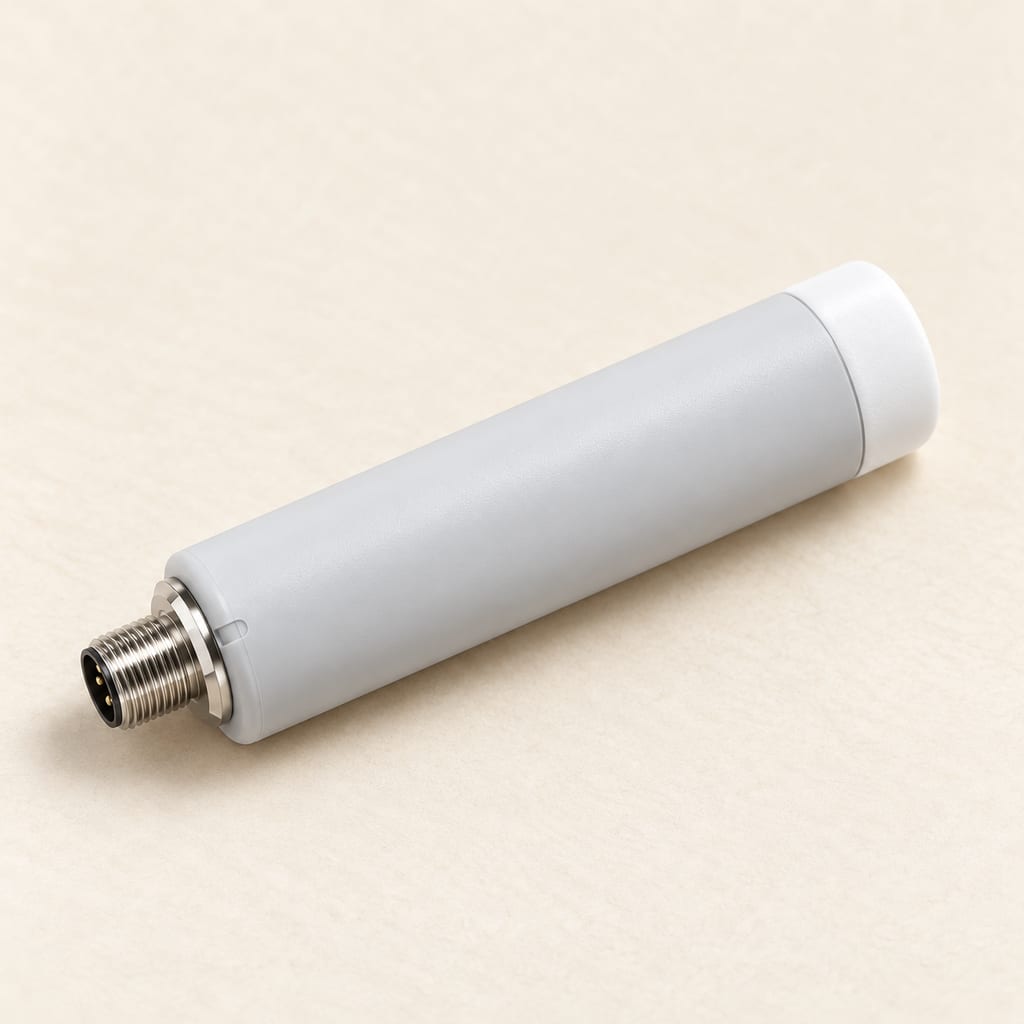
A carbon-dioxide sensor measures the proportion or concentration of CO₂ in a gas sample. That makes it different from an optical bubble counter, which counts individual bubbles crossing a defined path. A sensor reading describes gas at the probe or sampling point; it is not automatically the total gas produced by a ferment, the dissolved CO₂ in the liquid, or the rate of fermentation. The design, range and installation differ across sensors, so the Vaisala GMP251 discussed here is a documented contemporary example rather than a definition of every CO₂ instrument.
Sources for this section
A documented industrial probe
Vaisala introduced its CARBOCAP GMP251 in a press release dated 17 March 2016. The manufacturer describes it as a standalone percentage-level probe with a 0–20% CO₂ range, intended for demanding applications including life-science incubators, cold storage and fruit and vegetable transport. Its current product page also describes analog and digital outputs and operating temperatures from −40 to +60 °C. These are specifications for this model; they should not be copied onto another sensor simply because it is sold as a CO₂ probe.
The current product page lists fermentation and brewing among the application areas of Vaisala’s CO₂ instruments. Such industrial application context does not show that a probe is necessary, practical, or calibrated for every household ferment. The company's 2016 release says all its products were manufactured in Finland at that time. This is a dated manufacturer statement about its products, not evidence that CO₂ sensing originated in Finland or that every unit is made there today.
Sources for this section
How the measurement works
The GMP251 uses a silicon-based non-dispersive infrared, or NDIR, sensor. In the user guide’s account, infrared light passes through a cuvette containing the gas. CO₂ absorbs light at a characteristic wavelength; the instrument compares the absorption signal with a reference signal at a wavelength where CO₂ does not absorb. The ratio helps calculate the gas concentration while compensating for some effects of ageing or attenuation on the optical surfaces. This is a measurement of gaseous CO₂ in air-like gases, not an electrode placed in a fermenting liquid.
Conditions still matter. The probe includes temperature measurement and allows specified environmental compensation, including pressure and background gas. Its heated sensor head is designed to reduce condensation. A reading without an appropriate installation, calibration and compensation for the actual gas conditions may not answer the question a user has in mind. Follow the documentation for the exact probe and connected transmitter or control system; a product page or calibration certificate does not make every installation suitable for food-process control.
Sources for this section
Fermentation context and limits
In a closed process, yeast and other microbes can produce CO₂, and a headspace or sampled exhaust stream may be monitored as one part of process observation. The reading depends on where and how gas reaches the sensor, the enclosure and venting, gas mixing, pressure, temperature and the instrument’s measurement range. A probe in one location cannot by itself account for gas that escapes elsewhere, remains dissolved, or is produced and consumed through other microbial pathways. An open jar with no defined sampling point does not provide the same measurement boundary as a closed, instrumented process.
A CO₂ reading also cannot reconstruct beverage alcohol content. Fermentation pathways and gas exchange are not a fixed conversion: some CO₂ escapes, and microbes may consume ethanol while producing other compounds. The Fermentea background source for this candidate makes that limitation explicit. A 2026 controlled kombucha study likewise reports ethanol peaking on day 5 and declining later under its particular mixed-culture conditions; it did not establish a universal relationship between headspace CO₂ and ethanol. TTB's 2015 page describes alcohol testing as a separate assay, generally using distillation-specific gravity with a densitometer in its laboratory. That regulatory page is dated, and its statement is not a recommendation that every producer must use only that method.
Sources for this section
Form, power and care
The GMP251 is a slim cylindrical probe rather than a fermenting vessel. Its documented model size is approximately 9.6 cm long and 2.5 cm in diameter. It connects through a five-pin M12 interface and requires external DC power; voltage and wiring depend on the selected output configuration. It is not a battery-operated countertop reader. If a display or relay is needed, Vaisala lists separate Indigo transmitters that can host compatible probes.
Materials are model- and revision-specific. The January 2026 user-guide revision describes the probe body and M12 connector as housed in PBT polymer. An earlier user-guide revision listed PET for those parts; the change log identifies PBT as a later body-design update. The filter assembly also has revision-specific material details, including a PTFE membrane. This difference is a documented design revision, not grounds to claim that all CO₂ probes use one material. The manufacturer recommends using the exact model documentation for installation, calibration, adjustment and service; it cautions against opening the probe body because it contains no user-serviceable parts.
Sources for this section
History
Vaisala's dated 17 March 2016 release introduced the GMP251 product example. It states that all Vaisala products were manufactured in Finland at that time; this does not date or locate the wider sensor class.
Equipment details
CapacityA sensor, not a vessel; capacity does not apply.
Size9.6 cm tall, 2.5 cm across Approximate body dimensions of the Vaisala GMP251 model; not a class-wide size.
PowerElectric GMP251 model requires external DC power; supply depends on output configuration and transmitter/wiring. Not battery powered.
How you get oneBought, manufactured GMP251 is a manufactured industrial probe. Its product-specific market does not establish how all CO₂ sensors are obtained.
CareUse the exact model guide for wiring, calibration, environmental compensation and service. The GMP251 user guide says not to open the sealed probe body; its filter and installation are model-specific.
Made of
- Probe body and M12 connector (GMP251 current revision) — Houses the sensor and provides its connection
The January 2026 user-guide revision specifies PBT polymer; an earlier revision lists PET before a documented body-design update. Model- and revision-specific, not universal to CO₂ sensors. - Filter membrane (GMP251) — Protects the sensor's gas measurement path
The documentation describes a PTFE membrane; filter assemblies are model-specific.
Places
Finland
Manufacture · Country evidenceThe manufacturer said all Vaisala products were manufactured in Finland in this dated 2016 release. This is not an origin claim for CO2 sensors generally or a statement about every current GMP251 unit.