← Equipment

Built structures · Floors, basins and masonry tanks

Granite lagar

lagar de granito · Douro granite lagar · granite wine treading tank

Loading ratings…

A lagar is a fixed stone tank used to tread grapes in some Douro wineries. Granite examples sit in winery rooms where gravity can carry must to vats below; the sizes, layouts and surviving uses vary by estate.

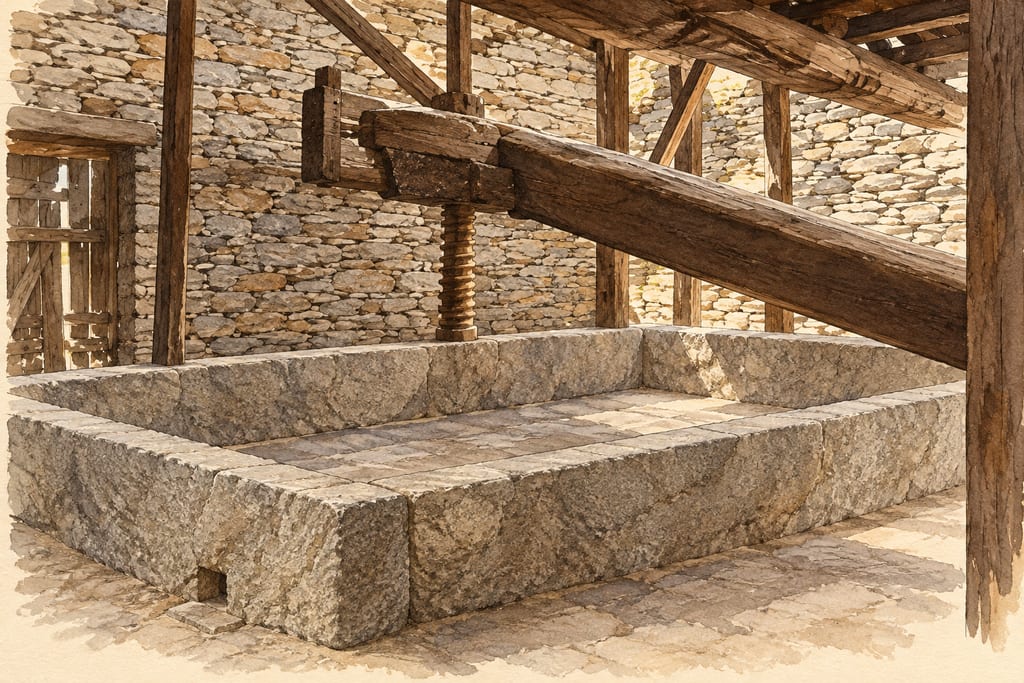
Interpretive illustration of a rectangular granite lagar beneath a timber press in a stone-walled Douro winery.

A granite treading tank in the Douro

A lagar is a stone tank used for grape treading and winemaking. In the Alto Douro region, examples were made of granite or schist and vary in size and installation. UNESCO's nomination description notes that some stand on granite risers, while others sit at floor level beside a narrow stone walkway. This page focuses on granite lagares as fixed winery installations, while keeping their forms and surrounding rooms site-specific.

The Douro is a wine-producing region in northern Portugal with a long viticultural history. The UNESCO World Heritage listing describes the landscape and its vineyards; Symington's account documents a current granite-lagar example at Quinta do Vesuvio. The page does not claim that every producer uses the same tank or still treads grapes by foot.

Sources for this section

Upper room, lower vats

Quinta do Vesuvio's winery, opened in 1827, has granite treading tanks on the upper level and a lower wine-storage room. Symington says gravity sends free-run wine from its lagares to chestnut vats below. The tanks are still used for foot-treading there, with later additions such as temperature-control tubing. This describes Vesuvio, not a standard for all Douro wineries.

A nineteenth-century account by Henry Vizetelly describes Upper Douro stone lagares, a receiving reservoir and pipes carrying juice to vats on a lower level. UNESCO's nomination likewise records stone drains and small receiving basins in some older wineries. These sources support gravity flow as a documented arrangement, while room plans and equipment differ between estates.

Sources for this section

Changing use and evidence

Traditional foot-treading continues at a small number of estates, but many wineries moved to modern tanks or mechanized systems. A lagar should therefore be described as a regional historical form and a living practice at named sites, not the only way to make Port. The preparation relationship here points to the Port-wine candidate because the source explicitly documents lagar use in Port production.

A 1933 Museu do Douro photograph from Pai Calvo shows a granite tank with a timber press in a stone building. It is an archival image of that installation, not Quinta do Vesuvio. The museum record identifies Álvaro Azevedo (Fotografia Alvão) and the IVP/Museu do Douro collection, but states no reuse license; its image is marked link-only. The generated hero is an interpretive illustration based on that inspected photograph and written sources, not a reconstruction of either winery.

Sources for this section

Site

SettingWine-making room in the Alto Douro region. Quinta do Vesuvio is a documented example with upper-level granite treading tanks and lower-level wine storage.
GroundDouro descriptions include tanks set on granite risers or at floor level with a narrow stone walkway. Drainage and receiving-basin arrangements vary; no single layout is asserted.
ClimateNo temperature or humidity performance is assigned to the lagar itself.
NotesThe granite lagar is a fixed winery installation. The generated illustration is interpretive and is not a reconstruction of Pai Calvo or Quinta do Vesuvio.

A build is made where it stands: moving it means building it again.

How it is built

Materials

  • Granite — The basin material named for Quinta do Vesuvio's treading tanks; other Douro lagares may use schist or different materials.
  • Stone masonry — Stone winery walls and associated stone drainage are documented in the cited historical and heritage descriptions; arrangements vary.
  • Timber — A 1933 Pai Calvo photograph shows a timber press assembly above a granite lagar. It is one historical example, not a universal press design.
  1. At Quinta do Vesuvio, granite lagares occupy the upper level of a two-storey winery, above the lower wine-storage room. This is a named estate example, not a plan that applies to every Douro cellar.
  2. During the vintage, grapes are trodden by foot in the lagar. The winery describes teams working in rows; other estates and periods may use different labor arrangements or mechanized equipment.
  3. At Vesuvio, free-run wine drains by gravity from the lagares to chestnut vats below, where wine and grape spirit are combined for Port. UNESCO's regional description also records stone drains and receiving basins in some older cellars.
  4. This entry describes one regional installation and its examples; it is not a universal building specification.

Places

Douro Valley

Documented use · Region evidence

The sources document granite lagares in Alto Douro wine cellars and the specific Vesuvio winery; regional evidence is not a claim that every lagar was made or used in one town.

Related

Community

No community contributions have been published for this entry yet.

Share what you made

Sign in to contribute. Published comments and photos are free to read.

Sources