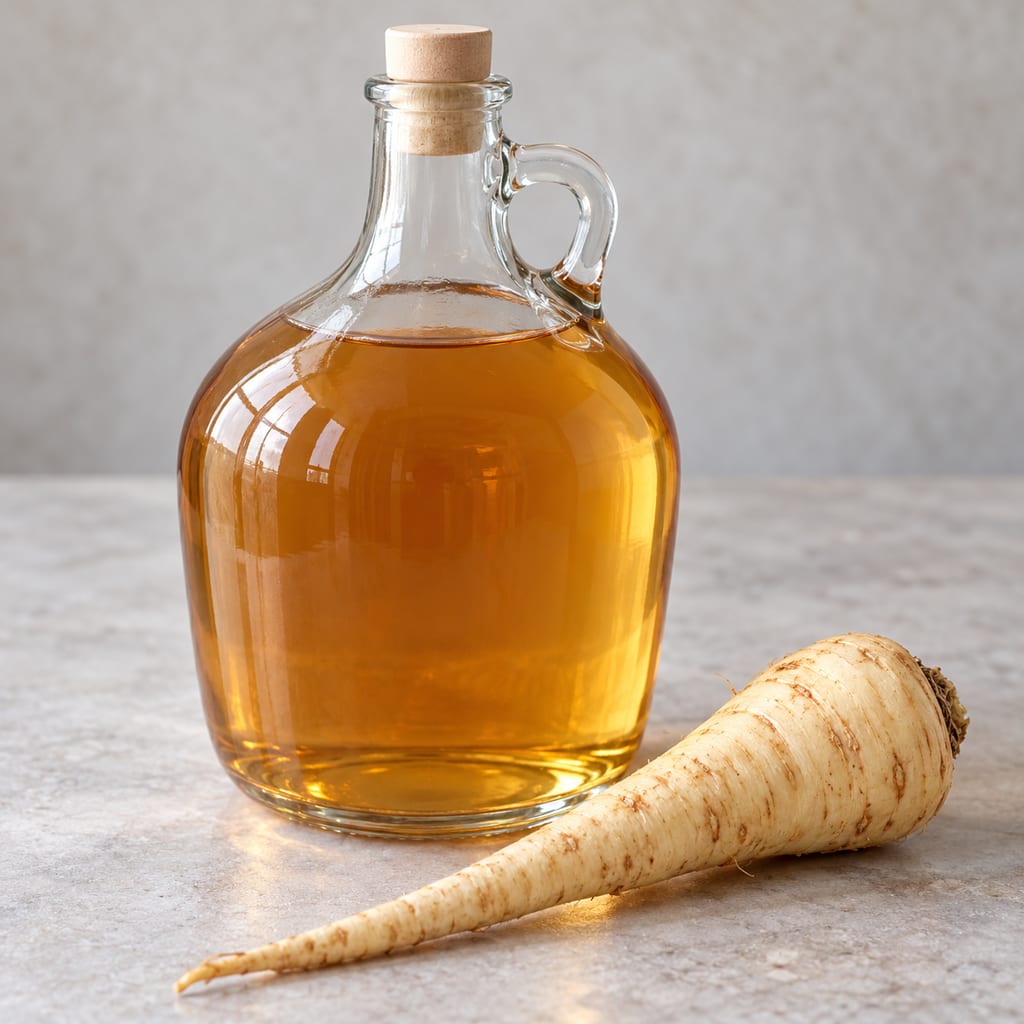
Parsnip wine with brandy
A root wine made from boiled parsnip liquor and lump sugar, fermented with yeast and finished with brandy before bottling.
 FermenteaWhere food goes to change
Substrates
Sweet, aromatic storage roots used as a cooked vegetable and in household wines, with starch and soluble sugars that change as the roots grow and are stored.
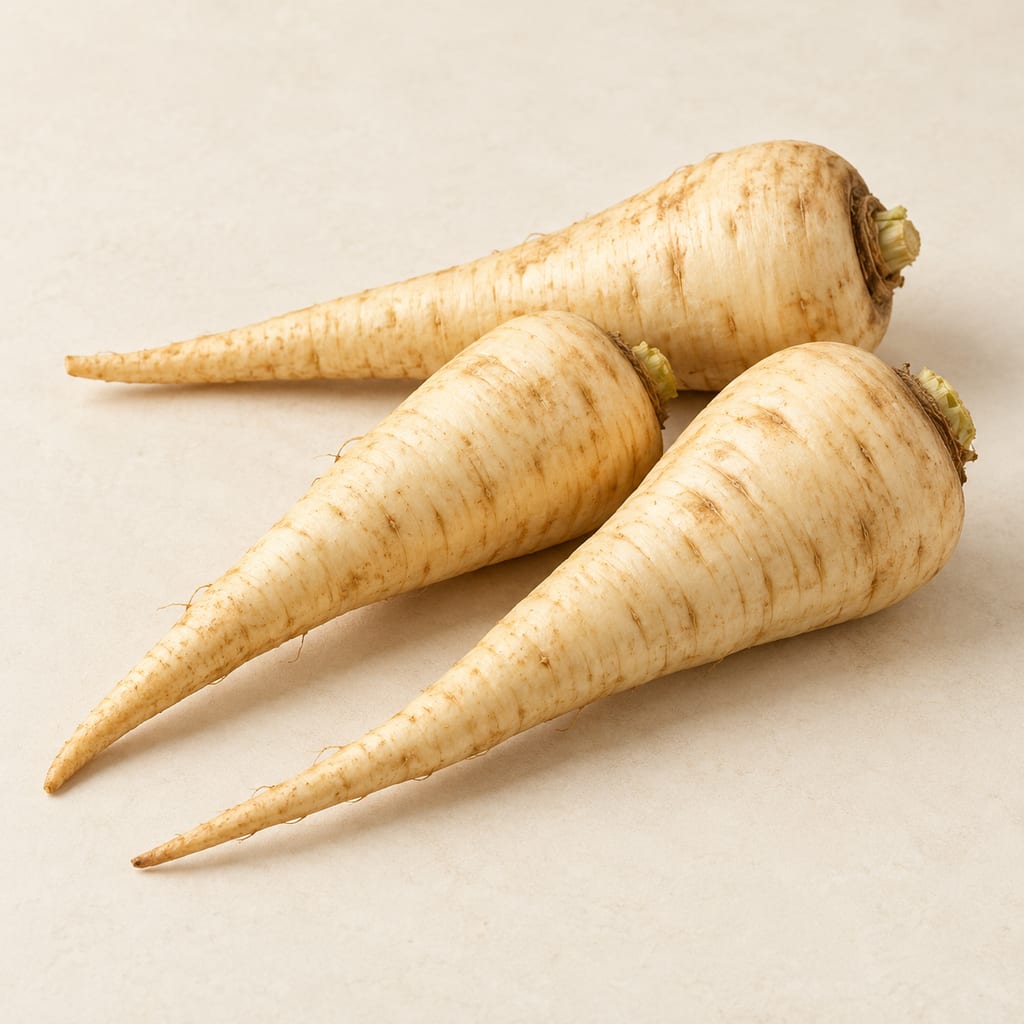
Parsnips are the fleshy storage roots of Pastinaca sativa, a member of the carrot family, Apiaceae. Their cream-yellow flesh is sweet and aromatic. The cultivated root belongs as readily in a winter meal as in the sweetened liquor of an old household wine. Its sweetness is a characteristic of a living plant's stored carbohydrate, not evidence that the root has already fermented.
The plant is biennial. In its first season it builds the familiar root beneath a rosette of leaves; in the following growing season it can send up a flowering stalk. By that later stage, the root becomes woody and unsuitable for the same kitchen uses. A parsnip sold as a vegetable therefore represents a particular stage in the plant's life, rather than any root dug from a flowering plant.
Cultivated and wild or escaped forms belong to the same species, but a roadside plant is not a substitute for a documented food crop. The ingredient here is the cultivated edible root. Neither a pale colour nor a family resemblance to carrot supplies a sufficient identification for gathered plants.
Parsnips have a long association with winter cooking, but their domestication cannot be assigned a secure place and date from the surviving record. Ancient Greek and Roman writers did not consistently distinguish them from carrots, and roots preserve poorly in archaeological deposits. An old name that resembles a modern botanical name is therefore an uncertain guide to what was actually grown or eaten.
Their sweetness once gave the roots another use beyond supplying a vegetable dish: they could contribute sweetness before cane and beet sugar became widely available. That does not mean a parsnip is a sack of crystalline sugar in vegetable form. It remains a root with water, structural material and a changing mixture of stored carbohydrates.
Selection also changed the cultivated food. The named variety Student became known for long, smooth roots and fine-textured flesh. Cultivars belong to the history of gardeners choosing useful root qualities, while the species name covers a wider range of plants. Historical recipes that ask simply for parsnips do not identify which selection reached the kitchen, or establish a uniform sweetness across every harvest.
A long root needs room to develop. Deep, loose, well-drained soil favours a straighter crop; stones and compacted ground can lead to forked or distorted roots. Shorter varieties can suit shallow, heavy or stony ground better than long-rooted forms. Shape is therefore partly a relationship between the plant and its growing conditions, rather than a simple ranking of long roots above short ones.
Parsnips are usually sown where they will grow because their taproots transplant poorly. Fresh seed matters, and germination can be slow. The crop then occupies its ground through a long growing season before the roots are lifted for autumn and winter eating.
Harvesting also calls for care. A fork helps ease out the long root intact, while damage around the top can make the crop more susceptible to canker. A resistant cultivar can help with that particular growing problem. Those choices affect the condition of the ingredient that reaches the cook: a root's history includes sowing, soil, water and lifting, alongside the knife work that follows in the kitchen.
Cold can change a parsnip's balance of starch and soluble sugars. In work with the cultivar White King, roots grown in a colder field season lost starch and gained total sugars before harvest, while the warmer season did not show the same change. During subsequent cold storage, starch declined and sucrose accumulated in both years.
The associated enzyme measurements help explain the change. Amylolytic enzymes break down starch; increased activity of alpha-amylase accompanied changes in malto-oligosaccharides, shorter chains derived from starch. The root's carbohydrate reserves are being redistributed. This is a plant response during growth and storage, rather than yeast making alcohol or bacteria souring a vegetable.
The familiar preference for frost-touched roots has a biochemical context, but it is not a fixed sugar specification. Cultivar, growing season and storage history can affect the starting material. The published experiment concerned a particular cultivar and defined conditions. It explains why two harvests can differ without supplying a universal waiting period, a required number of frosts or a prediction of the alcohol that a root wine will eventually contain.
A parsnip also contains a structure that persists when the root is softened or broken down. Work on parsnip suspensions identified soluble and insoluble dietary-fibre fractions, including pectic material and lignin, and examined how the particles behaved after homogenization. Greater homogenization broke the material into smaller cell clusters and changed the distribution of large and small particles.
Concentration mattered to the suspension's behaviour as well. At higher particle concentrations, the researchers found that the particles played an important part in the gel-like network. A smooth-looking root preparation can therefore retain structure at a scale too small to identify simply by looking at the original vegetable.
This is useful context when comparing a mash or purée with a strained root liquor. Reducing particle size and removing particles are different operations. Homogenizing a cooked root does not make all its material dissolve; straining can leave much of the structure behind. The study measured prepared suspensions, so its results should not be turned into a claim that every household parsnip mash has the same thickness or that a particular particle causes haze in wine.
In Anne Cobbett's 1851 English Housekeeper, parsnips occupy both the kitchen and the cellar. Her vegetable cookery treats them as roots to boil, allowing for differences in size and quality, and includes them in preparations with other roots, broth, butter and seasonings. The seasonal calendar values roots after frost has touched them. Wine-making gives the same familiar food another destination.
The change begins with what the cook keeps. A vegetable dish carries the softened root to the table. The parsnip wines carry forward the liquor drained from boiled roots. In one preparation the roots are sliced before boiling; in the other they are washed and peeled, cooked until tender and drained carefully without bruising. The second connects gentle draining with the desired clarity of the wine.
These are meaningful ingredient-handling choices. A root that is cut, boiled and separated from its liquid contributes differently from an intact roasted root or a purée in which the solids remain. The kitchen operation decides which part of the vegetable enters the next preparation. Calling all of them simply parsnip flavour would conceal that difference.
Cobbett's book placed wine-making within household provision, alongside storing, preserving and cooking food. The roots did not become a drink merely by standing for a long time. The household first made an extract, then introduced other ingredients and managed a fermentation in separate stages.
Boiling parsnips in water and draining them is an extraction and separation process. Yeast fermentation begins later, after the sweetened liquor has cooled and yeast is introduced. The roots provide the material from which the cooking liquor is made, while the separately measured sugar supplies an explicit addition to that liquid. The recipes contain no malt or added starch-digesting enzyme.
In general wine microbiology, Saccharomyces cerevisiae uses sugars and produces ethanol, carbon dioxide and heat. That explains the biological transformation of a sweet liquid into an alcoholic drink. It does not identify Cobbett's unspecified yeast as a particular species or strain, or show how much fermentable material came from her parsnips.
This distinction matters because starch and sugar are different starting materials for a ferment. The evidence for cold sweetening in a living root does not demonstrate that all remaining starch becomes fermentable sugar in a cooking pot. Nor does the sweetness of a cooked root give the extraction yield or the composition of the drained liquor. Root wine brings together a vegetable preparation and a sugar fermentation; the contribution of each cannot be reconstructed quantitatively from the vegetable's name alone.
Helen S. Wright's 1909 collection preserves several parsnip wines with different ways of extracting and handling the liquor. One uses a root boil and a long period in cask; another includes hops; another introduces yeast on toast and attends to topping up a working cask. The ingredient persists while the surrounding method changes.
The differences show why a root-wine tradition cannot be reduced to one invariant recipe. Extraction determines which material leaves the cooked roots. Other additions change the mixture presented to the yeast, and the vessels shape how an active wine is handled. One wine begins with a root boil and a long cask interval; hops distinguish another, while yeast on toast and cask topping-up belong to a third.
Cobbett's two alternatives already show variety within one household book: one finishes with brandy, while the other includes crude tartar and a long cask interval. Wright's later collection widens the comparison. These are documented uses of parsnip, rather than a basis for assigning one finished colour, aroma or sweetness to every drink made from the root. The recipe links retain the exact ingredient lists and measures for each preparation.
Storage changes more than sweetness. Analytical work on parsnips examined furocoumarins, naturally occurring plant compounds, in whole roots, cut pieces and homogenized material. Under the study's conditions, the pattern depended on how the root was prepared and stored. Whole roots with visible microbial infection developed much higher concentrations than the freshly harvested material.
That finding gives a concrete reason to treat the condition of a root as part of ingredient selection. Allowing a vegetable to deteriorate is not a way to obtain the cold sweetening associated with sound roots. The authors emphasized storage conditions that prevent microbial infection.
The experiment measured compounds under defined conditions; it did not establish a general home shelf life or a visual assay for their concentration. Its practical contribution is the distinction between purposeful cold storage of a crop and decaying material. A root intended for cooking or extracting should come from sound food stock, with its preparation and storage handled as food rather than as an uncontrolled extension of the growing season.
Wild parsnip sap can cause phytophotodermatitis: compounds on the skin react with sunlight or other ultraviolet exposure and can produce burns and blisters. Damaged stems and foliage are important exposure routes. Protective clothing and gloves are part of the handling advice for those plants. This is a reason to distinguish the cultivated root sold for food from work among damaged wild foliage.
Allergy is a different mechanism. Clinical work has reported contact sensitivity to parsnip alongside celeriac and carrot in a patient with systemic allergic dermatitis. That observation establishes that allergic reactions can occur; it does not give their frequency in the population or make every member of the carrot family interchangeable for an allergic person.
The distinctions belong with the ingredient rather than being hidden by its ordinary kitchen familiarity. A photosensitive skin reaction to sap, an individual allergy and deterioration during storage concern different exposures. None is resolved by assuming that a root's sweetness or familiar appearance describes every property of the plant.
Allergic reactions to parsnip have been reported.
Printed culinary use of the root; this is not its domestication or cultivation origin.
The cultivation origin of roots supplied to the historical recipes is unknown; the species native range is Europe to Central Siberia and Lebanon.
A root wine made from boiled parsnip liquor and lump sugar, fermented with yeast and finished with brandy before bottling.
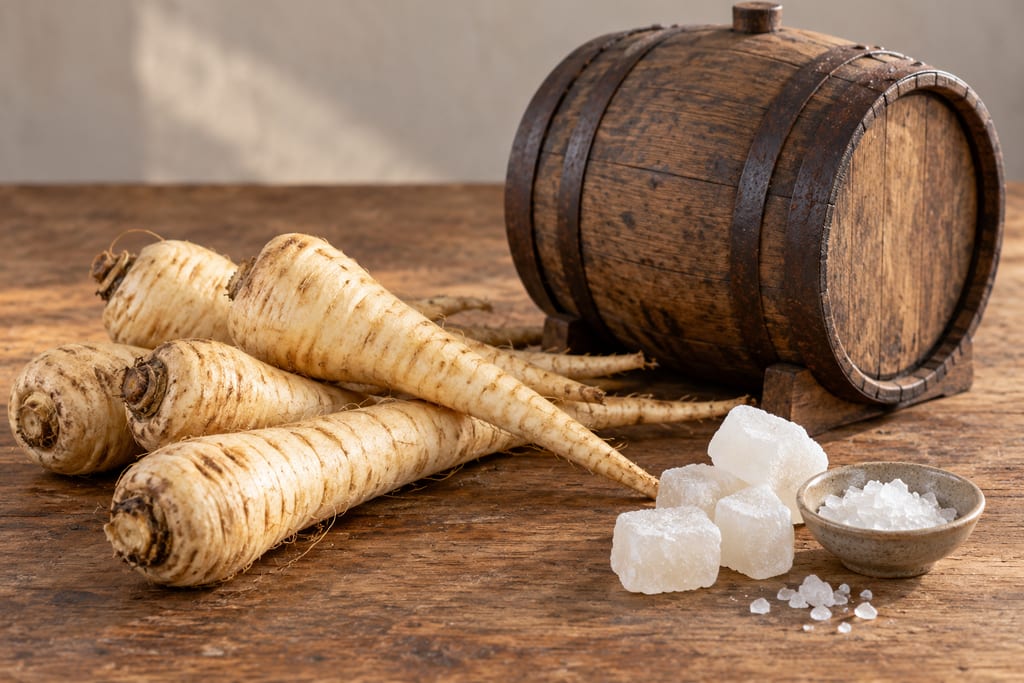
Parsnip liquor ferments with loaf sugar, crude tartar and fresh yeast, then matures in a cask for twelve months before bottling.
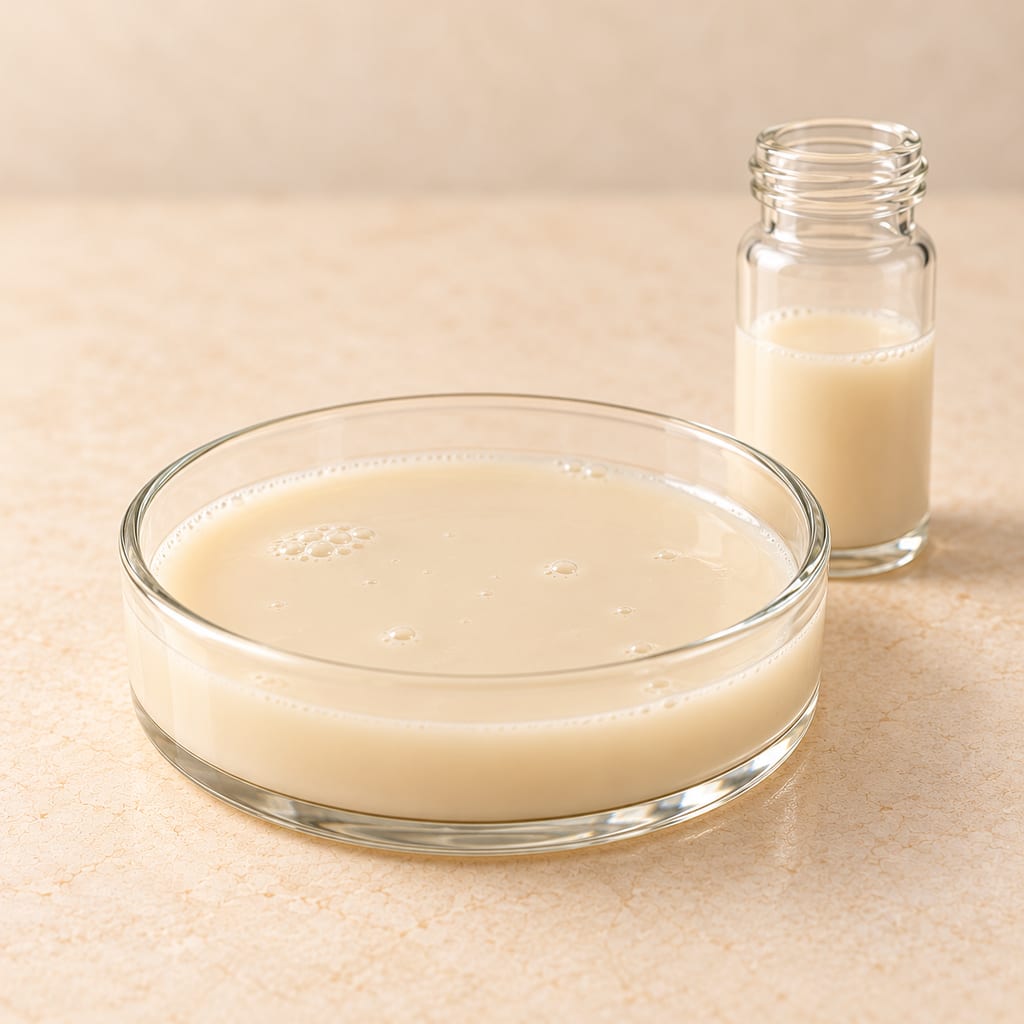
Brewer’s yeast is a working name for living cultures selected for brewing, not one strain or always one species. Ale and lager cultures differ, and older household books may use the term for foam or sediment from brewery beer.
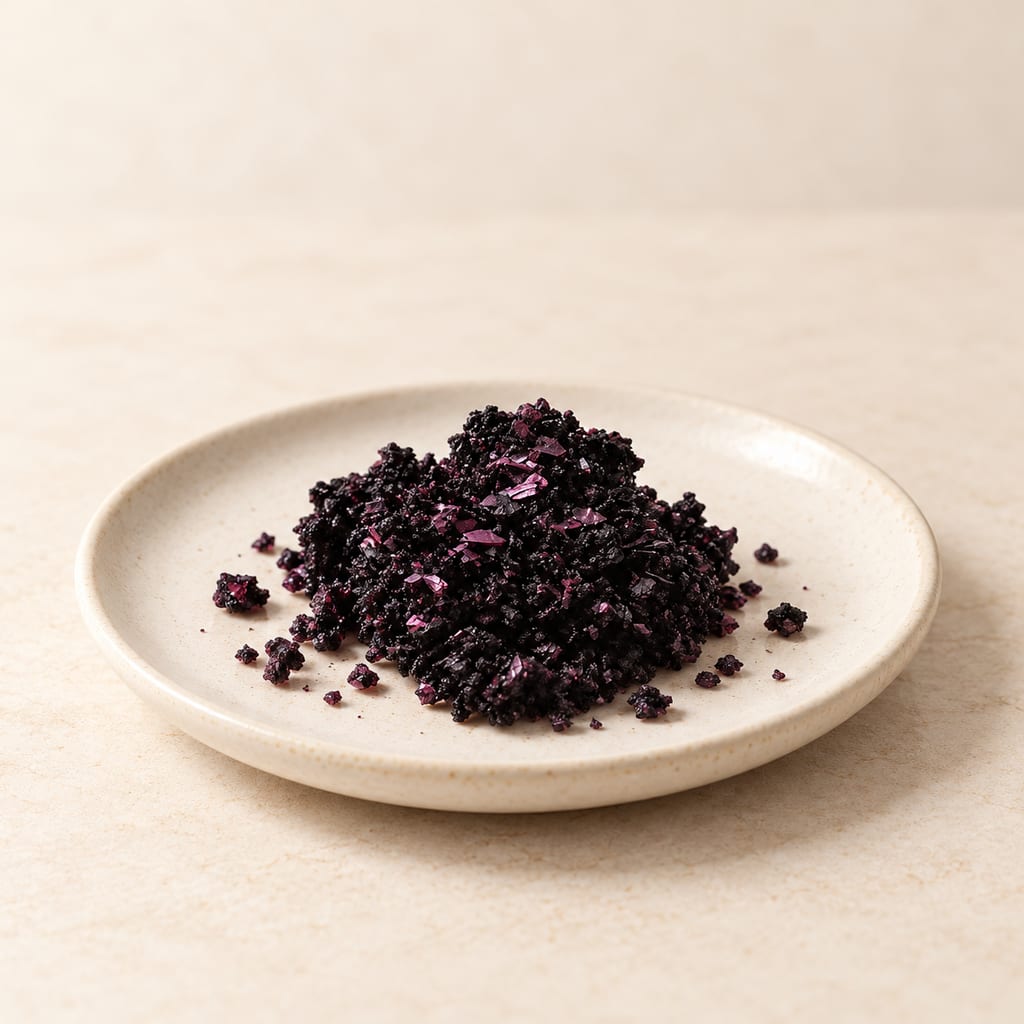
A mixed crystalline wine-vessel deposit, chiefly potassium hydrogen tartrate, used historically in wine recipes and recovered for refining into purer products.
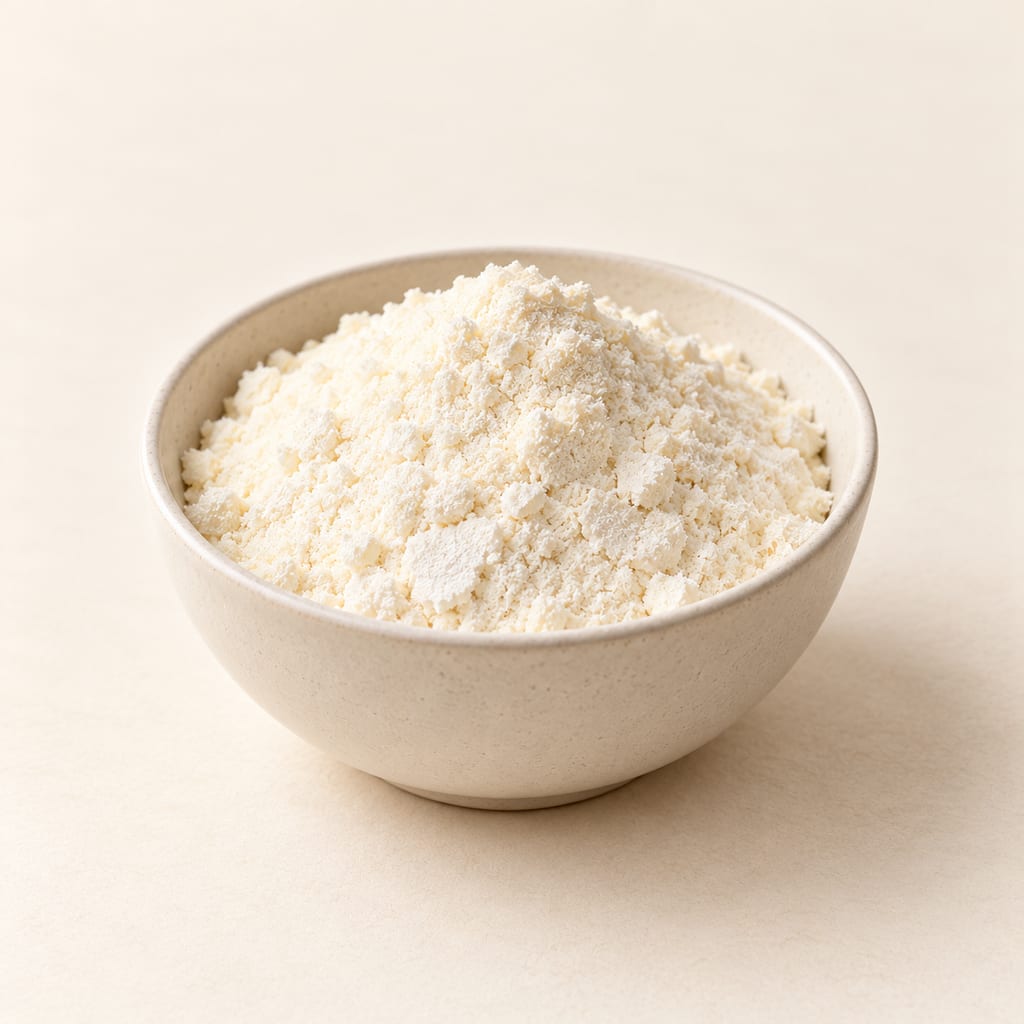
Dry milk is a family of dairy ingredients made by removing most water from milk or cream. The name includes distinct whole, partly skimmed and nonfat powders; fat level, heat treatment and particle form determine handling and use.
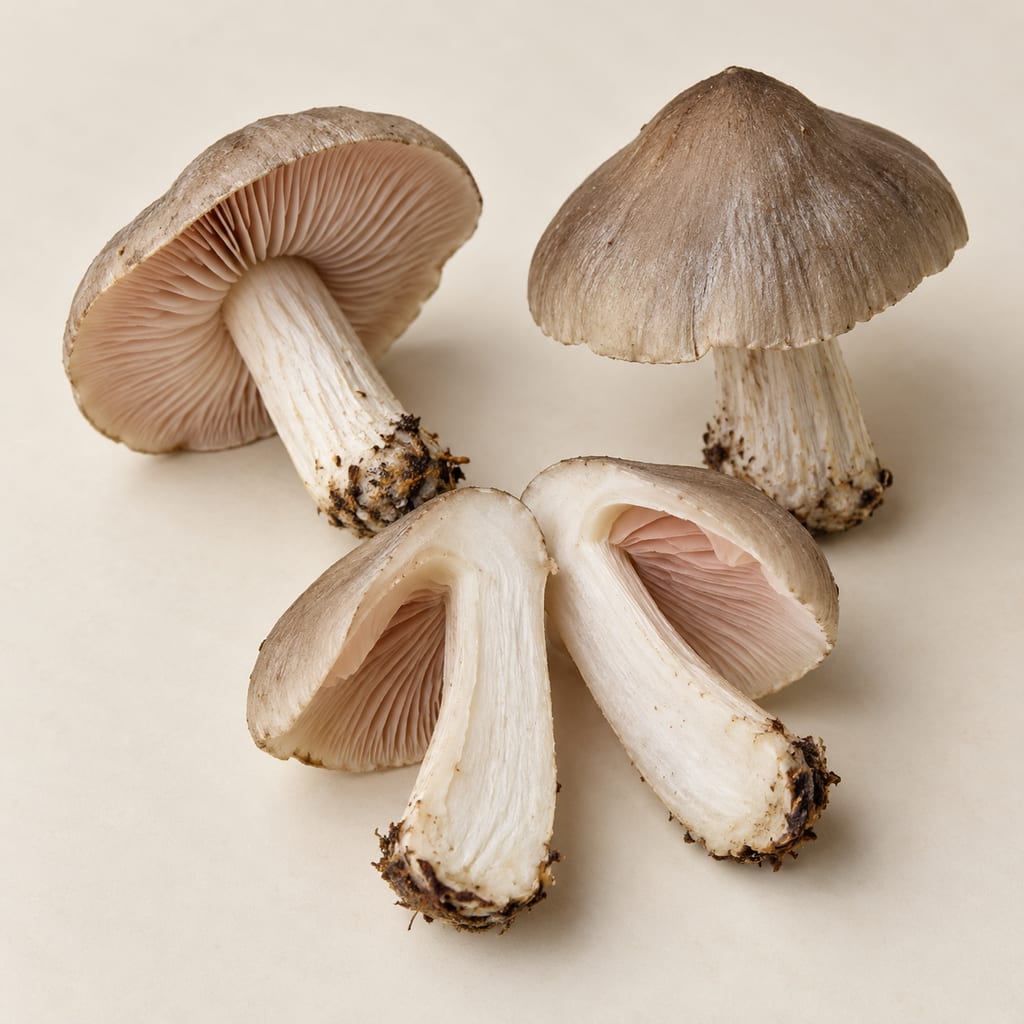
A woodland pinkgill reported as local food in Sikkim and parts of Italy, but difficult to identify and subject to strong regional warnings about confusion with toxic Entoloma species.
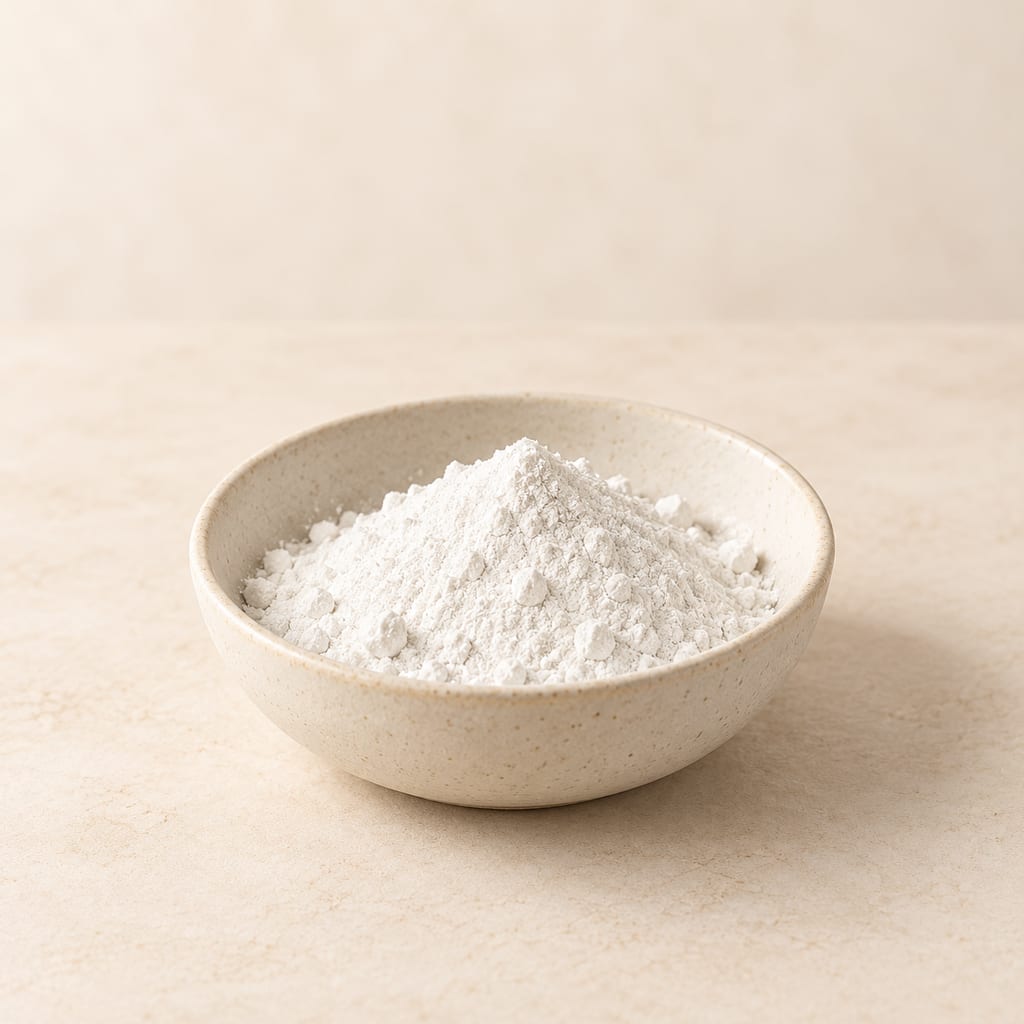
Gypsum is calcium sulfate dihydrate, a mineral salt that brewers dissolve in water for its calcium and sulfate and that tofu makers use to set soy curd.
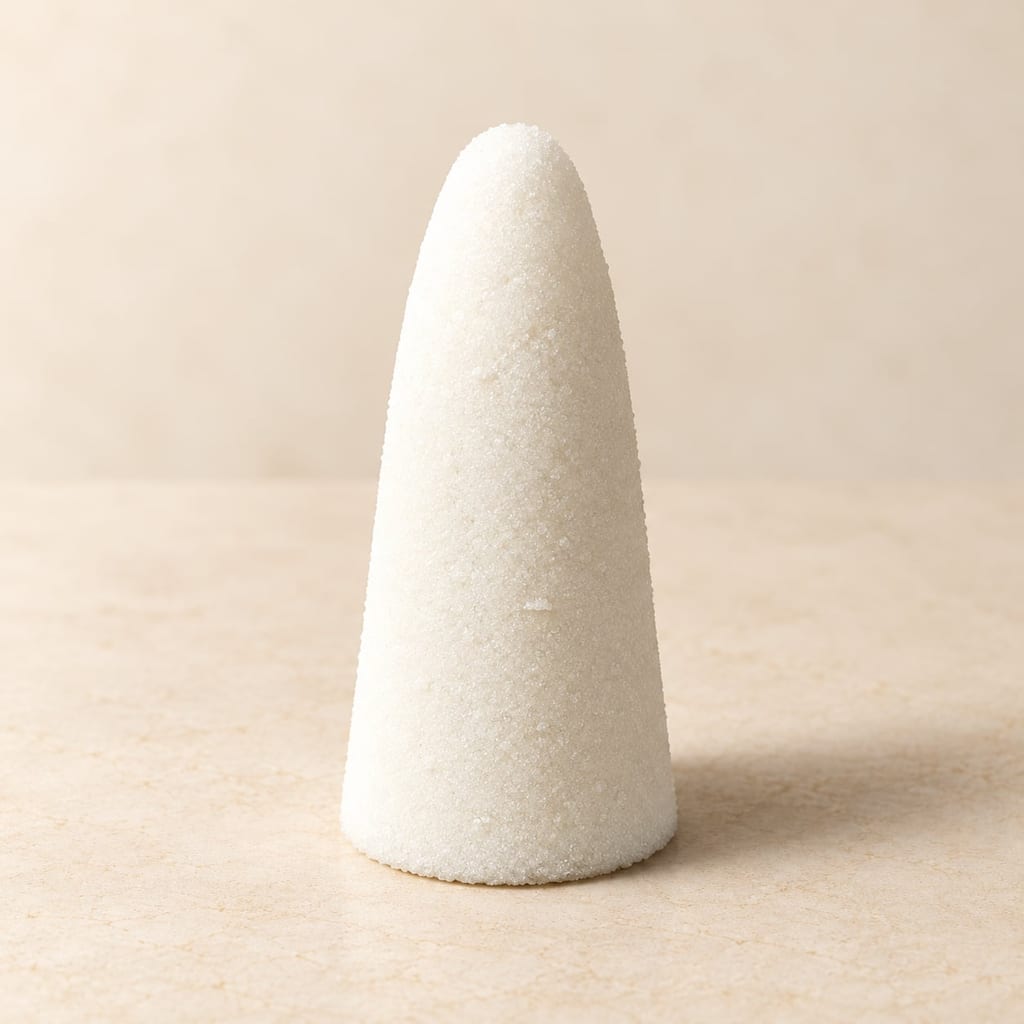
Refined sugar formed into a solid cone, historically cut or powdered for kitchen use and dissolved into wine liquor.
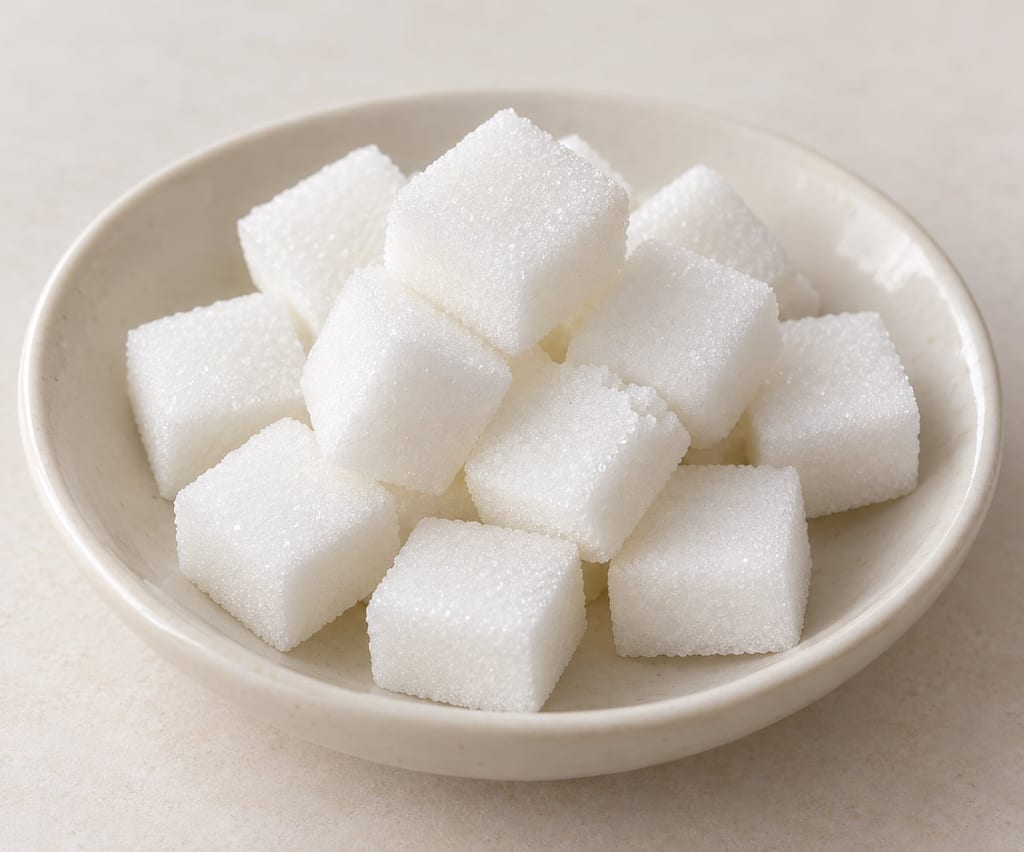
A historical refined-sugar form whose name has covered truncated cones and, in later usage, smaller pressed or cast pieces.
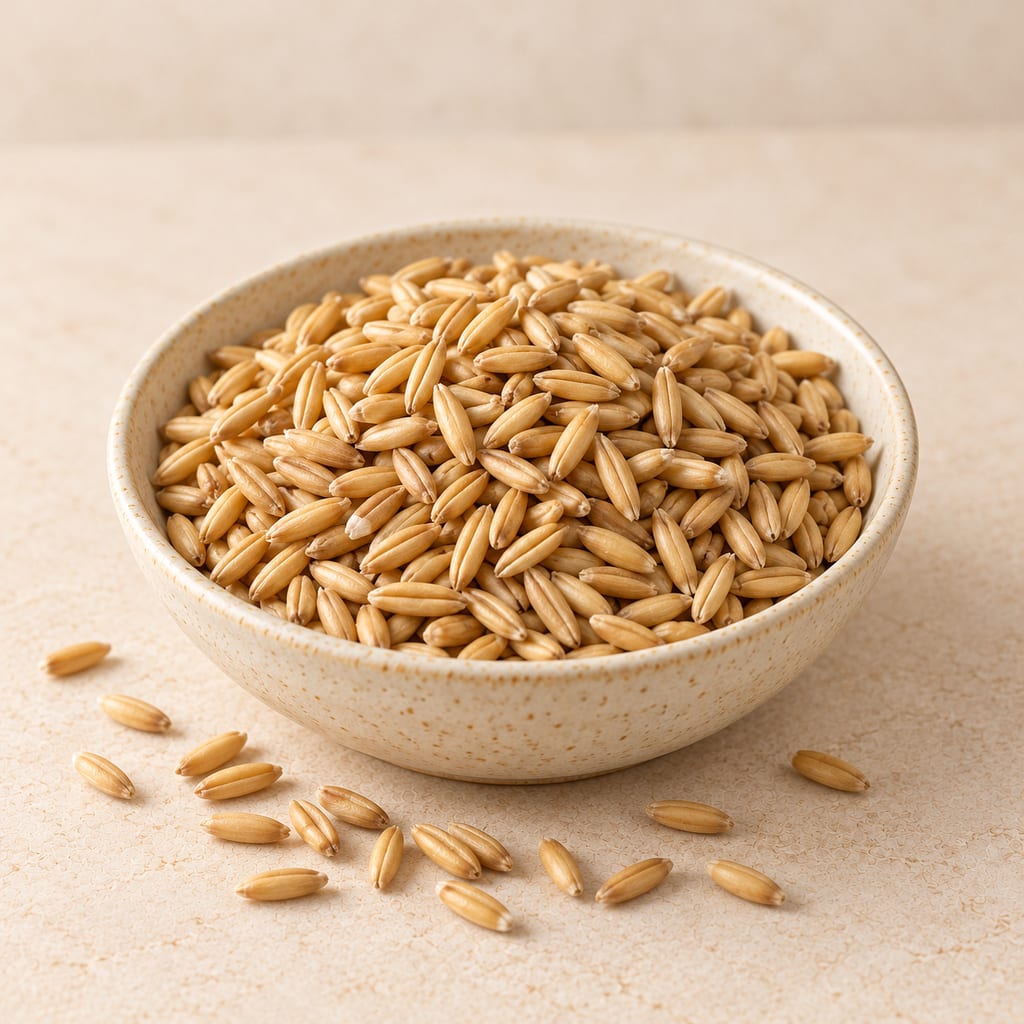
A cereal grain sold as groats, cut pieces, flakes, flour and malt. Oats shape porridge, bread and brewing differently as processing changes hydration, texture, starch, beta-glucan, protein and oil.
No community contributions have been published for this entry yet.
Sign in to contribute. Published comments and photos are free to read.
Royal Botanic Gardens, Kew
Pastinaca sativa L.Accepted species, Apiaceae, biennial habit and native range; native range is not a domestication locality.
Cited in: A pale root with a sweet winter character
Oxford University Plants400
Pastinaca sativa L. (Apiaceae): ParsnipSweet aromatic cream-yellow root, biennial root/flowering stages, ambiguous early domestication evidence, historical sweetening and Student cultivar.
Cited in: A pale root with a sweet winter character; A vegetable whose early history resists a neat origin story
Royal Horticultural Society
How to Grow ParsnipsRoot form and soil, direct sowing/fresh seed, slow growth, careful lifting, canker and resistant varieties.
Cited in: The growing ground leaves its mark on the root
The Journal of Horticultural Science and Biotechnology88(6),756–761
Changes in sugar and starch concentrations in parsnip (Pastinaca sativa L.) during root growth and development and in cold storageWhite King cold-associated starch/sugar changes over two field seasons and storage; amylolytic/alpha-amylase/MOS relationships.
Cited in: Cold sweetening is plant metabolism
Food Research International48(2),598–608 / Lund University
Parsnip (Pastinaca sativa L.): Dietary fibre composition and physicochemical characterization of its homogenized suspensionsSoluble/insoluble fibre, pectic material and lignin; particle distribution, homogenization, concentration and gel-network findings.
Cited in: Texture comes from more than dissolved sugar
A.Cobbett, London
The English Housekeeper: Or, Manual of Domestic Management, sixth editionParsnip vegetable cookery, seasonal list and separate root-wine alternatives; cooking/extraction versus yeast fermentation and distinct ingredients.
Cited in: From the vegetable dish to the cellar; Root liquor and yeast have different jobs; One root supported several household wines
University of California, Davis, Department of Viticulture and Enology
Saccharomyces cerevisiaeGeneral wine yeast sugar metabolism producing ethanol, carbon dioxide and heat; no identification of historical yeast.
Cited in: Root liquor and yeast have different jobs
The Page Company, Boston
Old-Time Recipes for Home Made Wines, Cordials and Liqueurs from Fruits, Flowers, Vegetables, and ShrubsThree distinct parsnip-wine variants, root extraction, hops, yeast on toast and cask handling.
Cited in: One root supported several household wines
Journal of Agricultural and Food Chemistry50(9),2565–2570
Effects of storage conditions on furocoumarin levels in intact, chopped, or homogenized parsnipsRoot preparation/storage-dependent furocoumarin changes and marked rise with visible mold infection; authors recommend preventing microbial infection.
Cited in: Keeping root condition separate from sweetening
Utah State University Extension
Wild Parsnip (Pastinaca sativa) Identification and Control in Residential LandscapesWild-plant sap furanocoumarins with ultraviolet exposure cause skin injury; protective clothing and gloves for handling.
Cited in: Sap exposure and allergy are different questions
Contact Dermatitis70(2),98–103 / University of Southern Denmark
Systemic allergic dermatitis caused by Apiaceae root vegetablesClinical case with contact sensitivity to parsnip, celeriac and carrot; individual case, not prevalence.
Cited in: Sap exposure and allergy are different questions