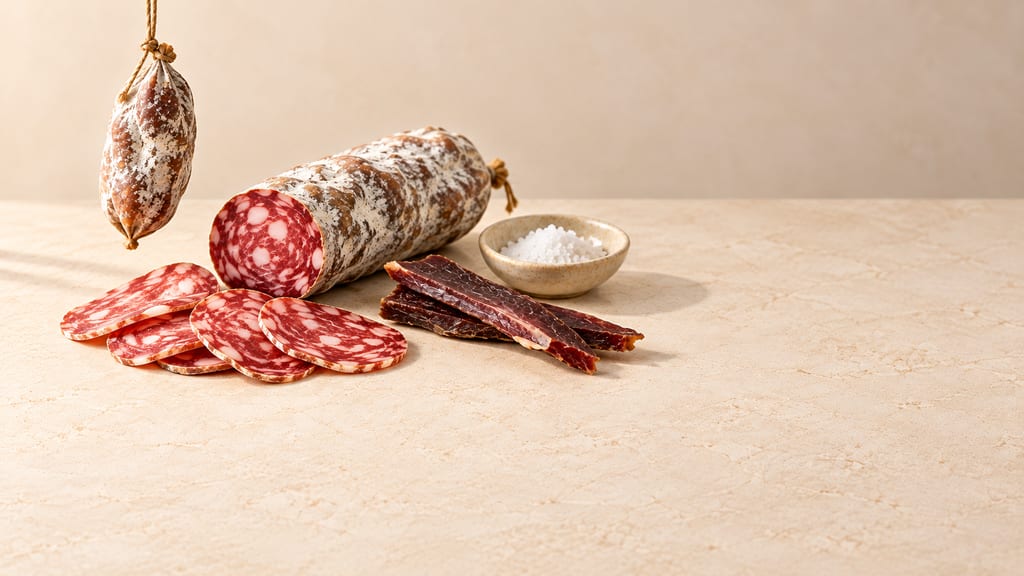
Fermented meat around the world
Dry salami, sour pork with rice, matured sheep and aged blubber follow different paths from animal to food. Their stories connect microbes with climate, slaughter, migration and the meals people share.
 FermenteaWhere food goes to change
Substrates
Long-finned pilot-whale meat, called Faroese tvøst, is eaten fresh and preserved in the Faroe Islands. Historical accounts place it among the meats hung to dry and pass through the ræst stage, distinct from blubber and other whale foods.
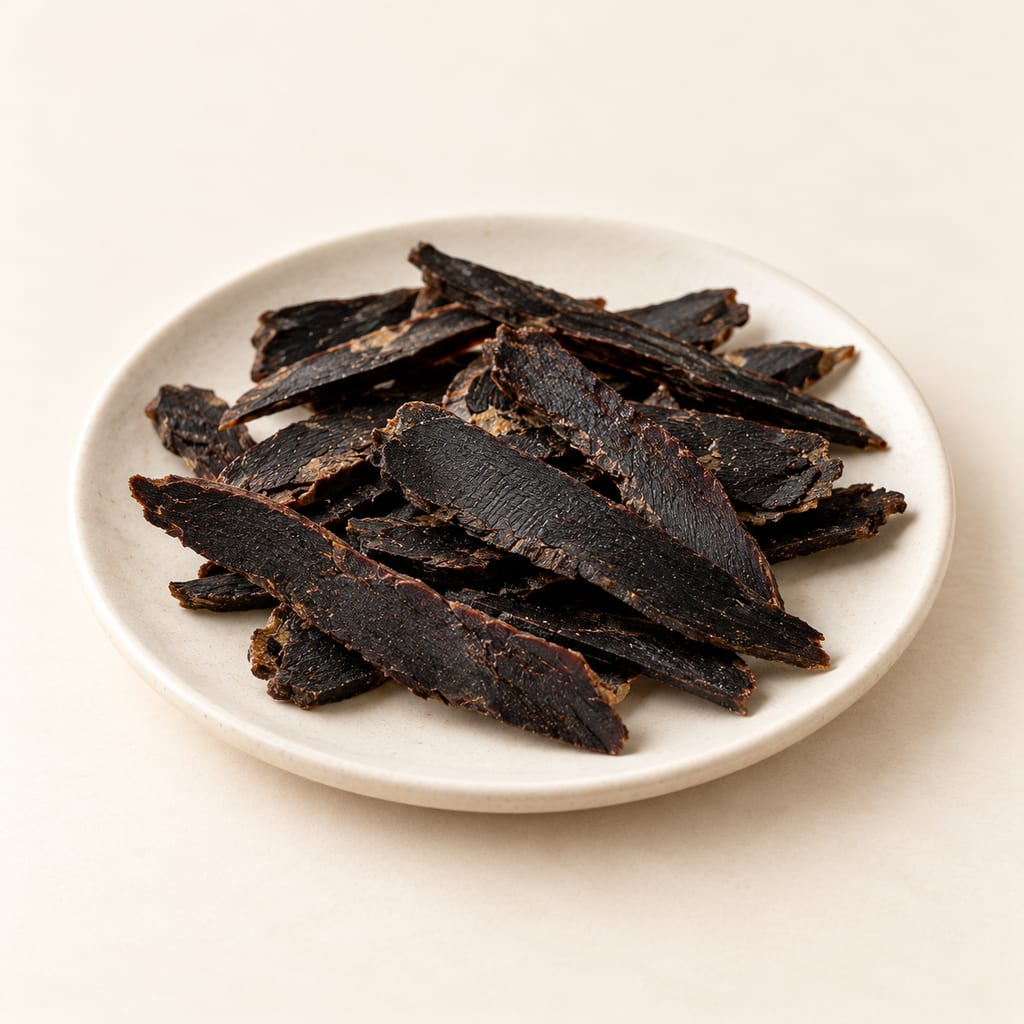
Tvøst is the Faroese word used for pilot-whale meat; spik is the animal’s blubber. The distinction matters in the kitchen, in historical accounts and in health advice. The animal most associated with Faroese foodways is the long-finned pilot whale, Globicephala melas, called grindahvalur in Faroese. It is a toothed whale of temperate and subpolar waters, a social squid-eater that also takes some small fish. The food in this page is its muscle, not the thick fat layer beneath the skin, organs, or a general category of whale meat.
Fresh meat has been compared in older descriptions to beef in appearance and flavour, while preserved meat changes markedly as it loses water and ages. A 2009 historical and ethnographic study reproduces seventeenth- and eighteenth-century descriptions of fresh meat being cooked and strips being hung to dry. Contemporary Faroese descriptions likewise separate fresh, ræst, dried, and salted meat. Those words refer to different states and preparations; they are not interchangeable labels for every piece of pilot-whale meat.
The long-finned pilot whale ranges broadly in the North Atlantic and beyond, but this food association is specifically Faroese. Its species range does not establish that every community in that range eats the meat or preserves it in the Faroese way. Greenlandic traditions and other whale foods have their own names, histories, cuts and processes. In particular, Iñupiat bowhead preparations such as mikigaq and maktak belong to a distinct Arctic food tradition and are not synonyms for Faroese tvøst.
The Faroe Islands’ food economy relied heavily on animal husbandry, fishing, seabird gathering and marine resources. On a small, windswept North Atlantic archipelago, seasonal availability made preservation consequential: food had to carry households through periods when fresh supplies were harder to obtain. Ethnographic writing describes drying and fermentation of several animal foods, including mutton, birds, fish and pilot-whale meat. This shared preservation setting does not make their methods identical in every detail.
A medical visitor, Peter Ludwig Panum, described Faroese food in 1846. His account, preserved and discussed by later ethnobiological research, says the same hanging method used for lamb was also applied to pilot-whale meat, fish and birds. He distinguished food called ræst from meat already wind-dried, describing the intermediate months in strongly negative terms. His language reflects an outsider’s nineteenth-century judgement, not a neutral modern sensory description or a food-safety assessment. The useful evidence is the distinction he observed between fresh, dry and ræst states and his report that several animal materials could undergo this preservation.
The date is an attestation, not a birth certificate for the practice. The pilot-whale hunt itself has a much longer record: Faroese catch statistics survive from 1584, and later historical work discusses written accounts from the seventeenth century. Those records establish a longstanding food relationship, but a record of a hunt is not automatically a record of ræst meat. The evidence assembled here supports fermented and dried pilot-whale meat by the nineteenth-century account and does not assign it an unsupported Viking-age origin.
The food’s history also includes a changing economy. Freezers became common in Faroese homes in the late 1960s and early 1970s, weakening preservation’s role as the only means of carrying animal foods between seasons. Frozen storage changed the practical choice available to households; it did not erase the cultural knowledge or preference for aged foods. Contemporary ethnography describes dried whale meat as an occasional food and records continued consumption of whale products even as everyday diets and supply chains changed.
Ræst is a Faroese preservation category associated with fermentation and partial drying. For meat, it names a stage and a style of aged food rather than one standardized recipe. Historic observers describe hanging animal meat in the open air without the salting or smoking they expected to see. Later records describe variation in handling, including salt water treatment before drying in some accounts. These descriptions belong to different moments and sources; they should not be collapsed into a universal instruction to salt or not salt.
Air movement and time remove moisture from exposed meat. At the same time, naturally present microorganisms and the meat’s own enzymes can contribute to changes during aging. The sources used for this page do not provide a controlled microbiological study of pilot-whale ræst meat that identifies its organisms, their succession, or the chemical compounds responsible for the finished flavour. Research on other Faroese ferments, especially sheep meat and fish, cannot simply be transferred to this product. The account therefore identifies the observed preservation process without assigning a particular bacterium or a precise biochemical pathway to pilot-whale meat.
This distinction also helps explain why fresh, ræst, wind-dried and salted forms taste and behave differently without pretending that all differences have one cause. Water loss concentrates the remaining tissue and changes its texture; microbial and enzymatic activity may alter flavour as the meat ages. The exact balance depends on the cut, thickness, handling, weather and environment, but the cited pilot-whale records do not quantify these variables or give a reproducible controlled process. A description of tradition is not a validated production specification.
The term ræst can be misleading when translated too literally. Panum’s description of a partly decomposed state was recorded in the nineteenth century and framed as criticism. Current Faroese food writing glosses ræst as fermented and describes its flavour as pronounced and savoury. Neither a powerful aroma nor an unattractive surface tells a reader whether a batch is safe. Sensory character explains cultural recognition; it cannot replace measured controls or establish safety.
Pilot-whale meat enters Faroese households through a communal harvest system rather than ordinary commercial livestock supply. Ethnographic accounts describe the meat and blubber being assessed and distributed under local rules among people involved in a hunt and residents of the relevant district. The allocation system has changed over time and has been shaped by law, custom and local institutions. Describing that system matters because the ingredient’s social context is part of how people receive, share and learn to prepare it.
Historical accounts record more than one use. Fresh meat was cooked; some was cut into strips and hung to dry, and older accounts also mention soups and other preparations. Present-day sources describe boiled meat served with blubber and potatoes, and steaks fried and served with gravy. Dried meat is cut in slices and can appear alongside potatoes and preserved blubber at festive tables. Ethnographic accounts describe a range of uses rather than a single canonical dish or recipe.
Some of the meat may be eaten fresh, some preserved, and some frozen. These categories answer different household needs: fresh meat is a direct meal, frozen meat extends access beyond the immediate distribution, and drying or ræst aging turns preservation into a distinctive food with its own texture and flavour. Dried meat’s darker, concentrated appearance is documented in visual and ethnographic descriptions, but this is not a grade or a reliable test of quality. A reader should not infer age, taste or safety from colour alone.
Food knowledge has traditionally been passed within families and communities. Svanberg’s ethnographic work describes household food craft and the continued cultural value of local animal foods, while a 2026 survey found that many respondents still reported eating cooked or dried pilot-whale meat. The survey also found generational differences in awareness of contaminant advisories. These findings show that the food remains culturally present, but they do not mean every Faroese person consumes it or that the practice has one shared meaning.
Pilot-whale blubber is a separate ingredient with different culinary roles. Faroese sources call it spik; it may be salted or brined and is served with dried fish or meat, while fresh meat itself may be boiled, fried or dried. Because blubber is rich in fat, historical accounts describe it as food, grease and a stored resource. Meat and blubber have sometimes been cooked together, but their composition and preservation are different. The name “pilot-whale meat” should not quietly include blubber, liver, kidneys or other organs.
This separation is practical as well as linguistic. Advice about contaminants differs by tissue, and official guidance explicitly discusses meat and blubber separately while excluding liver and kidneys from consumption. Blubber is not a lean accompaniment that can be treated as an optional garnish without consequence. A recipe that names meat, blubber, or both should say exactly which one it uses and should not assume that one can substitute for the other without changing texture, fat content and the safety context.
Pilot-whale food carries a serious contaminant concern. Faroese health research has focused on methylmercury and persistent pollutants including PCBs and related compounds. Because contaminants concentrate differently across tissues, risk assessment and dietary advice distinguish meat, blubber and organs. The presence of a longstanding food tradition does not remove the exposure question, and fermentation, salting, drying or cooking should not be assumed to remove these contaminants.
Advice has not appeared as one unchanged statement. In 2008, the Chief Medical Officer and the Department of Occupational and Public Health advised that the population should no longer consume whale meat and blubber. In 2011, the Food and Veterinary Authority published a separate recommendation allowing adults at most one meal per month and giving stricter advice for girls and women, including avoiding blubber while planning for children, and avoiding meat during pregnancy planning, pregnancy and breastfeeding. The 2011 document also says pilot-whale kidneys and liver should not be eaten. These recommendations arose from different authorities and dates; they should not be blended into a claim that Faroese officials have always issued one uniform limit.
A 2026 cross-sectional survey documents that both advisories remain part of public discussion and that people’s awareness, consumption and views vary by age and other characteristics. It reports that many respondents consume cooked or dried meat while fewer fully refrain. A survey of behavior does not revise the underlying health advice. Nor does a dated monthly ceiling guarantee that a particular portion, hunt or product is safe for an individual. Readers needing current guidance should consult the Faroese health authorities and their own clinician, especially where pregnancy or breastfeeding is relevant.
The 2011 figures are historical public guidance, not a process control and not an endorsement to eat the food. This catalogue records the date and source so that readers can see which authority said what. It does not invent a lower-risk portion, claim that fermentation detoxifies the meat, or imply that sensory examination establishes contaminant levels.
The supported culinary geography for this fermented-meat entry is the Faroe Islands. Long-finned pilot whales occur across a wide marine range, but the historical records and named ræst use cited here are Faroese. No specific village is a defensible birthplace for the food from this evidence, even though community distribution and local household practices occur in particular settlements. The geography should therefore stay at country-level precision rather than pinning an origin to a single island or bay.
Pilot whale is a common name, not a synonym for all cetacean meat. The account here concerns Globicephala melas and Faroese tvøst. It is separate from bowhead whale, Greenland shark, dolphin, seal and the many other marine foods preserved in northern communities. Similar words such as “fermented whale” can conceal major differences in species, cuts, season, handling and meaning. A useful comparison begins by naming those differences instead of assembling them into a pan-Arctic recipe.
The wider range of the animal is likewise not a claim about consumption. NAMMCO’s species account places long-finned pilot whales in temperate and subpolar waters of the North Atlantic and southern hemisphere, and describes their schooling, squid-focused feeding. That biological information identifies the animal; it does not tell us how a particular meat portion was harvested, shared, preserved or cooked. Those are historical and household questions with their own evidence.
In a catalogue context, identify whether a source is discussing fresh muscle, ræst meat, wind-dried meat, salted meat, blubber or an organ. This simple distinction prevents false equivalence among foods that share an animal name. The cited sources describe cooking and preservation categories but do not establish a current retail grading system, a dependable visual marker of good quality, a safe storage duration, or a home process with validated time and temperature limits. No shelf life or safety threshold is supplied here.
The historical drying accounts are valuable evidence of food practice, not instructions for reproducing it. Panum’s 1846 account is an observer’s record; modern official food pages describe current traditions in broad terms but do not publish a complete controlled method for pilot-whale meat. The dates or approximate durations mentioned by individual ethnographic sources belong to those particular descriptions and should not be generalized into a safety parameter. A recipe would need its own documented process and controls.
Readers should also keep the history of the ingredient separate from the ethical and regulatory debate around its harvest. The whaling practice has communal, legal and cultural dimensions as well as strong public disagreement, animal-welfare concerns and environmental-health concerns. An ingredient page can describe how the food is named, preserved and served without deciding those disputes for the reader. This entry’s precise claim is narrower: Faroese sources document pilot-whale meat in fresh and preserved forms, including ræst and drying, and contemporary consumption exists alongside explicit contaminant advisories.
That distinction is why the record treats pilot-whale meat as an ingredient rather than an invented universal preparation. Producing ræst meat involves a preservation process whose historical evidence warrants its own method-focused treatment; this page explains the raw material and its uses while keeping method details attached to the sources that actually report them. It does not turn a nineteenth-century observation into a recipe, and it does not substitute a different whale’s fermentation for the Faroese account.
Faroese accounts document pilot-whale meat in ræst and wind-dried preservation traditions. This is a country-level traditional association, not a precise origin claim.
Dry salami, sour pork with rice, matured sheep and aged blubber follow different paths from animal to food. Their stories connect microbes with climate, slaughter, migration and the meals people share.
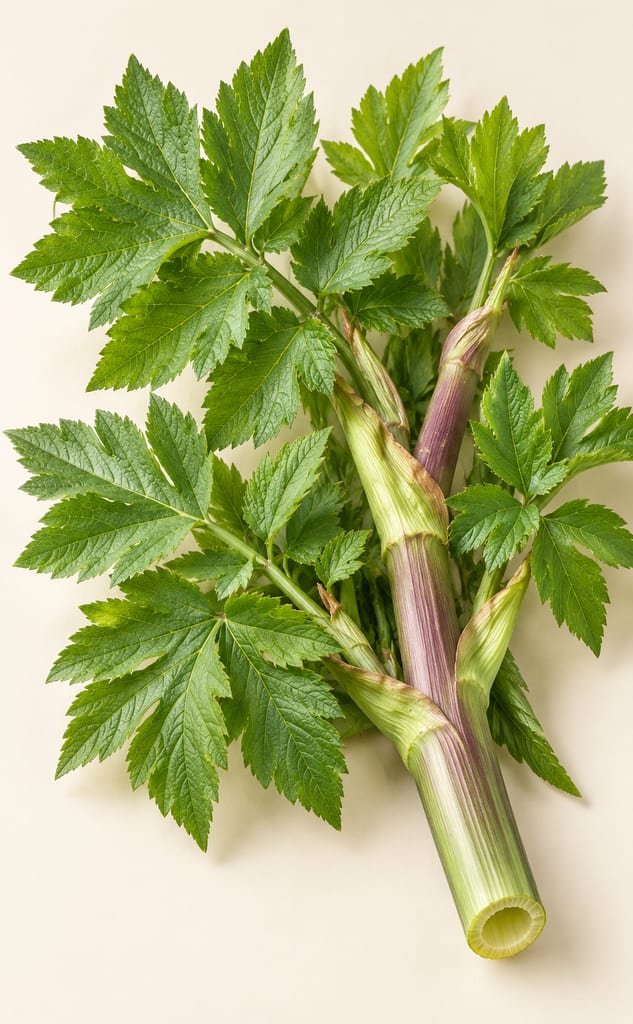
Angelica here means garden angelica (Angelica archangelica), an aromatic Apiaceae used as a vegetable, seasoning and candied stem, with Sámi food traditions linking it to preserved milk dishes.
Faroese spik is the under-skin blubber of the long-finned pilot whale, eaten salted alongside dried fish or whale meat and sometimes spread on bread. It is a distinct fat tissue, not meat, sheep tallow or rendered whale oil.
Saithe (Pollachius virens), also called coalfish and coley, is a North Atlantic cod-family fish used fresh and in distinct preserved forms. Faroese ræstur fiskur and Shetland salted piltocks are not the same product.
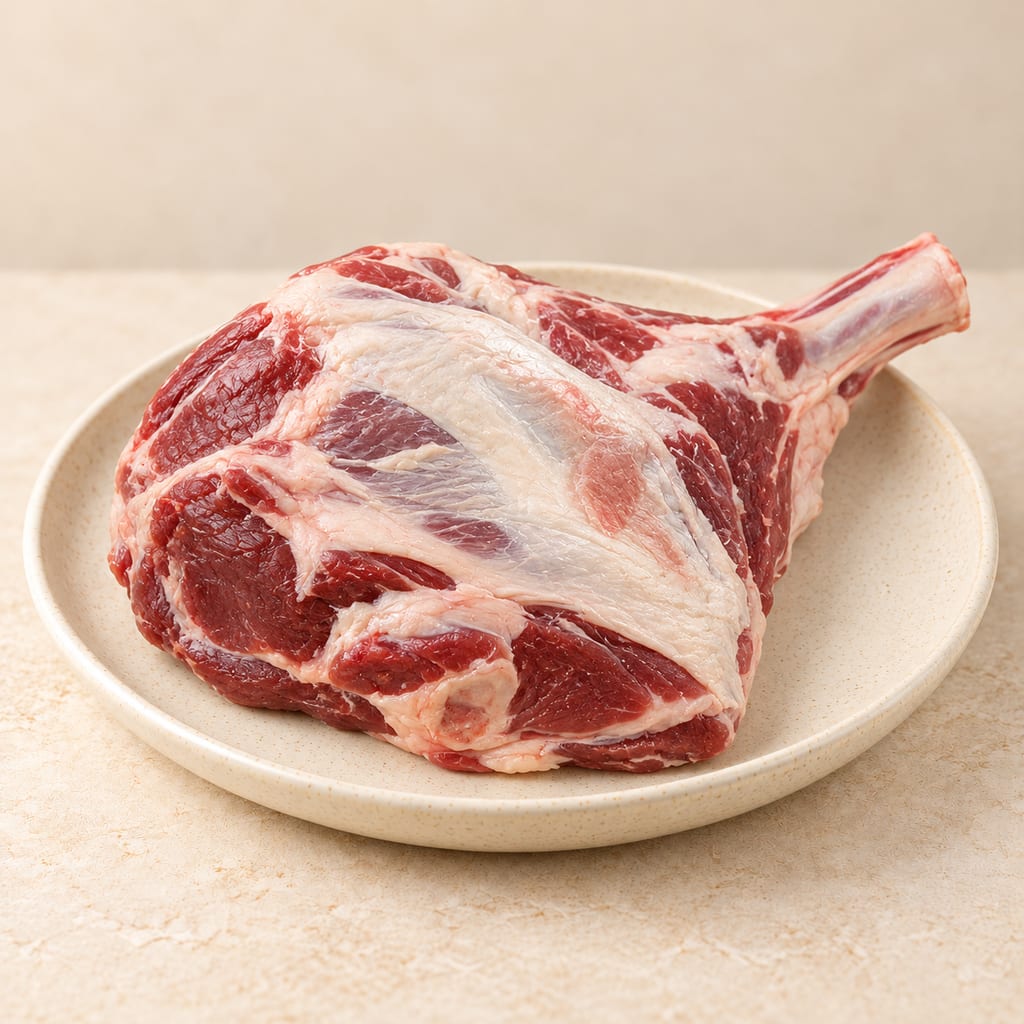
Sheep meat spans lamb from younger animals and mutton from mature sheep; age, breed, diet, cut and fat cover shape its texture and how it behaves in curing and fermentation.

A gelling polysaccharide extracted from red seaweeds, sold as kanten strips or powder; it sets firm at a low concentration and stays solid until about 85 °C.

A Dominican table and seasoning condiment of sour orange juice, mixed with lime and salt and bottled raw; garlic, oregano or a hot pepper may be added for meat or a spicier bottle.

Cicerbita alpina is an alpine perennial whose tender shoots and leaves have been eaten raw or cooked. Sámi milk preparations and modern Carnian dishes are distinct uses, with serious identification and preservation limits.

Japanese skipjack tuna cooked, then repeatedly smoked and dried over a wood fire by the hand-fired tebiyama method into a hard block for shaving into dashi: the first stage of katsuobushi.

A Swedish-style spirit vinegar made by fermenting neutral alcohol with live vinegar bacteria, with a separate guide to commercial ättika strengths.

A yeast-raised wheat ring shaped from a firm dough, briefly boiled and baked. This source-batch formula gives a gently malted crust and a chewy crumb.

A warm dip of garlic, anchovy and olive oil, often enriched with butter, that Piedmont serves over a flame with raw and cooked vegetables and bread.

Bechamel is a white sauce of milk thickened with a butter and flour roux, one of the French mother sauces, and the base from which Mornay and other cheese and cream sauces are made.
No community contributions have been published for this entry yet.
Sign in to contribute. Published comments and photos are free to read.
Frontiers in Sustainable Food SystemsHistory · Geography · Use · Safety
The Importance of Animal and Marine Fat in the Faroese Cuisine: The Past, Present, and Future of Local Food Knowledge in an Island SocietyIdentifies Faroese tvøst as pilot-whale meat and spik as blubber; names Globicephala melas.
Describes the nutritional and household role of pilot-whale products, preservation traditions and continued foodways.
Discusses distribution, use, dietary change and health concerns.
Cited in: Tvøst, meat from a North Atlantic whale; A preservation record, not a single origin date; How ræst meat changes, and what is not known; From communal harvest to household food; A cut of meat is not blubber; Place, species and limits of comparison
Journal of Ethnobiology and EthnomedicineHistory · Method · Geography
Ræstur fiskur: air-dried fermented fish the Faroese wayReproduces and contextualizes Peter Ludwig Panum’s 1846 description that the lamb hanging method was used for pilot-whale meat, fish and bird meat.
Distinguishes ræst from wind-dried meat and reports historical unsalted hanging in that account.
Provides evidence of preservation practice by 1846, not an origin date or a validated modern method.
Cited in: A preservation record, not a single origin date; How ræst meat changes, and what is not known; Place, species and limits of comparison; Choosing, handling and reading the record
Fróðskapur / Faroe University PressHistory · Use · Geography
Pilot Whaling in the Faroe Islands: History, Ethnography, SymbolHistorical and ethnographic account of Faroese pilot-whaling and food use.
Reproduces historical accounts of cooking fresh meat and drying strips.
Documents community distribution and describes changing food practice.
Cited in: A preservation record, not a single origin date; From communal harvest to household food
North Atlantic Marine Mammal Commission (NAMMCO)Identity · Geography
Long-finned Pilot WhaleScientific name, distribution, habitat, feeding and social characteristics of Globicephala melas.
Distinguishes the species’ broad range from the Faroese culinary association.
Cited in: Tvøst, meat from a North Atlantic whale; A cut of meat is not blubber; Place, species and limits of comparison
The Government of the Faroe IslandsUse · Method · History
Faroese food cultureDescribes whale meat as eaten fresh, ræst, dried and salted; gives boiled and fried serving examples.
Explains the change from preservation by drying/aging to freezer storage in general Faroese foodways.
Cited in: How ræst meat changes, and what is not known; From communal harvest to household food; Choosing, handling and reading the record
Faroe Food and Veterinary AuthoritySafety
Dietary recommendation on the consumption of pilot whale meat and blubberContains the authority’s dated 1 June 2011 recommendations, distinguishes them from the 2008 recommendation, and discusses mercury and dioxin-like PCBs.
States the 2011 advice for adults, pregnancy-related advice and the exclusion of liver and kidneys.
Cited in: Contaminants and dated health advice; Choosing, handling and reading the record
International Journal of Circumpolar HealthSafety
Dietary recommendations regarding pilot whale meat and blubber in the Faroe IslandsReviews contaminant studies and the evolution of Faroese dietary recommendations concerning pilot whale meat and blubber.
Cited in: Contaminants and dated health advice
International Journal of Circumpolar HealthSafety · Use · History
Awareness, cultural importance, risk perception and consumption behavior – the issue of contaminants in pilot whales in the Faroe IslandsA 2026 cross-sectional survey of consumption, awareness of the separate 2008 and 2011 advisories, risk perception and cultural importance.
Reports continued consumption of cooked and dried meat and differences in advisory awareness.
Cited in: Contaminants and dated health advice
Hoppō Bunka Kenkyū / Bulletin of the Hokkaido Museum of Northern PeoplesComparison · Use
On Sharing of Bowhead Whale Meat and Maktak in an Iñupiat Community of Barrow, Alaska, USADocuments sharing practices for bowhead whale meat and maktak in an Iñupiat community, a separate species and cultural context from Faroese pilot-whale meat.
Cited in: Tvøst, meat from a North Atlantic whale