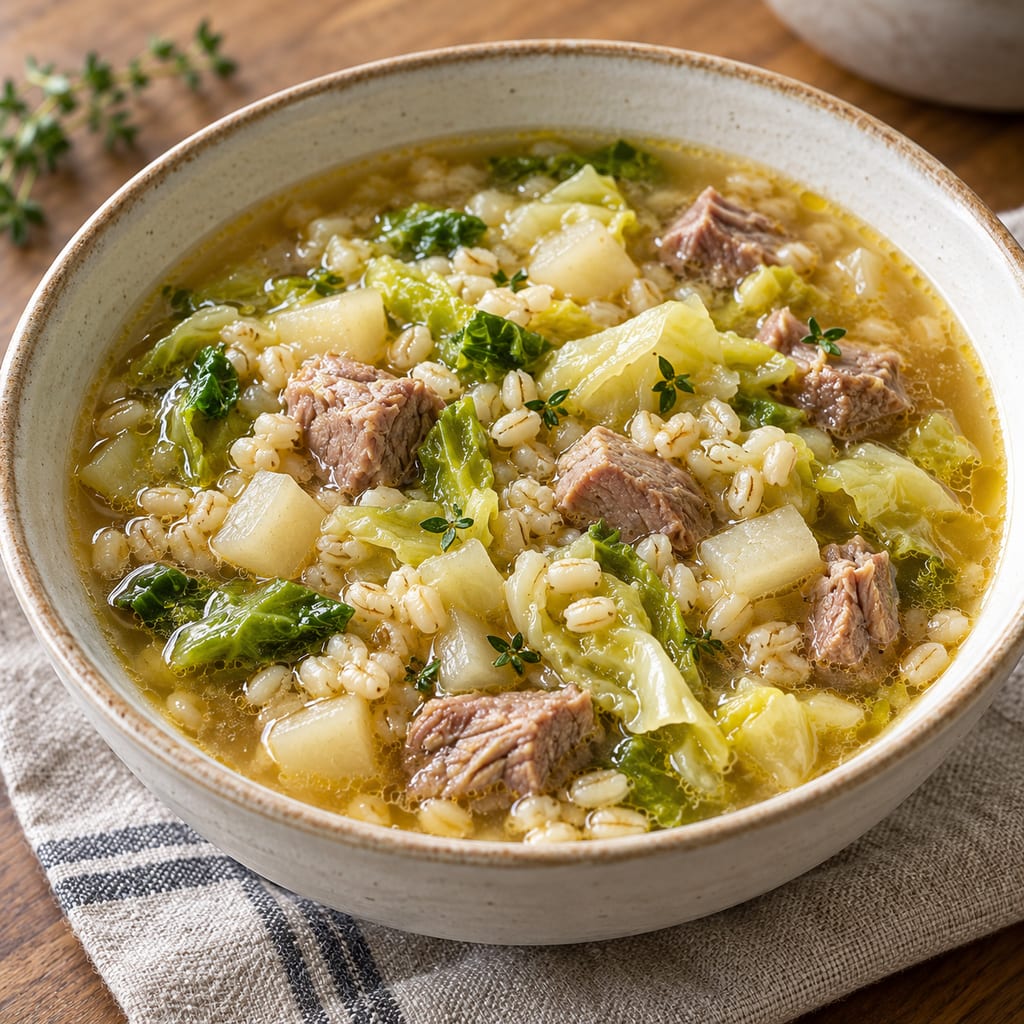
Lamb, barley and cabbage pottage (modern reconstruction)
Lamb shoulder simmered with pearl barley, turnip and leafy cabbage in one pot, a present-day reconstruction built from the animals, grains and vegetables of northern European farming.
 FermenteaWhere food goes to change
Substrates
Sheep meat spans lamb from younger animals and mutton from mature sheep; age, breed, diet, cut and fat cover shape its texture and how it behaves in curing and fermentation.
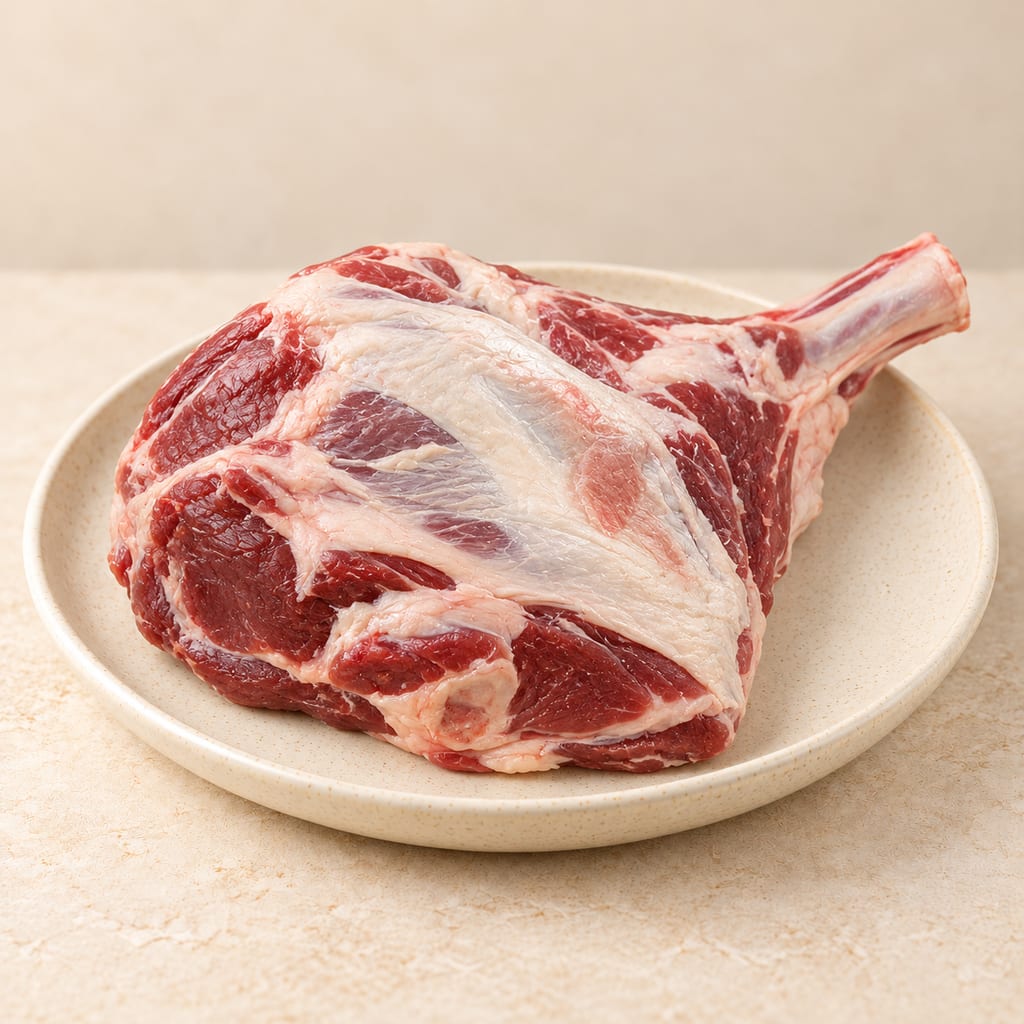
Sheep meat is the flesh of domestic sheep, Ovis aries. Lamb and mutton are familiar names for meat from different stages of a sheep’s life, but the boundary is not expressed in one universal way. The United States Department of Agriculture classifies ovine carcasses as lamb, yearling mutton or mutton from evidence of maturity in the skeleton and muscles. Its descriptions distinguish the finer, lighter lean typical of lamb from the darker, coarser lean and broader rib bones typical of mutton. In retail language elsewhere, age categories and naming can differ, so the label and specification for the meat in hand matter more than a supposedly global definition.
The animal is a small ruminant raised for several purposes. Sheep are kept for meat, wool, milk and hides, and breeds and husbandry systems vary with climate, land and local economies. Some are selected for meat production; others are dual-purpose or dairy animals whose meat also enters household and commercial food systems. Meat from a flock therefore does not have one fixed composition or culinary character. Breed, age, sex, feeding, rearing system, slaughter and handling all contribute to the carcass offered to a cook.
After slaughter, a carcass is divided into forequarter and hindquarter portions and then into cuts such as shoulder, breast, loin, leg and ribs. The exact names and boundaries vary among butchery systems. A leg contains large muscles that can be left whole for curing or boned, divided and minced; ribs and loin chops have a different arrangement of bone, muscle and external fat. These are not interchangeable shapes. Thickness, surface area, connective tissue, fat distribution and bone affect trimming, salt movement, drying and the way a cut fits a particular process. A recipe or cured-meat specification should name its cut and preparation instead of treating every piece of sheep as equivalent.
Skeletal muscle is mostly water and protein, with variable fat, connective tissue and mineral matter. A peer-reviewed comparison of biceps femoris from lambs and ewes, raised under one study’s defined conditions, found differences in moisture, protein and fat between the groups. Those values describe the sampled animals and muscle, not a universal nutrition panel for every breed or cut. A wider review likewise notes that lipid content varies by cut and that age, diet and production system influence meat quality. The practical lesson is that visible fat cover and marbling vary; they change richness and mouthfeel, and fat can soften a lean mixture, but one study’s percentages should not be transferred to a different animal or recipe.
Mutton’s stronger flavour is often treated as a defect, yet mature-sheep meat is a valued food in many cuisines. The perception and intensity of characteristic aroma depend on age, fatness, diet, storage and cooking, and the literature does not support reducing the experience to one simple cause. For fermentation and curing, a producer chooses lean and fat for a particular product. If a recipe specifies sheep fat, kidney fat, tail fat or another tissue, that is a separate ingredient choice: it should not be silently replaced by generic lean meat.
The choice between whole muscle and mince is especially important in cured products. A whole leg or loin retains a continuous muscle surface, while grinding cuts muscle into particles and brings formerly internal surfaces into contact with the grinder and other meat. Salt and drying must reach a product’s interior, so thickness and particle size influence the route through which moisture leaves and ingredients distribute. That physical difference explains why a procedure for a thin sausage casing or a minced mixture cannot be copied onto a whole leg. The exact settings still belong to a tested product method; the ingredient alone does not supply them.
Sheep meat enters fermented-meat traditions as whole muscle, diced or minced lean, and as part of mixtures with other meats and fat. Those forms create different foods. In a raw sausage, mincing distributes ingredients through the batch and greatly increases the area of meat exposed to equipment and contact surfaces. In a whole leg, the structure of muscle remains intact while a process acts from the outside inward. A dried leg, a fermented sausage, salted ribs and smoked mutton therefore need their own evidence and process descriptions; “sheep meat” is only the raw material, not one preservation method.
The fermented-meat atlas records whole sheep carcasses or cuts maturing in ventilated Faroese hjallur storehouses, and distinguishes the intermediate ræst stage from the later, drier skerpikjøt. It also describes Norwegian morr sausages in which sheep meat can appear alongside beef, pork and fat. The amount and role of sheep meat vary between formulations. A lamb variant of a mixed salami is not the same product as an all-sheep leg; similarly, a salted or smoked preparation is not automatically fermented. The process label follows evidence for the actual preparation, not the species in its ingredient list.
Microbiology research reinforces that distinction. In a small study of nine Faroese sheep legs from three producers, catalase-positive cocci were prominent overall, with Staphylococcus equorum especially common, while lactic-acid bacteria predominated in only one sample. The study also detected Clostridium putrefaciens in some leg cores. This is a description of those samples, not a claim about every producer, every season or the safety of the food. It shows why the meat cannot be assumed to behave like a vegetable ferment or a standard starter-culture salami. The material, native microbiota, environment and handling all matter, and a traditional product’s microbial profile is not a household process validation.
The same animal can appear in products with very different ingredient lists. In Swiss Salsiz, the usual mixture is pork, beef and fat, with documented lamb and game variants; in Norway, sheep meat can be used in morr alongside other meats and fat. By contrast, the Faroese leg tradition centers the sheep carcass itself. These examples show why the word “lamb” on one ingredient line does not establish the full recipe, and why a dish made with mixed meats should preserve its stated proportions rather than be rewritten as a pure sheep sausage.
Salted, smoked, dried and fermented are overlapping but distinct descriptions. Salted sheep meat may be a cured pantry food without an established microbial fermentation; smoking can add flavour or dry the surface without making an item ready to eat; drying changes moisture but cannot, by itself, demonstrate a safe endpoint. Faroese household vocabulary describes stages within a local practice rather than a universal recipe sequence. A careful account names the specific product and its documented steps, then treats any unknown temperature, duration, salt level or endpoint as an unanswered process question.
Sheep husbandry is widespread across contrasting environments, from wet northern European uplands to drylands in Africa, Asia and Australasia. The Food and Agriculture Organization maps sheep distribution globally and describes the species as adapted into many breeds for varied purposes and production systems. This breadth makes a single geographic origin for the ingredient itself misleading: meat is produced in many places, while the particular cut or preparation has its own history and geography.
The Faroe Islands offer a well-documented example of sheep’s place in a food economy. Sheep remain central to local husbandry and food culture, and the official tourism account discusses the 1298 Seyðabrævið, or Sheep Letter, alongside an earlier written reference to the islands’ sheep. Those records illuminate the history of sheep-keeping, not the first appearance of lamb meat or a single birthplace for sheep foods. In the fermented-meat tradition, autumn slaughter, household knowledge and the ventilated hjallur connect the raw sheep carcass to ræst maturation and drying. Norway’s morr sausage and Switzerland’s lamb-containing salsiz variants show different uses of the same species in mixed preparations.
The map associations on this page mark documented food uses rather than a claim that sheep meat originated in these countries. They also do not imply that every sheep product in a country shares one recipe. The name, cut, mix and preservation stage must be checked product by product.
Season and community shape the raw material as well as its later use. Faroese ethnography links autumn slaughter to household winter stores and describes local skill in preparing and hanging sheep meat. The official sheep-history account also records communal work in herding and slaughtering. These are geographically bounded accounts; they should not be used to assign the same calendar or handling practice to a flock elsewhere. The broad global distribution of sheep and the local knowledge of particular meat traditions belong together on this page, but they answer different questions.
Buy meat from a source that identifies the animal and cut, and follow the supplier’s conditions for chilled or frozen product. Prefer intact, cleanly trimmed pieces when a whole-muscle process specifies them; choose a mince only when the method calls for mince. The fat level and the portion of the animal should match the documented preparation. A leg intended for one traditional product is not a substitute for the measured lean-to-fat blend in a sausage formula. No general quantity, salt percentage, fermentation time or drying endpoint applies to sheep meat by itself.
Raw meat can carry harmful bacteria, and juices can transfer contamination to hands, utensils, surfaces and ready-to-eat foods. Keep raw meat and its juices apart from foods that will not be cooked, and wash hands, tools and work surfaces after contact. Grinding can spread contamination from the meat’s surface throughout the mixture. A fermented, salted, smoked or dried label alone does not establish that a product is ready to eat: use a process supported for the exact product, and follow supplier and local food-safety instructions. Smell, colour, texture and visible drying cannot prove safety.
The cited US Department of Agriculture guidance gives storage advice for retail lamb and distinguishes ground lamb from other cuts. Those suggested periods belong to its consumer guidance and should not be mistaken for a cure schedule or a universal shelf-life rule. For this ingredient record, no storage duration is assigned to all sheep meat. A cured product’s handling depends on its own process, packaging, temperature history and jurisdiction.
Fresh lamb is often roasted, grilled, braised or stewed, while mature mutton suits slow cooking in many food traditions. Bones, shoulder, ribs, breast, loin and leg each suit different cooking or preservation techniques. Sheep meat also appears in sausages, stews, minced fillings and regional preserved foods. The connected recipe pages identify where a specific source calls for lamb, mutton or a named cut; their amounts and techniques belong to those preparations rather than to this raw-material entry.
The whole animal may contribute more than muscle: blood, liver, kidneys, feet, head, stomach, intestines, skin and fat are used in some cuisines. Those materials have distinct texture, composition and hazards, and the catalogue keeps them as separate ingredients when a preparation names them. Sheep fat likewise has its own item and should not be rolled into the word “meat.” This page covers flesh from sheep, including cuts used in curing and fermentation; it does not stand in for offal, blood or rendered fat.
A cut can also be selected for how it will be served after preservation. Faroese ræst meat is described in ethnography as a stage that may be cooked before eating, whereas fully dried skerpikjøt is served thinly sliced. Norwegian fenalår is a distinct salted and dried leg, and pinnekjøtt begins with salted and dried ribs that are commonly soaked and steamed for a meal. These products illustrate different cut-and-use pairings, not interchangeable names for one sheep-meat process. A preparation page should identify whether it describes the raw material, a preserved product or the final cooked dish.
Documents sheep meat in distinct ræst and skerpikjøt traditions; this association does not claim the ingredient originated here.
The supplied atlas associates sheep meat with Norwegian morr sausage formulations alongside other meats and fat.
Lamb and game are documented variants in the wider Salsiz tradition; not every Salsiz contains sheep meat.
Lamb shoulder simmered with pearl barley, turnip and leafy cabbage in one pot, a present-day reconstruction built from the animals, grains and vegetables of northern European farming.
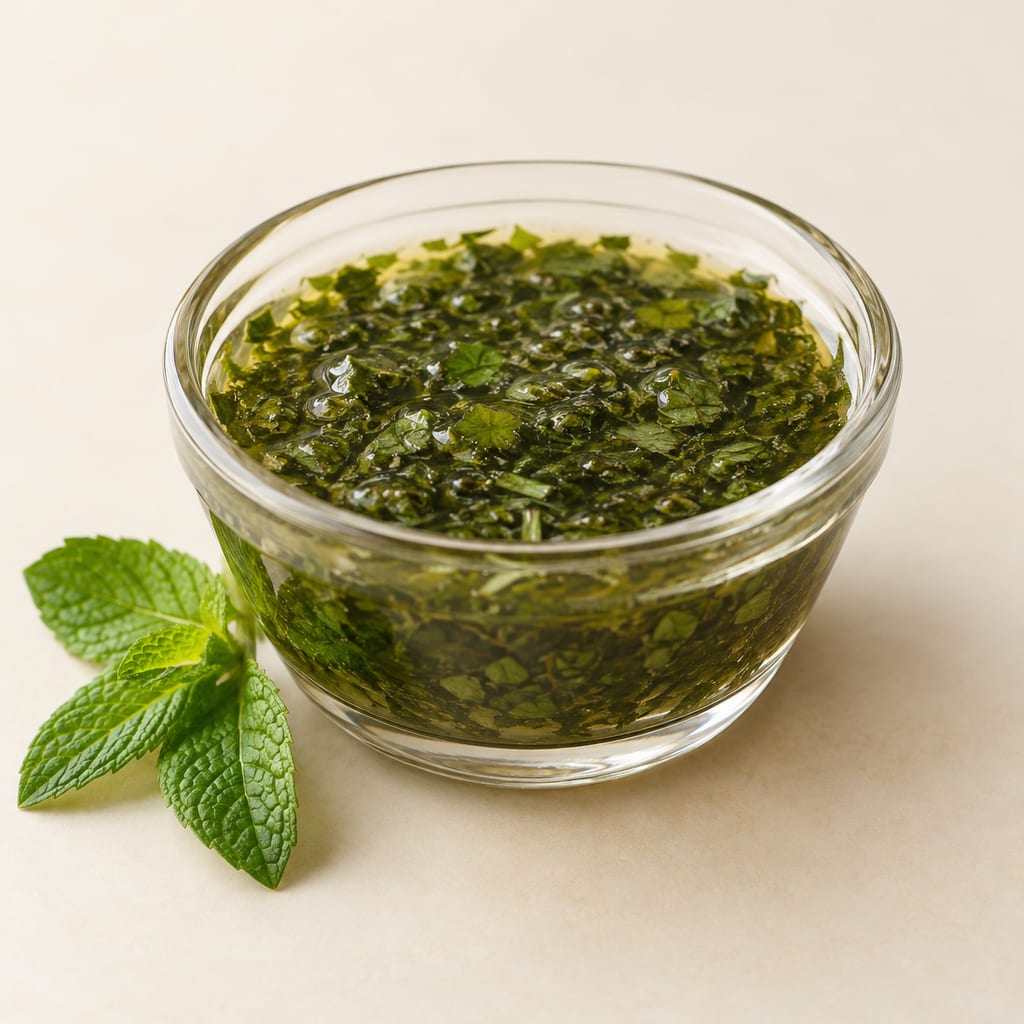
Finely chopped fresh mint steeped in a sweet and sharp liquid of white wine vinegar, sugar and water, the sauce traditionally served with roast lamb in Britain.
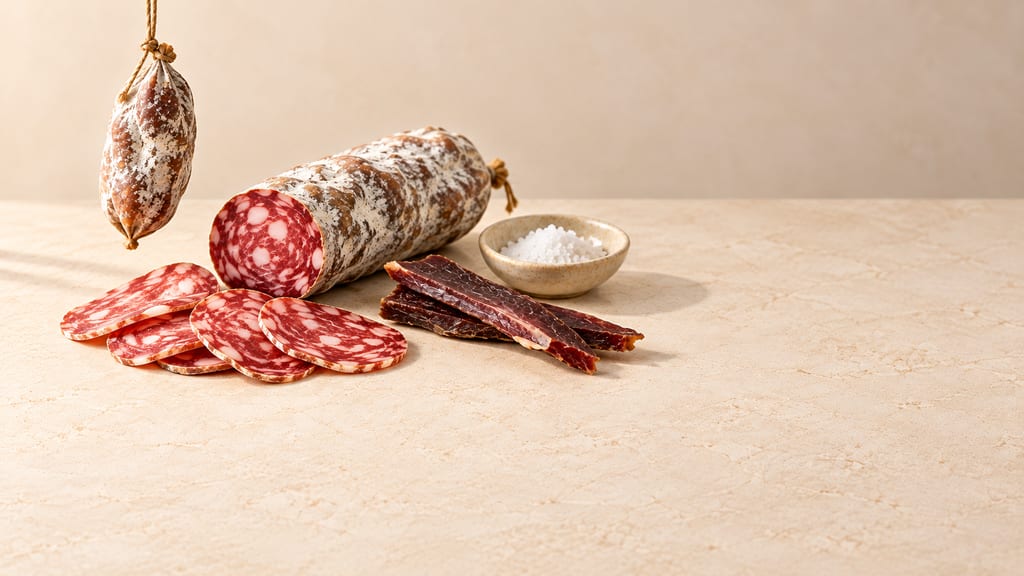
Dry salami, sour pork with rice, matured sheep and aged blubber follow different paths from animal to food. Their stories connect microbes with climate, slaughter, migration and the meals people share.
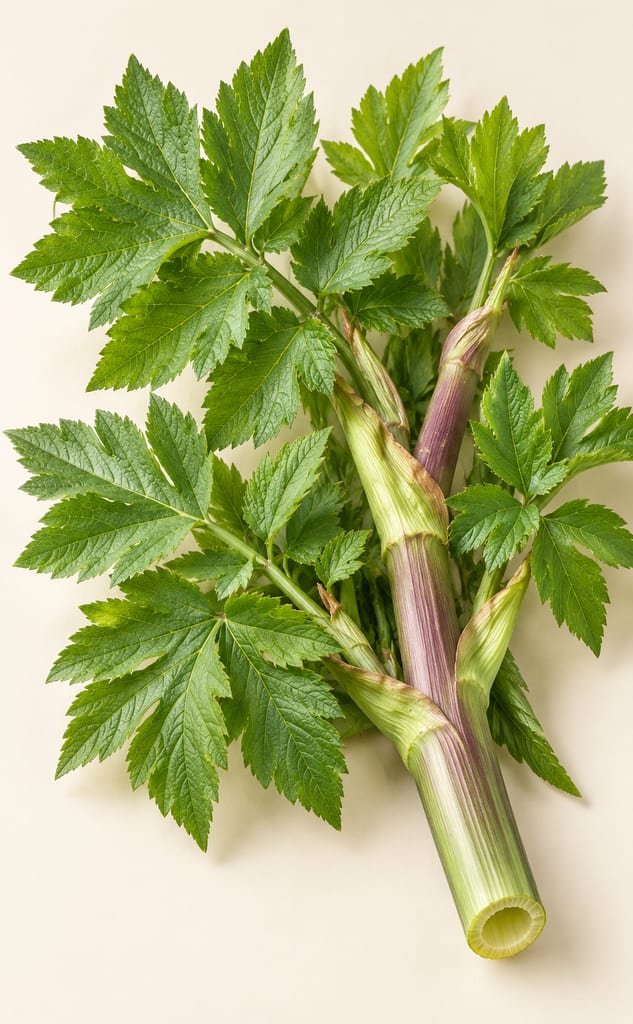
Angelica here means garden angelica (Angelica archangelica), an aromatic Apiaceae used as a vegetable, seasoning and candied stem, with Sámi food traditions linking it to preserved milk dishes.
Faroese spik is the under-skin blubber of the long-finned pilot whale, eaten salted alongside dried fish or whale meat and sometimes spread on bread. It is a distinct fat tissue, not meat, sheep tallow or rendered whale oil.
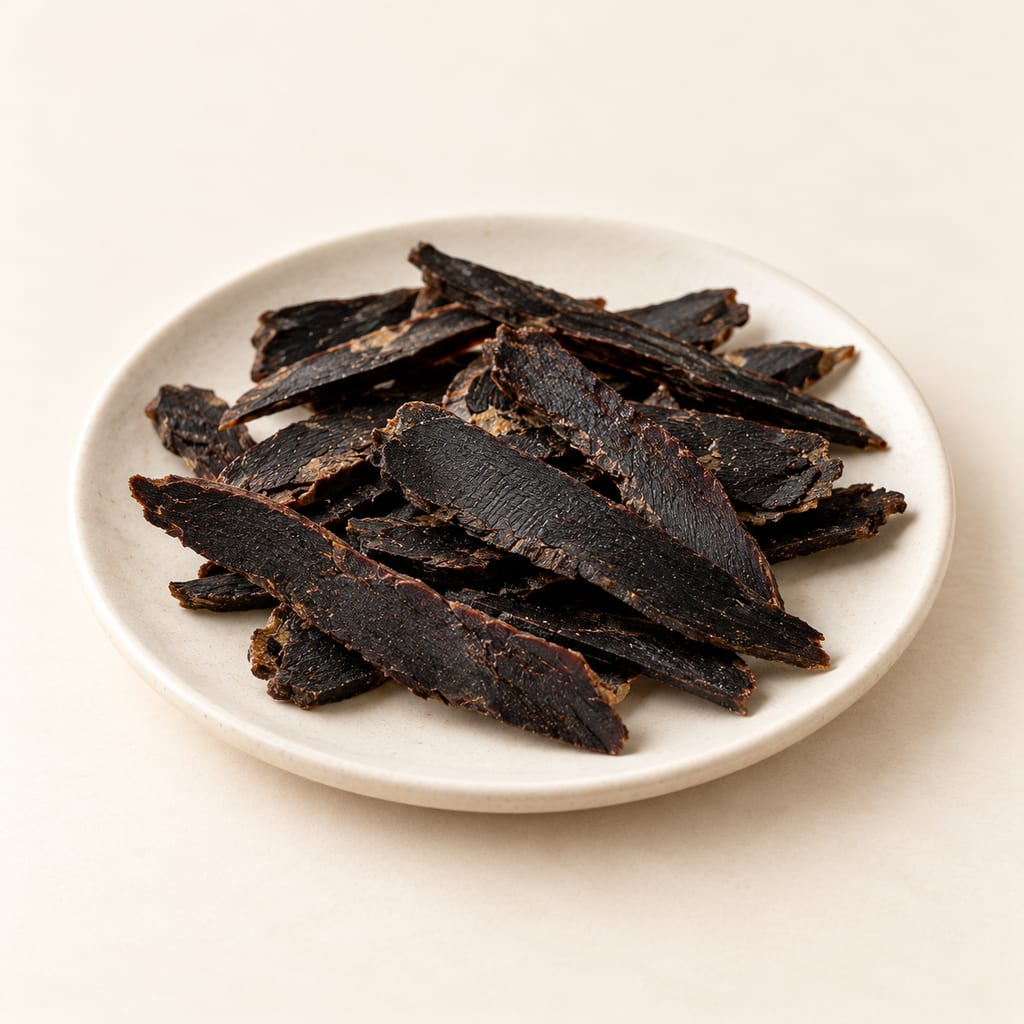
Long-finned pilot-whale meat, called Faroese tvøst, is eaten fresh and preserved in the Faroe Islands. Historical accounts place it among the meats hung to dry and pass through the ræst stage, distinct from blubber and other whale foods.
Saithe (Pollachius virens), also called coalfish and coley, is a North Atlantic cod-family fish used fresh and in distinct preserved forms. Faroese ræstur fiskur and Shetland salted piltocks are not the same product.
No community contributions have been published for this entry yet.
Sign in to contribute. Published comments and photos are free to read.
Food and Agriculture Organization of the United NationsIngredient context · Geography
Sheep | Livestock SystemsDomestic sheep are raised for meat, wool, milk and hides; breed and production systems vary across world environments.
Cited in: One species, different meats; Sheep and food landscapes; How the meat is used
USDA Agricultural Marketing ServiceIngredient identity
Standards for Lamb, Yearling Mutton and Mutton CarcassesUS carcass standards distinguish lamb, yearling mutton and mutton by maturity evidence, including skeletal and muscular traits and typical lean characteristics.
Cited in: One species, different meats; Carcass, muscle and cut
AnimalIngredient context
Factors affecting sheep carcass and meat quality attributesSheepmeat quality varies with the animal, production system, diet, age and processing; lipid content varies by cut.
Cited in: Carcass, muscle and cut
Archives Animal BreedingIngredient context
Chemical composition and fatty acid content in lamb and adult sheep meatA controlled study compared biceps femoris samples from lambs and ewes and reported group differences; its values are limited to the sampled animals and conditions.
Cited in: Carcass, muscle and cut
Visit Faroe IslandsHistory · Geography
The Sheep IslandsThe official account describes sheep in Faroese food and history, including the 1298 Sheep Letter and an earlier written reference.
Cited in: Sheep and food landscapes
Journal of Ethnic FoodsHistory · Ingredient context
Fermented mutton in the Faroe Islands: the survival of a local artisanship and food heritageEthnographic account of Faroese sheep meat, household knowledge and ræst/skerpikjøt stages.
Cited in: A substrate for many methods; Sheep and food landscapes; How the meat is used
International Journal of Food MicrobiologyMicrobiology
Bacterial species diversity of traditionally ripened sheep legs from the Faroe Islands (skerpikjøt)Study of nine legs from three producers reported a diverse bacterial community, including prominent catalase-positive cocci and Clostridium putrefaciens in some cores.
Cited in: A substrate for many methods
USDA Food Safety and Inspection ServiceSafety
How do I keep my foods safe to eat?Raw meat and juices should be kept away from ready-to-eat foods; wash hands and food-contact surfaces after handling.
Cited in: Choosing, storing and handling
USDA Food Safety and Inspection ServiceSafety
What are suggested storage times for lamb?Consumer storage guidance differentiates raw ground lamb from other raw lamb cuts; it is not a preservation-process specification.
Cited in: Choosing, storing and handling
Norwegian outbreak investigatorsIngredient context · Safety
An outbreak of Escherichia coli O103:H25 — bacteriological investigations and genotyping of isolates from foodThe supplied fermented-meat atlas cites this investigation as part of its evidence on Norwegian morr; an outbreak report is hazard evidence, not a process specification.
Patrimoine culinaire suisseIngredient context · Geography
Salsiz / Andutgel / AnduchelRegional synthesis documents lamb and game variants within the broader Salsiz tradition; not every Salsiz contains sheep meat.