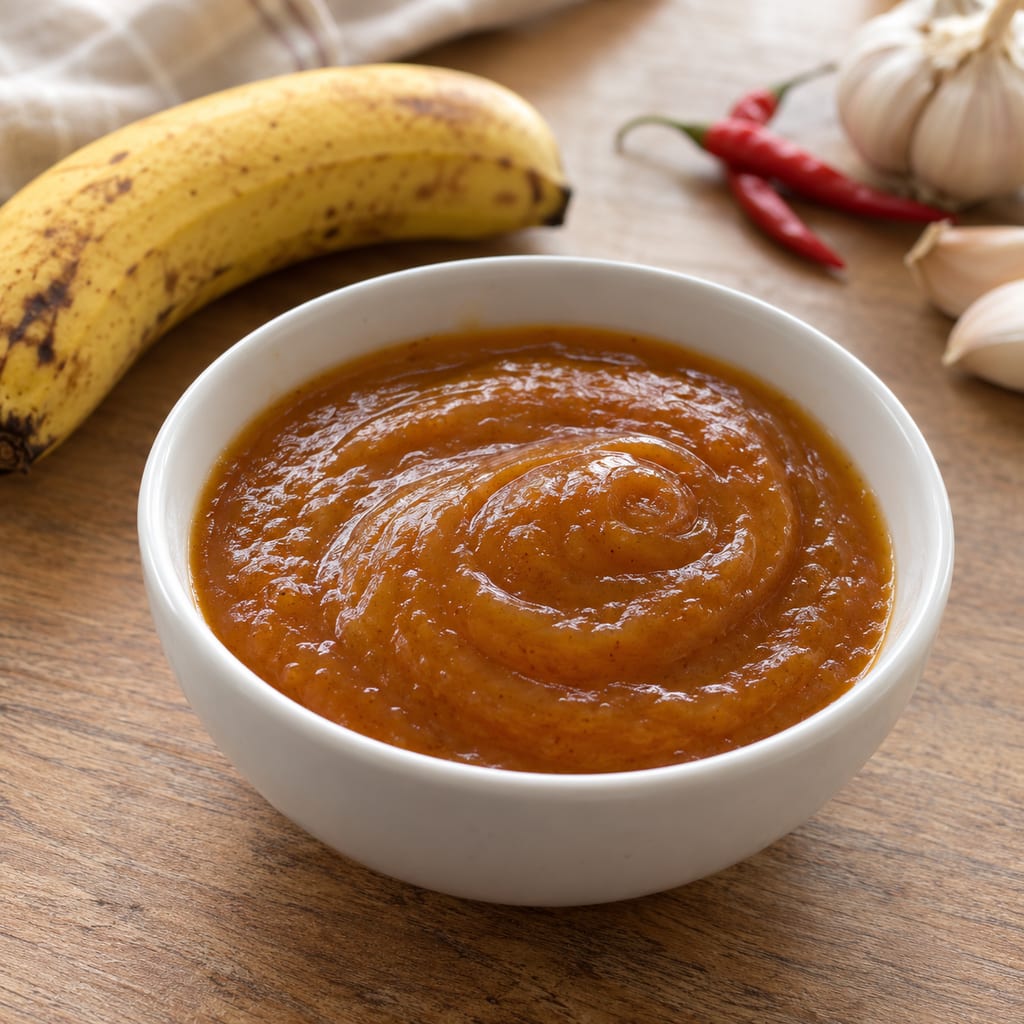
Banana ketchup in a Filipino-inspired direction
A sweet-hot table sauce of ripe banana simmered with vinegar, sugar, onion, garlic and fresh chilli, in the manner of Philippine banana ketchup. An untested development batch of about 500 g.
 FermenteaWhere food goes to change
Substrates
A ripe banana is sweet, soft pulp in which ripening has turned most of the starch into sugar. That sugar and softness make it a base for banana ketchup, beer, wine and vinegar.
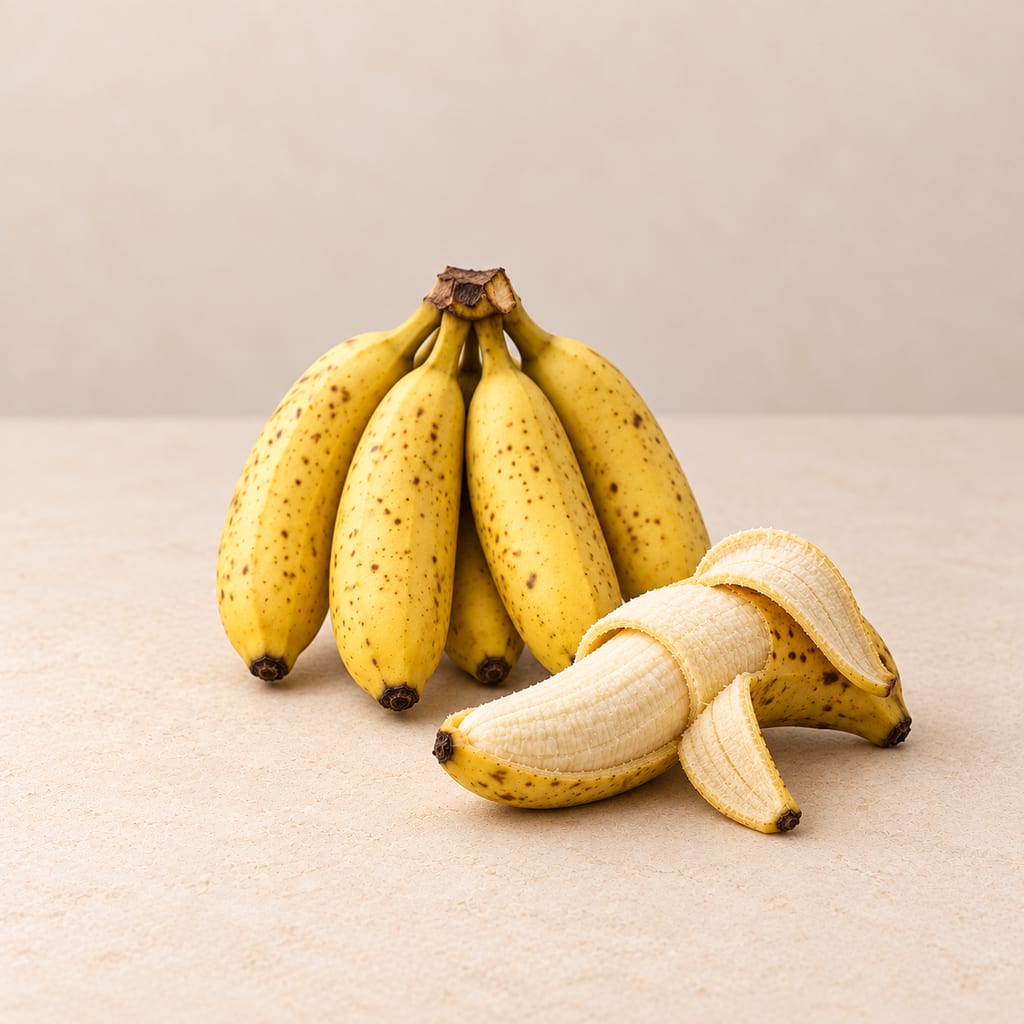
A ripe banana is the same fruit as a green one, caught at a different moment. Botanically it is a berry, borne in a hanging bunch on a giant herbaceous plant of the genus Musa. A bunch is built from about nine tiers called hands, with up to twenty fingers to a hand, and weighs somewhere between 22 and 65 kilograms. Picked mature but green, the fruit is firm, starchy and astringent; left to ripen, it turns yellow, softens, sweetens and takes on the aroma people call banana. Almost everything that matters about a banana in a kitchen, from how it mashes to how fast a yeast can work on it, depends on where it stands on that road.
The cultivated bananas of the world are mostly sterile triploids that set fruit without pollination and contain no seeds worth the name. Almost all of them descend from two wild species, Musa acuminata and Musa balbisiana, or from crosses between them. Geneticists write the contribution of each as letters. The sweet dessert bananas, Cavendish among them, are AAA; many of the starchier types that are usually cooked, including the Philippine Saba, are AAB or ABB, with balbisiana in the mix. Plantain is the best-known AAB cooking type, and the line between a banana for eating raw and one for cooking is a cultural and culinary habit as much as a botanical one. Some cultivars serve both purposes.
This page is about the banana at the ripe end of that road: soft, yellow to freckled, sweet and aromatic. Its two roles in the fermented kitchen are different from what a green banana offers. A ripe banana is a sugar source and a thick, pulpy base, and it is the form in which bananas are fermented into beer, wine and vinegar or cooked down into a sauce such as banana ketchup. Green bananas, which are starch and little else, belong to a different set of dishes.
The oldest evidence of people growing bananas comes from the highlands of New Guinea. At Kuk Swamp in Papua New Guinea, excavations have found banana phytoliths, the tiny silica bodies that plants leave in soil, in cultivation plots dated to at least 6950 to 6440 calibrated years before the present. The same dig shows plant exploitation on the wetland margin more than 10,000 years ago and taro in use in the early Holocene, so bananas were part of an agriculture that arose independently in the island of New Guinea rather than a borrowed one.
The edible banana is a creation of selection rather than of seed breeding. The fruit of the wild plants is full of hard seeds and has little pulp. Over a long time, people found and propagated individual plants that happened to set seedless, fleshy fruit, and they did it by moving suckers, the shoots that grow from the base of the plant. Most cultivated bananas are such mutants taken from wild populations at different places and different times, which is why the crop carries a patchwork of genomes, and why the same name in two countries can mean different plants.
The modern export trade is recent. North Americans began buying bananas on a small scale after the Civil War, consumption grew widely in the 1880s, and the plantation system was set up in the 1870s by the founders of the Boston Fruit Company. The Gros Michel, discovered in the 1820s, dominated that trade.
For much of the twentieth century the export banana was the Gros Michel, a sweet, thick-skinned AAA type that travelled well. It was wiped out as an export crop by Fusarium wilt, a soil-borne fungal disease known as Panama disease, caused by Fusarium oxysporum f. sp. cubense and first reported in Australia in 1876. Gros Michel is susceptible to race 1 of the pathogen. The Cavendish cultivars are resistant to it, and the industry replaced Gros Michel with them, an expensive changeover that solved the problem for decades.
The solution created a new weakness. Cavendish bananas are propagated as clones, so a whole industry rests on genetically identical plants. In subtropical areas where cold stress weakened them, Cavendish plants proved susceptible to a race 4 of the pathogen, and in 1990 a variant was reported that attacks Cavendish even in the tropics, now called tropical race 4. For more than twenty years it was confined to East and parts of Southeast Asia and northern Australia; it has since been confirmed in Jordan, Oman, Mozambique, Lebanon, Pakistan, Vietnam, Laos, Myanmar and Israel and has destroyed hundreds of thousands of hectares of Cavendish in China, the Philippines and Indonesia. The Food and Agriculture Organization counts it as confirmed in 21 producing countries.
Bananas are among the largest crops by volume. The FAO puts the Cavendish at just under half of global production, about 50 million tonnes a year, with world trade recently near 20 million tonnes. More than 90 percent of exported bananas come from Central and South America and the Philippines; India and China are the largest producers, mostly for their own markets. Over 1,000 varieties exist, and for many households in Africa and Asia the banana is a staple that is eaten at ripeness or cooked while green, not a dessert. In some producing countries banana farming accounts for around three-quarters of smallholder income.
A banana plant is not a tree. The apparent trunk is a pseudostem, a stack of tightly rolled leaf sheaths, and the plant is a herb that averages about five metres in height, with leaves that can reach 2.7 metres and a sheathing leaf that can grow up to 1.6 metres in a day. Each plant fruits once. After the bunch is harvested the mother plant is cut down and a sucker growing from its base takes its place, so a plantation renews itself without replanting.
Growers have used propagation to keep varieties true. Because most cultivars are sterile, they are multiplied by suckers and spontaneous clonal variants are observed and selected, as in the Cavendish group, where a family of height variants runs from tall types such as Lacatan and Robusta to dwarfs such as Dwarf Cavendish. The same clonal habit makes the crop vulnerable. Black sigatoka leaf spot, caused by Mycosphaerella fijiensis, commonly causes 50 percent crop losses, and in commercial plantations agrochemical sprays can account for up to 30 percent of production costs.
Export fruit is cut green and ripened at the destination. Cavendish bananas are shipped for three to four weeks at about 13 degrees Celsius, then held near 17 degrees and treated with low concentrations of ethylene, the plant hormone that triggers ripening. Colour turns yellow at around 18 degrees, and Cavendish ripened above about 27 degrees Celsius stays green. Fruit for local markets is often left to ripen on the bunch or in the home.
A green banana is mostly starch. A ripe one is mostly sugar. The shift is driven by ethylene, which switches on amylases that cut starch into sugars and pectinases that loosen the cell walls, and it is measurable stage by stage. Saba bananas can be sorted into five maturity stages by peel colour: all green, green turning yellow, greenish yellow, yellow with green tips, and yellow with brown flecks. Over those five stages total soluble solids rose from 4.2 to 16.45 degrees Brix, the pH fell from 6.66 to 4.70 and titratable acidity, expressed as malic acid, rose from 0.037 to 0.218 percent. Glucose and fructose, each about 0.2 percent of the fresh fruit when green, reached about 3.7 and 4.0 percent respectively, and sucrose climbed from 2.3 to about 8 percent, a threefold rise. Total starch fell by more than 40 percent, from about 26 to 14.75 percent, and resistant starch fell from 17.4 to 5 percent.
The starch that remains is a feature of the cultivar. In triploid hybrid bananas starch is reported to drop from 20 to 30 percent to 1 or 2 percent in ripe fruit; the Saba, which is a cooking banana, was still holding nearly 15 percent starch in its most ripe stage. A dessert banana left to the same point has far less. Sweetness, then, is not one number; it depends on the cultivar and on how far ripening has gone.
Texture follows the pectin. In unripe fruit the cell walls are held together by water-insoluble protopectin. As ripening proceeds, enzymes convert it to a more soluble pectin, the flesh softens, and the fruit can be mashed to a puree or squeezed for juice. Moisture content rises slightly, from 62.3 to 64.3 percent in the Saba, because the breakdown of starch releases water and because water moves from peel to pulp. Organic acids, mainly malic and citric, accumulate as the pH falls. In the fermented drink, the banana aroma is carried by esters, chiefly isoamyl acetate, which yeast makes during fermentation.
A fermenter wants sugar, and ripeness is how a banana provides it. Ripe banana juice reads around 10 degrees Brix, which is enough to make a drink of a few percent alcohol after dilution. Unripe fruit offers starch that wild yeasts cannot use and a mass of pectin that does not release its juice; a ripe fruit is soft, juicy and nearly all fermentable sugar. The ripening step is therefore a deliberate part of the traditional process.
In Uganda the beer is called tonto, with relatives in Kenya, Rwanda and Burundi (urwagwa), Burundi (isongo) and Tanzania (mbege). Beer-type bananas, including Pisang Awak (known locally as Kayinja), Kisubi and Mbidde, are cut mature and ripened for three to eight days in a pit lined with banana leaves. The ripe fruit is peeled and mixed with spear grass, which acts as a filter and pressing aid, and the juice is squeezed out with the feet in a canoe-shaped wooden vat. It is then filtered, diluted with water and combined with coarsely ground roasted sorghum, and left to ferment spontaneously at ambient temperature, with yeasts and lactic acid bacteria from the bananas, the vat and the sorghum doing the work. Over 60 hours in measured batches, total soluble solids fell from about 15 to 5 degrees Brix, pH fell from about 4.9 to 3.6, acidity rose from 0.21 to 0.77 percent as lactic acid, and ethanol rose from nothing to about 4.7 percent by volume. Thirty-eight volatile compounds were identified, mostly esters and alcohols, and isoamyl acetate gave the banana note.
Ripeness is also a safety matter. Methanol is made in the breakdown of pectin, and fruit that is unripe or unpeeled carries more of it. In measured samples of tonto, methanol ranged from none to 950 milligrams per litre, half the samples exceeded the Ugandan standard limit of 60 milligrams per litre, and the highest values came from a district where producers reported using unripe or unpeeled bananas. The point generalises to banana wine and any fruit-mash fermentation: use fully ripe, peeled fruit, because smell and taste do not reveal methanol, and methanol poisoning can show itself only after 12 to 24 hours.
The same sweetness works against safety in preserved sauces. A banana sauce is a sugary, acidic puree; ripeness raises its sugar and the pH range of the ripe fruit is already acidic, but neither the fruit nor its pH establishes that a bottled sauce is shelf-stable. Any home recipe for a preserved sauce needs a validated process.
In the Philippines the ripe banana became the base of a national condiment. The National Park Service account of the food technologist Maria Ylagan Orosa says tomato ketchup arrived in the Philippines after the Spanish-American War and became popular, but it was expensive and the climate did not suit tomatoes, so in the 1930s she made a ketchup from bananas. She is credited with almost 700 inventions and recipes, including soybean drinks and flours from cassava, green bananas and coconut, and died on 13 February 1945, killed with more than 400 others when an American bomb struck a hospital in the Battle of Manila. Banana ketchup, also called banana catsup, is now bottled by large manufacturers and is, in the Park Service words, a staple at Filipino meals.
The fruit most associated with it is the Saba. Saba is the most important banana in Philippine commercial production and trade, grown across Southeast Asia under other names: pisang kepok in Indonesia, pisang abu nepah in Malaysia, kluai hin in Thailand and chuoi mat in Vietnam. The ripe fruit can be eaten raw but is more often cooked, boiled or fried in syrup, and the green fruit is used like a vegetable and processed into chips, ketchup and sauces. It is cheaper than dessert bananas and rural households eat it as an alternative to rice and corn. The sources do not record which stage the ketchup is made from, and recipes differ, so the sweetness a cook gets from the fruit depends on the ripeness chosen.
Elsewhere ripe bananas go into fritters, curries, chips, jams and baked or steamed dishes, and Fe’i bananas of the Pacific are mostly cooked, while the Karat banana is eaten raw.
Ripeness shows on the peel. The five Saba stages give a usable scale: all green is a starch fruit; green turning yellow is still firm and astringent; greenish yellow is beginning to sweeten; yellow with green tips is edible; yellow with brown flecks is fully ripe, with the highest sugar, the lowest pH and the softest flesh. Brown flecks mark a banana at its sweetest, not a defective one. For a fermentation or a puree, this last stage is the one to use.
Bananas are tropical fruit, and the commercial cold chain runs at about 13 degrees Celsius for transit, not near freezing; once brought out, the fruit ripens quickly. No safe storage time for ripe banana pulp or puree is established, so none is given here: a mashed banana is a moist, sugary food that spoils or begins to ferment on its own and should be handled accordingly.
Banana allergy and the cross-reactions that link some fruit allergies to latex are real but outside the sources used for this page, and anyone with a known fruit or latex allergy should treat banana as a possible trigger.
The roughly 1,000 cultivars held in tissue culture at Bioversity International in Belgium show how wide the group is. For the fermented kitchen a few types matter most. The AAA dessert bananas, Cavendish among them, are the sweet types eaten raw. Saba and other ABB or AAB cooking types keep more starch: a ripe Saba still held nearly 15 percent starch, and it is the fruit most tied to banana ketchup. East African highland beer bananas, locally called Embiire in Ntungamo district, are high in fermentable sugar and also in tannin and sticky brown latex, with a bitter, astringent pulp that makes them useful for brewing and poor for the table. Mixed beer cultivars such as Kayinja, Kisubi and the hybrid FHIA 25, used in Kalungu, were chosen for a high juice yield and sweetness with lower latex and tannin.
Because different cultivars differ in sugar, dry matter, acidity and mineral content, a recipe that says only ripe banana leaves a lot undefined. The same ripeness colour can mean a different Brix in a different cultivar, and a cook who changes cultivar changes the sweetness, the juice yield and the pectin load.
Ripe-banana pulp, juice and sauce all keep poorly without a validated process, and no storage limit is given here. The sugar figures above come from the Saba cultivar and the juice figures from East African beer bananas; other cultivars differ. Which ripeness stage is used for banana ketchup is not established.
Earliest dated evidence of banana cultivation; it does not establish a single birthplace for every cultivar.
Home of banana ketchup and of the Saba banana, the country’s leading commercial cultivar; a country-level association, not a locality.
Tonto, a beer made from juice of ripened beer bananas, is documented in Ntungamo and Kalungu districts.
Export plantation region where the Gros Michel and then the Cavendish served the world trade; no single country is claimed.
A sweet-hot table sauce of ripe banana simmered with vinegar, sugar, onion, garlic and fresh chilli, in the manner of Philippine banana ketchup. An untested development batch of about 500 g.
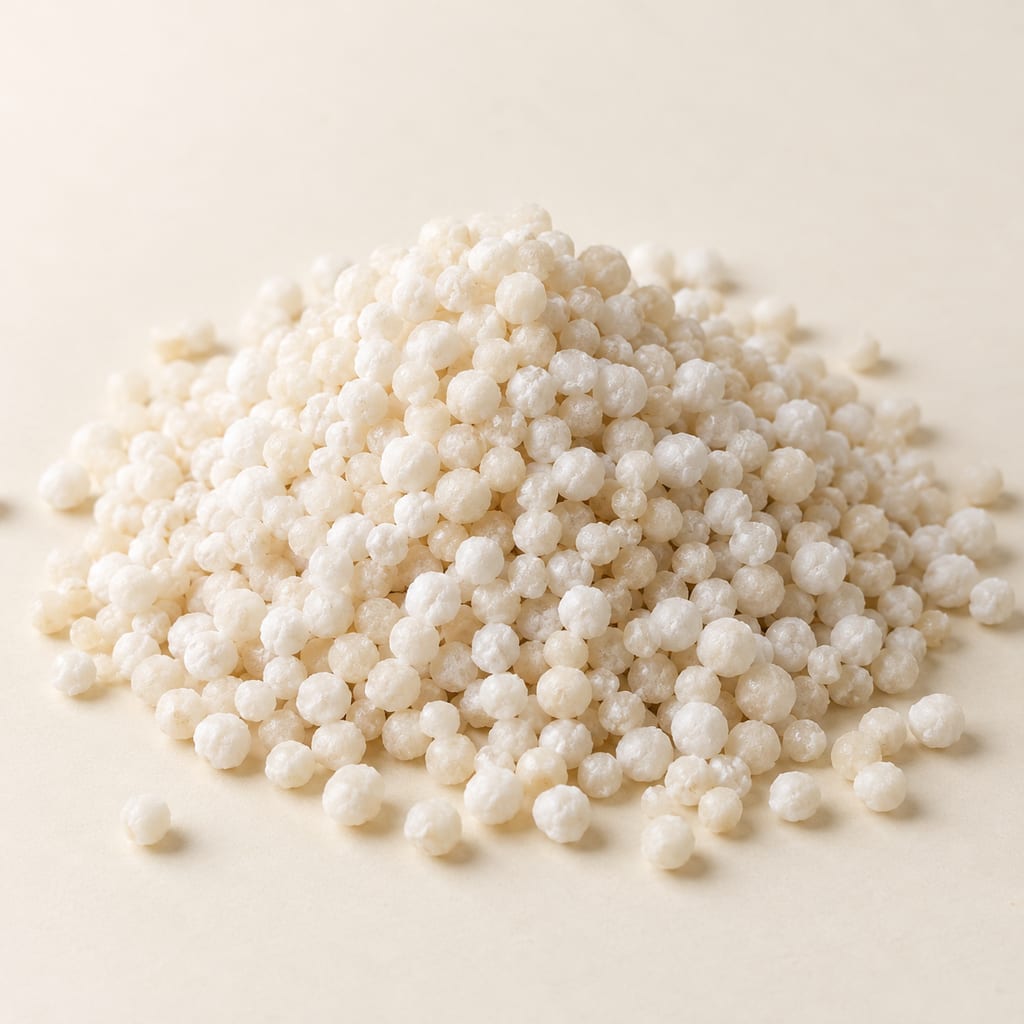
Sago is the starch extracted from the pith of several palms, mainly Metroxylon sagu, and it is dried into flour or pearls that are a staple in Southeast Asia and New Guinea.
Sago starch is edible starch recovered from the pith of sago palms. It is pressed into thin cakes for Indonesian sagu lempeng, cooked as porridge and formed into other foods; in some regions, wet starch also ferments during storage.

At North Abydos in Egypt, a fixed early Dynastic brewery comprised parallel semi-subterranean installations with rows of ceramic mash vats; excavation reports revise their number, scale and estimated batch capacity.

Ají amarillo is the orange-yellow Peruvian chilli cultivar group of Capsicum baccatum, used to colour and season huancaína sauce and ají de gallina. Published heat estimates do not establish one range for the named cultivar.

Toasted almonds are whole sweet almond kernels dry-roasted until golden to brown. Heat replaces their marzipan note with a roasted, nutty one; they thicken and flavour romesco.

Kodiak salmon, halibut and cod cut as seg'aq and hung on an initaq rack to become tamuuq, with kac'amaasaq and kupcuunaq named as different results.

Aniseed is the dried ripe fruit of Pimpinella anisum, an aromatic Apiaceae spice commonly called a seed. It adds a sweet, warm aroma to breads such as Moroccan krachel and South African mosbolletjies, and is distinct from star anise.

A fixed Late Chalcolithic installation in Areni-1 cave combined a shallow clay pressing basin with a large jar set into the cave floor and storage vessels nearby.

Ripe avocado flesh is the soft, buttery, fat-rich pulp of Persea americana, eaten raw. It is low in acid, so it is a fresh ingredient that needs care in chilled dishes.

A portable dome and pan used over a hearth, with embers on the lid and heat from below. Regional peka and saç forms share this principle while differing in materials, pan shape and how the food is cooked.
No community contributions have been published for this entry yet.
Sign in to contribute. Published comments and photos are free to read.
Scientific Reports (Nature Portfolio)Composition · Ripening · Cultivar
In vitro examination of starch digestibility of Saba banana [Musa ‘saba’ (Musa acuminata × Musa balbisiana)]: impact of maturity and physical properties of digestaFive maturity stages by peel colour with Brix, pH, titratable acidity, glucose, fructose, sucrose, resistant and total starch at each stage.
Starch falls by more than 40 percent from stage 1 to 5 in the Saba; earlier reports show starch falling from 20 to 30 percent to 1 to 2 percent in triploid hybrid bananas.
Protopectin converted to soluble pectin in ripening; Saba names in Southeast Asia, its role as an alternative staple, and its use for chips, ketchup and sauces.
Cited in: A fruit that finishes becoming food after it is picked; What happens inside the fruit as it ripens; What ripeness does in a fermentation; Banana ketchup and the cooked table; Choosing and keeping ripe bananas; Varieties and what they bring; Notes
Food Science & Nutrition (Wiley)Fermentation · Safety · Cultivar
Characterization of Physicochemical Properties, Volatile Compounds, and Sensory Attributes of Tonto, a Traditional Ugandan Banana-Based Alcoholic BeverageBananas ripened 3 to 8 days in a leaf-lined pit, peeled, pressed with spear grass, diluted and fermented with roasted sorghum for 60 hours.
pH, Brix, acidity and ethanol changes over 60 hours; isoamyl acetate as the banana aroma.
Methanol concentrations, the Ugandan standard limit of 60 mg/L, and the link to unripe or unpeeled fruit and pectin.
Beer-banana cultivars (Embiire, Kayinja, Kisubi, Mbidde, FHIA 25) and their sugar, tannin and latex traits.
Cited in: What ripeness does in a fermentation; Varieties and what they bring; Notes
Frontiers in Plant ScienceHistory · Economics · Disease
Fusarium Wilt of Banana: Current Knowledge on Epidemiology and Research Needs Toward Sustainable Disease ManagementGros Michel as the original export banana, susceptible to Foc race 1 and replaced by resistant Cavendish cultivars.
Subtropical race 4 and tropical race 4 (reported 1990); countries where TR4 has been confirmed; loss of hundreds of thousands of hectares of Cavendish.
First report of Fusarium wilt in Australia in 1876.
Cited in: Gros Michel, Cavendish and the economics of one clone; How the fruit is grown
Annals of BotanyTaxonomy · Domestication · Cultivation
Domestication, genomics and the future for bananaCultivated bananas are sterile, parthenocarpic, mostly triploid with AAA, AAB and ABB genome constitutions.
Domestication by collection of spontaneous mutants; sucker propagation; Cavendish height variants.
Black sigatoka losses and agrochemical cost; about 1,000 cultivars held at Bioversity International in Belgium.
Cited in: A fruit that finishes becoming food after it is picked; Where the banana began, and how it came to be everywhere; Gros Michel, Cavendish and the economics of one clone; How the fruit is grown; Varieties and what they bring
ScienceHistory · Domestication
Origins of agriculture at Kuk Swamp in the highlands of New GuineaAgriculture arose independently in New Guinea by at least 6950 to 6440 cal yr BP; bananas intensively cultivated by that time; wetland-margin plant use at 10,220 to 9910 cal yr BP; taro used in the early Holocene.
Cited in: Where the banana began, and how it came to be everywhere
Food and Agriculture Organization of the United NationsProduction · Trade · Disease
BananasOver 1,000 varieties; Cavendish just under half of production at about 50 million tonnes; trade about 20 million tonnes a year.
More than 90 percent of exports from Central and South America and the Philippines; India and China the largest producers for home use.
Tropical race 4 confirmed in 21 countries; banana farming can be around three-quarters of smallholder household income.
Cited in: Gros Michel, Cavendish and the economics of one clone
US National Park ServiceHistory
Maria Ylagan OrosaIn the 1930s Orosa made a ketchup from bananas because imported tomato ketchup was expensive and tomatoes unsuited to the climate.
Almost 700 inventions and recipes; killed in Manila on 13 February 1945.
Cited in: Banana ketchup and the cooked table
WikipediaLead · Ripening
BananaHands and fingers per bunch and bunch weight; berry classification.
Commercial ripening: transit at about 13 degrees Celsius for 3 to 4 weeks, ethylene treatment near 17 degrees, yellowing around 18 degrees, no yellowing above about 27 degrees; ethylene activates amylase and pectinase.
Fe’i and Karat bananas; uses in fritters, chips, preserves.
Cited in: A fruit that finishes becoming food after it is picked; Where the banana began, and how it came to be everywhere; How the fruit is grown; What happens inside the fruit as it ripens; Choosing and keeping ripe bananas