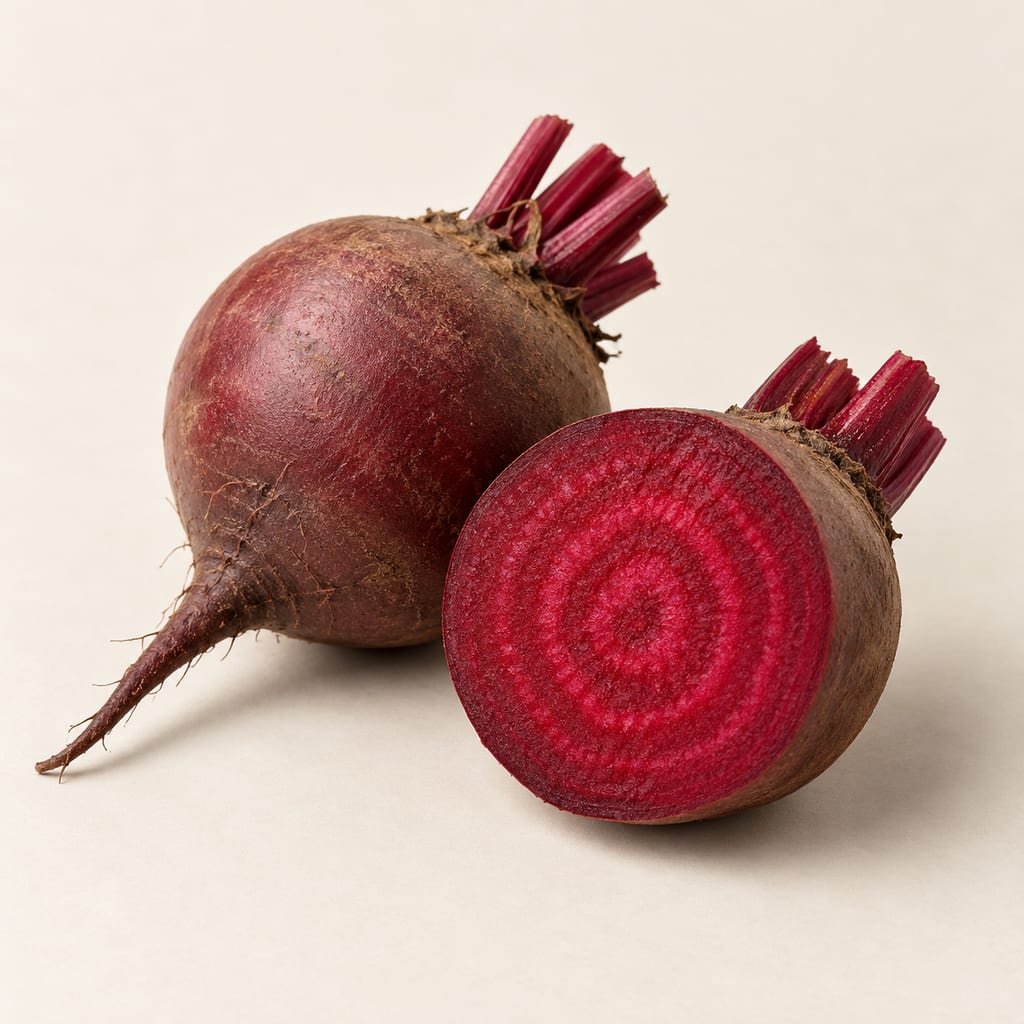
Beetroot
Beetroot is the red taproot of Beta vulgaris. In Poland its soured juice replaced hogweed as the base of barszcz from the eighteenth century, and beet leaven is still made for Christmas Eve.
 FermenteaWhere food goes to change
Modern method
Raw beetroot cut and packed into a jar under a salt-water brine, fermented until sour and deeply coloured; the batch weight is not recorded.
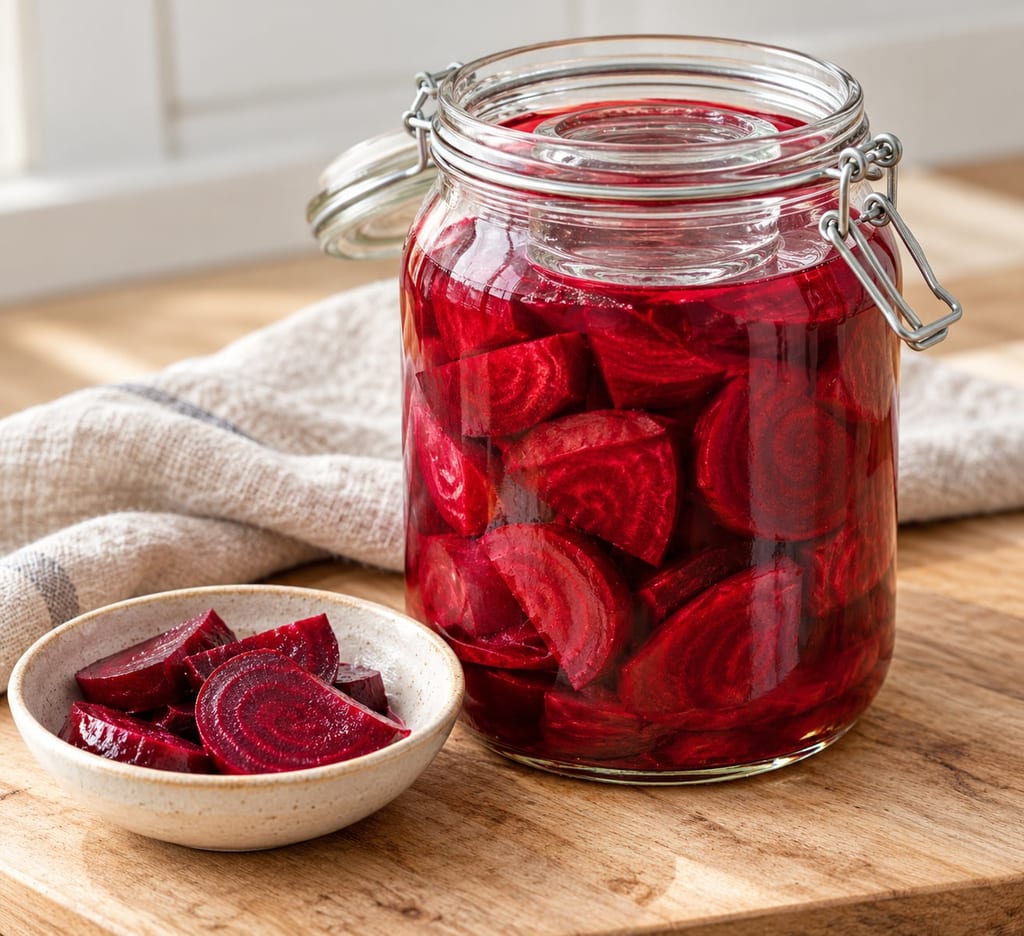
Lacto-fermented beets are pieces of beetroot preserved in a saltwater brine through the action of lactic-acid-producing microorganisms.
The vegetable is Beta vulgaris L., specifically the cultivated beetroot forms.
Beetroot contains soluble carbohydrates, plant fibres and strongly coloured pigments. During fermentation, some of its sugars are transformed into organic acids, changing the flavour from predominantly sweet and earthy to sweet-sour.
The recipe held in the Fermentea database uses peeled, sliced beets in a quart-sized jar.
It is a modern jar fermentation documented in a video demonstration.
That matters because beetroot appears in several older food traditions, but the precise origin of this particular recipe is unknown.
It should not automatically be classified as traditional Polish beet kvass, Ukrainian beet sour or a vinegar-pickled beet recipe.
Those products share some ingredients but may differ substantially in process and intended use.
Beets are strongly associated with Eastern and Central European cooking.
They appear in soups, salads, pickles, relishes and beverages.
Several traditional preparations use fermented beets or fermented beet liquid.
For example, beet sour preparations are associated with regional versions of barszcz and borscht.
The fermented liquid may serve as an acidic base for soup.
Other traditional beet preparations use vinegar, which creates acidity without relying on microbial fermentation.
These categories should remain distinct.
The Fermentea record concerns the preservation of sliced beetroot as the primary product.
Beet kvass, by contrast, generally emphasises the liquid.
A household may use both the fermented beets and their brine, but that does not make every fermented beet pickle a kvass.
The specific modern brine recipe also does not provide evidence for an ancient date of origin.
Its significance is that it adapts a familiar vegetable to a straightforward jar fermentation.
Fresh beetroot — Enough to fill a quart jar — Main substrate
Salt — 3 tablespoons — Brine and microbial selection
Water — 3 cups — Fermentation liquid
The demonstrated formula uses 1 tablespoon salt per cup water.
The salt may be kosher, canning or sea salt.
The recorded method does not specify a single salt brand or mass.
This creates an important uncertainty.
Different salt types have different crystal sizes and bulk densities.
Three tablespoons of fine salt may weigh considerably more than three tablespoons of certain coarse kosher salts.
Consequently, the original record does not establish one precise mass-based salt concentration.
It would be misleading to convert the tablespoons into a fixed percentage without weighing the salt.
Beetroot contains sugars that can support lactic-acid fermentation.
It also contains betalain pigments responsible for its familiar red-purple colour.
These pigments are chemically different from the anthocyanins of black carrots.
The red betalain group includes betacyanins, of which betanin is particularly important.
Yellow betalain pigments are known as betaxanthins.
Their relative proportions influence colour.
Beetroot also contains compounds associated with its characteristic earthy aroma.
Geosmin is one substance strongly associated with the earthy flavour of beetroot.
Fermentation may alter the balance of perceived sweetness, sourness and earthiness.
The exact result depends on the beet cultivar, salt concentration and microbial activity.
A successful ferment does not necessarily lose its earthy character; instead, acidity changes how that character is perceived.
1. Select suitable beets. The recorded method uses fresh roots. Reject those showing significant decay or unsuitable storage damage.
2. Wash thoroughly. Beetroot grows in soil, so cleaning is a critical initial step.
3. Trim and peel. The demonstrated recipe removes the outer skin before slicing.
4. Slice the beets. Prepare pieces that fit into a quart jar. The recorded method does not establish one exact slice thickness.
5. Pack the jar. Leave room for brine and a fermentation weight rather than compressing the slices so tightly that liquid cannot circulate.
6. Prepare the brine. Dissolve 3 tablespoons salt in 3 cups water.
7. Submerge the vegetables. Pour the brine over the beets and use a suitable weight to maintain coverage.
8. Allow fermentation. The video describes approximately 1–2 weeks at room temperature.
9. Assess and store. The recorded method does not provide a numerical fermentation temperature, validated endpoint pH or precise storage-life specification.
These are the recorded creator instructions.
They do not constitute an independently validated commercial preservation process.
Lactic-acid bacteria metabolise fermentable sugars in the vegetable.
This produces lactic acid and other compounds depending on the organisms involved.
The pH declines as acidity increases.
Acid development changes flavour and makes the environment less favourable to some competing microorganisms.
The rate of fermentation depends on temperature, salt concentration, starting microbial population and available carbohydrates.
Beet tissue also exchanges water and dissolved substances with the brine.
The salts and acids are not confined to the liquid.
They move into and out of the vegetable pieces.
The relative thickness of the slices influences how quickly these changes occur.
A thick beet wedge cannot be assumed to reach the same internal conditions as a thin slice after the same duration.
Recent research offers useful detail on how salt influences fermented beetroot.
A 2024 study investigated salt concentrations, betalain content, colour, pH, acidity and lactic-acid bacterial populations.
It identified 2–3% salt as favourable for bacterial growth and product characteristics under the investigated conditions.
The researchers also found that salt distribution changed substantially during fermentation.
In some treatments, nearly 50% of the added salt was absorbed into the beetroot tissue.
This is a particularly important result for interpreting the original jar formula.
The concentration of the initial brine is not necessarily the concentration of the liquid later in fermentation.
Nor does measuring only the liquid fully describe the salt distribution in the finished vegetable.
The published trial also identified changes in pigment composition, including different stability between red and yellow betalain fractions.
The findings apply to the studied formulations and conditions.
They do not independently validate the video's tablespoon-based recipe.
PubMed
The spectacular colour of fermented beetroot is one reason the product is attractive.
Betanin and related pigments can diffuse from cut tissue into surrounding water.
This can produce a deeply red-purple brine.
The visual change may begin soon after the beets are immersed.
It does not necessarily mean acid-producing bacteria have become established.
Colour extraction is a physical and chemical process that can occur independently of fermentation.
During fermentation, changes in acidity and exposure to other chemical conditions may influence pigment stability.
The 2024 salt study found that fermentation could reduce some betalain concentrations.
The red and yellow pigment groups did not always change at the same rate.
Another investigation examined the stability of betanin during fermentation and refrigerated storage.
Its results demonstrated that selected fermentation conditions can influence pigment retention.
That is useful for product development, but it does not establish that all fermented beets retain more pigments than fresh beets.
Beetroot is a poor visual indicator of fermentation success because it releases so much pigment.
A jar can look intensely red even before substantial acidification.
pH must therefore be assessed independently where safety matters.
A general threshold of pH 4.6 or below is important in acidified-food safety, but the finished equilibrium conditions and other process controls also matter.
The original video does not supply a measured pH.
A reader should not infer safe acidity simply from the demonstrated fermentation period.
Fresh beetroot is firm because of its cell-wall structure and internal water pressure.
Salting alters water movement.
Acids and enzymes can influence cell-wall materials.
The cut size changes how rapidly salt enters the tissue.
Thin slices generally permit faster exchange of dissolved substances than large pieces.
However, the original recipe does not identify a required thickness.
It is therefore impossible to claim that the documented one-to-two-week period applies identically to every possible cut.
A good sliced-beet pickle should retain a recognisable beet texture.
Excessive softening may be undesirable.
Unexpected sliminess or tissue breakdown can also indicate a problem.
Several related preparations deserve separate identification.
Beet kvass commonly prioritises the fermented liquid. Modern versions may use water, salt and pieces of beetroot.
Some historical and regional formulations involve bread or other ingredients.
Beet sour for soup is prepared specifically to provide an acidic beet component for dishes such as barszcz.
Vinegar-pickled beetroot uses prepared vinegar to acidify the vegetable rather than relying on spontaneous microbial fermentation.
Brined beet slices, the present recipe, are intended principally as an edible pickle.
The methods can overlap, but they are not necessarily interchangeable.
A database should distinguish whether the finished product is a beverage, soup base or vegetable pickle.
The sliced beets can be served cold as a side dish.
Their acidity makes them suitable alongside rich foods.
They can be chopped into salads with other vegetables.
Their colour provides strong visual contrast with potatoes, grains and pale ingredients.
They may accompany cheeses, sandwiches or cooked meats.
In a composed salad, the fermented beet brings both acidity and salt, so other dressings may need adjustment.
The texture is different from a cooked vinegar-pickled beet.
A raw fermented beet may retain more firmness, depending on the process.
The resulting food can offer a sharper contrast between crispness, sweetness and acidity.
Modern beetroot ferments sometimes include garlic, dill, peppercorns, caraway or other seasonings.
These can be reasonable culinary variations, but each added ingredient changes the formulation.
A small quantity of an aromatic ingredient may primarily influence flavour.
A substantial addition of another vegetable can change carbohydrate availability, moisture and microbial behaviour.
The original record contains only beetroot, salt and water.
Other vegetables and spices should therefore be presented as separately documented variations rather than silently inserted into the historical recipe.
The brine may become cloudy, and some gas may develop.
These changes can accompany fermentation.
But they do not demonstrate that the required acidity has developed.
Visible mould, rotten odours, persistent slime or gross tissue breakdown are reasons to reject a batch.
Because beetroot pigments can stain the liquid and vessel, colour alone is particularly unhelpful as a safety indicator.
The recorded method does not establish a complete validated refrigeration or room-temperature storage procedure.
Beetroot begins as a low-acid vegetable.
Preservation through lactic fermentation requires appropriate acidification.
The original recipe's salt measurement is volumetric and insufficient to establish one precise mass concentration.
A reliable production process should use measured ingredients, appropriate food-grade equipment and suitable acidity monitoring.
The University of Minnesota recommends monitoring pH and keeping vegetables submerged.
Penn State distinguishes research-tested fermented-pickle and sauerkraut procedures from other unvalidated home formulations.
This formulation is not a validated preservation method; its salt level, acidification and storage still need checking against a measured process.
A present-day online demonstration; no traditional history or geographic origin is asserted.
Scaling: source batch only
A vegetable ferment can spoil if acidification or brine coverage is inadequate; the video has not been independently process-validated.
Hazard sourceUse clean food-grade equipment, keep produce below brine and monitor acidity; do not transfer the video's unsupported sensory endpoint as a safety test.
Control sourceBased on a video demonstration; no professional process validation is recorded.
Do not use smell, taste, bubbling or appearance alone to establish safety.
The linked extension guidance recommends acidity monitoring; recipe-specific validated limits are not established.
Unknown; video does not establish recipe origin. The video documents a present-day demonstration, not a traditional regional origin.
Beetroot is the red taproot of Beta vulgaris. In Poland its soured juice replaced hogweed as the base of barszcz from the eighteenth century, and beet leaven is still made for Christmas Eve.
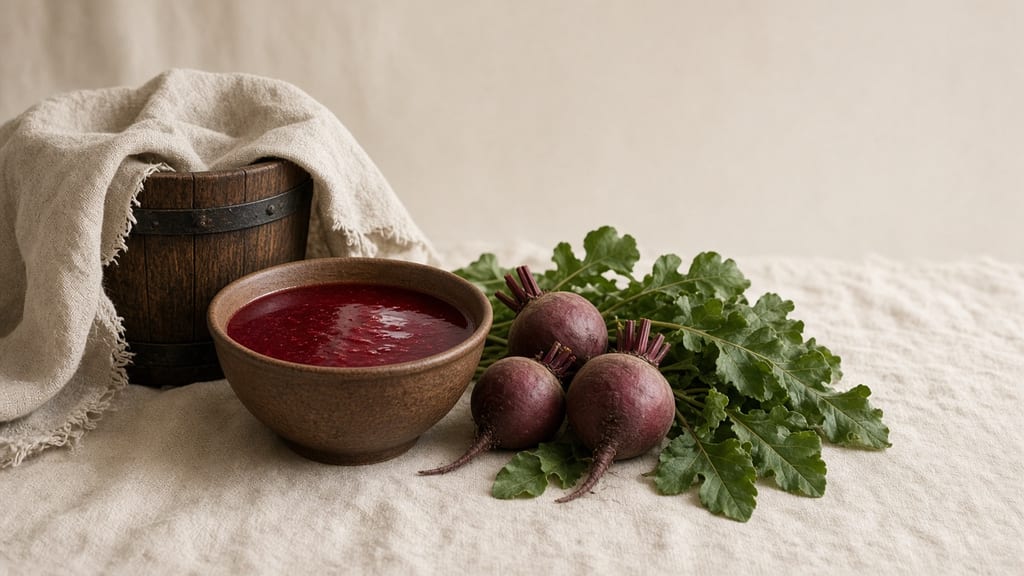
Before beetroot, Polish barszcz was a soup of soured hogweed leaves. Herbals, menus and an old cookbook show how a rye sour and then the beet barrel took over its name.
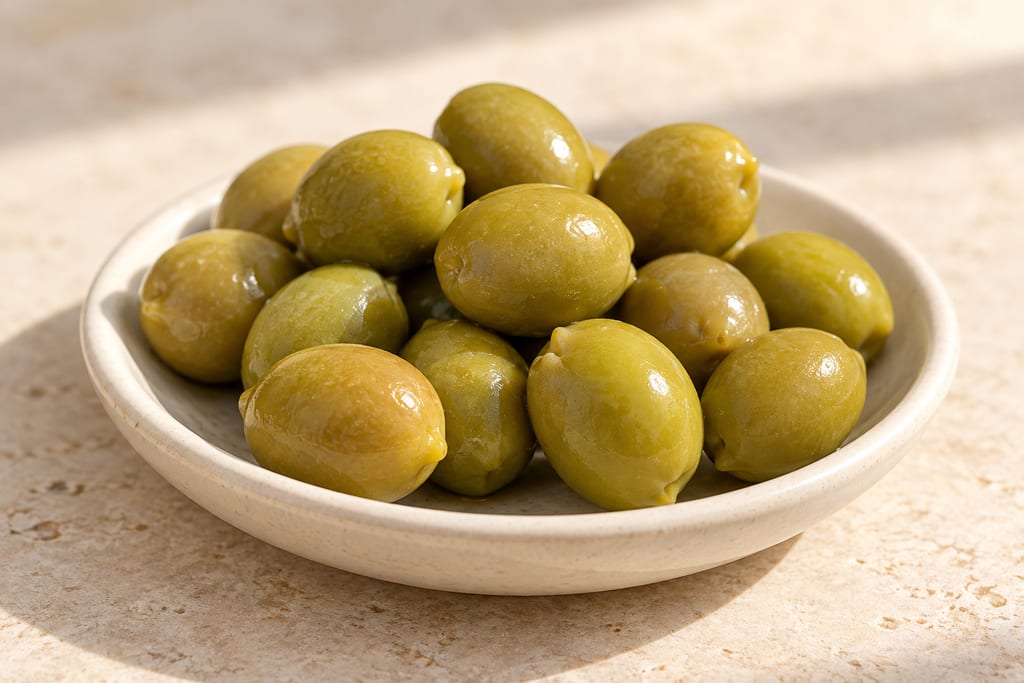
A Portuguese table-olive product from the Negrinha cultivar in northeastern Portugal, sold in three commercial styles, two of them brined fermentations and one oxidised to black.
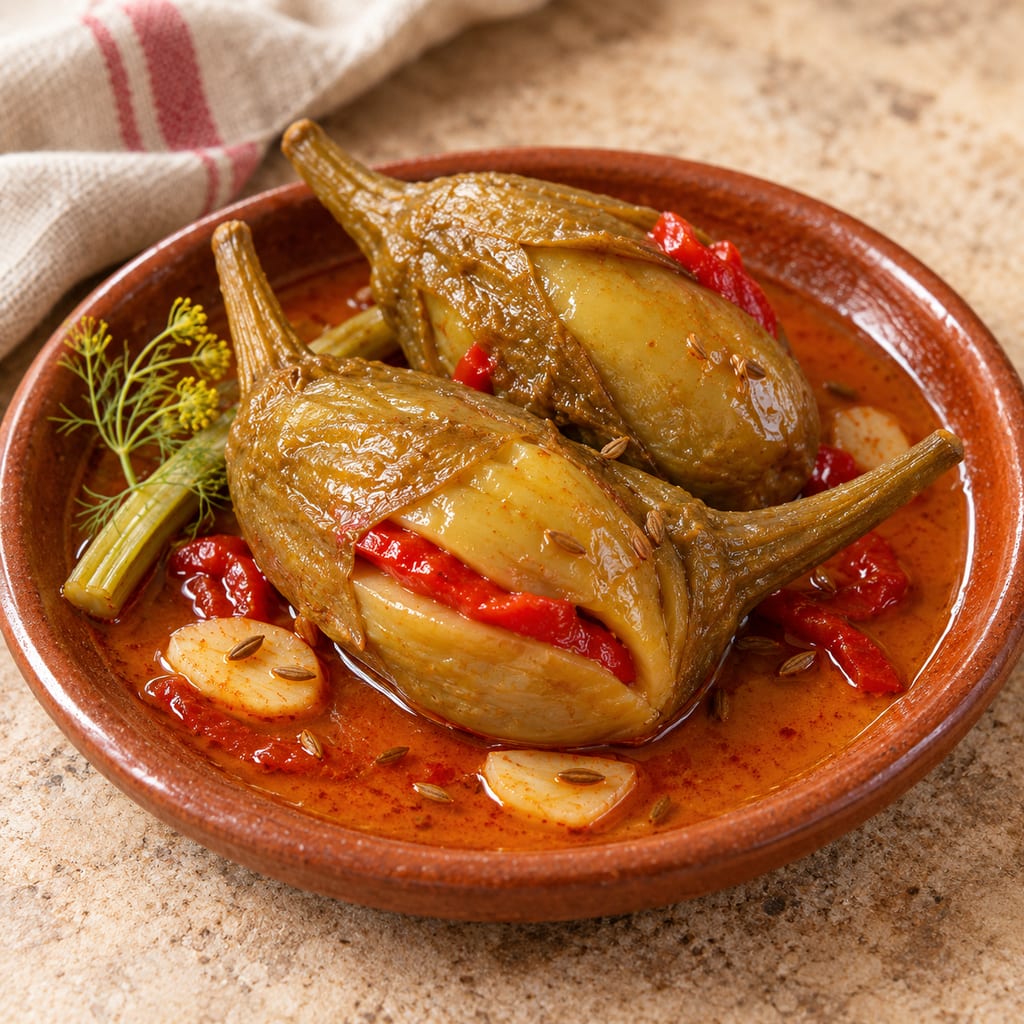
A protected aubergine preserve from Ciudad Real in Spain: tender fruit of the local Dealmagro variety, cooked briefly and then fermented in a vinegared, paprika-seasoned dressing.
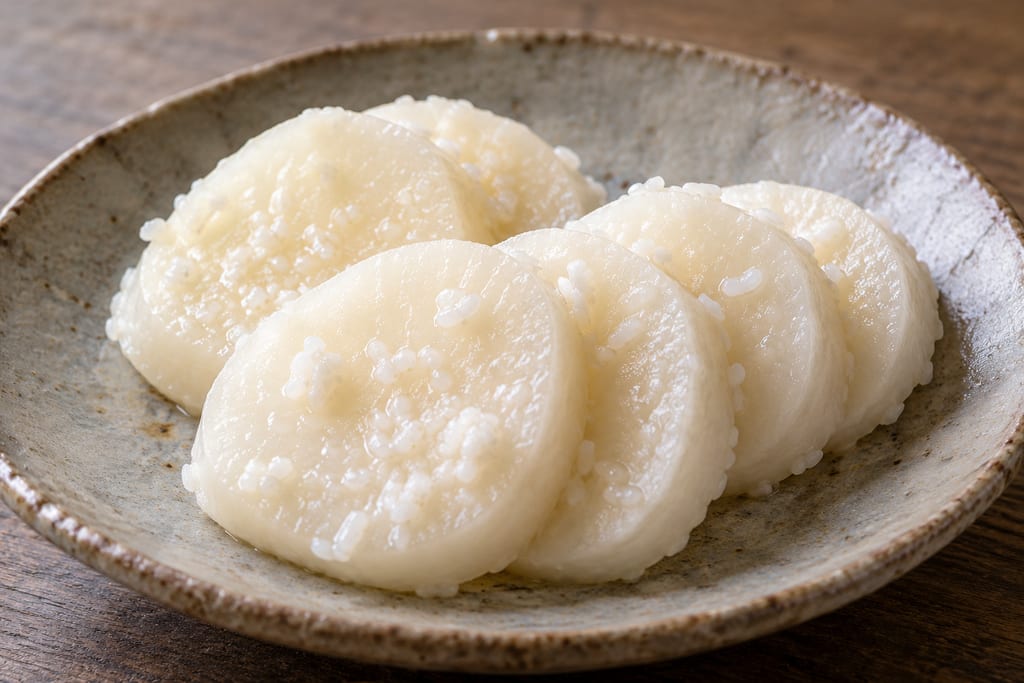
A sweet, crisp Japanese daikon pickle from Tokyo's Nihonbashi district, made by salting fresh radish and dressing it in rice koji, sugar or koji amazake without the heavy drying used for takuan.
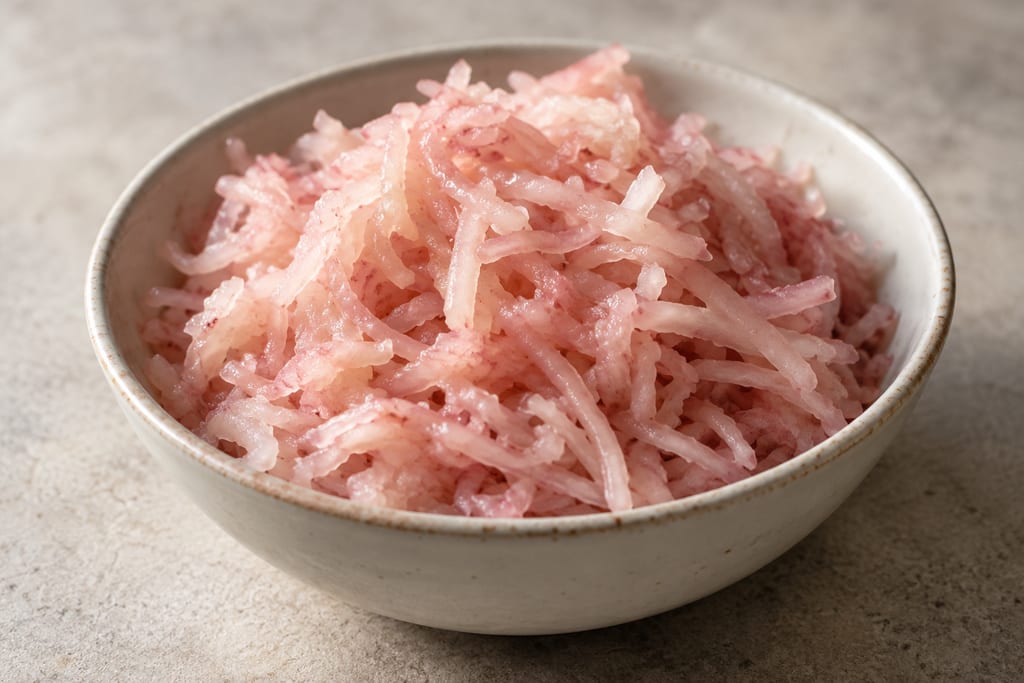
Source-specific Brovada DOP producer method for Friuli Venezia Giulia turnips and red-grape marc. This records a regulated producer process; it is not a validated home-scale recipe.
An industrial fermentation patio places factory-made fiberglass-reinforced polyester olive tanks below floor level, with drainage and transfer infrastructure arranged around the buried vessels.
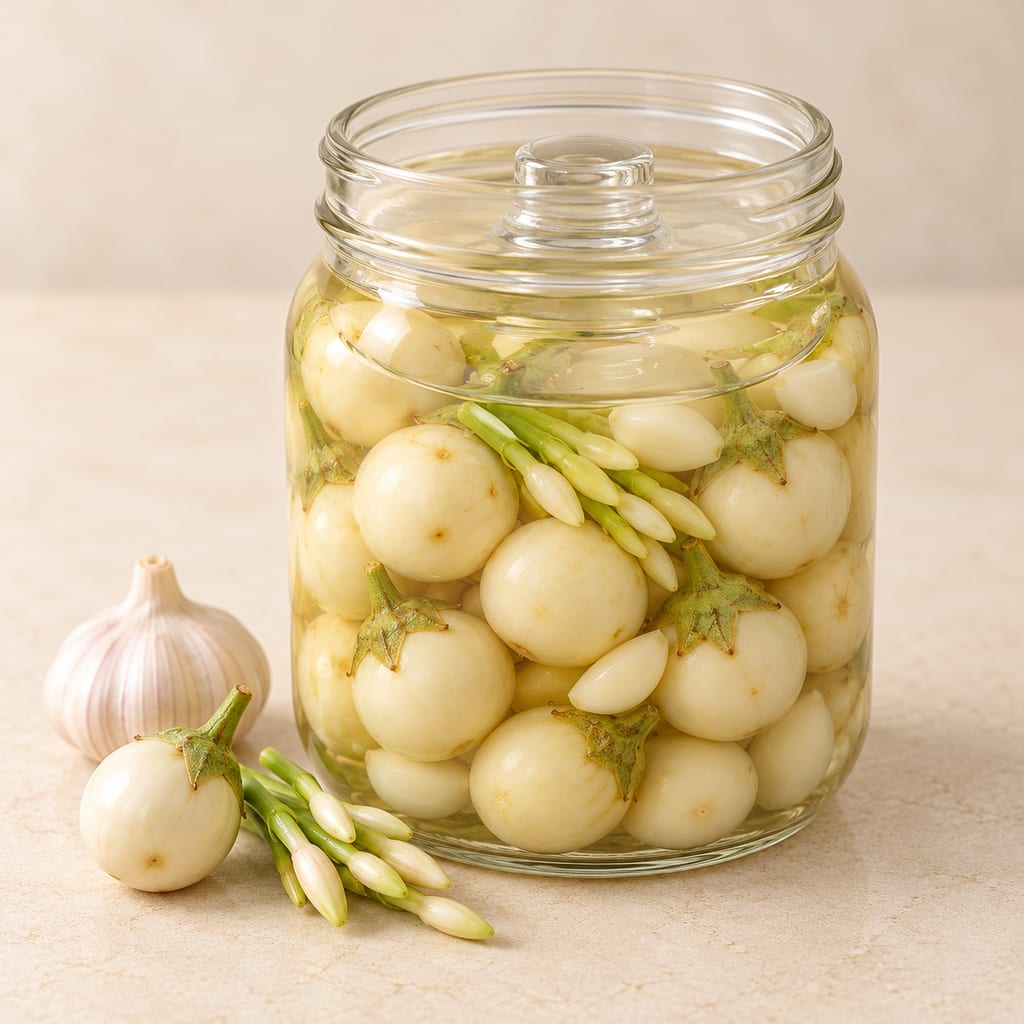
Vietnamese salted and fermented small eggplant, dried on the day of purchase, then held submerged in warm salty water with garlic and galingale flower for a week or longer.
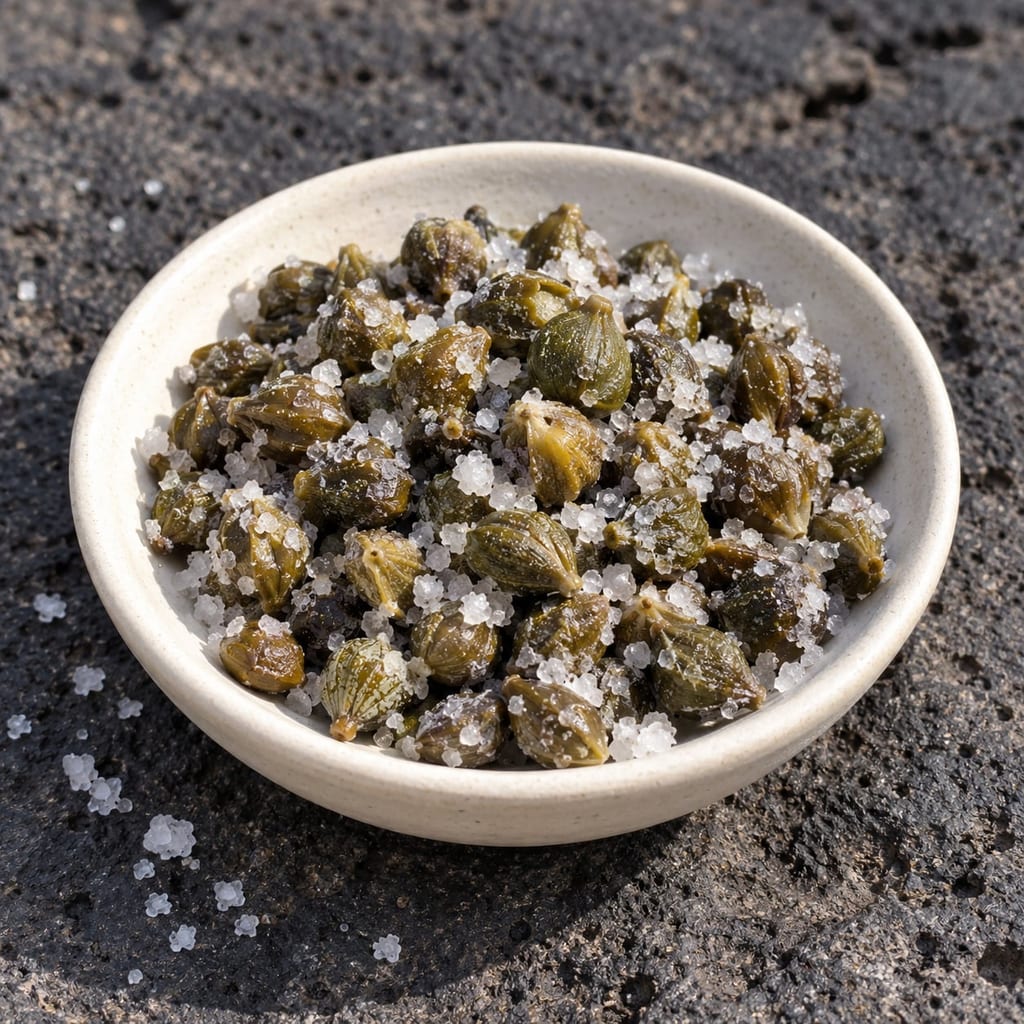
A protected Sicilian product: unopened caper buds from the island of Pantelleria, dry-salted with sea salt in a two-stage process that encourages lactic fermentation.
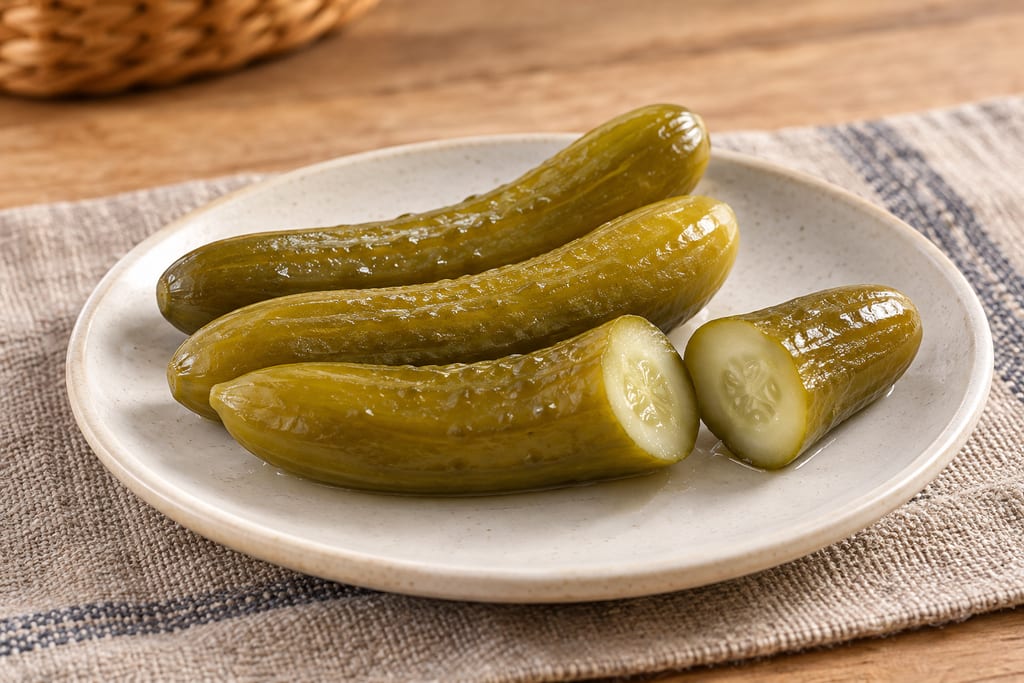
Çubuk turşusu is a registered pickle from Çubuk district in Ankara. Its cucumber variant is sold as Salatalık Turşusu, and a commercial specification sets its brine and room-temperature period.
No community contributions have been published for this entry yet.
Sign in to contribute. Published comments and photos are free to read.
Lady Lee's HomeInspiration
Lacto Fermented Beets - the EASIEST Way to Preserve Beets!Beet preparation at 01:29–02:29; salt formula at 05:42–06:20; covering at 06:33–07:17; room-temperature duration at 08:42–09:07.
Cited in: What are lacto-fermented beets?; Beetroot and Eastern European preservation; Ingredients — original recorded batch; The original preparation; The 2024 beetroot salt study; Beet kvass and beet sour; How fermented beets are eaten; Variations and flavour additions; Safety and storage
University of Minnesota ExtensionSafety
Preserving food at home: FermentationGeneral vegetable-fermentation controls; this is not a validation of the video recipe.
Cited in: Ingredients — original recorded batch; The original preparation; How fermented beets are eaten; Variations and flavour additions; Quality and spoilage; Safety and storage
Penn State ExtensionSafety
Let's Preserve: Fermentation — Sauerkraut and PicklesPenn State notes only sauerkraut and fermented pickles have research-based home processes and warns that changing tested proportions can make products unsafe.
Cited in: Ingredients — original recorded batch; Why beetroot is a distinctive substrate; The original preparation; What happens during beet fermentation?; Betalains and colour changes; The difference between pH and visible colour; Texture and slice size; How fermented beets are eaten; Variations and flavour additions; Quality and spoilage; Safety and storage
pmc.ncbi.nlm.nih.govReference
Studying the Influence of Salt Concentrations on Beetroot Fermentation, 2024Cited by the written account of this record.
Cited in: Why beetroot is a distinctive substrate; What happens during beet fermentation?; Betalains and colour changes; The difference between pH and visible colour; Texture and slice size; Variations and flavour additions
doi.orgReference
Fermentative Stabilisation of Betanin in BeetrootCited by the written account of this record.
Cited in: Ingredients — original recorded batch; Why beetroot is a distinctive substrate; The original preparation; What happens during beet fermentation?; Betalains and colour changes; The difference between pH and visible colour; Texture and slice size; How fermented beets are eaten; Variations and flavour additions; Quality and spoilage; Safety and storage
mdpi.comReference
Changes in Physical and Chemical Parameters of Fermented Beetroot and Carrot Juices, 2023Cited by the written account of this record.
Cited in: Ingredients — original recorded batch; Why beetroot is a distinctive substrate; The original preparation; What happens during beet fermentation?; Betalains and colour changes; The difference between pH and visible colour; Texture and slice size; How fermented beets are eaten; Variations and flavour additions; Quality and spoilage; Safety and storage