
Barley and oat porridge (Viking Age)
Crushed or milled barley cooked in water until the starch softens and the mixture thickens, the plainest way a northern household turned stored grain into a meal, here with apple and hazelnut.
 FermenteaWhere food goes to change
Modern method
Remoulade · Remulade · Danish remoulade · Dansk remoulade
Danish remoulade is a thick, yellow, mayonnaise-based sauce flecked with finely chopped pickled vegetables. Arla’s quick home version stirs piccalilli remoulade purée with mayonnaise, crème fraîche, diced apple and capers.
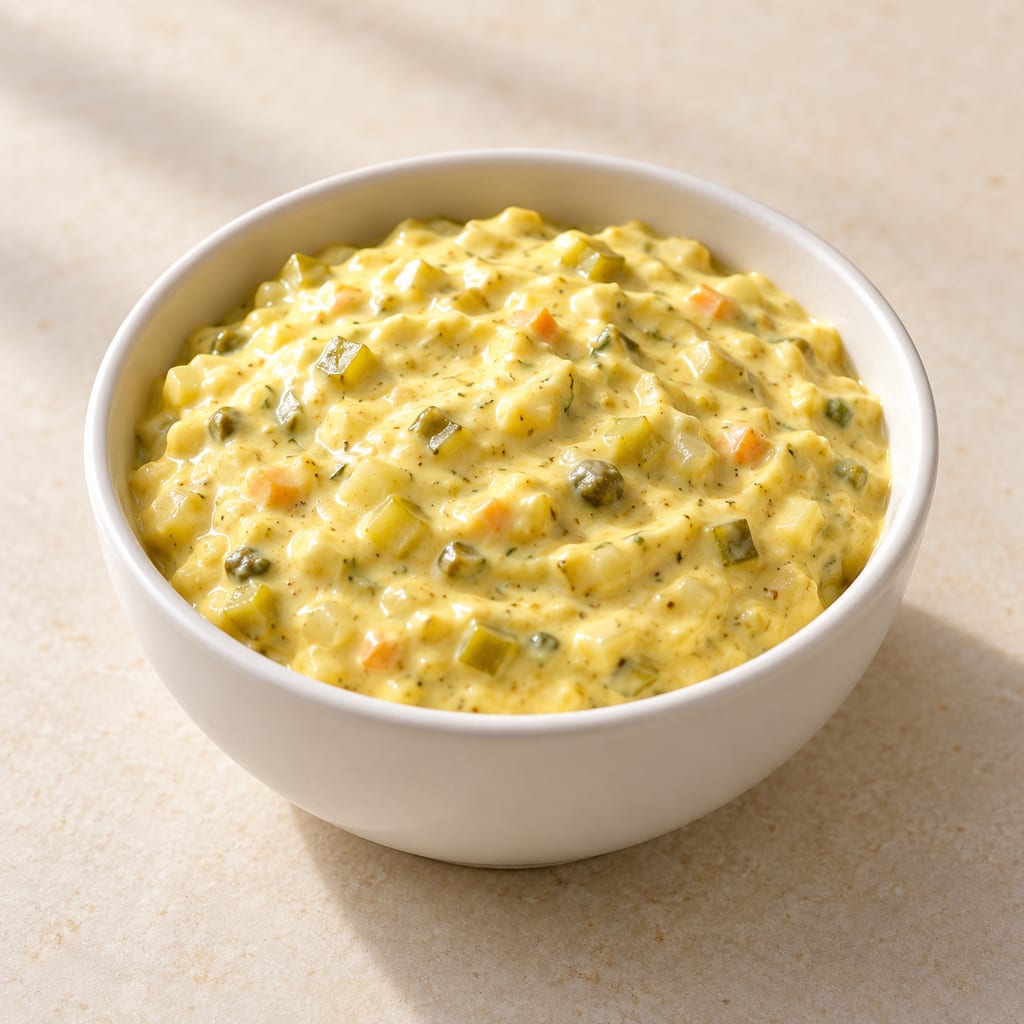
Danish remoulade is a cold, thick sauce with a pale-to-bright yellow colour and a spoonable, mayonnaise-like body. Finely chopped pickled vegetables interrupt the smooth base with small, crisp pieces; the taste is usually savoury, tangy and lightly sweet. The exact balance varies from one jar or household to another. In Danish writing the name appears as both remulade and remoulade, and Danish remoulade has become a recognizable condiment in its own right.
The name describes a broader sauce family. In its Danish form, remoulade is mayonnaise mixed with sweet mustard pickles, often producing the familiar yellow colour and vegetable texture. Arla’s home formula uses a prepared piccalilli remoulade purée, then adds more mayonnaise, rich crème fraîche, very finely diced apple and chopped capers. That combination makes a substantial, slightly softer sauce with a sweeter fruit note and a salty, briny accent. The page records one modern home version, rather than a universal formula for every Danish jar.
The word smørrebrød means an open sandwich, commonly built on a slice of bread with toppings. Danish dictionaries identify remoulade as a familiar topping for smørrebrød and as an accompaniment for fish. Its thick body lets it remain in place on a sandwich or beside a piece of food instead of running like a vinaigrette.
The name travelled into Danish from French rémoulade. The Académie française dates the French word to the eighteenth century and gives a probable etymology through Italian ramolaccio, meaning wild radish, with a possible Latin root. The etymology is tentative, and it does not prove that the modern sauce was invented by a radish grower or that every dish called rémoulade began with the same ingredients.
French and Danish references describe related but distinct sauces. The Académie’s current definition is a cold mayonnaise sauce sharpened with mustard and other condiments, used with salads and raw vegetables. Lex’s Danish entry describes mayonnaise combined with finely chopped sweet mustard pickles. The shared name signals a family resemblance; the Danish version’s pickled vegetable mixture and characteristic sweet yellow profile are its own regional signature.
The precise path by which the Danish version became established is not dated by the inspected sources. They do not name a first Danish cook, a city of invention, or a first written Danish recipe. It is safer to keep that gap open than to turn the eighteenth-century French word date into a claim about the Danish condiment. Arla’s page belongs to the current home-cooking tradition and explicitly takes the quick route by buying the mayonnaise and remoulade purée ready-made.
Remoulade is also a commercial category, not a single fixed composition. A 2026 DTU National Food Institute report sampled Danish supermarket sauces and analyzed composite samples that included classic and reduced-fat remoulades. That work treats the products as market varieties and records differences in their composition; it does not describe a single standard recipe or settle the history of the sauce.
The Arla preparation is a cold assembly. It contains no inoculation, incubation, aging or fermentation stage. The presence of pickled vegetables in the purée does not make this recipe a fermentation: the source uses a ready-made condiment base and does not say how that base was preserved or whether it was fermented.
Mayonnaise already supplies a thick sauce structure. DTU describes mayonnaise as a cold sauce based on oil, vinegar and egg yolks. In this recipe, those components arrive together in the prepared mayonnaise rather than being emulsified from the beginning. The method therefore asks the cook to stir the prepared ingredients together, not to build or stabilize an emulsion by slowly whisking oil into egg.
The visible texture comes from the combination of a smooth base and small pieces of pickled vegetables, apple and caper. The prepared purée contributes much of the remoulade's identity; the added mayonnaise and 38% crème fraîche soften and enrich the base, while the diced apple and capers remain distinct additions. Those sensory roles are practical readings of the ingredients and method, not separate transformations measured by Arla.
Piccalilly remoulade purée is the largest ingredient by volume in Arla’s batch. It brings the prepared pickled-vegetable base and the flavour profile that distinguishes Danish remoulade from plain mayonnaise. Arla gives 2½ decilitres, approximately 320 grams, and does not provide the purée’s own formula. A cook using a different commercial purée may get a different degree of sweetness, acidity, colour and chunkiness, so the recipe does not treat all products as interchangeable.
Mayonnaise provides the familiar rich, thick foundation. Crème fraîche at 38% fat contributes dairy richness and loosens that base into a more tender, less concentrated sauce. The apple is cut into very small dice so its sweetness and crispness appear in small, even bites; a large dice would change the texture of a sauce intended to spread across a sandwich. Chopped capers add a small, briny accent. Arla gives no salt, sugar, curry, herbs or extra vinegar in this version, so none is added to the ingredient list.
These ingredients explain why the Arla version should be read as a particular modern recipe, not as the only Danish remoulade. Lex’s shorter definition centers the Danish style on mayonnaise and sweet mustard pickles. Arla’s recipe adds a dairy component, apple and capers, while other ready-made purées and mayonnaise products can shift the balance before the cook begins.
The formula uses 2½ dl piccalilly remoulade purée (about 320 g), 1 dl mayonnaise, ½ dl crème fraîche with 38% fat, one apple and 2 tablespoons of chopped capers. Dice the apple very finely and chop the capers. Stir all five components together, then taste the finished sauce. That is the full source method.
The short sequence has a clear purpose: the prepared purée already carries the pickled-vegetable mixture and seasoning, so the cook only needs to cut the fresh apple and capers small enough to distribute through the sauce and combine them with the cold base. Arla describes its chosen ingredients as ready-made components and notes that a cook with more time could make mayonnaise and remoulade purée from scratch. It does not give formulas for those separate preparations here; they remain distinct recipes rather than substitutions to improvise within this one.
The source does not state a batch yield, active preparation time, resting period, measured temperature or storage window. No yield or shelf life is estimated. The recipe is best understood as an assembly to serve as a cold condiment, with ingredient quantities kept in the source proportions.
Danish remoulade is a familiar partner for fish and a topping for smørrebrød. Lex also lists cold meat and shellfish, while the Danish dictionary describes it with fish dishes. The sauce’s concentrated salt-sour-sweet profile and thick texture make it useful in small amounts beside foods whose flavour and surface can carry a creamy condiment.
The DTU report notes that mayonnaise and remoulade commonly garnish open sandwiches in Denmark. It also documents a modern retail category broad enough to include full-fat and reduced-fat remoulade products. The sauce therefore belongs both to home cooking and to the everyday packaged condiment shelf; that commercial presence is visible in current market sampling, even though it does not provide a historical origin story.
French rémoulade and Danish remoulade share a name and a mayonnaise-based cold-sauce structure, but they are not identical recipes. The French definition emphasizes mustard and condiments; the Danish account emphasizes sweet mustard pickles. A Danish formula using piccalilli purée, apple and capers is one expression of that regional sauce, not proof that all remoulade uses those ingredients.
Commercial Danish products also vary. DTU’s study distinguishes classic from reduced-fat remoulade and explains that its samples were composites assembled from multiple supermarket brands. This is a reminder to expect differences in richness and seasoning between products. The Arla formula uses a named ready-made purée and full-fat 38% crème fraîche; replacing one of those components changes the formula and should be described as a separate adaptation.
Serve the sauce as a cold condiment with fish or as a topping for an open sandwich. The Arla page does not state a storage duration or a preservation procedure. Its use of pickled vegetables does not establish that the finished mayonnaise-and-crème-fraîche mixture is shelf-stable. Keep the source’s scope clear: it is a quick prepared sauce, not a canning recipe or a fermented preserve.
Remoulade’s best-known Danish setting is the open sandwich, but the sauce sits inside a larger lunch tradition rather than defining it by itself. Lex’s account of smørrebrød traces the rise of the elaborately topped restaurant sandwich to the late nineteenth century: industrial work made packed lunches common, Copenhagen taverns served workers at midday, and restaurant menus for smørrebrød appeared in the 1880s. The same account notes that industrial-era refrigeration helped keep food fresh and that mayonnaise salads became possible additions to the sandwich table. This background helps explain why a cold, spoonable sauce belongs naturally beside fish and other toppings; it does not establish when remoulade itself entered Danish cooking.
The familiar fish pairing has a practical as well as a historical fit. A crisp breaded fish fillet has a browned coating and a mild interior; a small spoonful of tangy, creamy sauce adds moisture and acidity without requiring a separate poured dressing. Arla’s recipes recommend remoulade sauce with fish cakes, fish fillets and fried cod, while the Danish dictionary records fish dishes and smørrebrød as typical contexts. Lex extends the broader remoulade family to cold meat and shellfish. These are serving suggestions, not rules about which fish or sandwich must carry the sauce.
Smørrebrød can be a simple hand-held lunch or a more elaborate knife-and-fork meal. Lex describes the highly topped restaurant form as part of Danish bourgeois food culture from the late 1800s, and notes that contemporary cooks continue to reinterpret it with seasonal produce and new techniques. Remoulade can therefore serve as a familiar element in a classic combination while still appearing alongside newer toppings. The sources support this evolution of the sandwich tradition, but they do not describe distinct regional remoulade recipes within Denmark.
Arla publishes another home version under the name remouladesauce. It uses 2 dl crème fraîche, 2 dl finely chopped piccalilli, 2 tablespoons mayonnaise, 2 tablespoons very small apple dice and 2 tablespoons chopped parsley. The cook stirs the ingredients together, tastes, and may add a little salt or sugar. Arla describes the sauce as having more structure and bite than plain remoulade and suggests fish cakes, fish fillets or fried cod. This formulation differs from the quick recipe above: it uses finely chopped piccalilli directly, makes crème fraîche the largest measured component, and includes parsley, while the first recipe uses ready-made piccalilli remoulade purée as its largest ingredient and adds capers.
The contrast shows two ways to arrive at a similar family of sauces. A prepared purée gives the quick recipe a ready-seasoned base; a batch made with chopped piccalilli keeps the pickle pieces more explicit and lets the cook taste for salt or sugar at the end. Arla calls out the second sauce’s greater structure, a useful clue that cut size matters: very fine pieces spread more evenly on a sandwich, while larger pieces make a more visibly chunky sauce. The source does not give a universal chop size beyond finely chopped piccalilli and very small apple dice, so those descriptors remain the practical guide.
Other versions need not follow either Arla formula exactly. Lex’s short definition of Danish remoulade centers on mayonnaise and finely chopped sweet mustard pickles, while the general sauce entry mentions possible capers, pickled cucumber and anchovy in other remoulades. The Académie française defines the French sauce around mayonnaise, mustard and condiments. These descriptions help distinguish a regional family resemblance from one fixed ingredient list. When adapting the recipe, keep the documented version clear: changing the purée, dairy, pickle or herb changes the balance and texture, even if the result still belongs to the remoulade family.
For a well-distributed sauce, prepare the add-ins before mixing. Cut apple very finely and chop the capers so each spoonful carries the fruit and briny notes rather than a few oversized pieces. Fold or stir the ingredients until the purée and dairy are evenly combined, scraping the sides of the bowl so the thicker prepared base is incorporated. Arla’s method is deliberately brief: combine and taste. It does not call for whipping, heating, resting or additional seasoning by default.
Taste after combining because the ready-made purée supplies much of the seasoning. The original quick formula gives no salt or sugar measurement and explicitly stops at tasting; Arla’s separate remouladesauce recipe allows a little salt or sugar if needed. That difference is a useful adaptation boundary: adjust only after tasting and treat an adjustment as optional, not a missing required step. If the sauce seems denser or looser than expected, check the exact products used before changing quantities; both recipes are tied to their stated ingredients and do not offer a tested scaling formula.
Use the sauce cold as a condiment on bread or beside cooked fish, adding it close to serving so the contrast between creamy sauce and crisp fish remains clear. These are serving recommendations, not preservation instructions. Neither Arla recipe supplies a storage duration, a validated shelf-life process or a numeric holding temperature. Keep the preparation in the category of a fresh, cold sauce and follow safe handling guidance for the packaged mayonnaise, dairy and pickle products used.
The French word rémoulade is documented in French lexicography as an eighteenth-century term. The Danish form is a regional mayonnaise sauce built around finely chopped sweet mustard pickles, but the inspected sources do not date its appearance in Denmark or identify an individual inventor. Arla's recipe is a contemporary quick home version.
Scaling: source batch only
This is a cold prepared sauce, not a shelf-stable preserve. Arla's recipe gives no storage duration or preservation process.
These sources document Danish remoulade and a recipe published in Denmark; they do not establish a birthplace or invention date.
Crushed or milled barley cooked in water until the starch softens and the mixture thickens, the plainest way a northern household turned stored grain into a meal, here with apple and hazelnut.
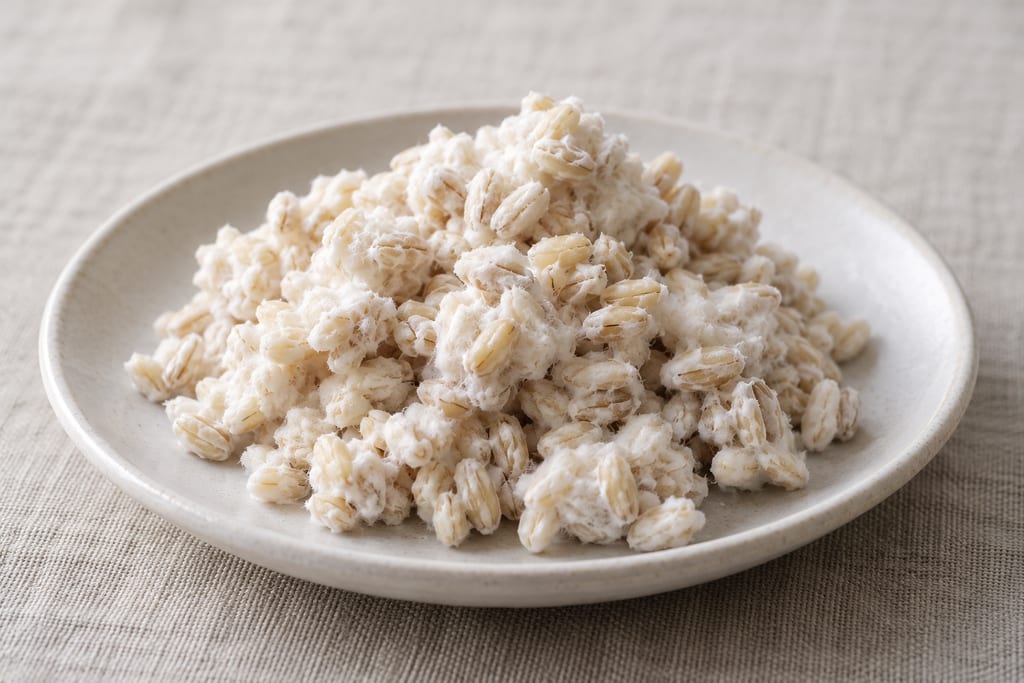
Steamed pearled barley grown into a white koji cake with Aspergillus oryzae over about 36 hours in a 30 °C chamber, turned three times under a damp cloth.
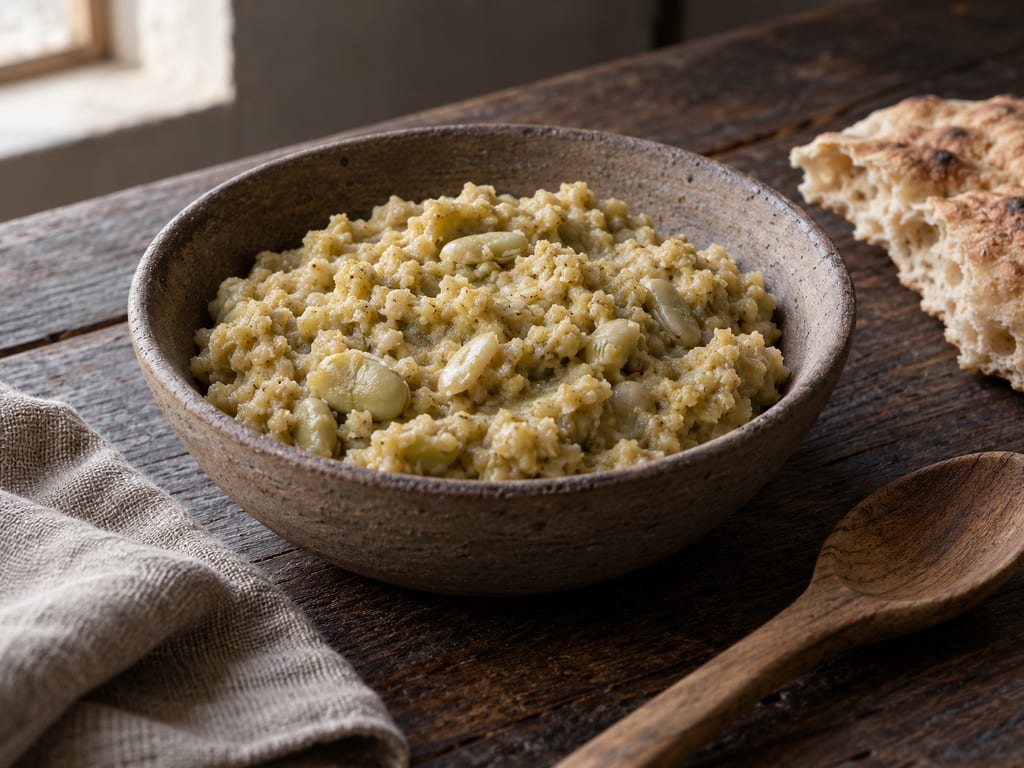
Cooked broad beans crushed to a thick paste with garlic and salt, a museum preparation built on the one European pulse that was already old when the Viking Age began.
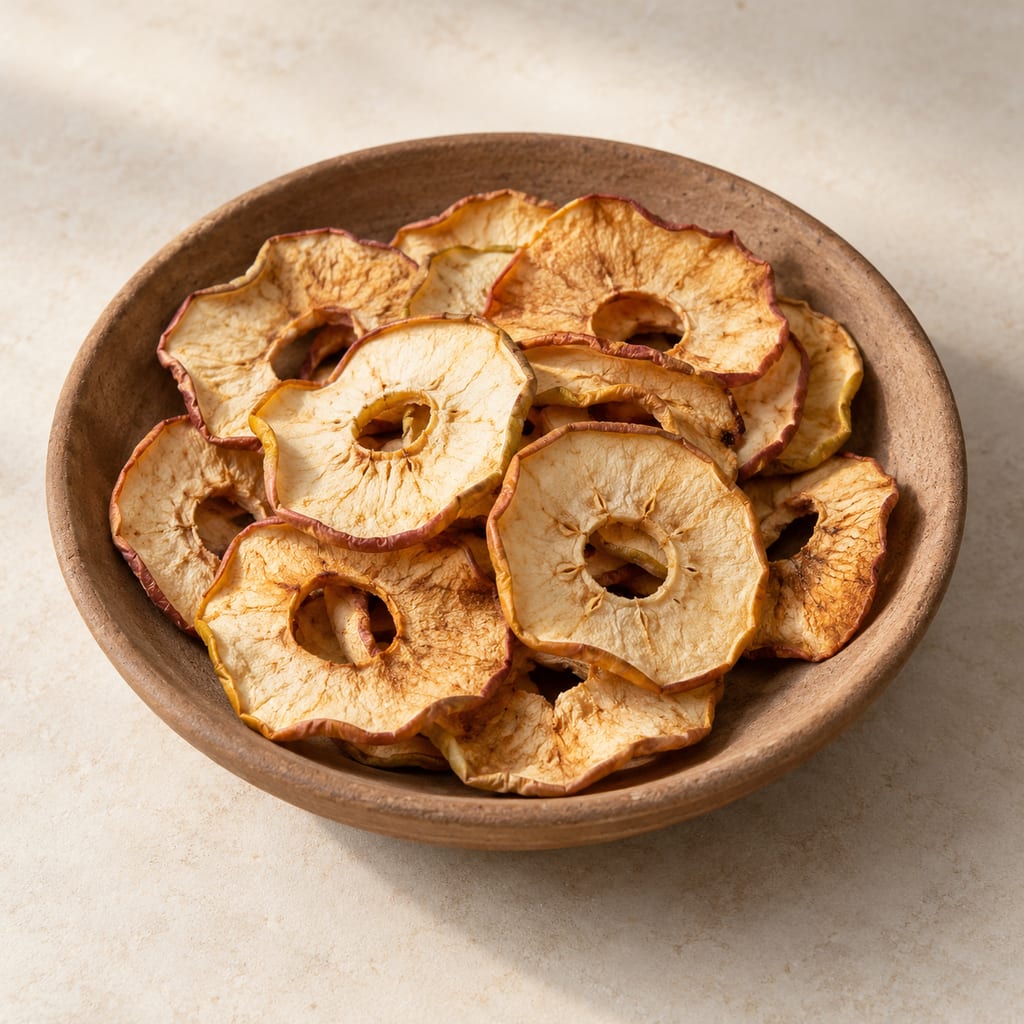
Apple slices dried until most of their water has gone, shrinking and concentrating into leathery or crisp rings, with the modern controls that a plausible old technique turns out to need.
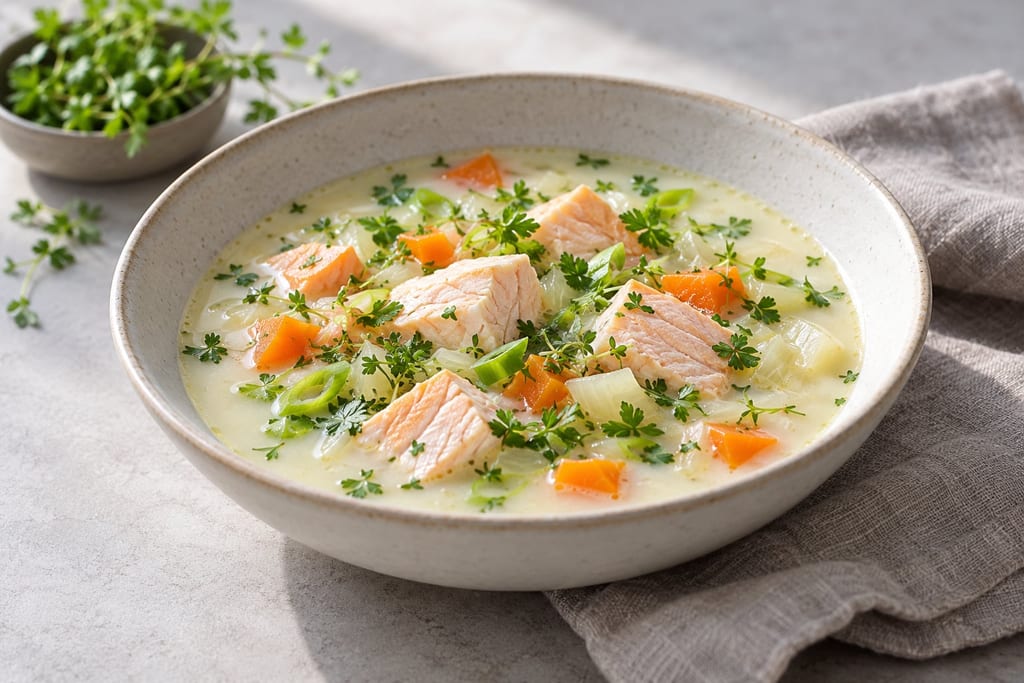
Trout or salmon poached at the end of a simmered broth of onion and root vegetables, a present-day reconstruction of coastal cooking built on excavated fish bones and a boiling pot.
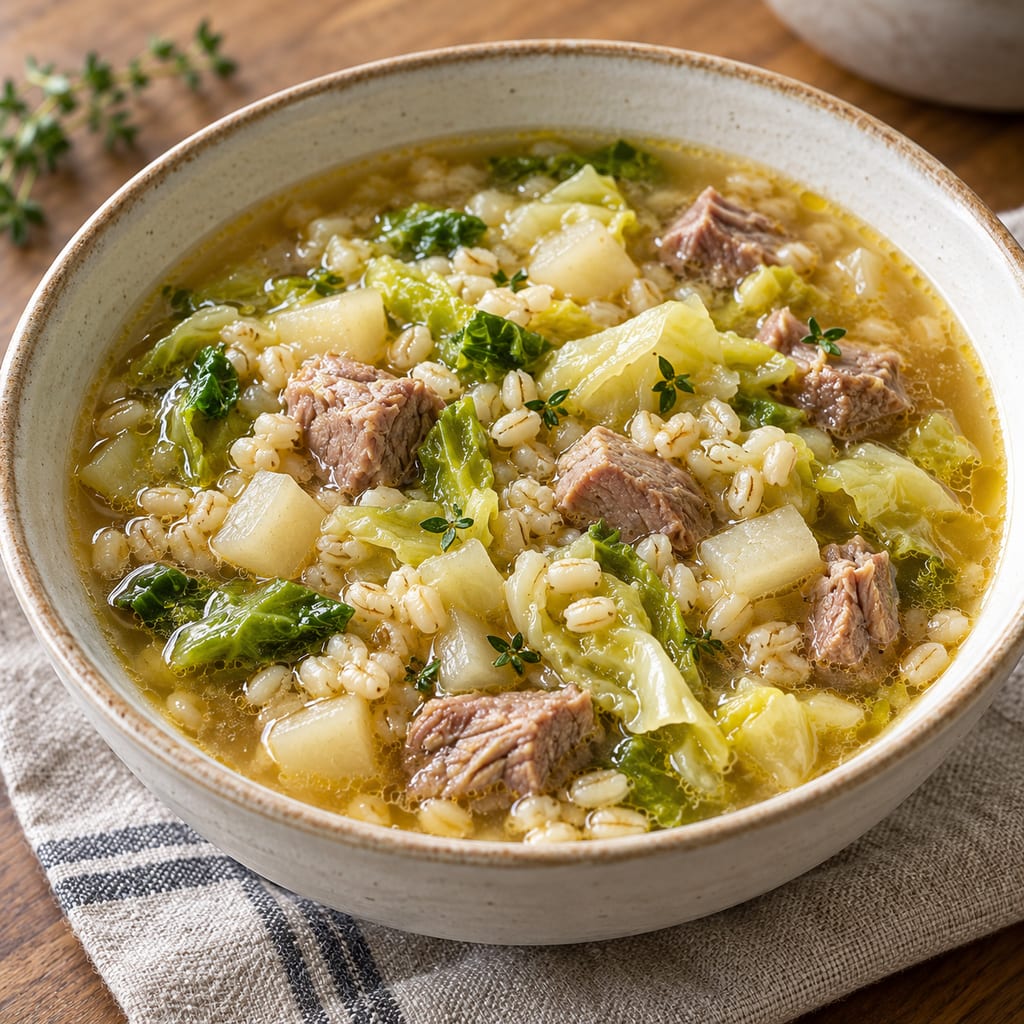
Lamb shoulder simmered with pearl barley, turnip and leafy cabbage in one pot, a present-day reconstruction built from the animals, grains and vegetables of northern European farming.
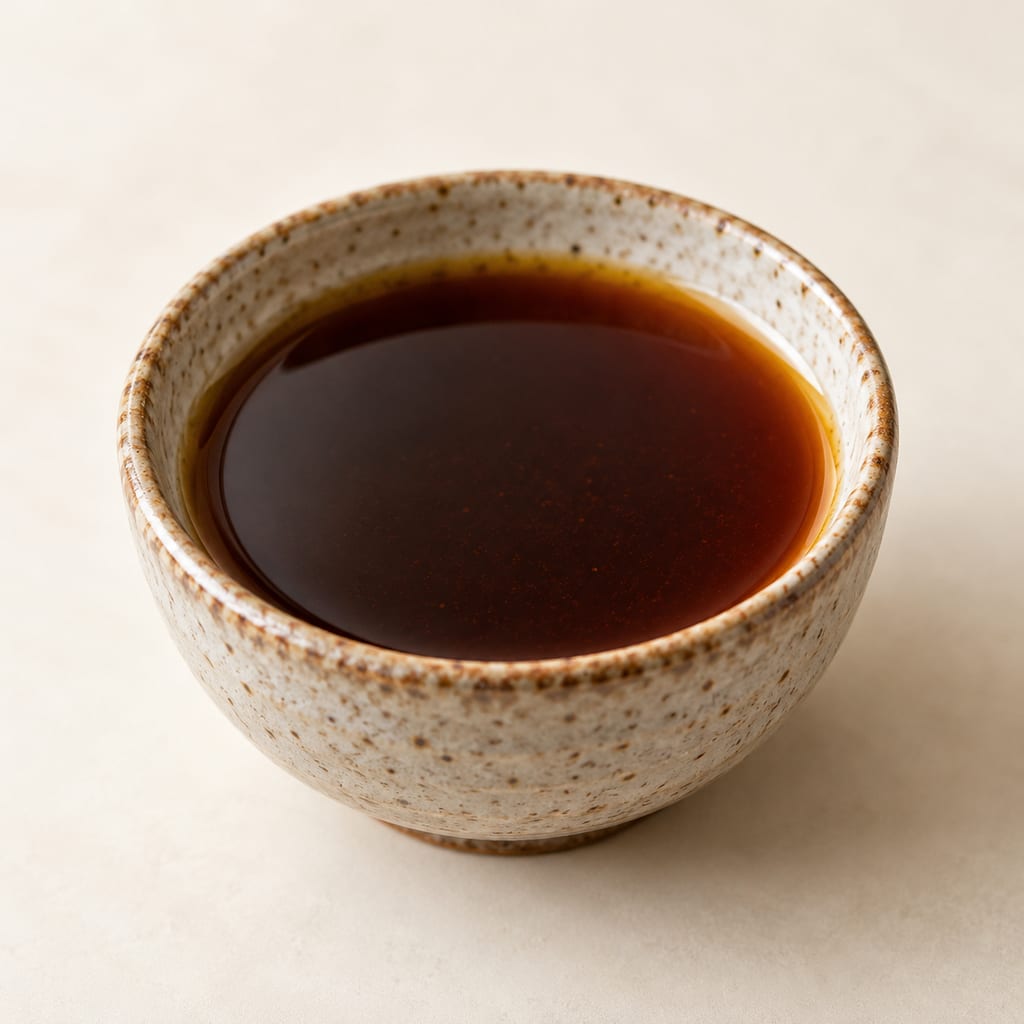
Mushroom garum is a savoury, smoked sauce made by crushing mushrooms with salt and rice koji and letting the mixture brew for months, a modern use of the garum method without fish.
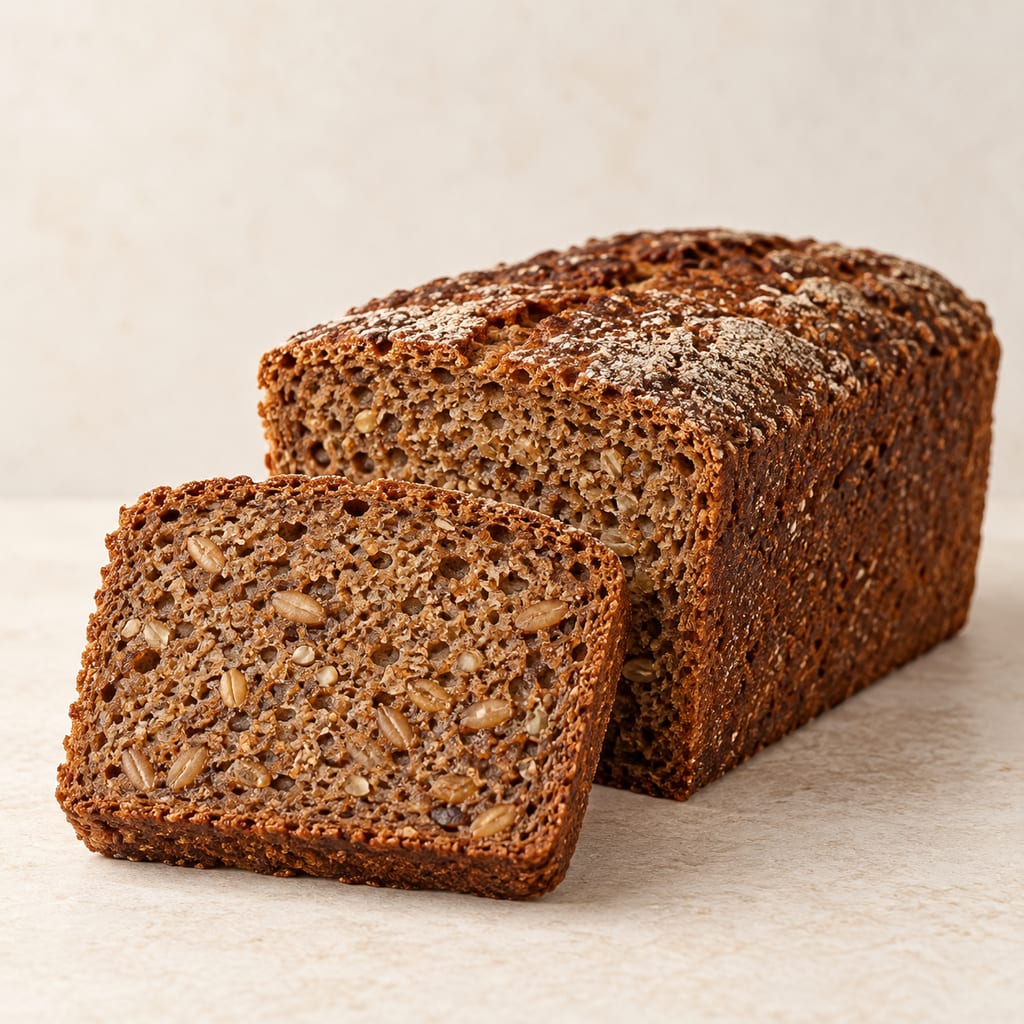
This Danish sourdough loaf combines wheat flour and kernels with rye flour and cracked rye, then rises in three tins before a long, low finishing bake.
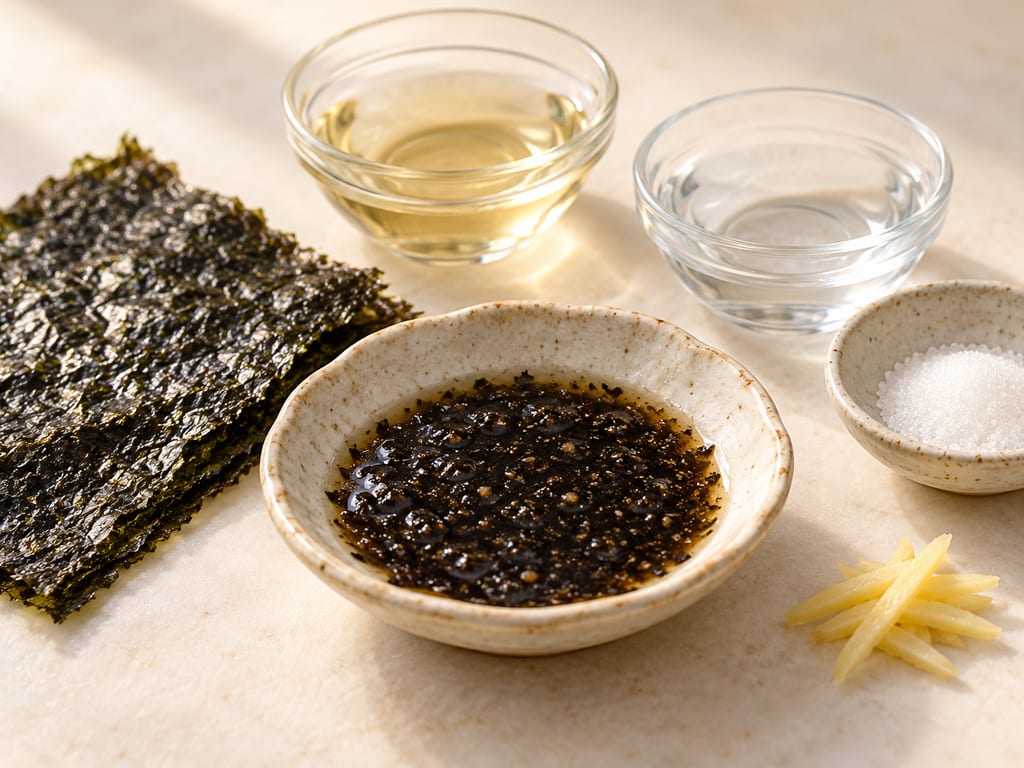
A fresh condiment in which crumbled nori softens in lightly sweetened vinegar and water. It is not vinegar fermented from seaweed.
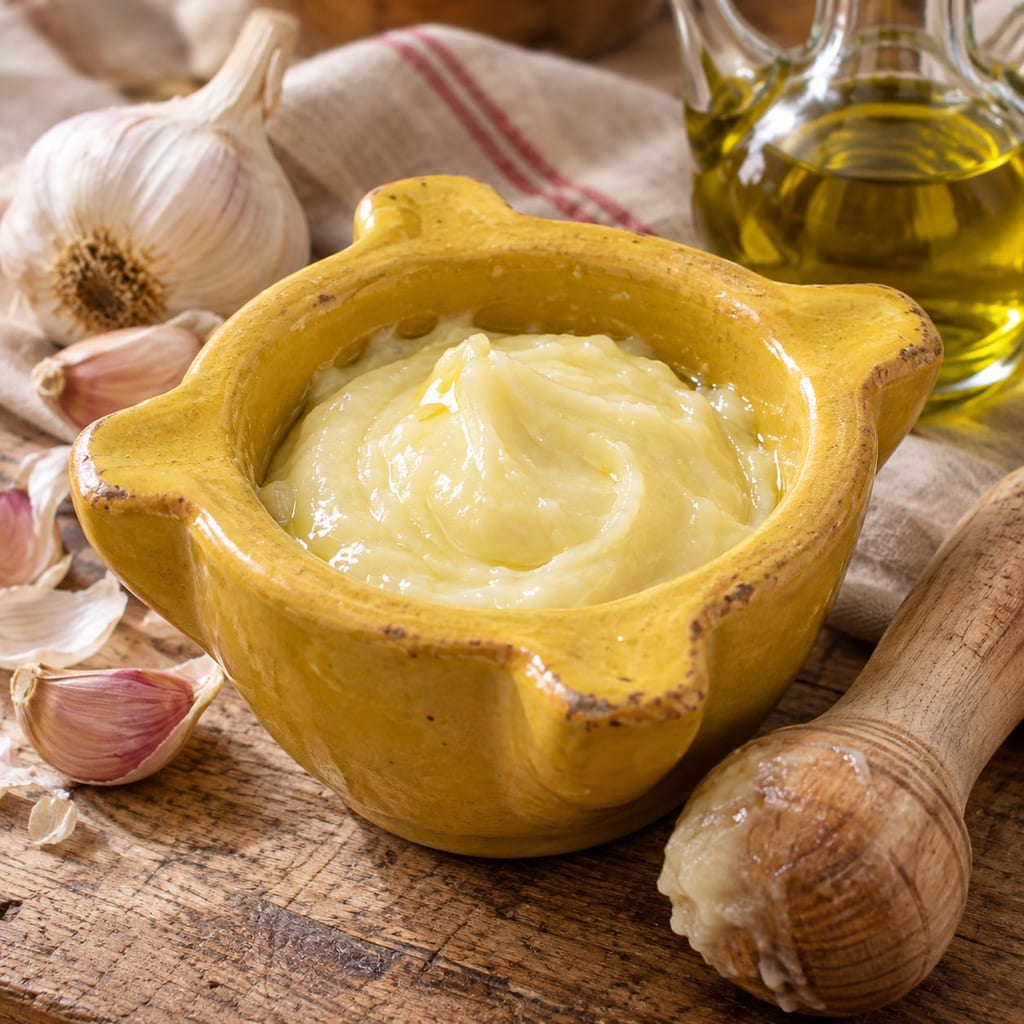
Traditional Catalan allioli is a dense emulsion of garlic, olive oil and salt made slowly in a mortar. This measured Barcelona-style version keeps egg-based garlic mayonnaise distinct.
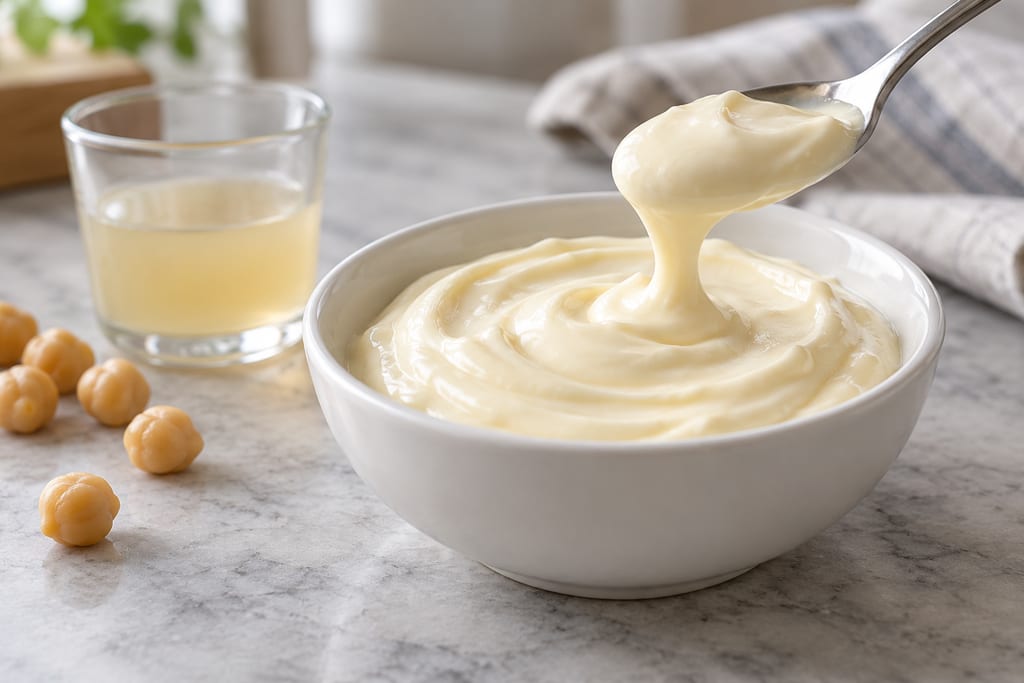
An eggless, untested emulsion made with canned chickpea liquid. Nominal yield 255 g.
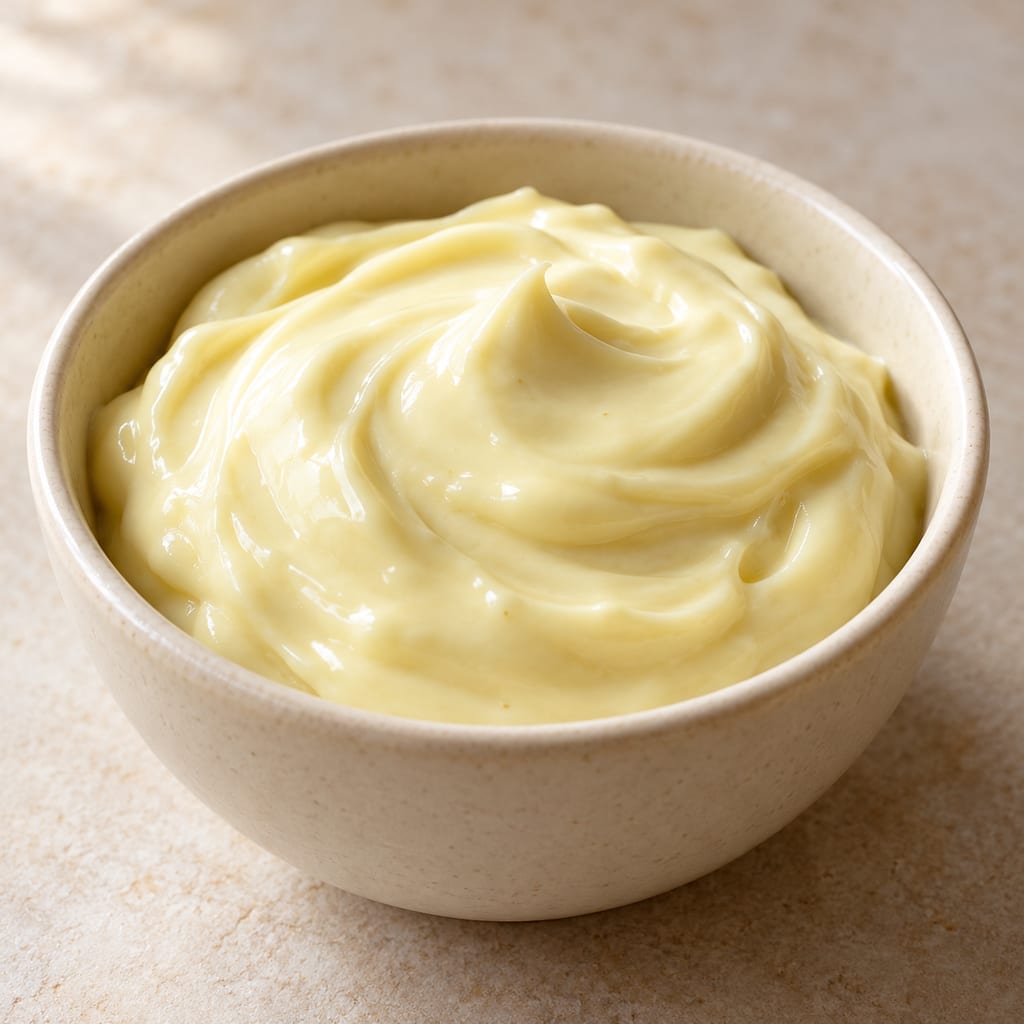
Avocado-oil mayonnaise is an ordinary egg-and-oil emulsion in which avocado oil supplies the oil phase. The oil changes flavour and colour, and it does not preserve the sauce.

Bechamel is a white sauce of milk thickened with a butter and flour roux, one of the French mother sauces, and the base from which Mornay and other cheese and cream sauces are made.
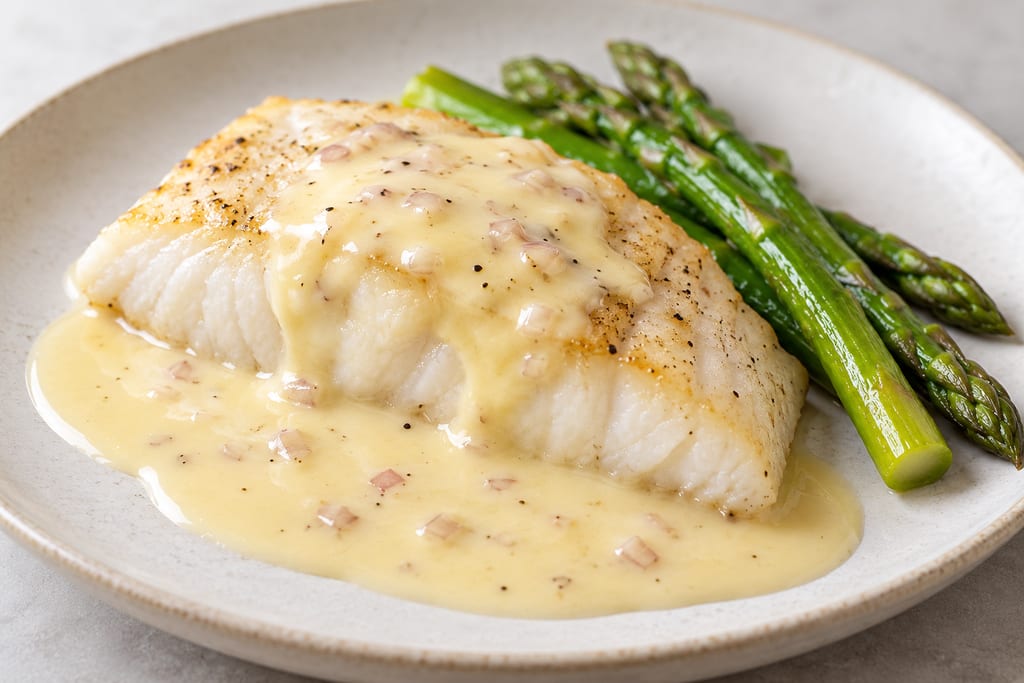
Beurre blanc is a warm emulsion of cold butter whisked into a reduction of white wine, vinegar or lemon juice and shallot, a sauce from the Loire Valley and its red-wine version, beurre rouge.
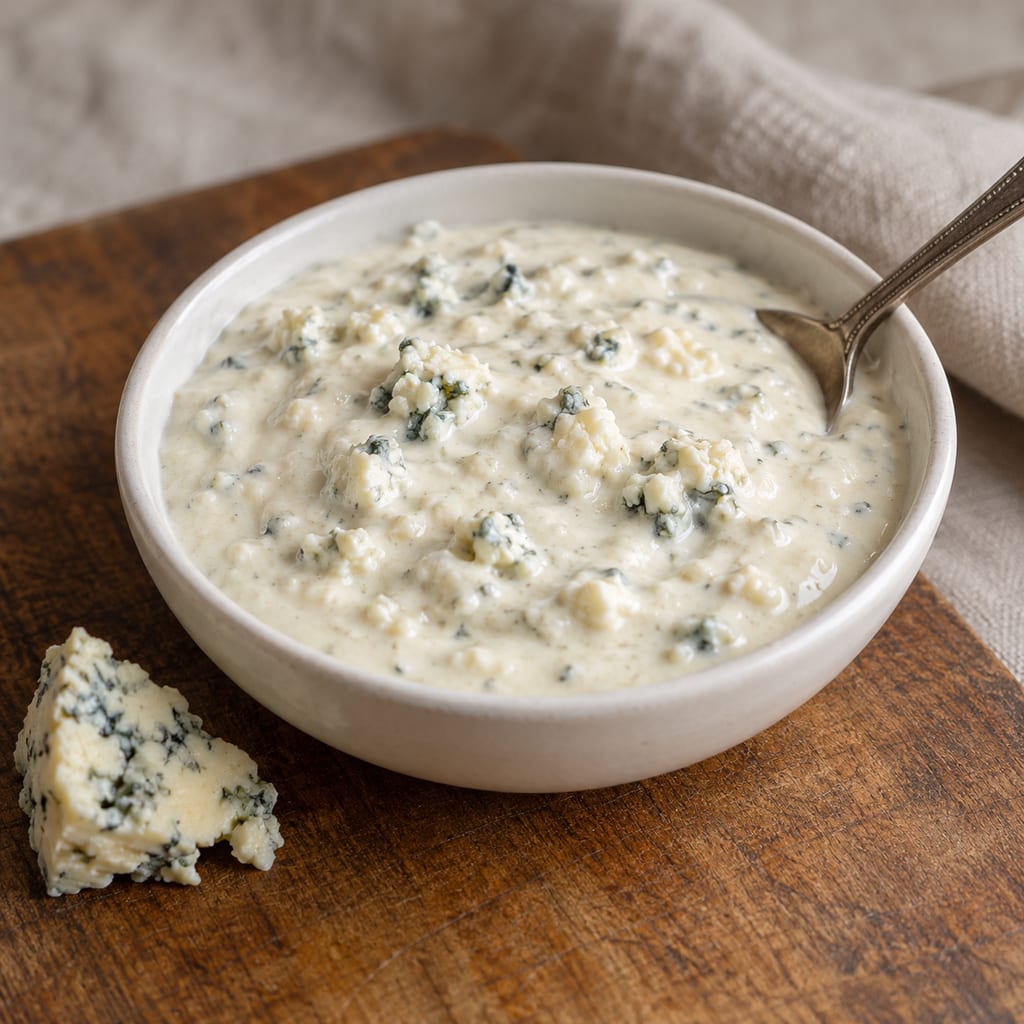
Blue cheese dressing is a creamy dressing built on crumbled blue cheese mashed into buttermilk, with sour cream, mayonnaise, vinegar and seasoning, and kept cold for up to two weeks.
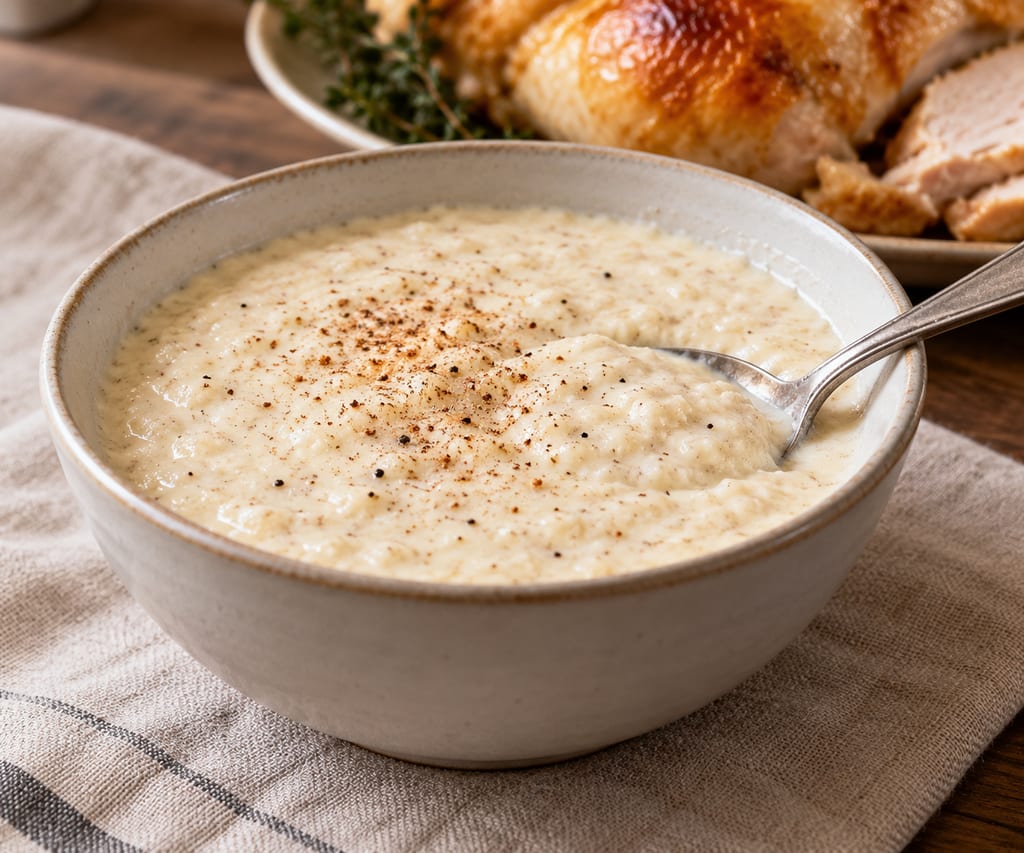
Bread sauce is a British sauce of milk infused with onion, clove and bay, thickened with stale breadcrumbs and finished with butter, served with roast chicken or turkey.
No community contributions have been published for this entry yet.
Sign in to contribute. Published comments and photos are free to read.
Arla FoodsMethod · Ingredients · Variant
Remoulade – Opskrift på skøn hjemmelavet RemouladeArla labels this a quick home remoulade using ready-made components; it says mayonnaise and remoulade purée may be made from scratch when there is more time.
The formula is 2½ dl (about 320 g) piccalilly remoulade purée, 1 dl mayonnaise, ½ dl 38% crème fraîche, one apple in very small dice and 2 tablespoons chopped capers.
The entire method is to stir the ingredients together and taste to adjust. The page gives no finished yield or storage duration.
Cited in: A yellow sauce with a Danish identity; A borrowed name and a regional transformation; An assembled condiment, not a fermentation; Why the ingredients matter; Arla’s quick home method; Related sauces and useful distinctions; Serving and handling; Small-scale technique and serving
Det Danske Sprog- og Litteraturselskab, Den Danske OrdbogIdentity · Use · Etymology
remulade / remouladeThe dictionary gives remulade and remoulade as spellings, derives the Danish word from French rémoulade, and describes a thick yellow cold mayonnaise sauce with spices and vinegar-pickled vegetables.
It records use as a topping on smørrebrød and with fish dishes.
Cited in: A yellow sauce with a Danish identity; Where it appears on the table; Serving and handling; A condiment in the Danish lunch tradition; Small-scale technique and serving
Lex, Danmarks NationalleksikonIdentity · Regional variation · Use · Etymology
remouladeLex distinguishes Danish remoulade—mayonnaise with finely chopped sweet mustard pickles—from other cold mayonnaise sauces with capers, pickled cucumber and anchovy.
It records use with cold meat, fish and shellfish and gives the word's French and possible radish-root etymology.
Cited in: A yellow sauce with a Danish identity; A borrowed name and a regional transformation; Why the ingredients matter; Where it appears on the table; Related sauces and useful distinctions; A condiment in the Danish lunch tradition; A second documented home style
Académie françaiseHistory · Definition
Rémoulade, 9e éditionThe 2024 ninth edition dates the French word to the eighteenth century and gives a probable derivation from Italian ramolaccio, 'wild radish', ultimately from Latin armoracea.
It defines French rémoulade as a cold mayonnaise sauce sharpened with mustard and condiments, used on salads and raw vegetables.
Cited in: A borrowed name and a regional transformation; Related sauces and useful distinctions; A second documented home style
DTU National Food InstituteComposition · Use · Modern market context
Nutrient Content in Dressing, Mayonnaise and RemouladeThe report describes mayonnaise as an oil, vinegar and egg-yolk sauce and remoulade as mayonnaise with spices and pickled vegetables; both are common garnishes on Danish open sandwiches.
The study combined products purchased from Greater Copenhagen supermarkets in 2021 and 2023 and analyzed composite samples; it includes classic and reduced-fat remoulades, showing that commercial formulations vary.
Its introduction reports remoulade as the leading item within Euromonitor's 'Other Sauces and Condiments' category in Denmark in 2024; that is market context, not a historical origin date.
Cited in: A borrowed name and a regional transformation; An assembled condiment, not a fermentation; Where it appears on the table; Related sauces and useful distinctions
Arla FoodsMethod · Variation · Use
Remouladesauce – klassisk til fisk og smørrebrødA separate Arla sauce recipe describes a chunkier remoulade sauce with crème fraîche, finely chopped piccalilli, mayonnaise, very finely diced apple and parsley.
It gives proportions of 2 dl crème fraîche, 2 dl finely chopped piccalilli, 2 tbsp mayonnaise, 2 tbsp tiny apple dice and 2 tbsp chopped parsley; the method is to stir, taste and optionally add a little salt or sugar.
Arla recommends this version with fish cakes, fish fillets or fried cod and says its greater structure gives more bite than plain remoulade.
Cited in: A condiment in the Danish lunch tradition; A second documented home style; Small-scale technique and serving
Lex, Danmarks NationalleksikonCulinary history · Use
smørrebrød – historie og udviklingLex traces packed lunches and workplace lunch culture in the nineteenth century, Copenhagen smørrebrød restaurants, and restaurant menus in the 1880s.
Lex notes industrial-era refrigeration helped keep food fresh and mayonnaise salads became possible additions; it describes later restaurant tradition and modern reinterpretations.
Lex describes fish and shellfish as common components in smørrebrød menus and distinguishes hand-held versions from elaborate knife-and-fork meals.
Cited in: A condiment in the Danish lunch tradition