Tipak is a Kapingamarangi breadfruit product: cooked breadfruit mashed, spread into sheets, sun-dried, rolled and wrapped in pandanus leaves as provisions for later.
Tipak is a dried breadfruit product from Kapingamarangi Atoll in the Federated States of Micronesia. It is a flat sheet of cooked breadfruit that has been dried in the sun, rolled and wrapped in pandanus leaves. It is stored as provisions, and it is not a fermented paste. The research archive makes this distinction explicit, because breadfruit is also made into fermented pastes elsewhere in the region, and the two must not be confused.
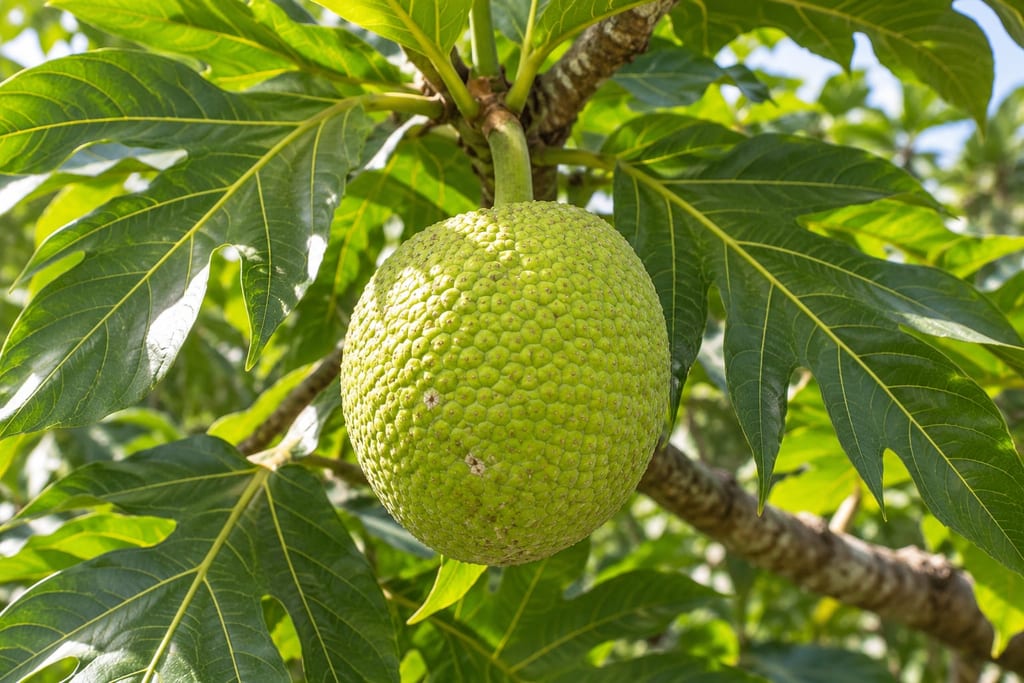
Breadfruit is central to life on the atoll. The Kapinga people live on coconuts, breadfruit, pandanus fruit and taro, and breadfruit gives the staple starch. The fruit is also used for materials: its bast was made into clothing and cordage, and traditional wooden grating stands were used for breadfruit.
The fruit is cooked, then mashed into a paste. The paste is spread out into sheets and dried in the sun. Once dry, the sheets are rolled and wrapped in pandanus leaves, which keep the rolls together and give them a natural wrapper for storage. The method is recorded from a 1961 account, which the research archive attributes to Coenen and Barrau and which FAO also describes.
The sheets are the product: the dried form is kept, and it is reconstituted or eaten dry when it is needed. The archive does not record how the sheets are cut, how thick they are, or how long they dry.
Tipak is made in the breadfruit season, so that the fruit is kept after it has ripened and passed its peak. It is a way to stretch a seasonal food into a period of scarcity. The method is therefore a response to the timing of the fruit, rather than a food eaten fresh in every season.
The archive gives no date for when the practice began. The earliest recorded account is the 1961 one, and no earlier dated source is recorded.
Several nearby forms of dried pandanus and breadfruit are recorded elsewhere. In the Solomon Islands, breadfruit is roasted, cut and dried, and baskets of the pieces are dried above a fire. In Kiribati, pandanus pulp is spread on leaves and dried into sheets or cakes. In the Marshall Islands, concentrated pandanus paste is spread, dried, rolled and wrapped.
These are related practices rather than one tradition. Each uses the local fruit, the local leaves and the local drying conditions, and none of them can stand in for tipak without its own record.
The recorded method gives the sequence of steps but no numbers. No cooking time, mashing ratio, sheet thickness, drying time, moisture figure or storage time is recorded, so a cook cannot reproduce the product exactly from the record alone. No image of tipak was found in the image archives consulted, so this page carries no picture of the product.
The primary text of the 1961 account was not located, so the method rests on the research archive's summary of it. That summary is treated here as the best available record, and it should be checked against the original before any detail is taken further.
Dried breadfruit keeps only while it stays dry. A dry sheet is not proof that it is safe, and smell or appearance cannot show that spoilage organisms are absent. Open-air drying exposes the sheets to dust, insects and rain, and the leaf wrap is the only protection the record describes.
The controls to name first are a dry drying surface, protection from insects and damp, and dry storage. No storage limit is recorded, so no time can be given for how long a wrapped roll remains safe.
Tipak is recorded from Kapingamarangi through a 1961 account, which the atlas attributes to Coenen and Barrau. The product is made around the breadfruit season, so that the fruit is kept for later provisions. The method is older than the record, but no earlier date is given.
Ingredients
Scaling: source batch only
BreadfruitCooked, then mashed.
No quantity recorded.
Pandanus leavesUsed to wrap the rolled sheets.
No quantity recorded.
Method
Risks and precautions
No validated endpoint for dried breadfruit
Sun-dried sheets are described, but no moisture, water activity or storage limit is recorded for tipak.
Hazard source
Open-air drying
Sheets dried in the open air can gather dust, insects and rain, and the recorded method does not describe protection beyond the leaf wrap.
Hazard source
Do not treat the traditional description as a validated safe process.
Smell and appearance do not establish that dried breadfruit is safe.
Keep dried sheets dry and protected from insects; no storage limit is recorded.
Cook the breadfruit until it is soft.
Mash the cooked breadfruit into a paste.
Spread the paste into thin sheets, then sun-dry them.
Roll the dried sheets.
Wrap the rolls in pandanus leaves and store them for later use.
Places
Kapingamarangi Atoll
Documented preparation · Locality evidence
The atoll is the place the method is recorded from. The Kapingamarangi economy source supports the staple foods, not the preservation method.
Every preserved food is a stack of barriers against microbes, enzymes, air and time. This is how they work, what a recipe's numbers measure, and how cooks worldwide build them.
Kosraean preserved breadfruit called furo in a 1919 ethnographic monograph. Two historical pit methods are recorded; the sources give no validated household process.
Pohnpeian mahr is breadfruit preserved in an earthen pit as an off-season reserve, then kneaded and prepared as bread. The FAO and NTBG accounts give no validated method or storage limit.
Chipotle is a ripe jalapeño pepper smoke-dried in a wood-fired cocedor. Camargo, Chihuahua, documents a large-scale version of the process; its source accounts do not establish a complete home batch or validated safety endpoint.
Hot-air dehydrated mushrooms are sliced mushrooms dried in a dehydrator or dryer with heated, moving air; a 2011 study dried button mushroom slices at 60 °C and compared them with microwave-vacuum and freeze-drying.
Merkén is the Mapuche seasoning of dried, smoked and ground ají cacho de cabra chile, sometimes with toasted coriander seed and salt, made in the Maule and La Araucanía regions of Chile.
Mushroom powder is dried mushroom tissue ground to a fine powder and added to gravies and sauces. Victorian cooks made it from fresh cultivated mushrooms when fresh ones were not to hand.
Protected solar-dried mushrooms are slices of wild Suillus luteus dried under a shade cover, a fitotoldo, rather than in open sun, as tested in an experimental study from Apurímac, Peru.
Hearth-dried mushrooms are dried on shelves above a cooking fire, so heat and smoke reach them. Tanzanian records describe the method; a Vietnamese study tested smoke-dried shiitake for fuel-dependent contaminants.
Community
No community contributions have been published for this entry yet.
Share what you made
Sign in to contribute. Published comments and photos are free to read.
Kapinga people subsist on coconuts, breadfruit, pandanus fruit and taro
Breadfruit bast used for clothing and cordage; breadfruit grating stands among traditional wooden implements
Cited in: What tipak is; How the sheets are made; When it was made; The wider Pacific context; What the record does not settle; Reading the result and its risks