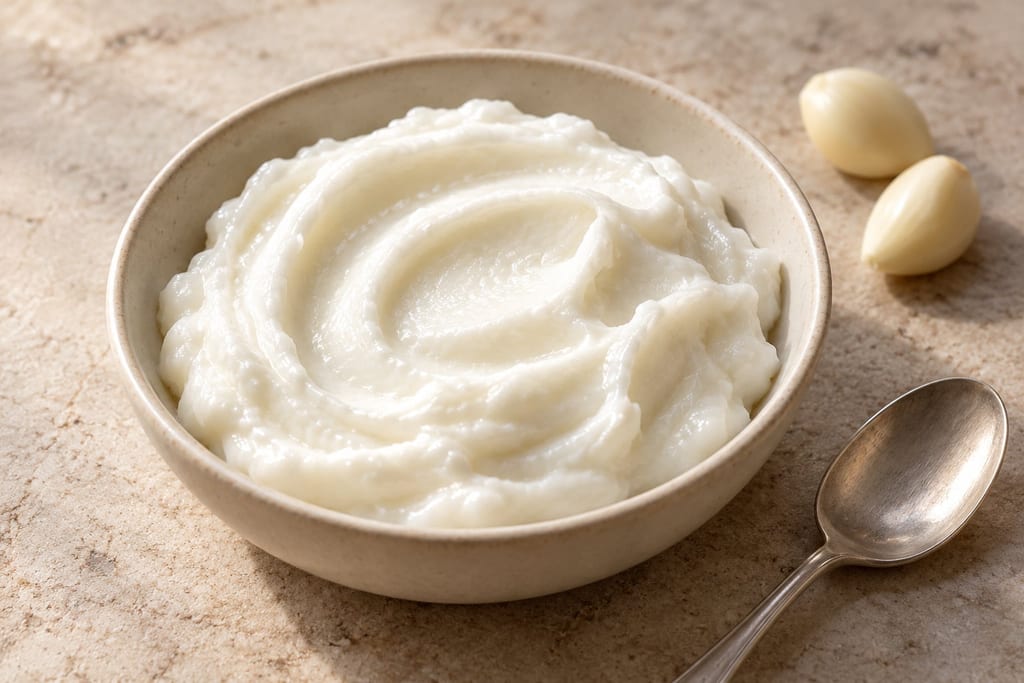
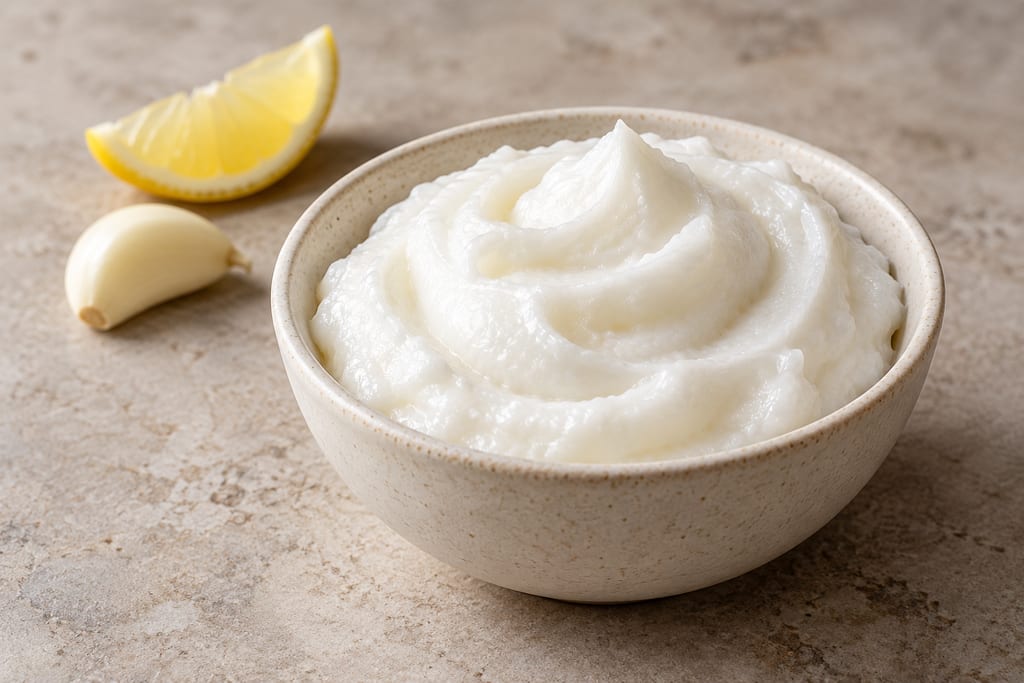
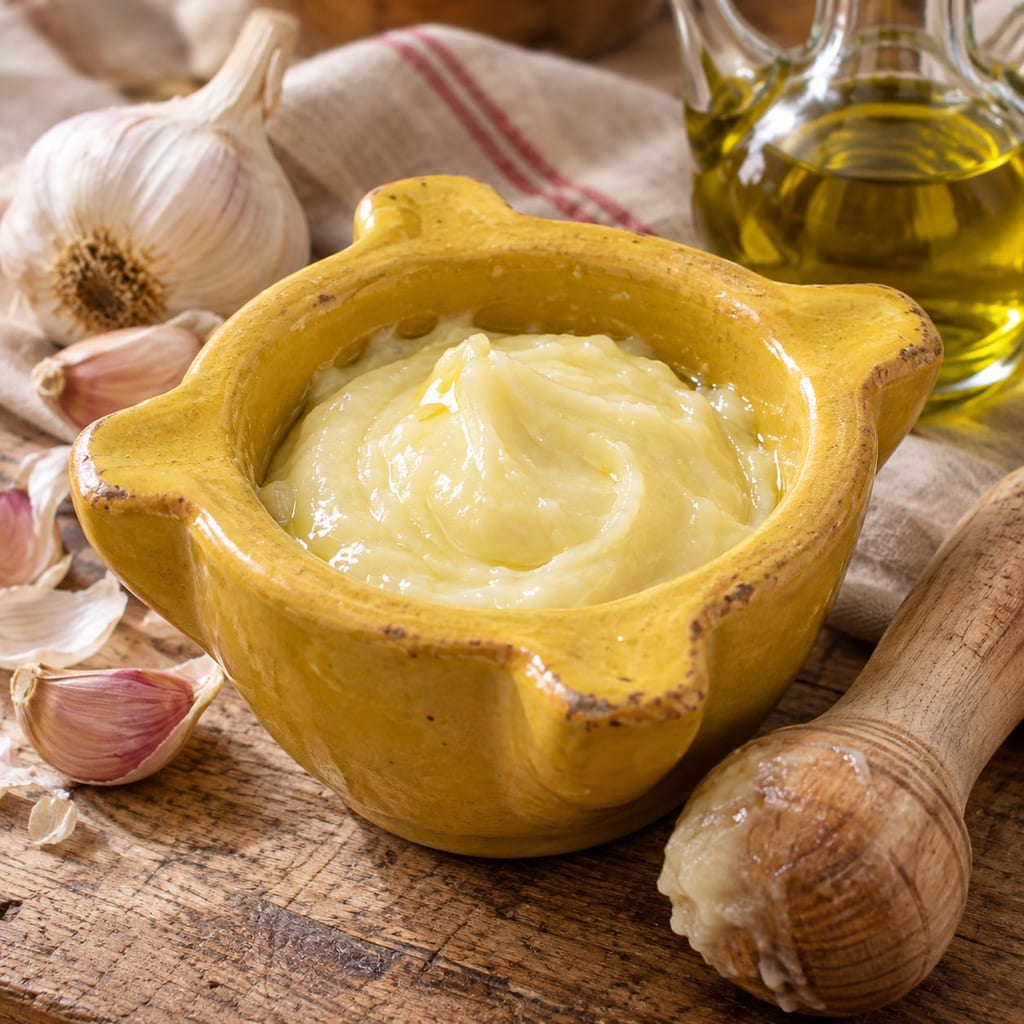
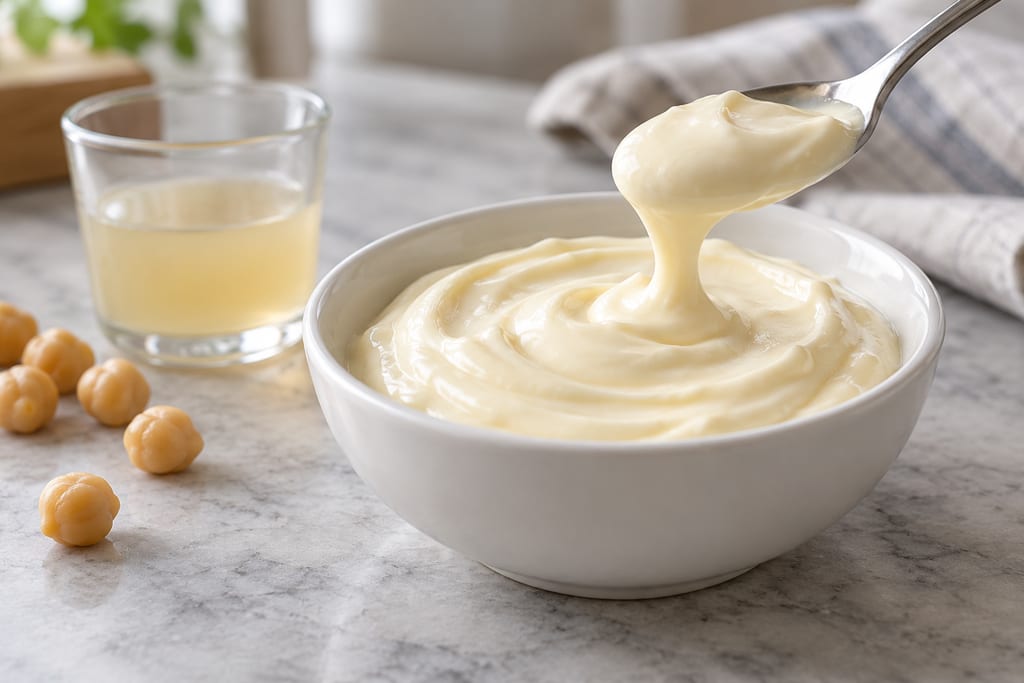
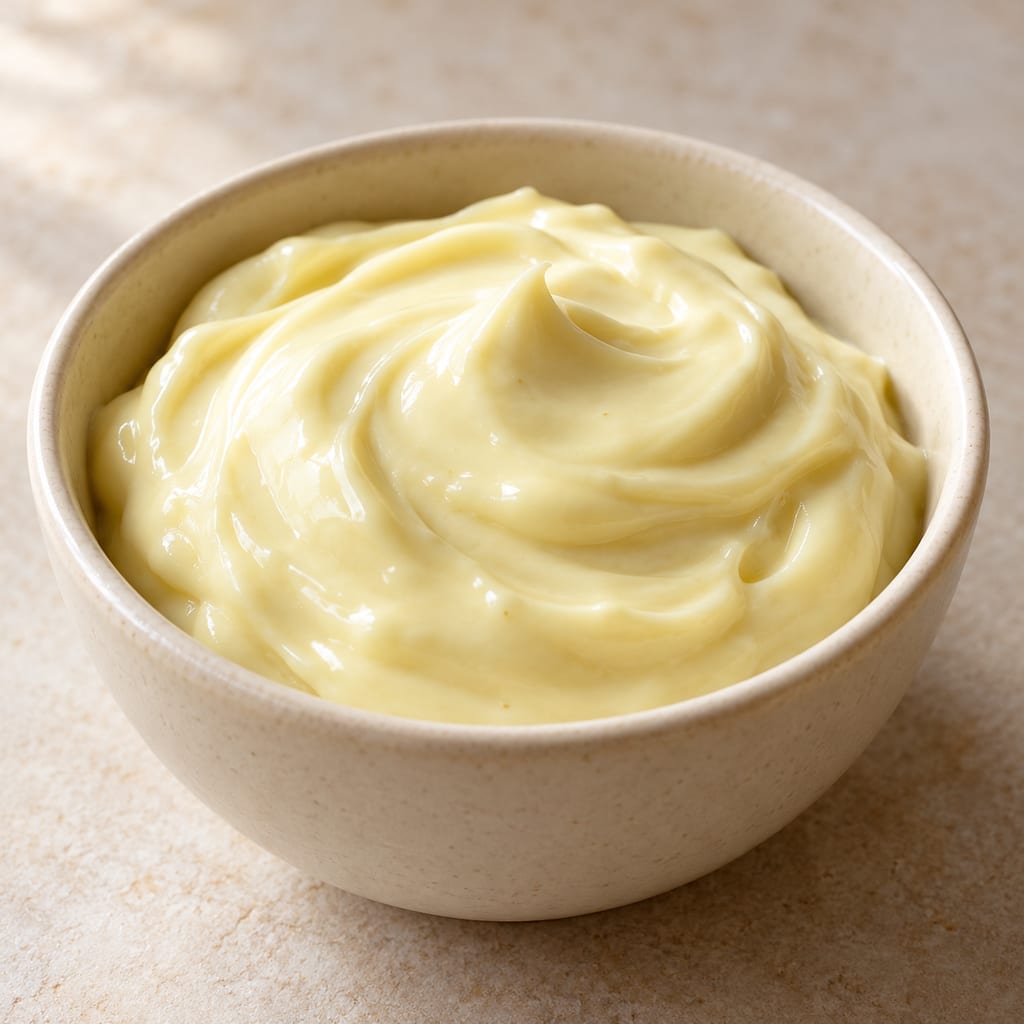
Toum is a Lebanese garlic-and-oil emulsion: raw garlic, salt, lemon and a little water are processed into a dense, pale, egg-free sauce. Slow oil addition builds its fluffy texture; it is served with grilled foods, sandwiches and mezze.
Toum is a smooth, pale garlic sauce whose name is also the Arabic word for garlic. Its simple ingredient list hides a precise physical transformation: raw garlic and salt become a fine paste, then a large amount of oil is incorporated gradually with lemon juice and water until the mixture holds as a thick, spoonable emulsion. There is no egg in the version here. The final sauce is intensely garlicky and creamy in texture, but it remains a garlic-based condiment rather than a flavored mayonnaise.
The form in this recipe is documented by a tested Mount Lebanon kitchen recipe: 100 grams peeled garlic, 500 millilitres neutral vegetable oil, 60 millilitres lemon juice, two tablespoons ice water and one and a half teaspoons salt. It is made in a food processor and chilled before serving. Other recipes change the ratios and the tool, so those quantities belong to this version alone. Toum is not one universally measured formula, and the word can cover household styles that use similar ingredients with different balances.
The sauce’s identity also depends on what it leaves out. Egg is not the primary emulsifier in the classic egg-free method described by the recipe sources. A cook can use egg white to rescue a broken emulsion, but that produces an altered sauce and changes what diners need to know about its ingredients. Here the recipe remains egg-free from start to finish.
Toum is closely associated with Lebanon and is eaten more widely across Levantine tables, but a responsible history does not invent a founding date. The Los Angeles Times spoke with chef and food historian Anissa Helou, who notes that dishes from the Levant are difficult to trace to a single origin because the region’s history and foodways cross modern borders; she describes toum as particularly ubiquitous in Lebanon. That is a useful account of present cultural geography and of the limits of the written record, not evidence that the sauce began at a particular date or in one village.
The same article offers a more specific twentieth-century story. Zankou Chicken began as a small family business in Lebanon in 1962. Its founder’s grandson recounts that his grandmother began making toum to serve with the family’s raw and rotisserie chicken, although he could not date the start precisely. The article credits Zankou with helping introduce the sauce to Southern California restaurants and grocery stores in the 1980s and 1990s. This documents one path of popularization; it does not claim that one business created a sauce already found across the Levant.
Personal accounts add another layer without becoming proof of ancient continuity. Amanda Carroll recalls toum as an ordinary fixture at family meals and at a Lebanese and Moroccan restaurant near her childhood home. She describes it with pita, kebabs and falafel at a large shared feast. Such memories explain how a condiment can be both a specific recipe and a familiar table presence, but they remain situated family memories rather than a comprehensive survey of every Lebanese household.
Oil and water naturally separate. In toum, a processor breaks the garlic into very small particles and releases the proteins and plant tissue that help stabilize tiny oil droplets in the watery lemon-and-garlic phase. The oil is dispersed while the blade keeps moving, and the garlic material helps the droplets stay apart long enough for the mixture to turn thick and cohesive. This is a mechanical emulsion, not fermentation: no culture, yeast or acid-producing organism is asked to transform the ingredients.
That physical structure explains why the first minutes matter. If oil is poured in too quickly, the watery phase can be overwhelmed before the garlic paste has a chance to hold the droplets apart. The sauce may look greasy or split instead of whitening and thickening. Starting with a smooth garlic paste, beginning with an exceptionally slow oil addition, and alternating small amounts of lemon and water gives the emulsion time to build. The lemon and water are incorporated liquids; they are not a substitute for slow processing.
Garlic itself is both the central flavor and the emulsion’s stabilizing material, so its condition and preparation matter. The tested Mount Lebanon recipe removes the green center of each clove, noting a reduction in bitterness. Serious Eats similarly recommends fresh, firm garlic and full processing to a smooth paste. These are practical quality choices for raw garlic, not safety tests: color, smell or a stable-looking sauce cannot establish how safely a batch was stored.
The formula uses an unusually large volume of oil relative to garlic. The oil gives the sauce its body and carries the sharp raw-garlic flavor across the palate; because the method keeps the oil droplets finely dispersed, the finished texture is dense and fluffy rather than a loose vinaigrette. The source specifies neutral vegetable oil and expressly excludes olive oil for this version. That choice makes the garlic the dominant flavor and avoids importing the strong flavor of a different oil into the cited formula.
Fresh lemon juice supplies acidity and brightness, while the small amount of ice water provides additional liquid as the oil is incorporated. Salt seasons the sauce and is processed with the garlic at the beginning. The recipe’s sequence respects the way the mixture holds together: garlic and salt first, a little lemon to loosen the paste, then gradual oil additions separated by lemon and water. A home cook should not assume that changing the oil, acid, garlic or water in isolation leaves the same texture.
Recipe writers make different choices. Maureen Abood’s contemporary Lebanese American version shares the egg-free garlic-and-oil idea and describes it as a flexible table sauce; Serious Eats gives another measured formula and explains a mortar-and-pestle option. Some commercial versions use citric acid, and some home recipes use olive oil. These are documented variants in technique and ingredient choice, not replacements silently folded into the Mount Lebanon recipe above.
The source method begins by peeling the garlic and removing its green germ. Garlic and salt go into the processor until they are very finely minced and begin to paste; scraping the bowl returns stray pieces to the blade. The first scant tablespoon of lemon juice is processed for about thirty seconds. Only after the paste is smooth does oil begin to enter, almost drop by drop at first. This small-batch discipline is what gives the sauce a chance to emulsify rather than turning into an oily dressing.
Once the first few tablespoons of oil have been accepted, the recipe alternates a very thin oil stream with small splashes of lemon juice and then ice water. The processor stays on throughout the gradual additions. The visual and sound changes the recipe describes—whitening, thickening and a change in motor sound—are useful signs that an emulsion is forming, but they are not precise measurements. If the mixture breaks, this page does not direct the reader to add an unlisted ingredient: adding egg white is an alternative repair described by Serious Eats, and it would no longer be the egg-free version.
A mortar and pestle is another documented route, but it changes the labor and rhythm. Serious Eats advises grinding garlic and salt to a smooth paste, then working in the oil in teaspoon amounts and adding a few drops of lemon after each tablespoon of oil. Depending on the mortar’s size, the batch may need halving or quartering. That hand technique is a useful traditional counterpart to the food processor, but the exact SOFRA ingredient amounts above are specified for the processor method and should not be combined casually with the small-batch mortar sequence.
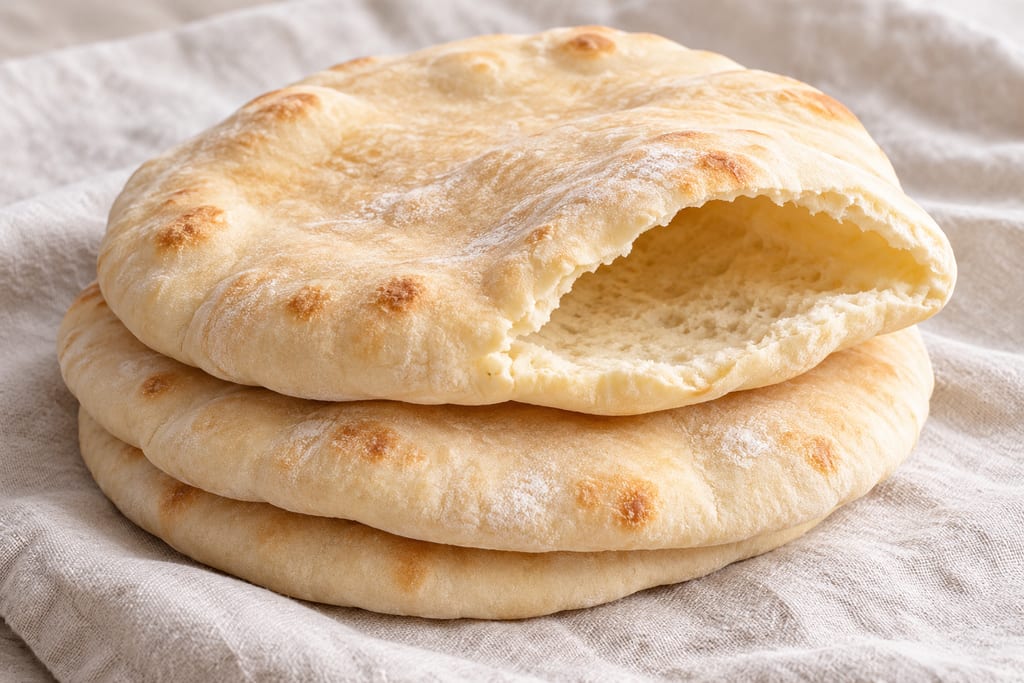
Toum is served as an accompaniment, spread and dip. In Lebanon it is commonly paired with shish tawook, grilled chicken and shawarma; the Los Angeles Times also describes chicken wings, tomatoes with sumac, and fish sandwiches in Tripoli with toum spread on pita. At a shared table, a small dish can sit beside grilled meats, pickles and bread, where each bite carries a different amount of garlic. Carroll’s family feast account places it among pita, kebabs, falafel, olives, rice, salads and other mezze dishes.
Beyond the traditional pairings described in those sources, Serious Eats presents toum as a flavor base for soups and pasta, a marinade for chicken, a finishing accent for roasted vegetables and a sandwich spread. These uses take advantage of its concentrated raw garlic flavor and creamy texture. It can stand in for mayonnaise in a dish that wants a pungent, egg-free condiment, but the two sauces are made differently and toum’s assertive garlic character changes the result.
The sauce’s texture shapes how it is used. A very thick version can be lifted with bread or spread inside a wrap; a thinner emulsion can coat grilled food or vegetables. Recipe sources vary their proportions and water additions, which explains some of the range readers encounter. The recipe here is the thick, fluffy style of the Mount Lebanon source, and its chilling step is part of serving texture rather than a long aging stage.
Toum is a fresh sauce made from raw garlic and a large amount of oil. Oregon State University Extension warns that garlic is a low-acid vegetable and that raw garlic stored improperly in oil can support growth of Clostridium botulinum and toxin formation. The source recipe’s lemon juice is an ingredient in the emulsion, but it does not provide a tested acidification schedule or a pH limit. It therefore cannot be used to claim that this batch is shelf-stable at room temperature.
Refrigerate the finished sauce promptly in a clean covered container. Oregon State Extension gives a four-day refrigerator limit for homemade garlic-in-oil mixtures, or freezing for longer storage; this recipe follows that conservative guidance. Do not leave the sauce on the counter to store, and do not assume that a month-long storage statement in a recipe article proves this exact formula has been tested for safety. Toum is prepared as a fresh condiment, not canned or preserved in a pantry.
The measured batch below follows SOFRA’s 100-gram garlic formula and 24-serving estimate. The source gives no serving weight, so the number describes its estimate rather than a precise portion. It calls for a food processor, neutral vegetable oil, fresh lemon juice, ice water and salt; the directions use the oil and liquids in a slow alternating sequence and chill the sauce for an hour before service.
Small details should stay attached to their source. The process is not a ferment, the resting period is refrigeration for texture, and there is no maturation claim. The source does not call for an added egg, dairy, starch or herb. The one-month refrigerator claim on some recipe pages is excluded here because the public extension guidance for home garlic-in-oil preparations is more conservative. By keeping those boundaries clear, a reader can enjoy the sauce as toum without confusing it with aioli, a garlic mayonnaise or a preserved flavored oil.
The consulted sources do not date toum’s origin. Food historian Anissa Helou cautions that Levantine dishes are difficult to trace to a single origin and describes toum as especially ubiquitous in Lebanon. Zankou Chicken’s family story places the sauce beside its chicken business in Lebanon before its later popularization in Southern California; that account does not establish an ancient first appearance.
Ingredients
Yield 24 servings
Garlic clovespeeled; remove green germs from the center
Garlic is low-acid and the oil limits oxygen; improperly stored garlic-in-oil can allow botulism toxin formation.
Hazard source
Refrigerate the finished sauce promptly, keep it refrigerated, and use within four days or freeze for longer storage.
Control source
The lemon in this recipe is part of the flavor and emulsion method; this formula is not a validated acidification process for room-temperature storage.
Peel the garlic cloves and remove any green germ from their centers; this recipe source says doing so reduces bitterness.
Put the garlic and salt in a food processor. Process until the garlic is finely minced and starting to form a paste, about 1 minute, scraping down the bowl.
With the processor running continuously, add a scant tablespoon of lemon juice and process for about 30 seconds.
Begin adding the oil as gradually as possible, almost drop by drop, while the processor runs. After 2–3 tablespoons of oil have gone in, add another small splash of lemon juice.
Continue with a thin stream of oil, alternating it with small splashes of lemon juice and then ice water. Keep the processor running as the emulsion builds.
Continue until all the oil and lemon juice are incorporated and the sauce is thick, white and fluffy.
Transfer the toum to a clean covered container and refrigerate for 1 hour before serving; chilling thickens the sauce further.
Keep leftovers refrigerated promptly. Use within 4 days of preparation or freeze for longer storage; do not keep homemade garlic-in-oil at room temperature.
Conditions
Yield24 servings
Active time30 min
Places
Lebanon
Traditional preparation · Country evidence
Toum is described as a staple of Lebanese cuisine and especially ubiquitous in Lebanon; no single origin is asserted.
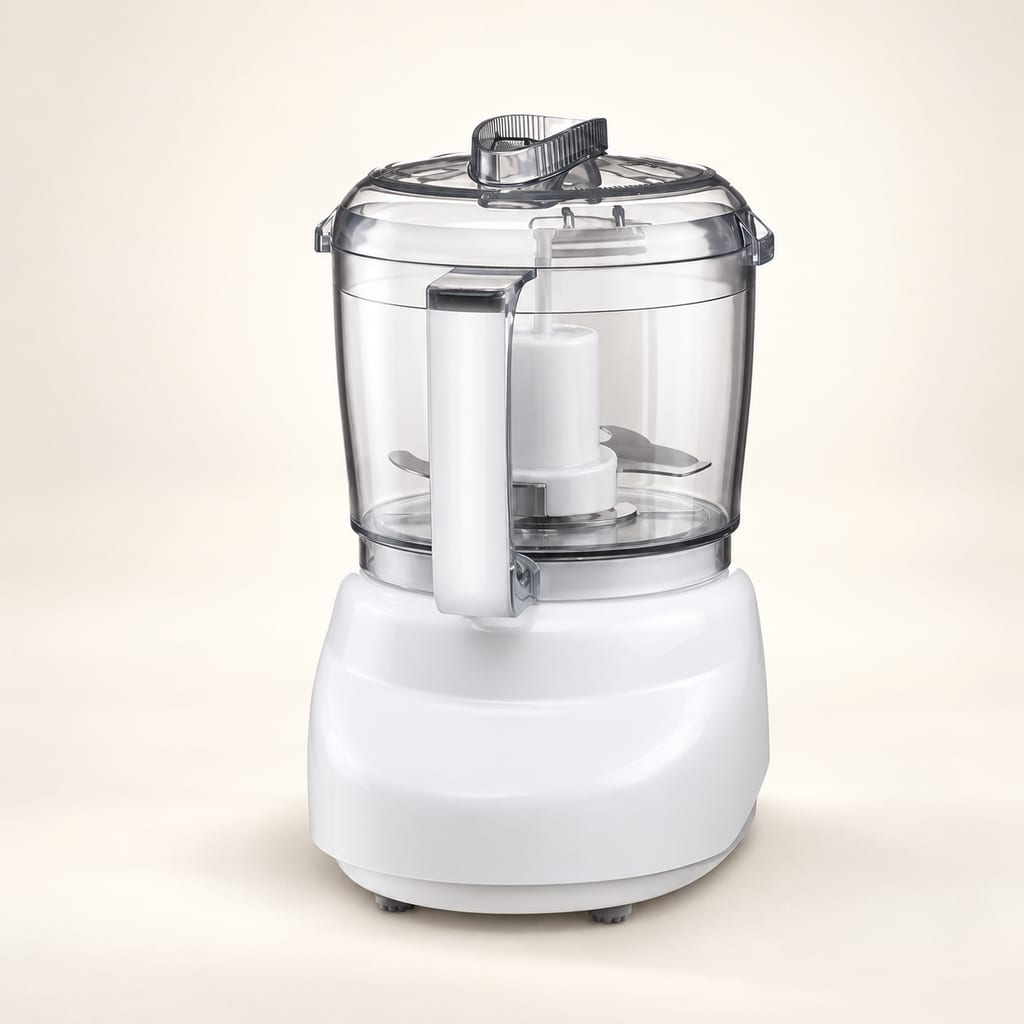
A small food processor is a countertop electric appliance with a motor base, removable lidded work bowl and central blade. Its smaller bowl can suit small batches of toum or herb sauce, but capacities, attachments and limits vary by model.
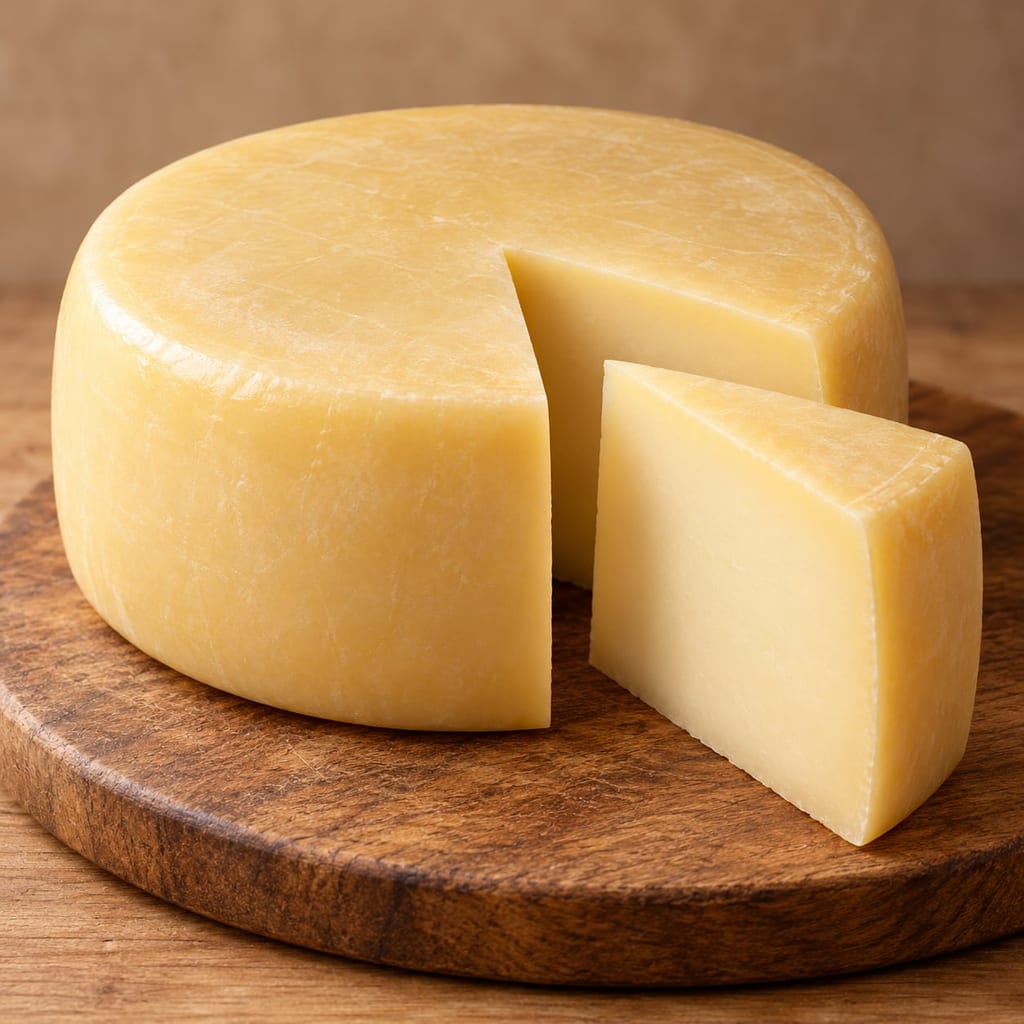
Kashkaval is a firm sheep-milk cheese whose acidified curd is worked in hot brine. This large-batch method finishes with repeated dry salting, wax coating and cool ripening.
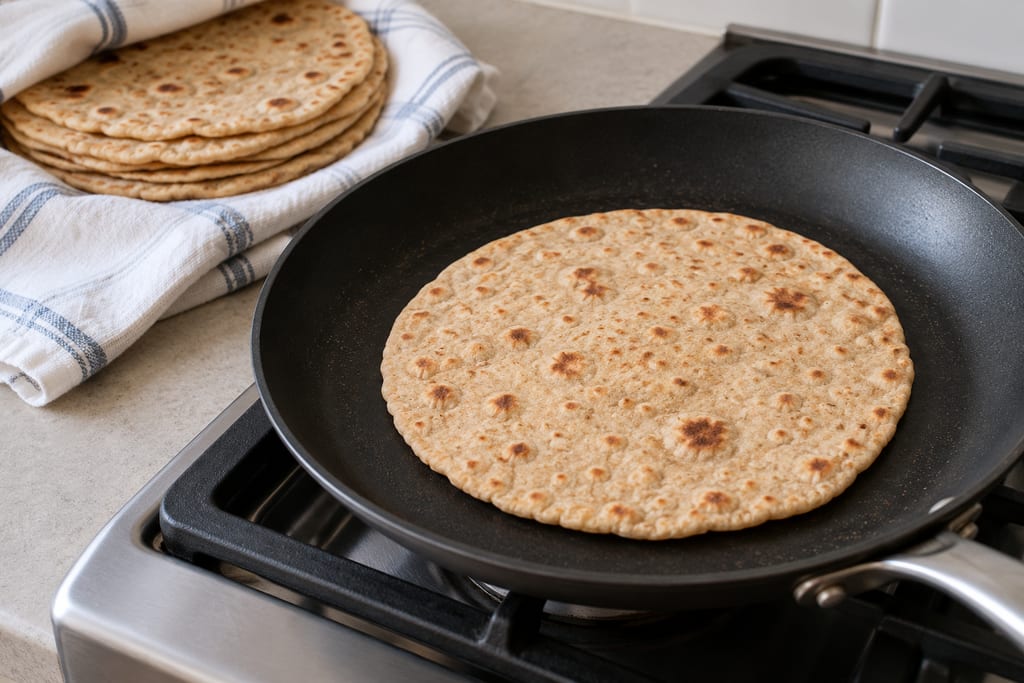
A small home-pan adaptation of Levantine markouk: rested wheat dough rolled into small rounds and cooked quickly on a hot flat pan. It is thicker and smaller than the hand-stretched sheets made on a saj.
Traditional Catalan allioli is a dense emulsion of garlic, olive oil and salt made slowly in a mortar. This measured Barcelona-style version keeps egg-based garlic mayonnaise distinct.
Avocado-oil mayonnaise is an ordinary egg-and-oil emulsion in which avocado oil supplies the oil phase. The oil changes flavour and colour, and it does not preserve the sauce.
Bechamel is a white sauce of milk thickened with a butter and flour roux, one of the French mother sauces, and the base from which Mornay and other cheese and cream sauces are made.
Beurre blanc is a warm emulsion of cold butter whisked into a reduction of white wine, vinegar or lemon juice and shallot, a sauce from the Loire Valley and its red-wine version, beurre rouge.
Blue cheese dressing is a creamy dressing built on crumbled blue cheese mashed into buttermilk, with sour cream, mayonnaise, vinegar and seasoning, and kept cold for up to two weeks.
Bread sauce is a British sauce of milk infused with onion, clove and bay, thickened with stale breadcrumbs and finished with butter, served with roast chicken or turkey.
Community
No community contributions have been published for this entry yet.
Share what you made
Sign in to contribute. Published comments and photos are free to read.
Tested kitchen recipe from Mount Lebanon with exact quantities and method for garlic, vegetable oil, lemon juice, ice water and salt; food processor and slow alternating additions; chill for an hour before serving.
Cited in: A sauce built from garlic, oil and patience; How an emulsion forms without egg; Why the ingredients and proportions matter; Processor and mortar techniques; Keeping a fresh garlic-and-oil sauce; Reading the recipe as one specific version
Explains garlic paste as source of emulsifying proteins and pulverized tissue; very slow oil addition and alternating aqueous ingredients; mortar and pestle alternative; serving and flavor uses; egg-white rescue is an altered version.
Cited in: A sauce built from garlic, oil and patience; How an emulsion forms without egg; Why the ingredients and proportions matter; Processor and mortar techniques; At the meal: chicken, bread, mezze and more; Keeping a fresh garlic-and-oil sauce; Reading the recipe as one specific version
Food historian Anissa Helou says Levantine dish origins are difficult to pinpoint and toum is especially ubiquitous in Lebanon; family account of Zankou Chicken in Lebanon and its role in Southern California's 1980s–90s spread; typical uses with grilled chicken and regional sandwiches.
Cited in: A Levantine food with a hard-to-date beginning; At the meal: chicken, bread, mezze and more
Personal family and restaurant context for toum at a Middle Eastern feast, paired with kebabs, falafel and pita; describes mortar-and-pestle tradition and food-processor adaptation as personal and contemporary experience.
Cited in: A Levantine food with a hard-to-date beginning; At the meal: chicken, bread, mezze and more
Accessed 2026-10-28
Oregon State University Extension ServiceFood safety · Storage
Raw garlic in oil should not be stored at room temperature; homemade garlic-in-oil mixtures require refrigeration and use within four days or freezing, because garlic is a low-acid ingredient.
Cited in: Keeping a fresh garlic-and-oil sauce; Reading the recipe as one specific version