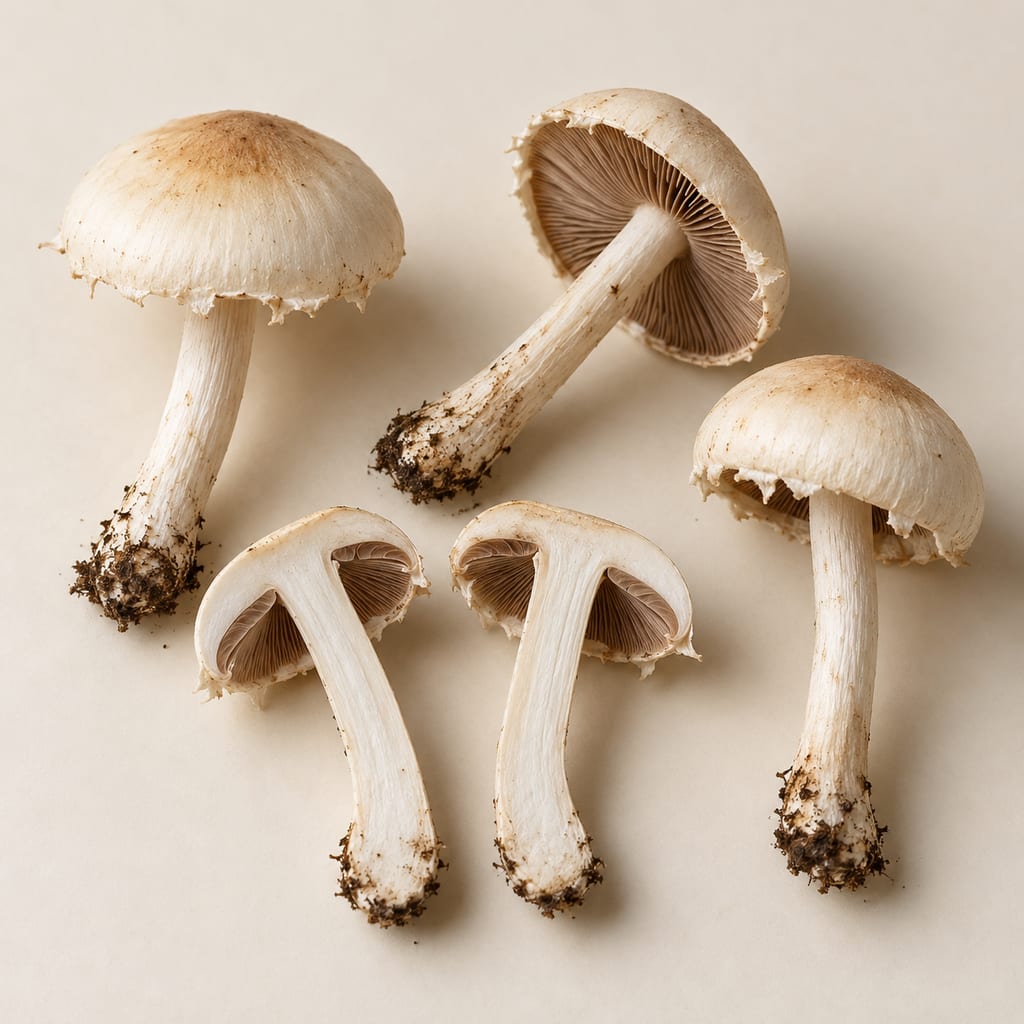
Agrocybe dura
A grassland agaric listed as edible in historical and scientific catalogues for Hong Kong and China. Taxonomic concepts and practical food value vary; the listings do not establish safe identification or culinary practice.
 FermenteaWhere food goes to change
Substrates
Duck is the dark, rich meat of a domesticated water bird, sold whole or as breast, leg, skin, fat, giblets, bones and trimmings, each with its own use in the kitchen.
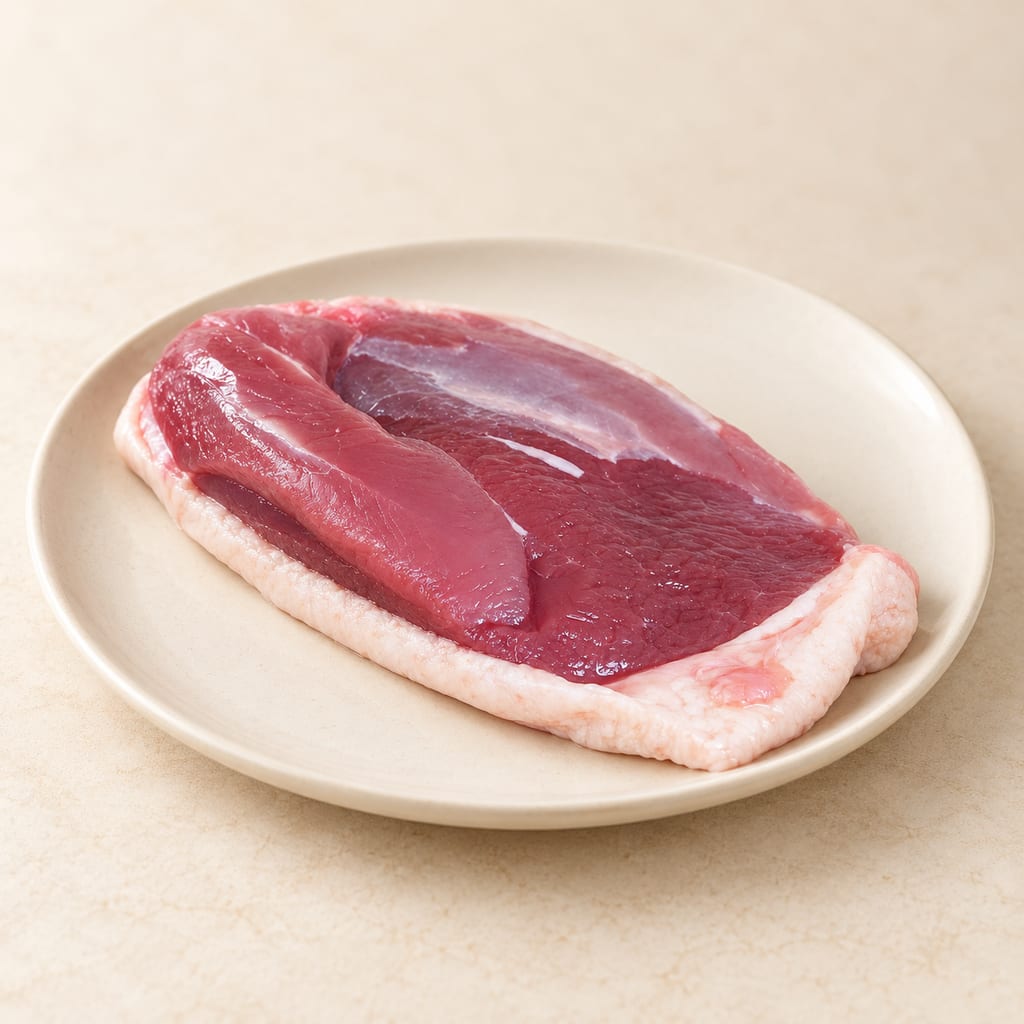
Duck is the meat of a domesticated water bird, and it sits oddly among the poultry. It is classed as poultry, but every part of it is dark. Ducks fly and paddle, so their breast muscle works hard and holds a lot of myoglobin, the protein that stores oxygen in muscle and colours it red. The result is a breast closer to red meat than to chicken, with a stronger, richer, faintly gamey flavour that holds up to fruit, spice and long cooking.
The second defining trait is fat. Ducks swim, and a thick layer of fat under the skin keeps them buoyant. That fat sits as a sheet between skin and muscle and is not marbled through the meat, so a cook can leave it on to render into the pan or cut it away. A raw duck with its skin carries about 39 g of fat in every 100 g of edible meat and skin, against roughly 6 g in 100 g of the meat alone. The same bird therefore gives you a lean, dense red meat and a source of cooking fat, depending on how it is cut.
Almost all duck on sale comes from the mallard, Anas platyrhynchos, which people domesticated into breeds such as the Pekin. The Muscovy, Cairina moschata, is a separate species from Latin America. A third kind, the mulard, is a sterile hybrid of the two. A label that says only "duck" does not tell you which of these supplied the meat, and the difference shows in fat, size and flavour.
Most domestic ducks descend from the mallard, which was domesticated in southern China. Today about 1.15 billion ducks are kept worldwide, around 89 percent of them in Asia, with the largest flocks in China, Viet Nam, Bangladesh and Indonesia. Selection over many generations separated birds kept mainly for meat from those kept mainly for eggs, and genome studies of Chinese domestic and wild mallards can still tell the two groups apart. Those studies model population history. They do not date a first duck farm, and no source pins domestication to a single place or year.
The Muscovy has a different story. Its wild range is Neotropical, it was domesticated in Latin America, and it is now also found in equatorial Africa and in Asia, especially Southeast Asia. Archaeologists have trouble recognising early Muscovy domestication because wild and domestic skeletons look alike and males are much larger than females; the early record remains incomplete. Muscovies forage well, need little water, and produce meat with less fat than other duck breeds.
Keeping the two histories apart matters to a cook for a practical reason. A Pekin breast from a supermarket, a Muscovy breast from a smallholding and a mulard breast come from animals with different ancestry, growth rates and fat, and none of them is "the" duck.
Duck has been cooked with care for a long time. The Roman collection attributed to Apicius gives several preparations for crane or duck. In one, the bird is parboiled with salt and dill, then finished with oil, broth, oregano, coriander and reduced grape must, and served with a separate sauce of pepper, lovage, cumin, coriander, laser root and rue in wine, honey, vinegar and cooking liquid. The meat is cooked simply and the character comes from sweet, sour and aromatic seasoning, a pairing that duck has kept ever since.
In China the best-known story is that of roast duck. A thirteenth-century account of Hangzhou describes roast duck sold door to door by street vendors, and in the Ming period Nanjing, the first Ming capital, became famous for it, cooked in a square brick oven with a door on every side. When the court moved to Beijing in the early fifteenth century, the dish followed it. Beijing cooks developed a local white duck with thin skin and tender flesh, reared outside the city and fattened before slaughter. In the Qing period the hanging oven, probably first built in palace kitchens, let a cook roast ducks one at a time to order; the restaurant Quanjude opened in 1864 around that method. Sources disagree on several of these dates, and the accounts are popular histories rather than archival studies, so treat them as the outline of a story and not as precise chronology.
The White Pekin, the bird at the root of that tradition, crossed the Pacific on a clipper ship in 1873 with fewer than a dozen birds and founded the American duck industry, which for decades centred on Long Island. Duck in a western household could also be plain. The anonymous New England Cook Book of 1836 offers it roasted, or stewed like pigeons in a gravy thickened with flour and browned afterwards, and suggests an onion dressing for wild ducks. Together these records show how many ways one animal can be treated: simmered then sauced in Rome, lacquered and roasted in Nanjing and Beijing, stewed in New Haven.
Duck farming runs from paddy fields to climate-controlled sheds. In rice-growing parts of Asia, ducks and rice work together: the birds graze insects, slugs and snails, and eat grain that would otherwise be lost in harvesting and winnowing, while their manure fertilises the field. Ducks are hardy, resist disease well, forage efficiently and are easy to herd in wetlands, which is why they are an important rural food source across Asia.
Commercial production in the United States is different. Almost all ducks are raised indoors, which protects them from predators and lets the grower collect manure for use as fertiliser. Most are now reared in Wisconsin and Indiana, because land on Long Island became too valuable to farm. They are fed corn and soybeans fortified with vitamins and minerals, and most feed contains no animal by-products. The birds are stunned, bled, scalded to loosen the large feathers and dipped in paraffin wax to lift the fine pin feathers. Down and feathers are a valuable by-product.
Ducks use feed less efficiently than chickens because their shovel-shaped bills waste a good deal of it when fed in confinement, one reason duck costs more than chicken. Age at slaughter determines what the label means. A broiler or fryer duckling is usually under eight weeks old, with a soft bill and windpipe, and weighs 3 to 6.5 pounds. A roaster duckling is usually under sixteen weeks and weighs 4 to 7.5 pounds. A mature duck, usually over six months, has toughened flesh and goes mostly into processed products. Plump, meaty birds with skin free of cuts and bruises carry the USDA Grade A shield.
The Pekin is the standard meat duck of the Western world: white-feathered, fast-growing and fat. Even within the Pekin type, lines differ. In a Polish comparison of two Pekin genotypes slaughtered at 49 days, a native strain called P33 carried more than 26 percent of its eviscerated carcass weight as skin with subcutaneous fat, while a commercial hybrid, Star 53 HY, produced a higher proportion of breast muscle and less fat. The hybrid was better suited to broiler production; the native strain scored better for sensory and textural qualities. The word "Pekin" on a pack does not fix the proportions of meat to fat.
The Muscovy is the lean alternative. Its meat has less fat than that of other duck breeds, which makes it popular where the goal is a firm, rich red meat with little to render. The mulard, a cross between a Muscovy drake and a Pekin-type duck, is sterile and is therefore called the mule duck. It is hardy and large, and it is raised in great numbers, mainly in France, where the males are fattened for foie gras and the females for meat. Mulard meat is leaner than Pekin.
A duck is sold whole, with giblets and neck, or in parts: bone-in legs and breast quarters, boneless breasts with or without skin, livers, hearts, gizzards, and tongues and feet, a delicacy mostly exported to Hong Kong. The same animal gives very different materials, and the numbers show how much.
Raw domesticated duck with meat and skin has 48.5 g of water, 11.5 g of protein and 39.3 g of fat per 100 g, about 404 kilocalories. Take the skin and the fat layer away and the raw meat alone has 73.8 g of water, 18.3 g of protein and 5.95 g of fat, about 135 kilocalories. Roasting renders much of the fat out: roasted meat with skin falls to 28.4 g of fat and 337 kilocalories per 100 g, and roasted meat alone has 11.2 g of fat and 23.5 g of protein. Raw liver is a different material again, at 18.7 g of protein and 4.64 g of fat, with 515 mg of cholesterol, compared with about 77 mg in the meat.
Breast and leg are not interchangeable. In a study of Cherry Valley ducks slaughtered at six weeks, the breast muscle (pectoralis major) was made only of fast-twitch fibres, which tire quickly, while the leg muscle (iliotibialis) held both slow and fast fibres, as expected of a muscle that works constantly. The leg had a higher pH, was lighter in colour and lost less water on cooking. The breast lost more juice and, being a lean, tight muscle, is a cut that suits fast cooking, and the US cooking chart browns it skin-side down in a skillet over medium heat and finishes it in a 425 °F oven for 12 minutes. The same chart gives legs and thighs 1 1/4 to 1 1/2 hours of roasting at 325 °F, or braising for about an hour or more, a slower treatment suited to a muscle that has worked harder.
The skin is where the fat is and where the flavour of roast duck comes from. Pricked all over before roasting, it renders its fat and crisps; the fat layer must have melted before a whole bird is done.
Rendered duck fat is a culinary ingredient in its own right. In raw duck with skin, of the 39.3 g of fat per 100 g about 13.2 g is saturated, 18.7 g monounsaturated and 5.08 g polyunsaturated, so nearly half of the fat is monounsaturated and about a third is saturated. Cooks keep what the bird renders and use it for roasting and frying.
The classic use of the fat is confit, a method from Gascony in south-western France. The name comes from confire, "to preserve". Duck legs are rubbed with salt and seasonings such as garlic, thyme and bay, left to cure overnight, dried, and then cooked slowly for several hours in duck or goose fat. Legs suit the method because they are rich in connective tissue and fat, which become tender under slow heat. Traditionally the meat was stored under its own cooking fat, which excluded air and let a household keep it for months before refrigeration. Dates for the method range from the thirteenth century upwards in popular accounts and are not firmly established. Today confit is made mainly for its flavour and texture.
Duck is also eaten cured, smoked, in pâté and as sausage. Smoked cooked breast and duck franks are sold as processed products, and the label must list additives such as salt, MSG or sodium erythorbate.
Meat does not stop changing when the animal dies. Enzymes naturally present in the muscle, mainly the calpains and cathepsins, keep breaking down proteins into smaller peptides during storage. This proteolysis explains why meat tenderises and changes colour and water-holding as it rests.
In a study that vacuum-packed Cherry Valley breast and leg muscle and held them at 4 °C for 10 days, calpain activity declined steadily and was higher in the breast than in the leg, and the breast pH fell significantly while the leg barely changed. Thousands of peptides were detected, 5,155 from 34 proteins in the breast and 4,222 from 32 proteins in the leg. The proteins most closely tied to colour and water-holding were those of glycolysis and the myofibrils. This is natural enzymatic change, not microbial fermentation, and the ten-day schedule was a laboratory condition, not advice for holding raw duck at home.
Most duck is sold frozen, because demand is smaller than for chicken or turkey, and fresh birds appear mainly around holidays. Look for a plump bird with undamaged skin and no missing parts. Plan on 1 to 1.5 pounds of raw whole duck per person, or about three servings per pound of raw boneless meat.
Fresh duck keeps one to two days in the refrigerator at 40 °F (4 °C) and about six months frozen at 0 °F (-18 °C) for best quality, although continuously frozen poultry stays safe indefinitely. Fresh giblets keep three to four days chilled and two to three months frozen. Thaw in the refrigerator, in cold water in its unopened packaging with the water changed every 30 minutes, or in the microwave if the duck will be cooked at once; never on the counter. A whole 3 to 4 pound duck thaws in cold water in two to three hours.
Raw poultry can carry Salmonella, and freezing does not kill it. Keep raw duck and its juices away from cooked food and from foods eaten raw. The safe minimum internal temperature is 165 °F (74 °C), measured in the innermost part of the thigh and wing and the thickest part of the breast of a whole bird, and in breast, drumsticks, thighs and wings when cooking pieces. Cooked duck can stay pink at that temperature, so colour is not a test. A whole 4 to 6 pound duckling roasts at 350 °F in 30 to 35 minutes per pound, and breast is seared skin-side down, then finished in a 425 °F oven for 12 minutes. Cooked duck keeps three to four days in the refrigerator.
A fermented meat sauce built on koji and salt needs three things from its raw material: protein for the koji enzymes to cut into peptides and amino acids, soluble extractives that turn into savoury flavour, and enough moisture for the enzymes to work. Bones and trimmings from a duck supply these in a different balance from lean muscle.
Trimmings are muscle scraps, skin and fat. Their protein is a mixture of myofibrillar proteins and connective tissue, and the muscle is dark and rich in myoglobin and extractives, which contribute colour and a strong meaty note. Bones add more. No source used here analyses duck bone, so the nearest measurements are from chicken: collagen from chicken skin and tendon has the structure of type I collagen, and the mineral of chicken foot bone is a calcium-deficient apatite with a calcium to phosphorus ratio of 1.54. Marrow and skin contribute fat. In a koji ferment the Aspergillus oryzae mould grown on grain makes proteases and amylases. Proteases release peptides and free amino acids; amylases from the same mould turn the starch of the grain into sugars. The salt holds spoilage organisms back while those enzymes work. The pork study described below sampled its mixtures at three months.
The closest measured model is a Japanese fermented pork sauce, shishibishio. In a study of it, ground pork was mixed with rice koji, pepper and salt at 15, 20 or 25 percent, and the commercial enzymes Alcalase or Pectinase 3S were added to speed proteolysis. Sampled at three months, the mixtures had fewer than 300 colony-forming units of viable bacteria per gram and no coliforms, with high peptide and free amino acid content. Adding either enzyme increased the yield of sauce and the recovery of protein by accelerating liquefaction and proteolysis, and the highest yields, 49.8 to 50.6 percent, came from the mixtures with 15 percent salt. That is a different meat, with added enzymes, so it shows the principle and not a duck recipe.
A commercial example is the Czech producer Goodlok, whose duck garum is made from duck bones and trimmings, barley-groat koji, salt and water. The producer does not publish the species, breed, proportions or timing, and those cannot be inferred from the label. The fat that separates in such a ferment floats as a layer, while the gelatin and peptides stay in the liquid.
Other fermentations use the meat, not the bones. Researchers making air-dried duck under a low-nitrite process combined the lactic acid bacterium Limosilactobacillus fermentum and the yeast Debaryomyces hansenii, with ultrasound pretreatment, and measured improvements in tenderness, water distribution and aroma compounds produced from protein and lipid breakdown. The result belongs to that formulation and those strains and is not a general method for fermenting poultry.
No allergen is recorded for duck meat itself. A product made from duck brings the allergens of its other ingredients: Goodlok's koji is made from barley groats, a gluten-containing grain. Two points stay open: the species and breed behind any particular supplier's duck, and the proportions of bone, skin and meat in a commercial trimming.
Broad domestication association for mallard-derived domestic ducks, not a precise birthplace or default retail origin.
Broad Muscovy domestication association; exact date and locality unresolved.
The duck used in the Goodlok product has no documented breed, species or production origin in the supplied evidence.
A grassland agaric listed as edible in historical and scientific catalogues for Hong Kong and China. Taxonomic concepts and practical food value vary; the listings do not establish safe identification or culinary practice.

Akahatsu, Lactarius akahatsu, is a wild milkcap of East Asian pine and mixed forests that is sold in Yunnan markets, with its edibility and identity still needing species-level review.
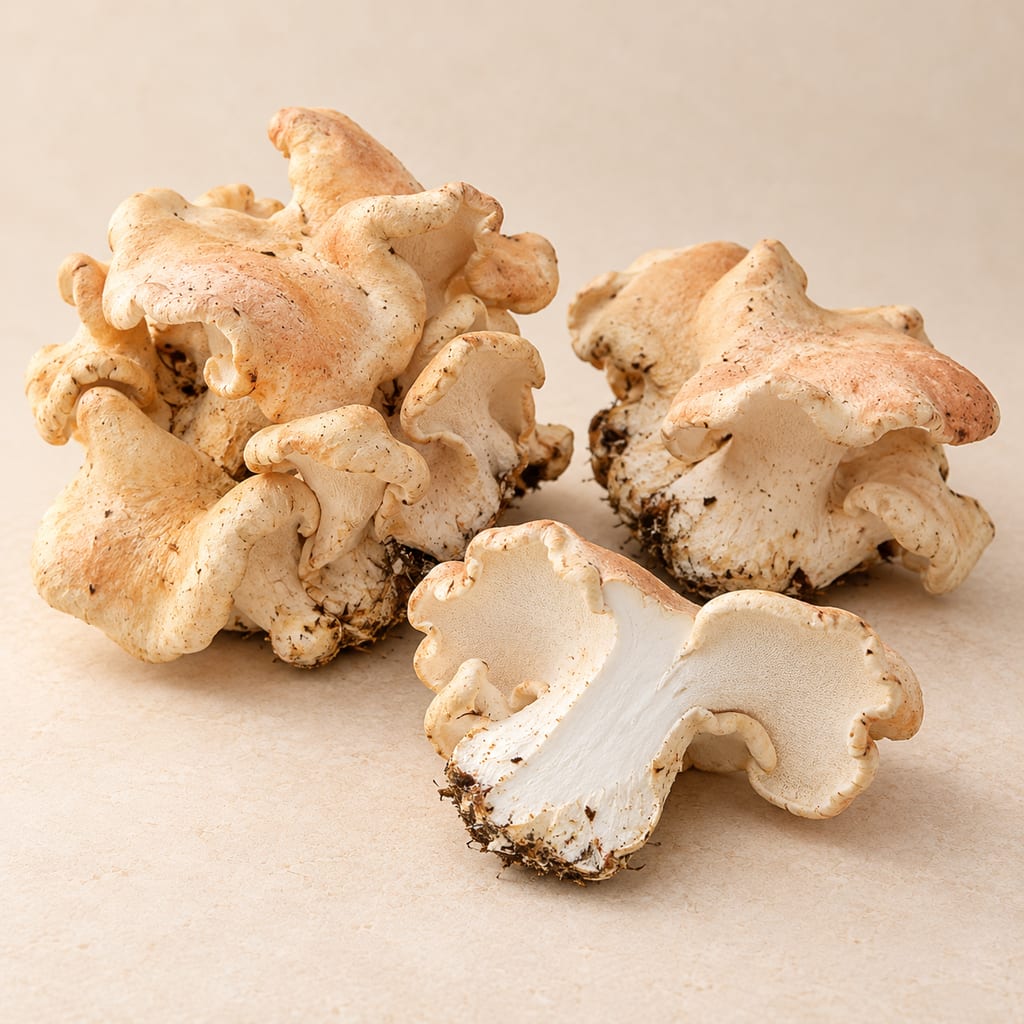
Albatrellus confluens is a ground-growing polypore with fused buff-orange caps. Sources document Chinese market use and regional edibility, but others reject it as too bitter; taxonomy also varies between Albatrellus and Albatrellopsis.
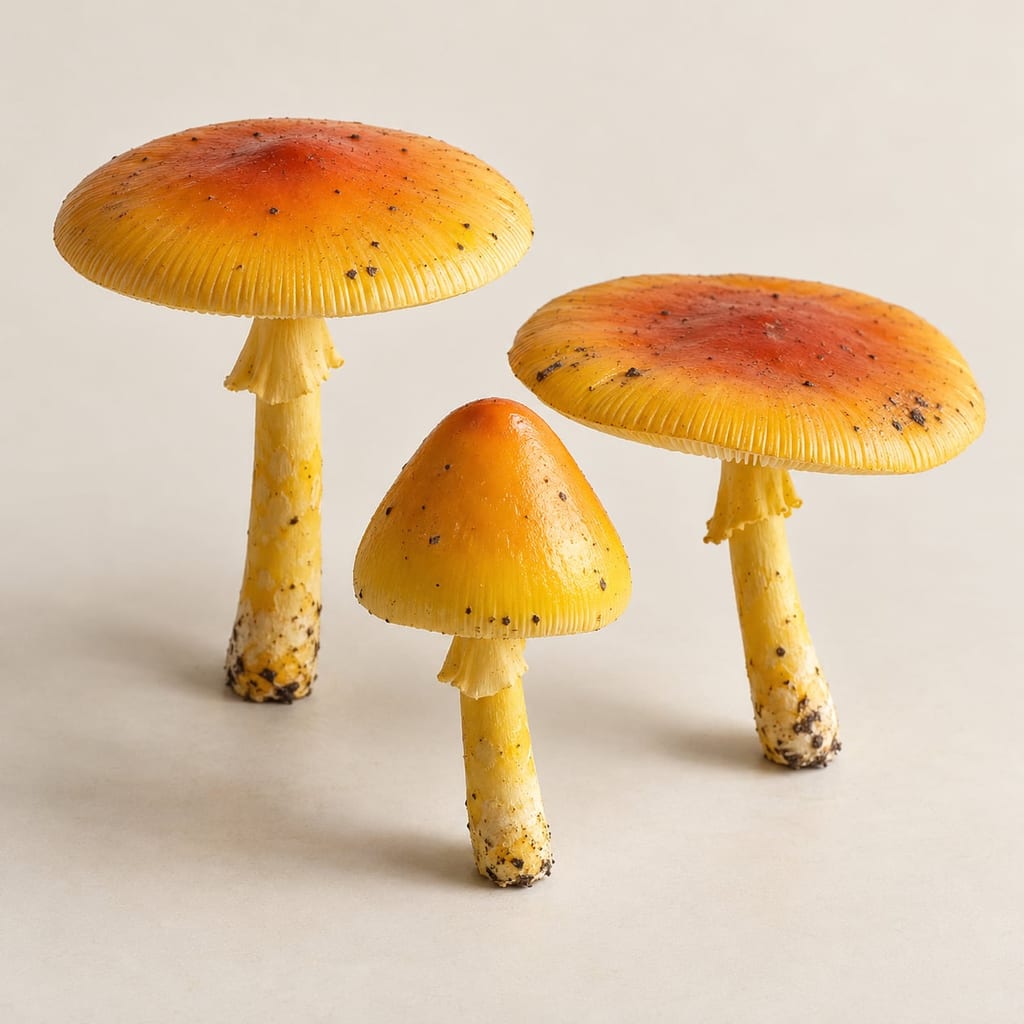
A wild Amanita recorded from China in a 2026 checklist of edible and medicinal fungi. The genus holds deadly species, so this page gives no identification or edibility verdict.
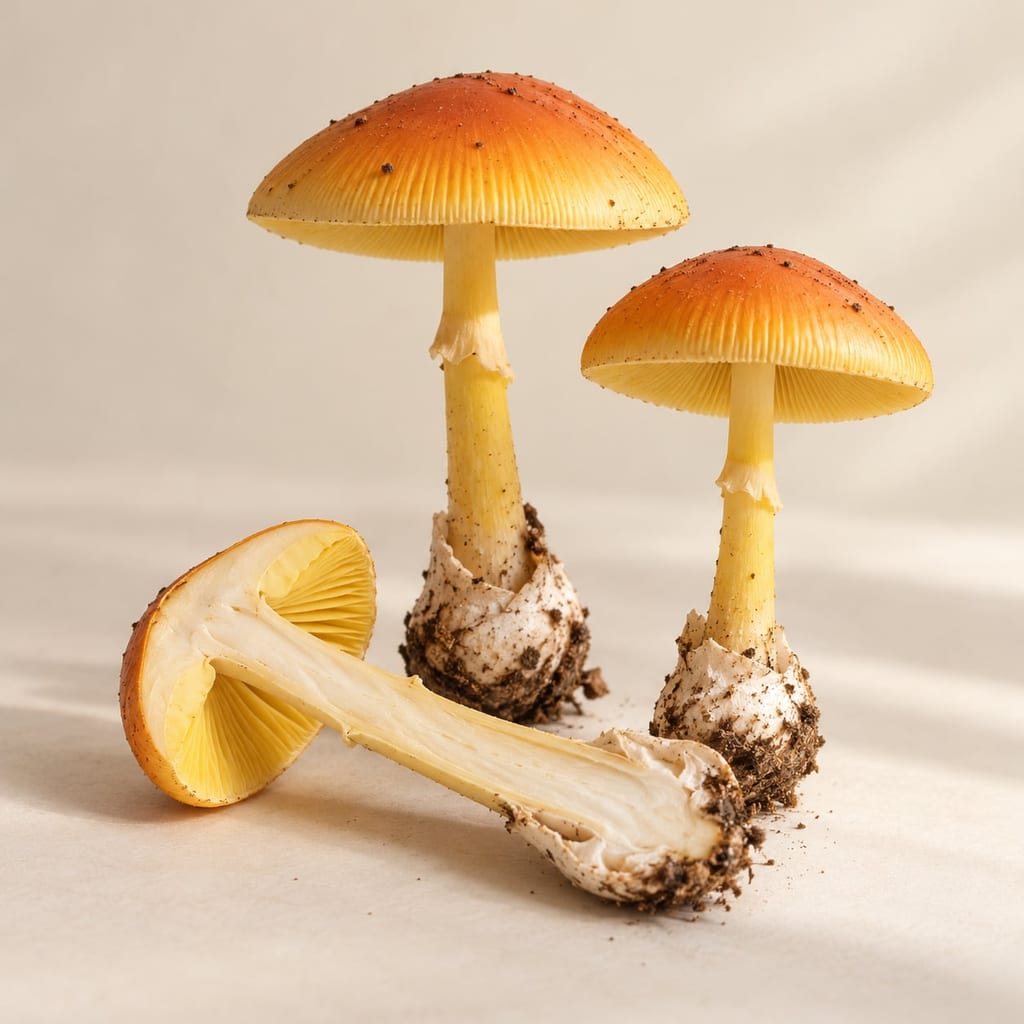
A wild Amanita of China, first reported there and listed as edible in a Yunnan ethnomycology study. The genus contains deadly species, so this page does not support identifying or eating it.
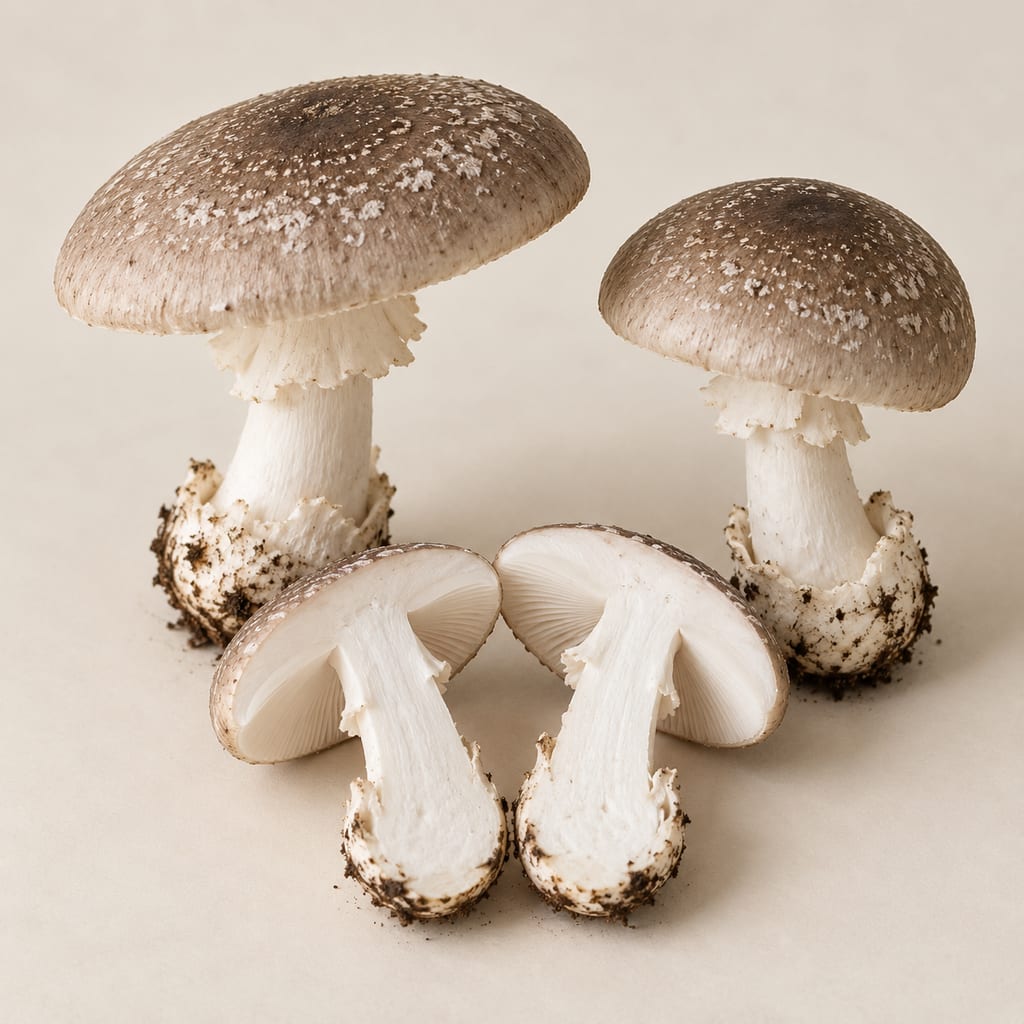
Amanita yuaniana is a Chinese Amanita that a 2023 Yanshan survey and a Yunnan ethnomycology survey list among edible species. No source tests it for safety, and the genus holds the most lethal mushrooms.
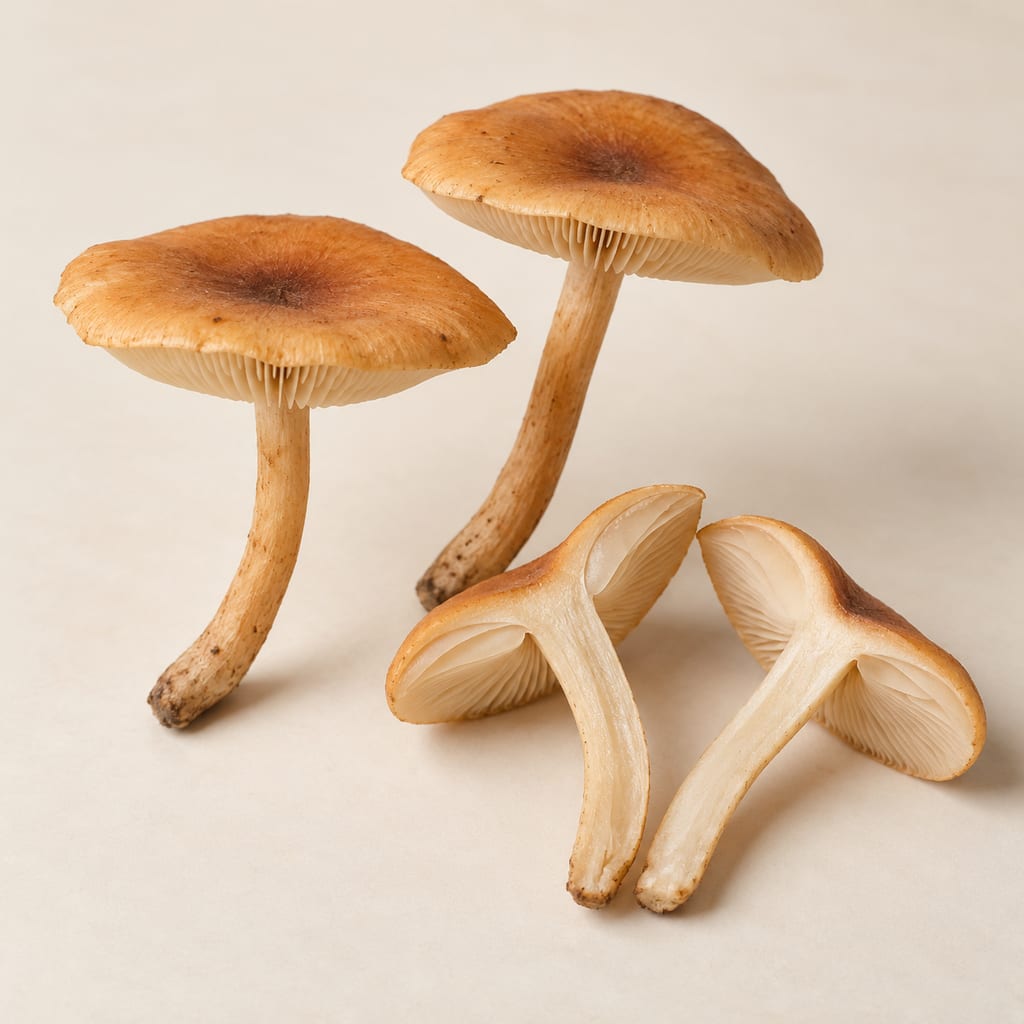
A wood-associated Armillaria recorded in Yunnan and Sichuan, China, and listed as edible in a 2026 Chinese catalogue.
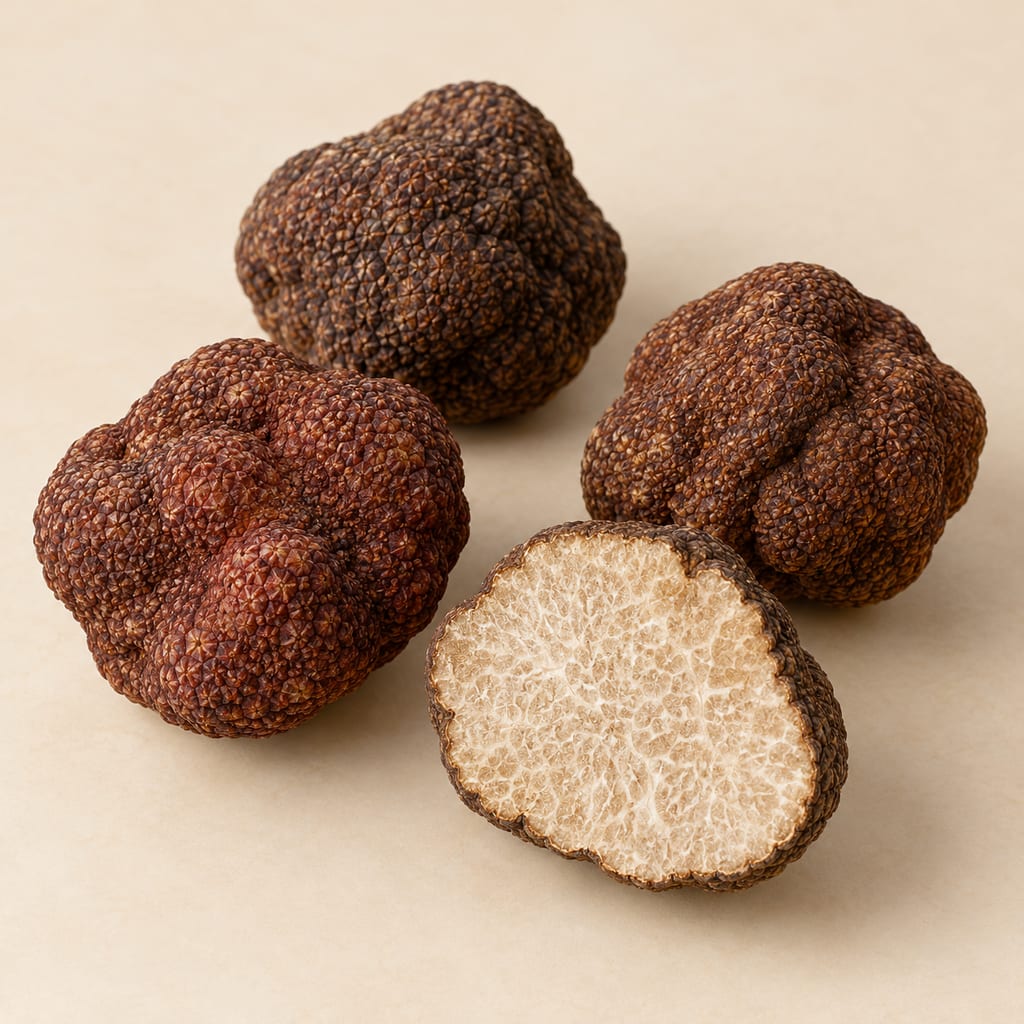
Tuber pseudohimalayense is a wild black truffle from Yunnan, China, listed as edible in a Chinese species catalogue. No independent assessment of its culinary use or safety is available.
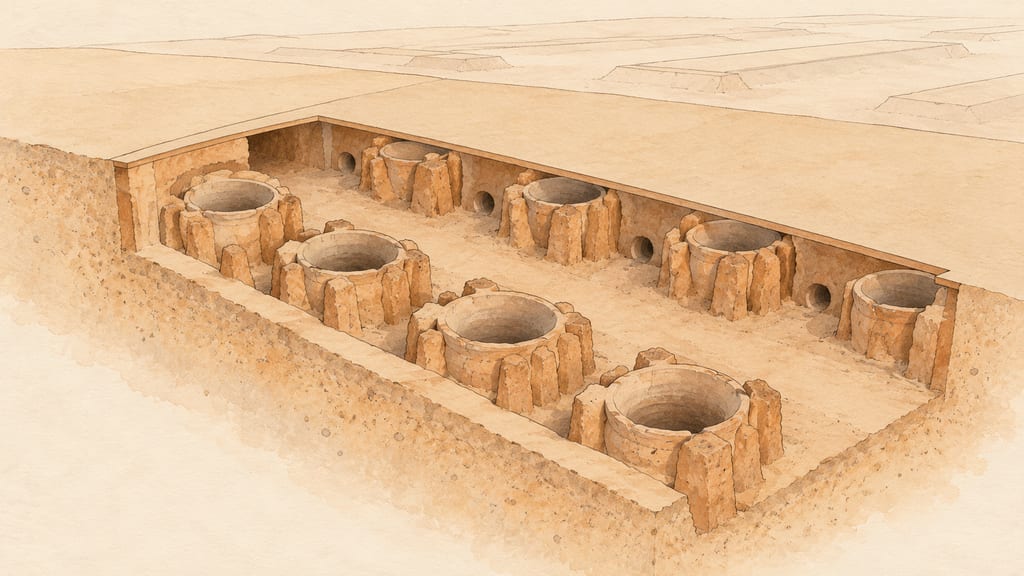
At North Abydos in Egypt, a fixed early Dynastic brewery comprised parallel semi-subterranean installations with rows of ceramic mash vats; excavation reports revise their number, scale and estimated batch capacity.
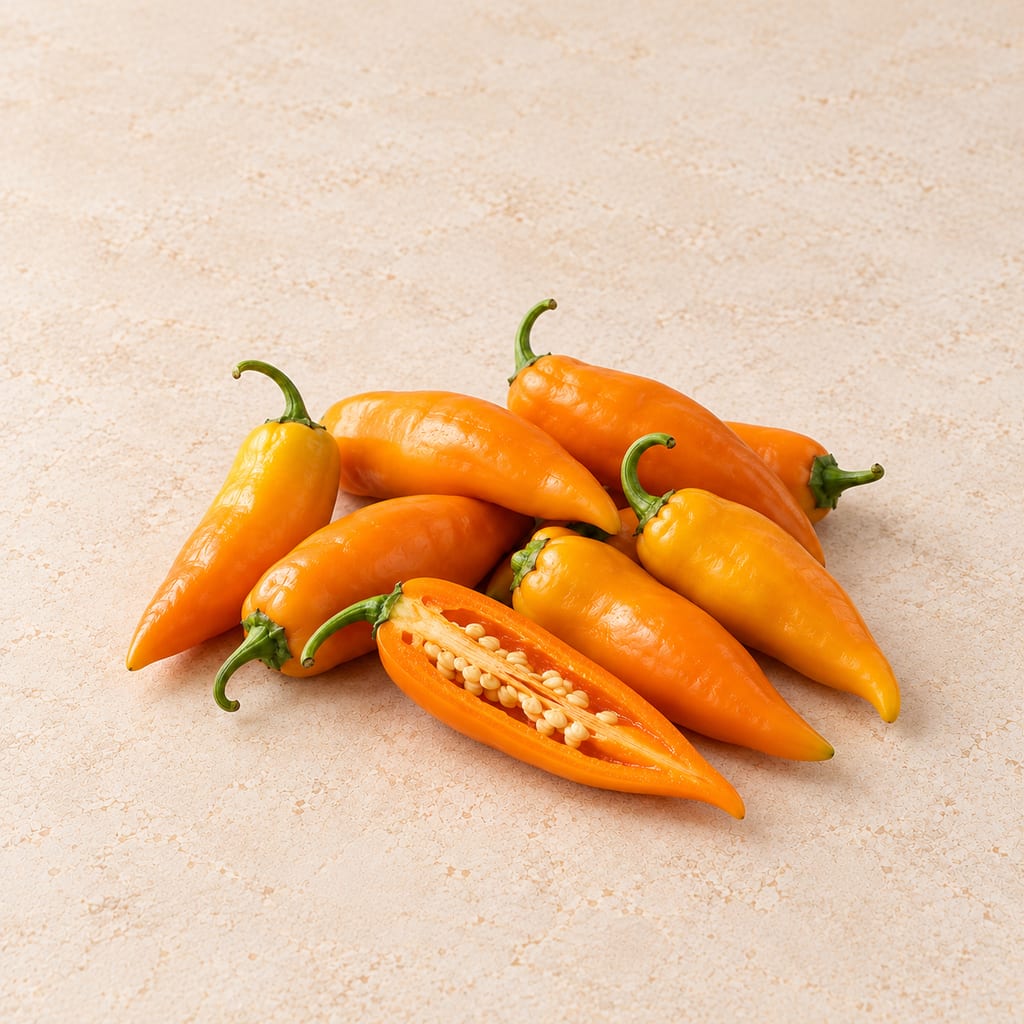
Ají amarillo is the orange-yellow Peruvian chilli cultivar group of Capsicum baccatum, used to colour and season huancaína sauce and ají de gallina. Published heat estimates do not establish one range for the named cultivar.

Toasted almonds are whole sweet almond kernels dry-roasted until golden to brown. Heat replaces their marzipan note with a roasted, nutty one; they thicken and flavour romesco.

Kodiak salmon, halibut and cod cut as seg'aq and hung on an initaq rack to become tamuuq, with kac'amaasaq and kupcuunaq named as different results.

Aniseed is the dried ripe fruit of Pimpinella anisum, an aromatic Apiaceae spice commonly called a seed. It adds a sweet, warm aroma to breads such as Moroccan krachel and South African mosbolletjies, and is distinct from star anise.
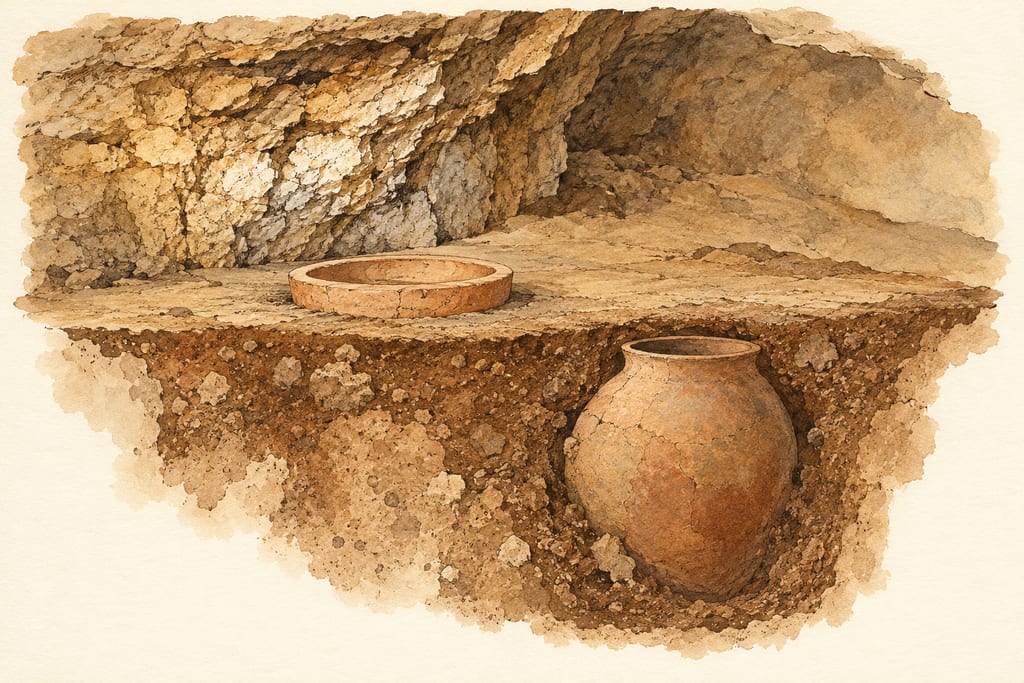
A fixed Late Chalcolithic installation in Areni-1 cave combined a shallow clay pressing basin with a large jar set into the cave floor and storage vessels nearby.

Ripe avocado flesh is the soft, buttery, fat-rich pulp of Persea americana, eaten raw. It is low in acid, so it is a fresh ingredient that needs care in chilled dishes.
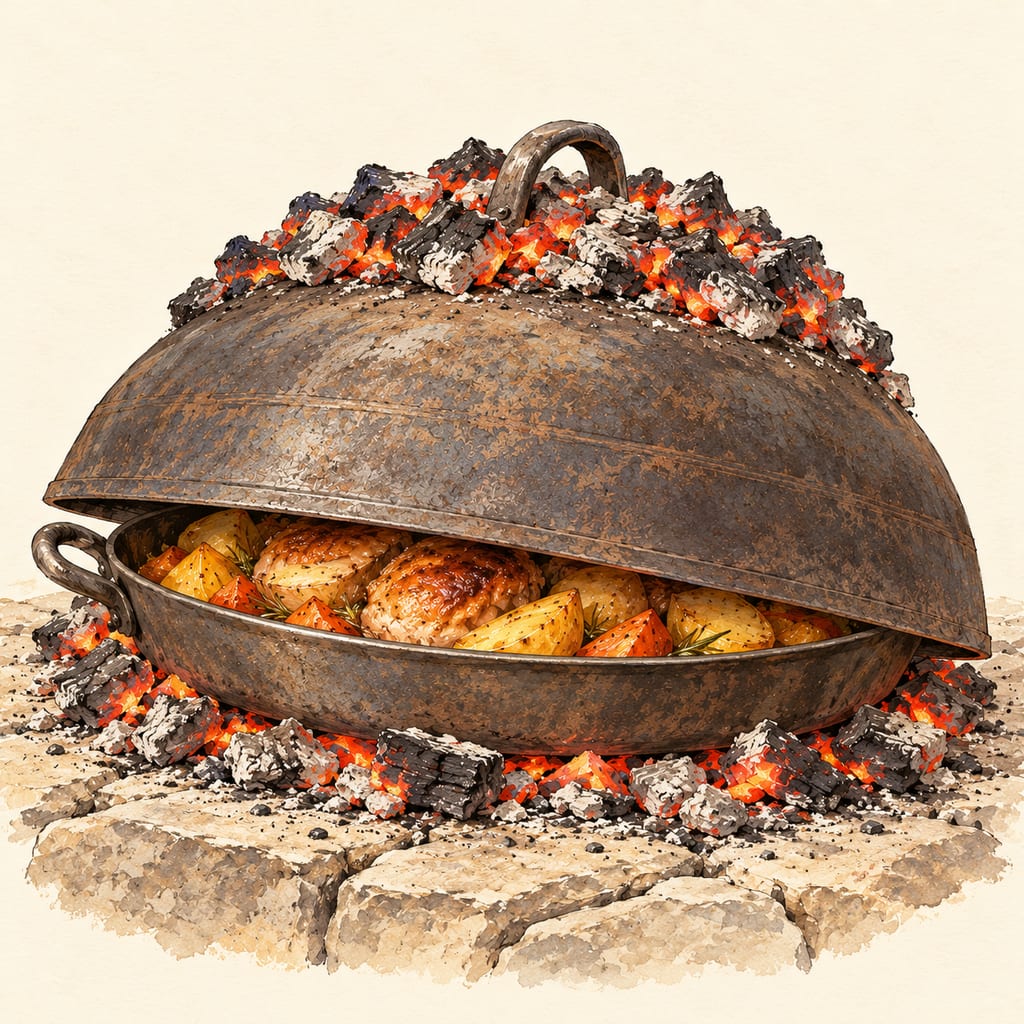
A portable dome and pan used over a hearth, with embers on the lid and heat from below. Regional peka and saç forms share this principle while differing in materials, pan shape and how the food is cooked.
No community contributions have been published for this entry yet.
Sign in to contribute. Published comments and photos are free to read.
Food and Agriculture Organization of the United Nations
Ducks — Gateway to poultry production and productsMost domestic duck breeds are mallard-derived, domesticated in southern China; Muscovy is a separate species domesticated in Latin America; about 1.15 billion ducks worldwide in 2020, 89 percent in Asia; duck-and-rice systems; Muscovy meat has less fat; ducks use feed less efficiently in confinement.
Cited in: What duck is; Two ducks, two domestications; How ducks are raised; Pekin, Muscovy and mulard
GigaScience
Whole-genome resequencing reveals signatures of selection and timing of duck domesticationChinese domestic and wild mallard populations compared; meat- and egg-type domestic groups distinguished; a demographic model of divergence that is not an archaeological date.
Cited in: Two ducks, two domestications
Journal of Archaeological Science
An exploratory osteological study of the muscovy duck (Cairina moschata) (Aves: Anatidae) with implications for neotropical archaeologyMuseum-skeleton criteria for distinguishing wild and domestic Muscovy ducks and the sexes; Neotropical origin; early domestication record incomplete.
Cited in: Two ducks, two domestications
Project Gutenberg, digitized historical translation
Cookery and Dining in Imperial Rome, Book VI, recipe 212: Crane or DuckRoman crane-or-duck preparations: parboiling with salt and dill, finishing with oil, broth, oregano, coriander and grape must; a separate sauce with pepper, lovage, cumin, coriander, laser root, rue, wine, honey and vinegar.
Cited in: From a Roman sauce to the hung oven
Hezekiah Howe & Co. and Herrick & Noyes, New Haven
The New England Cook Book, or Young Housekeeper’s Guide, entries21–22: Pigeons and DucksDuck roasted or stewed like pigeons with flour-thickened gravy, and an onion dressing for wild ducks, in a New Haven cookbook of 1836.
Cited in: From a Roman sauce to the hung oven
USDA Food Safety and Inspection Service; US Government Publishing Office archive
Duck and Goose from Farm to Table, revised May 2011Age classes and weights of ducklings; indoor rearing and feed; slaughter and waxing; fat layer and pricking; retail cuts; dark meat and myoglobin; buying quantities; refrigerator and freezer times; thawing; 165 F endpoint and pink meat; cooking times; White Pekin arrival in 1873.
Cited in: What duck is; From a Roman sauce to the hung oven; How ducks are raised; Breast, leg, skin, fat and giblets; Duck fat and confit; Choosing, storing and cooking; Allergens and notes
Asian-Australasian Journal of Animal Sciences
A comparative study of carcass characteristics and meat quality in genetic resources Pekin ducks and commercial crossbredsP33 (Polish native Pekin) and Star 53 HY ducks slaughtered at 49 days differ in breast muscle and skin with subcutaneous fat; P33 skin with fat exceeds 26 percent of the eviscerated carcass.
Cited in: How ducks are raised; Pekin, Muscovy and mulard
Food Science of Animal Resources
Comparison of Meat Quality Characteristics and Proteolysis Trends associated with Muscle Fiber Type Distribution between Duck Pectoralis Major and Iliotibialis MusclesCherry Valley breast and leg muscle: fibre types, pH, lightness, cooking loss, calpain activity and peptides over 10 days at 4 C.
Cited in: Breast, leg, skin, fat and giblets; What happens to the meat after slaughter
Food Chemistry: X
Effect of ultrasonic pretreatment with synergistic microbial fermentation on tenderness and flavor of air-dried duck under low nitrite processAir-dried duck with Limosilactobacillus fermentum, Debaryomyces hansenii and ultrasound: texture, water distribution and volatile compounds in a low-nitrite process.
Cited in: Duck in other cured and fermented foods
Goodlok / Goodlok Play
Duck garum / Kachní garumA Czech duck garum listing duck bones and trimmings, barley-groat koji, salt and water; no species, proportions or timing published.
Cited in: Why duck bones and trimmings suit a koji and salt ferment; Allergens and notes
Horizon Farms
平飼い 合鴨 ロース 胸肉 フリーレンジ 放し飼い ニュージーランド産 (240g)Retailer listing for raw, boneless, skin-on duck breast from New Zealand.
USDA FoodData Central, Standard Reference LegacyComposition
Duck, domesticated, meat and skin, raw (and related entries 172409, 172410, 172411, 174467)Per 100 g raw duck with meat and skin: 48.5 g water, 11.5 g protein, 39.3 g fat (13.2 g saturated, 18.7 g monounsaturated, 5.08 g polyunsaturated), 404 kcal; raw meat only: 73.8 g water, 18.3 g protein, 5.95 g fat, 135 kcal; roasted with skin 28.4 g fat, roasted meat only 11.2 g fat and 23.5 g protein; raw liver 18.7 g protein, 4.64 g fat, 515 mg cholesterol.
Cited in: What duck is; Breast, leg, skin, fat and giblets; Duck fat and confit; Why duck bones and trimmings suit a koji and salt ferment
National GeographicHistory
The complex history of Peking duckRoast duck sold in Hangzhou in the thirteenth century; Nanjing roast duck and the closed brick oven in the Ming period; move to Beijing in the early fifteenth century; the Beijing white duck; the Qing hanging oven; Quanjude opened in 1864. Dates differ between popular accounts.
Cited in: From a Roman sauce to the hung oven
Journal of the Science of Food and Agriculture 85(11):1829-1837 (Trang, Shimada, Sekikawa, Ono, Mikami, 2005)Fermentation
Fermentation of meat with koji and commercial enzymes, and properties of its extractShishibishio from ground pork, rice koji, pepper and 15, 20 or 25 percent salt, with the commercial enzymes Alcalase or Pectinase 3S added; at 3 months viable bacteria below 300 cfu/g and no coliforms; enzymes raised yield and protein recovery; highest yields of 49.8 to 50.6 percent in mixtures with 15 percent salt.
Cited in: Why duck bones and trimmings suit a koji and salt ferment
Revista Ciencia Agronomica 52(4) (Souza et al., 2021)Composition
Poultry by-products as source of collagen, nanokeratin and bioapatite for biomedical useCollagen from chicken skin and tendon has a type I collagen structure; bioapatite from chicken foot bones has a Ca/P molar ratio of 1.54, lower than stoichiometric hydroxyapatite.
Cited in: Why duck bones and trimmings suit a koji and salt ferment
Wikipedia (tertiary overview)Variety
MulardMulard is the sterile hybrid of a Muscovy drake and a Pekin-type duck; females raised for meat, males for foie gras; leaner meat than Pekin.
Cited in: Pekin, Muscovy and mulard
Fine Dining LoversUse
Confit: the French preservation techniqueConfit from Gascony: salt cure overnight, slow cooking in duck or goose fat, storage under the fat; legs suit it because of connective tissue and fat. Popular accounts date it to the thirteenth century.
Cited in: Duck fat and confit