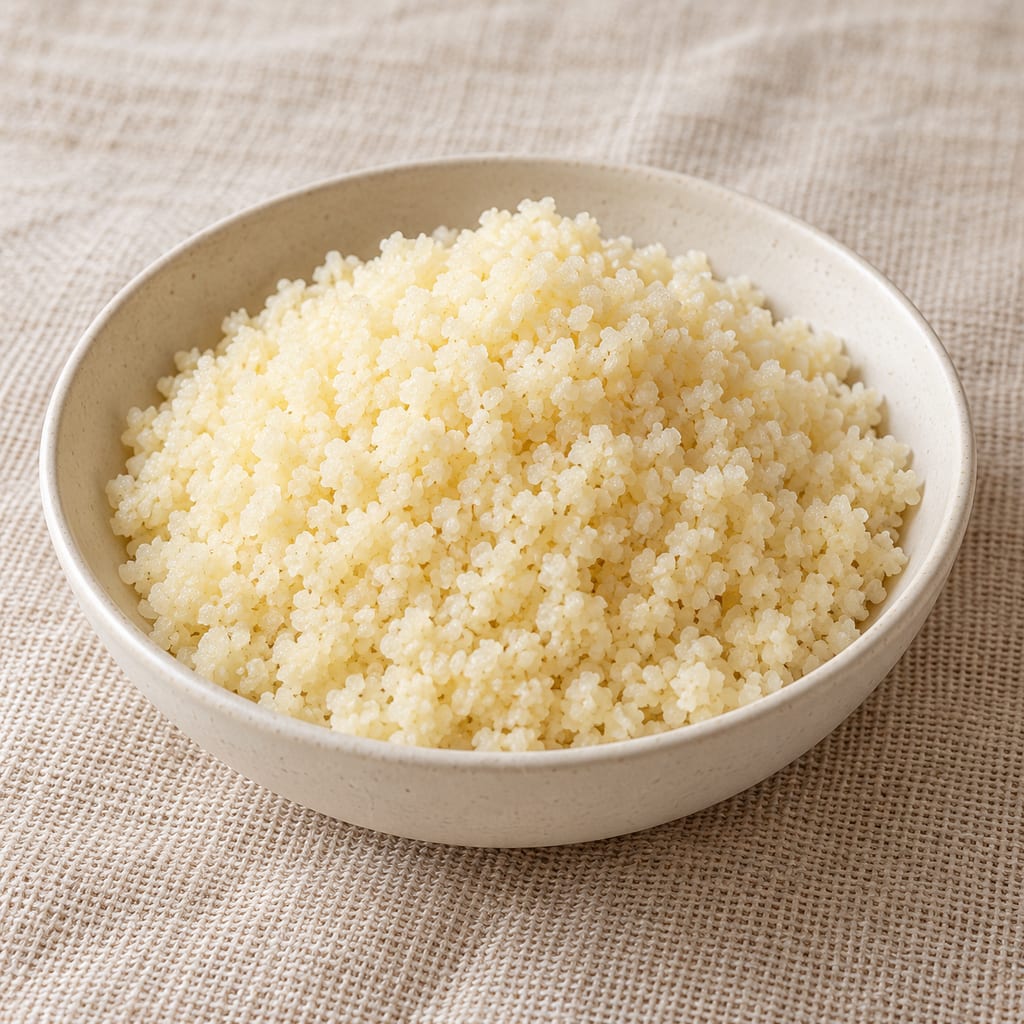
Attiéké
Ivorian cassava semolina: grated cassava is fermented overnight with a traditional inoculum, pressed, sieved into granules, dried and steamed. Documented in a 2006 field study; no sole original process is established.
 FermenteaWhere food goes to change
Modern method
Attiéké (also written attieke)
Attiéké is an Ivorian staple of grated cassava fermented with a traditional inoculum, then pressed, sieved, granulated, dried and steamed into fine couscous-like grains.
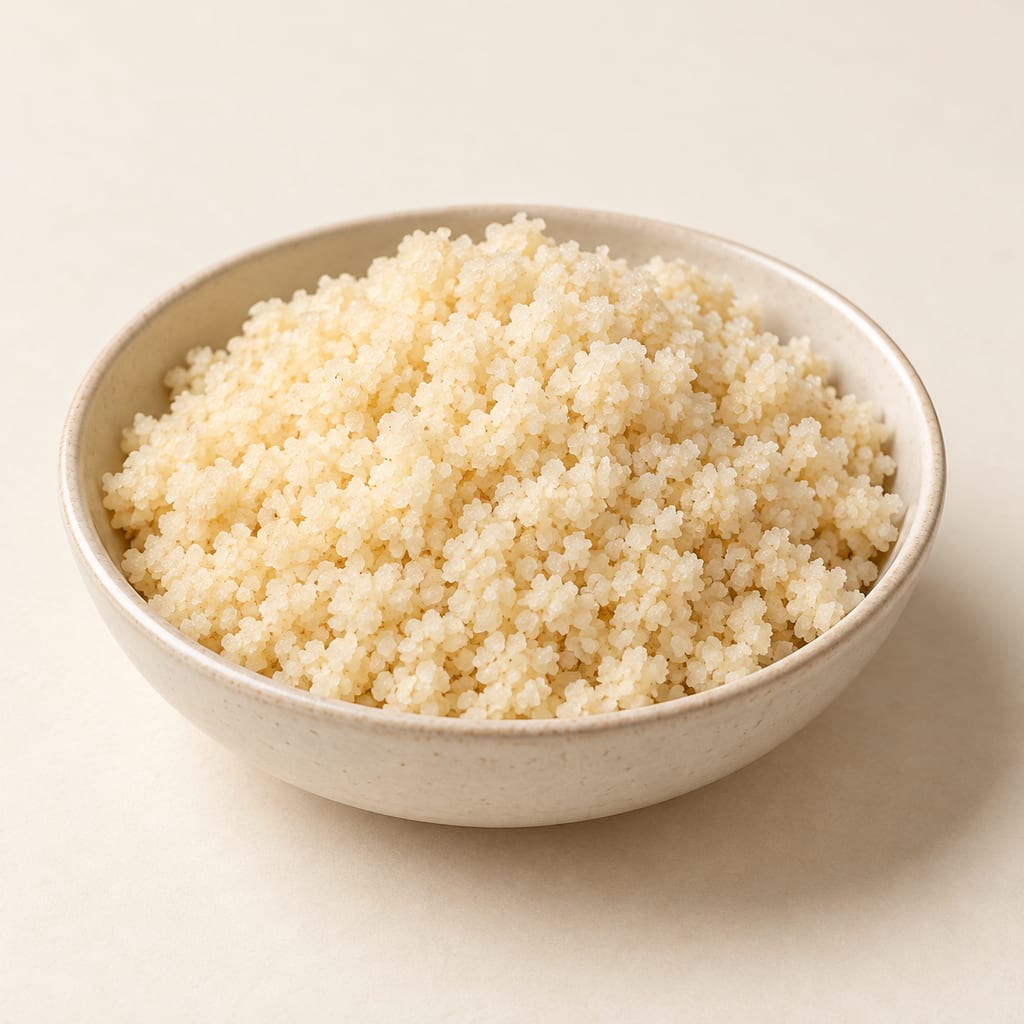
Attiéké is a fermented, steamed cassava preparation from Côte d'Ivoire. It consists of small, moist granules that resemble couscous in appearance but have a different raw material, production method and flavour.
The principal ingredient is cassava, Manihot esculenta Crantz, known in French as manioc. Cassava is a tropical root crop originally domesticated in South America and subsequently introduced to Africa.
Finished attiéké is pale, tender, lightly sour and pleasantly granular. It is generally served as a starch alongside fish, meat, vegetables, chilli or sauces.
Attiéké is not made by grinding dried cassava into ordinary flour and adding water. Its distinctive texture comes from a sequence of fermentation, pressing, sieving, hand granulation and steaming.
The fermentation also participates in reducing the cyanogenic compounds naturally present in cassava. This makes correct processing particularly important.
The food originated in the culinary traditions of Côte d'Ivoire's lagoon communities, including Adjoukrou, Ébrié, Alladian and other peoples. Its production and consumption have spread far beyond these communities.
In December 2024, the skills associated with attiéké production in Côte d'Ivoire were inscribed on UNESCO's Representative List of the Intangible Cultural Heritage of Humanity. This recognizes living knowledge and practices, not the invention of attiéké in 2024.
UNESCO Intangible Cultural Heritage
Attiéké — Ivorian French and regional usage — Fermented, granulated and steamed cassava
Atiéké — Alternative spelling — Same broad food category
Manioc — French — Cassava, Manihot esculenta
Semoule de manioc — French — Cassava semolina or granules
Ferment de manioc — French — Fermented cassava starter used in production
Garba — Ivorian street-food terminology — A popular dish pairing attiéké with tuna and accompaniments
The traditional names of attiéké vary among communities. It would be misleading to invent spellings in Adjoukrou or Ébrié without an authoritative language source.
Its commercial name is normally written in the Latin alphabet.
Attiéké must be distinguished from gari, another fermented cassava preparation. Gari is more thoroughly dried and roasted, while attiéké is granulated and steamed to produce a moist finished food.
Attiéké was developed within a region where cassava became an important food crop and where women maintained specialized knowledge of processing, fermenting and cooking roots.
The historical transfer of cassava from the Americas into Africa preceded the development of many regionally distinct cassava foods.
However, the exact first date of attiéké production is not established.
It cannot responsibly be described as an unchanged ancient African preparation from before cassava arrived on the continent.
Its identity is specifically West African, but its main crop has a transatlantic botanical history.
Traditional attiéké production is particularly associated with communities around southern Côte d'Ivoire's lagoons.
The process required more than household boiling.
Cassava was cultivated and harvested, peeled, ground, fermented, pressed, rubbed into grains and steamed.
Knowledge of the process passed through families and community networks.
The work was historically organized around a gendered division of responsibilities.
Men were frequently involved in cultivation, harvesting, transport and milling, while women took responsibility for processing, cooking, selling and distributing the finished product.
These roles are historically documented, although individual families and contemporary businesses may organize their labour differently.
Attiéké became an important source of income and economic independence for many women.
Urbanization and improvements in milling and transport expanded attiéké production.
In Abidjan, it became a familiar everyday food, sold with fried fish, grilled meat and other accompaniments.
Its convenience helped popularize it: cooked attiéké can be purchased and served without repeating the full manufacturing process.
Food enterprises now distribute fresh, refrigerated, frozen and other commercially prepared forms.
The name has also become commercially important outside Côte d'Ivoire.
The 2024 inscription recognizes knowledge of cassava cultivation, fermentation, granulation, steaming and distribution.
It also acknowledges the importance of women's work and the role of attiéké in everyday meals, festivals and ceremonies.
The recognition concerns a living tradition, rather than one standardized recipe with universally fixed quantities.
A documented Ivorian production study provides these ingredients and ratios:
Fresh cassava roots — Batch mass not stated — Main starchy substrate
Traditional fermented cassava starter — 5–10% of cassava weight — Introduces an active fermentation community
Water — 10% v/w in one recorded study method — Assists grinding and blending
Palm oil — Approximately 0.1% v/w in that study — Influences handling and granulation
A separate FAO description records palm oil at approximately 1% by weight, rather than 0.1% v/w.
These are different documented formulations and should not be combined into an assumed universal quantity.
Likewise, a fermented cassava starter is not equivalent to an arbitrary packet of baking yeast or yogurt culture.
Fresh cassava contains large quantities of starch and varying concentrations of cyanogenic glycosides.
The two principal cyanogenic compounds are linamarin and lotaustralin.
Their concentrations vary with cultivar, growing conditions and plant tissues.
Cassava roots should not be treated as automatically safe to eat raw.
Traditional starter is made from cassava that has already undergone fermentation.
It introduces microorganisms associated with the established production process.
Different communities prepare starter material in different ways.
Its microbiological identity and quality strongly influence the next batch.
Clean water is needed for washing the roots and for certain milling formulations.
The source-specific 10% v/w addition should not be interpreted as ten kilograms of water per hundred kilograms of roots without checking how volume and weight were defined.
A small oil addition can affect how the cassava mash handles and forms granules.
The amount and stage of addition vary among documented methods.
Palm oil is not the primary detoxification mechanism.
Traditional and contemporary production can require knives for peeling, washing vessels, a grater or mill, fermentation bowls or containers, clean pressing sacks, a mechanical or manual press, sieves, large bowls for rolling the granules and a steaming vessel.
The sieve is essential because it helps remove larger fibres and controls particle size.
The pressing equipment is just as important. Fermentation creates flavour and alters the cassava substrate, but it does not physically remove all the moisture that must leave before granulation.
Suitable food-grade contact surfaces are essential for modern production.
This is a record of an established manufacturing process, not a validated home method for detoxifying raw cassava. A safe process requires suitable raw roots and verification that cyanogenic compounds have been adequately reduced.
Begin with fresh cassava roots suitable for food manufacture.
Remove the peel and associated outer tissues.
Peeling removes parts that may contain relatively high concentrations of cyanogenic compounds and reduces soil contamination.
It does not, by itself, guarantee adequate detoxification of the remaining flesh.
Cut the peeled cassava into smaller pieces.
One documented production method washes the pieces three times with fresh water.
This removes visible residues and prepares the roots for milling.
Use potable water.
In the documented study method, mix the cassava with 5–10% traditional fermented cassava starter.
The same study describes additions of 10% v/w water and approximately 0.1% v/w palm oil before grinding.
These ratios belong to the published procedure.
The starting batch mass and exact physical form of every ingredient are not fully specified.
Mill the cassava to obtain a fine mash.
Grating and milling damage the root cells.
This is an essential technological step because it permits enzymes and microorganisms to contact components that were previously separated within the intact root tissues.
Place the mash in suitable fermentation containers.
A documented study reports 12–15 hours at approximately 30–37°C.
A separate FAO description gives 10–15 hours.
These observations reflect particular production systems.
Neither establishes that every cassava cultivar becomes safe after a fixed number of hours.
Transfer the fermented mash to a clean pressing sack and remove liquid.
A field description records pressing for approximately one hour.
The FAO description reports a dewatered mash moisture content of approximately 55–60%.
Removing liquid changes the texture and assists the physical preparation of granules.
It also helps remove soluble components, including some compounds associated with cassava detoxification.
Pass the pressed mash through sieves.
This breaks up compacted material and removes unsuitable fibres or larger fragments.
Some traditional operations use two sieves in succession.
The resulting material should be fine enough to form granules.
Place the sieved mash in a large bowl and use circular shaking and rubbing movements to produce small rounded particles.
This is one of the most distinctive manual skills in attiéké production.
The FAO records a traditional production rate of approximately 5 kg of granules per hour per person.
That figure describes productivity, not a required recipe quantity.
The formed grains may undergo a short drying stage to adjust their surface condition.
One FAO account describes approximately one hour of sun drying, sometimes omitted.
Other field methods report periods from a few minutes to approximately half an hour.
This stage differs fundamentally from drying gari into a relatively shelf-stable toasted product.
Transfer the grains to a steaming vessel.
A documented field study gives approximately 20–25 minutes of steaming.
The FAO describes approximately 30 minutes.
The granules absorb heat and undergo starch gelatinization, creating the characteristic tender texture.
Steaming is the principal cooking step.
After steaming, the attiéké is removed and allowed to cool.
Traditional distribution uses baskets lined with cassava leaves.
Modern products may be packaged in other food-safe containers.
The finished food is moist and perishable.
It should not be treated as a dry pantry product merely because its manufacturing process includes pressing and brief surface drying.
Attiéké production involves plant enzymes, microorganisms, moisture movement and starch chemistry.
Intact cassava cells contain cyanogenic compounds.
When the tissue is damaged by grating, linamarin can come into contact with enzymes such as linamarase.
Enzymatic reactions can generate compounds that release hydrogen cyanide.
The subsequent fermentation, pressing, washing and heat treatment contribute to reducing the cyanogenic load.
But no single stage should be assumed sufficient in every case.
The initial concentration of cyanogenic glycosides is important.
Lactic-acid bacteria participate in traditional attiéké fermentation.
Studies have found organisms including Leuconostoc and other lactic-acid-producing bacteria.
These organisms metabolize available carbohydrates and generate organic acids.
The result is a lightly sour flavour.
However, the precise microbial community varies between starters and production locations.
In one 2025 experimental study, a formulation using 10% starter and 12 hours of fermentation produced material with a measured pH of 4.8.
The same research reported lactic acid at 4.45 g/L and acetic acid at 1.35 g/L for its relevant treatment.
These are specific analytical results, not universal safety endpoints for attiéké.
A different root cultivar, starter or temperature can produce different outcomes.
During steaming, cassava starch granules take up water and undergo gelatinization.
This changes their structure and produces the soft, cooked character of attiéké.
The process is physical and chemical rather than primarily microbial.
It explains why freshly steamed attiéké feels different from the fermented, pressed raw granules before cooking.
Different communities of southern Côte d'Ivoire produce attiéké with distinctive grain sizes, acidity and textures.
Some products are finer and more delicate.
Others are coarser, more acidic or firmer.
Differences can arise from cassava variety, starter preparation, fermentation duration, pressing, sieving and granulation.
Urban commercial production has introduced mechanized operations, but manual granulation remains culturally important.
A regional variation should not be reduced to adding a different chilli or serving sauce.
The production method itself may change the finished food.
Attiéké is usually served as the starchy component of a meal.
A familiar preparation combines attiéké with grilled or fried fish, onions, tomatoes, chilli and other accompaniments.
The lightly sour grains contrast with the savoury richness of the fish.
Garba is an especially popular street-food combination of attiéké and fried tuna, often with onion, tomato, pepper and oil.
It is an assembled dish rather than a different fermentation method.
Attiéké may accompany grilled chicken, meat, vegetable sauces or fried plantain.
It is also served at family and community occasions.
The grains can absorb sauces while retaining their individual texture when properly prepared.
Excess moisture, inadequate pressing or poor granulation can produce a dense mass rather than distinct particles.
Insufficient sieving or irregular hand rolling produces a mixture of large and small particles that steam differently.
Starter quality, fermentation conditions and the raw cassava can influence flavour.
Harshness cannot be used as a test of cyanide concentration.
This can indicate deterioration in a moist product.
Discard contaminated finished attiéké.
Inadequate steaming or inappropriate handling after cooking can cause poor texture.
Cassava must be processed appropriately to address cyanogenic glycosides.
A food that smells mildly sour and looks properly steamed is not necessarily adequately detoxified.
The exact initial root variety and cyanide concentration matter.
For professional production, validated processing and suitable analytical checks are important.
Microbiological contamination of starter, water and equipment is another concern.
Cooked attiéké is moist and should be handled as a perishable food.
Older FAO descriptions mention short market storage periods of a few days, but these are observations of traditional distribution, not modern validated room-temperature shelf-life specifications.
For domestic cooking, buying professionally prepared attiéké and heating or steaming it according to the product's instructions is safer than attempting to improvise cassava detoxification.
Attiéké is a food in which biology, microbiology and human technique all have visible roles.
Cassava must first be transformed from a potentially toxic raw root into a suitable substrate.
Fermentation develops its flavour and participates in processing.
Pressing removes moisture.
Granulation creates its physical identity.
Steaming turns the grains into a finished meal.
Equally important, the technique supports the work and economic independence of women in Côte d'Ivoire.
Its UNESCO recognition reflects this complete system of knowledge, not simply the presence of cassava on a plate.
This contemporary technical account describes a traditional cassava food prepared by several ethnic groups in Côte d’Ivoire. The exact paper protocol is a documented preparation, not an origin claim.
Scaling: source ratios only
Cassava cyanogenic glycosides can release hydrogen cyanide; inadequate processing can leave a toxic product.
Hazard sourceFollow the complete source-described cassava preparation stages. FSANZ says cassava should be peeled and fully cooked before eating; the source process does not provide a finished-product cyanogen test or establish that every batch is adequately detoxified.
Control sourceCassava can contain cyanogenic glycosides. Fermentation and drying may reduce cyanogens, but this source does not establish a finished-product result for each batch.
Do not judge cyanogen removal by sourness, smell, color, texture, or appearance. This research process is not a validated detoxification control plan.
The paper identifies attiéké production in Côte d’Ivoire and the three principal production zones, without supporting a single birthplace.
Ivorian cassava semolina: grated cassava is fermented overnight with a traditional inoculum, pressed, sieved into granules, dried and steamed. Documented in a 2006 field study; no sole original process is established.
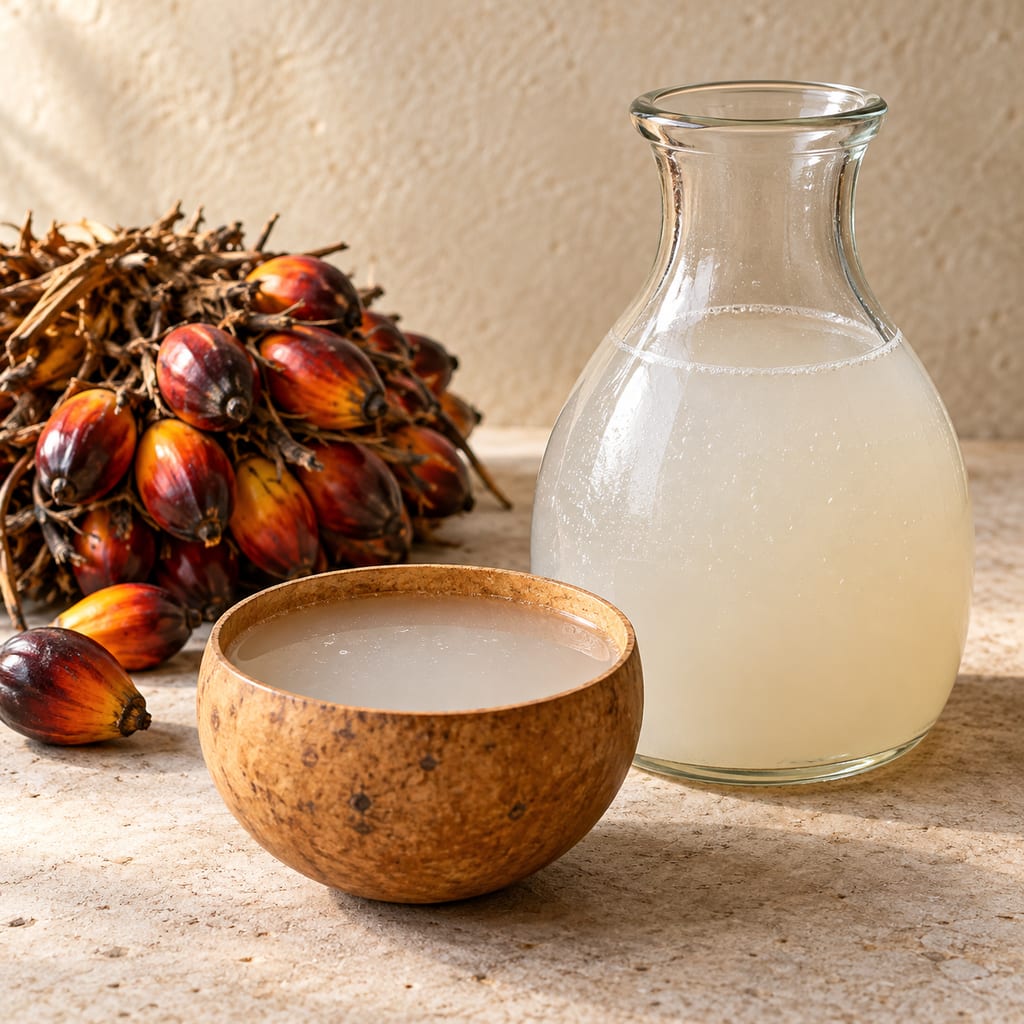
Palm wine is fermented sap from several palm species. West and Central African traditions differ in palm, tapping, vessel and serving stage; this page records shared principles without claiming one universal home-scale process.
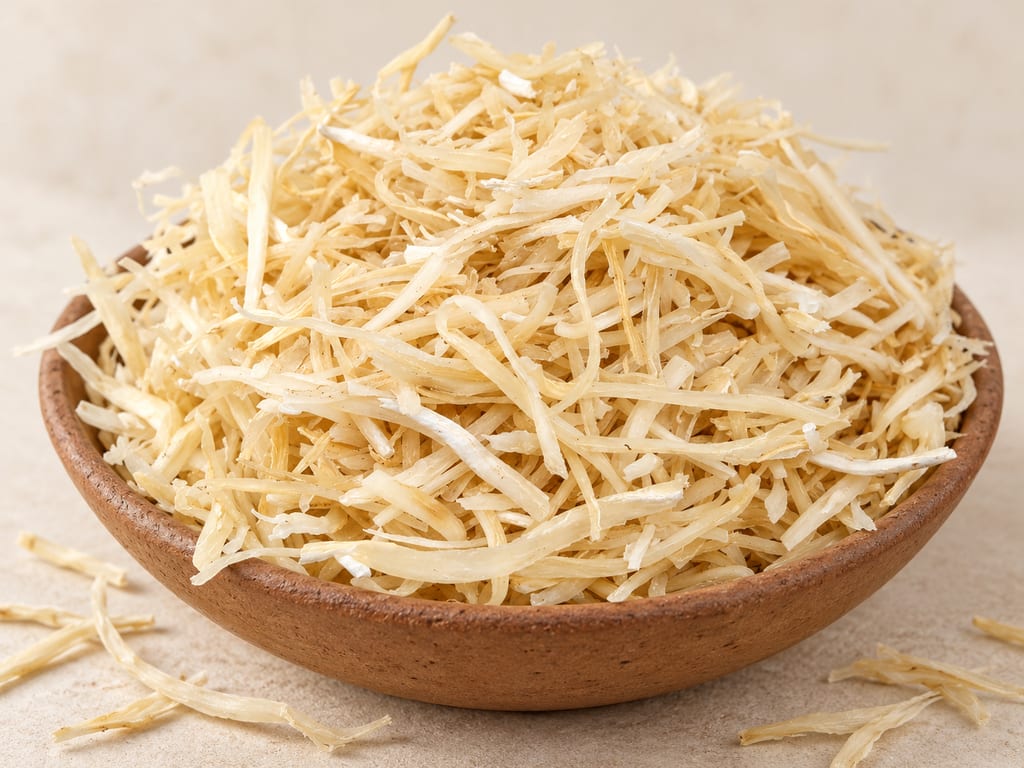
Abacha is a fermented cassava-strip preparation from southeastern Nigeria, sold wet or dried and later rehydrated for meals such as African salad.
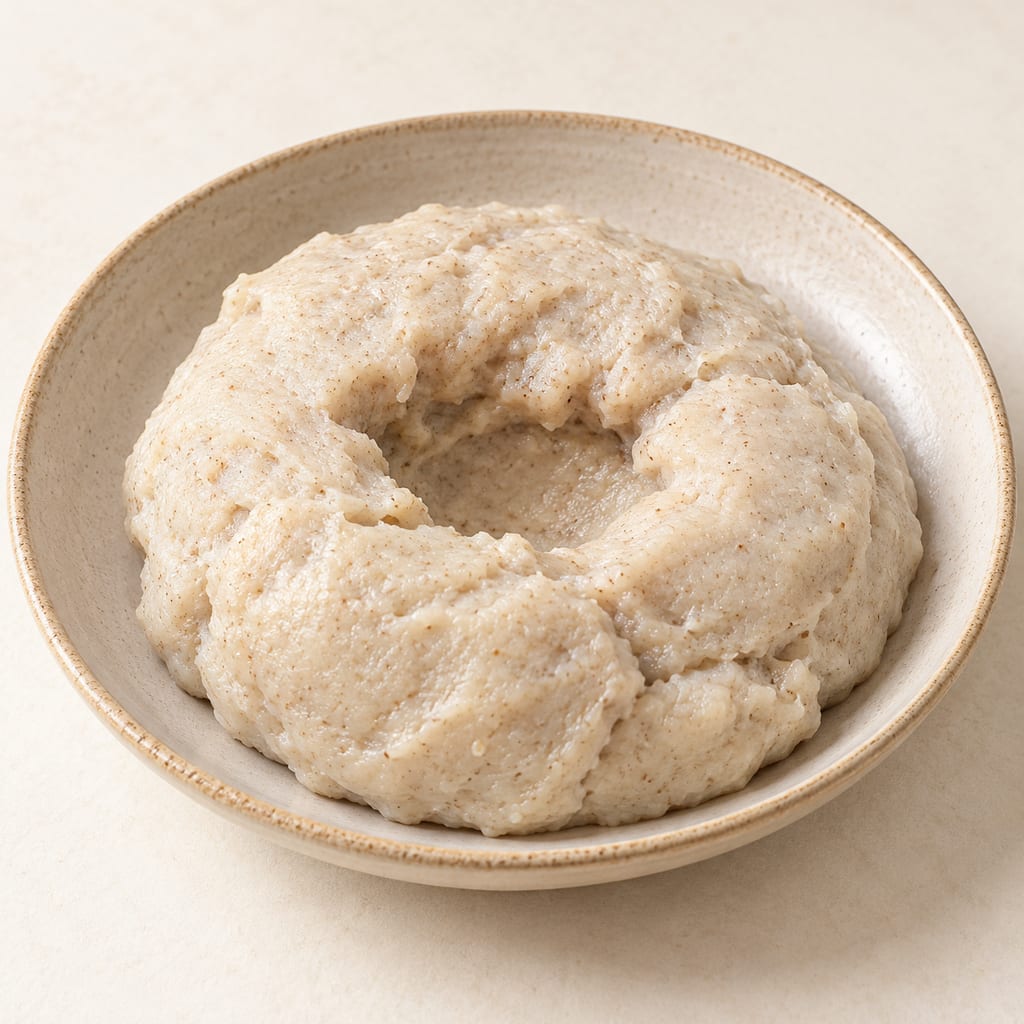
Aceda is Sudan’s firm cereal porridge, commonly made from sorghum and shaped into a smooth mound. Some versions use fermented dough; fermentation is not universal.
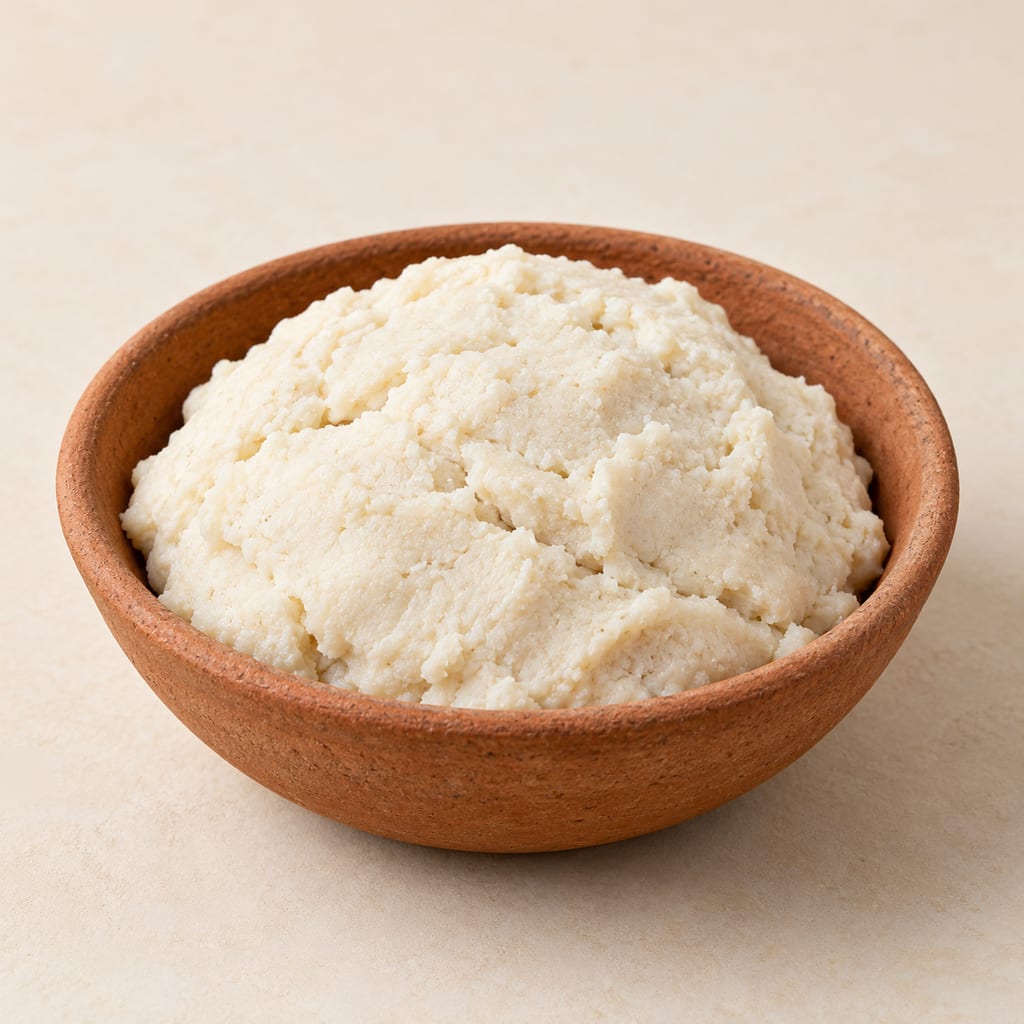
Ghanaian sour cassava dough fermented with traditional inoculum and drained during fermentation. It is used as a base for cooked foods such as banku and akple; process variants and safety outcomes differ.

Appam, or hoppers, are South Indian and Sri Lankan rice pancakes made from a fermented coconut-and-rice batter and cooked in a curved pan to a crisp lacy rim and a soft, spongy centre.
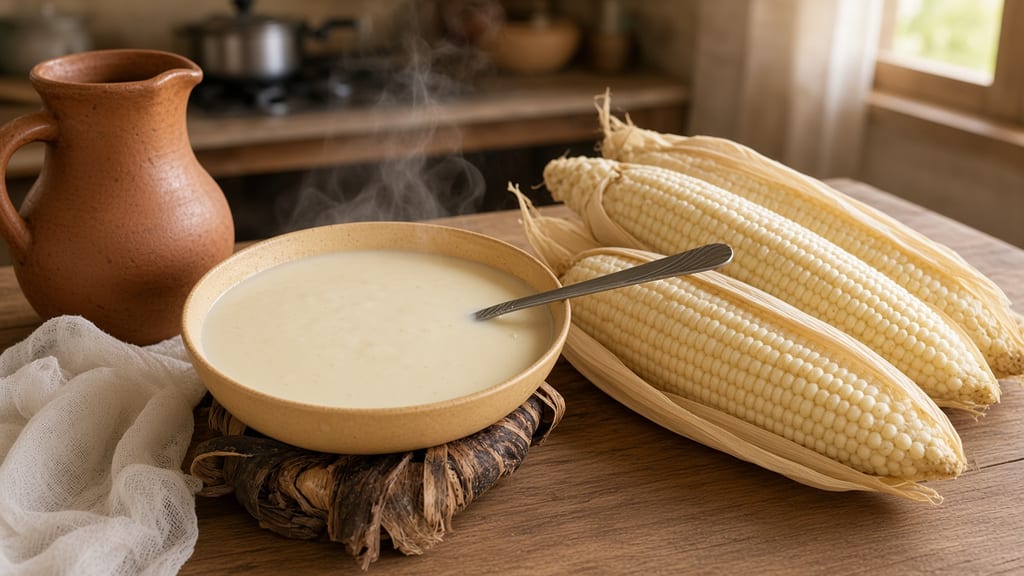
A hot, sour maize drink from Tabasco made from maize that is not lime-cooked. The ground grain sours for half a day, then makers strain it and boil it until thick.

Crushed or milled barley cooked in water until the starch softens and the mixture thickens, the plainest way a northern household turned stored grain into a meal, here with apple and hazelnut.
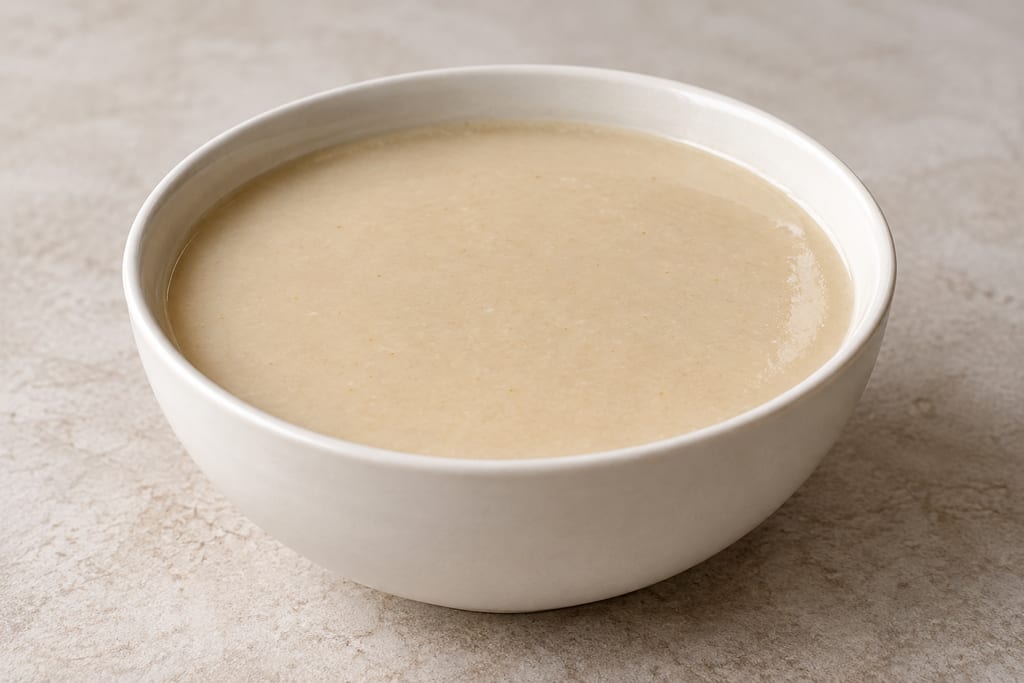
A fermented pearl-millet gruel documented in Ouagadougou, Burkina Faso. Whole grain is soaked, wet-milled and sieved; the settled paste ferments again before it is cooked with its liquid.
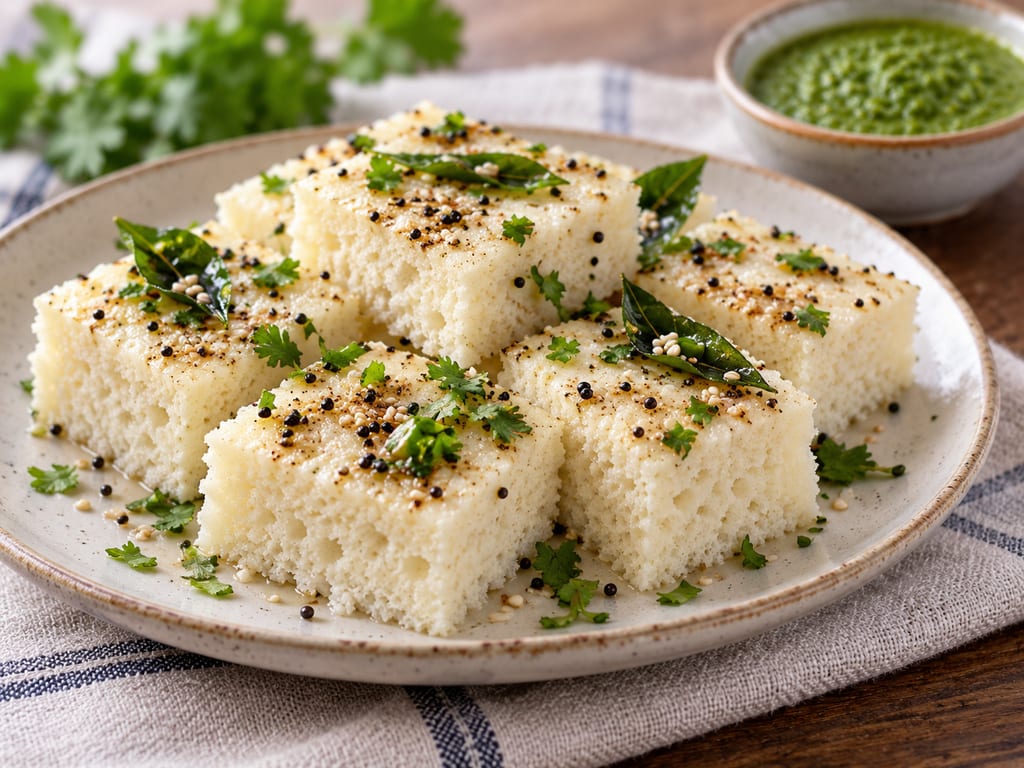
Dhokla is a Gujarati savoury steamed cake made from a fermented rice-and-pulse batter, whose lactic bacteria and yeasts give acidity, aroma and a porous crumb before steaming.
No community contributions have been published for this entry yet.
Sign in to contribute. Published comments and photos are free to read.
Food ControlInspiration · Process
Biochemical and microbial characterization of cassava inocula from the three main attieke production zones in Côte d’IvoireRelative inoculum, water and palm oil additions; ambient fermentation conditions; pressing, sieving, semolina formation, sun-drying and steaming stages.
Cited in: What is attiéké?; The lagoon communities; From regional food to national staple; Ingredients and why they are used; Fresh cassava; Fermented cassava starter; Water; Palm oil; How fermentation works; Cyanogenic glycosides; Microbial acid production; A measured research example; Starch gelatinization; Attiéké and fish; Garba; Other accompaniments; The grains become a paste; The grains are uneven; The flavour is unexpectedly harsh; The finished food becomes slimy; It develops visible mould; The grains are dry and hard; Why attiéké matters
Food Standards Australia New ZealandSafety
Cassava and bamboo shootsCyanogenic glycosides in cassava, peeling and full cooking advice; the page notes that cooking alone varies in detoxification effect.
Cited in: UNESCO recognition; Ingredients and why they are used; Equipment; Documented preparation method; Stage 1 — Select and peel the roots; Stage 2 — Cut and wash; Stage 3 — Combine with starter; Stage 4 — Grind; Stage 5 — Ferment; Stage 6 — Press and dewater; Stage 7 — Sieve; Stage 8 — Form the grains; Stage 9 — Brief drying; Stage 10 — Steam; Stage 11 — Cool and distribute; Regional variations; How attiéké is eaten; Safety and storage
UNESCOReference
UNESCO — Skills Related to Attiéké Production in Côte d'Ivoire, Inscribed 2024Cited by the written account of this record.
Cited in: Names and classification; History and cultural importance; UNESCO recognition; Ingredients and why they are used; Equipment; Documented preparation method; Stage 1 — Select and peel the roots; Stage 2 — Cut and wash; Stage 3 — Combine with starter; Stage 4 — Grind; Stage 5 — Ferment; Stage 6 — Press and dewater; Stage 7 — Sieve; Stage 8 — Form the grains; Stage 9 — Brief drying; Stage 10 — Steam; Stage 11 — Cool and distribute; How fermentation works; A measured research example; Regional variations; How attiéké is eaten; The flavour is unexpectedly harsh; Safety and storage; Why attiéké matters
FAOReference
FAO — Processing of Roots and Tubers, Attiéké ProductionCited by the written account of this record.
Cited in: Ingredients and why they are used; Equipment; Documented preparation method; Stage 1 — Select and peel the roots; Stage 2 — Cut and wash; Stage 3 — Combine with starter; Stage 4 — Grind; Stage 5 — Ferment; Stage 6 — Press and dewater; Stage 7 — Sieve; Stage 8 — Form the grains; Stage 9 — Brief drying; Stage 10 — Steam; Stage 11 — Cool and distribute; Regional variations; How attiéké is eaten; Safety and storage
pubmed.ncbi.nlm.nih.govReference
Microbiological Study of Traditional Attiéké ProductionCited by the written account of this record.
Cited in: Names and classification; History and cultural importance; Ingredients and why they are used; How fermentation works; A measured research example; The flavour is unexpectedly harsh; Why attiéké matters
scirp.netReference
Influence of Production Factors on Fermented Cassava Dough and Attiéké, 2024Cited by the written account of this record.
Cited in: Ingredients and why they are used; How fermentation works; A measured research example; The flavour is unexpectedly harsh; Why attiéké matters
ccsenet.orgReference
Research on Starter Rate, Fermentation Time and Attiéké Characteristics, 2025Cited by the written account of this record.
Cited in: Ingredients and why they are used; How fermentation works; A measured research example; The flavour is unexpectedly harsh; Why attiéké matters
rroij.comReference
Technical Sheet of Attiéké Production in Côte d'IvoireCited by the written account of this record.
Cited in: Ingredients and why they are used; Equipment; Documented preparation method; Stage 1 — Select and peel the roots; Stage 2 — Cut and wash; Stage 3 — Combine with starter; Stage 4 — Grind; Stage 5 — Ferment; Stage 6 — Press and dewater; Stage 7 — Sieve; Stage 8 — Form the grains; Stage 9 — Brief drying; Stage 10 — Steam; Stage 11 — Cool and distribute; Regional variations; How attiéké is eaten; Safety and storage
UNESCOReference
UNESCO — 2024 Inscription DecisionCited by the written account of this record.
Cited in: Names and classification; History and cultural importance; UNESCO recognition; Ingredients and why they are used; Equipment; Documented preparation method; Stage 1 — Select and peel the roots; Stage 2 — Cut and wash; Stage 3 — Combine with starter; Stage 4 — Grind; Stage 5 — Ferment; Stage 6 — Press and dewater; Stage 7 — Sieve; Stage 8 — Form the grains; Stage 9 — Brief drying; Stage 10 — Steam; Stage 11 — Cool and distribute; How fermentation works; A measured research example; Regional variations; How attiéké is eaten; The flavour is unexpectedly harsh; Safety and storage; Why attiéké matters