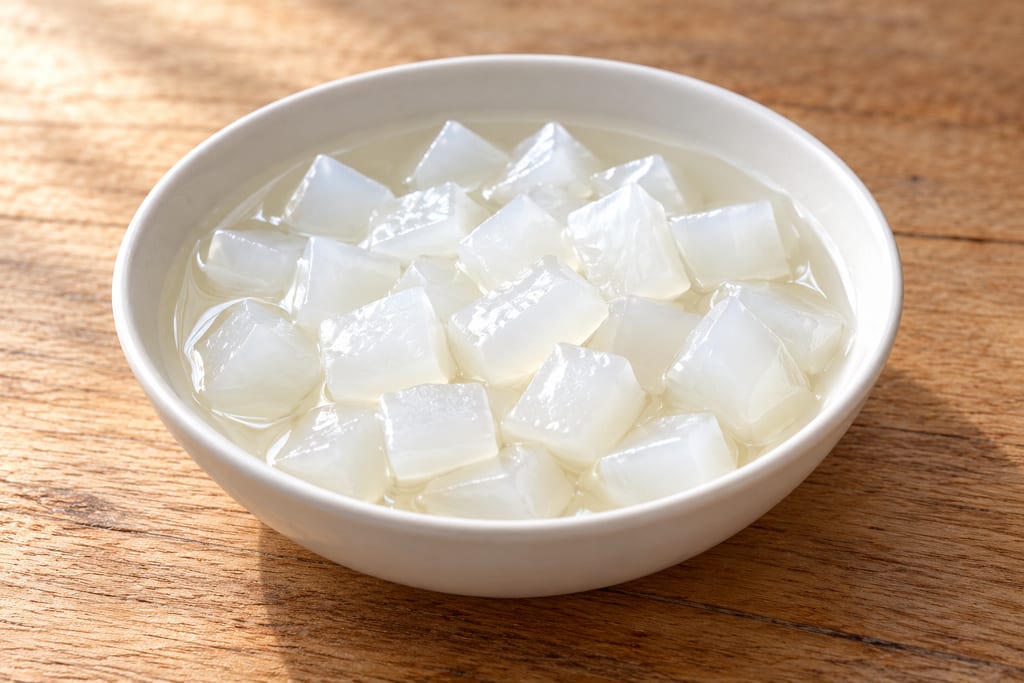
Nata de coco is a chewy, translucent dessert gel. It is cut from a cellulose pellicle that acetic acid bacteria grow on the surface of mature coconut water, then cleaned, boiled and usually stored in syrup.
Nata de coco is a dessert made from bacterial cellulose. A pellicle grows on the surface of coconut water, and the cleaned pieces are chewy and translucent. The cellulose is the material that is eaten. Acetic acid is a by-product of the bacteria's growth.
The name refers to the dessert. The pellicle is the fermented material. Harvesting, washing, cutting, boiling and syrup treatment belong to the finishing stage, which is separate from the growth stage.
The substrate is mature coconut water with sugar. Laboratory work adds yeast extract as a nitrogen source. The 2015 study names Gluconacetobacter xylinum for its isolate. Older literature uses Acetobacter xylinum, which current nomenclature places under Komagataeibacter xylinus.
Isolates differ. In a 2022 comparison of three Komagataeibacter strains from nata de coco culture, two produced cellulose and one did not. So the name of a species does not establish which organism a given batch contains.
The 2024 review associates nata products with the Philippines. That is a reported association. It does not establish a birthplace, an invention date or a single inventor, and no transmission history was inspected.
The historical article on the nata organism is catalogued from the 1960s. Its full text was not readable in the source review, so its contents are not used here.
The 2015 laboratory batch started with a culture grown in nutrient broth, harvested by centrifugation and washed. The medium was mature coconut water with sucrose and yeast extract, autoclaved, cooled and adjusted to pH 5.5 with acetic acid. The culture was added at 2.0 x 10^7 cells per mL and held static at 30 degrees C for 14 days in a shallow vessel. The reported result was 250 g per litre of wet cellulose.
This batch is a laboratory experiment. It is not a validated household method, and no source gives a household endpoint.
The 2015 batch washed the harvested pellicle in running water, diced it, boiled the cubes for 15 minutes and drained them. The cubes were then soaked in syrup at 72 Brix. One dessert variant adds a pigment and vanilla at the final boil.
Storage in sterilized containers at room temperature is described. It gives no validated shelf life, and boiling and syrup are not a safety check.
The review describes nata as a chewy jelly used in desserts, candies, ice cream, drinks, puddings and fruit cocktails. These are present-day uses in the review, not a historical record of each one.
No validated household recipe exists in these sources. They give no household shelf life, no storage method that has been tested, and no endpoint a cook can check.
A food-process specialist must review any household method, including the culture, cleaning, acidity, storage and finished product. Smell, taste and appearance do not establish safety.
The 2024 review associates nata de coco with the Philippines. No source inspected gives a birthplace, invention date or single inventor. A 1967/1969 Philippine Journal of Science article on the nata organism is catalogued, but its full text was not readable in the source review.
Ingredients
Scaling: source batch only
Coconut waterMature coconut water, the substrate for the pellicle.
Yeast extract (laboratory medium)Added to the medium in the laboratory batch.
5 g
per litre, laboratory batch; not a validated household ingredient
Acetic acid (to pH 5.5)Used to adjust the medium to pH 5.5 before inoculation.
amount not stated
Komagataeibacter xylinus cultureCellulose-producing acetic acid bacteria, added aseptically to the cooled medium. The 2015 batch used 2.0 x 10^7 cells per mL.
Amount not stated
laboratory inoculum; isolates differ in cellulose production
Method
Risks and precautions · Standard risk
Uncontrolled spoilage
No validated household shelf life or storage method is given. The 2015 paper mentions room-temperature storage in sterilized containers without a validated period.
Hazard source
No validated household method. The laboratory batch used a named isolate, autoclaving and aseptic handling.
Smell, taste, acidity and appearance do not establish safety.
Isolates of the cellulose-producing bacteria differ, so one culture does not describe every nata.
Use mature coconut water as the substrate. Add sucrose and, in the laboratory batch, yeast extract.
Autoclave the medium, cool it, and adjust it to about pH 5.5 with acetic acid.
Inoculate the cooled medium aseptically with the cellulose-producing bacteria.
Incubate statically at about 30 degrees C for 14 days, so the pellicle grows at the liquid surface.
Lift the pellicle, filter it, and wash it in running water before dicing.
Boil the cubes for 15 minutes, drain them, and soak them in syrup, as the dessert stage describes.
Conditions
Fermentation14 days
Temperature30°C
Temperature controlIncubated
Places
Philippines
Documented use · Country evidence
The 2024 review associates nata products with the Philippines. This is a reported association, not a proven birthplace or invention date.
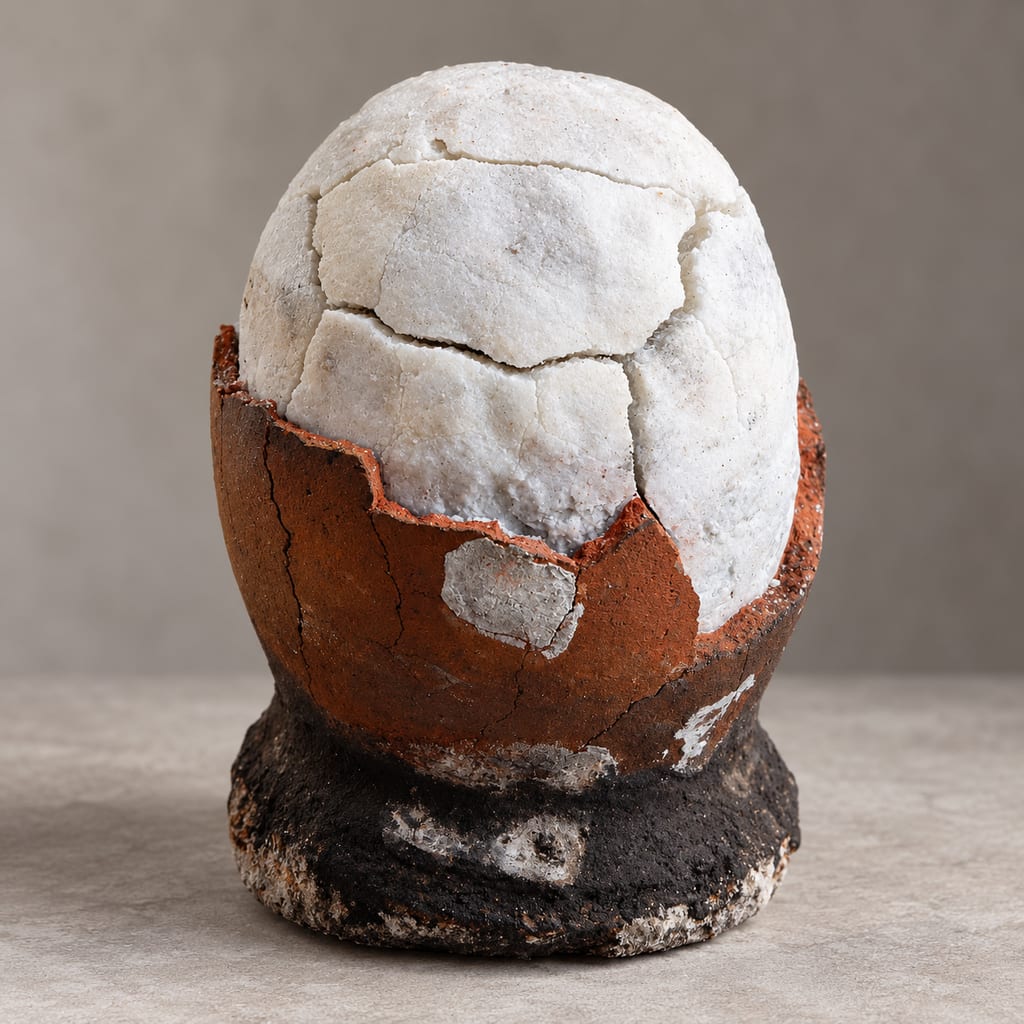
Asin tibuok is a Boholano salt-making craft that turns seawater-soaked coconut husks into a salt-rich ash, brine and formed sea salt in specialized clay pots. This record follows one published account of the community process; it is not a validated household formula.
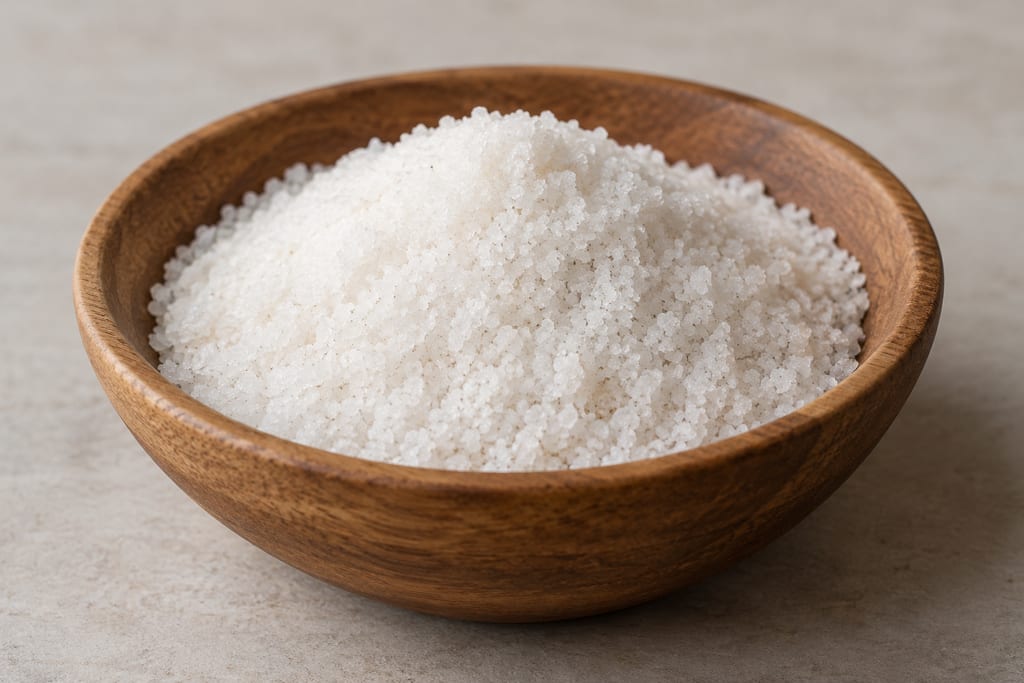
Asin sa buy-o is a fine sea salt made in Panayunan, Botolan, and packed in a woven nipa pouch called a buy-o. Salt-bearing coastal earth is leached with seawater, and the brine is boiled to crystals.
Bagoong isda is a Philippine fish paste: whole small fish salted and left to ferment for a month or more in earthen jars. It is the fish counterpart of bagoong alamang.
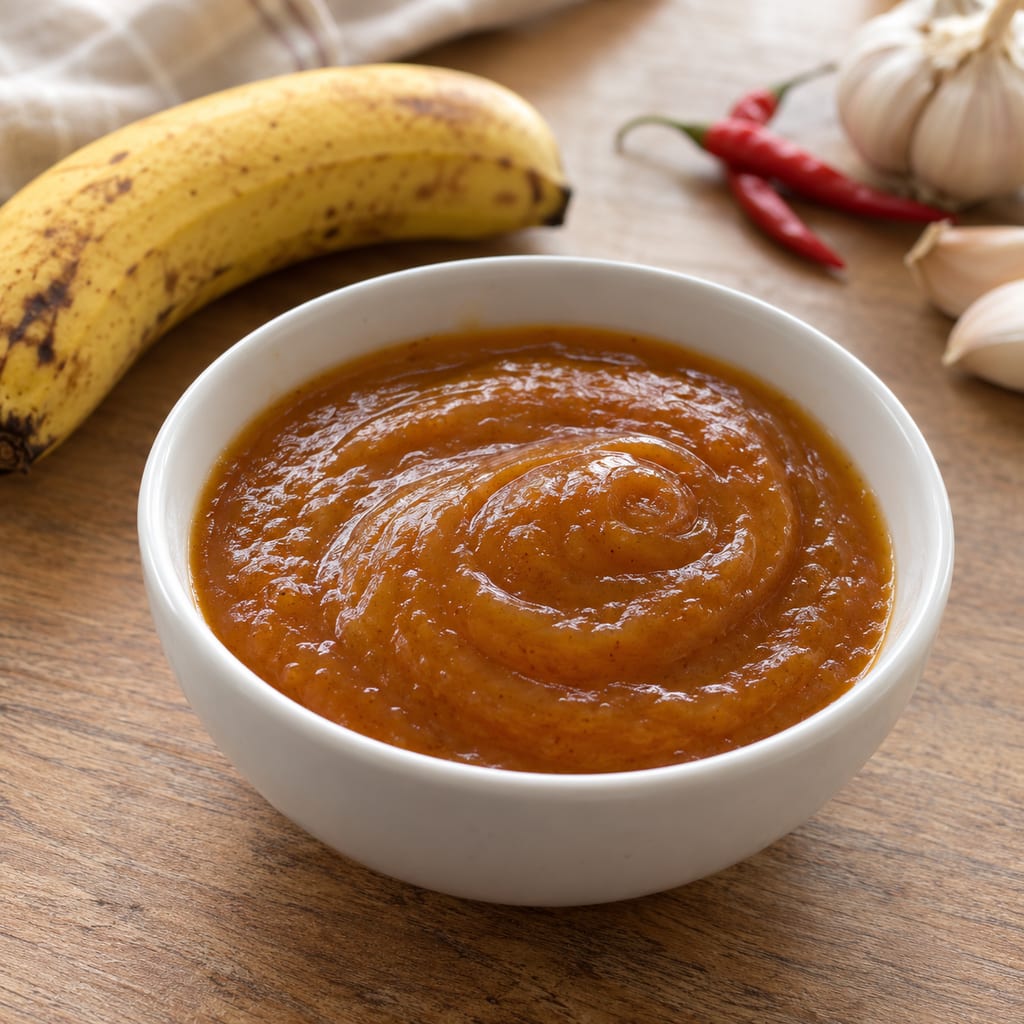
A sweet-hot table sauce of ripe banana simmered with vinegar, sugar, onion, garlic and fresh chilli, in the manner of Philippine banana ketchup. An untested development batch of about 500 g.
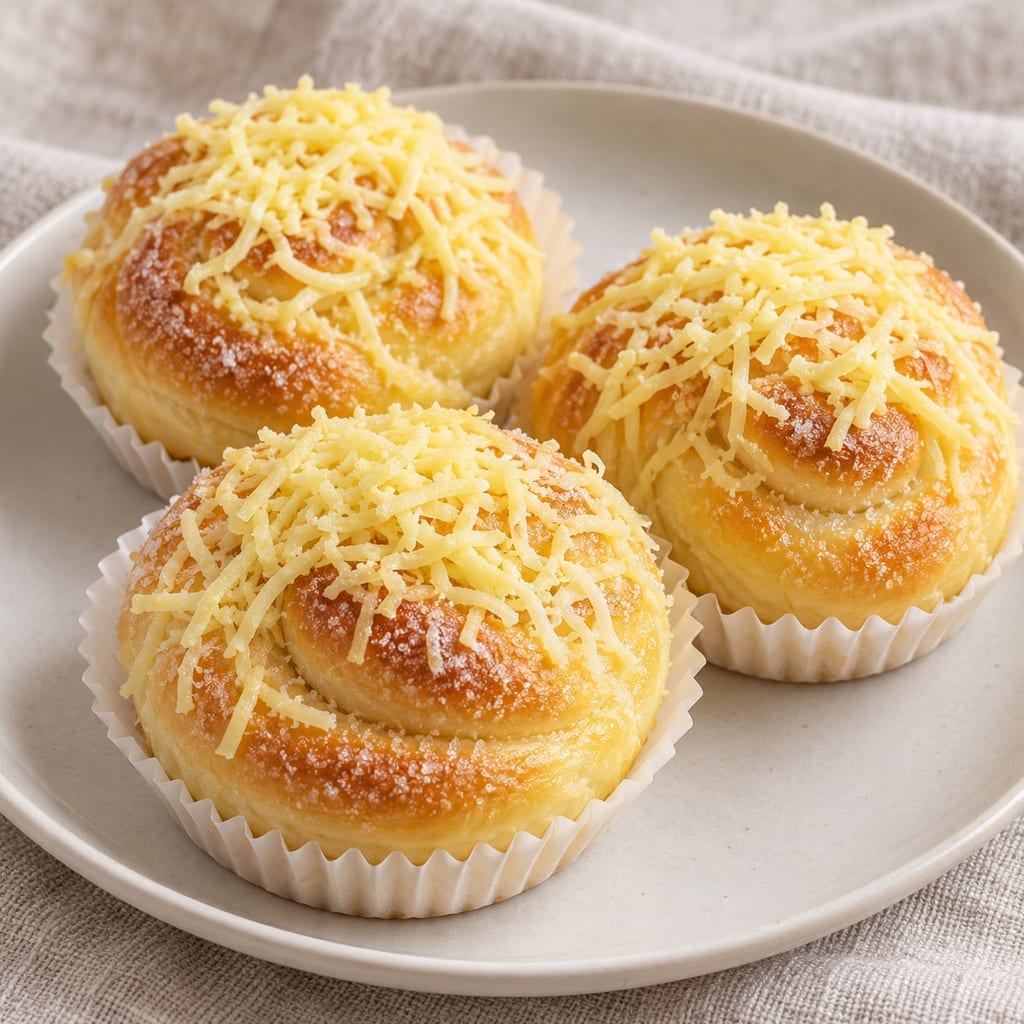
Soft Filipino ensaymada coils use enriched yeast dough, then receive butter, sugar and grated cheese. This modern Filipino version differs from Mallorcan ensaïmada and other Philippine regional formulas.
Kaya is a sweet Malay-rooted spread of eggs, coconut milk and sugar, scented with pandan and stirred over gentle heat until it thickens. In Singapore it is the filling of kaya toast.
A green Thai custard of pandan juice, coconut milk, egg yolks and sugar, cooked over a water bath until it coats a spoon and served for dipping soft bread, toast or sticky rice.
A chocolate and hot cream emulsion in a one-to-two ratio by weight, thin enough to pour, dip or drizzle, with cream and chocolate combined by whisking.
Laboratory batch: 1 L mature coconut water, 10 g sucrose, 5 g yeast extract, pH 5.5 with acetic acid, 2.0 x 10^7 cells per mL, 30 degrees C for 14 days, 250 g/L wet cellulose.
Harvest by filtration and running-water washing, then dicing; cubes boiled 15 minutes and soaked in 72 Brix syrup.
Cited in: Substrate and culture; Growing the pellicle, as the laboratory batch did; Finishing the dessert; Open questions and safety
Accessed 2026-10-26
Frontiers in Microbiology 13 (2022), article 798010Method