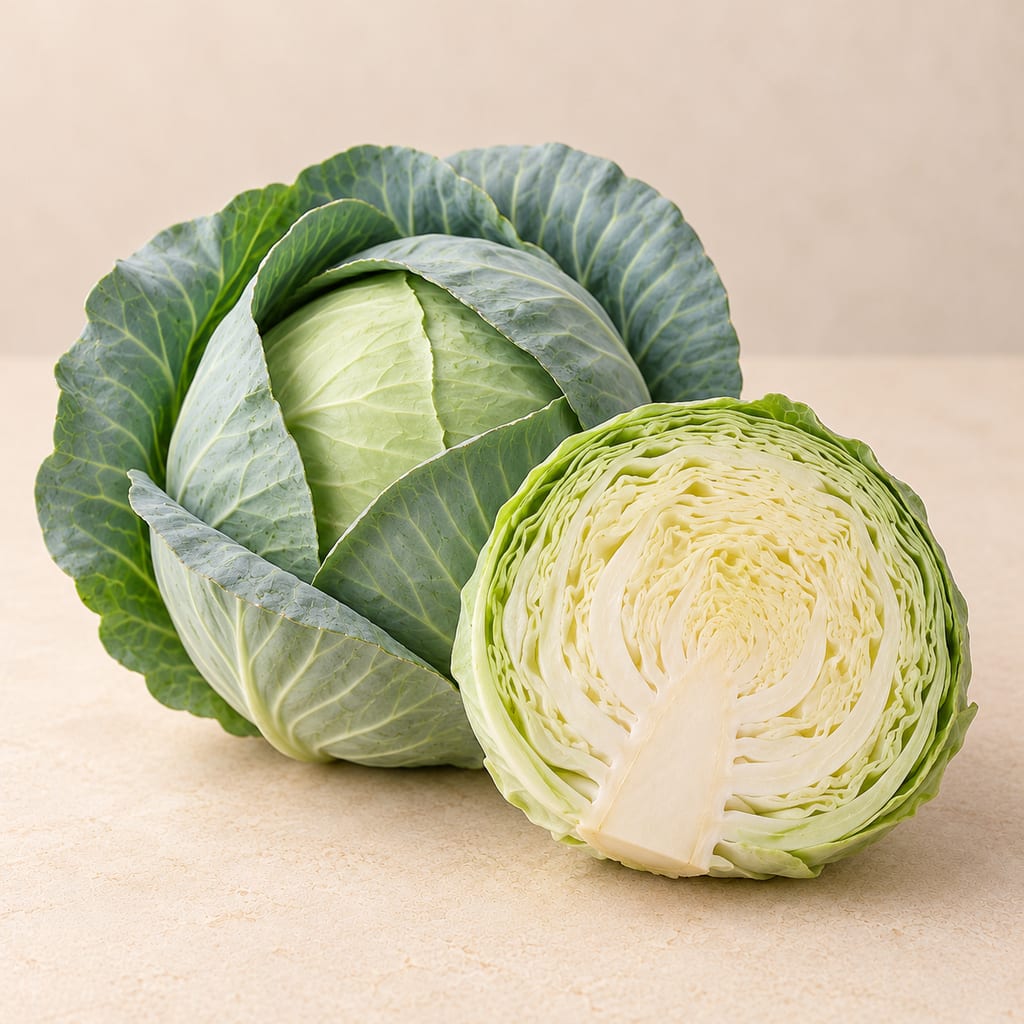
Cabbage
Cabbage is the dense leafy head of Brassica oleracea, a European vegetable that keeps for months and is the classic raw material for sauerkraut, with napa cabbage the base of kimchi.
 FermenteaWhere food goes to change
Traditional method
Sauerkraut
Red cabbage shredded, salted and fermented in its own brine; the pigment gives a deep violet kraut with a sharper flavour than the white-cabbage form.
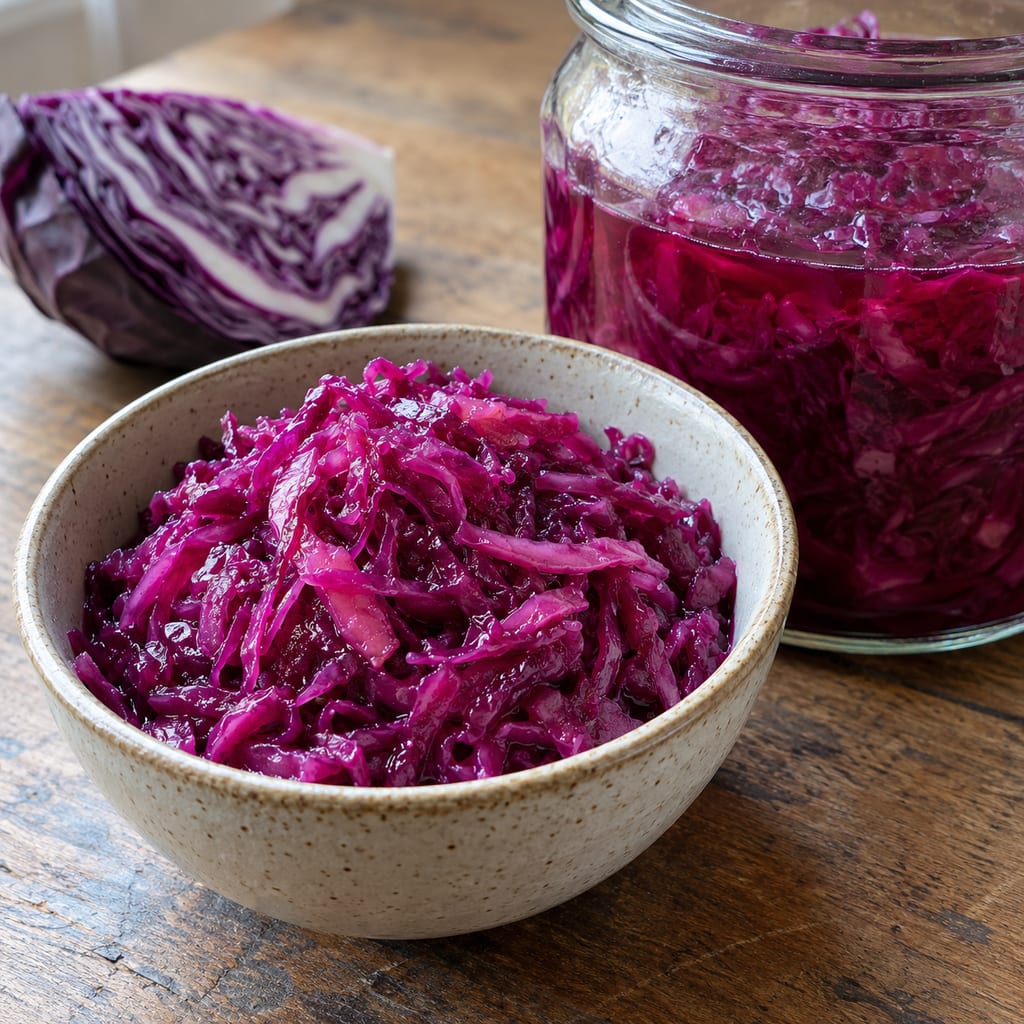
Red cabbage sauerkraut is shredded red or purple cabbage preserved through lactic acid fermentation.
Its basic production method is the same as that used for white cabbage: shred the vegetable, mix it with measured salt, encourage its natural juices to form a brine and keep the cabbage submerged while fermentation proceeds.
What makes red cabbage particularly interesting is its pigment chemistry.
Red cabbage contains anthocyanins, a family of plant pigments whose appearance changes with acidity.
As lactic acid bacteria produce acid, the cabbage often develops a pronounced pink-red or magenta colour.
This provides a visual record of chemical changes during fermentation, although colour must never be used as the sole measure of food safety.
Red cabbage sauerkraut belongs to the same culinary family as the white cabbage preparation. It is maintained as a separate Fermentea record because the original database gives it its own ID and because its pigment chemistry deserves fuller treatment.
It should not be represented as an entirely independent ancient fermentation tradition.
German — Rotkraut, Rotkohl, Blaukraut
German descriptive form — Fermentierter Rotkohl
Polish — Kiszona czerwona kapusta
English — Red cabbage sauerkraut
The vegetable is a red cultivar of Brassica oleracea Capitata Group.
The German words Rotkohl, Rotkraut and Blaukraut often refer to red cabbage generally or to cooked red cabbage dishes.
They do not automatically mean fermented red cabbage.
That distinction matters when researching regional food history.
Red cabbage has been cultivated in Europe for centuries.
Its appearance in a particular vegetable dish, however, does not establish that the dish was fermented.
In German-speaking regions, cooked sweet-and-sour red cabbage is a familiar accompaniment to meat dishes.
It may contain vinegar, apples, sugar and spices.
Such a dish differs technologically from genuine lactic-fermented sauerkraut.
In one case, acidity is introduced directly through ingredients such as vinegar.
In the other, microorganisms produce much of the acidity during fermentation.
Both can be sour, but their preparation and preservation systems differ.
The broader European history of sauerkraut is discussed in the white cabbage entry.
Penn State Extension explicitly documents that sauerkraut can be made from red cabbage as well as the more usual pale-green varieties.
That supports red cabbage as a legitimate fermentation substrate.
The original database attributed the record broadly to Germany and Central Europe but did not identify a historical recipe from a particular place.
No precise date for the invention of red cabbage sauerkraut can be justified from the sources examined.
Anthocyanins are water-soluble plant pigments belonging to the flavonoid group.
Red cabbage contains numerous anthocyanin derivatives, many based on cyanidin structures.
These compounds absorb visible light, producing the purple, blue-red and magenta colours associated with the vegetable.
Their molecular structures can change in response to pH.
At different levels of acidity, different chemical forms become more abundant.
This changes the wavelengths of light absorbed by the pigments.
Under acidic conditions, red tones are often enhanced.
At higher pH, blue-green colours may become more prominent.
This chemistry makes red cabbage extracts useful as natural pH indicators in educational experiments.
At the beginning of fermentation, shredded red cabbage may have a purple colour.
As acid accumulates, the brine can become increasingly pink or red.
The exact appearance depends on cabbage cultivar, pigment composition, concentration, temperature and other factors.
Colour development is not simply a matter of a dye remaining unchanged in an acidic environment.
Anthocyanins can undergo chemical reactions and degradation during processing.
A 2015 food-chemistry study identified twenty anthocyanins in red cabbage products and investigated their behaviour through fermentation, storage and cooking.
The published trial reported that fermentation reduced total anthocyanin content by approximately 24% under the conditions examined.
This is a result from a particular scientific study, not a universal loss rate for every homemade batch.
The pigments' response to pH is useful for understanding the process, but their chemical sensitivity also means that colour alone cannot prove a safe fermentation endpoint.
Red and white cabbage can support related lactic acid bacterial communities.
Fresh cabbage carries microorganisms from its growing and handling environment.
Once salted and submerged, the conditions change.
Salt inhibits some organisms and favours others.
Fermentative bacteria begin using plant sugars and producing acids and other compounds.
Early stages may involve Leuconostoc species.
As acidification progresses, acid-tolerant bacteria such as Lactiplantibacillus plantarum may become more important.
Scientific studies of sauerkraut identify additional genera, including Pediococcus and Levilactibacillus.
The exact community in red cabbage need not be identical to one observed in white cabbage.
Different batches contain different initial microbial populations and plant constituents.
No commercial starter culture is required by the particular traditional recipe retained in the database.
The original Fermentea record specifies the following batch:
Red cabbage — 5 lb
Canning or pickling salt — 3 tablespoons
The quantity corresponds to the large-crock sauerkraut ratio documented by Penn State Extension.
It is a source-supported cabbage procedure adapted to red cabbage, not a separate validation study of every red cultivar.
Do not mix the quantities from the two procedures.
The original red-cabbage record gives no finished yield.
Penn State estimates approximately two quart jars from a 5 lb cabbage batch in its small-jar procedure, but that is not an independently documented red-cabbage yield.
Choose firm, mature red cabbage.
Avoid heads showing rot, unusual soft patches or significant contamination.
A freshly harvested head is preferable to one that has deteriorated during lengthy storage.
The leaves should be crisp and reasonably dense.
Different cultivars may contain different amounts of pigment and water.
These differences can alter the finished colour, juice production and texture.
The exact sugar content of the batch is not specified.
Use ordinary canning or pickling salt suitable for fermentation.
Salt quantity matters because it affects both microbial selection and the release of cabbage juice.
Use a clean food-grade fermentation vessel, knife or shredder, accurate scales and measuring spoons, suitable fermentation weights and a covering that permits gases to escape.
A large crock is appropriate for the 5 lb recipe.
A suitable glass jar can also be used, but the published small-jar formulation has its own measured salt quantity and preparation details.
Avoid equipment likely to react with acidic brine.
Prepare sufficient space above the vegetables to accommodate brine movement during fermentation.
Remove damaged outer leaves.
Rinse the cabbage under clean running water.
Drain before cutting.
Cut the cabbage into quarters.
Remove the dense central core.
The remaining leaves can then be shredded more evenly.
Slice the cabbage finely.
Penn State's general sauerkraut instructions describe approximately 1⁄16 inch (1.5 mm) as an appropriate thin cut.
Consistent slices improve salt distribution and allow a relatively uniform texture.
Weigh out 5 lb red cabbage.
Mix thoroughly with 3 tablespoons canning or pickling salt for the crock preparation.
Do not change the measured salt proportion simply because the cabbage is red.
Massage and compress the mixture using clean hands or suitable equipment.
The leaves will begin losing some of their rigidity as water is drawn out.
Continue working until liquid accumulates.
Transfer the cabbage to the fermentation vessel.
Press it down to remove trapped air and raise liquid above the surface.
The brine may take on a purple colour as pigments move out of damaged plant cells.
Keep the cabbage below the brine.
Do not substitute plain water.
Use appropriate fermentation weights.
Cover the container so that contamination is limited and gas can escape.
Do not tightly seal an ordinary jar without a suitable means of pressure release.
For the large-crock cabbage process, Penn State gives:
70–75°F (21–23°C) — Approximately 3–4 weeks
60–65°F (15–18°C) — May take 6 weeks
These are documented cabbage-process conditions. The supplied red-cabbage record correctly noted that a separate red-cabbage-specific validated schedule had not been established.
Keep the material submerged.
Inspect according to the weighing method and fermentation instructions.
Normal gas production may occur.
The brine can gradually change colour as acidity increases.
If the product develops mould, an abnormal rotten smell or a slimy texture, do not taste it.
Once fermentation is successfully complete, store the sauerkraut using an established method.
Refrigeration, freezing and tested canning procedures are described by Penn State Extension.
Canning requires adherence to the complete applicable processing instructions.
Traditional cooked German red cabbage often involves heating shredded cabbage with other flavouring ingredients.
Those may include vinegar, apple and sugar.
Heat softens the vegetable and develops flavour directly.
In fermented red cabbage, the principal transformation takes place while the cabbage remains uncooked.
Lactic acid bacteria metabolise sugars and produce acid.
The finished product can later be cooked, but cooking it changes the presence of living microorganisms and can further soften the vegetable.
A recipe that begins by boiling cabbage in vinegar should not be classified as spontaneous lactic fermentation.
In German-speaking regions, fermented red cabbage may be served alongside pork, sausages or potatoes.
In Czech and Slovak cooking, sour cabbage preparations accompany substantial meat and dumpling dishes.
Polish fermented cabbage traditions are more commonly associated with white cabbage, but red cabbage can be fermented in a similar way.
Modern cooks sometimes introduce caraway, juniper or apple.
These change flavour but should not be casually added to a tested plain-cabbage fermentation formula without appropriate guidance.
The database does not contain authenticated historical regional formulations with precise differences in salt concentration.
It would therefore be misleading to assign named ancient German, Czech and Polish red-sauerkraut recipes.
Properly prepared red cabbage sauerkraut may develop a vivid magenta or red-purple appearance.
The cabbage should remain covered by brine.
Acidity develops and the fresh raw cabbage flavour changes.
A slight reduction in crispness is expected, but the material should not become abnormally slimy.
The brine may show signs of microbial activity during fermentation.
These observations are useful for quality assessment but cannot establish safety individually.
A bright red colour does not guarantee an appropriate pH.
A duller colour does not necessarily prove spoilage.
Pigments respond to many environmental factors besides microbial fermentation.
Cabbage stays purple rather than pink. Pigment response varies, and the fermentation may still be progressing. Colour alone is insufficient to assess completion.
Cabbage becomes very soft. Excessive warmth or prolonged unsuitable conditions may be responsible.
Brine level falls. The material may become exposed to air. Follow the documented brine-coverage instructions.
Mould appears. Do not taste the batch; reject it.
An unpleasant rotten smell develops. Treat the batch as failed.
The cabbage remains hard and relatively unchanged. Fermentation conditions may not have supported adequate microbial activity.
The finished cabbage tastes excessively salty. The recorded method ratio may have been measured incorrectly, or insufficient fermentation and liquid redistribution may have affected the result. Do not correct a safety-critical ratio mid-process by simply adding arbitrary water.
Red cabbage is not inherently safer than white cabbage.
The same need for measured salt, clean equipment, appropriate temperatures and brine coverage applies.
Do not rely on its colour change as a food-safety test.
For household preparation, follow the full tested sauerkraut process and keep the red-cabbage substitution within the scope described by an authoritative preservation source.
Refrigerate successfully fermented kraut or preserve it using a documented freezing or canning method.
If signs of spoilage appear, discard the product.
Red cabbage fermentation can be a useful practical demonstration of acid-base chemistry, but an experiment intended to show colour changes should not be treated as proof that the resulting food is safe to eat.
The source material supports red cabbage as a suitable vegetable for sauerkraut production.
Scientific research establishes that its anthocyanins change during fermentation.
It does not establish an ancient independent origin for red cabbage sauerkraut.
Nor does it supply a unique, experimentally validated fermentation endpoint for every red-cabbage cultivar.
The page therefore belongs alongside white cabbage sauerkraut as a closely related variant with distinctive pigment chemistry.
Penn State Extension documents red cabbage as a sauerkraut substrate. The process recorded here is the general cabbage method rather than a red-cabbage-specific tested formulation.
Scaling: source batch only
Poor brine coverage or inadequate acidity monitoring can allow spoilage; recipe-specific validated limits are not established.
Hazard sourceUse clean food-grade equipment, keep produce submerged and monitor acidity; no universal endpoint is supplied for this recipe.
Control sourceUnknown documented geographic association. The inspected recipe and safety sources document a process but do not establish its regional origin.
Cabbage is the dense leafy head of Brassica oleracea, a European vegetable that keeps for months and is the classic raw material for sauerkraut, with napa cabbage the base of kimchi.
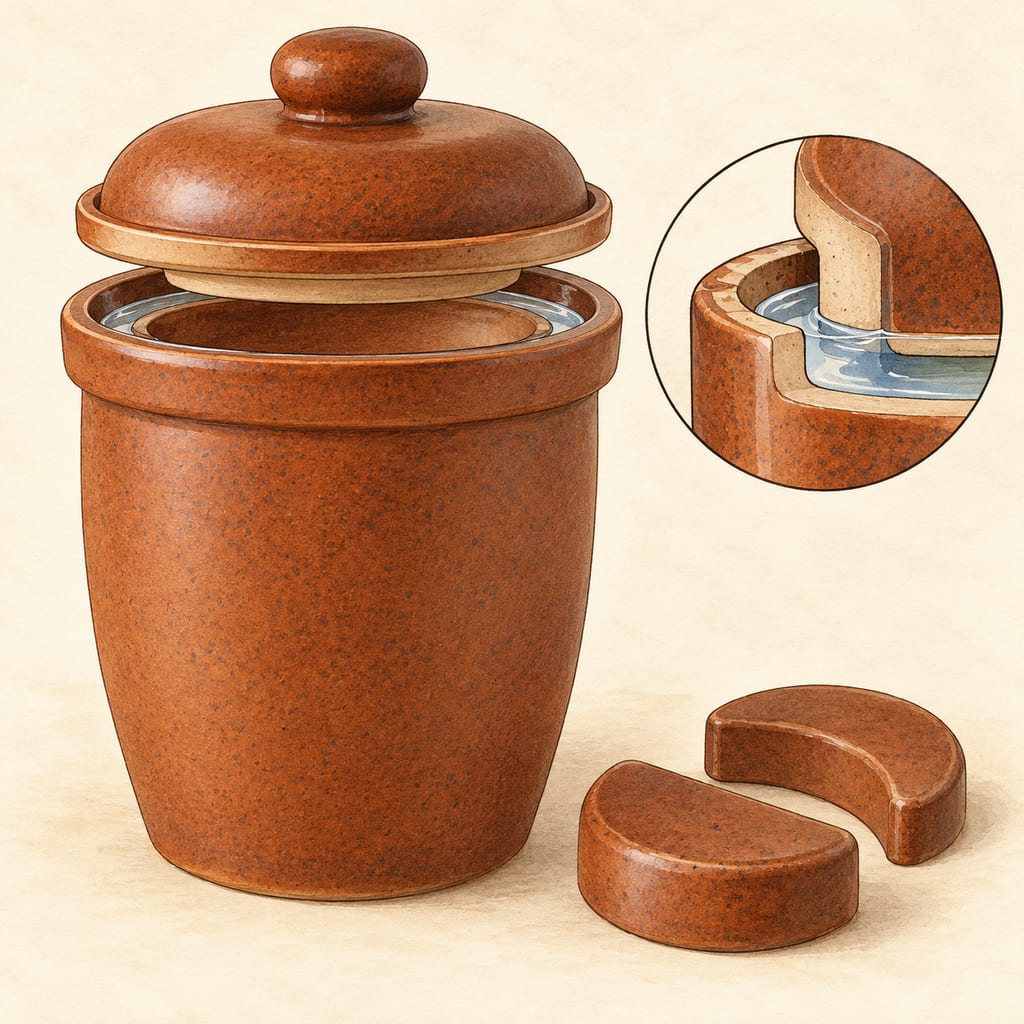
A movable stoneware sauerkraut crock with a fitted lid, ceramic weights and a water-filled rim channel. German sources call it a Gärtopf; Czech sources document the related zelňák or nádoba na kvašení zelí.
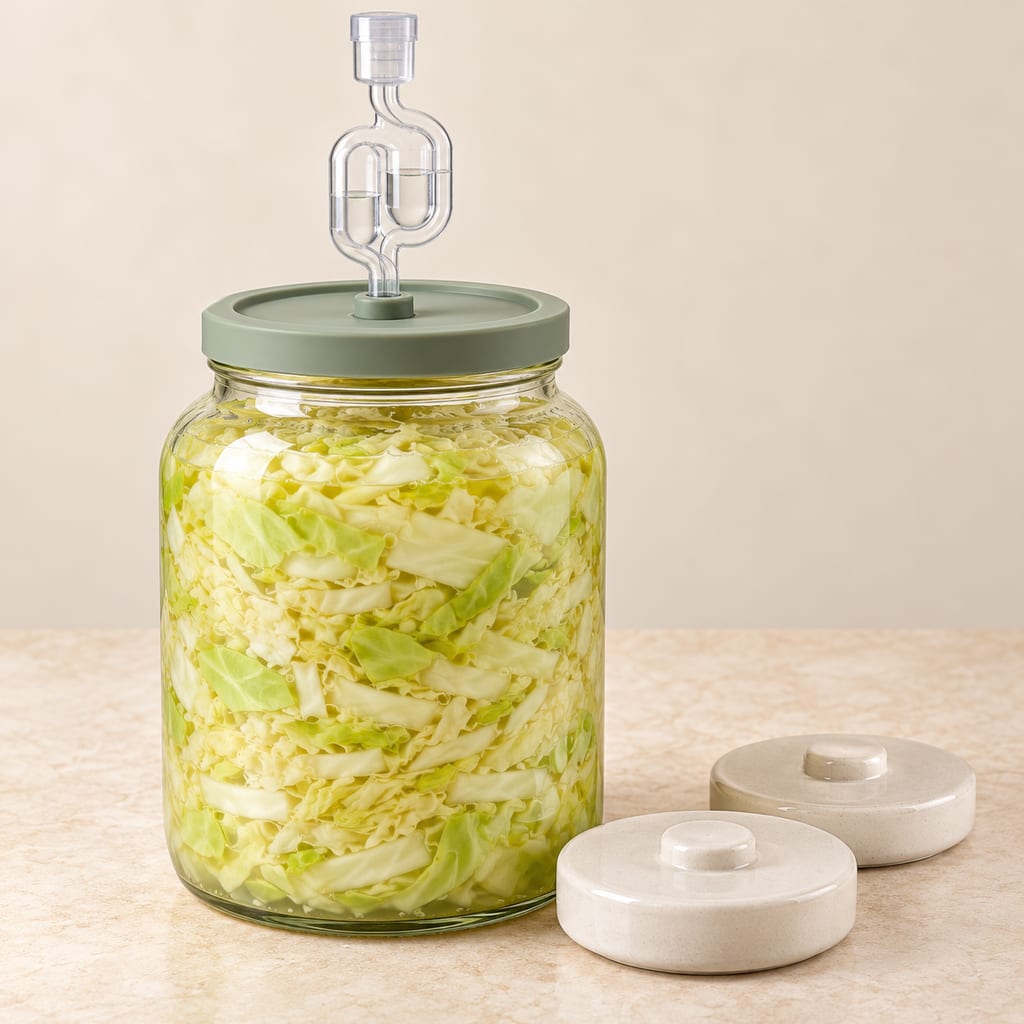
A modern wide-mouth glass jar for vegetable fermentation, often paired with a gas-release lid or airlock and follower weights. This accessory arrangement distinguishes it from general preserving jars and stoneware crocks.
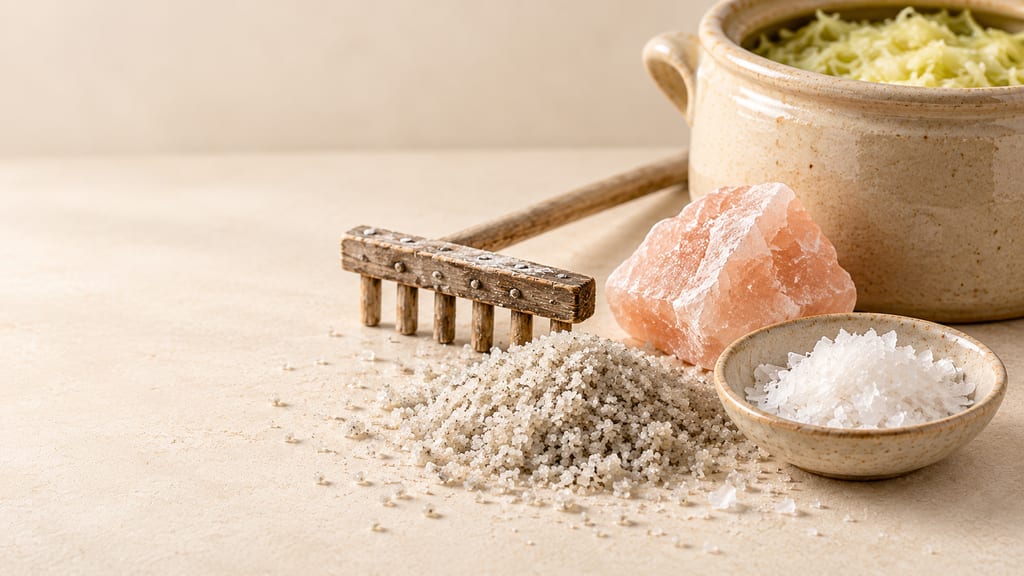
Salt seasons a meal, shapes fermentation and preserves food. Its history follows the people who mine, harvest, trade and transform it, and the choices hidden inside an ordinary packet.
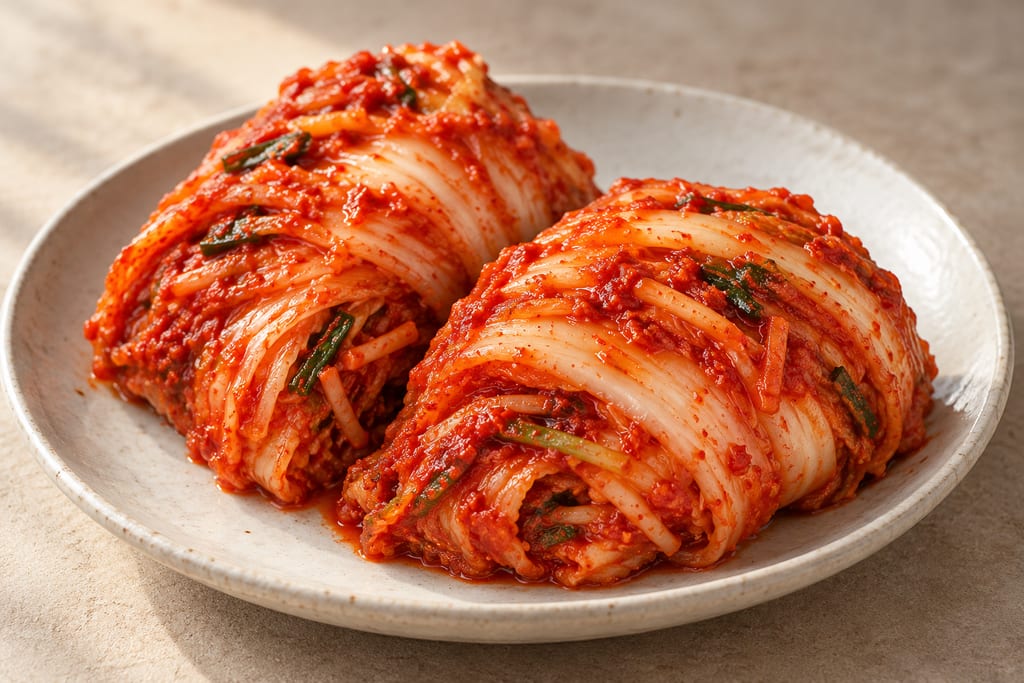
Napa cabbage salted, seasoned with a paste of gochugaru, garlic, ginger and salted seafood, and left to sour through lactic fermentation; Korea's everyday winter preserve.
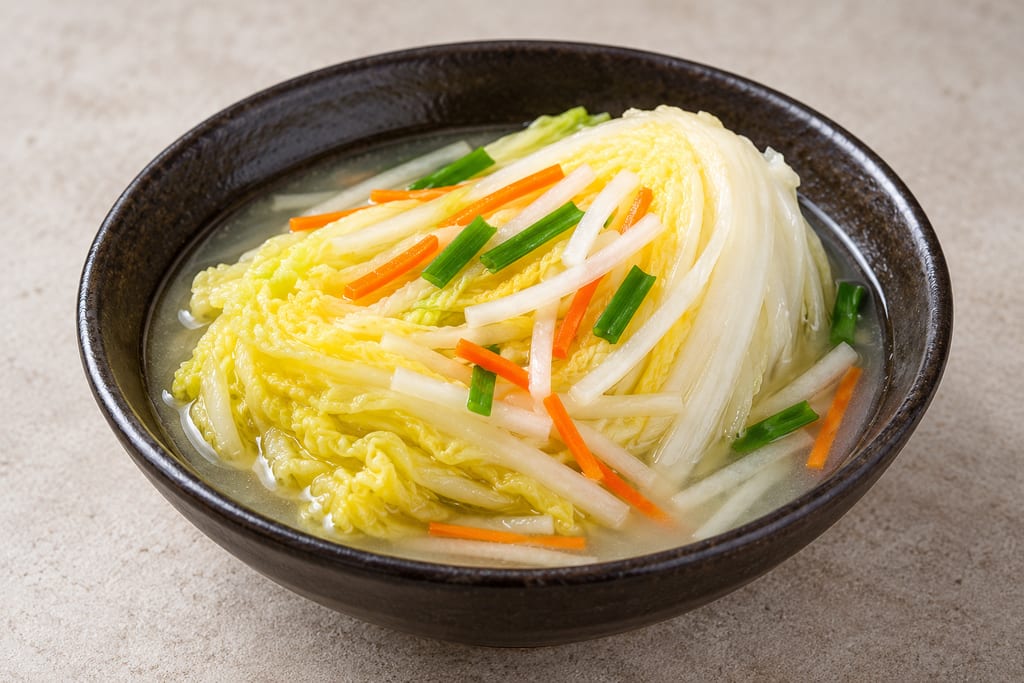
Napa cabbage is brined and filled with pear, radish, alliums, chives and fruit; this Korean kimchi omits red pepper flakes.
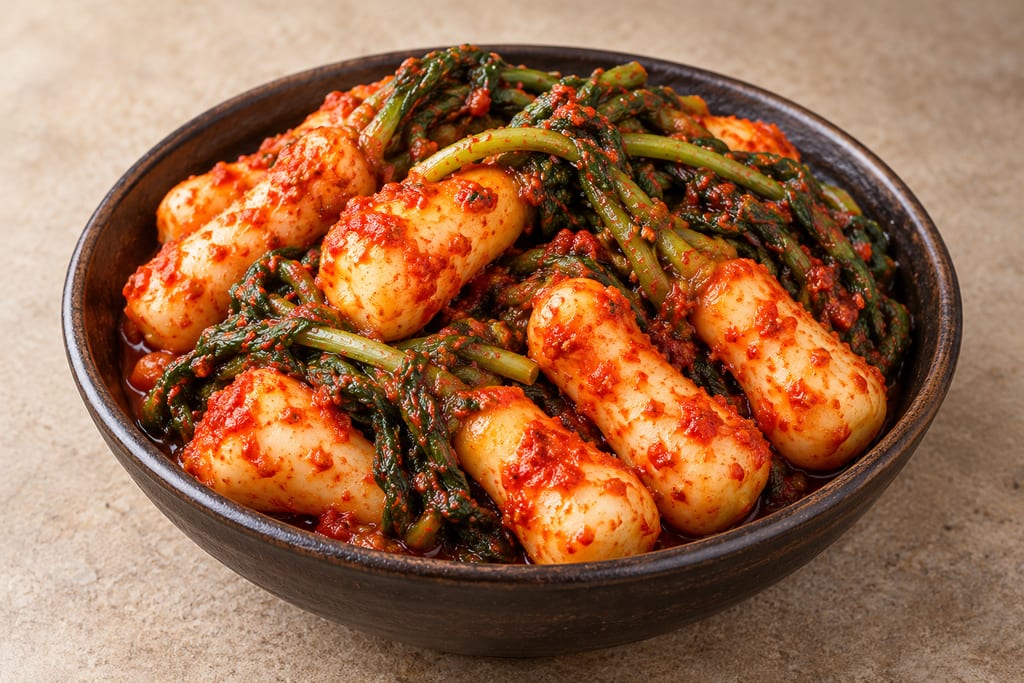
Small ponytail radishes keep their greens attached and ferment in a flour-and-chile seasoning paste.
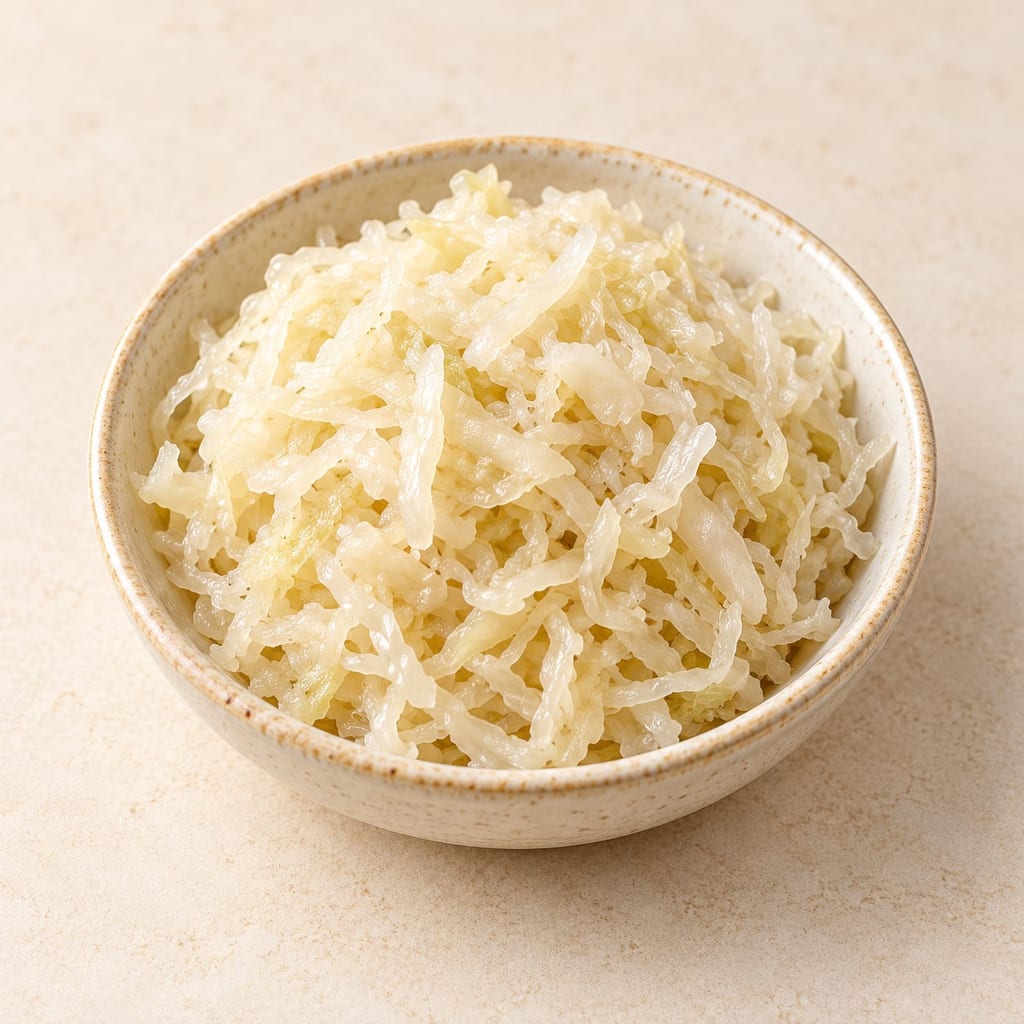
Finely cut cabbage fermented with salt in vats by natural lactic fermentation, a protected Alsatian product sold raw or cooked after fermentation.
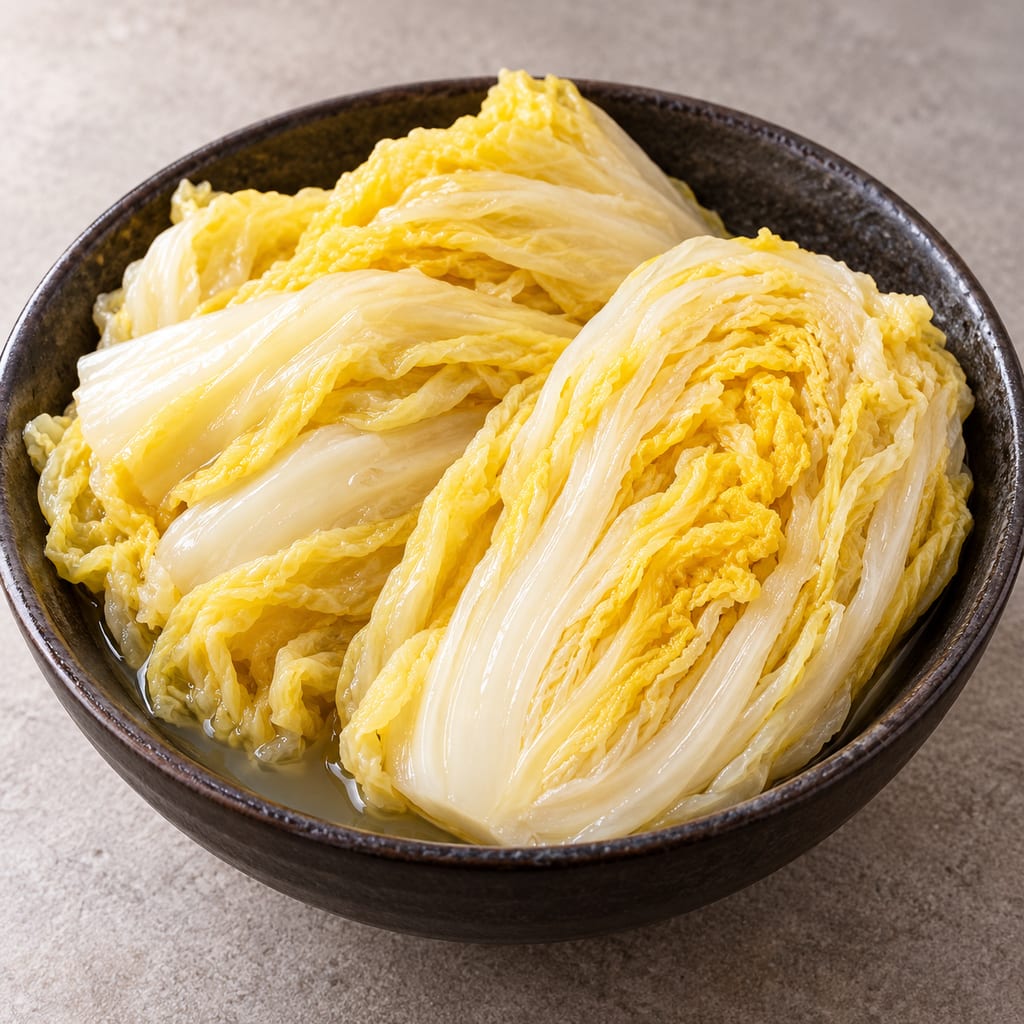
Napa cabbage fermented in a salt brine in Northeast China, traditionally in large ceramic or glass jars, until it turns sour.
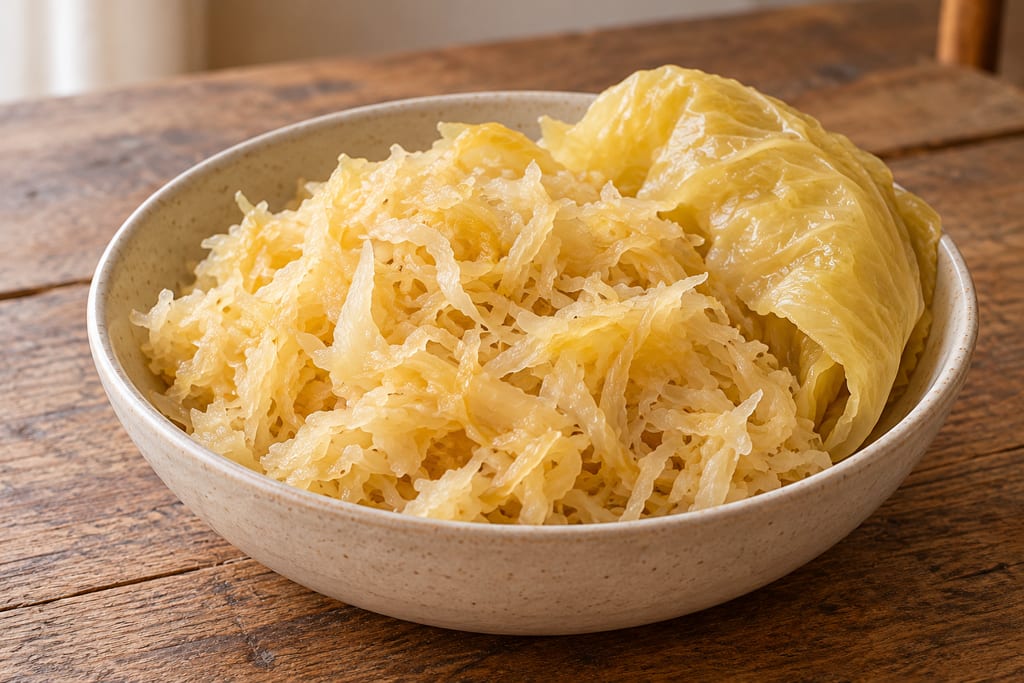
Serbian sour cabbage from the Futog area, made from the autochthonous Futoški cabbage population and registered as a protected product in 2008. It is a subset of general Serbian kiseli kupus.
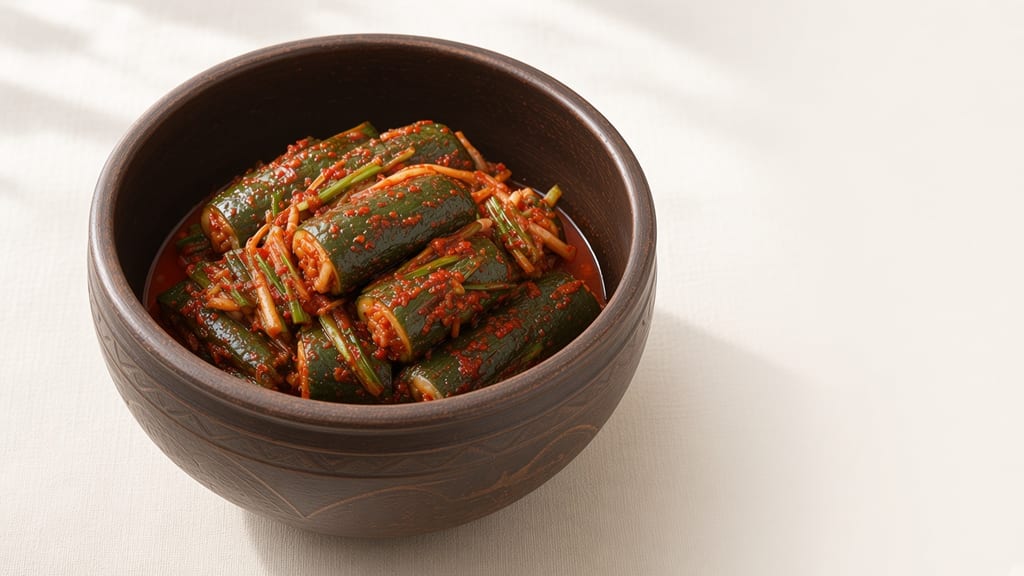
Hwanggwa damjeo is a cucumber kimchi from Yu Jung-rim's Jeungbo sallim gyeongje of 1766. Slit cucumbers are packed with chilli powder and garlic, scalded with hot salted water and sealed overnight.
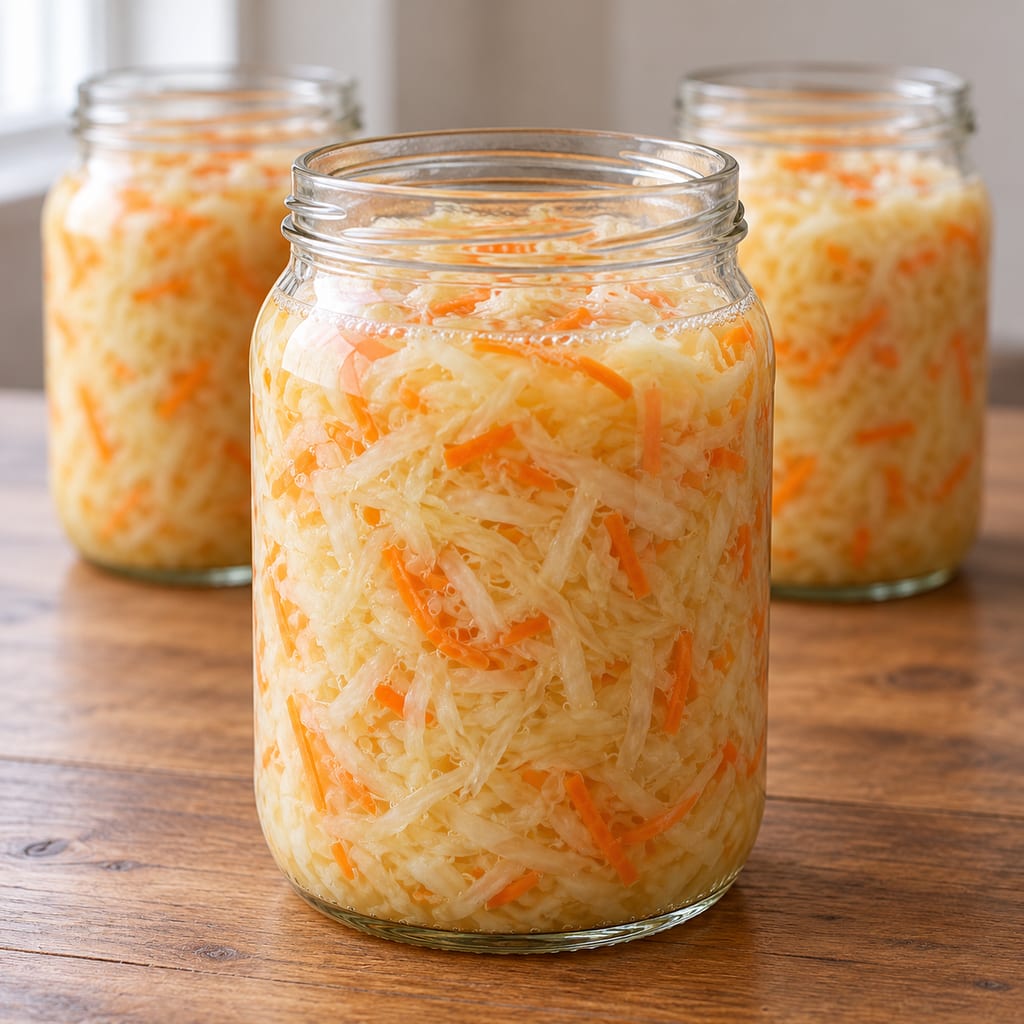
Shredded cabbage and grated carrot are salted to 20 g/kg, rested, packed into three jars and monitored during a creator-reported eight-day fermentation; measured temperature is not given.
No community contributions have been published for this entry yet.
Sign in to contribute. Published comments and photos are free to read.
Penn State ExtensionInspiration
Let's Preserve: Sauerkraut and Picklesred cabbage use, process and safety guidance
Cited in: What is red cabbage sauerkraut?; Names and botanical identity; Historical context; Red cabbage pigments; Ingredients; Ingredient selection; Equipment; Stage 1 — Clean and inspect; Stage 2 — Quarter and core; Stage 3 — Shred; Stage 4 — Measure the salt; Stage 5 — Work the cabbage; Stage 6 — Pack firmly; Stage 7 — Ensure submersion; Stage 8 — Weight and cover; Stage 9 — Ferment; Stage 10 — Monitor; Stage 11 — Refrigerate or preserve; Regional serving variations; What a successful batch looks like; Common problems; Safety and storage; Historical and scientific limits
University of Minnesota ExtensionSafety
Preserving food at home: FermentationProduce fermentation equipment, acidity monitoring and submersion controls.
Cited in: Ingredients; Ingredient selection; Equipment; Stage 1 — Clean and inspect; Stage 2 — Quarter and core; Stage 3 — Shred; Stage 4 — Measure the salt; Stage 5 — Work the cabbage; Stage 6 — Pack firmly; Stage 7 — Ensure submersion; Stage 8 — Weight and cover; Stage 9 — Ferment; Stage 10 — Monitor; Stage 11 — Refrigerate or preserve; Regional serving variations; What a successful batch looks like; Common problems; Safety and storage
Penn State ExtensionReference
Penn State Extension — Tips for Making Sauerkrautexplicit red cabbage use and fermentation advice
Cited in: Ingredients; Ingredient selection; Equipment; Stage 1 — Clean and inspect; Stage 2 — Quarter and core; Stage 3 — Shred; Stage 4 — Measure the salt; Stage 5 — Work the cabbage; Stage 6 — Pack firmly; Stage 7 — Ensure submersion; Stage 8 — Weight and cover; Stage 9 — Ferment; Stage 10 — Monitor; Stage 11 — Refrigerate or preserve; Regional serving variations; What a successful batch looks like; Common problems; Safety and storage
Wiczkowski and colleaguesReference
Wiczkowski and colleagues — Anthocyanin changes in red cabbage during fermentationpigment analysis. PubMed
Cited in: What fermentation does to the colour; The microorganisms; Why this is not cooked Rotkohl
Journal of Chemical EducationReference
Journal of Chemical Education — Monitoring red cabbage sauerkrautacid-base chemistry. ACS Publications
Cited in: What fermentation does to the colour; The microorganisms; Why this is not cooked Rotkohl
Microbiology SpectrumReference
Microbiology Spectrum — Sauerkraut microbial successionbacterial changes
Cited in: What fermentation does to the colour; The microorganisms; Why this is not cooked Rotkohl
Food ChemistryReference
Food Chemistry — Red cabbage anthocyanin reviewpigment chemistry. ScienceDirect
Cited in: What fermentation does to the colour; The microorganisms; Why this is not cooked Rotkohl