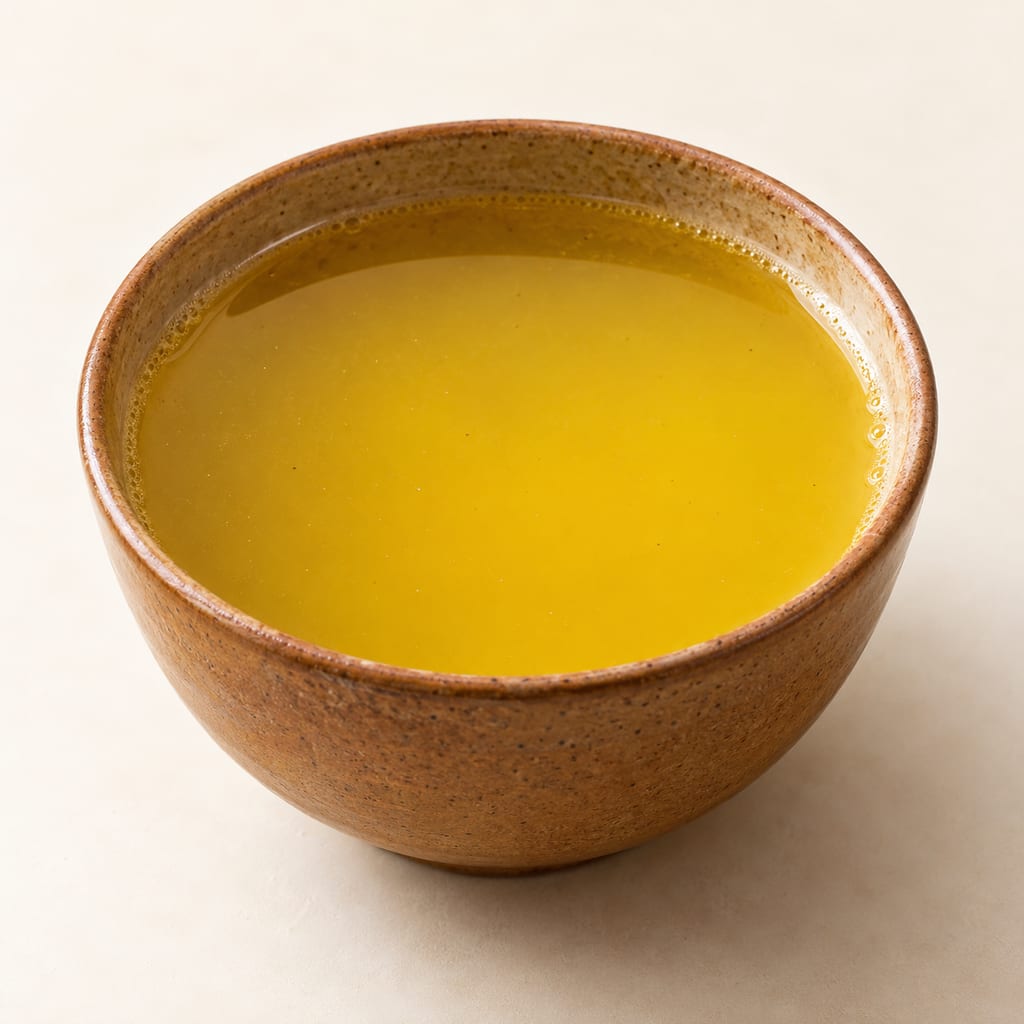
Tucupi
Tucupi is a yellow, sour liquid from the Brazilian Amazon, made from the juice of bitter manioc that is settled, fermented and cooked. It is the base of duck in tucupi and tacacá.
 FermenteaWhere food goes to change
Taruba · tarupá
Tarubá is a cassava drink documented in several distinct Amazonian settings. Community-linked accounts describe different beiju-based processes; they do not establish one universal recipe, fermentation culture or safety endpoint.
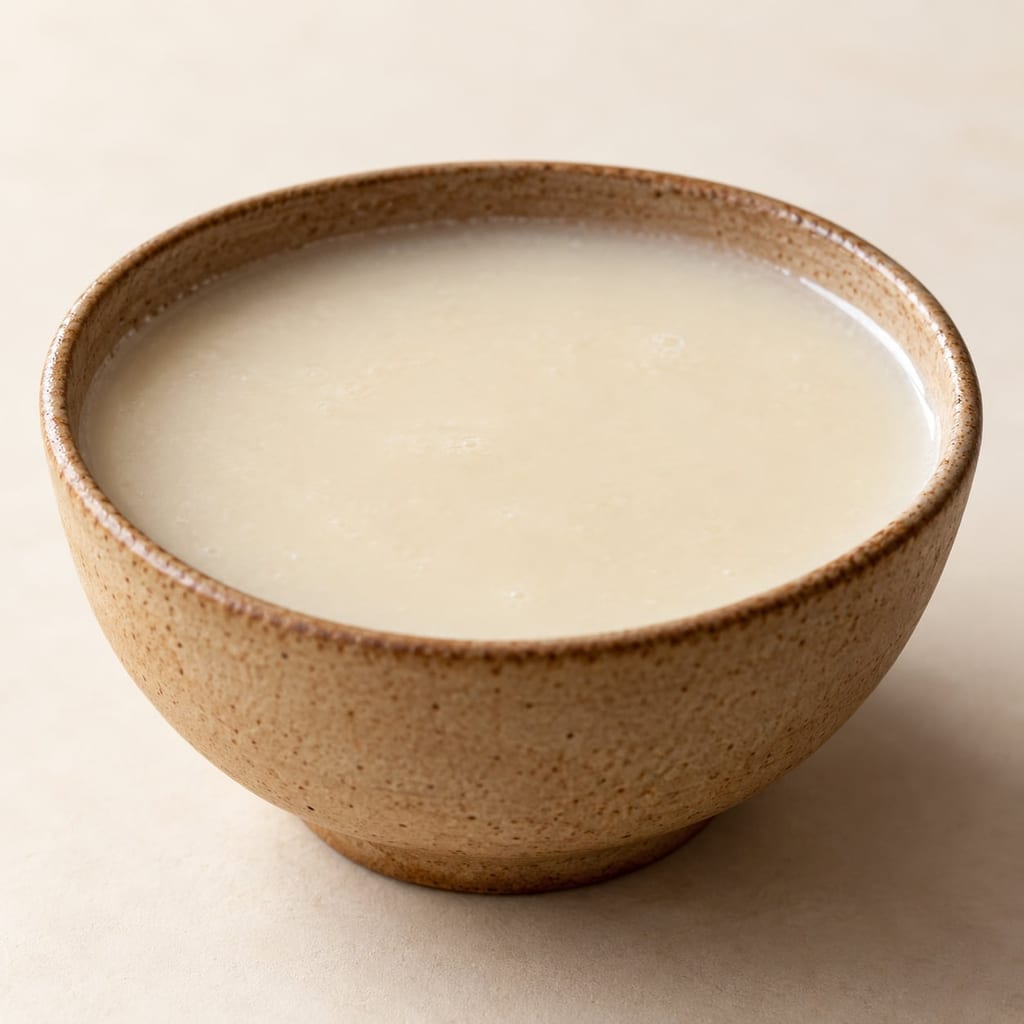
Tarubá is a cassava-based drink recorded in Pará and elsewhere in the Amazon. The spelling Tarubá appears in the 2021 study and the 2017 Slow Food entry; Barghini's 2022 review also writes tarupá for this drink. The accentless Taruba appears in source text. No single Indigenous-language name is established across the sources, and the record does not treat these spellings as separate drinks.
The sources do not describe one universal preparation. A 2021 paper documents work with Arapium community members at Aldeia Braço Grande near the Arapiuns River. A 2017 chemistry-education paper reports interviews and classroom work with Arapyun people at Vila Franca. Their places, contributors and process details stay attached to their own accounts. Neither paper represents all Amazonian communities or every product called Tarubá.
Barghini's 2022 review reports that Henry Walter Bates encountered Tarubá at Óbidos in 1849 and cites later descriptions by C. Souza in 1873 and Rodrigues in 1875. The review shows those later writers differed over the time beiju was left to “mold”: three days in one account and seven in another. This is a historical record mediated through a modern literature review; the original travel and nineteenth-century texts were not independently inspected for this entry.
The 1849 reference documents a named drink by that date in the review's account. It does not tell us when Tarubá began, whether practices continued without change, or whether present-day community processes match Bates's description. The review shows that Tarubá has been described as a refreshing or slightly alcoholic drink and that names and methods vary locally. Those qualifications matter: a historical attestation is not a recipe, and one text's description cannot stand in for community testimony today.
The 2021 study describes a process according to Indigenous people from Aldeia Braço Grande, which the authors identify as an Arapium village in the Tapajós-Arapiuns Extractive Reserve, Santarém municipality, Pará. They give field coordinates and say cassava roots were collected in that setting. The article acknowledges the village for supplying raw materials and knowledge, naming community members and especially women who shared knowledge. The location record refers to this study site only; it does not make it the drink's birthplace.
In the described sequence, cassava is grated and pressed to remove tucupi, the pressed mass is sieved and made into beijus, and the beijus are roasted and moistened. The researchers describe puçanga powder and green curumim branches being placed with the beiju mass in layers on a bed of palm leaves, then covered with further palm leaves for a three-day rest and fermentation. They report diluting the fermented mass with water at an observed ratio of 1 kg to 3 L. This is a published description of one community-linked study, not an instruction to reproduce the process.
The 2017 conference paper reports an educational project at an Indigenous school in Vila Franca, western Pará. Researchers interviewed older residents and some young people about preparation, how often the drink was consumed, and occasions for serving it; teachers and students then used a locally informed booklet to connect the process with classroom chemistry. The account shows an Arapyun community and records local participation. It does not say that its interviewees or process are the same as those in the 2021 Braço Grande study.
That paper describes grated cassava separated from tucupi with a tipiti, then sieved and baked into beiju. Its text says the beiju rests for three days, followed by adding water and sugar after straining. It does not provide measured amounts for the cassava, water or sugar, nor does it describe the same puçanga-and-curumim leaf-bed sequence given in the 2021 paper. The shared three-day period does not establish that the two accounts are one standardized method.
The 2017 authors say the practice is transmitted across generations in the community and report concern that some younger residents showed less interest as industrial drinks became easier to consume. That finding belongs to this educational study and its interview setting. It is not a survey of every Arapyun community or a claim that the practice has disappeared.
The 2021 paper names cassava, puçanga, curumim leaves and branches, palm leaves, and water in its process description. It prints the botanical name “Trema micranta L.” for curumim. The Slow Food Brasil entry inspected for this work instead names curumim-caá as Ravenala guianensis. Because the sources conflict, this entry preserves the exact names each source gives without deciding whether they refer to the same plant. No botanical identity is inferred from a local name alone.
The 2017 account includes water and sugar in its description, while the 2021 study's abstract names water dilution and its methods detail puçanga and fresh branches. The sources do not establish that sugar belongs in every Tarubá, or that one community's ingredients transfer to another. For that reason the catalogue record has no unified ingredient list. Its ingredient lines remain empty even where individual source accounts name components.
The 2021 process figure names a mill or grinder, a tipiti for pressing out tucupi, a sieve, equipment for making the beiju, and a palm-leaf bed raised on supports. The authors say the raised bed is used to avoid contaminants and insects. These details belong to the described Braço Grande setting; the paper does not give measurements or specifications for a modern household substitute. The article also calls its pressing tool Indigenous-developed. This record preserves that attribution without claiming that every community uses the same tool.
The 2017 account also names a tipiti and beiju-making stages, but presents them in an educational activity rather than a measured technical specification. Neither source provides an exact sieve mesh, roasting surface material, bed dimensions, batch capacity or vessel type for the three-day stage. Those omissions prevent a reliable equipment list for a home recipe.
The 2021 researchers additionally used a pH meter, bench refractometer, titration reagents and distillation with relative-density conversion to analyze samples. Those are laboratory measurement procedures, not household production equipment or consumer safety checks. A research instrument's presence in a paper does not imply that a cook can establish safety by taking one household pH or alcohol reading.
Ramos and colleagues' 2015 abstract reports lactic-acid and mesophilic bacteria among predominant organisms, with Torulaspora delbrueckii as the dominant yeast in their analysis. It lists several isolates with amylolytic activity. The abstract does not identify where the studied Tarubá came from or describe enough of the process to connect those organisms to a named community. These results therefore remain attached to that study rather than being treated as a starter culture for Braço Grande or Vila Franca.
Barghini's 2022 review discusses separate 1998, 2012 and 2015 analyses. It reports Rhizopus oligosporus and a yeast identified at the time as Hansenula anomala in Carvalho's 1998 account, several Pichia species and a wider set of microorganisms in the 2012 work, and the absence of amylolytic mold in the 2015 sample. The review itself notes that Tarubá processes vary locally and that only a small number of complete or partial analyses were available. The evidence does not support a single universal mold, yeast or bacterial culture.
The 2021 paper speculates that puçanga could be a source of yeasts, but it does not identify the organisms present in that batch. That hypothesis is retained as the authors' suggestion, not treated as a demonstrated mechanism. Nor is Tarubá equated with Parakari, Cauim, Caxiri or Tiquira. Shared cassava substrate or discussion in an article does not make those names, communities, ingredients or fermentation systems interchangeable.
The 2021 authors describe Tarubá in their Braço Grande context as served at ritual events, puxirum work gatherings and religious or Indigenous festivals. They report that the diluted drink is consumed on ordinary days, while the more alcoholic form is served on festive dates. The paper also attributes advice against excessive drinking to community members. These are culturally situated descriptions from that study, not a universal serving rule or a quantified account of alcohol intake.
The 2017 Vila Franca paper focuses on community knowledge and education. It discusses how preparation is taught across generations and how the process can support classroom learning. Slow Food Brasil's book entry places Tarubá among traditional products associated especially with Santarém. Each source has a different purpose: study, educational work or heritage documentation. None supplies a comprehensive regional survey, and they should not be combined into one account of all communities.
The 2021 study reports experimental alcohol observations in its table: 1.6, 5.7, 7.6, 7.9 and 7.9 percent by volume for T0, T1, T7, T17 and T30. Its method says the fermented mass rested for three days, then the beverage was bottled in sealed, sterilized bottles and stored in a 30 °C incubator for 30 days. Yet the table defines the labels as days after the start of mass fermentation. The paper does not reconcile that timing with the preceding three-day solid phase and subsequent beverage storage. The values are kept as one study's experimental series with this ambiguity; they are not a typical strength, a safe storage duration, or a recommended household temperature.
The paper also reports that the beverage was biphasic and that the authors considered stirring before consumption necessary in their sample. They discuss changes in several measured parameters and state that more work was needed on stability and other parameters before commercialization. These findings do not establish a safe shelf life or a reliable consumer test. Neither visual separation nor pH, sweetness, smell or taste confirms that a batch is safe.
The 2021 and 2017 accounts both describe removing tucupi from cassava mass before making beiju. The 2021 paper does not report a residual cyanogen assay for its batch or establish a cyanogen-control endpoint. General Codex material on cassava explains that cyanogenic content and reduction depend on both cultivar and processing, but it is not a Tarubá validation study. The fact that a source describes pressing or discarding a liquid cannot be presented as proof that all hazardous compounds were removed.
No reviewed source gives a validated home safety procedure for this preparation, a residual-cyanogen limit, complete fermentation control, bottle-pressure management, failure signs, storage temperature or safe storage duration. The 30-day incubator study is a laboratory observation and the paper itself identifies stability as further work. Fermentation, reported alcohol values, taste, smell or a single household measurement do not prove safety.
The accounts also omit a complete measured batch and do not resolve the plant identification conflict. Ingredients and steps remain empty; difficulty and safety are unassigned. The record preserves concrete observations and clearly marks what is not established so that a source-scoped history does not become an unsupported set of directions.
The source record supports multiple Tarubá references, including a dated nineteenth-century mention reported by a modern review, two community-linked process descriptions, an abstract on one microbiological study, and a heritage entry. These materials do not provide a representative household sample across the many communities named in broad regional writing. They also do not establish whether the term always refers to a drink at the same fermentation stage: historical sources and current descriptions include beiju or mass stages as well as diluted beverages.
A stronger public recipe would need community-approved, source-specific documentation of a complete batch, including quantities, ingredient identity, sequence, vessel and surface details, fermentation endpoint and storage evidence. A proper safety review would have to address cassava cyanogens and the particular fermentation and packaging process with suitable measurements. The evidence in hand does not supply those controls. The live record therefore remains descriptive, and it does not reconstruct local practice beyond what the cited accounts report.
Jimenez and colleagues' 2022 open-access review provides a process summary that it attributes to Ramos et al. (2015). It describes cassava being crushed, pressed and sieved, toasted for 30 minutes, then placed under Trema micrantha and Musa leaves in a wooden gareira for 12 days before dilution and filtering. The source is a review summary; the Ramos primary methods and the specific sampling site were not retrieved. The review supplies no batch mass, added-water ratio or yield for this sequence.
This account differs from the 2021 Braço Grande description and does not specify the same puçanga and curumim sequence. It also differs from the Tarumã interview below. Its reported 12-day period cannot replace or average with the other three-day and five-day accounts. The plant names are source spellings, not reconciled botanical identities. No source supports using this secondary process summary as a home recipe.
Carvalho's 2015 dissertation records a separate interview in Tarumã on 6 October 2014. The account is attributed to the interviewed community and described within the dissertation's Sateré-Mawé cultural context. It names a five-day preparation involving beiju, water, cane juice, palm leaves, a gareira and an herb called curuminzeiro. The account provides no measured amounts. The spelling curuminzeiro is kept distinct from the 2021 paper's curumim and puçanga names; the available evidence does not establish botanical identity or equivalence.
Carvalho also records that the drink accompanies storytelling and appears in festivities, including Tucandeira-related contexts, while noting consumption outside festivals in the described communities. The interview says the prepared drink can be consumed for several days. It gives no measured storage temperature or other storage conditions, and this statement is not a safety recommendation or a validated shelf life. These uses and process details belong to this attributed Tarumã account and are not transferred to the Arapium, Arapyun or Cucurunã records.
A separate Agência Pará report describes an Emater workshop with six families in the Cucurunã community near Santarém in 2021. The official account says families produced Tarubá for their own use and festive occasions, and reports an experiment adding regional fruit flavours such as cupuaçu, taperebá and muruci for a local fair. The article presents the offerings and smaller packaging as experimental. It does not give a preparation protocol, amounts, fermentation control or safety assessment.
The report shows the community and the extension project but does not identify the families' ethnic identity. It cannot be used to fill gaps in the Braço Grande or Tarumã processes. The photograph saved in the research archive is credited only as “Divulgação”; its pixels show a group and bottles but do not identify the liquid or a particular process stage. Rights are not established, so that image is not attached or displayed.
FSANZ explains that cassava contains cyanogenic glycosides that can release hydrogen cyanide and that risk reduction varies with preparation. That general consumer guidance is not specific to Tarubá, to the communities described here, or to the raw materials used in the individual studies. The 2021 Braço Grande paper describes removal of tucupi but does not report a residual-cyanogen assay for its sample. No source establishes that the described pressing or liquid removal alone is a validated detoxification step.
The sources reviewed do not give a Tarubá-specific cyanogen limit, household endpoint, full failure guidance, bottle-pressure management or verified storage duration. The 2021 laboratory storage series and the interview's statement about several days are observations with distinct contexts, not controls. Smell, taste, bubbles, appearance, measured acidity or elapsed time do not establish safety. No directions, safety tier or storage recommendation are assigned.
A 2022 scholarly review reports Henry Walter Bates encountering Tarubá in Óbidos in 1849, alongside later nineteenth-century references. Those passages are reported through the review; they attest a historical name and drink, not its origin or continuous use of one method. Modern studies document distinct community-linked practices.
The 2021 study identifies the village as Arapium and reports these field-site coordinates. This is the site of that study, not a birthplace or proxy for all Tarubá traditions.
A 2017 school-based study reports interviews and teaching work with the Arapyun community here. Its process account is kept distinct from the 2021 Braço Grande study.
The 2022 historical review and 2017 Slow Food entry associate Tarubá with Santarém and Pará. They do not establish a single regional method.
A dissertation attributes one five-day account to an interview recorded here on 6 October 2014. This is separate from the Pará studies and not a birthplace claim.
A 2021 Government of Pará report documents an Emater workshop with six families and an experimental fruit-flavouring/sales project. It does not identify a universal process or ethnic identity.
Tucupi is a yellow, sour liquid from the Brazilian Amazon, made from the juice of bitter manioc that is settled, fermented and cooked. It is the base of duck in tucupi and tacacá.
A source-bounded account of Wapishana Parakari in Aishalton, Guyana. It preserves observations of a Rhizopus stage followed by yeast fermentation; it is not a household recipe or cassava detoxification guide.

A Cap-Pelé boucanière is an Acadian herring-smoking building. The documented Willie Niles example is a one-storey wood-frame structure with a ridge smoke vent and interior bays for hanging fish-bearing cannes.

Achcharu is a family of Sri Lankan vinegar pickles made with mixed vegetables or seasonal fruit and a piquant spice dressing. This version is a quick, refrigerated, non-fermented mixed-vegetable pickle.

The acocote is a long, hollowed and dried gourd used to draw aguamiel from a mature maguey. It is a harvesting tool: the sap is transferred to a separate vessel before it ferments into pulque.

Adrak murabba preserves young ginger in sugar syrup, a sweet South Asian preparation recorded in Indian cookery and food-processing sources.

Parkia biglobosa seeds are fermented into regional West African seasonings, including nététou, iru, dawadawa and soumbala. The yellow fruit pulp is a separate food, and names and methods vary by place.

Japanese reddish-brown vinegar from sake lees matured about three years, turned to vinegar by acetic bacteria; the vinegar of Handa and Edomae sushi rice.

A refined common-wheat flour blended for a broad range of baking; its protein and behavior vary with wheat, milling and market.

The almond mushroom, Agaricus subrufescens, was cultivated in eastern North America in the 1800s, lost its market, and returned as a cultivated mushroom from Brazil, where it is grown under several names.
No community contributions have been published for this entry yet.
Sign in to contribute. Published comments and photos are free to read.
Scientia Amazonia 10(4), B1–B8Method · Geography · Social use · Measurement context · Equipment
Avaliação do processo fermentativo da bebida Tarubá produzida por indígenas da Aldeia Braço Grande, Pará, Brasil / Evaluation of the fermentative process of Tarubá drink produced by indigenous people from Aldeia Braço Grande, Pará, BrazilThe authors identify the study community as Arapium at Aldeia Braço Grande in the Tapajós-Arapiuns Extractive Reserve, Pará, and credit community members, especially women, for raw material and knowledge.
Their study-specific account describes grated/pressed cassava, tucupi removal, sieving and beiju-making, then moist beiju layered with puçanga powder and fresh curumim branches on a palm-leaf bed for three days, followed by water dilution; the abstract shows 1 kg fermented mass to 3 L water.
The paper shows a distinct daily diluted serving context and festive alcoholic context, with puxirum and religious/Indigenous festival uses. These statements remain attributed to this community and paper.
Table 2 reports one experimental alcohol trajectory, while its methods' three-day solid phase and 30-day bottle storage do not align cleanly with the table's timeline labels. The values are not household guidance or a representative range.
The paper's exact printed botanical text is “Trema micranta L.”; identification is left unresolved because the 2017 Slow Food entry gives a different plant identification for curumim-caá.
Cited in: A name used in distinct community settings; Arapium study at Aldeia Braço Grande; What the ingredients and names do not settle; Tools, work surfaces and laboratory instruments; Microbiology belongs to its own study samples; Different uses in different accounts; Alcohol measurements are not household limits; Cassava processing and safety gaps; Scope and remaining evidence; General cassava hazard evidence is not a Tarubá control
57º Congresso Brasileiro de QuímicaCommunity specific method · Social use · Geography · Equipment
O processo de preparação da bebida indígena Tarubá como tema gerador para o ensino de QuímicaThe educational study reports interviews with elders and younger people and preparation of teaching materials with students at an Indigenous school in Vila Franca, Pará; it identifies the community as Arapyun.
Its own account describes grated cassava, tipiti separation of solid mass and tucupi, sieving, baking, a three-day rest/fermentation, then water and sugar after straining. This remains a separate source-specific account; the source shows no measured amounts.
The authors report intergenerational transmission and concern that some younger people were less interested as industrial drinks became easier to obtain; this is their local study finding, not a region-wide trend.
Cited in: A name used in distinct community settings; A separate Arapyun educational account; What the ingredients and names do not settle; Tools, work surfaces and laboratory instruments; Different uses in different accounts; Cassava processing and safety gaps; Scope and remaining evidence
Food Microbiology 49, 182–188; PubMed recordMicrobiology · Mechanism
Microbiological and chemical characteristics of tarubá, an indigenous beverage produced from solid cassava fermentationThe accessible abstract reports lactic acid and mesophilic bacteria among predominant organisms and Torulaspora delbrueckii as the dominant yeast in that study.
It reports several isolates with amylolytic activity, but the abstract does not identify the sample locality or document a complete process. These findings are not assigned to Aldeia Braço Grande, Vila Franca, or all Tarubá.
Cited in: Microbiology belongs to its own study samples; Scope and remaining evidence; A secondary summary of a different process account
Boletim do Museu Paraense Emílio Goeldi. Ciências Humanas 17(3), e20200116History · Method comparison · Microbiology
New data on amylolytic fermentation in the AmazonThe review shows Bates encountering Tarubá in Óbidos in 1849 and compares later accounts that differ on whether beiju rested three or seven days; the review does not establish origin or continuity.
It says Tarubá can be nonalcoholic or slightly alcoholic and notes local variation in the small number of microbiological analyses; historical witnesses and older studies are mediated through this review.
The review treats tarubá/tarupá as spellings of the same drink in its discussion, and distinguishes Tarubá from tiquira, the distilled cassava product. It also distinguishes results from separate 1998, 2012 and 2015 studies.
Cited in: A name used in distinct community settings; A historical attestation, not an origin date; Microbiology belongs to its own study samples; Scope and remaining evidence
Slow Food Brasil / Arca do GostoIdentity · Heritage · Geography · Plant name conflict
A Arca do Gosto no Brasil — Tarubá entryThe inspected Portuguese book entry identifies Tarubá as a traditional drink associated especially with the Santarém region.
The entry's printed p. 116 calls a plant curumim-caá and identifies it as Ravenala guianensis; this differs from the 2021 study's printed “Trema micranta L.”, so this record does not resolve the taxon.
The source is heritage documentation, not a process validation. The live page returned a verification interstitial; the indexed PDF text was available in the research record.
Cited in: What the ingredients and names do not settle; Different uses in different accounts; Cassava processing and safety gaps; Scope and remaining evidence
Frontiers in Microbiology 13, 941866Secondary method summary · Microbiology
Microorganisms present in artisanal fermented food from South AmericaThe review's Tarubá subsection attributes a process summary to Ramos et al. (2015): crush, press and sieve cassava, toast it, hold it under Trema micrantha and Musa leaves in a wooden gareira, ferment for 12 days, then dilute and filter. It provides no batch mass, water ratio or yield; the primary paper's full text was not retrieved.
The review shows this process separately from Carvalho's Tarumã interview and from named Pará community accounts; it cannot establish the practice of all Tarubá makers.
The review shows the accessible Tarubá microbial analyses are few and differ; it compares separate studies rather than establishing a universal culture.
Cited in: A secondary summary of a different process account; General cassava hazard evidence is not a Tarubá control
Universidade do Estado do Amazonas, Programa de Pós-Graduação Mestrado em Letras/ArtesCommunity attributed method · Social use · Geography
Ritual da Tucandeira da etnia Sateré-Mawé: língua, memória e tradição culturalPrinted pages 39–40 record a Tarumã interview dated 6 October 2014; its account is attributed testimony in a Sateré-Mawé cultural dissertation, not a universal practice.
The interview gives a distinct five-day account involving beiju, water, cane juice, palm leaves, a gareira and an herb called curuminzeiro, with no measured quantities. It is not merged with the secondary 12-day Ramos-attributed summary or the Braço Grande process.
The dissertation records storytelling, festivities, Tucandeira-related context and use outside festivals for the interviewed communities, and says the prepared drink may be consumed for several days; it supplies no measured storage conditions or validated safety period.
Cited in: A Tarumã interview attributed to Sateré-Mawé people; General cassava hazard evidence is not a Tarubá control
Agência Pará / Governo do Pará (SECOM)Current producer context · Social use · Modern adaptation · Place
Em Santarém, Emater incentiva produção de Tarubá para gerar renda e resgate tradicionalThe report shows Emater trained six Cucurunã families in 2021 and describes community production for own use and festivities; it is a government report about this workshop, not a community-wide survey.
The article shows experimental fruit-flavoured offerings using cupuaçu, taperebá and muruci and a smaller sales package trial. It does not provide the base Tarubá recipe or safety controls.
The article's photo credit is only Divulgação; it supplies no image-specific public-domain, CC0 or reuse licence. No photo is included in the catalogue.
Cited in: A 2021 Cucurunã workshop and adaptation
Food Standards Australia New ZealandGeneral hazard context
Cassava and bamboo shootsFSANZ identifies cyanogenic glycosides in cassava that can release hydrogen cyanide and says risk reduction varies with cultivar and processing.
This consumer guidance is general cassava context for Australia and New Zealand. It does not validate Tarubá, the source-described removal of tucupi, or a Tarubá-specific cyanogen endpoint.
Cited in: General cassava hazard evidence is not a Tarubá control
